Last night was the real reason why we cheer for sports. We love watching athletes do things we can only imagine and dream of doing. But we truly relish when an athlete, who may not be as naturally talented as his superstar counterparts, finally gets his opportunity to perform after putting in work in hours and hours of practice. Now don’t get me wrong, every athlete works hard to get where they are at. Kevin Durant puts in just as much time in the gym as Daniel Orton. But we, as fans, probably relate more to Daniel Orton, than to Kevin Durant.
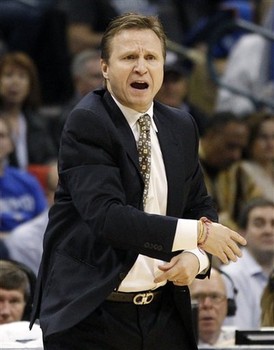
Which is what made last night’s game so special for us fans. Oklahoma City Thunder coach Scott Brooks constantly preaches about “the next man up.” But with the Iron Man lineup that we have, that saying barely has a chance to be put into practice. When the television broadcast for the game started, it was already a given that Serge Ibaka was going to be out with a bruised sternum. What wasn’t known until basically tipoff, was that Thabo Sefolosha would also be out with a strained neck (hotel pillows suck!). So the quick question was who would be inserted into the starting line-up at shooting guard? Would it be Kevin Martin? Would Jeremy Lamb finally be unleashed?
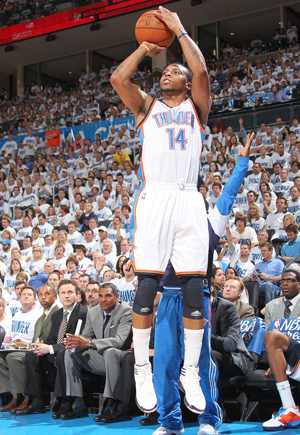
The blueprint to who would start was put into play last season. When Sefolosha missed 23 games due to a leg injury, Brooks started by inserting James Harden into the starting lineup. Harden, who had been the Thunder’s 6th man for 3 seasons, struggled in his role as a starter. At the same time, the Thunder’s bench struggled to score points. Brooks adjusted the next game by inserting Daequan Cook into the starting lineup and keeping Harden on the bench. The transition became a lot smoother after that until Sefolosha returned. With Kevin Martin being the Thunder’s 6th man this season and Brooks not wanting to mess with the team’s rotation too much, DeAndre Liggins got the start.
Liggins was a 2nd round pick of the Orlando Magic in the 2011 draft. After playing in 17 games his rookie season, Liggins was released by the Magic in an attempt to clear cap space and a roster spot for the eventual post-Dwight Howard rebuild. (Why Orlando would get rid of a cheap capable wing defender is beyond me.) Liggins was signed by the Thunder as a training camp invite to try out for the final 2 roster spots on the team. The team had 13 guaranteed contracts, and brought in a couple other players as training camp invites to battle for the remaining roster spots. In 5 preseason games (including 2 starts), Liggins averaged 20.8 minutes, 4.8 points, 4.2 rebounds, 1.4 assists, 1.4 steals, and 0.4 blocks per game. Based on his preseason performances and his propensity for energy and defense, Liggins willed his way onto the team as the final cut.
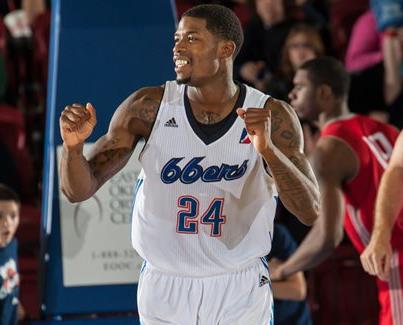
As a 2nd year player, Liggins was eligible to be assigned to the Thunder’s D-League affifiliate, the Tulsa 66ers, throughout the season. As I’ve written before, the Thunder take full advantage of their D-League usage. Liggins was sent down for a 3 game stint at the end of November and another 3 game stint at the end of December. In 6 games with the 66ers, Liggins has been the jack of all trades, averaging 10.2 points, 7.0 rebounds, 4.8 assists, and 1.8 steals per game. Since his last D-League game on December 29th, Liggins has been logging regular minutes off the bench for the Thunder.
Liggins took full advantage of his first career start. He played nearly 40 minutes and almost had a double double with 11 points and 9 rebounds. He played suffocating defense on Wesley Matthews and made life miserable for anyone that was around him when he was on the defensive end. Most importantly, he played the entire 4th quarter in a close game without looking nervous at all. In other words, he played like he belonged.
Liggins is just another example of what hard work and perseverance can do for an individual. These are the type of players that the organization is looking for. These are the types of players that relate to us, the fans. Thabo could start tonight against the Phoenix Suns and may not miss another game for the entire season. But for this one game, the Thunder mantra of, “next man up” held firm and true with DeAndre Liggins.
So the Los Angeles Lakers stand at 15-20, losers of five in a row, and in 11th place in the Western Conference. Even at their lowest, a game against the Lakers still includes bright lights and heightened exposure. Lakers fans and the NBA, as a whole, seems to have gone all “Chicken Little” with the Lakers’ current state, and yet, there remains an aura of hope that they will begin to click and reel off wins. So far, though, the Mike D’Antoni era Lakers have performed well below expectations.
The Oklahoma City Thunder come into the game with a 27-8 record, having defeated the injury-depleted Minnesota Timberwolves, 106-84, in their last game. Since losing to the Lakers in the 2010 playoffs, the Thunder are 8-4 against them to include a 4-1 series drubbing in the second round of last season’s postseason. The Thunder defeated the Lakers in their first meeting of this season 114-108. Russell Westbrook set the tone in that game, going for 27 of his 33 points in the 1st half. Durant punctuated the 2nd half of that game with 18 of his 36 points. Kobe Bryant scored 35 points for the Lakers, who were without Pau Gasol.
The Opponent
The Lakers are currently a team in disarray due to various reasons. First off, injuries have depleted the front line, with Dwight Howard (shoulder/back), Jordan Hill (hip), and Pau Gasol (concussion/knees) missing time recently. Secondly, the coaching change from Mike Brown to D’Antoni changed the entire system that was being run by the Lakers in the first month of the season. Thirdly, the chemistry is still under construction with the influx of new players, new coaches, and new systems. Fourth, the defense has been terrible, allowing 101.7 points per game, good for 26th in the NBA.
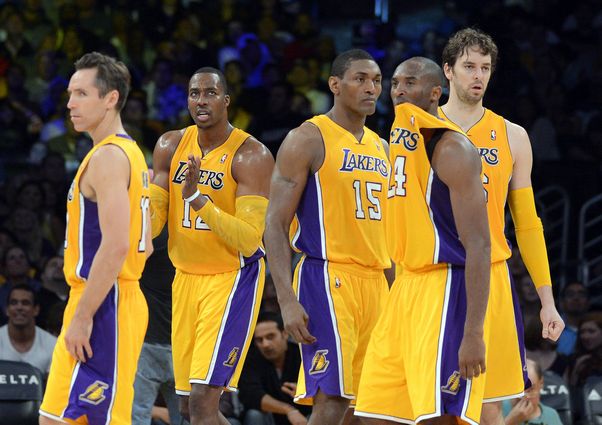
The back court is an array of All-Stars, former MVP’s, and future Hall of Famers. Kobe Bryant and Steve Nash may be just a tad bit slower, but are still great at what they do. Kobe is leading the league in scoring at 30.1 ppg and Nash is still dishing out almost 9 assists per game. While still a physical defender, Metta World Peace’s dwindling athleticism has begun to affect what he is primarily on the court for. With Howard out, look for either Gasol or Robert Sacre to man the middle. The bench has been another issue for the Lakers, as the player they have do not match the system they want to run.
Probable Starters
Los Angeles Lakers
PG – Steve Nash
PG – Darius Morris
SG – Kobe Bryant
SF – Metta World Peace
C – Pau Gasol
Oklahoma City Thunder
PG – Russell Westbrook
SG – Thabo Sefolosha
SF – Kevin Durant
PF – Serge Ibaka
C – Kendrick Perkins
3 Keys To Victory
Weather the Storm – I have a feeling the Lakers are going to come out guns-a-blazing to start off the game. Kobe let World Peace do much of the scoring early in their previous game and that partially led to them being down 9 by halftime. Kobe will come out gunning, Nash will come out assisting, and you know some bench/unknown player (Earl Clark, Jodie Meeks) will erupt from 3 point land against us. If they get past the initial onslaught and stay defensively disciplined, the Thunder should be okay.
Control the glass – With Howard definitely out and Gasol and Hill questionable, there should be no reason why the Thunder don’t win the battle of the boards by at least 8. One of the worst things to give an injured, struggling team is extra possessions.
Kevin Durant and Russell Westbrook – I don’t know what it is about these two when they play against the Lakers, but they seem to relish destroying this team. This game has Westbrook written all over it. I would think that the Lakers would start the game off with Kobe on Westbrook, but if they dare put Nash on him, watch out. Nash has lost a step or two this season, and Westbrook is one of the fastest athletes in the league.
This is literally the NBA’s best versus the NBA’s worst. When the Oklahoma City Thunder meet the Washington Wizards on Monday night, Washington will be 21.5 games behind the Thunder with 32 games already played. The Thunder come into the game having defeated the Toronto Raptors in a Sunday matinee, 104-92. Russell Westbrook and Kevin Durant led 5 Thunder players in double figures with 23 and 22 points, respectively. After dropping 3 of 6, the Thunder have won 2 in a row by an average of 18 points.
In their only meeting last season, the Wizards defeated the Thunder 105-102. That was the Thunder’s only loss in a 12 game stretch during the early portion of the strike shortened season. Wizards’ point guard John Wall led the way with a near triple double of 25 points, 7 rebounds, and 8 assists. Russell Westbrook had 36 points, 5 boards, and 7 assists, while Kevin Durant had 33 points, but the Thunder could never catch up after digging themselves a hole early in the game.
The Opponent
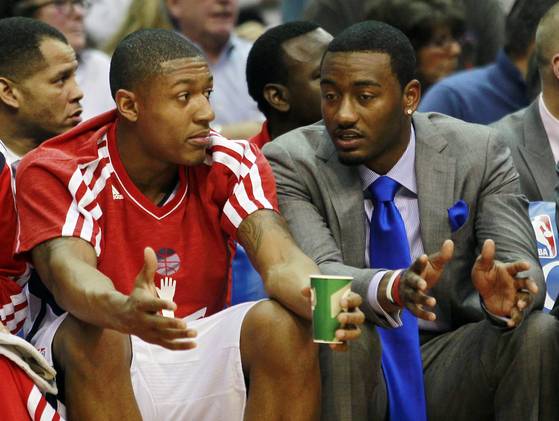
The Washington Wizards find themselves with the worst record in the NBA at 4-28. They score an anemic 88.9 points per game, good for last in the league, while allowing 97.2 points per game. Part of the reason for their slow start is the absence of John Wall, who has been sidelined with a knee injury the entire season. The Wizards start Garrett Temple and rookie Bradley Beal in the back court. Beal was rumored to be a target of the Thunder’s in a possible draft day deal involving then Thunder guard James Harden. After averaging 11 points per game his first month of the season, Beal has increased his scoring to 14.4 point per game in December and January. He has also nearly doubled his assists numbers in that same time frame from 1.6 to 3.4 assists per game. Three point specialist Martell Webster is the other starting wing at small forward. The Wizards are formidable inside with a trio of veteran big men in Emeka Okafor, Nene, and Kevin Seraphin. Together the trio combines for 31.6 points, 18.8 rebounds, and 2.6 blocks per game. Off the bench, the Wizards deploy some fire power in the form of guard Jordan Crawford and Cartier Martin, who can easily rattle off 15-20 points in a game.
Probable Starters
Washington Wizards
PG – Garrett Temple
SG – Bradley Beal
SF – Martell Webster
PF – Nene
C – Emeka Okafor
Oklahoma City Thunder
PG – Russell Westbrook
SG – Thabo Sefolosha
SF – Kevin Durant
PF – Serge Ibaka
C – Kendrick Perkins
3 Keys to Victory
1) Long-term and short-term memory – The Wizards were 1-12 when the Thunder faced them last season and lost 105-102. The Wizards were 1-13 this season when they beat the Miami Heat, 105-101. Regardless of record, this is still a collection of professional players that plays in the NBA. With their record, they view the big time opponents as their playoff games.
2) Wizards inside trio (Okafor, Nene, Seraphin) vs. the Thunder’s inside trio (Perkins, Ibaka, and Nick Collison) – Though not as effective as they used to be, Emeka Okafor and Nene can still come up with double double games if given the opportunity. Seraphin is a lot like Ibaka from 2 years ago, still raw, but polished enough to give big minutes. The Wizards are the 7th best rebounding team in the league with an average of 43.6 rebounds per game. If the Thunder big men are not on their post games, the Wizards could collect second chance boards and make a game out of this.
3) Kevin Durant – Trevor Ariza is the only player on the Wizards that has a sliver of hope of guarding Durant, and he’ll probably be out with a strained calf. Martell Webster is too short, Chris Singleton is too slow, and Jan Vesely is too European to guard Durant one on one. Hometown Durant could be on full display tonight. The only person stopping Durant tonight is Durant…and the bench if he doesn’t get off of it in the 4th quarter.
Regardless of what you think of Nike’s “KD is not nice” campaign, imagine the fear in the Philadelphia 76ers’ locker room when A) they have to face the Thunder after a loss and B) they have to face Kevin Durant after the first ejection of his career. The Thunder come into the game having lost to the Brooklyn Nets in one of the more frustrating games of the season. After being down by 20+ in the first half, the Thunder battled back to tie the game in the 4th, only to completely squander the game through bad defense and questionable officiating.
The Thunder come into the game 24-7, tied for 1st in the Western Conference. They lead the season series 1-0, after beating the Sixers in Philadelphia in overtime 116-109. Durant scored 37 and Russell Westbrook had 30 points in a game that the Thunder could never put the Sixers away. Every time the Thunder got a sizeable lead, Philly went on a run. The difference came in overtime in the form of four consecutive 3-pointers from 4 different Thunder players.
The Opponent
The Sixers come into the game with a 15-18 record, clinging on to the 8th spot in the East over Boston by percentage points. The Sixers are 3-9 in their last 12 games and have been plagued by lack of consistency on the offensive end, as evidenced by their 93.3 points per game average (good for 26th in the league). They are led by 4th year point guard Jrue Holiday who is blossoming this season, averaging 18.8 points, 9 assists, and 4.2 rebounds per game. He is joined in the backcourt by veteran Jason Richardson and 3rd year wingman Evan Turner, who is also starting to come into his own after struggling his first two seasons in the league. The front court is undersized, manned by versatile PF Thaddeus Young and Lavoy Allen. Their bench can be explosive led by Nick Young and Dorell Wright and center Spencer Hawes. Each of the bench players is capable of catching fire from 3-point land and putting up big numbers.
Probable Starters
Philadelphia 76ers
PG – Jrue Holiday
SG – Jason Richardson
SF – Evan Turner
PF – Thaddeus Young
C – Lavoy Allen
Oklahoma City Thunder
PG – Russell Westbrook
SG – Thabo Sefolosha
SF – Kevin Durant
PF – Serge Ibaka
C – Kendrick Perkins
3 Keys to Victory
1) Russell Westbrook vs. another UCLA point guard – Russell Westbrook has had a go of it lately versus his fellow Bruins point guards. He got torched by Darren Collison of the Dallas Mavericks for 32 points and 4 assists a week ago. Utah Jazz reserve guard Earl Watson had one of his higher assist games against the Thunder with 8 assists. The good news is that Westbrook held Holiday to 6 points on 3-11 shooting the last time they played.
Another note – Russell Westbrook shot over 50% in his last game. He has not shot over 50% in consecutive games this season. I think he’s due.
2) Serge Ibaka vs. Thaddeus Young – Young is one of those versatile, undersized power forwards that give Ibaka fits. He does most of his work in the midrange area, thus negating Ibaka’s biggest strength as a defender. This was on full display the last time the Sixers played the Thunder, as Young had 29 points and 15 rebounds. All the while, Ibaka had 0 blocks and 9 boards.
3) Rebound advantage – The Thunder should take full advantage of the Sixers being undersized in the post. Young and Allen don’t go over 6’9, and while Hawes is a legit 7 footer, he spends a lot of his time on the perimeter, thus negating his offensive rebounding potential. Durant should take full advantage of this opportunity and drop down to the post to help out on the boards.
So I had this blog detailing why I didn’t think the Oklahoma City Thunder would sign James Harden by the October 31st deadline. I was going to work on it this weekend and publish it on Monday. I was hoping Harden and the team would still be in negotiations by the time I finished said blog. I truly believed the negotiations would be an issue that would be shelved until next offseason when the front office had more information (an entire season’s worth) to make more of an informed decision. Instead, with the OU/Notre Dame tied at 13 in the 4th quarter, I checked my twitter feed and saw this inconspicuous tweet:
Wow #Harden
I don’t remember who the tweet was from. But it piqued my curiosity and I clicked on the hash tag. I thought it was going to be a person that was surprised Harden had turned down a 4 year/ $52 million dollar contract extension. Instead, to my complete and utter surprise/horror, I started seeing the all the tweets about Harden being traded to the Houston Rockets for Kevin Martin and Jeremy Lamb. The “Whhhhaaaatttttt???!!!” I let out startled my wife into rushing out of the kitchen to see what the hell was going on. The rest of the OU game was a blur to me after that. I went into Twitter frenzy mode and didn’t stop until after midnight. Once the shock and awe of it wore off (which most of it hasn’t), I was able to process the trade and evaluate it.
Here are the details from the trade:
Houston gets SG James Harden, C Cole Aldrich, SG Daequan Cook, and SF Lazar Hayward
Oklahoma City gets SG Kevin Martin, G/F Jeremy Lamb, 2013 first round pick (from Toronto, top 3 protected), 2013 first round pick (from Dallas), and 2013 second round pick (from Charlotte)
Here are some of the thoughts I have about it. I call this my “Mr. Harden’s Opus.”
The Good
My first option would have been to keep the Thunder nucleus together. But if you are going to trade Harden, this was probably the perfect batch of expiring contract, promising rookie, and draft picks galore. Let’s start with the big name from Houston: Kevin Martin. If you are going to find a substitute teacher for Harden, Martin is probably the best one year prospect available. An effective scorer who has averaged 18.4 points per game for his career, with a great mid-range game and an effective 3-point shot (38%). Someone who goes to the free throw line 6.6 times per game for his career. Defensively, Martin may not be as big as Harden, but it isn’t like Harden was in line for the All-Defense team, either. Both are sieves on the perimeter, but Harden is able to bang with bigger bodies like Kobe Bryant and Stephen Jackson. The one thing Harden really has on Martin is his play-making ability.
If the Thunder plan on bringing Martin off the bench, this plays out perfectly for them. With Eric Maynor back, Martin won’t need to take Harden’s place as a play-maker on the second team. Martin could be the gunner off the bench and the Thunder could use him in late game situations if offense is needed. For all the talk about Martin being a selfish player, he has never played with players of the caliber of Kevin Durant, Russell Westbrook, and Serge Ibaka. The focus will be off Martin and he can do what he does best, which is score from the perimeter and get to the line.
The second, lesser known name in the trade was rookie Jeremy Lamb. This, in my opinion, will determine whether this trade will be viewed as a success or a failure. Lamb has the skill set and potential to be that dual threat shooting guard that the Thunder have been coveting in their championship run. Someone, potentially, with the length, athleticism, and defensive ability of Thabo Sefolosha, but also with the scoring and shooting ability of James Harden. Jeremy Lamb could prove to be that kind of player. With Martin in the mix for at least one season, Lamb can sit and learn this season without the pressure of being a starter.
The draft picks were probably what sealed the deal on this trade. Getting a good veteran with an expiring contract like Martin, and a rookie dripping with potential, like Lamb are things that many teams could have offered. But not many teams could have offered that and a slew of draft picks like Houston could. The Thunder, as weird as this sounds, are a championship contending team that got younger and obtained great assets. The Toronto pick will be a great trade chip going forward, as the Raptors are not expected to improve much from where they were last season. The 2nd round pick from Charlotte will also be valuable as it will probably be one of the first few picks from the 2nd round.
The Bad
According to sources, the final offer the Thunder made to Harden was in the 4 years / $55.5 million dollar range. Harden will probably end up signing with Houston for 4 years / $60 million dollars. You mean to tell me the difference between a potential dynasty with an established core, and completely blowing up a team 5 days before its season opener is $4.5 million dollars. That difference amounts to $1.125 million per season. The ownership group, which has made a commitment to all of its core players, could not come up with $4.5 million dollars more? This group of multi-millionaires and billionaires were panicking over an extra $1.125 million per year. Don’t get me wrong, though. I understand it is their money and not mines. But, keeping this core intact for at least another 4 years would almost certainly guarantee runs to the Western Conference Finals and NBA Finals in that allotted time. Those extra games means about $20-40 million dollars extra in profit for the ownership group. You can talk about cap flexibility and assets until you are blue in the face, but when you have the potential to win championships in the here and now, AND you’re making money, you take those chances.
The scariest part about this trade is that a championship contending team was blown up less than a week before the start of the season when it didn’t need to be. We just went through 7 preseason games with our normal core intact, and now we only have 4 days worth of practice time to integrate 2, and possibly more, pieces to our team. When, in the minds of the front office personnel, did they say, “You know, this sounds like a great idea.” While the linchpin of this trade may have been Harden, Cole Aldrich may prove to be a big loss for the Thunder. He seemed ready to assume the role of back up center, getting 2 double-doubles in the preseason. Now, we are heading into the season with Hasheem Thabeet as our backup center. Granted, Nick Collison, Serge Ibaka, and possibly, Perry Jones III can all play the 5 in a pinch. But in a future playoff series against the Memphis Grizzlies, Los Angeles Clippers, or Los Angeles Lakers, having an inexperienced and oft maligned center as a back up could prove to be detrimental.
The Ugly
Can someone tell me why the hell we had a lockout last season? All I heard during the lockout was about the percentage of the revenue that the players got and how salaries had gotten out of hand. Some even tabbed it as the “Rashard Lewis” lockout, with Lewis being the best example of a 2nd or 3rd tier player that received a max extension, thus limiting the cap flexibility of that team for up to 5 seasons. Basically, it was a lockout to keep the owners from actually overspending their profitabilities. So, then, why are teams paying players like Eric Gordon, Roy Hibbert, and James Harden max extension money. I thought max money was for top 10 players like Lebron James, Kobe Bryant, and Kevin Durant. Instead teams are throwing around stupid money for 2nd tier players. There’s 5 years left until the owners and players can revisit the CBA, and believe me, it will be revisited again, and this time, I fear, with dire consequences.
WWJD – What would James do?
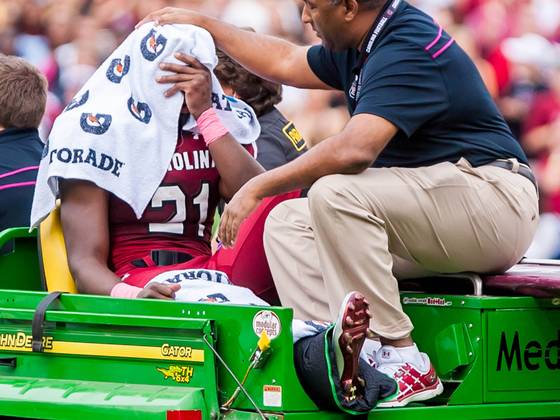
Do you know who I’m not mad at for this trade? James Harden. Before the OU game on Saturday, I spent the whole afternoon thinking about University of South Carolina running back Marcus Lattimore, who had just suffered a gruesome right knee injury. If you haven’t seen it, just think of Shaun Livingston’s knee injury from 5 years ago. Reports are coming out that Lattimore tore a couple ligaments and completely dislocated his kneecap. To make matters worse for Lattimore, he was coming back from a torn ACL in his left knee suffered the previous season. If Lattimore was a stock and NFL teams were the buyers, he would currently be considered a toxic asset.
In a profession where your best years are in your mid to late 20’s, your earning potential is contingent on 5-7 years of performance and luck. If you suffer an injury or get involved in a legal scandal, your earning potential will go down. You, as an athlete, cannot dictate what the market will pay for you. If the market wants to pay you max money, then that’s what they pay. If they want to pay you veteran minimum money, then that is what you will get paid. I don’t blame Harden for taking what the market gives him.
As I wrote in my Pippen/Westbrook column, Pippen consistently took less than his market value to keep the core of the Bulls team together. Where did that leave him? Broke (most of it his fault, but still) and bitter. Harden could have taken a couple million less than what the market had placed his value at, but why. While we like to moralize athletics into this great teaching tool where you sacrifice for the greater good, at the end of the day, its a business. If a player can’t perform anymore, the owner is going to let that player go and move onto the next able body. It’s a business and a player would be a fool to leave money on the table.
I’m the Oklahoma City Thunder blogger for the blogging network called Hoops Talk Nation through the website www.thebreakdownshow.com. I currently blog on there for free. But if ESPN, YahooSports, or CBSSports ever called to offer me a spot on their blogging network for cash, I would take it in a heart beat. While I love the opportunity that Audley Stephenson and Dave Mendonca have afforded me, I wouldn’t be able to turn down the possibility of blogging AND earning cash to do it. Regardless of how I fancy myself as a blog writer, I would never turn down the opportunity to move up on the pay scale.
OKC fans should not hold this against James Harden. This is a business, and him turning down less money is a business decision. He is doing what he feels is best for himself and his family. Not unlike what we do everyday, but with less zeroes attached to it. Many will be mad for what they perceive was a lie from Harden with all the “sacrifice and brotherhood” talk. What did you expect from him? To come out and say, “I don’t give a shit what you think I’m worth. If the market says I’m a max player, I want max money!”
Being a fan is an emotional experience. When you mix emotion and money, you don’t make sound decisions. So, if you take the emotion out of the equation, you’d realize that James Harden did the same thing you and I would’ve done, which is to never leave 7.5% of a raise on the table.
The Trade and the Thunder
Well, what’s done is done. The NBA is not going to step in and rescind this trade, as Harden does not suffer from any pre-existing toe injuries or heart ailments. He is a Houston Rocket. And so are Daequan Cook, Cole Aldrich, and Lazar Hayward. We cannot worry about them anymore.
What we do have are two unique players and 2 roster spots to fill. I think Kevin Martin will slide in seamlessly into Harden’s role off the bench. His efficient scoring and knack for getting to the line will have Thunder fans wondering whether James Harden shaved his beard, lost some weight, and slightly bleached his skin. The real prize in this trade could be Jeremy Lamb. If, in an alternate basketball universe, the basketball DNAs of James Harden and Thabo Sefolosha were interwoven, the result could be a player like Lamb. A 6’5” shooting guard with a 7’0 wing span and the ability to knock down long jumpers and play in transition. If you thought the Thunder were good with the Sefolosha/Harden SG platoon, imagine if only one player supplied most of those needs. There’s still a lot of development that needs to take place, but the skill set is already in place.
The open roster spots are a different story. The Thunder not only traded their 6th man of the year, but also their back up center, their designated 3-point specialist, and their designated end of the bench guy. While Hayward won’t be that difficult to replace, Aldrich and Cook could. I fully expect the Thunder to sign Daniel Orton to a minimum deal to compete with Hasheem Thabeet for back-up center minutes. The final roster spot is a bit of a mystery, though. Before training camp started, the Thunder signed Georgetown sharp shooter Hollis Thompson to a non-guaranteed 3 year contract. After playing in only 2 preseason games, he was one of the final roster cuts by the Thunder. They could sign him as a future replacement for Cook. Or, they could leave that roster spot open for future options, such as taking on a salary in a trade, or signing a veteran free agent (Derek Fisher, anyone?).
As for the core players, I’m curious to see how Nick Collison will react. He and Harden had one of the top 5 pick and roll combos in the league. Collison is one of the consummate professionals in the league and will be fine no matter what situation he is placed in. I think the onus of this transition will fall mainly on Russell Westbrook. If Westbrook continues to be consistent, as he was this preseason, then the Thunder should be fine. But if there was one player that helped Russell when he got into Honey Badger mode, it was Harden. Harden would take over the point guard duties and become the primary play-maker, especially at the end of games. That role now falls primarily in the hands of Westbrook, and to a lesser extent, Eric Maynor. While Maynor could fill the role of play-maker at the end of games, no defense will respect Maynor’s ability to drive and draw fouls like they did Harden’s. Martin could always be inserted at the end of games, but his play-making ability may be less than Westbrook’s.
How does this change affect the Thunder? They have never had to deal with a core-rattling trade like this one. The Jeff Green for Kendrick Perkins trade shook the tree, but it was necessary given that Green was out of position at the 4 spot and affecting the team’s post defense. This trade wasn’t necessary for anything on the floor. Instead, it was a financial deal the team made to avoid paying costs in the future. The biggest negative in all of this is that it happened 5 days before the first game of the regular season. There will be no preseason games to indoctrinate the new players. Only a couple practices and then on to the season. The only positive I see in this situation is that our biggest threat, the Los Angeles Lakers, are also having to work out chemistry issues, after bringing in 2 main cogs (Dwight Howard and Steve Nash) in the offseason. The Western Conference may come down to whoever vibes first.
I do think this affects us this season. These guys just went from going to the Finals, then to the Olympics, then through training camp and preseason thinking they were going to defend their Western Conference title without a hitch. Then, BOOM!!! Over a quarter of the team gone, with 2 new pieces coming back. This is a team that is used to consistency. This consistency is what fostered to current Thunder culture. Consistency leads to comfort. Comfort leads to confidence. If you were part of the culture, you were part of the brotherhood. Now a shred of that is gone. I do think it will take the team a while to adjust from this one. Has their championship window closed? No, it hasn’t closed, but somebody definitely threw a baseball through it. The Thunder may come out stronger in the end, but I think it will be a case of one step backwards, two steps forward.
In Memoriam
I will miss the Beard. Harden became a part of the fan culture. When you mentioned the characters on the team, you always had to mention Harden and his Beard. If the Thunder had a Teenage Mutant Ninja Turtles-like quartet, Harden was definitely Michaelangelo (the party dude!). I wish him nothing but the best in Houston. But if we are being honest, Harden was but a great role player. He scored when called upon, drove and drew fouls when needed, and made plays at will. But I never considered him to have the “it” to be The Man. Westbrook has that dogged “it” to be The Man. Durant is The Man. But Harden just seemed happy doing what needed to be done. So if Harden wants to see how his life will be post-Thunder, he need look no further than the man he was traded for.
In remembering these past 2 weeks, and watching the first 6 minutes of the first quarter in the Phoenix game, I’m reminded that, even though the Oklahoma City Thunder are athletically superior to most teams, their defense will be the tell-tale sign whether they reach glorious heights this postseason. A lot of the defensive breakdowns they had last season, are back again this season. The cast of characters is the same, so the fact that improvements have not been made, is really worrisome for their future postseason success.
Two seasons ago, when the Thunder had Ron Adams as an assistant coach, they were near the top of the league in defensive efficiency and used that to propel them to the postseason for the first team since moving to Oklahoma City. Since Adam’s departure after that postseason, there has been a lack of defensive focus that is being masked and hidden by the team’s improved offensive efficiency. When the team struggles offensively, this lack of defensive focus can have adverse effects on the Thunder’s ability to win, especially in the playoffs.
The thing about defensive breakdowns is that they are usually a combination of several defensive breakdowns in one series. It’s not just one play in a possession that causes this. It’s usually a chain reaction of defensive lapses. The first thing the Thunder struggle with is their pick-n-roll defense. The Thunder guards, Russell Westbrook, in particular, have a tendency to go over the pick, instead of fighting through it to stay in front of their man. The problem with this is if the big man doesn’t hedge over a bit, the opposing guard just blows right by them and past their primary defender.
It’s a play like this where you have to know your opponent’s tendencies. If the scenario is guarding a slower guard (i.e. Jason Kidd or Mike Conley), then the Thunder guard can go over the screen as there is no threat of a blow-by. The only threat is if the guard is a competent 3-point shooter. The big man in this situation has to know who he is guarding and decide whether to hedge or stay with his man. In this case, if we are talking about Dirk Nowitzki or Zach Randolph, then it would probably be best for the defending big man to stay on his man.
If the situation is changed to a speedier guard, such as Ty Lawson or Tony Parker, then the big will have to hedge to allow the defending guard a chance to stay in front of his man. The worst thing that can happen in this situation is a switch, where the big is guarding a speedy guard, and the defending guard is on the offensive big. This opens up a ton of options for the offense and puts a lot of pressure on the defense.
The primary goal of the pick-n-roll is to allow movement towards the rim. But, against the Thunder, this is also achieved through dribble penetration. When he was drafted out of UCLA, Russell Westbrook was advertised as a defensive guard, having just won Pac-10 defensive player of the year. But what worked in college (gambling on steals, using other-worldly athleticism to pressure opponents) hasn’t worked quite as well in the NBA where the world’s best basketball players play. A lot of what makes defense work is where you are positioned. If you are not in the correct defensive position, an NBA player will blow by you in a heartbeat.
Where Thabo Sefolosha is more of a technical defender, using his length to make the opposition adjust their play, Westbrook is more an instinctual defender, always trying to go after the steal. But don’t mistake steals for good defense. When you constantly gamble for steals, you put pressure on the rest of the defense to play 4 on 5 defensively. Eventually, the open man will be located, and its usually on the 3-point line or for an easy bucket.
This, then leads to the next defensive issue for the Thunder, which is closing out shooters. After the acquisition of Kendrick Perkins and the insertion of Serge Ibaka into the starting lineup last season, the Thunder went from squishy soft interior presence to hardcore interior presence. One would surmise, with that kind of support in the interior (to also include Nick Collison and Nazr Mohammed), the Thunder wings would trust their bigs more and not sink in every time the ball gets into the paint. Instead, it’s become commonplace for the entire defense to sag into the paint when a breach occurs which leads to wide open three point shots. Teams like San Antonio and Dallas feast on this and always give the Thunder problems.
Once the defense has been breached and the ball is in the paint, then the advantage goes to the offense. When big men have to move around, it takes them out of their comfort zone. Our big men like to battle until the shot goes up and then box out for a rebound. But if ball is penetrated into the paint, then the bigs have to move around to defend the paint. Even with Ibaka leading the league in blocked shots, this still puts the defense at a disadvantage. If Ibaka leaves his man and whiffs on a blocked shot attempt, then his man is in position for the offensive rebound and put back. Much like steals, blocked shot don’t automatically equate to good defense. But if you are going to have Ibaka play free safety in the paint, then KD needs to slide down on defense and help out on the boards. While it may seem like this has been happening, as evidenced by Durant averaging a career high 7.9 rebounds per game, it also needs to be taken into account that the Thunder have played a lot more small ball with Durant at the 4 this season.
The most important issue with the Thunder’s lack of defensive intensity is their will. A lot of their deficiencies can be overcome by focusing more on the defensive end and working smarter. Ron Adams may have been a great defensive strategist. But even more important was that he held the players accountable for their actions on the defensive end. Once he left, there was a general sense of apathy concerning smart defensive basketball. The Thunder were content with just being good enough defensively and letting their athleticism dictate their defensive schemes. This is especially evident in the 4th quarter of close games. When the Thunder are focused, they can play great defensively and use that close out games.
It’s not all bad though. Due to their athleticism, length, and youth, the Thunder are one of the better teams at defending the fast break. They are constantly stifling transition opportunities for the opposition and cause a good number of turnovers defending the fast break. As we saw in the 4 game stretch from March 25th thru April 1st, where the Thunder played the Heat, Trailblazers, Lakers, and Bulls, the Thunder can put together a string of great defensive games. The question becomes, will that translate to the playoffs?
Business transactions are always about needs versus assets. And that’s what trades in professional sports are. A GM will assess their team and see what is needed and what can be given up. Sam Presti, the GM for the Oklahoma City Thunder, has made his bread and butter in the previous 5 seasons by taking advantage of other teams’ needs for financial relief. It’s how he obtained Thabo Sefolosha, Eric Maynor, Kendrick Perkins, Daequan Cook, and the draft pick that became Serge Ibaka. He did this by meticulously managing his cap space and not making hasty free agent/trade decisions.
Now that the Thunder are done with the rebuilding process, and are currently in the championship building phase of their development, some of the things that Presti used to swing advantageous deals are no longer available. The Thunder are currently $900K over the salary cap, meaning that they can’t absorb contracts, and must instead match salaries up to 125%. As ironic as it sounds, a negative of being frugal and careful with your spending, is that the Thunder are not saddled with any bad contract, which can become very advantageous in their expiring years.
Needs
With the loss of Eric Maynor earlier in the season, the Thunder lost one of the best game managers (backup or starting) in the game. He was the ultimate yin to Russell Westbrook’s yang, and provided the Thunder with a stabilizing force at the point guard position whenever necessary. Now, in his place, is a rookie, Reggie Jackson, who has looked every bit the part of a rookie. His play, while improving, has been inconsistent, as he is still trying to find his comfort zone on this championship caliber team. Kind of a tall order for someone who wasn’t expected to be thrust into such an important position at this moment in his young career. Because of Jackson’s inconsistent play, a quality backup point guard has suddenly become a need for the Thunder.
The thing about a wing oriented team is that if the shots aren’t falling and the “box and 1” defense is working, it makes it nearly impossible to consistently score points. The Thunder are lucky to have such dynamic scorers like Kevin Durant, James Harden, and Westbrook. These players have made their careers by consistently hitting shots with hands in their faces. But in basketball, the closer you are to the basket, the more efficient and easier your scoring becomes. And the Thunder have never had a low post scoring threat. It’s one of those things that makes scoring in the playoffs a whole lot easier.
Realistic Assets
Nazr Mohammed – $3.75 Million – Veteran big man that could fit in on a contender that needs size.
Cole Aldrich – $2.29 Million – 2nd year big man that has shown improvement and could be a good rotational big, if not for the Thunder, than for another team.
Thabo Sefolosha – $3.3 Million – Veteran wing who is still one of the better wing defenders in the league.
Royal Ivey – $1.2 Million – Veteran guard who provides good energy off the bench.
Charlotte’s 2013 2nd round pick (obtained in the Byron Mullens trade) – Charlotte probably isn’t going to get much better next season and that pick will probably be in the 30-35 range, where a good player can still be picked up.
OKC’s 2012 1st round pick – Will probably be in the 25 – 30 range of the first round. Late in the first, but still useful for stashing an overseas pick or rebuilding.
Possible trade partners (based on need and cost of transaction):
Boston – Keyon Dooling ($2.25 M) and Marquis Daniels ($854 K) for Nazr Mohammed. Boston is in desperate need for big men after the losses of Jeff Green, Jermaine O’Neal, and Chris Wilcox. Keyon would provide a veteran point guard that has played in the playoffs before. Daniels would more than likely be cut.
New Jersey – Sundiata Gaines ($854 K) for Charlottes 2013 2nd round pick – Gaines has quietly put up a good season as a backup point guard for the New Jersey Nets.
New York – Mike Bibby ($854 K) for OKC’s 2013 2nd round pick – With the emergence of Jeremy Lin and the return of Baron Davis from injury, Mike Bibby is no longer necessary in New York.
Cleveland – Ramon Sessions ($4.3 M) for Nazr Mohammed and Charlotte’s 2013 2nd round pick – Compared to other teams’ offers, this is probably a “No” for Cleveland, but it’s still worth a try.
Milwaukee – Andrew Bogut ($12 M) for Kendrick Perkins, Daequan Cook, and OKC’s 2012 1st round pick – Bogut is just as good defensively as Perkins, while providing a lot more offense, if necessary. The Bucks will probably want either Harden or Serge Ibaka, which would make this a deal breaker for the Thunder.
New Orleans – Greivis Vasquez ($1.11 M) for Lazar Hayward and Charlotte’s 2013 2nd round pick – New Orleans is in full rebuild mode and looking to acquire quality draft picks. A very high 2nd round pick would do just that. The question becomes how does New Orleans view Vasquez?
Charlotte – DJ Augustine ($3.2 M) for Nazr Mohammed and Lazar Hayward – I don’t understand Charlotte’s desire to trade Augustine, as Kemba Walker is still a rookie and is more undersized SG than starting PG at this point in his career. But, if they want to, we’ll participate if the cost is not too much.
Free Agent – Anthony Carter (formerly of the Toronto Raptors) was recently waived to give him the opportunity to sign with a contender. Using our Disabled Player Exception from the Maynor injury, which comes out to $758,340, we could sign Carter for the rest of the season.
And just for fun:
Orlando – Dwight Howard ($18.1 M) and Ish Smith ($762 K) for Kendrick Perkins, James Harden, Eric Maynor, Cole Aldrich, OKC’s 2012 1st round pick, and Charlotte’s 2013 2nd round pick. I don’t know if Orlando gets a better infusion of young talent and draft picks from any other team.
What does the team look like on Thursday at 3:01 PM?
I think we stay pat. Making reactionary moves is not Presti’s style. He knows we still have Maynor next season and Jackson will have gained an invaluble amount of experience in his rookie season. A smaller scale signing, like Anthony Carter will be possible, though.
Any time I hear the word halftime, this is the first thing I think about.
We’ve reached the half-way point in this strike-shortened season. Half time, baby! Everyone to the locker room, or as it’s called in the NBA, All-Star Weekend. Coming into the season, I didn’t know what to expect. We were bringing back our entire 10 man rotation, plus a couple young guys that had potential. But with a very short training camp, no summer league, and only 2 preseason games against the same team, it was a little difficult to gauge how the team would come out the gates. Conventional wisdom would say that in a shortened season, a team that experienced hardly any change would benefit the most early in the season.
That thought has not proven to be incorrect when it comes to the Oklahoma City Thunder. They are currently tied for the best record in the league at 25 – 7 and have a 2 game lead in the hyper-competitive Western Conference. If natural progression is the law of the land, then the Thunder are right where they are supposed to be. After finishing 4th in the conference last season and making it all the way to the Western Conference Finals, the Thunder are poised to take the next step in their natural progression.
Individual Grades (alphabetical order): I take into account what was expected of the player before the season started and how that player has fared in this first half of the season.
After spending last season shuffling between the Thunder and the Tulsa 66ers of the D-League, Aldrich was expected to continue developing into a rotational big man. When Nazr Mohammed was re-signed before the beginning of the lockout, it was an indication that the organization wanted Cole to continue to develop. In the 12 games that he has gotten in, Cole has shown a knack for causing havoc on the defensive end with his long wingspan and penchant for blocking or altering shots. On the offensive end, he has shown flashes of a nice post-up game (hooks, drop step, put back dunks), but has yet to fully assert himself and ask for the ball on the block consistently. He tends to be a bit over zealous on the defensive end and is prone to picking up fouls pretty quickly, especially on pump fakes. Aldrich shows great heart on the floor, though, constantly diving for loose balls. #FreeCole!
The No-Stats MVP. The ultimate glue guy. Collison was expected to continue being the first big man off the bench. A key cog that can be plugged in seamlessly if foul trouble or defensive lapses rear their ugly heads. Collison has not disappointed in his role. He is basically the same guy from last season with more of a willingness to unleash the soul crushing 12-15 foot jumper. A charge magnet, the 2nd unit gets their defensive identity from Collison. One of the smartest players in the league that is usually in the right place, at the right time (and not by coincidence). Future coach potential.
One of the wild cards coming into the season, Cook started last season in a rut that eventually led to him getting over 30 DNP-CD’s in the first half of the season. When finally given an opportunity to play, Cook became the deep threat that the Thunder had hoped for when they traded for him on draft night in 2010. Cook has continued to provide the deep threat for the Thunder this season and has also become a more integral part of the rotation, even starting 12 games in place of injured SG Thabo Sefolosha. He has improved his man on man defense and has involved himself more on the boards.
Expected Grade – C+ Mid-Term Grade – B-
Kevin Durant (Stat line: 32 GP (32 GS), 37.8 mpg, 8.2 rpg, 3.3 apg, 1.3 blks, 1.3 stls, 27.7 ppg)
A candidate for MVP coming into the season, Durant has not disappointed. While his scoring may have gone down just a tad bit, his rebounding, assists, and blocks are at career high levels. He is scoring at the most efficient rate in his career and he is starting to be relevant defensively, especially on the boards. He is learning how to get the ball in better spots and how to position himself to get better shots in crunch time. The only negative I can see in his game is the turnovers. The athletic part of Durant is starting to mesh with the cerebral part. And that is a scary reality for the rest of the league.
The glue that holds the “feuding” yin and yang that is Kevin Durant and Russell Westbrook together. We all know that the “feuding” part of that statement has proven to be false as this season has progressed. What started as an improvement over the 2nd half of the season last year morphed into calls for Harden to be the starting 2-guard as the new season began. Coach Scott Brooks kept Harden on the bench and he has turned into arguably the best 6th man in the league, providing instant offense off the bench, ala Jason Terry or Jamal Crawford. Along with being the unquestioned leader of the bench unit, he’s also in the game with the starters to close it out in most games. His playmaking ability and penchant for getting foul calls make Harden an offensive weapon to be marveled. While steadily improving defensively, he can still be had by good 2-guards, especially if quickness is a factor. Also, the home/road splits were an issue in the beginning of the season, but have normalized since then. Hopefully that doesn’t come up in the playoffs.
Expected Grade – B+ Mid-Term Grade – B+
James Harden’s Beard (Stat line: No stats can measure the greatness)
Seriously, this needed its own section. We’ve seen this thing grow from when Harden first joined the Thunder in June 2009. It started off so small and has blossomed into something so much greater. Olympic gods now bow in the presence of the Beard.
Expected Grade – A+ Mid-Term Grade – Infinity on a 4 point scale
Haywardwas obtained in a deal with the Timberwolves before the season. Hayward’s presence on the team is more as a practice player than as a regular rotation player. I believe, the bigger bodied Hayward has allowed Durant to simulate what its like to go against a stronger defender and to see what works against these types of defenders and what doesn’t. In his time on the floor,Hayward has shown to be a good transition player. He needs to be more consistent with his shot, especially from the 3-point line. Defensively, Hayward is an average defender.
Just like James Harden (and Kevin Durant and Russell Westbrook before them), Ibaka was expected to make the big 3rd year leap that we’ve seen from developing Thunder players. At the beginning of the season though, Ibaka seemed a bit out of sync. He wasn’t as aggressive and was settling for jumpers, instead of trying to do his damage from the inside. But over the last month, we’ve seen the Ibaka that we love and that opposing teams hate. In the last 3 weeks, we’ve seen 3 double digit block games, a man’s triple double (points, boards, blocks), and a disruptive defensive force not seen since the heydays of Ben Wallace. He still leaves a lot to be desired on the offensive end of the court as an inside presence. Though he sometimes leave us salivating with Olajuwon like post moves, he still prefers the 15 footer, which he is starting to hit with more consistency lately. His penchant for going for blocks usually leaves a gaping hole in the middle for offensive rebounders.
Ivey’s role on the team is that of veteran point guard. He’s a defensive minded player that probably pushes Russell Westbrook and Eric Maynor in practice. When he has received playing time, Ivey has made a couple 3 pointers and played good defense. He has recently been called to duty a lot earlier in games because of some injuries to players. His defense keeps him in games, but his lack of a true identity (not really a point guard, but not very consistent with his jumper) can be a detriment if the team starts to struggle offensively.
My expectation for the rookie was that he would split time between the Thunder and the Tulsa 66ers of the D-League, gaining valuable experience against lesser competition in preparation to possibly be a regular rotation player next season. But with the injury to Maynor, Jackson was thrust into the rotation as the primary back up point guard. The results have been par for the course for a late first round rookie point guard. Some flashes of decent play sandwiched between lessons from the school of hard knocks. They say that experience is the best teacher, so hopefully this is a blessing in disguise for the future. But in the present, Reggie has shown that he has the athletic ability to play in this league, but is still trying to figure out the nuances of the point guard position. If he is on the floor with one of the three main ball handlers (Westbrook, Durant, or Harden), he immediately defers to them to run the offense. Also, defenses have learned to pressure the rookie into making bad decisions. With all that said, though, I like what I see in Jackson and believe this experience will help him immensely in the future.
As a third year player, I fully expected Maynor to make that leap from okay player to good player. Already labeled by some to be the best back-up point guard in the league, Maynor’s steady hand at point made him the quarterback of one of the best bench units in the league. Like many players in this condensed season, Maynor’s play at the beginning was a bit careless, as he was averaging less assists and more turnovers. Nine games into the season though, Maynor suffered a torn ACL and was lost for the season. For all intents and purposes, Maynor’s recovery seems to be going ahead of schedule and he will be ready for training camp next season.
Expected Grade – B Mid-Term Grade – Inc.
Nazr Mohammed (Stat line: 31 GP (1 GS), 12.4 mpg, 3.0 rpg, 0.3 apg, 0.6 blks, 3.1 ppg)
The old man of the crew. In a room full of 20-somethings, Mohammed is the revered veteran. Mohammed’s role is that of back up center. Last season, he was invaluable as a stop gap until Kendrick Perkins came back from injury and as Perkins’s backup. There have been times this season where Mohammed has looked as spry as a spring chicken. And then there’s been blocks of game where Mohammed has literally looked like he has cement shoes on. That’s what you get with a 14 year vet. You take the good with the bad.
One of the most polarizing players on the team. Last year, Perkins was coming off major knee surgery and was slowed by bulky knee braces and the weight he put on while recovering. Vowing to come into camp more in shape, Kendrick came in 30-40 pounds lighter and shed the knee braces. But it’s been the same ol’ Perkins; a good post defender who does well against traditional centers, but gets lost if a team has an athletic and/or undersized center. Offensively, Perkins is a turnover waiting to happen. I don’t know if he lost some coordination during his recovery from surgery, but when he puts the ball on the floor, he usually loses it. When he attempts a shot, it’s usually a flat jump hook that is easily rejected. I don’t like to blast on Perkins since the Thunder’s record is so good with him in the lineup, but his biggest asset to the team is that he frees up Ibaka on the defensive end to be the NBA’s version of a roaming free safety. Another negative is the boneheaded technicals that Perkins picks up. He putting himself in a position to get suspended and miss time because of his hard-headedness.
Every year there’s that one guy that you, as a fan, attach your heart strings to. The underdog. The runt of the litter. Ever since the Thunder drafted Reid in the 2nd round of the 2010 draft, I’ve followed his career in the D-League. I was pleasantly surprised when the Thunder offered Reid the final roster spot for this season. This organization rewards “those” types of players that work hard to pursue their dream, even if everyone else has told them they have no chance. Last season it was Robert Vaden. Next season it may be Latavious Williams or Tibor Pleiss. When Reid finally got some run on the Valentine’s Day game, I was texting my brother in law in all caps. Literally, this was my text, “RYAN REID SCORED!!!!!!!!!” Honestly, in his limited game time, he has shown a good mid-range jumper and has shown the potential to be a future glue guy.
Another polarizing player on the team. While he is one of the best wing defenders in the league, his offensive inefficiencies can sometimes lead to the Thunder playing “a man down” on the offensive side of the court. The clamoring for a change in the starting line-up only got louder as last season’s playoffs pushed forward, and teams began corralling Durant and Westbrook. The thinking was that Harden, as a floor spreader, would allow Durant and Westbrook more room to operate on the offensive end. Hypothetically, this would seem like the correct way to go. But, as this season has shown, the value of a great wing defender should never be lost in the search for more efficient offense. The game is played on both ends of the court. As an added bonus, Sefolosha had shown signs of being more offensively efficient this season. He had begun to drive the ball more to the basket and was shooting the 3-pointer at a 48% clip. Not that he shot that many, but of the few that he did shoot, he was making almost half of them. I still cringe when I see him lead a fast-break, though. Unfortunately though, Sefolosha has been battling foot issues and has been limited this season and is expected to miss one more month.
Expected Grade – B- Mid-Term Grade – B+
Russell Westbrook (Stat line: 32 GP (32 GS), 4.8 rpg, 5.5 apg, 1.9 stls, 23.4 ppg)
Probably the most polarizing player on the Thunder. Last season, ironically, Westbrook’s 3rd, he went from good player to superstar. He, along with Derrick Rose, became the new standard for point guards: hybrids that could score 25 ppg and dish out 8 assists per game, while constantly breaking down a defense and doing their damage from the paint. You knew that Durant could score and that all he needed to do was refine the finer points of his game (rebounding, playmaking, etc). But you didn’t know where the learning curve would take you with Westbrook. Because of the criticism that Westbrook was receiving in last season’s playoffs and in the off-season, and the upcoming contract extension, I didn’t know what to expect from Westbrook. In the first 2 weeks of the season, it seemed like Westbrook was in the funk of all funks. His shot wasn’t falling, his assists were down, and there were rumblings of a true feud between he and Durant. Thankfully, things seemed to turn around in the middle of January (coincidentally once Russell signed his new contract) and Russell has been playing great ever since, garnering a couple Western Conference Player of the Week awards along the way. With Derrick Rose’s injury woes this season, Russell Westbrook has taken the role of premier point guard with his driving ability and consistent mid-range jumper. He still turns the ball over way too much and doesn’t always work to involve his teammates, but what I’m seeing from Russell this season is surprising because he’s still improving at a tremendous clip.
Expected Grade – A- Mid-Term Grade – A
Surprises:
It’s amazing how important a real training camp and 4+ preseason games are to players in their preparation for a season. I noticed that in many of the Thunder players’ performances. They didn’t really take off until after the 2nd week of the season, which in actuality, would be the same amount of time as training camp and preseason games in a normal regular season.
I kept hearing about how injuries would shape this season because of the condensed schedule. But I had no idea it would be this bad. The Thunder have never experienced many injuries in their 4 season in Oklahoma City. An ankle sprain here. A pulled hamstring there. But this season, we’ve seen Maynor go out with a torn ACL, Sefolosha miss significant time with foot issues, and other players miss 1-2 games with general soreness.
Looking ahead:
The schedule gets tougher from here on out. We play the Lakers 3 more times, Miami and the Clippers twice, Chicago, Philly, Dallas, and San Antonio once each, and 6 more games against division rivals. We have a 3 game East coast trip after the All-Star break and a 5 game West Coast trip close to the end of the season. Needless to say, if we stay at the top the Western Conference, we would have definitely earned it.
Possible trade targets – Since the trading deadline is on March 15, I looked a possible trade targets for the Thunder and their struggles on the bench:
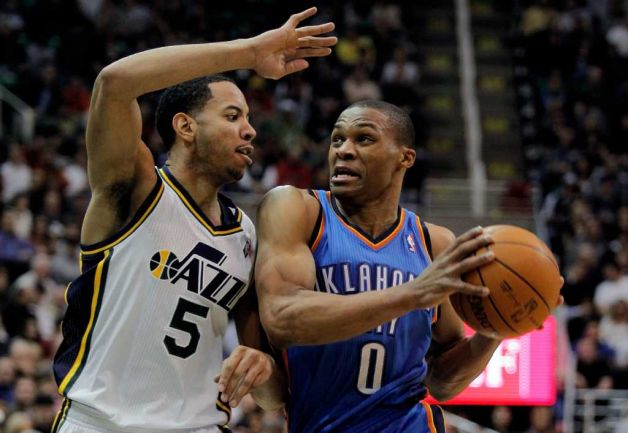
The Oklahoma City Thunder finally got to sleep consecutive days in their own beds and will enjoy the confines of their abode from now until the All-Star break, sans one trip to Houston. This will be the second of 3 meetings between the two teams this season. The Thunder’s last game was against these Jazz, while for the Jazz, this will be their 3rd game in as many nights. The Thunder won the last meeting going away 101 – 87.
The Opponent
The Utah Jazz have the definition of consistently inconsistent. They started off the season losing 3 of their first 4. Then the reeled off 9 wins out of their next 11 games. And now they’ve lost 6 of their last 10 games. They currently sit at 14-13, good for 4th in the division and 9th in the conference. The Jazz are led by their front court of Al Jefferson and Paul Millsap. Together they are averaging 35 points and 18.6 rebounds per game. Though a bit undersized, they are one of the more formidable front courts in the league. Last season’s first round pick, Gordon Hayward, is rounding into a good role player providing more scoring, rebounding, and playmaking as the starting SF. The backcourt of Devin Harris and Raja Bell is veteran-laden, but a bit limited in all facets of the game. The bench for the Jazz can be inconsistent, with veterans CJ Miles, Josh Howard, and Earl Watson getting the bulk of the bench minutes. The Jazz’s defense is pretty suspect as they allow 97.2 points per game, which is 23rd best in the league. This will be the 3rd game in as many nights for the Jazz, while the Thunder haven’t laced them up since last Friday.
Probable Starting Line-ups
Oklahoma City
PG – Russell Westbrook
SG – Thabo Sefolosha
SF – Kevin Durant
PF – Serge Ibaka
C – Kendrick Perkins
Utah
PG – Devin Harris
SG – RajaBell
SF – GordonHayward
PF – Paul Millsap
C – Al Jefferson
Matchup to look out for
Russell Westbrook vs. Devin Harris
When the Utah Jazz chose their poison in the last game and decided to focus all their defensive attention on Kevin Durant, it freed up Westbrook to take advantage of the smaller Harris and score 28 points on 10/20 shooting from the field. It will be very interesting to see how the Jazz choose to defend Westbrook this time around and how Westbrook adjusts to this.
3 in the Lane
Turnovers. Please gentlemen, let’s keep these turnovers to a minimum. I don’t know a good number, but the more you turn it over, the more you give the other team opportunities to score on their end. Everyone on the court is an NBA player, and eventually, if given enough opportunities, even bad teams will score on their increased opportunities.
Interior defense. Millsap and Jefferson are very similar to Marc Gasol and Zach Randolph in that they aren’t overly athletic, but are very fundamentally sound and have good mid range games. For being undersized, Millsap is deceptively good on the interior. It’ll be very important that Ibaka, Perkins, Mohammed, and Collison stay with these guys at all times, as they have been know to drop 30 and 15 type games.
Offensive schema. There is no one on the Jazz that can consistently guard Kevin Durant or Russell Westbrook. Durant is so much bigger than Bell,Hayward, or Howard. And Westbrook is so much stronger than Harris and quicker than Watson. The key will be the shooters (Cook, Sefolosha, and Harden). If they are making their shots, the defense won’t be allowed to collapse on Durant and Westbrook, as their primary defenders will need help throughout the game.
In a season where you have the best record in the league after 25 games, a lot of things have to go right as far as player development is concerned. Your young guys have to keep developing, while the veterans have to either add new wrinkles to their games or maintain the status quo from the previous season. While a big part of our success this season is due to the continued development of our young core (Kevin Durant, Russell Westbrook, James Harden, and Serge Ibaka), one of the biggest developments this season has been the evolution of Daequan Cook.
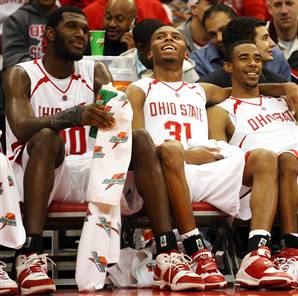
Mind you, Cook has always been a talented player. Though he was overshadowed for most of his high school career by OJ Mayo in Ohio, he was still considered a great player in his own right, and was a highly touted prospect that landed in Ohio State’s vaunted 2006 recruiting class, which also included Greg Oden and Mike Conley. For his one and only college season, he averaged just under 10 points per game as the Buckeye’s main outside threat on a team that made it all the way to the national championship game.
Coming off his freshman season, many thought Cook needed another year of seasoning at the college level to continue building his game. Instead, he chose to go the NBA route with his freshman brethren Conley and Oden. Here are some of the online scouting reports that were written about Cook:
“Unlike many young players he possesses an excellent mid-range game. Moves well without the ball, and understands how to fully utilize the entire floor to get his shot off. Has an NBA ready body that has shown development from his senior year of high school. Explosive scorer who can reel off big points in a hurry…Possesses legit three point range on his jumper. Unselfish and shows solid court vision to get teammates involved in the offense. Is a good athlete who contributes on the boards nightly. Has the ball handling ability and quick first step to break his man down on drives. Excellent finisher in transition and can end plays in dramatic fashion. Has a tremendous amount of confidence in his ability, rarely does he get rattled by the moment. Has all the physical gifts needed to emerge as a defensive presence…Defensively Cook has a habit of gambling too much and being impatient This exposes him to pick up quick fouls by reaching in or defending his man too aggressively”
“Cook already can score the ball at an NBA level, and with the trend towards undersized shooting guards of late, he has a very good chance to make significant contributions for a team in his future. The most notable thing about his scoring ability is how he can hit a shot with a hand in his face and how he’s so strong and able to hit shots nearly effortlessly from long range, as easy as he does from 10-15 feet out…In terms of things Cook brings to the table other than scoring, he’s not really going to wow you in any other area just yet…Cook did a solid job on the defensive end, but at 6’4, he’ll be at a bit of a disadvantage at the next level, even with his good physical tools.”
From the scouting reports, it appeared that Cook was going to be a good offensive player with the ability to develop other facets of his game (i.e. defense and playmaking).
After being chosen with the 21st pick in the 2007 NBA draft by the Philadelphia 76ers, and then promptly traded to the Miami Heat, Cook showed great promise in his rookie season. He averaged 8.8 points on 33% shooting from the 3 point line, but gave little else in the form of rebounds, playmaking, or defense. In his second season, he increased his scoring average to 9.1 points per game, but saw a decrease in every other major category. On a positive note, though, he won the 3-point shooting contest at the All-Star game. In his 3rd season, nagging injuries and a falling out of favor with his coach led to Daequan playing in the least amount of games in his professional career and saw his scoring average dip to 5 points per game. After being an integral member of the Heat’s young core, Daequan’s position on the team could best be summed up by blogger Albert Random of www.heathoops.com :
“Daequan Cook: No surprise here. He’s playing at a D-League level yet he’s set to make $2.2 million next season, after Riley inexplicably picked up his option. He is shooting 29% from the field, and 29% from beyond the arc. Need I say more? The hope is that he turns things around, because he will be on the Heat roster in 2010/11. Grade: F”
With the impending free-agent frenzy of the summer of 2010, the Heat positioned themselves into being able to offer 3 max contracts to the likes of Dwayne Wade, Lebron James, Carlos Boozer, Amare Stoudemire, or Chris Bosh. In one of their final cost cutting moves, they traded Daequan Cook and their No. 18 pick to Oklahoma City for the Thunder’s second round pick (No.32).
Daequan was allotted a new start on a young, up and coming team. Not too different from the situation he was in while playing for Miami. He came in as a necessary sharp shooter, but had to find his spot in the rotation on a playoff team that returned its entire rotational roster from the previous season. Daequan was kind of force-fed into the rotation in the first 8 games of the season, and the results looked a lot like the 2nd half of the previous season with Miami. He struggled, averaging 1.9 points per game while shooting just 19% from the 3-point line. But the coup de grace was in what else he provided…which was basically nothing. He gave the Thunder 5 boards, 3 assists, and 2 steals TOTAL in those 8 games. Not to mention he had a -7 differential in those early season games.
Scott Brooks did what any good coach with a struggling young player would do. He sat him down and told him to earn his spot in the rotation through his performance and effort in practice. In coachspeak, that basically means, “Everyone struggles offensively in the NBA at some point. It’s what you can provide other than the scoring that can keep you on the floor.” If you are a one trick pony who isn’t performing your one trick, while giving little else, the NBA machine will chew you up and spit you out pretty quickly. Some players crumble under this pressure and are never to be heard from again in NBA circles.
Daequan decided to put in work. He could’ve cried and complained to his agent that he wanted out of Oklahoma City. Instead, he sat for 36 of the next 37 games honing his craft in practice and adapting to the Thunder way. Daequan had always been a good offensive player with the “potential” to become a good all-around player. When he finally got his opportunity to perform in late December, he relished that opportunity and played with effort every night. He notched a couple double-digit scoring games and became an integral part of the rotation as a sharp-shooter and floor spacer. But the important thing was that he was invested on the defensive side of the floor and gave effort in the other facets of the game (rebounding, making smart plays). Did he have overly impressive numbers? No, but he impressed with his effort as the season played out.
In the offseason, Daequan re-upped with the Thunder for 2 years. His role on the team would remain the same, but, hopefully, without the whole transition period. He has not disappointed in this early season run, providing 3 point shooting at a 41% clip, while being solid defensively and a great help on the defensive glass. In the past 5 games, he has started for the injured Thabo Sefolosha, and has averaged 9.2 points, 4 rebounds, and 1.2 blocks on 46% shooting from the 3-point line. This has provided a stop-gap to keep James Harden on the bench where he is much more effective coming in with the second unit. The Thunder are 4-1 in these past 5 games.
Every championship team has a guy or two like this; specialists that perform a specific job. It necessitates that a role player perform one act greatly. Usually that is all the player is asked to do. But if that one player can also provide other things to the team other than his skill, then he becomes an invaluable asset. And that is what Daequan Cook has become to the Thunder. “All Dae, Er’r Dae!”

















 Now That's Thunder Basketball