Tag Archives: Houston Rockets

The Eric Maynor Sweepstake

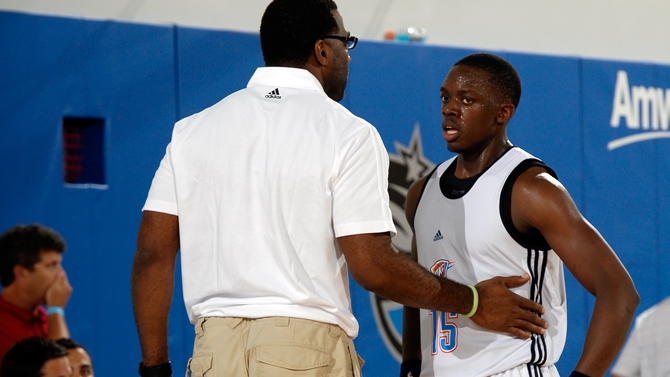
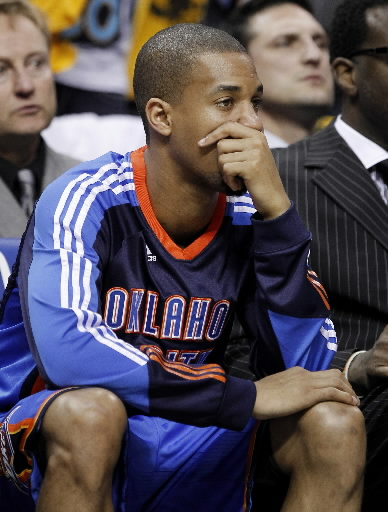
bench maynor

With Eric Maynor’s DNP-CD on Wednesday night, in a blowout of the Denver Nuggets, it was quite apparent that his run with the Oklahoma City Thunder is over. Ten months after suffering a torn right ACL, Maynor’s athleticism and confidence seemed to be wavering to the point that 2nd year guard Reggie Jackson took over sole possession of the back-up point guard duties on the team 25 games into the season. While Maynor’s numbers were never that impressive, his command of the 2nd unit (and sometimes, the 1st unit) showed he had the potential to run his own team.

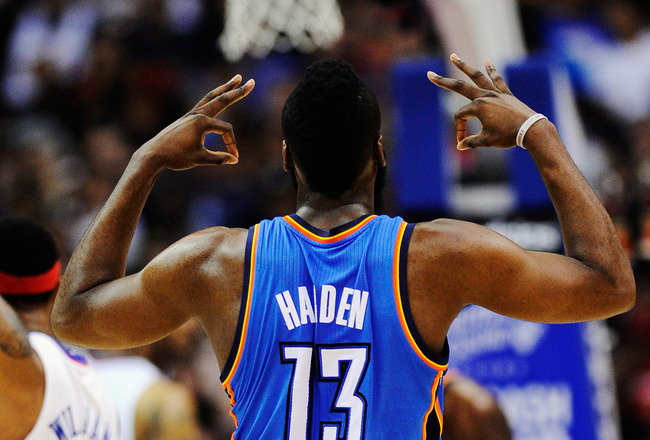
Back about two years ago, Maynor was being hailed at the best back-up point guard in the league. He led one of the best benches in the league, along with James Harden and Nick Collison. In hindsight, though, it seems that a lot of Maynor’s success was due in large part to James Harden. The former Thunder guard is now the 4th leading scorer in the NBA, with a 26.3 points per game average. The skills that he is currently exhibiting now as a Houston Rocket, were on full display during his first 3 seasons in the league, the last of which culminated with the NBA’s 6th Man of the Year award.

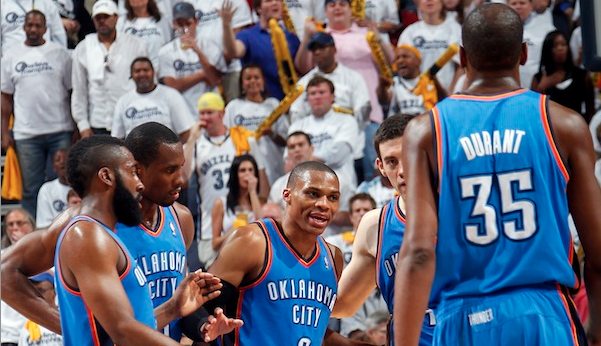
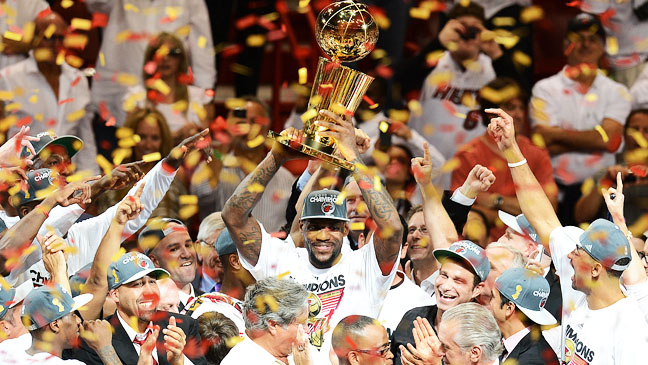
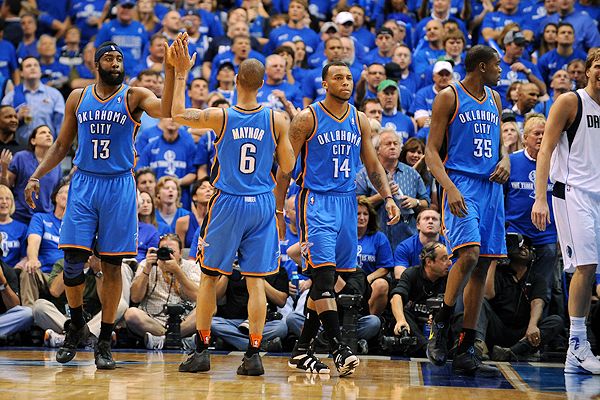
dal_g_thunder_bench_b1_600

Maynor’s game was never dependent on athleticism. He was a prober that constantly tried to find the open man or an open lane, and rarely turned the ball over. After the knee injury, though, what little athleticism Maynor did have was sapped, as was his confidence. Maynor began to drive less and shoot more, leading to career lows in FG% (30%) and assists per game (2.1). Though he was never touted for his defense, that part of Maynor’s game suffered greatly after the injury. He was constantly getting beat off the dribble, which led to either leads dwindling or deficits increasing. After 24 games, the Thunder decided to try Reggie Jackson as their primary back-up point guard. Though not the floor general that Maynor is, Jackson’s athleticism and physical tools lend him to be a better defender and more of a driving threat on offense.

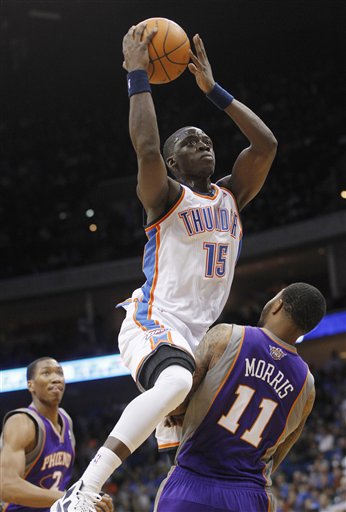
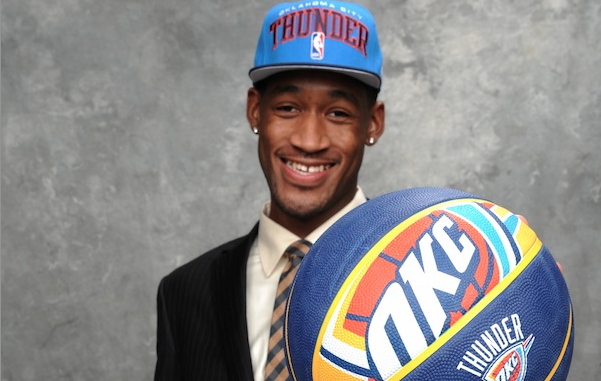
Reggie Jackson, Markeiff Morris

Being that Maynor is a free agent after this season, the Thunder would still like to get some value for him before the trading deadline. Maynor can still play the game, and maybe a change of scenery will help get his confidence back. Maynor’s value may not be that high, but the Thunder can package him with any number of assets to get a necessary piece to their championship puzzle. The Thunder are loaded with picks (Toronto’s top 3 protected, Dallas’s top 20 protected, and Charlotte’s 2013 2nd rounder) and young talent (Jeremy Lamb, Perry Jones III, DeAndre Liggins, and Daniel Orton) that would be very attractive in a deal. I, for one, am not in favor of dealing Lamb, Jones, or Liggins. With the current cost of the top half of the roster, the Thunder will need good, cheap talent to stay in championship contention.

That would leave Maynor and Orton, plus the picks, as the only tradable assets I see on the roster. Being that the only feasible need I see for the Thunder is another bench scorer, hopefully a 3/4 tweener, I’ve decided to become armchair GM for the day, and see what moves I can come up with. Move over Sam Presti, my shine is too bright for the both of us.

Disclaimer: All moves have been approved on ESPN’s NBA Trade Machine. Any move involving Daniel Orton would need to get done after January 31st.

Deal 1

  •  Houston get Eric Maynor and the Thunder’s 2014 2nd rounder.
  • Oklahoma City gets Royce White and the rights to either Sergio Llull or Furkan Aldemir.

furkan

Why Houston makes the deal – Houston is loaded with PnR-reliant guards in Jeremy Lin, James Harden, and Toney Douglas. If a defense knows how to defend the PnR effectively, it cuts off the Rocket’s first plan of attack. Having a traditional point guard would be a change of pace for the Rockets and will allow them to exploit other facets of their offense, such as Omer Asik’s post game and Chandler Parson’s 3 point shooting. Also, Houston gets rid of a headache in White. The verbal/social media sparring that has gone on between White and the Rockets is well documented concerning his mental health.

Why Oklahoma City makes the deal – While this eschews the notion of obtaining a bench scorer now, having the rights to either Llull or Aldemir would be a steal. Llull is the premier combo guard in Euroleague and would fit immediately into the Thunder’s rotation. Aldemir is great on the boards and would really help the Thunder in the post. Presti would probably tell White to stay at home and would negotiate a buy-out with his agent.

Deal 2

  • Milwaukee gets Eric Maynor, Daniel Orton, and the Mavericks top 20 protected pick.
  • Oklahoma City gets Mike Dunleavy

Why Milwaukee makes the deal – Milwaukee will be in a state of flux after the season. Their top two point guards, Brandon Jennings and Beno Udrih, are both free agents, though Jennings is restricted. The Bucks have been on record as saying they will retain Brandon Jennings, no matter what. A large enough extension would make retaining Udrih, currently making $7.8 million, nearly impossible. A cheap replacement like Maynor, who would sign for far less, would be more feasible. They could test drive Orton for half a season as all of their true centers are also free agents at the end of the season. The draft pick is just a sweetner.

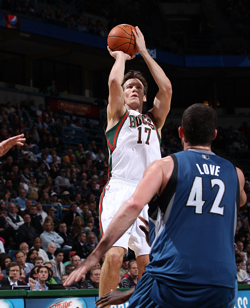
mike-dunleavy-jr

Why Oklahoma City makes the deal – Mike Dunleavy would immediately have an impact on the 2nd team as a scorer and shooter. The dribble and drive ability of Jackson would open up even more with Dunleavy and Kevin Martin on the floor together.

Deal 3

  • New Orleans gets Eric Maynor and the Thunder 2013 draft pick
  • Oklahoma City gets Al-Farouq Aminu

Why New Orleans makes the deal – With Ryan Anderson, Anthony Davis, and Robin Lopez on the front line, Aminu becomes the odd man out. His inconsistent play has been a source of ire from the Hornet’s fan base. A veteran point guard would help this young roster out and an extra first rounder will help in the Hornet’s rebuilding process.

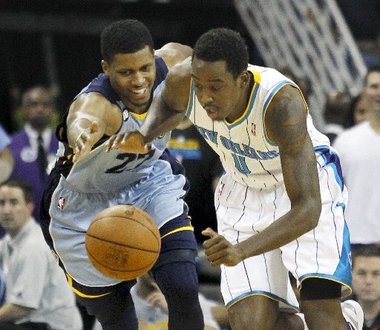
aminu

Why Oklahoma City makes the deal – Aminu is exactly the type of player that the Thunder covet. A 3/4 tweener with possible upside and a long wingspan (7’3!!). In the right system, he could be a valuable contributor off the bench.

Deal 4

  • Phoenix gets Eric Maynor, Daniel Orton, the right to swap either of their lottery picks (theirs or the Lakers’) lottery picks if it benefits the Suns, and the Thunder’s 2013 pick.
  • Oklahoma City gets Jared Dudley

Why Phoenix makes the deal – Let’s face it. Phoenix is rebuilding and is not interested in long-term role player contracts. Dudley still has 2 years at $4.25 million guaranteed after this season, plus a player option for the same amount. Phoenix could flip Dudley for a young center, a possible better lottery pick, and a late first rounder.

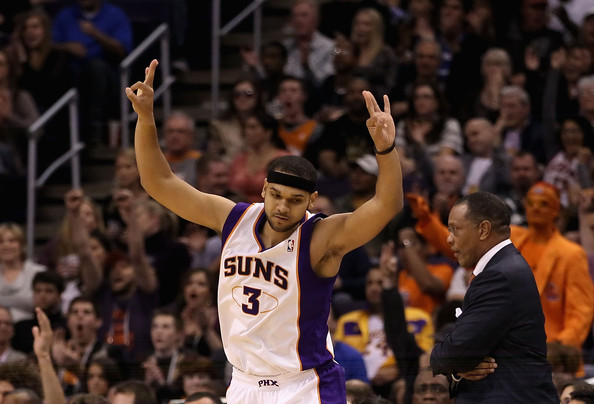
dudley

Why Oklahoma City makes the deal – The Thunder get a great role player with a good contract for the next 2-3 seasons. Plus, a player like Dudley has value and can possibly be flipped for other assets.

Deal 5

  • Cleveland gets Eric Maynor and Dallas top 20 protected pick.
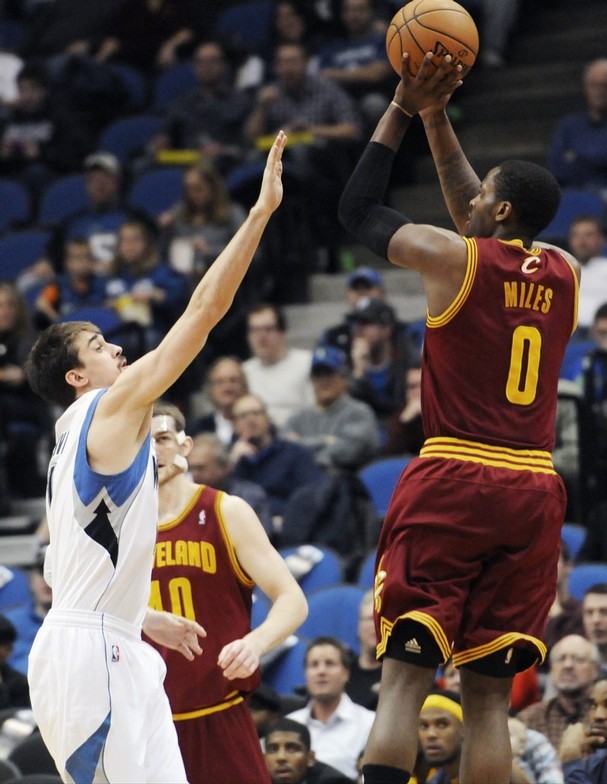
  • Oklahoma City gets CJ Miles

cj miles

Why Cleveland makes the deal – It isn’t the Anderson Varejao deal, but Cleveland still gets a future first rounder for a role player that’s a free agent after this season. Plus, Maynor could dispense some veteran wisdom onto Kyrie Irving.

Why Oklahoma City makes the deal – The Thunder get a good role player that can shoot and stretch the floor. Plus, they don’t give up much.

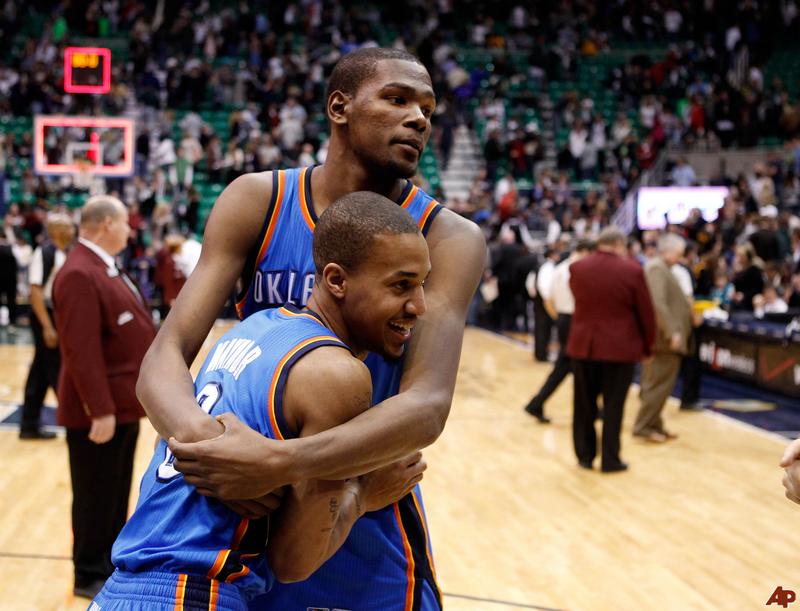
kevin-durant-eric-maynor-2011-2-6-0-1-11

As a fan, I would hate to see Maynor go. He’s grown with this team and was a big part of its development. But, as we’ve seen with the Jeff Green and Harden trades, it is also a business in which every team is trying their hardest to get better. If a move can be made, and it is advantageous to the team, then it’s a deal that must be made. When the inevitable happens, I wish Maynor nothing but the best. He’s been a consummate professional and has a long career ahead of him.

….The More They Remain The Same

Any time something catastrophic happens, people always measure time from that point forward. In the show “Revolution”, everything is measured from the blackout, which is the catastrophic event in the show. Similarly, anytime something shocking happens to a sports team (i.e. trade, injury, retirement, suspension, etc), everything is measured from that time for the immediate future. No matter what they tell you, Clevelanders are still thinking about Lebron and The Decision. It’ll take a nice playoff run or two from Kyrie Irving, Dion Waiters, and the young Cavs to start to erase the time clock from their collective memory. Chicagoans have become quite adept at handling these differentiating time clocks for the past 20 years. They’ve had Michael Jordan’s first retirement, his comeback, his second retirement, and, finally, Derrick Rose’s knee injury. They are just chomping at the bit to start the Derrick Rose comeback timeclock.

The Oklahoma City Thunder experienced something very similar a month ago. On October 27, 2012, the Thunder traded James Harden, Daequan Cook, Lazar Hayward, and Cole Aldrich to the Houston Rockets for Kevin Martin, Jeremy Lamb, 2 future first round picks, and a 2013 2nd round pick. The Thunder were just coming off a trip to the Finals with their young core just coming into its own. They had their world-class scorer in Kevin Durant, their hyper-competitive floor general in Russell Westbrook, their pogo-stick blocking machine in Serge Ibaka, and their “jack of all trades” in James Harden. All under 24 years of age at the time. THIS team was supposed to grow together and contend for the next decade. Instead, after not being able to come to terms on a long term extension, Thunder GM Sam Presti decided to pull the trigger on the trade,  and send Harden to Houston. 

The first thought amongst Thunder fans was how Martin would compare to Harden. The players, while similar in some facets, were completely different in other facets. Both were great shooters who were very adept at drawing fouls when driving to the basket. The major difference between the two players was that Harden was more of a playmaker, while Martin was more of a scorer. That major difference was of chief concern to Thunder fans because Harden was usually the go-between when Durant and Westbrook were on the floor together in the 4th quarter. When Durant and Westbrook were out there on the floor together, teams had an idea on how to guard the duo. But add Harden to that mix, and the floor spaced out like the Red Sea of Moses.  

Basketball skills aside, the primary concern was how this trade would affect the Thunder’s chemistry. This Thunder team was one that had been hardened by its experiences. The struggles of learning how to win followed by the lessons of winning when favored. It was a 180 degree turn that many teams never experience. Many teams have trotted out young talented rosters that have either failed to pan out or were destroyed from within when it was time for contract extensions. The best comparison I have for the Durant-Westbrook-Harden-Ibaka Thunder was the late 90’s Dallas Cowboys of Troy Aikman, Emmitt Smith, and Michael Irvin. Eliminate one of the Triplets from that mix, and the Cowboys aren’t winning 3 Super Bowls in four seasons. This is the current dilemma facing the Thunder.

One month in, and the transition has been about as smooth as it can be when changing out key parts. There have been some transitional growing pains, but that is to be expected when a core shattering trade is made 4 days before the start of the regular season. What is important is the Martin seems to be integrating quite nicely into his role as the team’s 6th man. Luckily, the team’s schedule has been home-heavy in this early going with the opponent’s collective win percentage being under .500. On the other hand, against teams with strong playoff pedigrees, such as the Spurs, Grizzlies, Clippers, and Celtics, the team has struggled and is 1-3 against those teams. The surprising revelation is that compared to James Harden’s stat line from last season’s first 15 games, you would almost not even notice a difference.

  • Stat                                       Harden (11-12)      I       Martin (12-13)
  • Minutes per game                     30.0                              30.7
  • Points per game                       16.3                              15.9
  • Turnovers per game                  1.8                                 1.8
  • Steals per game                         0.8                                1.3
  • Blocks per game                        0.2                                 0.1
  • Assists per game                       3.1                                 1.8
  • Rebounds per game                  3.9                                 2.7
  • FT Attempts per game               6.5                                 4.6
  • FT Made per game                     5.7                                 4.4
  • FT %                                             86.7%                           94%
  • 3pt FG attempts per game          4.6                                4.9
  • 3pt FG made per game               1.7                                 2.4
  • 3pt FG %                                       36.2%                           50%
  • FG attempts per game                 9.9                                9.9
  • FG made per game                      4.5                                4.6
  • FG %                                              43%                              46%
  • TS %                                               66%                             66.5%
  • eFG %                                            58.2%                          58.3%
  • Thunder Record                            12 – 3                            11 – 4

Other than the difference in assists per game, Harden and Martin have virtually the same offensive stats. Eventually, even the assists may be a wash, as Martin has shown a willingness to become more of a playmaker. People tend to forget that Martin has been the main offensive option on most of the teams that he’s played on and has been given the green light to shoot at will. But, with teammates like Durant, Westbrook, and Ibaka on the floor, Martin has shown that he can find the open man for an easy bucket or two. 

Defensively, Martin has been a liability, but Harden wasn’t necessarily on his way to being named to any of the All-Defensive Teams. This first half of the season will be one lesson after another for the Thunder. Durant and Westbrook have been learning on the fly how to incorporate Martin into their crunch time offense. And Martin has been learning how to be more aggressive as a bench player. Overall, the transition has gone a lot smoother than many Thunder fans had feared. With Harden coming to town on Wednesday with his new team, the cycle seems to have come full circle. The more things change…….

Mr. Harden’s Opus

So I had this blog detailing why I didn’t think the Oklahoma City Thunder would sign James Harden by the October 31st deadline. I was going to work on it this weekend and publish it on Monday. I was hoping Harden and the team would still be in negotiations by the time I finished said blog. I truly believed the negotiations would be an issue that would be shelved until next offseason when the front office had more information (an entire season’s worth) to make more of an informed decision. Instead, with the OU/Notre Dame tied at 13 in the 4th quarter, I checked my twitter feed and saw this inconspicuous tweet:

Wow #Harden

I don’t remember who the tweet was from. But it piqued my curiosity and I clicked on the hash tag. I thought it was going to be a person that was surprised Harden had turned down a 4 year/ $52 million dollar contract extension. Instead, to my complete and utter surprise/horror, I started seeing the all the tweets about Harden being traded to the Houston Rockets for Kevin Martin and Jeremy Lamb. The “Whhhhaaaatttttt???!!!” I let out startled my wife into rushing out of the kitchen to see what the hell was going on. The rest of the OU game was a blur to me after that. I went into Twitter frenzy mode and didn’t stop until after midnight. Once the shock and awe of it wore off (which most of it hasn’t), I was able to process the trade and evaluate it.

Here are the details from the trade:

Houston gets SG James Harden, C Cole Aldrich, SG Daequan Cook, and SF Lazar Hayward

Oklahoma City gets SG Kevin Martin, G/F Jeremy Lamb, 2013 first round pick (from Toronto, top 3 protected), 2013 first round pick (from Dallas), and 2013 second round pick (from Charlotte)

Here are some of the thoughts I have about it. I call this my “Mr. Harden’s Opus.”

The Good

My first option would have been to keep the Thunder nucleus together. But if you are going to trade Harden, this was probably the perfect batch of expiring contract, promising rookie, and draft picks galore. Let’s start with the big name from Houston: Kevin Martin. If you are going to find a substitute teacher for Harden, Martin is probably the best one year prospect available. An effective scorer who has averaged 18.4 points per game for his career, with a great mid-range game and an effective 3-point shot (38%). Someone who goes to the free throw line 6.6 times per game for his career. Defensively, Martin may not be as big as Harden, but it isn’t like Harden was in line for the All-Defense team, either. Both are sieves on the perimeter, but Harden is able to bang with bigger bodies like Kobe Bryant and Stephen Jackson. The one thing Harden really has on Martin is his play-making ability.

If the Thunder plan on bringing Martin off the bench, this plays out perfectly for them. With Eric Maynor back, Martin won’t need to take Harden’s place as a play-maker on the second team. Martin could be the gunner off the bench and the Thunder could use him in late game situations if offense is needed. For all the talk about Martin being a selfish player, he has never played with players of the caliber of Kevin Durant, Russell Westbrook, and Serge Ibaka. The focus will be off Martin and he can do what he does best, which is score from the perimeter and get to the line.

The second, lesser known name in the trade was rookie Jeremy Lamb. This, in my opinion, will determine whether this trade will be viewed as a success or a failure. Lamb has the skill set and potential to be that dual threat shooting guard that the Thunder have been coveting in their championship run. Someone, potentially, with the length, athleticism, and defensive ability of Thabo Sefolosha, but also with the scoring and shooting ability of James Harden. Jeremy Lamb could prove to be that kind of player. With Martin in the mix for at least one season, Lamb can sit and learn this season without the pressure of being a starter.

The draft picks were probably what sealed the deal on this trade. Getting a good veteran with an expiring contract like Martin, and a rookie dripping with potential, like Lamb are things that many teams could have offered. But not many teams could have offered that and a slew of draft picks like Houston could. The Thunder, as weird as this sounds, are a championship contending team that got younger and obtained great assets. The Toronto pick will be a great trade chip going forward, as the Raptors are not expected to improve much from where they were last season. The 2nd round pick from Charlotte will also be valuable as it will probably be one of the first few picks from the 2nd round.

The Bad

According to sources, the final offer the Thunder made to Harden was in the 4 years / $55.5 million dollar range. Harden will probably end up signing with Houston for 4 years / $60 million dollars. You mean to tell me the difference between a potential dynasty with an established core, and completely blowing up a team 5 days before its season opener is $4.5 million dollars. That difference amounts to $1.125 million per season. The ownership group, which has made a commitment to all of its core players, could not come up with $4.5 million dollars more? This group of multi-millionaires and billionaires were panicking over an extra $1.125 million per year. Don’t get me wrong, though. I understand it is their money and not mines. But, keeping this core intact for at least another 4 years would almost certainly guarantee runs to the Western Conference Finals and NBA Finals in that allotted time. Those extra games means about $20-40 million dollars extra in profit for the ownership group. You can talk about cap flexibility and assets until you are blue in the face, but when you have the potential to win championships in the here and now, AND you’re making money, you take those chances.

The scariest part about this trade is that a championship contending team was blown up less than a week before the start of the season when it didn’t need to be. We just went through 7 preseason games with our normal core intact, and now we only have 4 days worth of practice time to integrate 2, and possibly more, pieces to our team. When, in the minds of the front office personnel, did they say, “You know, this sounds like a great idea.” While the linchpin of this trade may have been Harden, Cole Aldrich may prove to be a big loss for the Thunder. He seemed ready to assume the role of back up center, getting 2 double-doubles in the preseason. Now, we are heading into the season with Hasheem Thabeet as our backup center. Granted, Nick Collison, Serge Ibaka, and possibly, Perry Jones III can all play the 5 in a pinch. But in a future playoff series against the Memphis Grizzlies, Los Angeles Clippers, or Los Angeles Lakers, having an inexperienced and oft maligned center as a back up could prove to be detrimental.

The Ugly

Can someone tell me why the hell we had a lockout last season? All I heard during the lockout was about the percentage of the revenue that the players got and how salaries had gotten out of hand. Some even tabbed it as the “Rashard Lewis” lockout, with Lewis being the best example of a 2nd or 3rd tier player that received a max extension, thus limiting the cap flexibility of that team for up to 5 seasons. Basically, it was a lockout to keep the owners from actually overspending their profitabilities. So, then, why are teams paying players like Eric Gordon, Roy Hibbert, and James Harden max extension money. I thought max money was for top 10 players like Lebron James, Kobe Bryant, and Kevin Durant. Instead teams are throwing around stupid money for 2nd tier players. There’s 5 years left until the owners and players can revisit the CBA, and believe me, it will be revisited again, and this time, I fear, with dire consequences.

WWJD – What would James do?

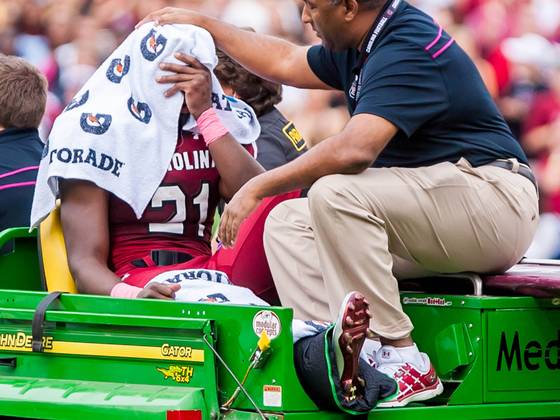
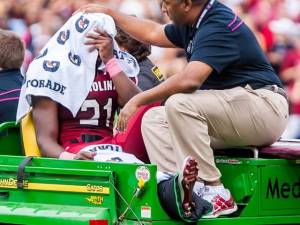
Do you know who I’m not mad at for this trade? James Harden. Before the OU game on Saturday, I spent the whole afternoon thinking about University of South Carolina running back Marcus Lattimore, who had just suffered a gruesome right knee injury. If you haven’t seen it, just think of Shaun Livingston’s knee injury from 5 years ago. Reports are coming out that Lattimore tore a couple ligaments and completely dislocated his kneecap. To make matters worse for Lattimore, he was coming back from a torn ACL in his left knee suffered the previous season. If Lattimore was a stock and NFL teams were the buyers, he would currently be considered a toxic asset.
In a profession where your best years are in your mid to late 20’s, your earning potential is contingent on 5-7 years of performance and luck. If you suffer an injury or get involved in a legal scandal, your earning potential will go down. You, as an athlete, cannot dictate what the market will pay for you. If the market wants to pay you max money, then that’s what they pay. If they want to pay you veteran minimum money, then that is what you will get paid. I don’t blame Harden for taking what the market gives him.

As I wrote in my Pippen/Westbrook column, Pippen consistently took less than his market value to keep the core of the Bulls team together. Where did that leave him? Broke (most of it his fault, but still) and bitter. Harden could have taken a couple million less than what the market had placed his value at, but why. While we like to moralize athletics into this great teaching tool where you sacrifice for the greater good, at the end of the day, its a business. If a player can’t perform anymore, the owner is going to let that player go and move onto the next able body. It’s a business and a player would be a fool to leave money on the table.

I’m the Oklahoma City Thunder blogger for the blogging network called Hoops Talk Nation through the website www.thebreakdownshow.com. I currently blog on there for free. But if ESPN, YahooSports, or CBSSports ever called to offer me a spot on their blogging network for cash, I would take it in a heart beat. While I love the opportunity that Audley Stephenson and Dave Mendonca have afforded me, I wouldn’t be able to turn down the possibility of blogging AND earning cash to do it. Regardless of how I fancy myself as a blog writer, I would never turn down the opportunity to move up on the pay scale.
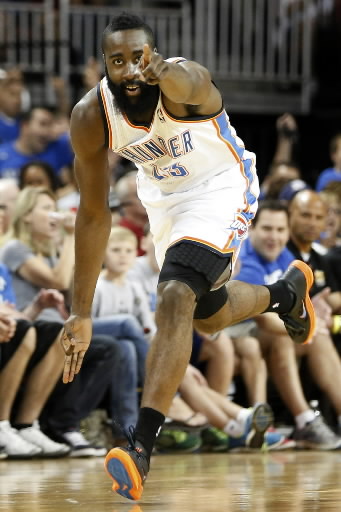
OKC fans should not hold this against James Harden. This is a business, and him turning down less money is a business decision. He is doing what he feels is best for himself and his family. Not unlike what we do everyday, but with less zeroes attached to it. Many will be mad for what they perceive was a lie from Harden with all the “sacrifice and brotherhood” talk. What did you expect from him? To come out and say, “I don’t give a shit what you think I’m worth. If the market says I’m a max player, I want max money!”

Being a fan is an emotional experience. When you mix emotion and money, you don’t make sound decisions. So, if you take the emotion out of the equation, you’d realize that James Harden did the same thing you and I would’ve done, which is to never leave 7.5% of a raise on the table.

The Trade and the Thunder

Well, what’s done is done. The NBA is not going to step in and rescind this trade, as Harden does not suffer from any pre-existing toe injuries or heart ailments. He is a Houston Rocket. And so are Daequan Cook, Cole Aldrich, and Lazar Hayward. We cannot worry about them anymore.

What we do have are two unique players and 2 roster spots to fill. I think Kevin Martin will slide in seamlessly into Harden’s role off the bench. His efficient scoring and knack for getting to the line will have Thunder fans wondering whether James Harden shaved his beard, lost some weight, and slightly bleached his skin. The real prize in this trade could be Jeremy Lamb. If, in an alternate basketball universe, the basketball DNAs of James Harden and Thabo Sefolosha were interwoven, the result could be a player like Lamb. A 6’5” shooting guard with a 7’0 wing span and the ability to knock down long jumpers and play in transition. If you thought the Thunder were good with the Sefolosha/Harden SG platoon, imagine if only one player supplied most of those needs. There’s still a lot of development that needs to take place, but the skill set is already in place.
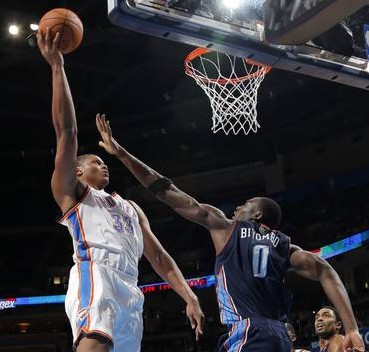
The open roster spots are a different story. The Thunder not only traded their 6th man of the year, but also their back up center, their designated 3-point specialist, and their designated end of the bench guy. While Hayward won’t be that difficult to replace, Aldrich and Cook could. I fully expect the Thunder to sign Daniel Orton to a minimum deal to compete with Hasheem Thabeet for back-up center minutes. The final roster spot is a bit of a mystery, though. Before training camp started, the Thunder signed Georgetown sharp shooter Hollis Thompson to a non-guaranteed 3 year contract. After playing in only 2 preseason games, he was one of the final roster cuts by the Thunder. They could sign him as a future replacement for Cook. Or, they could leave that roster spot open for future options, such as taking on a salary in a trade, or signing a veteran free agent (Derek Fisher, anyone?).

As for the core players, I’m curious to see how Nick Collison will react. He and Harden had one of the top 5 pick and roll combos in the league. Collison is one of the consummate professionals in the league and will be fine no matter what situation he is placed in. I think the onus of this transition will fall mainly on Russell Westbrook. If Westbrook continues to be consistent, as he was this preseason, then the Thunder should be fine. But if there was one player that helped Russell when he got into Honey Badger mode, it was Harden. Harden would take over the point guard duties and become the primary play-maker, especially at the end of games. That role now falls primarily in the hands of Westbrook, and to a lesser extent, Eric Maynor. While Maynor could fill the role of play-maker at the end of games, no defense will respect Maynor’s ability to drive and draw fouls like they did Harden’s. Martin could always be inserted at the end of games, but his play-making ability may be less than Westbrook’s.

How does this change affect the Thunder? They have never had to deal with a core-rattling trade like this one. The Jeff Green for Kendrick Perkins trade shook the tree, but it was necessary given that Green was out of position at the 4 spot and affecting the team’s post defense. This trade wasn’t necessary for anything on the floor. Instead, it was a financial deal the team made to avoid paying costs in the future. The biggest negative in all of this is that it happened 5 days before the first game of the regular season. There will be no preseason games to indoctrinate the new players. Only a couple practices and then on to the season. The only positive I see in this situation is that our biggest threat, the Los Angeles Lakers, are also having to work out chemistry issues, after bringing in 2 main cogs (Dwight Howard and Steve Nash) in the offseason. The Western Conference may come down to whoever vibes first.

I do think this affects us this season. These guys just went from going to the Finals, then to the Olympics, then through training camp and preseason thinking they were going to defend their Western Conference title without a hitch. Then, BOOM!!! Over a quarter of the team gone, with 2 new pieces coming back. This is a team that is used to consistency. This consistency is what fostered to current Thunder culture. Consistency leads to comfort. Comfort leads to confidence. If you were part of the culture, you were part of the brotherhood. Now a shred of that is gone. I do think it will take the team a while to adjust from this one. Has their championship window closed? No, it hasn’t closed, but somebody definitely threw a baseball through it. The Thunder may come out stronger in the end, but I think it will be a case of one step backwards, two steps forward.

 In Memoriam
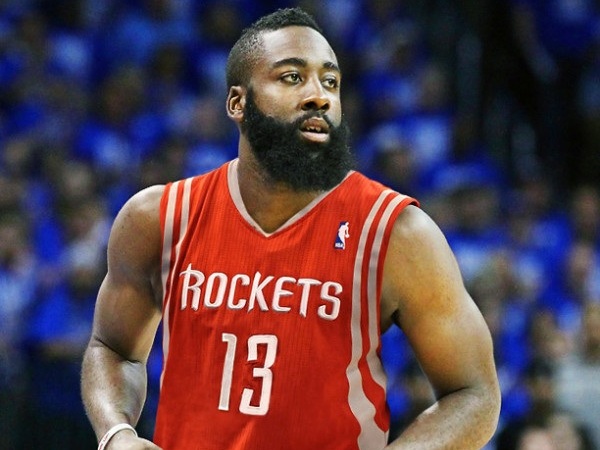
I will miss the Beard. Harden became a part of the fan culture. When you mentioned the characters on the team, you always had to mention Harden and his Beard. If the Thunder had a Teenage Mutant Ninja Turtles-like quartet, Harden was definitely Michaelangelo (the party dude!). I wish him nothing but the best in Houston. But if we are being honest, Harden was but a great role player. He scored when called upon, drove and drew fouls when needed, and made plays at will. But I never considered him to have the “it” to be The Man. Westbrook has that dogged “it” to be The Man. Durant is The Man. But Harden just seemed happy doing what needed to be done. So if Harden wants to see how his life will be post-Thunder, he need look no further than the man he was traded for.
The Thunder and their Manchurian Candidate

During the offseason, the Oklahoma City Thunder did something very unconventional. Instead of hiring a scout to serve as their video coordinator/analyst, they, instead, hired premier basketball video blogger Sebastian Pruiti. For those of you who don’t know who Pruiti is, he ran a website called nbaplaybook.com, in which he used clips of games to break down film and explain why a team may or may not have been successful in certain sets. Pruiti did a great job of explaining the content in a way that even the average NBA fan could understand.

His understanding of the game was not without any background. He served as a volunteer assistant coach for the New Jersey Institute of Technology Highlanders. Then, he served as an assistant coach for the Fort Wayne Mad Ants of the D-League. Needless to say, the man is an astute basketball mind. One of the best basketball writers of our generation, Bill Simmons, noticed this and decided to hire Pruiti for his newly formed Grantland multimedia conglomerate. In fact, Simmons was the one that broke the news on Twitter that Pruiti had been hired by the Thunder.

The thought of a Simmons’ disciple going to the Thunder, though, got my conspiracy  mind thinking. On the one hand, Simmons has written about his disdain for how the Seattle Supersonics eventually became the Oklahoma City Thunder. Not that he necessarily carries any ill regard for the team itself, but more for the process that eventually landed the team in the Great Plains. As punishment, he has yet to call the team by its current moniker in any of his writings, instead referring to them as the Zombie Sonics. On the other hand, Simmons’ crowning achievement in life would be to someday become an NBA GM. It’s a dichotomous train of thought that is one part Manchurian Candidate and one part Great Expectations.

Think about it. Before Simmons hired Pruiti, he probably kept tabs on him for years like a spy cultivating an asset. He was the best video blogging analyst in the game and worked on several basketball-related sites. As a basketball junkie, Simmons had to immediately recognize his work and his talent. One of Simmons’ most important traits as a writer is his ability to read situations before they occur. He has correctly predicted the “Ewing Theory” on many occasions, and has a keen understanding of how people will react to certain situations. These are all characteristics of a great point guard; someone who sets things in motion, directs the traffic, sees things before they happen, and makes proper adjustments whenever necessary.

I could see Simmons playing chess, while everyone else plays checkers. He knew that Thunder GM Sam Presti is very analytical and values statistics as a means to better answer questions. He also knew that Presti is young and probably very in tune with the basketball blogosphere and advanced cybermetrics. In terms of probability, there’s a lot better chance that someone like Presti or Houston Rockets GM Daryl Morey would hire Pruiti, than someone like Detroit Pistons GM Joe Dumars or Indiana Pacers GM Donnie Walsh.

Eventually, Presti finally took the bait and hired Pruiti. And with that, Simmons finally had his Manchurian candidate in place. As George W. Bush would say, “Mission (half-way) accomplished!” As a video coordinator/analyst, Pruiti’s job is to break down every one of the Thunder’s possessions (both offensive and defensive), looking to see what works and what doesn’t work for the team. If coaching were compared to another Charles Dickens classic, A Christmas Carol, Pruiti would be the Ghost of Coaching Past and Future, while Scott Brooks would be the Ghost of Coaching Present. The information Pruiti garners from game film will help steer how the team plays in the future.

With Pruiti in the door, does he begin to show skewed video evidence to the Thunder front office suggesting a Keith Bogans for James Harden trade would be beneficial to the team? Does he show slanted video proof that Kendrick Perkins should get the ball more in late game situations? Does he systematically try to derail the team’s ascension from the inside out?

Or perhaps, the motive is completely selfish on Simmons’ part. Let’s say Pruiti climbs up the coaching ranks and gets in good with the owner of a struggling team. Who’s to say that Pruiti won’t put in a good word to the owner that Simmons is a master capologist (via ESPN’s Trade Machine, of course), a burgeoning talent evaluator, and a great judge of character? With those qualifications, which struggling team wouldn’t hire Simmons as their GM?

That would literally make Simmons, Mr. Magwich, to Pruiti’s Pip. While Simmons may have assisted Pruiti in the past and present, Pruiti may some day perform the quid pro quo for Simmons in the future. In life it’s all about your contacts and the more connections you make, the more possibilities you have. Who knows, maybe one day Sebastian Pruiti will be the Thunder’s head coach and Bill Simmons will be the Thunder’s (gulp!) GM. That would be the irony of all ironies. At least then, he would probably have to mention the Thunder by name.

What offseason? Basketball Never Stops!

As a fan of the game, I’ll watch any basketball game you have on the television, especially playoff games. But there’s a slight disconnect when your team is not involved. It’s not as emotionally taxing. With that said, I’ve never enjoyed basketball as a connected fan all the way into mid-June. Though I’m disappointed that we lost in the Finals, its fun to look at the calendar and know that in 3 months, training camps should begin to open up. I’ve forgotten what it feels like for the season to be over in mid-April. But this all leads us to the offseason. Time to rest and recover from the grind of the season. Oh, I forgot we have the draft coming up. And then we have Summer League. And all the offseason moves and transactions. All the while, we have the national team gearing up to defend its gold medal in this summer’s Olympics. What the hell does the off in offseason mean?

There’s a saying that the NBA season is a marathon, not a sprint. The things that happen after the All Star break, such as trades and the signing of recently released players, can have a big impact on the rest of the season and the postseason. The Thunder have been the beneficiary of both of these player transaction moves in the past two season. Two seasons ago, at the trading deadline, the Thunder traded Jeff Green and Nenad Krstic to the Boston Celtics for starting center Kendrick Perkins and ultimate cheerleader Nate Robinson. Then, last season, they signed point guard Derek Fisher off waivers after he was released from the Houston Rockets. Due to the team’s stability, the Thunder usually remain pretty quiet during the offseason, though.

2012 NBA Draft

This offseason, though, the moves have been quiet, but plentiful. Heading into the draft, the Thunder’s only draft pick was the 28th pick in the first round. When you are picking this late in the draft, this usually means your team already has the necessary players to succeed. For a team as set as the Thunder, there wasn’t an immediate need that any player chosen this late was going to provide. One of the biggest needs the Thunder had was a big that was agile enough to defend other athletic bigs while being able to score from the outside and inside. Players with this skill set don’t usually last this long in the draft. The thinking was that the team would draft either an athletic wing or an overseas player that would be stashed in Europe for a couple of seasons.

Sometimes, though, the stars and planets align, and a player you were needing all along falls into your lap. There was always concern about Perry Jones III’s work ethic. The word ‘motor’ usually came up when his draft status was discussed. But, no one could deny the potential he had. The description of a 6’11” athletic forward that could score from outside and inside is the type of player that usually has teams salivating for his services. But a day before the draft, they were reports that many teams were concerned with the condition of his knees. After the recent knee concerns of Greg Oden and Blake Griffin proved to be true, not many teams were willing to spend a lottery pick on a player whose work ethic AND knees were called into question. Surprisingly though, 11 other teams outside of the lottery chose to pass on Jones III also. So when the Thunder’s name came up, Thunder general manager Sam Presti never hesitated, and went with the best player available, which coincidentally also filled a need. The best thing about it, though, is that it comes at an extremely cheap price.

Orlando Summer League

After the draft, the focus turned to the Orlando Summer League, where the Thunder were participating with 7 other NBA teams. As I wrote previously, the Summer League is full of good young players, Fringers, and Dreamers. Some of the players are already guaranteed a spot on an NBA roster and just want to mix in some team-oriented scrimmages and practices during the offseason. Most of the players though, are clawing and scratching for an opportunity to get onto an NBA roster. The Thunder’s roster consisted of 4 guys that, barring a trade, will be on the Thunder’s opening day roster (Perry Jones III, Reggie Jackson, Lazar Hayward, and Cole Aldrich). The rest of the players were probably not going to make it onto the Thunder’s roster, but could make an impression on another team depending on how they played.

The Thunder finished the Orlando Summer League 3-2. Reggie Jackson played like the most seasoned guy on the team controlling the tempo of the offense and attacking the basket at will. He even gave 2012 NBA Dunk champ Jeremy Evans a taste of his own medicine. Lazar Hayward showed why he’ll be at the end of an NBA bench for the next couple of years. He does a lot of things good, but nothing great. Cole Aldrich’s play was mediocre, at best. For a player that is looking to step up and be the back up center, his lack of improvement was a bit alarming. But, I would ask people to please step off the ledge when it comes to Aldrich’s development. Summer league games are made for wing players. They are glorified street games with refs and NBA assistant coaches on the sidelines. Aldrich will be asked to defend the paint, set picks, and put up a couple hook shots in the regular season. He will be fine. Perry Jones III suffered a sprained ankle in the 2nd half of the 2nd game, but not before impressing with his array of inside/outside skills. He will be in the Thunder’s regular rotation, if not in the 2nd half of this season, then definitely in the 2013-14 season. Other notables were forward Latavious Williams, who needs to be on an NBA roster somewhere, and Garrett Temple, whose play was almost veteran-like.

Off-season Moves

The Thunder has never been a big player in free-agency in their time in Oklahoma City. But in reality, they’ve never had to be a big player. Their main focus has always been on player development. When you have players like Kevin Durant, Russell Westbrook, James Harden, and Serge Ibaka, that’s what you put most of your focus on. That came to fruition in the last two seasons with consecutive trips to the Western Conference Finals and a trip to the NBA Finals this past season. The Thunder had 3 players that were coming up on free agency and all of them were veterans. Nazr Mohammed, Derek Fisher, and Royal Ivey could have all been signed to cheap veteran deals. But due to their years of employment in the league, even their minimum salaries would have been upwards of $1.5 million. The Thunder chose instead to let those vets walk, and focus on cheaper, younger alternatives. With Perry Jones III signing his rookie contract, that left 2 more spots on the roster.

The Thunder signed much maligned center Hasheem Thabeet to a 2-year veteran minimum contract. Now the difference between Thabeet’s veteran minimum deal and any of the other 3 Thunder players that were up for an extension, is that Thabeet has only been in the league for 3 seasons. For the final roster spot, the Thunder signed undrafted free agent Hollis Thompson from Georgetown to a 3 year contract. Thompson is a sharp-shooter in the Thunder mold (tall and long) that could be a cheap replacement for Daequan Cook in upcoming seasons.

The two signings sent Thunder nation into a tizzy, and not for good reasons. Most were questioning the “lackluster” moves by the team, while the team that beat us in the Finals picked up former All-Stars Ray Allen and Rashard Lewis, and one of our biggest threats in the West, the Lakers, picked up a former 2-time MVP (Steve Nash) in their biggest position of weakness (point guard) without giving up a single player. The thinking was that the curse of the small market team was starting to take hold of the Thunder. That the ideology that small market teams can’t attract free agents and can’t spend money like the big boys was starting to rear its ugly head.

I, for one, completely disagree with that thinking. While it would be nice to sign former All-Stars ad-nauseam every offseason, the reality is that that would be bad business in this new NBA. The goal is to try and keep cost down while maintaining a competitive team. If your team does spend into the luxury tax territory, it better be winning. The Thunder have the right components in place to continue winning. The moves they made this offseason were made to keep those components in place. When you start talking about the luxury tax, every dollar counts. And if the Thunder are truly looking to keep both James Harden and Serge Ibaka on the same team as Durant and Westbrook, they are going to have to continue making these cost effective moves. Both Harden and Ibaka will demand deals that get them at least $10+ million per season. And, rightfully so. We’ll be in the luxury tax no matter what, if we keep these 4 players. The payments get more feasible, though, if you are competing for and winning championships.

Another thing that these signings do is maintain the flexibility that Presti loves. These signings not only have low cost-high reward potential, but they are also short term deals. That way, the team isn’t saddled with long-term contracts if the player, in question, either gets injured or doesn’t produce. Also, if someone better comes along, you could cut your losses with the player and attempt to obtain the better option. Cap flexibility is a commodity in the NBA, and Presti is one of the best at maintaining it.

Team USA

As if this offseason hasn’t been crazy enough, you have Team USA preparing for the Olympics in London. Not only that, but the Thunder has 4 representatives in the Olympics (Kevin Durant, Russell Westbrook, and James Harden for Team USA, and Serge Ibaka for Spain). Durant and Westbrook were near locks to make the team, but Harden was actually a surprise addition after players like Dwayne Wade and Derrick Rose bowed out because of injury. The team torched the Dominican Republic and eeked out a victory against a tough Brazil squad in the US leg of pre-tournament games. After this, it’s across the pond for a couple friendlies and then the real thing. Durant has a possibility of leading the team in scoring, while Westbrook will be the defensive pitbull/offensive sparkplug off the bench. Harden will probably play a role similar to what he does with the Thunder, but to a smaller degree.

As a fan of the game, I love this. Before NBA-TV, the offseason was usually a time to hear about a trade or two, and wait for football season to start. So, even though, this has been a whirlwind offseason, I still appreciate it. When this offseason gets too crazy, I always hark back to the 2011 offseason. Oh, you don’t remember the 2011 offseason? Oh, thats right, because there wasn’t an offseason that year.

The Thunder and the 2nd Seed

With San Antonio’s win over the Portland Trailblazers on Monday night, the Oklahoma City Thunder were assured of the No. 2 spot in the Western Conference. While it is disappointing that they stumbled in the last month of the season to fall to the 2nd spot, the fact still remains that this is progression in a positive direction. Three seasons ago they were challenging to become the worst team in league history. Two seasons ago they were a surprise 8th seed and took the eventual champion Los Angeles Lakers to 6 games in their 1st round matchup. And last season they were the 4th seed and made it to the Western Conference Finals where they lost to the eventual champs, the Dallas Mavericks. Progression from here on out will be measured by what happens in the playoffs.

Now that the Thunder are set in their playoff seeding, it is time to look ahead and see how they match up with their potential opponents, both of whom are very familiar to the Thunder. The Denver Nuggets and Dallas Mavericks are both battling for the 6th seed. The Nuggets hold a ½ game lead over the Mavericks and have 2 games remaining, the first of which is against the Thunder, and the last of which is against the “nothing to lose” Minnesota Timberwolves. The Mavericks have one game remaining, on the road, against the Atlanta Hawks, who may still be battling the Orlando Magic for seeding. The Mavericks hold the tie breaker if the teams finish with identical records.

Denver

The Denver Nuggets have become the Thunder’s regular whipping boys these last two seasons. Including the playoffs, the Thunder are 9-2 in the teams’ last 11 meetings. When these two teams meet, points will definitely be scored as it features 2 of the top 3 scoring teams in the league. The Thunder’s rate of success against this team is surprising because the Nuggets have a deep collection of talent at all positions. They feature 6 players that average double figures and 4 other players that average at least 8.6 points per game. That’s 10 players that average at least 8 points per game! The crux to all the scoring, though, is that no one on the team averages more than 16.3 points per game. In crunch time, this team lacks a clearly defined offensive star to score that necessary bucket.

Defensively, the Nuggets are the 3rd worst team in the league, allowing 101.2 points per game. They are a lot like the SSOL (Seven Seconds Or Less) Suns of the early 00’s, focusing a lot of their energy on transition opportunities and increased offensive usage. With the acquisition of Javale McGee and the increased playing time of rookie Kenneth Faried, the Nuggets have become even more of a transition team. But when the Nuggets play another offensively potent team that plays good defense, such as the Thunder, the Nuggets eventually run out of gas in the 4th quarter. That’s been their M.O. in most games that they play against the Thunder.

Dallas

The defending champion Mavericks are a bit of an enigma this season. They lost their defensive anchor (Tyson Chandler), their offensive sparkplug off the bench (JJ Barea), and had a failed offseason acquisition (Lamar Odom). They have been consistently inconsistent this entire season, alternating winning streaks with losing streaks. The Mavs ended the Thunder’s season last year in the Western Conference Finals, defeating them in 5 games. This season has been a different story, though, with the Thunder winning the season series 3-1.

The Mavericks are still led by Dirk Nowitzki, but his scoring average has dipped this season from 23 points per game to 21.6 points per game. A lot of their core is a year older and a step slower. The young players (Rodrigue Beaubois, Ian Mahinmi, and Brendan Wright) are just now getting their feet wet and are playoff neophytes. This team is middle of the road in nearly every statistical category, but still has enough championship moxie to be considered dangerous. The defense has suffered with the departure of Chandler and DeShawn Stevenson, but is still in the top half of the league, allowing only 94.7 points per game.

So who do the Thunder want to face? They already dominated the Nuggets in the playoffs last season, and have continued that trend into this season. They were beat by the Mavs in 5 games last postseason, but held the lead in the 4th quarter in 3 of the 5 games, and have dominated the season series this year. Will we see a different Mavs team emerge in the playoffs? Will they be similar to the 1995 Houston Rockets team that won their second championship in a row as a 6th seed? The answer to both those question, in my opinion, is no. The Mavs team is a shell of what it was last season. They are building for the future (ahem, Deron Williams, ahem) by sacrificing a year of their present. The Thunder finish off both of these teams in 6 games tops. The real question becomes, who do the Mavs or Nuggets want to face; the Thunder or the Lakers?

Growing Pains

One of the most difficult things to do as a parent is letting your children make their own mistakes, and hoping that they learn from them. As a father of 3, I know this very well. And being that my oldest is still under 10 years of age, I know that I have a lot more stresses coming my way in watching them live and learn. The end result is usually great, but the journey can be angst-filled.

It’s very comparable to being a fan of a team. Just like with your own kids, you take ownership of that team. You buy the season tickets and the merchandise, all in hopes of providing nourishment (capital) to the development of that team. You turn any available television to the local broadcast, wherever you are at, in hopes that increasing the number of homes in which the game is viewed will increase the advertising revenue for the team. You hope that, even though you are only one of probably tens of thousands, your contributions will help in the team rise up to its full potential.

As you invest in the growth of the team, you also expect for the players on the team to perform. But just as you expect your kids to perform well in school and behave in all facets of life, you also know that they will commit mistakes. Why should it be any different when it comes to athletes on the playing field? Mind you, when I use this analogy, I’m only speaking about the athlete on the playing field. I’m not talking about their lives outside of the playing surface. And this analogy carries a little more weight when most of the players on the team are young.

Case in point, the Oklahoma City Thunder. They are a peculiar case because they are so young, but have been through the postseason battles for the past 2 seasons. You really don’t see too many cases where a team goes from being possibly one of the worst in league history (starting off 3-29 in the 2008-09 season) to contending for the best record 3 seasons later, with basically the same nucleus. This isn’t a team that was built through free-agency. Instead, this has been a team that has been allowed to grow organically while shrewdly adding pieces to the core. We, as fans, have witnessed this progression and are emotionally attached to it.

As we’ve seen since the All Star break, the Thunder have been acting a little hard-headed. They are akin to a high school student, whom you know can pull off straight A’s, but you battle with constantly about their aloofness and lack of maturity. Lately, they’ve played unfocused basketball for 75% of the game, while choosing to turn up the cooker in the 4th quarter to mixed results. In the 8 games they’ve played since the All-Star break, they have been behind in the 2nd half in 7 of them, losing 3 in the process. While the Thunder have a penchant for making big plays in the 4th quarter, the law of averages dictates that, when they put themselves in this predicament, that they won’t win every one of those games. There are set backs to being too clutch.

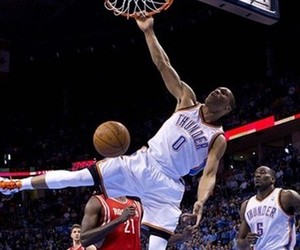
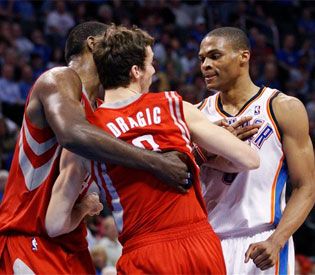
What we saw two nights ago against the Houston Rockets was a bad day at school for one of the Thunder’s star pupils. Russell Westbrook’s meltdown in the final minutes of the 4th quarter sent Thunder Nation into a tizzy, even bringing up trade requests since it was 3 days before the deadline. Did his technical foul and turnovers cost the Thunder the game? Partially, yes. Could his post game interview antics rub people the wrong way? Yes. But look at it this way; it was a mistake (actually, it was a cascade of mistakes). The thing about Westbrook is that he usually learns from his mistakes pretty quickly. He is who he is: a cauldron of fire that sometimes blow its lid. The same energy that he uses to torch opponents can sometimes burn him if someone pushes the right buttons. And Goran Dragic was pushing all the right buttons that night. The good thing about all this is that it happened in March. I can guarantee you, because of these recent events, this will not take place in May.

Sometimes as a parent, you have to let your children learn on their own. Those bumps along the road are what forge the person that they become. One of the lines from the late rapper Guru stated, “Experience, the best teacher…”. As fans, we need to understand that young teams will make mistakes. The key is to learn from the mistakes and use that experience. It’s these experiences that will forge what the Thunder will do in the postseason this season, and what they will do in seasons to come.

Cause and Its Effect: A Jeremy Lin Comparison

Ever since Linsanity gripped the nation about a week and a half ago, people have been trying to find a similar situation to compare the phenomenon to. Its human nature to take something new and try to relate to something that has already occurred. Prior knowledge is one of our most important tools, but it can be clouded by our insistence on recency.

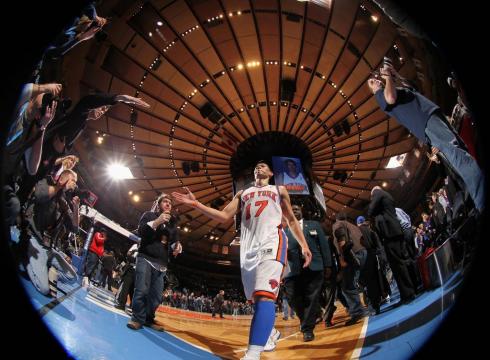
So when Jeremy Lin started dropping 25 points per game and leading the New York Knicks on a 5 game winning streak, people were hard-pressed to find a comparable variable. So, naturally, people looked in the direction of the last phenomenon, which was Tebow-mania. Which is a little strange, because the two phenomenon could not be anymore different. The only thing connecting them is the hype.

For a comparison to work, the basic elements of the hype have to be similar. And that’s where the similarities stopped with Timothy Tebow. He didn’t come out of nowhere. He was hyped coming out of high school and hyped coming out of college. Which is the complete opposite of the hype associated with Lin. A more apt comparison for the Lin-fueled hype is Kurt Warner.

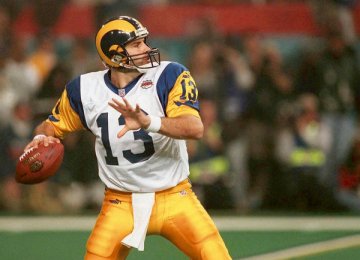
There are two basic elements that make the Warner and Lin story very similar. First, it’s what I like to call ‘The Struggle’. We all know Warner’s story. Undrafted out of Northern Iowa, he signs with the Green Bay Packers who cut him, but advise him he has potential. Warner goes back home to stock shelves at his local Hy-Vee grocery story while working as a graduate assistant for Northern Iowa. He gets his opportunity to play football in the Arena Football League with the Iowa Barnstormers and goes on to have two of the best statistical seasons of any quarterback in league history while leading his team to two straight Arena Bowl appearances (they lost both Bowl games by the way). He finally gets an opportunity to try out for an NFL team with the Chicago Bears, but isn’t able to go because of a spider bite on his throwing elbow sustained during his honeymoon. He goes back to the Arena league and has his best statistical season of his Arena League career. In 1998, he finally gets an opportunity to try out for an NFL team, and eventually gets signed by the St. Louis Rams as their 3rd string quarterback. Warner barely plays in that first season and the team arranges for him to get some reps in NFL Europe with the Amsterdam Admirals. In his second season with the Rams, he’s promoted to 2nd string quarterback and watches as starting quarterback Trent Green tears his ACL in a preseason game. Warner finally gets his opportunity and goes on to have one of the greatest seasons for an NFL quarterback ever. The hype machine starts humming, churning out names like “The Greatest Show on Turf” to describe the Ram’s offense and labeling Warner the greatest quarterback ever to play. It was Warner-mania.

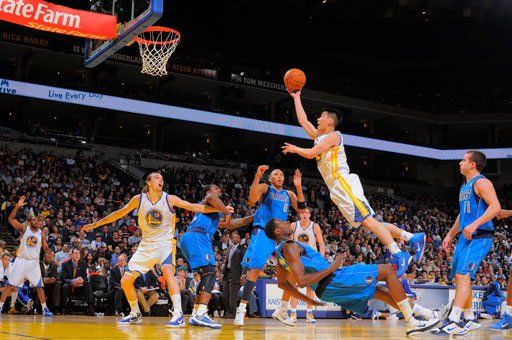
The ‘Struggle’ for Lin started when he was in high school. He led his high school to the state championship beating famed powerhouse Mater Dei and was named Northern California Division II Player of the Year. After not receiving any scholarship offers from any Division I schools, Lin decided to play for Harvard, who showed interest but could not offer a scholarships due to never traditionally offering athletic scholarships. Lin played four seasons for Harvard and left school as one of the greatest modern day Ivy League players. Many had him tabbed as a possible 2nd round pick as draft day rolled around, but he ended up being undrafted. His underdog status and play in college gave Lin a bit of a cult following, which only increased when he was signed by his hometown Golden State Warriors. The cult following continued to gain steam because of the Bay Area’s large Asian population.

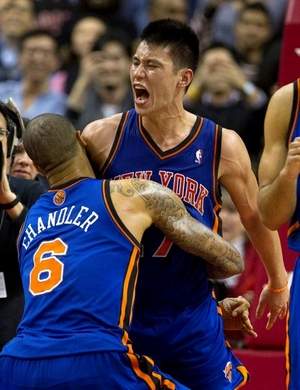
Lin had an up and down rookie season, as he showed flashes of potentially being a good player, while being shuffled back and forth between the Warriors and their D-League affiliate, the Reno Bighorns. After the lockout ended, Lin was cut in a cost cutting move in an attempt to sign budding big man DeAndre Jordan. Lin was picked up by the Houston Rockets two weeks before the season started, but succumbed to the same fate a day before the start of the season as the Rockets cut him in a cost-cutting measure in order to sign big man Samuel Dalembert. The New York Knicks claimed Lin two days after the season started, and had him on the bench for most of the first month and a half. But injuries and lackluster guard play led to Knicks coach Mike D’Antoni taking a chance and putting Lin in the starting lineup. And what has happened since then, has been nothing short of remarkable. It’s a feat that has never been seen in modern basketball history. In Lin’s first 4 starts, he scored the most points ever by someone starting for the first time. Ever! We are talking about greats like Michael Jordan, Shaquille O’Neal, Lebron James, Kevin Durant, etc. None of them scored as much in their first 4 starts as Lin. And of course, the hype machine took off after that, naming the phenomenon ‘Linsanity’ and causing New Yorkers to freak out and try to buy into any and everything Lin.

In both cases, the Struggle made each of their successes fascinating stories. People love stories that make them feel good. Stories about underdogs who continue to believe in their dreams and eventually succeed on a grand scale, critics be damned. It’s the American dream, encapsulated in leather, and shown on either a hardwood floor or a grassy field. But what makes these stories even grander is ‘The Cause’ behind each stories that gives it that extra push.

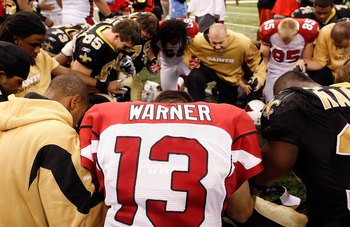
In Warner’s case, the ‘Cause’ was his openness about his religious beliefs and his “ahh shucks” persona. He wasn’t your typical braggadocio superstar that we were used to seeing. Instead, he was humble hard worker who caught his break and succeeded like the public never thought he would. He usually thanked God and his wife during interviews. We hear athletes thank God all the time during interviews, but very seldom do we hear them thank their wives. Warner was Tebow before Tebow was ever heard of.

People like to attach their values to their athletics, and religion, whether you believe in it or not, is usually at the core of their values. So when an athlete not only performs great on the field, but also praises the same deity you worship openly, you tend to cheer for that guy a little harder. It’s an attachment that goes beyond the playing field. The ‘Cause’ fuels the hype machine to an extent that the ‘Struggle’ never could by itself. We all love underdog stories, but if that underdog represents a cause that you live for, then you not only cheer for the athlete, but also for the cause, which usually wields a much stronger influence on your psyche.

The funny thing about the ‘Cause’ is that the person championing it (i.e. the athlete) usually doesn’t intentionally choose to represent that cause. In Jeremy Lin’s case, his cause is as a representative for the worldwide Asian community, but more importantly, for Asian American. There have been Asian superstars, but they have always been from the Motherlands (i.e. China or Japan). There has never been an Asian American superstar that the public can invest in and support. That’s what Lin represents. And to do it all in New York, at MSG, makes it even more magical.

We know how the Kurt Warner story played out. His play oscillated from injury plagued bad to redemption good, which led to him becoming a polarizing figure amongst fans. But, for the most part, he still remained a well-liked figure because he never wavered from his ‘Cause’. We are just now witnessing the beginning of the Jeremy Lin story. I have no idea how it will play out. I’ve constantly thought that the next game would be the one where he finally returns back to Earth, but it hasn’t happened yet. Along the way, I’ve gone from apathetic observer to curious seeker to all-out fanatic. While I’m not Asian, I am a minority, and do understand the pride that builds up when “one of your own” succeeds on the highest level. Last night, in the game against Toronto, in Toronto, the cheers for the opposing player weren’t just for his stellar play. The cheers were mostly for what he represents….and that’s the Cause.

Seeds of Discord

There are two reasons for sending out a state of the union letter. The first reason is to inform your constituents of your progress and where you stand as a whole. This is the reason the President holds a State of the Union address at least 2 – 3 times a year. It allows the citizens to be a part of the process/progress. The second reason to send out a State of the Union letter to quell any feelings of discord or doubt. The back to back letters sent out by union President Derek Fisher and Executive Director Billy Hunter on consecutive days should be seen as more of a plead for unity than an informational guide to the progress/process of the labor negotiations.

 In surprising fashion, the most important person in these labor negotiations has become FOXSports.com columnist Jason Whitlock. His article about Derek Fisher’s backdoor wheelings and dealings has sent the player’s union into a damage control frenzy. Stephen A. Smith has also said that what Whitlock wrote in his article is basically true. If anything, even if this story is not entirely true, there still is some truth to it. Unfortunately, the seeds of discord have already been spread and the damage has been done.

Within the past 24 hours, the divide between players has become very evident. This morning, Boston Celtics free agent Glen “Big Baby” Davis tweeted , “Take the 51% man and let’s play.” Houston Rockets swingman Terrance Williams tweeted, “Hey @TheNBPA Let’s play BALL enough with the stare off”. Recent reports have said that Derek Fisher and Kobe Bryant have both indicated that they would take a 50/50 split. On the other side of things, Oklahoma City Thunder big man Nazr Mohammed tweeted, “Since I have @NBA & @NBA_Labor’s ear…Why can’t y’all come up to 52.5% since we already gave in 100’s of millions & on system issues?” A later tweet by Mohammed stated, “Don’t know what the percentage will be but I’m willing to #StandUnited with my union cuz players b4 me did it when I was a rookie. #OnlyFair”.

Another thing that lends credence to the fact that there may be discord among Fisher and Hunter is what’s at stake for both of them. Hunter’s legacy is on the line as this seems to be his last hurrah as union Executive Director. He may be reelected to lead the union into their next labor negotiations in 6 – 10 years, but with how much the union has given up in these negotiations, that does not seem so certain. Hunter is trying to get the best deal possible (52.5%) to lessen the blow the owners are trying to place on the players. On the other hand, Derek Fisher is still a player, and at the bottom of his core, probably wants to do everything possible to get this thing done and play ball. Fisher is on his last leg as far as his playing career is concerned and the Lakers are still one of the favorites to contend for a championship.
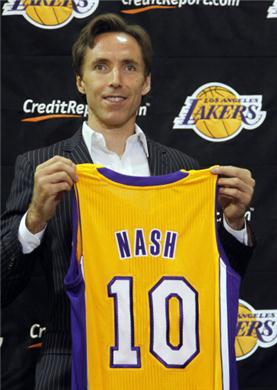
It is pretty fascinating to see the middle to lower tier younger players start to bite their nails at the prospect of missing paychecks, while the older veteran players (who have, more than likely, been saving up for this day) are pressuring all the players to stay united and stay the course. Add to that, the dialoging in the media by the NHL players who suffered through a lost season and a lost season’s worth of pay, while coming out on the other side of the lockout in a much worse position than when the lockout started.

The cracks and fissures are starting to become chasms. The quiet whisper of discord is starting to become a booming roar. Eventually the person with the most money, usually wins the battle. The owners are billionaires whose income is not solely dependant on the ownership of their teams. The players, on the other hand, are completely dependent on the paycheck that comes from playing the game of basketball. The most important meeting of this labor negotiation has yet to occur. Many people think the most important meetings of this labor negotiation happened within the last two weeks. The truth is that the most important meeting of these labor negotiations will come on Thursday, when the players’ union meets to discuss their next plan of attack.