Tag Archives: draft

Trains of Thought: Thunder and the 2013 Draft

NBA: NBA Draft

Approaching a draft, there are always differing trains of thought as to whom a team should choose. A team has to analyze what their needs are and if they can realistically draft a player that will fill said need(s). This is especially true if you are holding one of the lottery picks. Teams picking in these first 14 slots usually have a plethora of needs to address. But for a championship contending team like the Oklahoma City Thunder, who have many of the necessary cogs already in place, a pick in the lottery can be the final piece of the puzzle to get the team over the hump. 
darko

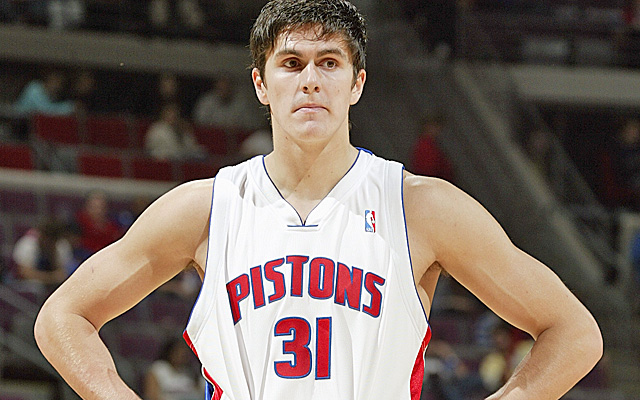
Drafting a final piece is not always guaranteed to get a team over the hump, though. In the summer of 2003, the Detroit Pistons had just come off a trip to the Eastern Conference Finals and also held the No. 2 pick in the upcoming draft, which was loaded at the top. Easy pickings, right? Get the 2nd best player available and you should be set for the next 5 years. But success and good fortune can sometimes make you think you are smarter than you really are. In a draft where the Pistons could have chosen any of Carmelo Anthony, Dwayne Wade, or Chris Bosh, they instead decided to go with the experimental Euro-project named Darko Milicic. Even though the Pistons won the championship the next season, it had nothing to do with Milicic, who was famously tagged as the “human victory cigar” due to the bulk of his playing time coming at the end of blowout victories. The Pistons went on to lose in the NBA Finals in the next season and played in 3 consecutive Eastern Conference Finals after that. Add that up, and in a 6 year span, the Pistons played in 6 consecutive ECFs, went to the Finals twice, and won one championship. Nothing is guaranteed, but I think the number of championships would have increased if the Pistons had drafted one of the other players mentioned above. 

Granted, this draft is not as loaded as the 2003 draft was. But the Thunder find themselves in a position to draft a position of need, instead of having to pay for it through free agency or trade for it. There are probably two trains of thought for what type of the player the Thunder should draft with the 12th pick: either a defensive minded big man capable of developing some semblance of an offensive game or a scoring wing adept at making perimeter shots. In other words, either a replacement for Kendrick Perkins or a replacement for James Harden. The big man pick is more targeted towards future success, while the perimeter wing would be for more immediate results.
pacers

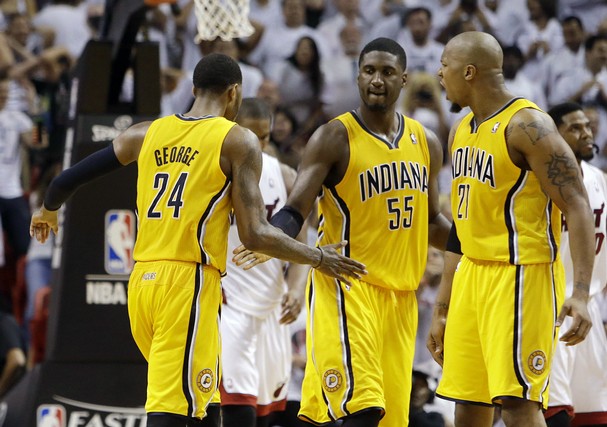
The conference finals and NBA Finals have given the Thunder a blueprint as to what they need for sustained success. In the Eastern Conference Finals, the Indiana Pacers showed what two competent big men can do against the Miami Heat. David West and Roy Hibbert gobbled up offensive rebounds and scored in the paint, almost at will. In the Finals, the San Antonio Spurs have shown that playing the same brand of basketball as the Heat (dribble penetration and 3-point shooting) can befuddle and frustrate them, especially if the opponent is hitting 3-pointers at a 45% clip.

Train of Thought No. 1 – Big Man
perk ii

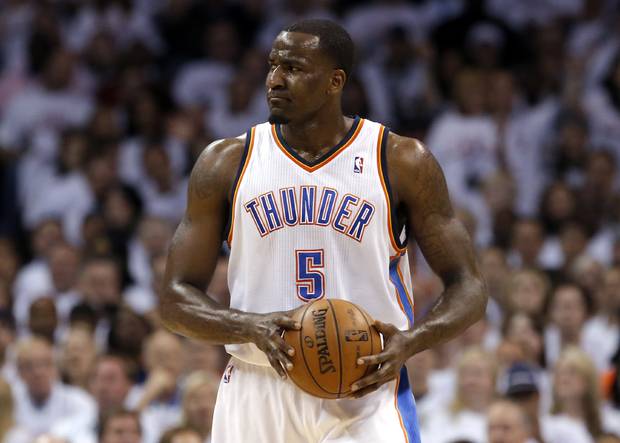
Everybody knows I love crazy uncle Perk (Kendrick Perkins). For a person who grew up on 90’s basketball, Perkins’ style of play harks back to that physical era. But, truth be told, he laid a complete goose egg in the playoffs this season. He surprisingly had a better run last post season when he played with a torn groin and a torn ligament in his wrist. That Perkins has no semblance of an offensive game is a known fact. But that is usually masked by constant attacking nature of Kevin Durant and Russell Westbrook. When Westbrook went out with his knee injury in the first round of the playoffs, that lack of an offensive game led to the further stagnation of an offense that was already compromised. It wasn’t just that Perkins couldn’t get the ball in the basket, it’s that he was a walking turnover. He had a negative PER in the playoffs and was a liability not just on the offensive end, but also on the defensive end. I didn’t even know negative PERs existed.

Needless to say, with 2 seasons left on Perkins’ contract, it may be time to start looking for his replacement sooner rather than later. Picking up a big man at this slot would be a pick for the future, as big men generally take longer to develop and no post player in this draft has that “ready to play now” look to them.

Before deciding what type of big man could be drafted, it’s important to see what is already in the cupboard. Besides Perkins, the other starter is Serge Ibaka, one of the most versatile power forwards in the NBA. In addition to leading the league in blocks for the 2nd consecutive season, Ibaka also has a deadly midrange game that occasionally stretches out to the 3-point line. His next stage of development should be to learn a post move or two. Off the bench, Nick Collison is a heady post player who plays good defense, can score inside, and can occasionally hit a midrange jumper. The only negative with Collison is that he is getting long in the tooth and starting to show signs of that. Hasheem Thabeet is an average center who is just now learning how to contribute 10-12 solid minutes per game. Perry Jones III is still in the initial stages of his development, but has the physical tools to become a solid contributor. And Daniel Orton is probably the odd man out in the game of big man roulette.

adams noel

Any post player selected will be drafted with the intent to eventually be the starting center. The Thunder tried that 3 seasons ago with Cole Aldrich, but he never panned out. If the Thunder’s system remains similar for the next 3-5 seasons, a player with Perkins’ toughness and defensive chops, but better offensive potential would probably be the selection. Players that fall in that category would be Alex Len, Steven Adams, Mason Plumlee, and Gorgui Dieng. If the Thunder decides to go for an offensive-minded big man, look for them to select Kelly Olynyk or Cody Zeller.

Train of Thought No. 2 – Perimeter Wing

harden

The Thunder have a little more flexibility here than with the center position. When the Thunder made the trade with Houston, they not only traded Harden, but also Daequan Cook. These floor spacers are very important when the bulk of your offense is dependent on two perimeter oriented players. The drive and dish becomes a lot more driving into defensive walls if the dishees aren’t reliable 3-point shooters, especially in the playoffs.

Seeing as the NBA is becoming more of a drive and dish league, having penetrators and 3-point shooters is tantamount to a team’s success. It used to be that if you had a great big man, you were almost guaranteed a deep playoff run. That began to change with the elimination of hand checking. Once that happened, it unshackled quick wing players to have a more prominent role in the offense. No longer were defenders able to keep quicker players at an arm’s length, thus eliminating their speed advantage. Now, defenses had to converge on the quicker players, which opened up shooters on the perimeter, especially on the 3-point line. And, as any kindergartener will tell you, 3 is more than 2 any day of the week.

Looking at the Thunder’s inventory when it comes to wing players, the Thunder already have two of the best dribble penetrators in the league, in Durant and Westbrook. Add to that Reggie Jackson, and the team has their fair share of attackers on the offensive end. What’s lacking on the team is the amount of shooters. Thabo Sefolosha has improved his 3-point shooting to the point where he’s effective, but his slow release make him a liability against teams with long defenders. Kevin Martin was, for the most part, an effective perimeter shooter, but his inconsistency and disappearing act in key games, proved to be a big problem for the Thunder. DeAndre Liggins is on the team for defensive purposes, and Jeremy Lamb was never given a chance to show his shooting chops on the NBA level, though he was very effective in the D-League.
ben-mclemore-dunk

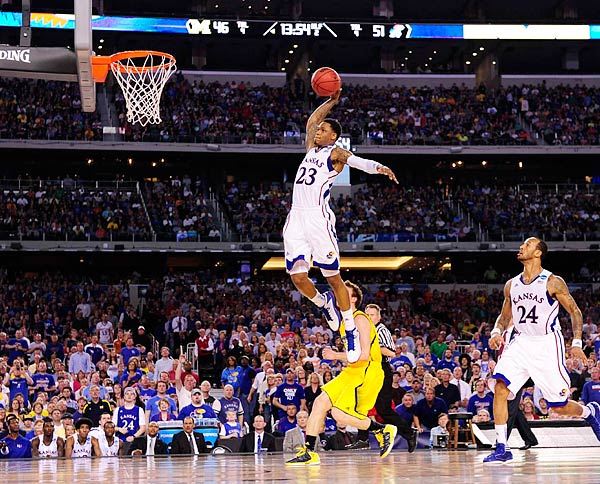
There are two choices for where the team wants to go with this train of thought. One choice is an instant offense type player off the bench. If this is the way the Thunder may be leaning, then look for them to choose CJ McCollum or Shabazz Muhammad. If the Thunder are looking for more of a complete player to eventually take over the shooting guard spot, then the options become Ben McLemore, Victor Oladipo, and Kentavious Caldwell-Pope.

The Thunder will go into draft day with a couple players in mind and counter moves for each situation. In my opinion, the Thunder are extremely high on about 5 players: McLemore, Len, McCollum, Adams, and Oladipo. I think it’ll all be dependent on where the players fall. If McLemore or Len slip down to the 4-6 range, I think the Thunder will throw every possible trade, not involving Durant, Westbrook, or Ibaka, at those teams in that range.

The good thing is that the Thunder have options. Their high 2nd round pick affords them the possibility of obtaining an extra first round pick from a team looking to involve themselves in this year’s free agency. The ability to put a package together with multiple 1st round picks and young players can be very enticing to a team that is rebuilding. Soon enough, it’ll be draft day and Thunder GM Sam Presti will be able to put his plan into play.

The Thunder and the 32nd pick

draft pj 3

The Oklahoma City Thunder hold 3 draft picks in this upcoming draft. They have two in the first round, No.12 and 29, and one in the second round, No. 32.  While people are usually enamored by the first round picks, it’s the early second round picks (No. 31-35) that hold more value to teams. It’s an opportunity to grab first round talent without the constriction of a guaranteed contract. Here’s a list of notable players that have been drafted in the 31-35 range in the last 5 season: Nikola Pekovic, Mario Chalmers, DeAndre Jordan, Kyle Singler, Jeffery Taylor, Jae Crowder, Draymond Green. The difference in talent from the last 5 picks of the first round and the first 5 picks of the second round is infinitesimal.

For teams holding a slot in those first 5 picks of the 2nd round, it is an opportunity not only to draft a talented player, but also to procure a trade for an asset. The fact that a team can take a flyer on a player without having to offer a guaranteed contract, makes these picks more valuable than those in the lower end of the first round. These picks becomes doubly valuable before the beginning of a maddening free agency season. When teams vying for free agents want to clear cap space and/or not take on anymore guaranteed salary, they dump players and first round picks in exchange for high second round picks.

presti

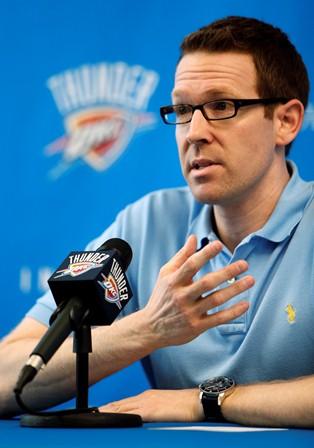
Thunder general manager Sam Presti took advantage of this during the last frenzied free agency class, where he also owned the 32nd pick. We arm-chair GM’s love to talk about the would’ves, could’ves, and should’ves. But we have that beautiful thing called hind-sight in our back pockets. Real NBA GM’s don’t have that advantage, but those few great  GM’s have a little thing called foresight. While we focus on our team in the present tense, great GM’s look at the health of other franchises and plot how they can take advantage of their needs. Presti is great at this and seems to be on the prowl again in this draft.

On July 27th, 2009, the Thunder traded Damien Wilkins and Chucky Atkins to the Minnesota Timberwolves for Etan Thomas and 2 second round picks. Most people thought this was just one of those offseason trades where a team trades 2 bench players for another bench player. But the haul in that trade was actually the 2nd round pick that turned into No. 32 in the 2010 NBA draft.

Etan Thomas, Andrew Bynum

The 2010 offseason was known for one thing and one thing only….the summer of Lebron. That was the offseason where most of the bumper crop from the 2003 draft class was coming up on their 2nd extensions, while other players like Amare Stoudemire, Carlos Boozer, and Joe Johnson were also coming up on unrestricted free agency. If you were a team that believed in quick fixes, this was the summer for you. While a handful of teams were trying their hardest to unload as much salary as possible, the other teams were more than willing to take on decent players (salary) and first round picks.

The Thunder had assets galore in the 2010 draft with 3 picks in the first round (18, 21, and 26) and 2 picks in the second round (32 and 51). The consensus with most teams is that you don’t head into training camp with five rookies. So, the Thunder knew they had to wheel and deal to get what they wanted in this draft, which was a defensive minded big man and more assets. Their first move was to trade the 32nd pick to Miami for the 18th pick and Daequan Cook. Miami was looking to cut salary to position themselves for the summer of Lebron. The Thunder knew they couldn’t get what they wanted at 18, so they traded it to the Clippers for a future first rounder. They eventually traded up to the 11th pick where they picked Cole Aldrich. The future first rounder from the Clippers helped to facilitate the trade with the Boston Celtics for Kendrick Perkins at the trading deadline that following season.

benchmob

There are a lot of similarities between this offseason and the 2010 offseason. First off, the top tier in this free agency class includes some franchise players, such as Chris Paul, Dwight Howard, Andrew Bynum, and Josh Smith. Secondly, these free agents are available and willing to hear out every offer on the table. Thirdly, there are team already vying to dump salary and 1st round draft picks to clear cap space. And, fourthly, the Thunder have the 32nd pick.

The story behind the 32nd pick is akin to the story of Hebrews wandering in the desert for 40 years in the book of Exodus. A little bit of controversy, a little bit of disobedience, and finally back to where it ultimately needed to be. On December 19, 2011, the Thunder traded Byron Mullens to the Charlotte Bobcats for their unprotected 2013 2nd round pick. Simple, right? Wrong! When the Thunder traded for Perkins, they sent Nenad Krstic and Jeff Green to Boston along with that Clippers draft pick. Everything was going good until doctors discovered the following season that Green was suffering from an aortic aneurysm, would need immediate surgery, and would miss the entire 2011-12 season. Boston contended that Oklahoma City knew of this condition previous to the trade. On June 16, 2012, the NBA decided to give Boston the Charlotte pick as compensation for the Green debacle. On July 20, 2012, the Celtics traded the pick to the Houston Rockets as part of a three team trade for guard Courtney Lee. Finally, on October 27, 2012, the pick was sent back to Oklahoma City as part of the James Harden trade. I’ve joked that, to everyone outside of Oklahoma City, the trade between OKC and Houston will be known as the James Harden trade. But to the people in Oklahoma City, the trade will be known as the “reacquisition of the Charlotte 2nd round pick” trade.

Oklahoma City is in prime position to make a significant move to improve their team in this draft. The rumor mill is already rampant with teams wanting to dump salary and picks for a chance at one of the top tier free agents. Adrian Wojnarowski of Yahoo!Sports reported that Houston is looking to unload the No. 5 pick from last season’s draft, Thomas Robinson, in order to clear further cap space. Chad Ford of ESPN.com reported that the Dallas Mavericks were looking to trade away the No. 13 pick in order to avoid the $1.6 million cap hold that the pick carries. Also, Atlanta has picks 17 and 18, but are also looking to throw their hat in the free agency fray. There will be plenty of opportunities to nab a necessary piece on this draft day.

Chris Bosh, LeBron James, Dwyane Wade, Carmelo Anthony

Also, there is one more thing to look out for in this draft. There might be an epic free agency class coming up next offseason. Lebron James, Carmelo Anthony, Chris Bosh, and Dwayne Wade all have early termination options to become free agents in 2014. Add to that, the 2014 NBA draft is predicted to be a lot stronger than this draft class, and you have the perfect storm for further wheelings and dealings. Look for the Thunder to not only get what they need in this draft, but also to pick up assets for the 2014 draft. Let the madness begin!

Scoreboard Watching

kd

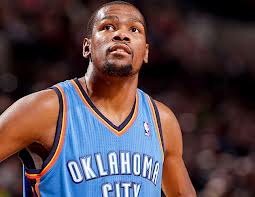
Last month of the season. A time where every game has meaning. Teams are either jockeying of playoff positioning or draft positioning. The worst teams are balancing between increasing their chances in the NBA draft lottery and creating a late season winning attitude to carry over into the next season. And the best teams are either trying to solidify their spot in the playoff rankings in an effort to get home court advantage throughout the playoffs, or trying to get into the playoffs.

For most teams in the playoff hunt, the only thing they are worried about is playoff seeding. For these teams, their draft picks for the next draft will be in the 15-30 range, and unfortunately, there aren’t too many franchise saviors drafted in that range. What these teams will end up drafting in this range are solid rotation players, Euro-stashes, and players that most fans won’t hear about again once their rookie contracts have run their course. But sometimes, due to prior trades or deals, some of these teams luck into a lottery pick.

nba-draft-lottery

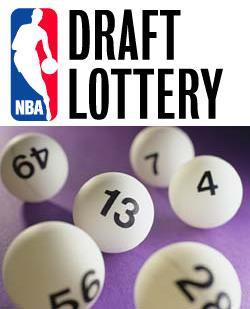
The Oklahoma City Thunder find themselves in the position of battling for the number 1 seed in the Western Conference and picking in the lottery in the following NBA draft. When the Thunder traded James Harden to the Houston Rockets, some of the assets that OKC obtained were draft picks. These are the 3 draft picks the Thunder obtained in that trade and their restrictions:

  • Dallas Mavericks 1st round pick (Top 20 protected until 2018)
  • Charlotte Bobcats 2nd round pick (no restrictions)
  • Toronto Raptors 1st round pick (Top 3 and 15-30 protected in 2013 and 2014, Top 2 and 15-30 protected in 2015 and 2016, Top 1 and 15-30 protected in 2017 and  2018, unprotected after that.)

The Dallas pick probably won’t come to fruition in this draft as Dallas is currently in the lottery and has a very small chance of even reaching the 21st pick if they make the playoffs. They would need to win out and have the 7 other playoff teams currently under 45 wins completely fall apart. A scenario that is very unlikely. The Toronto and Charlotte picks, on the other hand, are in play for the 2013 Draft. As a fan of the Thunder, this has made scoreboard watching in April must-see-TV.

Toronto Pick (Teams that warrant watching – Philadelphia, Washington, Minnesota, Sacramento, New Orleans, and Toronto)

Again, this pick is Top 3 and 15-30 protected for this upcoming draft. Since the Raptors aren’t making the playoffs this season, you can eliminate the 15-30 protection from their draft pick. As of April 1st, the Raptors are slated to pick No.8. With 8 games left, the Raptors have the possibility of picking as high as third (if they lose out) or as low as 13th (if they win out). The position of the Raptors’ pick is not only dependent on their play, but also on the play of the teams around Toronto in the league standings. This is how the teams listed above are currently slotted and how far apart they are in games as of April 1st:

11. Philadelphia          –

10. Washington           3

9. Minnesota               3

8. Toronto                   3.5

7. Sacramento             3.5

6. New Orleans           4.5

So there are currently 3.5 games separating Toronto from the Number 11 slot in the draft and 1 game separating Toronto from the Number 6 slot in the draft. A lot of movement is possible in the standings within the final 2 weeks of the season.

Charlotte Pick (Teams that warrant watching – Orlando and Charlotte)

The Charlotte pick is not protected meaning wherever Charlotte’s pick falls in the 2nd round, that’s where Oklahoma City will pick. Granted, 2nd round picks are more miss than hit. The players selected in the 2nd round of the NBA draft fall into one of four categories. You have the 1st round talents that slipped into the 2nd round for a myriad of reasons, the Euro-stashes, the upper classmen that may surprise and make it onto an NBA roster, and the players that are a reach. Usually, the higher you pick in the 2nd round, the higher the probability of success in the NBA.

adam-silver-draft

With the worst record in the NBA, the Charlotte Bobcats would get the 1st pick of the 2nd round (pick No. 31). Here’s a list of the last 5 players selected with the 31st pick:

  • 2008: Nikola Pekovic (currently with the Minnesota Timberwolves)
  • 2009: Jeff Pendergraph (currently with the Indiana Pacers)
  • 2010: Tibor Pleiss (still playing in Europe, rights owned by the Oklahoma City Thunder)
  • 2011: Bojan Bogdanovic (still playing in Europe, rights owned by the Brooklyn Nets)
  • 2012: Jeffrey Taylor (currently with the Charlotte Bobcats)

These are 3 quality players that were obtained with the first pick in the 2nd round, along with two Euro-stashes whose NBA careers have yet to begin. The allure of a 2nd round pick is that the contract is not initially guaranteed. Every player selected in the first round gets a contract that is guaranteed in the first two seasons with team options for the next 2 seasons at a set salary depending on where they were drafted. Most second round players have to prove their worth in summer league and training camps before the team offers them a guaranteed contract.

For a while it appeared that Charlotte had a stranglehold on the bottom spot in the NBA. In the last few weeks, though, Orlando has lost their veteran interior presence (Glen Davis) to injury, traded their veteran wing/bench scorer (JJ Redick), and lost their starting shooting guard (Arron Afflalo) to injury. Combine that with the general rebuilding nature the franchise currently finds itself, and that has led to Orlando losing 9 of its last 10 games. Orlando trails Charlotte by only 1.5 games for the final spot in the NBA.

bobcat magic

Is there a difference between the 31st and 32nd pick? I don’t know, but of the last 5 players selected with the 32nd pick, only one is still the NBA (Dexter Pittman) and one is still in Europe. The other three have fizzled out and are currently out of the league. Based on this recent history, it is definitely better to get the 31st pick instead of the 32nd pick.

Number 1 seed in the Western Conference (Teams that warrant watching – San Antonio and Oklahoma City)

With the Oklahoma City Thunder trailing the San Antonio Spurs by one game for the top spot in the Western Conference, every game from here on out is of tantamount importance to both teams. The two teams play each other one more time on April 4th. As I mentioned in a previous article, home court advantage may be more important to the Thunder this season than it was last season, when the Thunder beat the No.1 seeded Spurs in the Western Conference Finals. The Thunder had an overhaul to their bench before the season began, and have a couple unproven players (as far as playoff experience goes) that perform better at home than on the road.

perk smash

Every day that goes by offers a game that is of importance to the Thunder. It is a fun time to be a fan of the team, and a fan of the NBA in general. Whether it affects their future or present, you can be certain that Thunder fans will be watching that scoreboard every day until the season ends.

Westbrook and The Boost

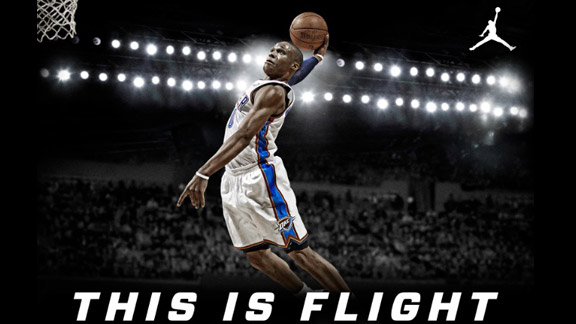
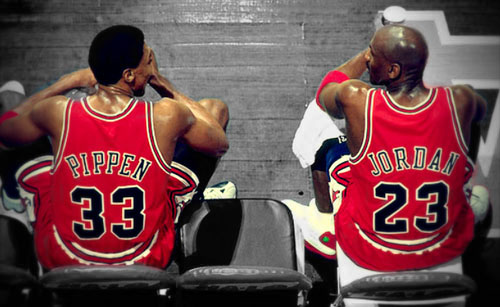
This past week, Russell Westbrook signed with Jordan Brand, after being with Nike for the first 4 years of his career. While Westbrook has carved out his own following of fans, he’s always been known as Kevin Durant’s sidekick. The Robin to Durant’s Batman. This generation’s ultimate second banana. There hasn’t been a sidekick this good since Scottie Pippen. But, Pippen never received the boost in popularity that Westbrook is about to receive.

What qualifies for a sidekick? A sidekick has to be a rookie or a very young player that is brought in after the primary player is established to specifically fill the needs the team is missing. Another qualification is that the pairing has to be together for 5+ seasons. For example, Scottie Pippen was obtained by the Chicago Bulls in a draft day deal, while already having an established superstar in Michael Jordan. Russell Westbrook was drafted by the Seattle Supersonics (Oklahoma City Thunder) after they already had an established young star in Kevin Durant. Anfernee Hardaway almost made it to great sidekick status, but injuries and Shaquille O’Neal’s departure to the Los Angeles Lakers negated that possibility. The Lebron James/Dwayne Wade/Chris Bosh mash-up wouldn’t qualify as sidekicks because they were all alpha males on their respective teams before they joined forces. Kobe Bryant and the aforementioned O’Neal made a great duo, but they were brought onto the Lakers the same year and often quibbled over who was the alpha male. 

To understand the road Westbrook is on, it is important to see what happened to Pippen throughout his career. When Pippen first started college at the University of Central Arkansas, he was a 6’1” walk-on that needed to moonlight as the team’s manager to pay his tuition costs. After 3 more collegiate seasons, a 7 inch growth spurt, and consensus All-NAIA player honors, Pippen was drafted with the 5th overall pick in the 1987 NBA draft to the Seattle Supersonics (who subsequently traded him to the Chicago Bulls). The scouting report on him read as follows:

  • 7’4” wingspan and a 41” vertical
  • Strong outside, but needs work inside
  • Not bad driving to the hoop, but doesn’t look to drive
  • Good foul shooter
  • Can make a three
  • Terrific passer at that position
  • Won’t give you much of anything on the offensive glass, and is a so-so defensive rebounder
  • Excellent defensively and a disruptive force in the passing lanes
  • Good ball handler, but commits a ton of turnovers
  • Could start on most teams

Not necessarily the sexiest of scouting reports for someone who would eventually become one of the top 50 players in league history. While Pippen built his legacy on defense, he was also an apt offensive player, becoming the archetype for the point forward position. During his prime (1989-1999), Pippen had per game averages of 19.1 points, 7.1 rebounds, 5.9 assists, 2.2 steals, and 0.9 blocks. Not necessarily the offensive prowess that Larry Bird possessed, but with a stat line like that, Pippen should have been heralded as his generation’s defensive Larry Bird. Instead, he was teamed up with arguably the greatest player of any generation in Michael Jordan. There usually isn’t a lot of spotlight left when you are playing with the greatest. Ask 100 people who the lead singer of Aerosmith is, and most will answer Steven Tyler. Ask them who the drummer is, and not many will know the answer.

Pippen’s play on the court should have spurred him to more shoe deals, more advertisement contracts, and more widespread popularity. And yet, when his career was all said and done, you couldn’t help but wonder whether Pippen got everything that was owed to him. There were the stories of how Pippen felt he wasn’t getting paid what he deserved (which he wasn’t). There were the rumors that he felt slighted being outside of the limelight, when he provided so much to the team. While he did have his own shoe line (the PIPs) from Nike, they only lasted about two series. So, needless to say, not many companies bought into Scottie Pippen.

It wasn’t Jordan’s fault, though. Most of the blame lies squarely on Pippen. He didn’t have the same tact with the media that Jordan did. He was dismissive and defensive at times with reporters. Then there were the crunch time situations. Those critical times in games that live in lore and become mythologized. It’s not that Pippen didn’t perform well during those times. On the contrary, he performed great during crunch time. But he’s instead remembered for the times he quit on his team in the most critical of moments. There was the time he sat out Game 7 of the 1990 Eastern Conference Finals against the Detroit Pistons with a migraine headache. The Bulls eventually lost that game. Probably the most damning, though, was the one where he sat out the final 1.8 seconds of Game 3 of the 1994 Eastern Conference Semifinals against the New York Knicks because Phil Jackson drew up a play for Toni Kukoc to take the final shot, instead of Pippen. To make matters worse, Kukoc actually hit the game winner. This one was the most damaging because it came at a time when the Bulls were his team due to Jordan’s hiatus into baseball. When you are known to quit on your team during crucial periods, your popularity takes a big hit.

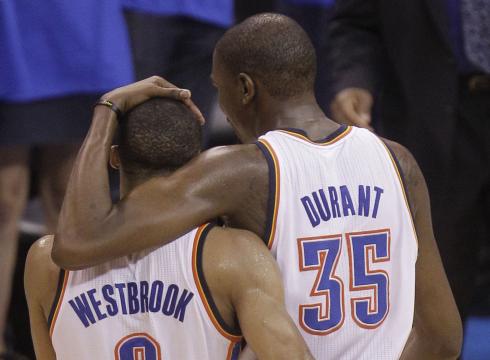
Which brings us to the best sidekick of this generation, Oklahoma City Thunder guard Russell Westbrook. Like Pippen, Westbrook was not highly decorated coming out of college. Like Pippen, Westbrook was drafted by a team that already had a young star in Kevin Durant. Like Pippen, Westbrook is seen as not being very media friendly. Coincidentally, Durant, much like Jordan, is viewed as a media favorite. And, while not by his own doing, Russell was also involved in a critical game snafu, when Thunder coach Scott Brooks sat an ineffective Westbrook for the entire 4th quarter of Game 2 of the 2011 Western Conferences Finals.

But, not everything is negative when it comes to Pippen and Westbrook. Both of these players are insanely loyal to their teams and teammates. Pippen had a couple opportunities to seek greener pastures during the championship run, but decided to sign for less to stay with the Bulls. Westbrook could have done the same last season, but decided to sign for the allowable max. Both players are highly competitive, with possible chips on their shoulders from being labeled second bananas. Both players are very team oriented, as evidenced by them sacrificing a little of their own games to coexist with two great players. The good severely outweighs the bad when it comes to Westbrook and Pippen, but the bad usually has more advertising power.

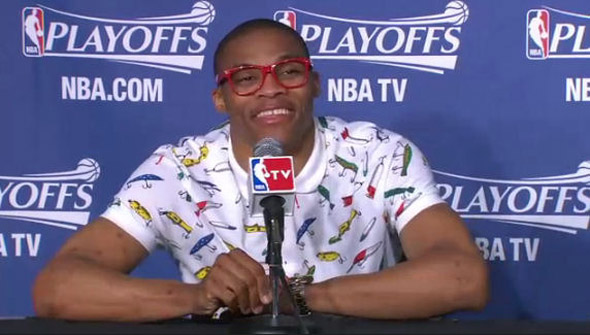
Which is why I found the signing of Westbrook to Jordan brand to be a bit ironic. Not ironic in the sense that he doesn’t deserve it. But ironic in the sense that a move like this will probably propel Westbrook into superstar territory, as far as media exposure goes. Into a territory that Scottie Pippen unfortunately never reached. With an endorsement team that includes Carmelo Anthony, Derek Jeter, Chris Paul, and Michael Jordan, himself, Russell Westbrook will have plenty of opportunity to expand his brand. He already has a slogan in place (WhyNot?), and already has a following outside of basketball because of his unique fashion sense. In a way, Jordan is helping this generation’s top sidekick become what his sidekick should have become.

Summer League: Hope Springs Eternal

One of my favorite things about the offseason is Summer League. Everything is so optimistic during this time of year. That late 2nd rounder you got from another team for cash considerations? Of course he’s going to become a 3-time All Star for you. The combo guard you took with the 27th pick? You’d be crazy not to think he’s isn’t going to average 20 ppg this upcoming season. The 2nd year player who sat at the end of the bench all of his rookie season, and was the team’s honorary “human victory cigar”? Yep, he’s going to make the leap. Everything about Summer League is based on potential and hope.

In reality though, 80% of the players in Summer League will never get a whiff of the NBA. If you follow your team as voraciously as I do, you’ll learn the players’ names and then forget them just as quickly when Summer League ends. The only ones that stick in my mind are the ones that actually make the team, and the ones that end up with the Thunder’s D-League team, the Tulsa 66ers. And it truly is a shame, because for 99% of us fans, these players are just advancing to a point in their basketball careers that we could only dream of advancing to. There really are some good basketball players in Summer League, but like any other situation in life, if they are not cultivated in the right system, they go to waste. 

That’s why I love cheering for the Thunder during Summer League. This is a team that takes pride in cultivating players and rewarding them for their hard work and dedication. In 2011, Robert Vaden, our 2009 2nd round pick, was signed to play the final week of the season and was added to the playoff roster for the Thunder. Did he ever play an actual game for the Thunder? No, but he got to practice with the team, sit on the bench in a suit,  and cash a couple paychecks signed by Clayton Bennett and David Stern. Last season, our 2nd round pick from 2010, a little known forward from Florida State named Ryan Reid was signed at the beginning of the season. He actually played in a couple games and averaged 1.6 points. 

This year’s squad features a guy the team is grooming to become the back-up center (Cole Aldrich), a guy they are grooming to possibly become the back-up point guard one day (Reggie Jackson), a guy who could be an asset if injuries ravage the team (Lazar Hayward), and a rookie they are grooming to possibly become a rotational big someday (Perry Jones III). These players are locks to be on the opening day roster, barring any trades. They are in town to either sharpen their skills or test new skills. 

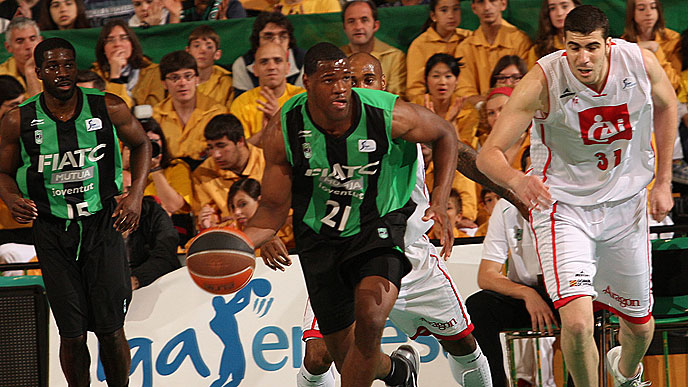
The other guys, the ones I like to call the Fringers, are usually just on the outside looking in. Back on the Thunder squad is Ryan Reid, trying to make it back to the NBA after being cut in the middle of last season to make room for seasoned veteran Derek Fisher. Another guy battling for a roster spot is Latavious Williams. This athletic forward made a bit of history in 2009, becoming the first high schooler to be drafted straight out of high school into the NBA Developmental League. The next season, when he became eligible to be drafted into the NBA, he was selected by the Miami Heat in the 2nd round, and was immediately traded to the Thunder. After playing one more season in the D-League, Williams signed to play for FIATC Joventud in Spain last season, winning Most Spectacular Player of the ACB League. Another player trying to get back into the league is Morris Almond, who is something of an NBDL superstar, but has never quite put it all together in the NBA. Basically, 3 guys possibly battling for one roster spot. 

Then, there are the Dreamers. The guys we should all be cheering for, because they remind us of our short lived hoop dreams. Kent Bazemore, Dwight Buycks, Marquez Haynes, John Holland, James Mays, Gary McGhee, and Garrett Temple. Remember those names, because you probably won’t hear of them ever again. Is there a chance some of them will make it as end of the bench guys in the league? Sure. And they’ll probably have a great story to tell about their journey to the NBA. But for the most parts, these guys will fade into overseas and D-League rosters. 

Such is the life of most professional basketball players. Always remember, that professional doesn’t just mean NBA. The players that play in the Philippines for pay are also considered professionals. As are the ones that play in Iran. And the ones in Mexico. The road in the journey to do something you love isn’t always paved in gold and silver. And it very rarely is a straight line. So I commend and salute the Fringers and the Dreamers for doing what they love, even if the road is full of potholes and roadblocks. So keep on hooping, gentlemen, because if many of us were given that opportunity, we’d be doing the same thing.

The Evolution of Daequan Cook

In a season where you have the best record in the league after 25 games, a lot of things have to go right as far as player development is concerned. Your young guys have to keep developing, while the veterans have to either add new wrinkles to their games or maintain the status quo from the previous season. While a big part of our success this season is due to the continued development of our young core (Kevin Durant, Russell Westbrook, James Harden, and Serge Ibaka), one of the biggest developments this season has been the evolution of Daequan Cook.

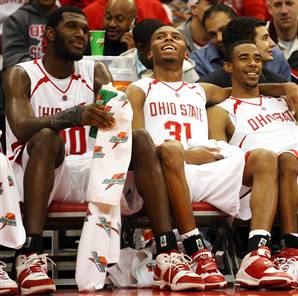
Mind you, Cook has always been a talented player. Though he was overshadowed for most of his high school career by OJ Mayo in Ohio, he was still considered a great player in his own right, and was a highly touted prospect that landed in Ohio State’s vaunted 2006 recruiting class, which also included Greg Oden and Mike Conley. For his one and only college season, he averaged just under 10 points per game as the Buckeye’s main outside threat on a team that made it all the way to the national championship game.

Coming off his freshman season, many thought Cook needed another year of seasoning at the college level to continue building his game. Instead, he chose to go the NBA route with his freshman brethren Conley and Oden. Here are some of the online scouting reports that were written about Cook:

Matthew Mauer of www.thedraftreview.com wrote:

“Unlike many young players he possesses an excellent mid-range game. Moves well without the ball, and understands how to fully utilize the entire floor to get his shot off. Has an NBA ready body that has shown development from his senior year of high school. Explosive scorer who can reel off big points in a hurry…Possesses legit three point range on his jumper. Unselfish and shows solid court vision to get teammates involved in the offense. Is a good athlete who contributes on the boards nightly. Has the ball handling ability and quick first step to break his man down on drives. Excellent finisher in transition and can end plays in dramatic fashion. Has a tremendous amount of confidence in his ability, rarely does he get rattled by the moment. Has all the physical gifts needed to emerge as a defensive presence…Defensively Cook has a habit of gambling too much and being impatient This exposes him to pick up quick fouls by reaching in or defending his man too aggressively”

Joseph Treutlein of www.draftexpress.com wrote:

“Cook already can score the ball at an NBA level, and with the trend towards undersized shooting guards of late, he has a very good chance to make significant contributions for a team in his future. The most notable thing about his scoring ability is how he can hit a shot with a hand in his face and how he’s so strong and able to hit shots nearly effortlessly from long range, as easy as he does from 10-15 feet out…In terms of things Cook brings to the table other than scoring, he’s not really going to wow you in any other area just yet…Cook did a solid job on the defensive end, but at 6’4, he’ll be at a bit of a disadvantage at the next level, even with his good physical tools.”

From the scouting reports, it appeared that Cook was going to be a good offensive player with the ability to develop other facets of his game (i.e. defense and playmaking).

After being chosen with the 21st pick in the 2007 NBA draft by the Philadelphia 76ers, and then promptly traded to the Miami Heat, Cook showed great promise in his rookie season. He averaged 8.8 points on 33% shooting from the 3 point line, but gave little else in the form of rebounds, playmaking, or defense. In his second season, he increased his scoring average to 9.1 points per game, but saw a decrease in every other major category.  On a positive note, though, he won the 3-point shooting contest at the All-Star game. In his 3rd season, nagging injuries and a falling out of favor with his coach led to Daequan playing in the least amount of games in his professional career and saw his scoring average dip to 5 points per game. After being an integral member of the Heat’s young core, Daequan’s position on the team could best be summed up by blogger Albert Random of www.heathoops.com :

Daequan Cook: No surprise here. He’s playing at a D-League level yet he’s set to make $2.2 million next season, after Riley inexplicably picked up his option. He is shooting 29% from the field, and 29% from beyond the arc. Need I say more? The hope is that he turns things around, because he will be on the Heat roster in 2010/11. Grade: F” 

With the impending free-agent frenzy of the summer of 2010, the Heat positioned themselves into being able to offer 3 max contracts to the likes of Dwayne Wade, Lebron James, Carlos Boozer, Amare Stoudemire, or Chris Bosh. In one of their final cost cutting moves, they traded Daequan Cook and their No. 18 pick to Oklahoma City for the Thunder’s second round pick (No.32).

Daequan was allotted a new start on a young, up and coming team. Not too different from the situation he was in while playing for Miami. He came in as a necessary sharp shooter, but had to find his spot in the rotation on a playoff team that returned its entire rotational roster from the previous season. Daequan was kind of force-fed into the rotation in the first 8 games of the season, and the results looked a lot like the 2nd half of the previous season with Miami. He struggled, averaging 1.9 points per game while shooting just 19% from the 3-point line. But the coup de grace was in what else he provided…which was basically nothing. He gave the Thunder 5 boards, 3 assists, and 2 steals TOTAL in those 8 games. Not to mention he had a -7 differential in those early season games.

Scott Brooks did what any good coach with a struggling young player would do. He sat him down and told him to earn his spot in the rotation through his performance and effort in practice. In coachspeak, that basically means, “Everyone struggles offensively in the NBA at some point. It’s what you can provide other than the scoring that can keep you on the floor.” If you are a one trick pony who isn’t performing your one trick, while giving little else, the NBA machine will chew you up and spit you out pretty quickly. Some players crumble under this pressure and are never to be heard from again in NBA circles.

Daequan decided to put in work. He could’ve cried and complained to his agent that he wanted out of Oklahoma City. Instead, he sat for 36 of the next 37 games honing his craft in practice and adapting to the Thunder way. Daequan had always been a good offensive player with the “potential” to become a good all-around player. When he finally got his opportunity to perform in late December, he relished that opportunity and played with effort every night. He notched a couple double-digit scoring games and became an integral part of the rotation as a sharp-shooter and floor spacer. But the important thing was that he was invested on the defensive side of the floor and gave effort in the other facets of the game (rebounding, making smart plays). Did he have overly impressive numbers? No, but he impressed with his effort as the season played out.

In the offseason, Daequan re-upped with the Thunder for 2 years. His role on the team would remain the same, but, hopefully, without the whole transition period. He has not disappointed in this early season run, providing 3 point shooting at a 41% clip, while being solid defensively and a great help on the defensive glass. In the past 5 games, he has started for the injured Thabo Sefolosha, and has averaged 9.2 points, 4 rebounds, and 1.2 blocks on 46% shooting from the 3-point line. This has provided a stop-gap to keep James Harden on the bench where he is much more effective coming in with the second unit. The Thunder are 4-1 in these past 5 games.

 Every championship team has a guy or two like this; specialists that perform a specific job. It necessitates that a role player perform one act greatly. Usually that is all the player is asked to do. But if that one player can also provide other things to the team other than his skill, then he becomes an invaluable asset. And that is what Daequan Cook has become to the Thunder. “All Dae, Er’r Dae!”

The Future Economics of the Lockout

When the owners first started complaining, we were in the beginning of a recession. You started to hear the whispers from the owners that big changes were needed about 3 seasons ago. And the players actually played along with that and actually stated that, “Yes, in this economy, some concessions would need to be made on their parts.” But, I’m pretty sure, their thinking was that by the time the players and the owners actually had to start negotiating (basically 3 years later) that the economy would have been fixed (or at least recovering) by then.

Fast forward to where we are now, and there are actually rumblings that we are entering an even worser recession. So instead of things improving, economically, they will probably begin to get worse for us fans in terms of disposable income. As an owner, if I see that the same system is being kept in place, and I want to stay competitive and get into or stay in the black, I may have to increase ticket prices. And that’s where this starts to affect me, as a John Q. Public fanatic.

You can talk about smart spending (in terms of a team) all you want. But, if you are completely honest with your self, you’ll know that we (the Thunder) got extremely lucky. Portland and OKC basically had the same formula. Tank for a couple seasons. Trade away horrible contracts for draft picks. Try to get lucky in the draft. We picked KD and Russ. They picked Oden and Roy. A couple knee surgeries later, and we are on the brink of becoming dynastic and Portland is on the brink of becoming one of those middle of the road teams (good enough to lose in the first round, but not bad enough to get a significant draft pick).

My question is, should Portland fans have to pay for the bad luck that has been bestowed on their team. Fans eventually tire of middle of the road teams. Once that happens, then those season ticket numbers start to decrease. Once that happens, an owner may be forced to increase ticket prices to meet his/her bottom line. Remember, this could have been OKC’s fate in some alternate universe.

Are you willing to continue paying (paying more) for a system that is broken? Do you know how much quicker Portland could bounce back, if they could’ve either cut Roy/Oden or restructured their deals? And remember, I’m not asking this because I necessarily want to see Portland become elite. I’m asking this because it could easily happen to OKC. As a small market team, you need to ride the highs for as long as possible and stay out of the middle to the lows for as long as possible. In this current system, a tweak of a knee here or a tweak of a back there, and we may be in the same boat.

Oh, and here’s one more thing about this recession talk. Its affecting the whole world, especially Europe. And that’s where it becomes bad for the players. There’s no other league in the world that can offer what the NBA offers. There are rumors that Kobe is looking to sign in Italy for $6.5 million. Do you know how much Kobe made last season? $25 million. And if you sign in China, you have to stay there for the entire season. So, while the “we can play and get paid overseas” thing sounded like a game-changer for the players, its actually enhancing the owners’ position.

So while I may love the NBA and may miss the game if some of the season is missed, I want a deal that keeps ticket prices as low as possible. I haven’t gotten a raise in 3 years at my job. If, for any reason, the owners were forced to hike up ticket prices in the near future, I’m screwed. If the owners and players were really progressive thinkers, they would sign a deal that tilts in the owners’ favor for the first half of the deal, and then tilts back in favor of the players towards the back end of the deal, with the option to revisit the results in the middle of the deal.

Possibility of NBA players hooping overseas

The NBA players and owners currently find themselves in a labor dispute, in which the owners locked the players out on July 1st. This is your basic negotiating ploy by the owners to bleed the players until they finally succumb to “poverty” and come back to the negotiating table with less of a leg to stand on. It happens in every labor dispute where players are locked out. The players, especially mid-tier players and below (aka the majority), eventually run out of revenue streams and plead with the union head to try and strike a deal, regardless of how bad it is. But what happens if the revenue stream doesn’t stop for some of those players? What happens if a small contingent of those players happen to find an alternate source of income that can supplement them through the “tough” times? This is the owners’ worst nightmare and something that no ownership group in any of the 4 major US sports has ever faced.

One of the major differences in this lockout and the ’99 lockout is the availability of leagues that offers comparable salaries and unique fringe benefits. The only drawback to those perks is the fact that the leagues are located throughout Europe and Asia. In an effort to keep up with the popularity of the NBA, basketball leagues throughout Eurasia have flourished with an organized govererning body (FIBA) and leagues and owners that are awashed with money. David Stern’s masterplan as NBA commissioner (globalization of his product), may now become one of his biggest nightmares in this labor dispute.

Globalization of Basketball

Blame it on one of the owners at the negotiating table. Michael Jordan’s meteoric rise in popularity coincided with many world events that brought American culture to the forefront on many foreign lands. The end of the Cold War, the advent of the internet and affordable satellite TV, and global capitalism all came together at the right time to foster an environment where the star of someone could shine brightest. Michael Jordan became the right guy at the right time and the NBA piggy-backed off of that. Then the Dream Team happened.

David Stern made sure to capitalize on the popularity of the Dream Team, and capitalize he has. While baseball remains a popular sport around the world, it is still mainly focused in the US, Latin American, and Japan. Hockey doesn’t really appeal to anyone who lives below the 50º N line on the map. And football, while extremely popular here, has never really taken off anywhere outside of the US. With its visible players, cheap equipment (trash can and paper, if necessary), ability to be a team sport or an individual activity, and uptempo pace, Stern has taken advantage of a product that can, and has, appealed to many. On top of that, most teams now have at least one foreign born player, with some of those players being bonafied superstars. And, add to that the fact that the NBA has taken advantage of technology and social media, in a way that no other sport has, and you have the makings of a global sport.

The globalization of the sport has a trickle down effect on other industries as well. With more and more foreigners wanting to buy their favorite player’s products, it was only a matter of time before companies
starting sending their product pushers over for promotional tours. We’ve seen Kevin Durant start making annual pilgrimages to China to promote his products. We’ve seen Kobe Bryant, Dwight Howard, and Dwayne Wade all make trips abroad to promote their products. We’ve seen the NBA send players over as goodwill ambassadors to impoverished areas (Basketball Without Borders). We’ve seen preseason contests between NBA teams and Euroleague teams, and we’ve seen preseason and regular season games played abroad. While this has been good for the brand, it has also taken away the isolationist advantage that owners once held on American players.

The Boogeyman isn’t that scary anymore

While there have been some great American players that have played overseas (Bill Bradley, Mike D’Antoni), most American players are overseas for one of two reasons; either they weren’t good enough to play in the NBA, but good enough to play overseas, or the money overseas was too good to pass up. In the past, American players did not go overseas because they wanted to play overseas. They went because it was the best option.

Brandon Jennings completely changed the game with his decision to forgo his freshman year in college, and instead, play in the Euroleague with Italian club Lottomatica Roma. After that one season, he was
drafted in the top 10 and has gone on to have a successful NBA career. During his time in Italy, he was not taken to a back alley and beaten by punks who were speaking a language he did not understand. He was not taken advantage of by foreign swindlers looking to make a quick buck. Instead, he was treated like any other rookie player and had to earn his playing time. He earned $1.65 million (tax-free!!) in salary AND was given $2 million by UnderArmour to promote their product overseas. And he was all of 19 years old.

With the advent of social media, 24/7 news, the Travel Channel, and easier accessibility, the world that used to seem so big 10 years ago, has now gotten exponentially smaller. The veil of secrecy that covered some places has now been lifted by this basketball globalization. This generation of players was raised in a smaller world, technologically speaking. Those encyclopedia pictures of some obscure land from the past, are now live satellite feeds on YahooMaps. They haven’t been influenced by the Cold War to fear anything across the Atlantic and Pacific Oceans. Instead, they have been influenced by the Dream Team and their foreign teammates to explore the possibilities.

And look at what some of these teams are offering. Millions of dollars tax free. Free living quarters. Chauffeurs. Access to top chefs. Partial ownership in the team while there. It’s a plethora of abundance. Of course, players like Sonny Weems and Jannero Pargo aren’t being offered this entire deal, but players like Deron Williams, Dwight Howard, Kevin Durant, Kobe Bryant, etc, would definitely be offered this deal. And those players would take it. Players with little, to no, baggage (i.e. wife, kids, etc) would love this opportunity. Players with families would treat it as a regular season, but a little further away. Its already known that some players don’t live where they play, especially if they are year to year veterans.

You don’t think Deron Williams spoke to ex-teammate Mehmet Okur or to ex-NBA great Allen Iverson about Turkey before making his decision to sign with Turkish club Beşiktaş? You don’t think that Kevin Durant and his people have developed contacts in China with his annual trips down there? Can you imagine how big KD would be in China if he played a couple games there with one of their clubs? While he plays in the one of the NBA’s smaller markets, in OKC, that wouldn’t really matter if he had a billion supporters in China. He’d be guaranteed the starting small forward in the All Star Game for the next 15 years. There’s already been chatter about Dwight Howard playing overseas if the lockout starts taking games away. He would conquer a market that Shaq never did, and you know he’d enjoying rubbing that into the Diesel’s face. The possibilities are all there. The fear that used to permeate their view of the world is no longer there. Deron Williams was the first domino to fall. Who will be next?