All posts by Alex Roig

Unknown's avatar

About Alex Roig

Never been a writer. Probably will never be a writer. But always a fan.

Westbrook and The Boost

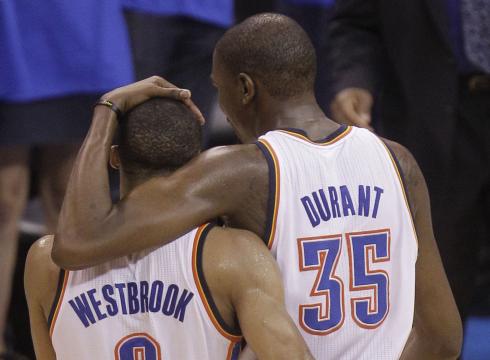
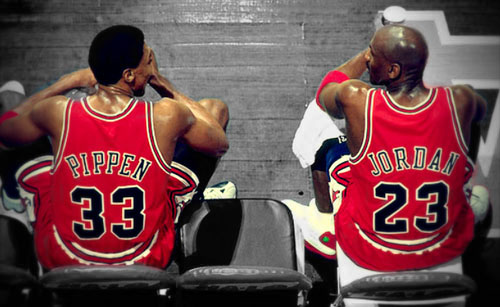
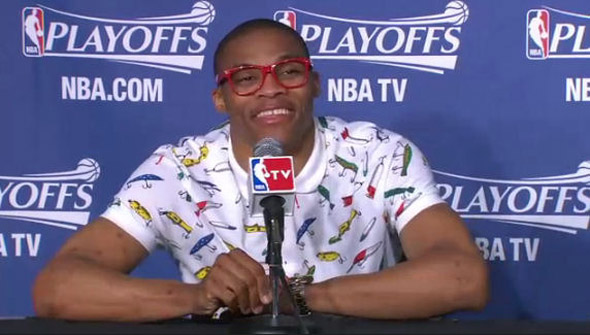
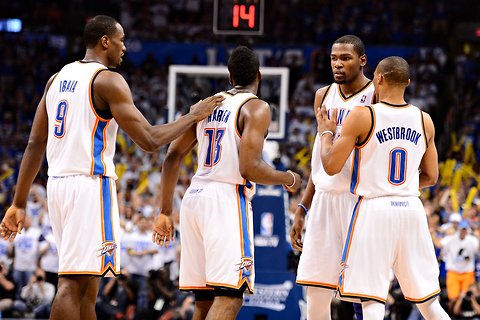
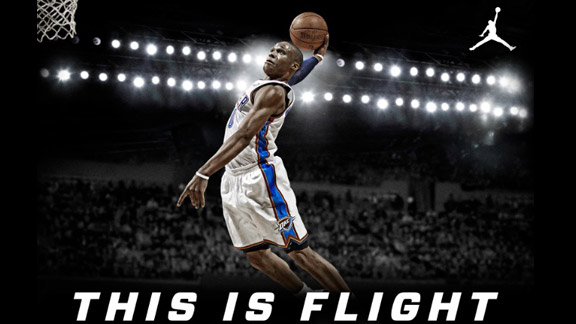
This past week, Russell Westbrook signed with Jordan Brand, after being with Nike for the first 4 years of his career. While Westbrook has carved out his own following of fans, he’s always been known as Kevin Durant’s sidekick. The Robin to Durant’s Batman. This generation’s ultimate second banana. There hasn’t been a sidekick this good since Scottie Pippen. But, Pippen never received the boost in popularity that Westbrook is about to receive.

What qualifies for a sidekick? A sidekick has to be a rookie or a very young player that is brought in after the primary player is established to specifically fill the needs the team is missing. Another qualification is that the pairing has to be together for 5+ seasons. For example, Scottie Pippen was obtained by the Chicago Bulls in a draft day deal, while already having an established superstar in Michael Jordan. Russell Westbrook was drafted by the Seattle Supersonics (Oklahoma City Thunder) after they already had an established young star in Kevin Durant. Anfernee Hardaway almost made it to great sidekick status, but injuries and Shaquille O’Neal’s departure to the Los Angeles Lakers negated that possibility. The Lebron James/Dwayne Wade/Chris Bosh mash-up wouldn’t qualify as sidekicks because they were all alpha males on their respective teams before they joined forces. Kobe Bryant and the aforementioned O’Neal made a great duo, but they were brought onto the Lakers the same year and often quibbled over who was the alpha male. 

To understand the road Westbrook is on, it is important to see what happened to Pippen throughout his career. When Pippen first started college at the University of Central Arkansas, he was a 6’1” walk-on that needed to moonlight as the team’s manager to pay his tuition costs. After 3 more collegiate seasons, a 7 inch growth spurt, and consensus All-NAIA player honors, Pippen was drafted with the 5th overall pick in the 1987 NBA draft to the Seattle Supersonics (who subsequently traded him to the Chicago Bulls). The scouting report on him read as follows:

  • 7’4” wingspan and a 41” vertical
  • Strong outside, but needs work inside
  • Not bad driving to the hoop, but doesn’t look to drive
  • Good foul shooter
  • Can make a three
  • Terrific passer at that position
  • Won’t give you much of anything on the offensive glass, and is a so-so defensive rebounder
  • Excellent defensively and a disruptive force in the passing lanes
  • Good ball handler, but commits a ton of turnovers
  • Could start on most teams

Not necessarily the sexiest of scouting reports for someone who would eventually become one of the top 50 players in league history. While Pippen built his legacy on defense, he was also an apt offensive player, becoming the archetype for the point forward position. During his prime (1989-1999), Pippen had per game averages of 19.1 points, 7.1 rebounds, 5.9 assists, 2.2 steals, and 0.9 blocks. Not necessarily the offensive prowess that Larry Bird possessed, but with a stat line like that, Pippen should have been heralded as his generation’s defensive Larry Bird. Instead, he was teamed up with arguably the greatest player of any generation in Michael Jordan. There usually isn’t a lot of spotlight left when you are playing with the greatest. Ask 100 people who the lead singer of Aerosmith is, and most will answer Steven Tyler. Ask them who the drummer is, and not many will know the answer.

Pippen’s play on the court should have spurred him to more shoe deals, more advertisement contracts, and more widespread popularity. And yet, when his career was all said and done, you couldn’t help but wonder whether Pippen got everything that was owed to him. There were the stories of how Pippen felt he wasn’t getting paid what he deserved (which he wasn’t). There were the rumors that he felt slighted being outside of the limelight, when he provided so much to the team. While he did have his own shoe line (the PIPs) from Nike, they only lasted about two series. So, needless to say, not many companies bought into Scottie Pippen.

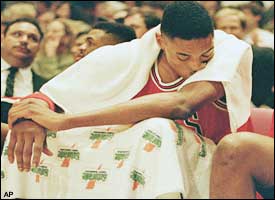
It wasn’t Jordan’s fault, though. Most of the blame lies squarely on Pippen. He didn’t have the same tact with the media that Jordan did. He was dismissive and defensive at times with reporters. Then there were the crunch time situations. Those critical times in games that live in lore and become mythologized. It’s not that Pippen didn’t perform well during those times. On the contrary, he performed great during crunch time. But he’s instead remembered for the times he quit on his team in the most critical of moments. There was the time he sat out Game 7 of the 1990 Eastern Conference Finals against the Detroit Pistons with a migraine headache. The Bulls eventually lost that game. Probably the most damning, though, was the one where he sat out the final 1.8 seconds of Game 3 of the 1994 Eastern Conference Semifinals against the New York Knicks because Phil Jackson drew up a play for Toni Kukoc to take the final shot, instead of Pippen. To make matters worse, Kukoc actually hit the game winner. This one was the most damaging because it came at a time when the Bulls were his team due to Jordan’s hiatus into baseball. When you are known to quit on your team during crucial periods, your popularity takes a big hit.

Which brings us to the best sidekick of this generation, Oklahoma City Thunder guard Russell Westbrook. Like Pippen, Westbrook was not highly decorated coming out of college. Like Pippen, Westbrook was drafted by a team that already had a young star in Kevin Durant. Like Pippen, Westbrook is seen as not being very media friendly. Coincidentally, Durant, much like Jordan, is viewed as a media favorite. And, while not by his own doing, Russell was also involved in a critical game snafu, when Thunder coach Scott Brooks sat an ineffective Westbrook for the entire 4th quarter of Game 2 of the 2011 Western Conferences Finals.

But, not everything is negative when it comes to Pippen and Westbrook. Both of these players are insanely loyal to their teams and teammates. Pippen had a couple opportunities to seek greener pastures during the championship run, but decided to sign for less to stay with the Bulls. Westbrook could have done the same last season, but decided to sign for the allowable max. Both players are highly competitive, with possible chips on their shoulders from being labeled second bananas. Both players are very team oriented, as evidenced by them sacrificing a little of their own games to coexist with two great players. The good severely outweighs the bad when it comes to Westbrook and Pippen, but the bad usually has more advertising power.

Which is why I found the signing of Westbrook to Jordan brand to be a bit ironic. Not ironic in the sense that he doesn’t deserve it. But ironic in the sense that a move like this will probably propel Westbrook into superstar territory, as far as media exposure goes. Into a territory that Scottie Pippen unfortunately never reached. With an endorsement team that includes Carmelo Anthony, Derek Jeter, Chris Paul, and Michael Jordan, himself, Russell Westbrook will have plenty of opportunity to expand his brand. He already has a slogan in place (WhyNot?), and already has a following outside of basketball because of his unique fashion sense. In a way, Jordan is helping this generation’s top sidekick become what his sidekick should have become.

The Thunder and their Manchurian Candidate

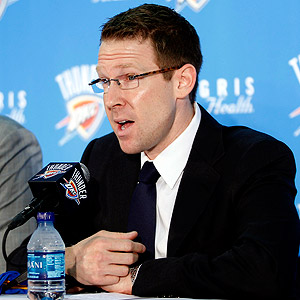
During the offseason, the Oklahoma City Thunder did something very unconventional. Instead of hiring a scout to serve as their video coordinator/analyst, they, instead, hired premier basketball video blogger Sebastian Pruiti. For those of you who don’t know who Pruiti is, he ran a website called nbaplaybook.com, in which he used clips of games to break down film and explain why a team may or may not have been successful in certain sets. Pruiti did a great job of explaining the content in a way that even the average NBA fan could understand.

His understanding of the game was not without any background. He served as a volunteer assistant coach for the New Jersey Institute of Technology Highlanders. Then, he served as an assistant coach for the Fort Wayne Mad Ants of the D-League. Needless to say, the man is an astute basketball mind. One of the best basketball writers of our generation, Bill Simmons, noticed this and decided to hire Pruiti for his newly formed Grantland multimedia conglomerate. In fact, Simmons was the one that broke the news on Twitter that Pruiti had been hired by the Thunder.

The thought of a Simmons’ disciple going to the Thunder, though, got my conspiracy  mind thinking. On the one hand, Simmons has written about his disdain for how the Seattle Supersonics eventually became the Oklahoma City Thunder. Not that he necessarily carries any ill regard for the team itself, but more for the process that eventually landed the team in the Great Plains. As punishment, he has yet to call the team by its current moniker in any of his writings, instead referring to them as the Zombie Sonics. On the other hand, Simmons’ crowning achievement in life would be to someday become an NBA GM. It’s a dichotomous train of thought that is one part Manchurian Candidate and one part Great Expectations.

Think about it. Before Simmons hired Pruiti, he probably kept tabs on him for years like a spy cultivating an asset. He was the best video blogging analyst in the game and worked on several basketball-related sites. As a basketball junkie, Simmons had to immediately recognize his work and his talent. One of Simmons’ most important traits as a writer is his ability to read situations before they occur. He has correctly predicted the “Ewing Theory” on many occasions, and has a keen understanding of how people will react to certain situations. These are all characteristics of a great point guard; someone who sets things in motion, directs the traffic, sees things before they happen, and makes proper adjustments whenever necessary.

I could see Simmons playing chess, while everyone else plays checkers. He knew that Thunder GM Sam Presti is very analytical and values statistics as a means to better answer questions. He also knew that Presti is young and probably very in tune with the basketball blogosphere and advanced cybermetrics. In terms of probability, there’s a lot better chance that someone like Presti or Houston Rockets GM Daryl Morey would hire Pruiti, than someone like Detroit Pistons GM Joe Dumars or Indiana Pacers GM Donnie Walsh.

Eventually, Presti finally took the bait and hired Pruiti. And with that, Simmons finally had his Manchurian candidate in place. As George W. Bush would say, “Mission (half-way) accomplished!” As a video coordinator/analyst, Pruiti’s job is to break down every one of the Thunder’s possessions (both offensive and defensive), looking to see what works and what doesn’t work for the team. If coaching were compared to another Charles Dickens classic, A Christmas Carol, Pruiti would be the Ghost of Coaching Past and Future, while Scott Brooks would be the Ghost of Coaching Present. The information Pruiti garners from game film will help steer how the team plays in the future.

With Pruiti in the door, does he begin to show skewed video evidence to the Thunder front office suggesting a Keith Bogans for James Harden trade would be beneficial to the team? Does he show slanted video proof that Kendrick Perkins should get the ball more in late game situations? Does he systematically try to derail the team’s ascension from the inside out?

Or perhaps, the motive is completely selfish on Simmons’ part. Let’s say Pruiti climbs up the coaching ranks and gets in good with the owner of a struggling team. Who’s to say that Pruiti won’t put in a good word to the owner that Simmons is a master capologist (via ESPN’s Trade Machine, of course), a burgeoning talent evaluator, and a great judge of character? With those qualifications, which struggling team wouldn’t hire Simmons as their GM?

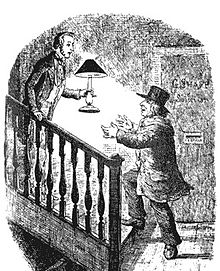
That would literally make Simmons, Mr. Magwich, to Pruiti’s Pip. While Simmons may have assisted Pruiti in the past and present, Pruiti may some day perform the quid pro quo for Simmons in the future. In life it’s all about your contacts and the more connections you make, the more possibilities you have. Who knows, maybe one day Sebastian Pruiti will be the Thunder’s head coach and Bill Simmons will be the Thunder’s (gulp!) GM. That would be the irony of all ironies. At least then, he would probably have to mention the Thunder by name.

Seize The Day

During Sam Presti’s “opening of training camp” press conference last week, he mentioned that starting center Kendrick Perkins would be out for the entire preseason, recovering from the 2 offseason surgeries he had on his groin and wrist. Being that Perkins is a 10 year veteran and a consummate professional, I am not at all worried about his conditioning, or whether he’ll be ready to play once the season starts. As an aside, can you believe that Perkins has already been in the league a full decade? But, in a way, I’m ecstatic that our younger centers now have a chance to prove themselves in some real game action before the season begins.

Oklahoma City’s trainer Joe Sharp and his medical staff have done a great job of keeping the Thunder players healthy, for the most part. And to their credit, the players’ quick healing and sheer stubbornness have also played a part in them hardly missing any games. With that said, I’ve always wondered how Eric Maynor would fare as the starting point guard for the Thunder in a couple games. We all know how he performed in the 4th quarter of Game 2 of the Western Conference Finals in the 2011 playoffs. Was that an aberration or was it really how Maynor would perform with top notch talent consistently around him?  Not that I necessarily want to see Maynor as a starter for an extended period of time, but if Russell Westbrook were to sit out a game or two in the preseason, I wouldn’t mind at all. In fact, I would welcome it.

The biggest detriment to a young player’s development is lack of playing time. Would Darko Milicic be a better player today had he played for a lottery bound team that immediately needed him to develop, instead of being the human victory cigar for the Eastern Conference runners-up Detroit Pistons? We will never know that answer, but it serves as a cautionary tale in how teams handle their young players’ minutes. In the case of the Pistons, there just wasn’t enough room on the team for Milicic to develop on the floor. With Mehmet Okur, Ben Wallace, Tayshaun Prince, Rasheed Wallace, and Antonio McDyess manning the front line for Detroit at different times during a 5 year championship window, there simply wasn’t enough minutes in a game to help develop a young center while still contending.

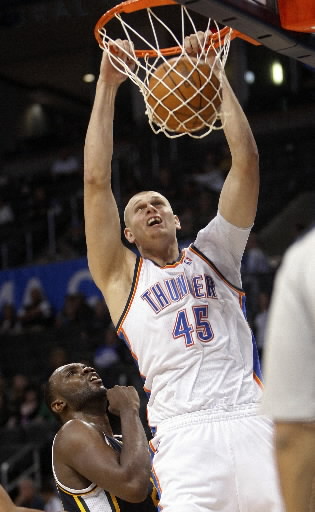
Which brings us to the three young centers on the Thunder’s preseason roster. Cole Aldrich, Hasheem Thabeet, and Daniel Orton are all trying to find their spots in the NBA. Three different stories that lead to the same two things: playing time and development. Aldrich would seem to hold the upper hand amongst the 3 centers, as he has been with the organization the longest. The 11th overall selection in the 2010 NBA draft, Aldrich has been entrenched as the team’s 3rd center behind Perkins and Nazr Mohammed. He’s shown enough in D-League stints and garbage time to keep the team intrigued with his defensive potential. With Mohammed’s departure to the Chicago Bulls in the offseason, the back-up center position is his to lose.

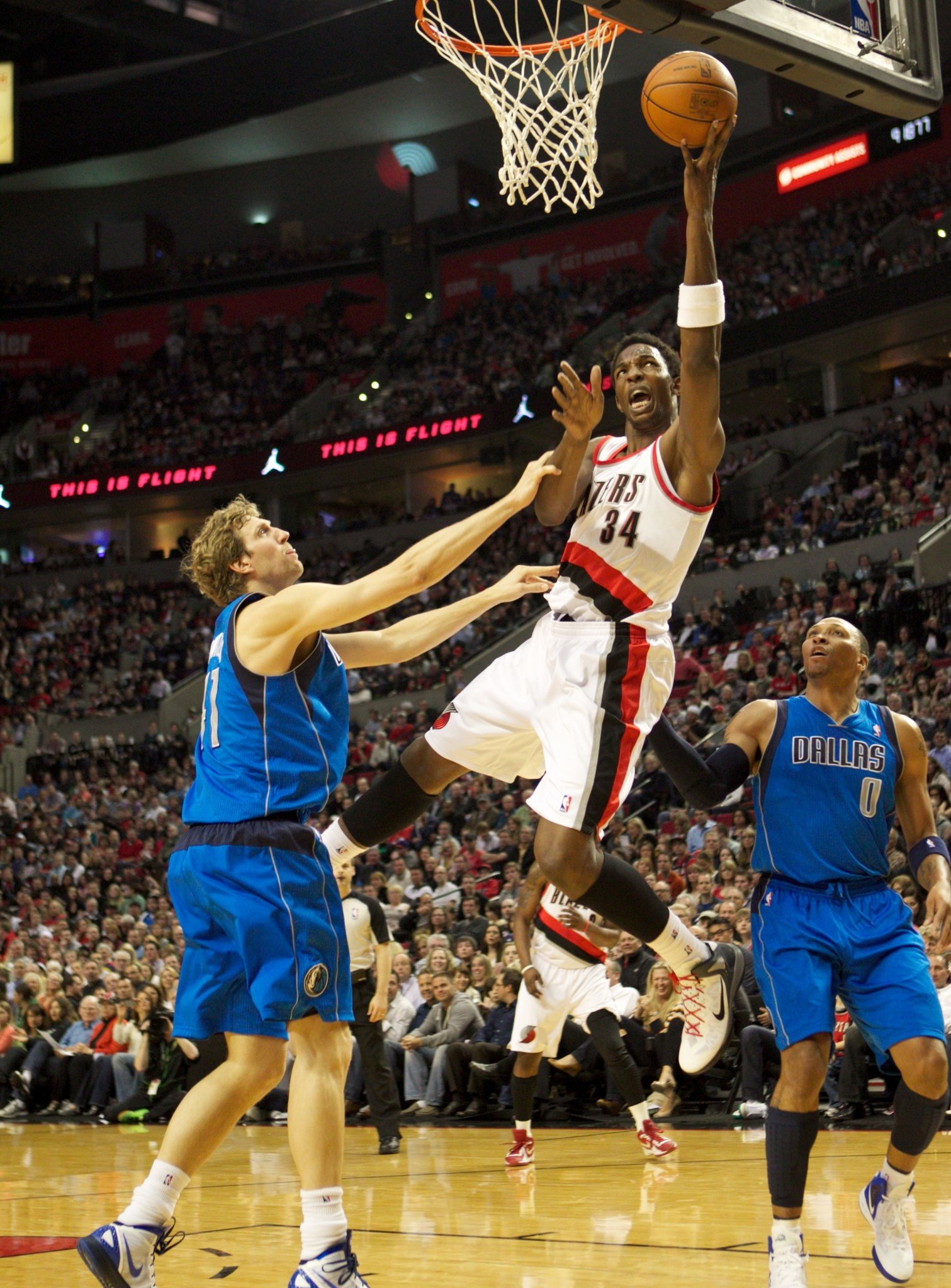
Sometimes, an opportunity presents itself that you just have to try out. Sam Presti has always been intrigued by Hasheem Thabeet, going all the way back to the 2009 NBA draft. Thabeet was off the board by the time the Thunder selected James Harden with the 3rd pick, but Presti kept close tabs on him after that. There were always rumors of OKC trying to obtain Thabeet during the trading deadline. After 3 disappointing seasons, in which Thabeet had stints on three NBA teams and two D-League teams, the Portland Trailblazers decided not to pick up his 4th year option, thus allowing him to become an unrestricted free agent going into this offseason. Seeing the potential for a low risk, high reward player, Presti signed him to a 2 year, vet-minimum contract. The center, who is pretty mobile, despite being the tallest player in the league (7’3”), has the potential to be a disruptive force on the defensive end. The question is whether he can put all his physical attributes and talent together to be an effective NBA player.

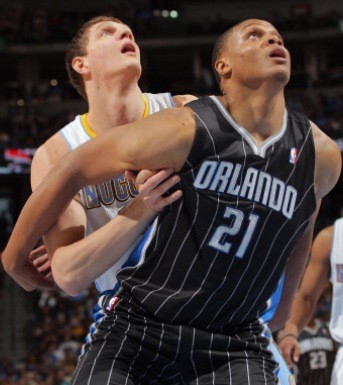
Sometimes injuries play a part in negating a young player’s time on the court. Daniel Orton was drafted in the same year as Aldrich by the Orlando Magic as a possible back-up to Dwight Howard. After suffering a torn ACL during his senior season in high school, Orton once again suffered a season ending knee injury during his rookie season while in the D-League. After recovering in the 2010-11 season, Orton finally saw some game action in the 2011-12 season. The Magic decided not to pick up his 3rd year option, thus allowing him to enter unrestricted free agency. The Thunder decided to bring Orton in as a training camp invite to see how he fits into their system. He probably has the most untapped potential out of the 3 young centers on the team. Rumor has it that if the Thunder don’t sign Orton to a contract, they may try to keep him in their system through the Tulsa 66ers, their D-League affiliate.

The preseason will be a great opportunity for these three young players to show what they got. It may actually be their last chance to prove they are NBA-caliber players. The NBA is a league of “what have you done for me lately?” If a player hasn’t shown anything in his allotted time in the league, you can bet there is another player somewhere looking to seize the day and take that spot.

OKC Thunder: Training Camp Roundtable

Special thanks to the contributions by Zebulun Benbrook of Welcome To Loud City (WTLC) and by one of the smartest basketball minds I know, Max Trueblood (MTB). 

With the turning of the seasons, there are two things you can always look forward to: colder weather and the start of NBA training camps (unless there’s a lockout). Most of the players are already setting up shop in their NBA cities, preparing for the upcoming season. No matter how familiar you are with your team, a new season always brings about new questions. Here are a couple of questions in regards to the beginning of training camp for the Oklahoma City Thunder:  

  • 1)      With the recently finished strike shortened season, a trip to the Finals, and involvement in an Olympic tournament, how do you think Scott Brooks will handle Kevin Durant, Russell Westbrook, James Harden, and Serge Ibaka during training camp?

NTTB: I think they will limit their availability in preseason games, but I don’t think they will limit their training camp practice time. Last season, teams hardly got any practice time due to the compacted schedule. Less practice time meant less time to try new schemes and less time to build cohesion. Luckily for the Thunder, they brought back their entire core and all of their coaching staff from the previous season and didn’t need the practice time in training camp to indoctrinate new players or learn new schemes. This year it’s more of the same, but with more time for practice. Despite their age, the Thunder are a veteran team and the extra practice time will be invaluable to the younger Thunder players, such as Reggie Jackson, Cole Aldrich, Perry Jones III, and Hasheem Thabeet.

WTLC: Once players get to a certain point of their careers, I think you’ve gotta give them room to breathe. Durant and company have proven themselves in the context of the NBA, and while they have room for improvement, they’re pretty much known quantities in the sense of what they can and can’t do. My thought is that Training Camp will focus on the younger guys on the team, like Cole Aldrich, PJ III, and Reggie Jackson. And I’d like to think that it will focus on trying to get them adjusted to the team, rather than improving a certain skill. The Summer League and D-League are more focused on personal improvement, in my opinion.

As for the stars, I’ve gotta think Scott Brooks will make it business as usual. Everybody’s extra motivated after the Finals loss, and they are coming off of a break, even if it is shorter than normal. The NBA season is a long grind, and if you can’t make it through training camp, you probably won’t be able to make it through the dog days of January, either. I think what’s important to remember is that part of the reason Tim Duncan is so successful is that, even in his old age, he still allows Gregg Popovich to coach him like he was a rookie. It sends a message to the rest of the team about how to act, and what it takes to make it to the top. If Durant, Westbrook, Harden, and Ibaka act the same way, then we’re in for a long road of success.

MTB: I’m usually not a fan of preferential treatment for superstar players but given the busy off season for the “Big 4”, I wouldn’t have a problem with them getting a few days off here and there.

 Let’s not forget, this has basically been 3 straight busy off seasons for KD. He had the World Championships in 2010, then played in just about every street ball game imagineable last summer and of course the Olympics this time. 

  • 2)      Out of Daniel Orton, Hollis Thompson, DeAndre Liggins, and Andy Rautins, who earns the coveted 15th spot on the team, and why?

NTTB: I’d say it’s a two man battle between Hollis Thompson and DeAndre Liggins. These two players are both long, which fits into the Thunder’s DNA, with Liggins being more defensive minded, and Thompson being more of a 3-point shooter. With so much of the offense being predicated on dribble penetration, the team would probably benefit from another shooter on the team. So, I would give the nod to Thompson, with Orton, Liggins, and Rautins leading the Tulsa 66ers the NBDL title. 

WTLC: Well, that’s a tough one. I haven’t seen too much of Hollis Thompson, but he’s pretty much the Perry Jones of the second round. He was considered a legitimate prospect and worked out for several teams, but a lot of teams decided to draft and stash Europeans with their later picks, letting him fall off the board. It really depends on how well he can return from his groin injury, and whether he’s really enough of a scorer to be considered better than Daequan Cook, or Andy Rautins. Rautins will be a good litmus test to see how good Thompson really is. Rautins is an excellent shooter, but he’s not very dynamic, which is why he’s never really caught on in the NBA. I’d only see him making the roster is Thompson doesn’t really pan out.

The strongest candidate, aside from Thompson, to make the roster is DeAndre Liggins. He didn’t get too much time with the Magic last year, but he was very efficient in how he played. He never took an unreasonable shot, and he he has good defensive awareness. He’s kind of like Kyle Weaver, but with a bit less energy. The big knocks on him are that his shot is extremely inconsistent (he’s airballed open threes) and that he works best under a slow pace, which doesn’t help when you’re playing with a fast breaking team like the Thunder.

The other guy on the list is Daniel Orton, but I think he’s really only there for the hometown appeal, as he went to Bishop McGuiness. When you see how many big men the Thunder have stockpiled, and the fact that Orlando didn’t re-sign him despite being really thin at center, seeing him make the roster seems like a pipe dream.

MTB: I’m going to roll with Andy Rautins on this one. I think the Thunder have tons of athleticism so an athlete like Liggins or Thompson isn’t really needed but with the team possibly cutting back on bench payroll in anticipation of retaining Harden at a max salary, I could see Presti seeing if Cook has a short term replacement and that would be a shooter. Rautins is the best of the group.

  • 3)      Heading into training camp, how will Perry Jones IIII fit into the rotation, if at all?

NTTB: With Kendrick Perkins coming back from two offseason surgeries and Nick Collison bound to suffer from one of his yearly training camp injuries (sore groin, sore ankle, sore knee, etc), I’m pretty sure we’ll get some idea how he will fit into the rotation right away. He’ll get a lot of reps in practice in our small ball lineups and that’s primarily where I see him being used in the rotation during the season.

WTLC: He won’t be a rotation guy. There’s too few minutes to split with Cole Aldrich, and Thabeet is probably ahead of him due to his previous NBA experience. It really all depends on how he does in training camp, but I don’t think he’ll see regular minutes unless there’s an injury or Cole Aldrich doesn’t live up to expectations.

MTB: I wouldn’t mind seeing Perry get some time in the D league this year. If Serge or Collison get hurt, he can always be called up from Tulsa.

I don’t know enough about Jones to really gauge where his confidence is but lots of young players lose confidence when they get drafted well below where they were expected to be taken. Of course, there are exceptions. Rashard Lewis and Deandre Jordan come to mind. But getting big minutes and success on the D league level could wind up being what’s best in the long run for him. 

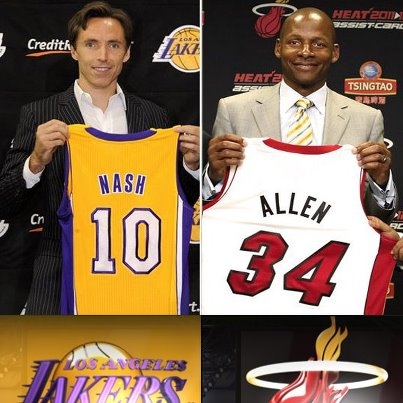
  • 4)      With other teams making significant moves to get better (Lakers acquiring Dwight Howard and Steve Nash / Miami acquiring Ray Allen and Rashard Lewis), is there any way that the Thunder got better without making any major moves? 

NTTB: I think we’ll get better organically because of our youth, but the line on the organic improvement line graph is probably starting to plateau. There’s probably not much more that these guys can do, besides averaging a triple double for a season, that would register as far as team improvement goes. Getting Perry Jones III in the draft negated any necessity to obtain a scoring big. I expect the Thunder to be a big player after the trading deadline, though, for a veteran big man.

WTLC: Well, we got better in the sense that we’ll have another year under our belts to develop. How much that will translate into next year remains to be seen. The Thunder were really sputtering late in the season, dropping a lot of winnable matchups and letting non-playoff teams come back from huge deficits. But when you get right down to it, the Thunder have the talent to beat the Heat and the Lakers. What they need to do is come up with more creative solutions for their obvious flaws.

But on a tangible level, there is improvement in sight. Cole Aldrich might be more of an offensive threat than Nazr Mohammed was, and he was working on a hook shot while in the Summer League. Kendrick Perkins will be fully recovered from his injury. Eric Maynor will be returning, offering a steady offense and a refreshing break from Derek Fishers’ 0fers and terrible defense. Serge Ibaka’s jumpers are getting come consistent. And, of course, James Harden will have had the experience of being on a boat.

MTB: I think the Thunder got better just based on the fact that their star players haven’t hit their prime years yet. It’s rare that All star caliber players take a step back before they hit their prime so I see the Thunder getting better via the internal improvement route. 

  • 5)      Are the Thunder now this season’s participant in the reality show drama known as the “player vs team negotiation” game that the media will incessantly babble about for possibly the next 300 days?

 NTTB: I don’t think so. There are two players out in LA that will be causing a bigger stir with their impending free agency (Dwight Howard and Chris Paul). Plus, the Thunder organization is very hierarchal in nature, and if the top (owner Clay Bennett and GM Sam Presti) remains quiet, you can bet the bottom (players and coaches) will remain quiet. This will not be an issue at all this season. It wasn’t an issue when Westbrook’s extension was in play and it won’t be an issue with Harden’s being in play.   

WTLC: Yes, 100 times yes. If there’s one thing the media love to babble on about, its’ contract negotiations. Nevermind the fact that the Thunder are a title threat now, what are we going to do when Kevin Durant comes off of contract in 2016?! Aye aye aye. Just bring on the basketball, man. I’ll worry about the size of James Harden’s penthouse later. 

MTB: I sincerely hope not. I’m really hoping that Presti and Harden’s representation can just come out and say that they will table negotiations until next summer. That will take the media out of the picture and will simultaneously take the pressure of Harden. Let’s see what type of numbers he can put up and then negotiate a contract based on production.

In conclusion…..one more week!!!!!!!

The Harden Conundrum

I have a friend that currently finds himself at a crossroads in life. Now, before I continue, let me give a little background of my friend. He moved into town about 5 years ago right out of law school. He was from a bigger city, but decided to start a law office in a smaller town to avoid the oversaturation of law offices in the bigger cities. He started the law firm with one of his old law school classmates, who was already in the area working as a public defender. After struggling for a couple years, they finally started building a good clientele portfolio from in and around town. Besides his job, my friend also began laying down roots in the community, marrying a local girl and becoming a recognized lawyer in the area. With that recognition, comes opportunities, of which, some were not local.

Now, I’ll keep my friend nameless, because I am privy to his finances. Due to them having their own business, much of their profits go to operational costs. My friend currently pays himself a salary of $65,000; enough to get by pretty well in the small town. As his clientele portfolio has expanded, he has increased his salary by $2000 every year since he began. He recently got a job offer from a law firm in a bigger city that would start him off at $100,000 with the opportunity to be a partner within a year of accepting the job.

My friend’s partner has started his own attack to keep my friend by his side. He has started pulling on my friend’s heartstrings, telling him that they can be the best law office in the area if they continue what they started; telling him that he is like the brother he never had; and even said he would increase his salary to $78,000 to prevent him from leaving. So this is where my friend finds himself: an opportunity to go to a major law firm and be a major player in the future or stay behind based on loyalty to continue building something that he started.

What would you do?

Before you answer, realize that there is no wrong answer. When it comes to financial decisions, you always decide with one of the two things: your heart or your wallet. Sometimes those two things are homogenous, making decisions extremely easy. But sometimes, those two things are at war, making the decision that much tougher. But in the end, you make your decision and live with it. Like I told my friend, people will always judge, but the only judges that matter are the ones at home and, more importantly,  the one in the mirror.

Would you fault this person for whatever decision they make?

I would hope that most people wouldn’t. When we are talking about money in the $50,000 – $100,000 range, we see a lot of ourselves in those dollar amounts, and know how we would side. In my friend’s case, he was debating between $100K and $78K. In this economy, many people would take the money and hope that the extra 22% would cushion the homesick feeling that sometimes accompanies a job-related move. And yet, when those figures move from $100,000 to $63 million, sports fans feel completely sickened by the fact that an athlete would choose the money over the team.

James Harden, of the Oklahoma City Thunder, currently finds himself in a boat similar to the one my friend is in. In a year, he could take the money and sign a max 4 year/$63 million contract with another team. Or, he could take less money (possibly as low as the $49 million Serge Ibaka extended for) to stay with the tightly-knit, championship-contending team he has help build from the foundation up. We, sports fans, are sometimes so myopic in our thinking, that we don’t realize the difference in money between my friend’s two offers and James Harden’s two possible offers are the same in terms of percentage (22%).

Would you ever leave 22% of your possible future income on the table?

Think about that. How ecstatic would you be if your job offered you a 22% raise tomorrow? I don’t know if there is a sound proof room insulated enough to not hear my screams of joy if that happened. And yet, sports fans like to believe they are above reproach and would always choose loyalty over money. And let’s not argue over the semantics of thousands versus millions. Most people in our salary range would like to think they can live just fine off of one million dollars per year. But if you had the opportunity to choose between $63 million and $49 million, would you really leave $14 million on the table? Forty nine million dollars can help you and children. Fourteen more can help your grandchildren. Money is money. The more you have, the better off you usually are.


I know James Harden’s heart is currently at war with his wallet. He has stated that he loves the city, loves the team, and hopes to continue building a possible dynasty with his brothers. He even intimated that he is willing to take less money, but, recently has backed off of that statement. When you don’t know what you are worth, you make statements like that. But when you realize what your market value is, your wallet (agent) starts to do the talking. I won’t fault Harden if he runs and takes the money. In an occupation where you are an injury away from not earning another paycheck, you take what you can, when you can. If the stories of my friend and James Harden are parallel, then we Thunder fans better enjoy the Bearded One as much as we can this season.

Thunderstruck:The Review

There’s a saying that goes musicians and actors want to be athletes, and athletes want to be musicians and actors. Call it what you may; a mutual respect for each others’ crafts or the need to test one’s self. But when that person ventures into the other crafts, the results are usually forgettable and regrettable. We see how entertainers perform in celebrity basketball games. The basketball players in those games, almost always retired players, have to play at 50% just to make the game even a little bit enjoyable. Basketball players are born to play basketball. While some try other ventures, they rarely achieve the success known to them on the basketball court. When it comes to music, many ball players have tried, but only two have had any form of success: Wayman Tisdale, who went on to become a world renowned bass player, and Shaquille O’Neal, who, regardless of what you think of his skills as a rapper, released 4 studio albums, with one going gold, and another going platinum.

When it comes to basketball players and acting, the list of successes is even smaller. The greatest role for an athlete is as an athlete, especially if they are playing themselves. If you take them outside of that element, the results are extremely varied with a very high “hit or miss” potential. Kareem Abdul-Jabbar did a great job as co-pilot Roger Murdock on Airplane. John Salley did a good job in his small role as Fletcher, the computer hacker, on the two Bad Boys films. Outside of those two roles, I can’t really think of a successful acting venture for a basketball player that does not involve dribbling a basketball.

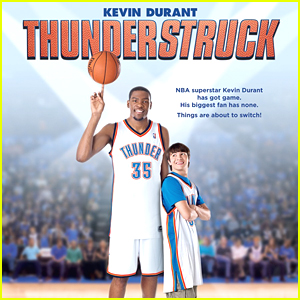
Now, if the role involves playing a little basketball, then the athlete can go ahead and ease into his comfort zone. Shaq’s best acting role was as Neon Boudeaux, the “out-of-nowhere” star recruit in the movie ‘Blue Chips’. Honestly, though, that’s not really saying much when compared to such classics as ‘Kazaam’ and ‘Steel’, but you get the picture. When an athlete is able to do the thing that comes naturally to them, it makes the unnatural thing (acting) come that much easier. So when I heard that Kevin Durant was starring in his own movie, I was a little worried to say the least. He wasn’t a big personality like Shaq was in his heyday, and his advertisement portfolio, while growing, wasn’t necessarily anything that would indicate we had a burgeoning thespian on our hands. Also, when I heard the synopsis of the film, basically ‘Like Mike, part 8,’ I was a bit concerned that the cheesiness factor would be too much.

With all that said, I thought this would be a good RedBox rental in a couple of months. Then, out of the (Thunder) blue, my ticket rep called me asking if I wanted to attend the red carpet premiere of KD’s movie. Like any good Hollywood socialite, I told him I would have to check my schedule. Two seconds later, I told him I would go, and I would be bringing 5 guests with me (my entourage).

So, when the day came, we all got suited up and made our way to the premiere. We got there about an hour and a half early and watched as they vacuumed the red carpet. I vacuum my carpet all the time, but this was a RED carpet. Awesome, to say the least. We finally got our tickets and walked into the theatre, on the newly vacuumed red carpet. After getting our popcorn and drinks, we waited for the VIP’s to arrive.

First through the red carpet was the always lovable Rumble, in a tux only a bison could wear. He, of course, had two Thunder girls draped on his arms. When I die, I want to come back as a hooved mascot. They get all the perks. Next up, it was the always exquisite Wanda Pratt, who rocked her aquamarine dress to a tee. “You go girl!” was all I could think in my mind. Mama Durant basically became part of the family as she bear hugged my sister twice on her walk down the red carpet. At that very moment, I turned around and legendary Oklahoma Sooners coach Barry Switzer was behind me about to walk into the theatre.

Co-star Taylor Gray was the next one through the red carpet. I didn’t really know who he was, but all the pre-teen girls knew who he was. So, I figured he was somebody in the film. Then, the love child of Marty McFly and Breckin Meyer walked through the red carpet. Its always good to see Coach Scott Brooks in his offseason’s best, hair and beard both grown out. Finally, the star of the film came through. Kevin Durant looked dashing as ever in his brownish checkered vest and black undershirt, completely owning the red carpet. After a small introduction by the director of the film, it was finally time to see some movie magic.

Without giving too much away in this review, I initially went into the film wondering how many cringe-worthy, cheesy moments there would be in the film. Brian (Taylor Gray) is a high school student who has aspirations of playing basketball, but is only good enough to be the water boy on the team. A huge fan of the Oklahoma City Thunder, Brian gets a chance to shoot a half court shot at halftime of a game. His shot falls way short, hitting Rumble on the head, and he ends up in the tunnel with Kevin Durant, who sympathizes with the kid and signs a ball for him. As he is handing the ball to Brian, his basketball skills are transferred to Brian in a weird cosmic mix up. The teenager ends up joining the basketball team and becoming its star, while Durant struggles with having the skills of a water boy.

Through his struggles, Durant’s agent, Alan (Brandon T. Jackson), keeps looking for reasons and solutions to Durant’s dismal slump. He finally sees a mirror of Durant’s talent in this scrawny little high school kid and realizes that Durant’s talent must have been stolen. Alan approaches Brian and levels with him about his new found talent. Brian soon realizes that Alan is right and must decide whether he wants to continue with his new found fame or do the right thing and find a way to return Durant’s talents back.

Are there some corny moments in his film? Of course. But, to my surprise, there weren’t any cringe-worthy, “I’m too old for this crap” moments. The surprising comedic performances of Jim Belushi, as the coach of the high school team, and Doc Shaw, as Brian’s best friend, provide enough comedy to keep you laughing out loud from time to time. Taylor Gray actually carries the movie pretty well as the lead actor, and Kevin Durant does a good job as Kevin Durant. John  Whitesell, the director, does a good job of showing off Durant’s strength (basketball ability), while not trying to overdo his still burgeoning acting ability.

For what I was expecting, this movie turned out to be a pleasant surprise. It had a good flow to it and didn’t lull you in the middle of the movie. My kids, 7 and 5 years old, loved it, and it held their interest throughout the entire movie. A solid ‘B’ in my book and a highly recommendable family movie.

Alternate Reality – Dream Team vs. 2012 Team USA

In collaboration with Akeli Jackson of DYST Media, Steve Person of Hooptalk365.com and Jon Midget of SLCDunk.com.
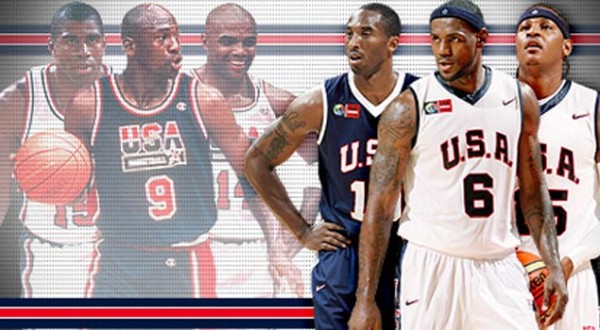
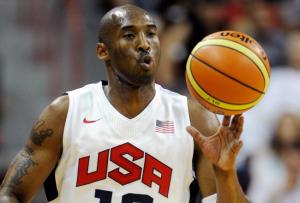
The debate has been raging all summer long about which team is better: the 1992 Dream Team or the 2012 US Men’s Olympic basketball team. Members from both teams have spoken publically and most have said that the Dream Teamers would be the victors. But the tally hasn’t been 100% on the side of the Dream Teamers. Kobe Bryant, in an interview, stated, “If you’re asking me, ‘Can you beat them one game?’ Hell yeah, we can beat them in one game. You didn’t ask me if we could beat them in a 7-game series. In one game, we can beat them. No question about it.” This discussion was presented for each of the subsequent “Dream Team” teams after the ’92 team, but the discussion usually died down pretty quickly. For some reason, though, the debate for the 2012 team has lingered on longer than it did for any of its predecessors. Maybe it’s Twitter, where the in your face, non-stop commentary sometimes leads to a paradigm shift in thought, even if it’s just for a moment. Maybe, people see a 2012 team that is loaded with a combination of great players and potential great players. Sadly, though, these types of debates usually remain as they are….figments of our statistical imagination. 
 

Fortunately, I have more money than I know what to do with. So I decided to call a buddy of mine who works at an anti-aging clinic. He told me he would be able to revert the older Dream Teamers back to their 1992 form using hormone replacement and gene therapy. Of course, the players on the ’92 squad would have to agree with this. So, that’s where their ego and my money came into play. I got all the players from the Dream Team to sign on by offering them $10 million each and telling them that the 2012 team would wipe the floor with them. Christian Laettner even asked my buddy if he had anything that would bring his “Duke-swag” back. My buddy told him he didn’t have anything to cure failed potential. Surprisingly, Larry Bird required the least amount of work. His body is basically in the same physical shape now as it was then. Unfortunately, the anti-aging clinic didn’t have anything to bring Chuck Daly back from the after-life, so Lenny Wilkens, who was an assistant on the Dream Team, agreed to be the coach. The fine folks at Coachella kindly declined when we asked them if they could have Hologram Chuck Daly walk back and forth on the Dream Team sideline. 


After 2 weeks of intense anti-aging therapy, and a month of “training camp”, the Dream Team was looking like its old self again. Magic Johnson was passive-aggresively talking trash, Larry Bird was sinking flat footed 3 pointers, and Michael Jordan was dunking on Patrick Ewing. The game was set up to happen the night before the gold medal game of this year’s Olympics. Only a few writers were privy to the game. Everyone who was witness to the game was CIA-scanned for electronic devices, meaning no photos or video of the game would ever exist. The 4 writers who were invited were each assigned a quarter to write about in detail. No one was allowed to release any information until after the gold medal game. This, is what transpired: 

Pre-Game 

The game would be played using a mixture of FIBA and NBA rules. The quarters would be 10 minutes in length to maximize the athletic potential of all the participants in the game. The FIBA 3-point line would be used, and the painted area used was the standard rectangular NBA format. Players wouldn’t be able to touch the ball on the rim like in international play. It would be counted as a goaltend, if the ball is touched while still on the rim. A team would have 8 seconds to bring the ball up past the half court line. The style of refereeing would be more international, allowing the players to be a little bit more physical on the perimeter and on the inside. The officials would be Ken Mauer, Dan Crawford, and Dick Bavetta. And, finally, a game like this wouldn’t be right without the use of an official David-Stern signed, NBA Spalding ball.  

One of the most amazing sights to see on a basketball court are the pre-game antics of the different players. Some have customary handshakes and dances that they do. Some have a specific routine of stretching and warming up. One thing that stood out while watching these two teams warm up was the gawking and wide-eyed fandom that was apparent on the 2012 team’s side of the court. It is easy to think of athletes as robotic in nature, while forgetting that they were once young fans wanting to be like they hardwood idols. Especially when their idols are on the other side of the court with their deity-like skills on hand for display. But, just as quickly as they were star-struck, they were just as quickly snapped back into reality by Kobe Bryant, and, surprisingly, by Russell Westbrook. The Dream Team squad was all business on their end. 

The referees called out the captains of each team (Johnson and Bird for the Dream Team and Bryant and James for Team USA). The Dream Team was in their classic whites and the 2012 squad in their new look blues. They all shook hands, the referees explained their expectations of the game, and each team went to their sidelines. Game time!!! 

1st Quarter

 Coach Lenny Wilkens trotted out Magic Johnson, Michael Jordan, Patrick Ewing, Scottie Pippen, and Charles Barkley as his starting five. Coach Mike Krzyzewski countered with Chris Paul, Kobe Bryant, Tyson Chandler, Lebron James, and Carmelo Anthony. And, just like that, 10 of the greatest basketball players were on the court exchanging pleasantries and shaking hands. Chandler and Ewing would be jumping at center court. Bavetta tossed the jump ball, and it is controlled by Ewing. Both teams started off by missing their first shot attempts. On the Dream Team’s 2nd trip down the floor, Kobe snuck into the passing lane and intercepted a pass from Pippen to Jordan leading to a breakaway dunk by Lebron James. The first two points were officially on the board. On their next trip down, Magic Johnson found Ewing on a no-look bounce pass for an and-1 layup. The teams exchanged makes and misses pretty consistently for the first 5 minutes. 

After a timeout, Wilkens substituted Larry Bird and David Robinson for Pippen and Ewing. For Team USA, their first substitutions saw Kevin Durant and Deron Williams coming in for Chris Paul and Carmelo Anthony. On the first trip down for Team USA after the timeout, Durant made a 3 pointer off an offensive rebound from Chandler. Barkley gave Durant a shoulder check as he turned to go to the other side of the floor. Durant pushed Barkley and both players were given a double technical. On the next possession, Pippen, playing point guard, found Michael Jordan on the baseline for a jumper. 12-11 Dream Team at the half way point of the 1st quarter. After a Deron Williams layup, the Dream Team went on a 10-2 run, with Larry Bird supplying two 3-pointers and Tyson Chandler picking up his 2nd foul during that run. 

After a run-stopping timeout, Coach K trotted out a line of Kevin Durant, Carmelo Anthony, Kevin Love, Deron Williams, and Russell Westbrook. Wilkens brought in Bird, Karl Malone, Robinson, John Stockton, and Clyde Drexler. Anthony and Malone exchanged buckets in the next two possessions. On the next Team USA possession, Westbrook lost possession of the ball, which was stolen by Stockton, who found a streaking Drexler for an easy 2. Another turnover, this time, by Kevin Love, led to a mid-range jumper by Malone. 28-17 Dream Team, with under two minutes left in the quarter. After a missed jumper by Durant, the Dream Team brought the ball up the court looking to add to their double digit lead. Stockton passed it to Bird, who is wide open for a corner 3, but missed it, leading to a transition 3 by Carmelo Anthony. On the next Dream Team possession, Williams poked the ball from Robinson as the shot clock expired, which led to a thunderous (pun intended) dunk by Westbrook on the other end. After a Stockton miss, Williams brought the ball up for the final possession of the quarter. Durant got the ball above the 3-point line, dribbled a little while jabbing towards the basket, and let loose a 28-foot dead on three that splashed through the net as time expires. 28-25 Dream Team, after one quarter. 

2nd Quarter 

The Dream Team came out to begin the 2nd quarter with Stockton, Drexler, Mullin, Bird, andEwing. Team USA squad went with Deron Williams, Kobe, Durant, Lebron, and Love. Team USA took advantage of the Dream Team’s limited defense, and scored on their first four possessions. However, the Dream Team extended their lead at the same time with three from downtown: two from Bird and one from Mullin. 

On the Dream Team’s fourth possession, Lebron nearly steals the ball by knocking it out of Ewing’s hands, but it goes out of bounds instead. In a surprising display,Ewing thumped his chest several times, telling everyone in a loud voice, “I am a WARRIOR!” over and over. Mullin looks stunned for a moment as he wonders what his team would actually be like if Ewing really were a (GoldenState) Warrior. The Dream Team inbounded it toEwing, who immediately shows off his WARRIOR-ness by throwing up a running 18-foot fadeway that clanks off the rim (he was, admittedly, intimidated by the perpetual shut-down defense of Kevin Love). 

Still, the Dream Team led 37-33 as Team USA calls a timeout. 

Out of the timeout, The Dream Team came out with the same lineup. The 2012’ers let Lebron rest a bit and replaced him with Carmelo. Williams drove past Stockton to get an and-1. Stockton, one of the better defenders in NBA history, takes it personally, scowls, and on the next inbounds, rushes up the court and dropped a pull-up 3 right in Deron’s face. Realizing that Carmelo had Bird and Mullin taking turns “guarding” him, the 2012 squad goes to him on the next three trips down the court, with Carmelo hitting a 2 and a 3 (and having a missed 3 tipped in by Love). During that same time frame, the Dream Team goes on a bit of a cold streak from the field, and Team USA takes the lead 41-40, prompting the Dream Team to call a timeout.

One of the most amazing things to witness in a game like this is the interactions in the timeout huddle. While Team USA was all high-fives and laughs, it was all business in the Dream Team huddle. Lenny suggested putting in Laettner, but nobody even blinked. The players all knew they were old enough and wise enough to be coaches themselves. They noticed the 2012 squad trotting out Paul, Williams, Carmelo, Lebron, and Love. In response, Pippen tells Wilkens he’ll guard Carmelo so “they won’t have to worry about him touching the ball again”. Jordan says he and Stockton can take Paul and Williams. One of the funnier moments was when the Dream Teamers decided to put David Robinson in on Love, knowing that the Admiral would completely take advantage of the shorter, less athletic Love. The only person left to guard was Lebron, so they decided that, even though he can’t match LeBron’s total athleticism, the Mailman is the guy who can best match his speed and strength. So in came Malone. 

On the first play, Pippen ran Carmelo through a beautiful “elbows-out-I’m-going-to-send-you-to-the-floor-weeping” screen set by Stockton. Anthony gets up a little wobbly and goes back to the bench, replaced by Durant. Pippen smiles. 

At this point in the game, the Dream Team asserted themselves offensively and defensively. They continuously went inside to the Admiral, who routinely dunked it, probably wondering whether it was Kevin Love or a fruit fly he felt along the way. On the defensive side of the court, Chris Paul could barely make it past midcourt with Jordan hounding him. Paul passed to Deron Williams, who was being bumped and maimed by Stockton. Williams probably began to wonder why his team only had four guys on the court since he could not find Durant under that Pippen defensive blanket.   

On Team USA’s next possession, Williams found Love with a nifty pass. Unfortunately David Robinson shoved the layup down Love’s throat. It seemed for a moment, while Love looked at Robinson in awe, that he was wondering if he was looking at a Greek God incarnate, or just the most ripped athletic specimen to ever walk the earth. Fortunately, Lebron wasn’t as impressed with Robinson’s physique, as he picked up the loose ball and put in the score. 

The Dream Team continued to put on an offensive clinic in the next few possessions, going inside to David Robinson and running the 2012 defenders through a series of cuts and screens that sends everybody on Team USA into at least one Stockton screen. Chris Paul and Deron Williams, taking the brunt of the physicality, start to vehemently complain about the screens. As a writer, it’s crazy when the crowd noise is taken out of the equation and you can hear almost every conversation on the court. In response to the complaining about the screens, Dick Bavetta told the two 2012 guards, “Hey, if you want to try to knock down guys 50 to 100 pounds heavier than you 10 to 12 times every game, I’ll let you do it too.” Paul and Williams suddenly realized they were nowhere as tough as the guy with the short shorts.   

On the other end of the floor, Paul and Williams were getting picked apart by Jordan’s defense and Durant was made to seem like he didn’t even exist on the floor anymore. Love kept looking to the bench, wondering why Coach K hadn’t noticed that David Robinson has 5 more inches and 8 times the athleticism on him. Lebron, realizing that he is only player that can do anything at this moment, begins to try to take over the game. He got past Malone on a couple of occasions, but the veteran power forward either stripped Lebron or knocked him off balance on his jumpers. 

In all, it was a 16-6 run by the Dream Teamers that put them up 56-47 with two minutes to go in the half. 

Time out for Team USA.   

The 2012 team put in their small ball line-up for the final two minutes of the half: Chris Paul, Deron Williams,Kobe, Durant, and Lebron. The Dream Teamers decided to show the young guys that they can also go fast AND big at the same time. They trotted out Magic, Jordan, Pippen, Barkley, and the Admiral.

 After the timeout, the 2012 squad looked to take advantage of their small ball lineup, especially at point guard with Magic being in the game. Heading into the game, one of the main headlines was the Kobe vs. Michael matchup. How would the player most compared to Jordan fare against him? In a couple words, not very well (in the first half, at least). Kobe tried to challenge Jordan in the final two minutes, but instead ended up costing his team.Kobe went 0-2 with two turnovers during that time-span.

 Those turnovers and missed jumpers allowed the Dream Team to basically turn every defensive possession into a fast break opportunity. Magic was at his “Showtime” best, setting up Jordan, Pippen, and Robinson for dunks. On the final possession of the half for Team USA, Pippen deflected a Deron Williams pass that ended up in the hands of Charles Barkley who had a full head of steam with 5 seconds left. The only person back for the 2012 squad was Lebron, but even he realized that he’d rather fight another day than try to challenge Barkley with a full head of steam. Two-handed slam, buzzer, and that was the 1st half. 66-51 Dream Team.  

 3rd Quarter

 Coming out of halftime, the 2012 squad looked to get back in the groove, down by 15. Coach K decided at halftime to throw caution to the wind and go with a more assertive lineup to combat these NBA greats. He turned the reigns of point guard over to Lebron, with Kobe alongside in the backcourt, Durant and Carmelo on the wings, and Chandler in the post. The Dream Team decided to start the 2nd half with Stockton, Jordan, Pippen, Malone, and Ewing in the paint.

 Again, one of the great things about eliminating the crowd noise is that you can hear the different conversations going on between the players and coaches. At the scorer’s table, Jordan walked up to Kobe and tells him, “You may be able to sit at many players’ tables, but you still can’t sit at my table, rook.” Kobe, in turn, responded, “We’ll see about that. I still got a couple years left”, while he powdered his hands. On the sideline, Ewing, looking as refreshed as someone with a jersey soaked in sweat could look, barked at Chandler, saying “this my paint, you ready to bang?” Chandler responded with a smirk as Dick Bavetta handed him the ball. Chandler passed it toKobe and the second half began. 

With Lebron controlling the ball at point, Team USA jumped out on a 6-0 run. On their first two possessions, on what looked like to be the same play, Lebron found a wide open Anthony who connected on back to back 3’s. Kack kaack!! “String music” yelled Carmelo. Jordan, disgusted by Pippen’s defensive effort, screams at his Bulls teammate, “get your man, Scottie!!!” Immediate timeout called by Coach Wilkens in an attempt to get the Dream Team’s focus back. The run, got the 2012 squad within single digits early in the 3rd quarter. 

After the timeout, the Dream Team makes the necessary defensive adjustments. The two teams continue to battle back and forth throughout the quarter. Jordan would score, then Lebron would respond. The two teams began to trade baskets in an offensive display like none other. The 2012 squad continued to hang close, only down by 9 points. On the next possession, Kobe swiped the ball from Stockton with a chance to cut the lead to 7, but inexplicably dribbled the ball off his knee. From that point on, the Dream Team turned up their defensive intensity, which seemed to stifle Team USA’s offensive production in the middle of the 3rd. Jordan was all on top of Kobe, giving him a real headache. When Kobe drove left, Jordan was there. When Kobe drove right, Jordan was there. It was his Airness at his defensive best. Malone and Ewing were being savages in the paint, giving Chandler and Carmelo more than they could handle. But no one was stopping Durant, who kept the 2012 team treading water with a couple jumpers. The 2012 team remained down by 9, midway through the 3rd quarter, heading to an officials’ timeout. 

The two teams made line up changes and exchanged baskets and misses for the next 3 minutes. With only a minute and a half left in the 3rd, the lead for the Dream Team was still 9, at 82-73. Lebron knew if something was going to happen, it had to happen now. One of the things that he learned in his championship season was to pick and choose when to take over, especially on a team full of superstars. It was go time. He knew it. Coach K knew it. Everyone on that 2012 bench knew it. After exchanging misses, Lebron drove to the basket using his strength to get an and-1 lay-up after a hard foul by Malone. After sinking the free-throw, Lebron blocked a last second shot attempt by Jordan to end the quarter. As the clock expired, both team walked to their respective sides knowing that the 4th would be a pure dogfight. With three quarters in the books, the Dream Team led 90-84.

 4th Quarter 

At the beginning of the 4th stanza, both teams decided to rest their main guys knowing that in order to win this dog fight, sustaining energy for the long haul was absolutely paramount.  The Dream Team entered the quarter with Stockton, Mullin, Drexler, Malone, and Robinson, while Team USA countered with Williams, Westbrook, Iguodala, Carmelo, and Love.  Team USA wasted their first two possessions on ill-advised 3-pointers by Russell Westbrook, while the Dream Team played much more efficient basketball, getting two easy buckets inside from Karl Malone. With that, the Dream Team took back control of the game, pushing their lead to 10, 94-84, a minute and a half into the fourth quarter. 

On their next possession, Iguodala lets a tipped pass get by his finger tips out of bounds, leading to a turnover. On their way back to the other side of the court, Barkley gets up off the bench and starts barking at Carmelo, “You can’t hold the Mailman!” Carmelo looked back, replying, “Don’t talk too soon Chuck, still a long way to go.” Not even a minute later, Williams was able to strip the ball from Drexler while he was driving to the basket, leading to a 3 on 1 fast break which Williams converted to a layup to cut the lead down to 8. With that, Coach K got off the Team USA bench with two clinched fists in the air, signaling for a full court press. Realizing that Stockton was the only legitimate ball handler on the court for the Dream Teamers, Coach K put Westbrook, and his ravenous ball pressure skills on Stockton, while the other four Team USA defenders went into heavy man to man denial mode. Westbrook’s defensive pressure works as Stockton picked up his dribble near midcourt. Chris Mullin comes to the half court as a pressure release as Stockton passes the ball, but Iguodala is a half second quicker in the passing lane, leading to a fast break opportunity for TeamUSA. Iguodala got the ball to Westbrook, who penetrated to the basket only to have his shot rejected by David Robinson, who came from the other side of the court. Kevin Love (as always) was in the right position to corral the loose ball, drop step, and finish a layup to bring Team USA within 6 points, 94-88. 

With 8 minutes and some change left in this heavyweight matchup, Dream Team coach Lenny Wilkens inserts Scottie Pippen in place of Mullin, while Coach K completes the chess match by substituting Durant and Paul for Iguodala and Williams. Before play begins, Krzyzewski calls Love over and whispers a brief 2-3 second order into his ear, to which Love gives a nod of agreement. After the teams exchange misses, the Dream Team was looking to utilize their advantage in the post. Stockton brings the ball up and passes it to Drexler on the wing. Drexler takes one dribble to the right, but passes it to Pippen who is coming off a Malone screen. Pippen zips a pass into the post to Robinson who has positioned himself for a quick shot. The Admiral goes up for a 3-foot hook shot, but is immediately fouled by Love. Coach K’s message to Love was to foul Robinson on his next shot attempt and make him earn those points due to the fact that Robinson was a 59% FT shooter in the ‘92 Olympics. The plan works as Robinson misses both free throws. Carmelo grabs the rebounds, dribbles up past the half court line as Coach K calls timeout with Team USA down 6. The coach knows that the next few minutes could be very important and wants to discuss strategy with the team.

 And so it begins……. 

6:43 left and both teams bring back their heavy hitters. The Dream Team 5 consists of Magic, Jordan, Barkley, Malone, and Ewing, while Team USA counters with Lebron, Kobe, Durant, Carmelo, and Chandler.

 As expected, Jordan comes out of the timeout hitting a 2 pointer off a flare screen by Barkley, which, in the NBA, would’ve been illegal, but since the refs are allowing a more physical game, it was allowed to happen. On Team USA’s next possession, Lebron, using Kobe as a decoy, was able to complete a give and go in which Lebron backdoors Magic for the 3 point play, giving Team USA a chance to cut the lead to 5.  Lebron completes the 3-point play with the free throw and cuts the lead to 96-91 with 5:44 to go in the 4th quarter.

 After a failed possession by each team, and a costly turnover by Chandler in the post, the Dream Team has the ball with 3:37 to go. Kobe gets a ticky tack foul called on him, as he slightly bumps Barkley while attempting a double team. Barkley looks at Kobe and yells, “I know you’re not double-teaming me with the guy that is guarding Michael!” Barkley gets the ball out of bounds and gets it to Jordan, who raises up for a 17 ft jumper that bounces off the back of the rim. Durant grabs the rebound and quickly gets the ball out to Kobe. Kobe gets the ball up the court and quickly passes to Lebron who finds Durant trailing on the play for a wide open 3….good!  Team USAonly down two, 96-94, much to the dismay of Coach Wilkens. 

 With 2 minutes to play, Coach Wilkens makes what is perhaps the coaching move of the game. He substitutes Pippen for Barkley, whose defensive lapses on the perimeter had cost the Dream Team most their lead. That move pays dividends as the defensive pressure from Jordan and Pippen limits Kobe to 1-4 shooting in the final 2 minutes, and keeps the ball out of Lebron’s hands by double teaming him every time he caught the ball in the perimeter. On the offensive end, the veteran leadership of the Dream Team took over. Magic Johnson showed poise in running the point, managing the shot clock, and finding Karl Malone for two back breaking 20 footers as the shot clock was expiring. The perimeter-oriented offense of Team USA proved to be their demise as they could not get anything easy going late in the game. When the final buzzer sounded, it was 100-96, Dream Team.

 Both teams hugged and congratulated each other like it was the end of a hard fought playoff series. All the Dream Teamers were grabbing their younger counterparts and dispelling small nuggets of wisdom. And, of course, the Team USA members were all ears, soaking it all in like sponges. At center court, Michael Jordan hugged Kobe Bryant and talked with him for about a minute. What was said? Only those two know. But I would bet it would have something to do with respect and love for the game, for these two teams exemplify what being a basketball player and being a basketball team is to us fans. In a game that would seem only to occur in the imagination, this was an incredible display of basketball at its finest.

What offseason? Basketball Never Stops!

As a fan of the game, I’ll watch any basketball game you have on the television, especially playoff games. But there’s a slight disconnect when your team is not involved. It’s not as emotionally taxing. With that said, I’ve never enjoyed basketball as a connected fan all the way into mid-June. Though I’m disappointed that we lost in the Finals, its fun to look at the calendar and know that in 3 months, training camps should begin to open up. I’ve forgotten what it feels like for the season to be over in mid-April. But this all leads us to the offseason. Time to rest and recover from the grind of the season. Oh, I forgot we have the draft coming up. And then we have Summer League. And all the offseason moves and transactions. All the while, we have the national team gearing up to defend its gold medal in this summer’s Olympics. What the hell does the off in offseason mean?

There’s a saying that the NBA season is a marathon, not a sprint. The things that happen after the All Star break, such as trades and the signing of recently released players, can have a big impact on the rest of the season and the postseason. The Thunder have been the beneficiary of both of these player transaction moves in the past two season. Two seasons ago, at the trading deadline, the Thunder traded Jeff Green and Nenad Krstic to the Boston Celtics for starting center Kendrick Perkins and ultimate cheerleader Nate Robinson. Then, last season, they signed point guard Derek Fisher off waivers after he was released from the Houston Rockets. Due to the team’s stability, the Thunder usually remain pretty quiet during the offseason, though.

2012 NBA Draft

This offseason, though, the moves have been quiet, but plentiful. Heading into the draft, the Thunder’s only draft pick was the 28th pick in the first round. When you are picking this late in the draft, this usually means your team already has the necessary players to succeed. For a team as set as the Thunder, there wasn’t an immediate need that any player chosen this late was going to provide. One of the biggest needs the Thunder had was a big that was agile enough to defend other athletic bigs while being able to score from the outside and inside. Players with this skill set don’t usually last this long in the draft. The thinking was that the team would draft either an athletic wing or an overseas player that would be stashed in Europe for a couple of seasons.

Sometimes, though, the stars and planets align, and a player you were needing all along falls into your lap. There was always concern about Perry Jones III’s work ethic. The word ‘motor’ usually came up when his draft status was discussed. But, no one could deny the potential he had. The description of a 6’11” athletic forward that could score from outside and inside is the type of player that usually has teams salivating for his services. But a day before the draft, they were reports that many teams were concerned with the condition of his knees. After the recent knee concerns of Greg Oden and Blake Griffin proved to be true, not many teams were willing to spend a lottery pick on a player whose work ethic AND knees were called into question. Surprisingly though, 11 other teams outside of the lottery chose to pass on Jones III also. So when the Thunder’s name came up, Thunder general manager Sam Presti never hesitated, and went with the best player available, which coincidentally also filled a need. The best thing about it, though, is that it comes at an extremely cheap price.

Orlando Summer League

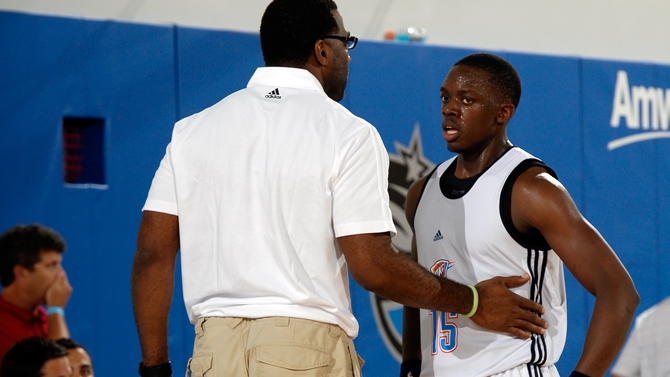
After the draft, the focus turned to the Orlando Summer League, where the Thunder were participating with 7 other NBA teams. As I wrote previously, the Summer League is full of good young players, Fringers, and Dreamers. Some of the players are already guaranteed a spot on an NBA roster and just want to mix in some team-oriented scrimmages and practices during the offseason. Most of the players though, are clawing and scratching for an opportunity to get onto an NBA roster. The Thunder’s roster consisted of 4 guys that, barring a trade, will be on the Thunder’s opening day roster (Perry Jones III, Reggie Jackson, Lazar Hayward, and Cole Aldrich). The rest of the players were probably not going to make it onto the Thunder’s roster, but could make an impression on another team depending on how they played.

The Thunder finished the Orlando Summer League 3-2. Reggie Jackson played like the most seasoned guy on the team controlling the tempo of the offense and attacking the basket at will. He even gave 2012 NBA Dunk champ Jeremy Evans a taste of his own medicine. Lazar Hayward showed why he’ll be at the end of an NBA bench for the next couple of years. He does a lot of things good, but nothing great. Cole Aldrich’s play was mediocre, at best. For a player that is looking to step up and be the back up center, his lack of improvement was a bit alarming. But, I would ask people to please step off the ledge when it comes to Aldrich’s development. Summer league games are made for wing players. They are glorified street games with refs and NBA assistant coaches on the sidelines. Aldrich will be asked to defend the paint, set picks, and put up a couple hook shots in the regular season. He will be fine. Perry Jones III suffered a sprained ankle in the 2nd half of the 2nd game, but not before impressing with his array of inside/outside skills. He will be in the Thunder’s regular rotation, if not in the 2nd half of this season, then definitely in the 2013-14 season. Other notables were forward Latavious Williams, who needs to be on an NBA roster somewhere, and Garrett Temple, whose play was almost veteran-like.

Off-season Moves

The Thunder has never been a big player in free-agency in their time in Oklahoma City. But in reality, they’ve never had to be a big player. Their main focus has always been on player development. When you have players like Kevin Durant, Russell Westbrook, James Harden, and Serge Ibaka, that’s what you put most of your focus on. That came to fruition in the last two seasons with consecutive trips to the Western Conference Finals and a trip to the NBA Finals this past season. The Thunder had 3 players that were coming up on free agency and all of them were veterans. Nazr Mohammed, Derek Fisher, and Royal Ivey could have all been signed to cheap veteran deals. But due to their years of employment in the league, even their minimum salaries would have been upwards of $1.5 million. The Thunder chose instead to let those vets walk, and focus on cheaper, younger alternatives. With Perry Jones III signing his rookie contract, that left 2 more spots on the roster.

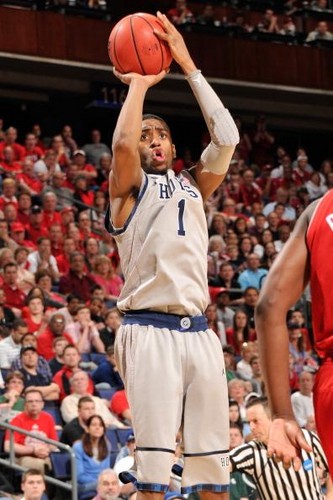
The Thunder signed much maligned center Hasheem Thabeet to a 2-year veteran minimum contract. Now the difference between Thabeet’s veteran minimum deal and any of the other 3 Thunder players that were up for an extension, is that Thabeet has only been in the league for 3 seasons. For the final roster spot, the Thunder signed undrafted free agent Hollis Thompson from Georgetown to a 3 year contract. Thompson is a sharp-shooter in the Thunder mold (tall and long) that could be a cheap replacement for Daequan Cook in upcoming seasons.

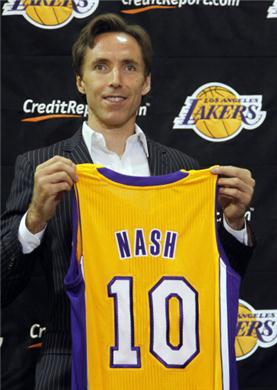
The two signings sent Thunder nation into a tizzy, and not for good reasons. Most were questioning the “lackluster” moves by the team, while the team that beat us in the Finals picked up former All-Stars Ray Allen and Rashard Lewis, and one of our biggest threats in the West, the Lakers, picked up a former 2-time MVP (Steve Nash) in their biggest position of weakness (point guard) without giving up a single player. The thinking was that the curse of the small market team was starting to take hold of the Thunder. That the ideology that small market teams can’t attract free agents and can’t spend money like the big boys was starting to rear its ugly head.

I, for one, completely disagree with that thinking. While it would be nice to sign former All-Stars ad-nauseam every offseason, the reality is that that would be bad business in this new NBA. The goal is to try and keep cost down while maintaining a competitive team. If your team does spend into the luxury tax territory, it better be winning. The Thunder have the right components in place to continue winning. The moves they made this offseason were made to keep those components in place. When you start talking about the luxury tax, every dollar counts. And if the Thunder are truly looking to keep both James Harden and Serge Ibaka on the same team as Durant and Westbrook, they are going to have to continue making these cost effective moves. Both Harden and Ibaka will demand deals that get them at least $10+ million per season. And, rightfully so. We’ll be in the luxury tax no matter what, if we keep these 4 players. The payments get more feasible, though, if you are competing for and winning championships.

Another thing that these signings do is maintain the flexibility that Presti loves. These signings not only have low cost-high reward potential, but they are also short term deals. That way, the team isn’t saddled with long-term contracts if the player, in question, either gets injured or doesn’t produce. Also, if someone better comes along, you could cut your losses with the player and attempt to obtain the better option. Cap flexibility is a commodity in the NBA, and Presti is one of the best at maintaining it.

Team USA

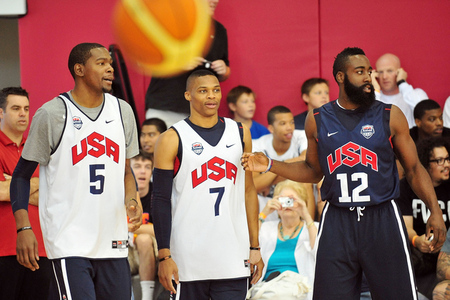
As if this offseason hasn’t been crazy enough, you have Team USA preparing for the Olympics in London. Not only that, but the Thunder has 4 representatives in the Olympics (Kevin Durant, Russell Westbrook, and James Harden for Team USA, and Serge Ibaka for Spain). Durant and Westbrook were near locks to make the team, but Harden was actually a surprise addition after players like Dwayne Wade and Derrick Rose bowed out because of injury. The team torched the Dominican Republic and eeked out a victory against a tough Brazil squad in the US leg of pre-tournament games. After this, it’s across the pond for a couple friendlies and then the real thing. Durant has a possibility of leading the team in scoring, while Westbrook will be the defensive pitbull/offensive sparkplug off the bench. Harden will probably play a role similar to what he does with the Thunder, but to a smaller degree.

As a fan of the game, I love this. Before NBA-TV, the offseason was usually a time to hear about a trade or two, and wait for football season to start. So, even though, this has been a whirlwind offseason, I still appreciate it. When this offseason gets too crazy, I always hark back to the 2011 offseason. Oh, you don’t remember the 2011 offseason? Oh, thats right, because there wasn’t an offseason that year.

Summer League: Hope Springs Eternal

One of my favorite things about the offseason is Summer League. Everything is so optimistic during this time of year. That late 2nd rounder you got from another team for cash considerations? Of course he’s going to become a 3-time All Star for you. The combo guard you took with the 27th pick? You’d be crazy not to think he’s isn’t going to average 20 ppg this upcoming season. The 2nd year player who sat at the end of the bench all of his rookie season, and was the team’s honorary “human victory cigar”? Yep, he’s going to make the leap. Everything about Summer League is based on potential and hope.

In reality though, 80% of the players in Summer League will never get a whiff of the NBA. If you follow your team as voraciously as I do, you’ll learn the players’ names and then forget them just as quickly when Summer League ends. The only ones that stick in my mind are the ones that actually make the team, and the ones that end up with the Thunder’s D-League team, the Tulsa 66ers. And it truly is a shame, because for 99% of us fans, these players are just advancing to a point in their basketball careers that we could only dream of advancing to. There really are some good basketball players in Summer League, but like any other situation in life, if they are not cultivated in the right system, they go to waste. 

That’s why I love cheering for the Thunder during Summer League. This is a team that takes pride in cultivating players and rewarding them for their hard work and dedication. In 2011, Robert Vaden, our 2009 2nd round pick, was signed to play the final week of the season and was added to the playoff roster for the Thunder. Did he ever play an actual game for the Thunder? No, but he got to practice with the team, sit on the bench in a suit,  and cash a couple paychecks signed by Clayton Bennett and David Stern. Last season, our 2nd round pick from 2010, a little known forward from Florida State named Ryan Reid was signed at the beginning of the season. He actually played in a couple games and averaged 1.6 points. 

This year’s squad features a guy the team is grooming to become the back-up center (Cole Aldrich), a guy they are grooming to possibly become the back-up point guard one day (Reggie Jackson), a guy who could be an asset if injuries ravage the team (Lazar Hayward), and a rookie they are grooming to possibly become a rotational big someday (Perry Jones III). These players are locks to be on the opening day roster, barring any trades. They are in town to either sharpen their skills or test new skills. 

The other guys, the ones I like to call the Fringers, are usually just on the outside looking in. Back on the Thunder squad is Ryan Reid, trying to make it back to the NBA after being cut in the middle of last season to make room for seasoned veteran Derek Fisher. Another guy battling for a roster spot is Latavious Williams. This athletic forward made a bit of history in 2009, becoming the first high schooler to be drafted straight out of high school into the NBA Developmental League. The next season, when he became eligible to be drafted into the NBA, he was selected by the Miami Heat in the 2nd round, and was immediately traded to the Thunder. After playing one more season in the D-League, Williams signed to play for FIATC Joventud in Spain last season, winning Most Spectacular Player of the ACB League. Another player trying to get back into the league is Morris Almond, who is something of an NBDL superstar, but has never quite put it all together in the NBA. Basically, 3 guys possibly battling for one roster spot. 

Then, there are the Dreamers. The guys we should all be cheering for, because they remind us of our short lived hoop dreams. Kent Bazemore, Dwight Buycks, Marquez Haynes, John Holland, James Mays, Gary McGhee, and Garrett Temple. Remember those names, because you probably won’t hear of them ever again. Is there a chance some of them will make it as end of the bench guys in the league? Sure. And they’ll probably have a great story to tell about their journey to the NBA. But for the most parts, these guys will fade into overseas and D-League rosters. 

Such is the life of most professional basketball players. Always remember, that professional doesn’t just mean NBA. The players that play in the Philippines for pay are also considered professionals. As are the ones that play in Iran. And the ones in Mexico. The road in the journey to do something you love isn’t always paved in gold and silver. And it very rarely is a straight line. So I commend and salute the Fringers and the Dreamers for doing what they love, even if the road is full of potholes and roadblocks. So keep on hooping, gentlemen, because if many of us were given that opportunity, we’d be doing the same thing.

A BIG Thank You

Throughout my lifetime as an NBA fan, I’ve never anticipated an NBA season more than I did this one. I, honestly, don’t know the reason why, though. Maybe it was the fact that the team I am civically connected to was a title contender. Maybe it was an appreciation of an NBA season almost lost. Maybe it was the fact that I was more intimately involved in the game this season than any other season. Or it maybe it was a combination of all of those things. Whatever the reason, the anticipation of the season was well conceived as it turned out to be the greatest season I have ever witnessed personally. 

Now, when I say personally, I specifically mean me. You may have a differing opinion on the greatness of this season, especially if you are a fan of the Dallas Mavericks, Los Angeles Lakers, or San Antonio Spurs. Conversely, the fans of the Miami Heat probably loved this season, also. To each their own, I guess. But the one theme that made this season stick out more than any other was FAMILY. Not just my immediate family, but also the families I became a part of throughout the season. 

It’s a funny thing about families. Sometimes we are born into them, sometimes we marry into them, and sometimes we are accepted into them. But families are the people that make things that much more enjoyable. I could have enjoyed this NBA season just fine all by myself. The addition of family, though, made it exponentially better. So as a reminder of this great season, I would like to give thanks to all the people that made this season so enjoyable for me. 

First off, to my wife and kids. Thank you for allowing me to enjoy this season and not judging the craziness of my fandom. Thank for understanding that, even though I work two jobs, I do need something to de-stress myself. Some guys throw themselves into booze; some into cars. My vice is basketball, specifically Thunder basketball. Thanks to Wifey for picking my brain about basketball to either show that she “really” is interested or to gather knowledge, even if she isn’t that big of a sports fan. Regardless, I love her for it. Thank you to my oldest for being my protégé; for learning the names and numbers of the players, and wondering why one of the white guys (Cole Aldrich) doesn’t play that much. To my middle child, for being honest and showing me that not everyone has to like sports. Thank you for showing me that Despicable Me is sometimes better than a game. And to my little one. Thank you for belting out, “Let’s Thunder Up,” every time I said, “Its game time/ Its game time.” It’s been awesome for you guys to be a part of this season. 

Thank you to my parents and sister. To my mom, the lady that introduced me to being a fan of the game. To the woman that would talk about the game with me when we would take our 3-mile treks during my childhood. There’s nothing better than watching a game with the original fan, especially when she pays for the food at the arena (a HUGE plus). There’s nothing more that I would’ve wanted than for you to be there when we won the Western Conference Championship. Maybe next year, you’ll be in town, and the tickets won’t be so difficult to obtain. Thanks to my sister, aka Westbrook’s stalker, aka Meme Queen for becoming a super fan this season. Way to Thunder Up! And to my father, thank you for not being a sports fan, but rocking the free playoff t-shirts when it comes to mowing the lawn and washing the car. You Thunder Up in your own manner, old man. 

Thanks to my partner in crime; my brother that I split my season tickets with. That 90 mile trek to the game would not be as fun without you. Every victory is that much more awesome and every loss is that much more manageable. We are the super fans in Section 315 and will continue to lead the charge. Let’s take this thing all the way to the ‘ship.  And, maybe one day, we’ll call into the post game radio show and finally get the answer as to why Etan Thomas still hasn’t gotten any playing time (inside joke). 

Now that’s blood family. But in the progression of life, we also became parts of other families, where blood is not involved. This season, I decided to toss my hat in the blogosphere of basketball. Now mind you, I’ve never been a serious writer for anything. I hated English class and despised writing essays. But I started noticing that I loved writing about basketball on my favorite OKC basketball site, http://www.thunderfans.com . I started building up my writing confidence with posts about the Hornets, Sonics, and Thunder, and eventually asked to become the front page blog writer for the site. The owner of the site gave me the opportunity and I’ve been bitten by the blog bug ever since. So, for that, I need to say thank you to my favorite forum site for the establishment of my blogging roots. 

The next step in this story was starting my own blog. This was a process in, and, of itself. I’m pretty computer saavy, but not very internet saavy. So I started my blog site, http://www.nowthatsthunderbasketball.wordpress.com , and it sat dormant for about a month. After figuring out how to log on and how to use the Word Press format, I finally started blogging. My initial thought was that I would put some of my articles on the blog site and then let some of the people on the forum site know about it. And that’s how it started. But then I located the “link to Twitter” option, and I found a better avenue to get my work out to a more diverse crowd. 

From there, I became a Twitter junkie. I’ve never been a huge fan of Facebook, but the format of Twitter really appealed to me. I started following every basketball head I could think of and started to link my blog to them. Some responded back, but most didn’t. But the purpose of Twitter started to run its course. I was beginning to get feedback from people outside of the Oklahoma City market. And that’s where I met some of the people that would become my basketball media family. 

First, I met Audley Stephenson of http://thebreakdownshow.com who was planning to start up a blogging network that featured bloggers for all 30 teams. He pitched me the idea about becoming the blogger for the Thunder for http://www.hoopstalknation.com , and I jumped at the opportunity. I don’t even think 30 seconds went by before I responded back to his direct message with a resounding YES! Honestly, I don’t know if my articles have increased any of their page views or whether any one reads my work. But what I do know is that Audley and Dave Mendonca showed enough faith in this blogging neophyte to hand me the keys to my own team and let me operate and learn on my own. For that, I will always be thankful for them. 

Thank you to my brothers and sisters on the Hoops Talk Nation blogging network. I don’t know any of you personally, but it’s been a blast talking to you guys throughout the season about the one thing that binds us all….our love for basketball. The passion for each of our respective teams is only trumped by our passions for the sport. Let’s keep this thing moving forward and achieve greater things next season. 

While it’s exciting to be involved in an international blogging network, (remember, Toronto is in the Canada, so technically, we are international) it’s always nice to be involved with a group that’s closer to home. So for that, I have to thank Josh Hastings and Mike Erwin from http://www.visitorssection.com . These two gentlemen have given me the opportunity to expand myself as a podcaster, asking me to be their Thunder correspondent while the team went on their playoff run. Again, I don’t know if my inclusion in the podcast helps them out, but I do know the opportunity and experience I have gained have been priceless. 

The final thank you goes to the Oklahoma City Thunder. In a sports world where cynicism and skepticism are the words of the day, it is heart-warming to see a team that actually embraces the nuances of the community they play in, and ties their themes to the core values of the populance. Whether it’s genuine or not, shouldn’t even matter, as the leaders of the team have tapped into the soul of the city and made a product that understands “us”. Themes like “Team Is One”, “One Thunder”, and “Team is 18,203” remind us, the fans, that we are just as important to the equation as the players. And the players, surprisingly, seemed to have become awestruck and humbled by the outpouring of support from the fans. 

It’s a delicate balance that can go awry in a very short span of time. An injury here or a difficult contract negotiation there, and the empire that was being built can crumble in an instant. The goodwill can quickly change to apathy and disgust. But I will always look back at this season with a huge smile on my face. And that huge smile is largely due to all the relationships I have built or been a part of over the course of the season. Thank you!