Tag Archives: Western Conference Finals

5 for 5: The Longest Shortest Season

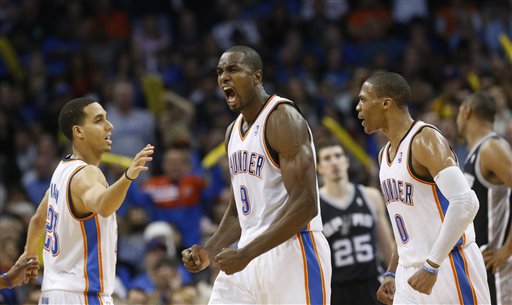
thunder western conference champs

5 for 5: Tragedies, Courtrooms, and Beginnings | 5 for 5: The Rivalries  |  5 for 5: The Run  |  5 for 5: The Thunder’s Godfather

This past season, the Oklahoma City Thunder completed their 5th season in the state of Oklahoma. In a world dominated by round numbers, getting to the midway point is always a cause for celebration. In any relationship, you look back at key moments that made it possible to arrive at certain anniversary marks. In the next few weeks heading into training camp, I’ll be looking at 5 defining moments that made it possible for the Thunder to not only roar into the Plains, but also to do it in winning fashion.

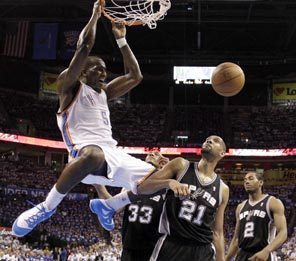
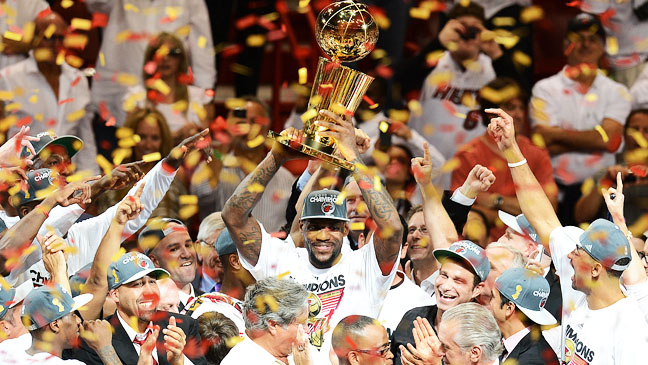
The first part of this series focused on the beginnings of the Thunder organization in Oklahoma  City. For the second part of the series, I want to focus on what was the apex for these first five years of Thunder basketball, the 2012 NBA Finals. For a little comparative perspective, there are 9 NBA teams (in their current city/team format) that have never reached the NBA Finals. The Toronto Raptors, Atlanta Hawks, Sacramento Kings, Memphis Grizzlies, Charlotte Bobcats, Minnesota Timberwolves, Los Angeles Clippers, Denver Nuggets, and New Orleans Hornets/Pelicans have never tasted the fine champagne of a conference championship. I’m excluding the Brooklyn Nets from the list because they’ve only been in Brooklyn for one season and went to the Finals as the New Jersey Nets twice. The proximity of Brooklyn, NY to Newark, NJ (about 15 miles apart) negates a huge change of fan base because of distance. I’m also excluding the Washington Wizards because they made it to the Finals as the Bullets, but decided to change the team’s name in 1997 due to the negative connotation between actual bullets and WashingtonDC being mentioned in the 90’s as the murder capital of the US.

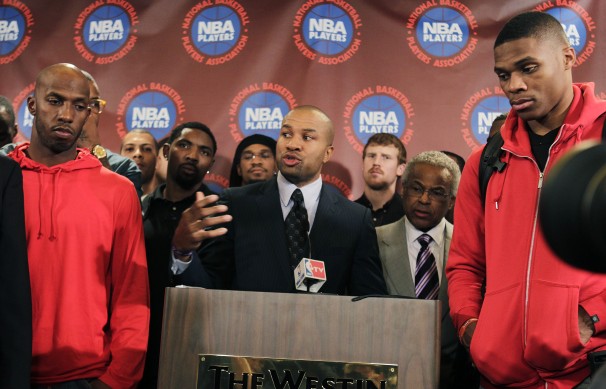
The road to the Finals that season was like the Grateful Dead’s greatest hits album; that is to say a long, strange trip. To begin with, it was a season that almost never was. Although this lockout never reached the DEFCON 4 levels the ’98-‘99 lockout did, it was still nerve-wracking to watch every labor meeting end with the two sides having separate press conferences to disparage the other side. It was like watching your parents, after a nasty divorce, arguing over your custody.

nba lockout

When you are a fan of a team that is drastically improving and just entering the prime of its championship window, the last thing you want is a work stoppage. Anything that cuts into a year of your team’s development when you are close to becoming a perennial contender is the ultimate of detriments. The chemistry built from the previous seasons basically gets thrown out the window if players are allowed to sit for 15-18 months with no access to team coaches or trainers. Not to mention, the veteran players would be a year older and there would be a ton of questions regarding roster moves.

But alas, on November 26th, 2011, after months of hearing about BRI, luxury tax, hard caps, and mid-level exceptions, cooler heads prevailed and an agreement was reached between the NBA and the players’ union. Instead of playing an entire 82 game schedule, the regular season would be trimmed to 66 games with the first day of the season beginning on Christmas. If seeing your team in the NBA Finals is Christmas in June, then seeing the NBA come back from a lockout was, literally, Christmas on Christmas. Continue reading 5 for 5: The Longest Shortest Season

Scoreboard Watching

kd

Last month of the season. A time where every game has meaning. Teams are either jockeying of playoff positioning or draft positioning. The worst teams are balancing between increasing their chances in the NBA draft lottery and creating a late season winning attitude to carry over into the next season. And the best teams are either trying to solidify their spot in the playoff rankings in an effort to get home court advantage throughout the playoffs, or trying to get into the playoffs.

For most teams in the playoff hunt, the only thing they are worried about is playoff seeding. For these teams, their draft picks for the next draft will be in the 15-30 range, and unfortunately, there aren’t too many franchise saviors drafted in that range. What these teams will end up drafting in this range are solid rotation players, Euro-stashes, and players that most fans won’t hear about again once their rookie contracts have run their course. But sometimes, due to prior trades or deals, some of these teams luck into a lottery pick.

nba-draft-lottery

The Oklahoma City Thunder find themselves in the position of battling for the number 1 seed in the Western Conference and picking in the lottery in the following NBA draft. When the Thunder traded James Harden to the Houston Rockets, some of the assets that OKC obtained were draft picks. These are the 3 draft picks the Thunder obtained in that trade and their restrictions:

  • Dallas Mavericks 1st round pick (Top 20 protected until 2018)
  • Charlotte Bobcats 2nd round pick (no restrictions)
  • Toronto Raptors 1st round pick (Top 3 and 15-30 protected in 2013 and 2014, Top 2 and 15-30 protected in 2015 and 2016, Top 1 and 15-30 protected in 2017 and  2018, unprotected after that.)

The Dallas pick probably won’t come to fruition in this draft as Dallas is currently in the lottery and has a very small chance of even reaching the 21st pick if they make the playoffs. They would need to win out and have the 7 other playoff teams currently under 45 wins completely fall apart. A scenario that is very unlikely. The Toronto and Charlotte picks, on the other hand, are in play for the 2013 Draft. As a fan of the Thunder, this has made scoreboard watching in April must-see-TV.

Toronto Pick (Teams that warrant watching – Philadelphia, Washington, Minnesota, Sacramento, New Orleans, and Toronto)

Again, this pick is Top 3 and 15-30 protected for this upcoming draft. Since the Raptors aren’t making the playoffs this season, you can eliminate the 15-30 protection from their draft pick. As of April 1st, the Raptors are slated to pick No.8. With 8 games left, the Raptors have the possibility of picking as high as third (if they lose out) or as low as 13th (if they win out). The position of the Raptors’ pick is not only dependent on their play, but also on the play of the teams around Toronto in the league standings. This is how the teams listed above are currently slotted and how far apart they are in games as of April 1st:

11. Philadelphia          –

10. Washington           3

9. Minnesota               3

8. Toronto                   3.5

7. Sacramento             3.5

6. New Orleans           4.5

So there are currently 3.5 games separating Toronto from the Number 11 slot in the draft and 1 game separating Toronto from the Number 6 slot in the draft. A lot of movement is possible in the standings within the final 2 weeks of the season.

Charlotte Pick (Teams that warrant watching – Orlando and Charlotte)

The Charlotte pick is not protected meaning wherever Charlotte’s pick falls in the 2nd round, that’s where Oklahoma City will pick. Granted, 2nd round picks are more miss than hit. The players selected in the 2nd round of the NBA draft fall into one of four categories. You have the 1st round talents that slipped into the 2nd round for a myriad of reasons, the Euro-stashes, the upper classmen that may surprise and make it onto an NBA roster, and the players that are a reach. Usually, the higher you pick in the 2nd round, the higher the probability of success in the NBA.

adam-silver-draft

With the worst record in the NBA, the Charlotte Bobcats would get the 1st pick of the 2nd round (pick No. 31). Here’s a list of the last 5 players selected with the 31st pick:

  • 2008: Nikola Pekovic (currently with the Minnesota Timberwolves)
  • 2009: Jeff Pendergraph (currently with the Indiana Pacers)
  • 2010: Tibor Pleiss (still playing in Europe, rights owned by the Oklahoma City Thunder)
  • 2011: Bojan Bogdanovic (still playing in Europe, rights owned by the Brooklyn Nets)
  • 2012: Jeffrey Taylor (currently with the Charlotte Bobcats)

These are 3 quality players that were obtained with the first pick in the 2nd round, along with two Euro-stashes whose NBA careers have yet to begin. The allure of a 2nd round pick is that the contract is not initially guaranteed. Every player selected in the first round gets a contract that is guaranteed in the first two seasons with team options for the next 2 seasons at a set salary depending on where they were drafted. Most second round players have to prove their worth in summer league and training camps before the team offers them a guaranteed contract.

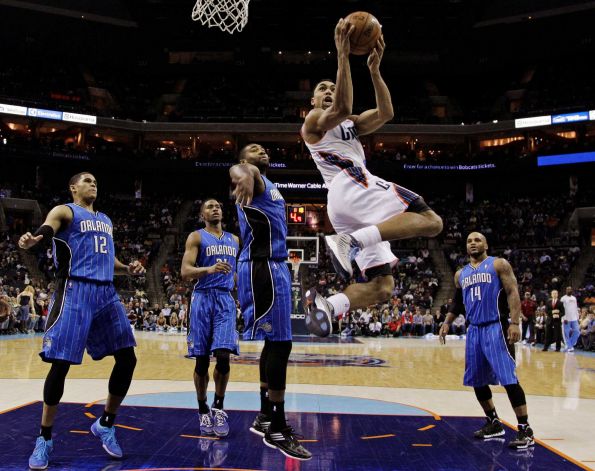
For a while it appeared that Charlotte had a stranglehold on the bottom spot in the NBA. In the last few weeks, though, Orlando has lost their veteran interior presence (Glen Davis) to injury, traded their veteran wing/bench scorer (JJ Redick), and lost their starting shooting guard (Arron Afflalo) to injury. Combine that with the general rebuilding nature the franchise currently finds itself, and that has led to Orlando losing 9 of its last 10 games. Orlando trails Charlotte by only 1.5 games for the final spot in the NBA.

bobcat magic

Is there a difference between the 31st and 32nd pick? I don’t know, but of the last 5 players selected with the 32nd pick, only one is still the NBA (Dexter Pittman) and one is still in Europe. The other three have fizzled out and are currently out of the league. Based on this recent history, it is definitely better to get the 31st pick instead of the 32nd pick.

Number 1 seed in the Western Conference (Teams that warrant watching – San Antonio and Oklahoma City)

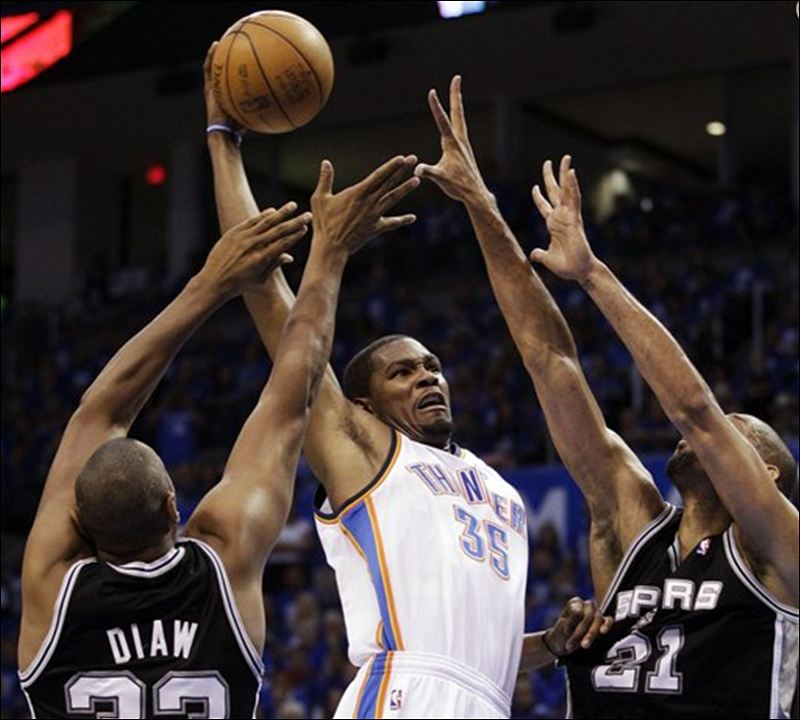
With the Oklahoma City Thunder trailing the San Antonio Spurs by one game for the top spot in the Western Conference, every game from here on out is of tantamount importance to both teams. The two teams play each other one more time on April 4th. As I mentioned in a previous article, home court advantage may be more important to the Thunder this season than it was last season, when the Thunder beat the No.1 seeded Spurs in the Western Conference Finals. The Thunder had an overhaul to their bench before the season began, and have a couple unproven players (as far as playoff experience goes) that perform better at home than on the road.

perk smash

Every day that goes by offers a game that is of importance to the Thunder. It is a fun time to be a fan of the team, and a fan of the NBA in general. Whether it affects their future or present, you can be certain that Thunder fans will be watching that scoreboard every day until the season ends.

The Final Push: Impact of OKC’s next 5 games

Spurs-Thunder-Basketball-Kevin-Durant

If the goal of the regular season is to get home court advantage throughout the playoffs, then this is probably the most important stretch of the season for the Oklahoma City Thunder. With their win over the Portland Trailblazers and San Antonio’s loss to the Houston Rockets last night, the Thunder find themselves 1.5 games back of the Spurs for first place in the Western Conference. These next two weeks may be the most critical for the Thunder in their quest for home court advantage in the Western Conference playoffs.

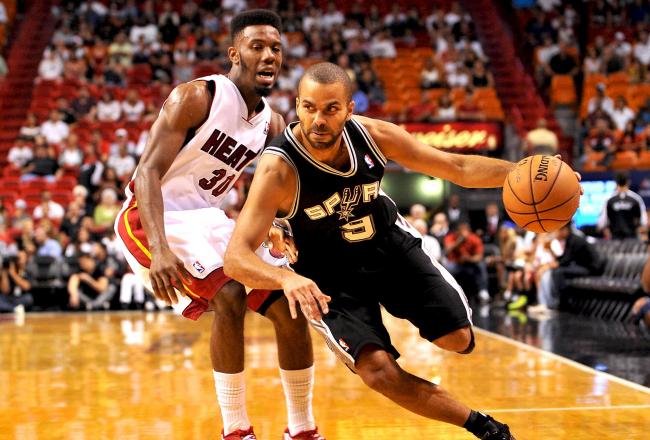
Any time you’re playing catch-up, you always need a little help from the team that’s ahead of you. Luckily for the Thunder, the Spurs play an incredibly difficult slate of games before their meeting with the Thunder on April 4th. The Spurs next five games look like this: vs. Denver, vs. Los Angeles Clippers, vs. Miami, at Memphis, and vs. Orlando. While 4 of those 5 games are at home, the combined winning percentage of these five teams is .623. San Antonio is very good at home, but this stretch comes at a time when the Spurs play 6 games in 9 nights (to include the Thunder game). With San Antonio’s propensity for resting it’s veterans during these types of stretches, there’s not a lot of wiggle room in the schedule for the Spurs to do that without risking a game or two.

parker

The Thunder, on the other hand, play 3 games in 4 nights beginning Wednesday: at home against Washington, and then a double dip on the road on back to back nights against Minnesota and Milwaukee.  The combined winning percentage of these three teams is .406. Not exactly the gauntlet that San Antonio has to face during that same time period. After that short road trip, the Thunder get four days off before their game against the Spurs. While the Thunder will be well rested, the Spurs will be playing their 4th game in 5 nights. After the Spurs game, though, the Thunder will hop on a flight to Indianapolis to face the Pacers the next night. 

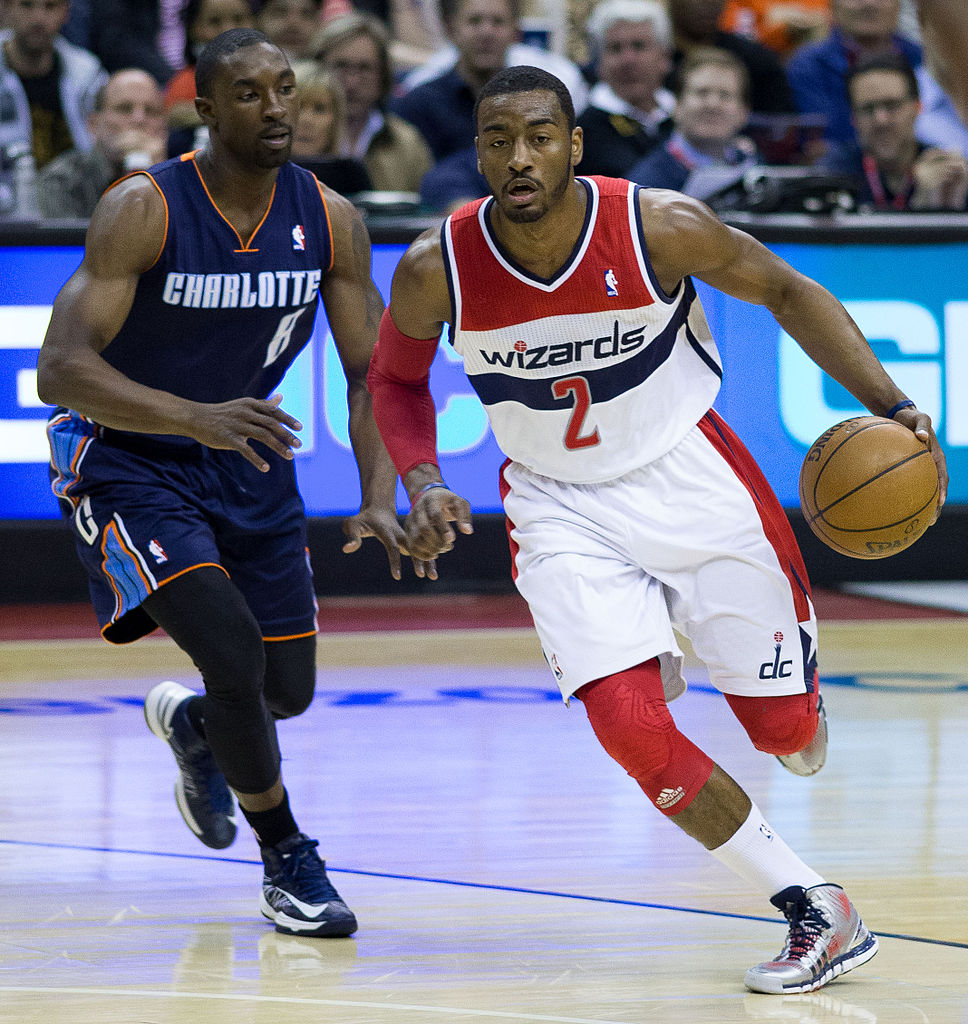
The key word in the next 10 days will be focus, sprinkled with a little bit of luck. The Thunder should win their next 3 games easily. But the Thunder have been known to play down to the level of their competition, especially on the road. Even the game at home against the Wizards will be fraught with caution, as John Wall has completely recovered from the knee injury that caused him to miss the first 33 games of the season. In his last 9 games, Wall is averaging 25 points, 9.3 assists, and 2 steals per game, while leading the Wizards to a 6-3 record over that time against some stiff competition. The Timberwolves always give the Thunder problems, especially in Minnesota, regardless of who is on the active roster. And Milwaukee is chock full of players that can go off for 30+ points at any time (Monta Ellis, Brandon Jennings, JJ Redick, Ersan Ilyasova).

John wall

All this is before they actually play the Spurs. The Thunder had an opportunity to take over first place from the Spurs two weeks ago, but decided to fall asleep at the wheel in the 2nd quarter of that game and never recovered. The Spurs are offensively great where the Thunder are defensively weak (dribble penetration and 3-point shooting). The Thunder have the ability to beat the Spurs, as shown in last season’s Western Conference Finals, but usually have to catch a couple jabs to mouth before they wake up. Hopefully, the Thunder comes into this game with a winning streak and the Spurs are coming off a loss or two.

The most important game in this whole stretch may be the Indiana game. If the Thunder accomplish their goal and take over first place after the Spurs game, they still have to regroup and come back the next night against one of the toughest teams in the league. This is where their focus comes into play. It would be a shame for the Thunder to gain control of the conference one night, and then give it away because of the lack of focus the next night. Trap games are usually reserved for games before rivalry games, but this may be a case of a post-trap game.

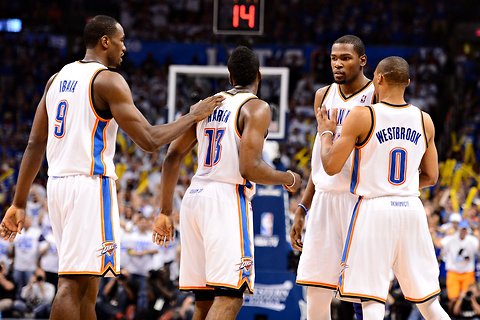
Serge Ibaka, Kevin Martin, Russell Westbrook

The Thunder needs to live by their creed of “one game at a time,” and treat every game with utmost importance for here on out. Do they need San Antonio to possibly lose a game or two? Yes. But that becomes a moot point if the Thunder doesn’t take care of their own business. In a time where it seems like every elite team is streaking and peaking, Oklahoma City has some how managed to tread water long enough to position itself into possibly getting the top spot in the West. Do the Thunder need to win the West to advance to the Finals? They didn’t need it last season when they were the number 2 seed and still beat San Antonio in the Western Conference Finals. But, this is a different team, whose role players seem to respond a lot better at home than on the road. For that reason alone, the Thunder should be making every possible push to get home court advantage throughout the Western Conference playoffs. It’s all about staying focused from here on out.

Westbrook and The Boost

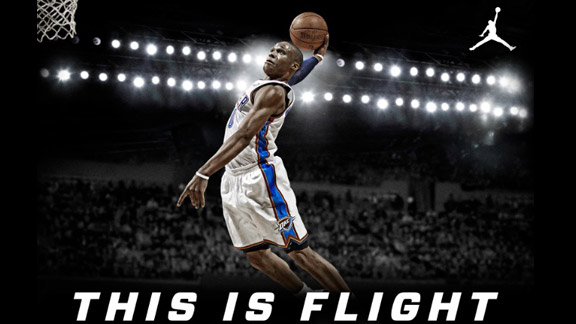
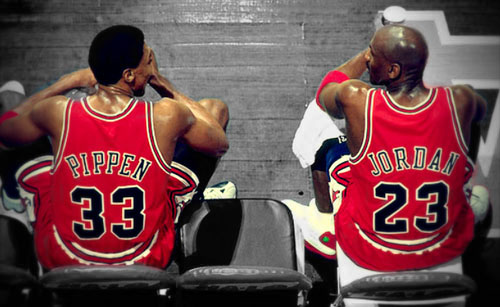
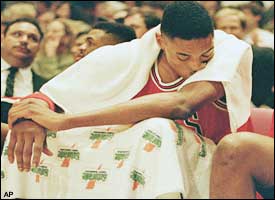
This past week, Russell Westbrook signed with Jordan Brand, after being with Nike for the first 4 years of his career. While Westbrook has carved out his own following of fans, he’s always been known as Kevin Durant’s sidekick. The Robin to Durant’s Batman. This generation’s ultimate second banana. There hasn’t been a sidekick this good since Scottie Pippen. But, Pippen never received the boost in popularity that Westbrook is about to receive.

What qualifies for a sidekick? A sidekick has to be a rookie or a very young player that is brought in after the primary player is established to specifically fill the needs the team is missing. Another qualification is that the pairing has to be together for 5+ seasons. For example, Scottie Pippen was obtained by the Chicago Bulls in a draft day deal, while already having an established superstar in Michael Jordan. Russell Westbrook was drafted by the Seattle Supersonics (Oklahoma City Thunder) after they already had an established young star in Kevin Durant. Anfernee Hardaway almost made it to great sidekick status, but injuries and Shaquille O’Neal’s departure to the Los Angeles Lakers negated that possibility. The Lebron James/Dwayne Wade/Chris Bosh mash-up wouldn’t qualify as sidekicks because they were all alpha males on their respective teams before they joined forces. Kobe Bryant and the aforementioned O’Neal made a great duo, but they were brought onto the Lakers the same year and often quibbled over who was the alpha male. 

To understand the road Westbrook is on, it is important to see what happened to Pippen throughout his career. When Pippen first started college at the University of Central Arkansas, he was a 6’1” walk-on that needed to moonlight as the team’s manager to pay his tuition costs. After 3 more collegiate seasons, a 7 inch growth spurt, and consensus All-NAIA player honors, Pippen was drafted with the 5th overall pick in the 1987 NBA draft to the Seattle Supersonics (who subsequently traded him to the Chicago Bulls). The scouting report on him read as follows:

  • 7’4” wingspan and a 41” vertical
  • Strong outside, but needs work inside
  • Not bad driving to the hoop, but doesn’t look to drive
  • Good foul shooter
  • Can make a three
  • Terrific passer at that position
  • Won’t give you much of anything on the offensive glass, and is a so-so defensive rebounder
  • Excellent defensively and a disruptive force in the passing lanes
  • Good ball handler, but commits a ton of turnovers
  • Could start on most teams

Not necessarily the sexiest of scouting reports for someone who would eventually become one of the top 50 players in league history. While Pippen built his legacy on defense, he was also an apt offensive player, becoming the archetype for the point forward position. During his prime (1989-1999), Pippen had per game averages of 19.1 points, 7.1 rebounds, 5.9 assists, 2.2 steals, and 0.9 blocks. Not necessarily the offensive prowess that Larry Bird possessed, but with a stat line like that, Pippen should have been heralded as his generation’s defensive Larry Bird. Instead, he was teamed up with arguably the greatest player of any generation in Michael Jordan. There usually isn’t a lot of spotlight left when you are playing with the greatest. Ask 100 people who the lead singer of Aerosmith is, and most will answer Steven Tyler. Ask them who the drummer is, and not many will know the answer.

Pippen’s play on the court should have spurred him to more shoe deals, more advertisement contracts, and more widespread popularity. And yet, when his career was all said and done, you couldn’t help but wonder whether Pippen got everything that was owed to him. There were the stories of how Pippen felt he wasn’t getting paid what he deserved (which he wasn’t). There were the rumors that he felt slighted being outside of the limelight, when he provided so much to the team. While he did have his own shoe line (the PIPs) from Nike, they only lasted about two series. So, needless to say, not many companies bought into Scottie Pippen.

It wasn’t Jordan’s fault, though. Most of the blame lies squarely on Pippen. He didn’t have the same tact with the media that Jordan did. He was dismissive and defensive at times with reporters. Then there were the crunch time situations. Those critical times in games that live in lore and become mythologized. It’s not that Pippen didn’t perform well during those times. On the contrary, he performed great during crunch time. But he’s instead remembered for the times he quit on his team in the most critical of moments. There was the time he sat out Game 7 of the 1990 Eastern Conference Finals against the Detroit Pistons with a migraine headache. The Bulls eventually lost that game. Probably the most damning, though, was the one where he sat out the final 1.8 seconds of Game 3 of the 1994 Eastern Conference Semifinals against the New York Knicks because Phil Jackson drew up a play for Toni Kukoc to take the final shot, instead of Pippen. To make matters worse, Kukoc actually hit the game winner. This one was the most damaging because it came at a time when the Bulls were his team due to Jordan’s hiatus into baseball. When you are known to quit on your team during crucial periods, your popularity takes a big hit.

Which brings us to the best sidekick of this generation, Oklahoma City Thunder guard Russell Westbrook. Like Pippen, Westbrook was not highly decorated coming out of college. Like Pippen, Westbrook was drafted by a team that already had a young star in Kevin Durant. Like Pippen, Westbrook is seen as not being very media friendly. Coincidentally, Durant, much like Jordan, is viewed as a media favorite. And, while not by his own doing, Russell was also involved in a critical game snafu, when Thunder coach Scott Brooks sat an ineffective Westbrook for the entire 4th quarter of Game 2 of the 2011 Western Conferences Finals.

But, not everything is negative when it comes to Pippen and Westbrook. Both of these players are insanely loyal to their teams and teammates. Pippen had a couple opportunities to seek greener pastures during the championship run, but decided to sign for less to stay with the Bulls. Westbrook could have done the same last season, but decided to sign for the allowable max. Both players are highly competitive, with possible chips on their shoulders from being labeled second bananas. Both players are very team oriented, as evidenced by them sacrificing a little of their own games to coexist with two great players. The good severely outweighs the bad when it comes to Westbrook and Pippen, but the bad usually has more advertising power.

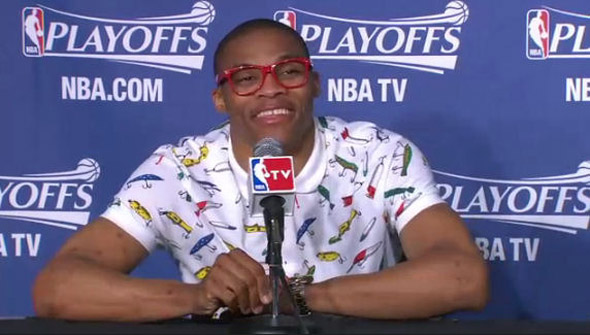
Which is why I found the signing of Westbrook to Jordan brand to be a bit ironic. Not ironic in the sense that he doesn’t deserve it. But ironic in the sense that a move like this will probably propel Westbrook into superstar territory, as far as media exposure goes. Into a territory that Scottie Pippen unfortunately never reached. With an endorsement team that includes Carmelo Anthony, Derek Jeter, Chris Paul, and Michael Jordan, himself, Russell Westbrook will have plenty of opportunity to expand his brand. He already has a slogan in place (WhyNot?), and already has a following outside of basketball because of his unique fashion sense. In a way, Jordan is helping this generation’s top sidekick become what his sidekick should have become.

What offseason? Basketball Never Stops!

As a fan of the game, I’ll watch any basketball game you have on the television, especially playoff games. But there’s a slight disconnect when your team is not involved. It’s not as emotionally taxing. With that said, I’ve never enjoyed basketball as a connected fan all the way into mid-June. Though I’m disappointed that we lost in the Finals, its fun to look at the calendar and know that in 3 months, training camps should begin to open up. I’ve forgotten what it feels like for the season to be over in mid-April. But this all leads us to the offseason. Time to rest and recover from the grind of the season. Oh, I forgot we have the draft coming up. And then we have Summer League. And all the offseason moves and transactions. All the while, we have the national team gearing up to defend its gold medal in this summer’s Olympics. What the hell does the off in offseason mean?
There’s a saying that the NBA season is a marathon, not a sprint. The things that happen after the All Star break, such as trades and the signing of recently released players, can have a big impact on the rest of the season and the postseason. The Thunder have been the beneficiary of both of these player transaction moves in the past two season. Two seasons ago, at the trading deadline, the Thunder traded Jeff Green and Nenad Krstic to the Boston Celtics for starting center Kendrick Perkins and ultimate cheerleader Nate Robinson. Then, last season, they signed point guard Derek Fisher off waivers after he was released from the Houston Rockets. Due to the team’s stability, the Thunder usually remain pretty quiet during the offseason, though.

2012 NBA Draft

This offseason, though, the moves have been quiet, but plentiful. Heading into the draft, the Thunder’s only draft pick was the 28th pick in the first round. When you are picking this late in the draft, this usually means your team already has the necessary players to succeed. For a team as set as the Thunder, there wasn’t an immediate need that any player chosen this late was going to provide. One of the biggest needs the Thunder had was a big that was agile enough to defend other athletic bigs while being able to score from the outside and inside. Players with this skill set don’t usually last this long in the draft. The thinking was that the team would draft either an athletic wing or an overseas player that would be stashed in Europe for a couple of seasons.
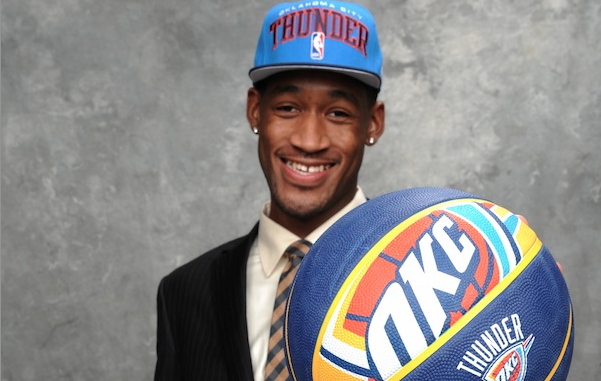
Sometimes, though, the stars and planets align, and a player you were needing all along falls into your lap. There was always concern about Perry Jones III’s work ethic. The word ‘motor’ usually came up when his draft status was discussed. But, no one could deny the potential he had. The description of a 6’11” athletic forward that could score from outside and inside is the type of player that usually has teams salivating for his services. But a day before the draft, they were reports that many teams were concerned with the condition of his knees. After the recent knee concerns of Greg Oden and Blake Griffin proved to be true, not many teams were willing to spend a lottery pick on a player whose work ethic AND knees were called into question. Surprisingly though, 11 other teams outside of the lottery chose to pass on Jones III also. So when the Thunder’s name came up, Thunder general manager Sam Presti never hesitated, and went with the best player available, which coincidentally also filled a need. The best thing about it, though, is that it comes at an extremely cheap price.

Orlando Summer League

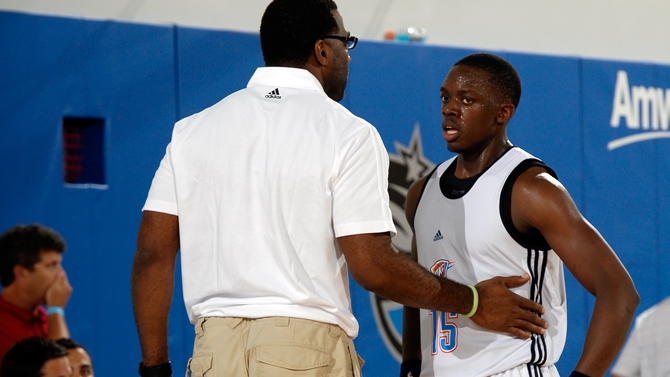
After the draft, the focus turned to the Orlando Summer League, where the Thunder were participating with 7 other NBA teams. As I wrote previously, the Summer League is full of good young players, Fringers, and Dreamers. Some of the players are already guaranteed a spot on an NBA roster and just want to mix in some team-oriented scrimmages and practices during the offseason. Most of the players though, are clawing and scratching for an opportunity to get onto an NBA roster. The Thunder’s roster consisted of 4 guys that, barring a trade, will be on the Thunder’s opening day roster (Perry Jones III, Reggie Jackson, Lazar Hayward, and Cole Aldrich). The rest of the players were probably not going to make it onto the Thunder’s roster, but could make an impression on another team depending on how they played.
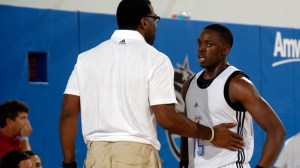
The Thunder finished the Orlando Summer League 3-2. Reggie Jackson played like the most seasoned guy on the team controlling the tempo of the offense and attacking the basket at will. He even gave 2012 NBA Dunk champ Jeremy Evans a taste of his own medicine. Lazar Hayward showed why he’ll be at the end of an NBA bench for the next couple of years. He does a lot of things good, but nothing great. Cole Aldrich’s play was mediocre, at best. For a player that is looking to step up and be the back up center, his lack of improvement was a bit alarming. But, I would ask people to please step off the ledge when it comes to Aldrich’s development. Summer league games are made for wing players. They are glorified street games with refs and NBA assistant coaches on the sidelines. Aldrich will be asked to defend the paint, set picks, and put up a couple hook shots in the regular season. He will be fine. Perry Jones III suffered a sprained ankle in the 2nd half of the 2nd game, but not before impressing with his array of inside/outside skills. He will be in the Thunder’s regular rotation, if not in the 2nd half of this season, then definitely in the 2013-14 season. Other notables were forward Latavious Williams, who needs to be on an NBA roster somewhere, and Garrett Temple, whose play was almost veteran-like.

Off-season Moves

The Thunder has never been a big player in free-agency in their time in Oklahoma City. But in reality, they’ve never had to be a big player. Their main focus has always been on player development. When you have players like Kevin Durant, Russell Westbrook, James Harden, and Serge Ibaka, that’s what you put most of your focus on. That came to fruition in the last two seasons with consecutive trips to the Western Conference Finals and a trip to the NBA Finals this past season. The Thunder had 3 players that were coming up on free agency and all of them were veterans. Nazr Mohammed, Derek Fisher, and Royal Ivey could have all been signed to cheap veteran deals. But due to their years of employment in the league, even their minimum salaries would have been upwards of $1.5 million. The Thunder chose instead to let those vets walk, and focus on cheaper, younger alternatives. With Perry Jones III signing his rookie contract, that left 2 more spots on the roster.

The Thunder signed much maligned center Hasheem Thabeet to a 2-year veteran minimum contract. Now the difference between Thabeet’s veteran minimum deal and any of the other 3 Thunder players that were up for an extension, is that Thabeet has only been in the league for 3 seasons. For the final roster spot, the Thunder signed undrafted free agent Hollis Thompson from Georgetown to a 3 year contract. Thompson is a sharp-shooter in the Thunder mold (tall and long) that could be a cheap replacement for Daequan Cook in upcoming seasons.

The two signings sent Thunder nation into a tizzy, and not for good reasons. Most were questioning the “lackluster” moves by the team, while the team that beat us in the Finals picked up former All-Stars Ray Allen and Rashard Lewis, and one of our biggest threats in the West, the Lakers, picked up a former 2-time MVP (Steve Nash) in their biggest position of weakness (point guard) without giving up a single player. The thinking was that the curse of the small market team was starting to take hold of the Thunder. That the ideology that small market teams can’t attract free agents and can’t spend money like the big boys was starting to rear its ugly head.
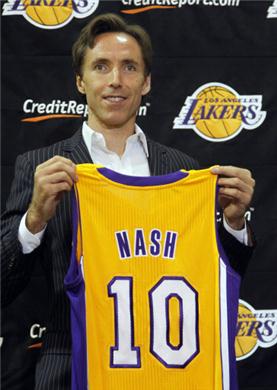
I, for one, completely disagree with that thinking. While it would be nice to sign former All-Stars ad-nauseam every offseason, the reality is that that would be bad business in this new NBA. The goal is to try and keep cost down while maintaining a competitive team. If your team does spend into the luxury tax territory, it better be winning. The Thunder have the right components in place to continue winning. The moves they made this offseason were made to keep those components in place. When you start talking about the luxury tax, every dollar counts. And if the Thunder are truly looking to keep both James Harden and Serge Ibaka on the same team as Durant and Westbrook, they are going to have to continue making these cost effective moves. Both Harden and Ibaka will demand deals that get them at least $10+ million per season. And, rightfully so. We’ll be in the luxury tax no matter what, if we keep these 4 players. The payments get more feasible, though, if you are competing for and winning championships.

Another thing that these signings do is maintain the flexibility that Presti loves. These signings not only have low cost-high reward potential, but they are also short term deals. That way, the team isn’t saddled with long-term contracts if the player, in question, either gets injured or doesn’t produce. Also, if someone better comes along, you could cut your losses with the player and attempt to obtain the better option. Cap flexibility is a commodity in the NBA, and Presti is one of the best at maintaining it.

Team USA

As if this offseason hasn’t been crazy enough, you have Team USA preparing for the Olympics in London. Not only that, but the Thunder has 4 representatives in the Olympics (Kevin Durant, Russell Westbrook, and James Harden for Team USA, and Serge Ibaka for Spain). Durant and Westbrook were near locks to make the team, but Harden was actually a surprise addition after players like Dwayne Wade and Derrick Rose bowed out because of injury. The team torched the Dominican Republic and eeked out a victory against a tough Brazil squad in the US leg of pre-tournament games. After this, it’s across the pond for a couple friendlies and then the real thing. Durant has a possibility of leading the team in scoring, while Westbrook will be the defensive pitbull/offensive sparkplug off the bench. Harden will probably play a role similar to what he does with the Thunder, but to a smaller degree.
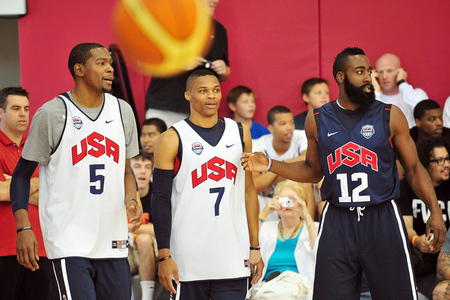
As a fan of the game, I love this. Before NBA-TV, the offseason was usually a time to hear about a trade or two, and wait for football season to start. So, even though, this has been a whirlwind offseason, I still appreciate it. When this offseason gets too crazy, I always hark back to the 2011 offseason. Oh, you don’t remember the 2011 offseason? Oh, thats right, because there wasn’t an offseason that year.
It Was All A Dream

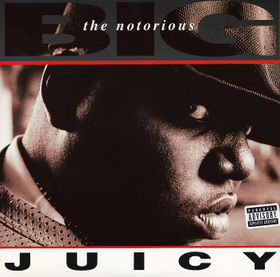
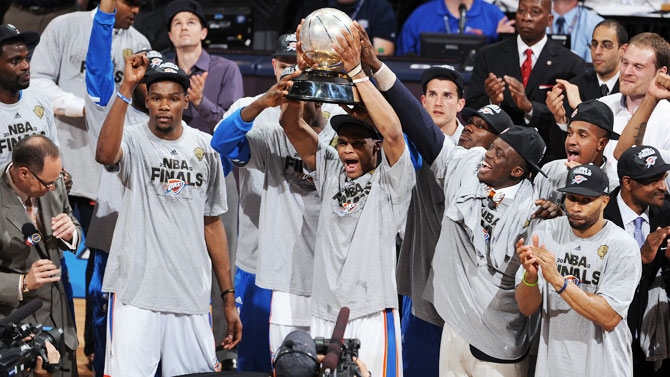
“It was all a dream…” The opening line to “Juicy”, one of the greatest rap songs ever written. Christopher “Notorious B.I.G” Wallace’s opening salvo into our collective consciousness was, perhaps, the greatest conveyment of a musical rags-to-riches story. Great things always have a way of starting off small. Facebook started off as a social network for only Ivy League students and had the word ‘the’ in its original title. Microsoft started off as two friends who were great computer programmers. The Oklahoma City Thunder started off as a 23 win franchise that was in the running to be the worst team in league history for much of the season. But, oh, how things have changed. 

From a fan’s perspective, this was a celebration of the Thunder’s first trip to the NBA Finals. From the outside, this just looked like the finality of a four year run that started off very slow, but has been on a uphill trek ever since. But from the inside, this wasn’t just about the last 4 years. That collective cheer that you heard from the Chesapeake Energy Arena on June 06, 2012 at about 10:30 PM was a roar of passion. Passion, not only for the team, but for the state. A roar for ourselves. Not for each collective ‘me’, but instead, for the collective ‘we’. 

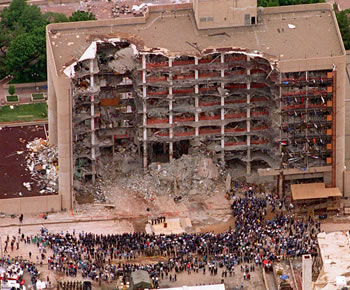
 When you are from Oklahoma, you always hark back to THAT day. April 19, 1995. The day innocence was ripped from the hearts of Oklahomans of all ages. The day we learned about evil and heartbreak. But, on April 20, 1995, we got up and started using a new vernacular. We started to live by words like RESILIENCY, COMMUNITY, SACRIFICE, TOGETHER, HUMILITY, HARDWORK. We knew the trek ahead was tough, but we knew it was a trek we would take together. 

If that wasn’t bad enough, 4 years later, the city was struck by what has been called the Monster of all tornadoes. An F5 tornado with multiple vortices, ripped through the southern part of Oklahoma City, destroying the suburb of Moore, Ok and the city of Bridge Creek, Ok. Once again, probably because of the hard lessons learned from the Murrah Building Bombing, we knew how to react to this tragedy and pulled together.  

City leaders, construction workers, politicians, and citizens all stepped up to the plate to improve the namesake city of the state. What was once a warehouse district was transformed into a sprawling entertainment district in the span of 20 years. With those improvements, came a 20,000 seat indoor sports arena originally known as the Ford Center. This would become the hub of our professional sports dream. 

Of course, with any dream, there are obstacles that stand in the way of achieving the ultimate goal. First, was the fact that we were the 44th largest TV market in the United States. While that sounds great in comparing it to the other 25,000 cities in the United States, that doesn’t bode well for any professional sports league looking for an expansion city. Secondly, was that fact that the professional sports leagues weren’t necessarily looking to expand at that time. The NBA last expanded in 2004, MLB in 1998, NFL in 2002, and the NHL in 2000. 

There’s a saying that goes, “When opportunities comes a’knocking, you better open the door.” When the tragedy of Hurricane Katrina happened in September 2005, the New Orleans Hornets were left with no place to play and hardly a populance to play for. Looking to lend a helping hand AND prove our worth as a big league city, Mayor Mick Cornett and city officials lobbied the NBA’s front office for the opportunity to host the Hornets for as long as necessary. While initially down playing the idea, the NBA decided to give Oklahoma City this opportunity of a lifetime and allow the Hornets to play at the Ford Center for what would eventually become 2 seasons. 

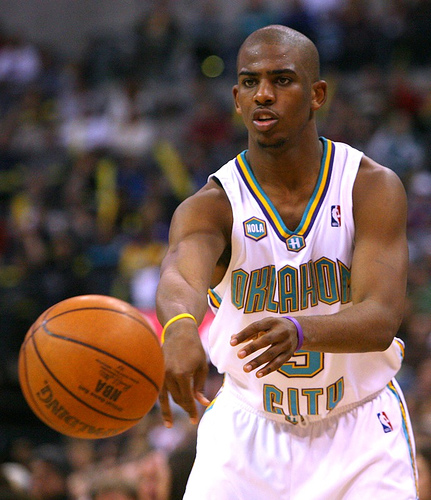
And Oklahoma City proved its worth, quickly growing a reputation as one of the loudest fan bases in the league for its adopted team. For those two seasons, the Hornets became synonymous with having a distinct home court advantage. It became OKC’s first foray into professional sports. Chris Paul won Rookie of the Year in his first season in OKC and David West became a burgeoning All-Star. Tyson Chandler became known as one of the best defensive big men in the league and Peja Stojakovic became known as one of the biggest free agency busts in his one season in OKC. And after two seasons, the music stopped. 

It was a bit disappointing when the Hornets left. Its like being in a 2-year relationship with someone that still had ties to their ex, and then being single again when your significant other goes back to their ex. We always knew the Hornets were going back to New Orleans, but the hope of them some how staying in OKC long-term was still in the back of most our minds. But this was no time to hold our heads down. Their was another opportunity to be had, and another team in the horizon. 

Regardless of what you think of the way OKC got the Thunder, the fact still remained that as of July 2008, the Seattle Supersonics ceased to exist and the Oklahoma City Thunder came into existence. Civic pride will make you argue the move until you are blue (Thunder blue, of course) in the face, but Oklahoma City had its team and it was time to show and prove. That first season was brutal, though. We knew we were getting a skeleton crew of a team with some young, unproven talent, but we didn’t know it was going to be this bad. 

The morning after another of our home losses, I called to the local morning sports talk radio show and just vented. I didn’t know if I could do this anymore. Living 90 miles from OKC and having to drive more than an hour each way, made driving back from the mounting losses excruciating. It’s almost like the team was stuck in a rut when it first got here and you had to wonder whether there wasn’t some karmic justice at play at how we had obtained the team. Thankfully, a coaching change and the general improvement of the young players led to a good finish and a hope for the next season. 

We all know what has happened the last two seasons. After a meteoric rise in their second season in OKC, the Thunder made the playoffs as an 8th seed and took the eventual champion Los Angeles Lakers to the brink of a 7th game in a riveting first round series. The team’s young stars (Kevin Durant and Russell Westbrook) went on to be the main components for a Team USA squad that won gold in the 2010 World Championships. In the next season, we finished with the 4th seed and made it all the way to the Western Conference Finals, losing in a close 5-game series to the eventual champion Dallas Mavericks. Suffice to say, expectations were definitely mounting.

Finally this year, in a season that was on the brink of not happening at all due to labor strife, the team exerted its dominance on most of the league and finished with the 2nd seed in the West. Two things became apparent as we marched towards this point. Number 1: This team was mature beyond its years and eschewed the notion that youth has to wait. Number 2: The home crowd was actually beginning to affect the play of the young Thunder. 

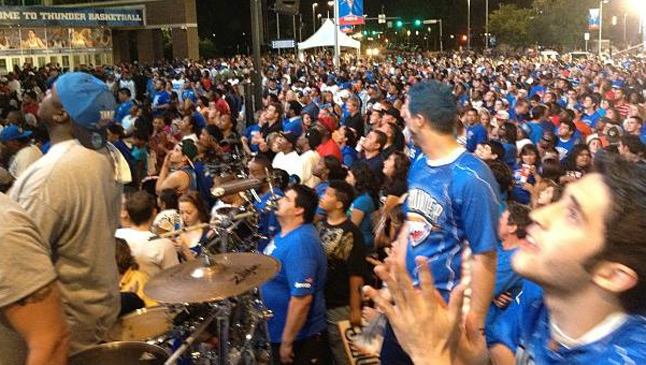
While last season, the Thunder players were the ones being criticized in the postseason, it was our turn, as fans, to be criticized this postseason. It started when the organization began playing games on the huge jumbotron TV outside of the stadium. What became famously known as Thunder Alley started as a small gathering (1000-2000) of fans that could not get tickets to the game, but wanted to experience, first-hand, the atmosphere of being at the playoff game. Eventually that small gathering turned into an all-out block party that some reports say reached as high as 10,000 + spectators in Thunder Alley. When you get that many people in a small space, bad things are bound to happen. Violence erupted after the clinching game of the 2nd round, and the postseason form of Thunder Alley was shut down. It is pretty sad when real fans have to suffer at the expense of a couple knuckleheads. Some people aren’t fortunate enough to be able to afford playoff tickets, but still want to be in the playoff atmosphere. 

Then there were the complaints that we actually wear our free t-shirts that the team supplies to each fan during playoff games. The travesty that fans would wear those shirts and cheer together as one. Who does that? Who cheers every great play and jeers every questionable call? I thought this was the norm for fans. I thought it was par for the course. But, just like everything else, we do things just a little different. We actually feel emotionally attached to our team. I saw grown men and women crying tears of joy for our trip to the Finals. People from the outside will never understand. As we venture into the unknown world of the NBA Finals, we will move forward the only way we know how: Together as one team. #TeamIsOne

The Thunder and the 2nd Seed

With San Antonio’s win over the Portland Trailblazers on Monday night, the Oklahoma City Thunder were assured of the No. 2 spot in the Western Conference. While it is disappointing that they stumbled in the last month of the season to fall to the 2nd spot, the fact still remains that this is progression in a positive direction. Three seasons ago they were challenging to become the worst team in league history. Two seasons ago they were a surprise 8th seed and took the eventual champion Los Angeles Lakers to 6 games in their 1st round matchup. And last season they were the 4th seed and made it to the Western Conference Finals where they lost to the eventual champs, the Dallas Mavericks. Progression from here on out will be measured by what happens in the playoffs.

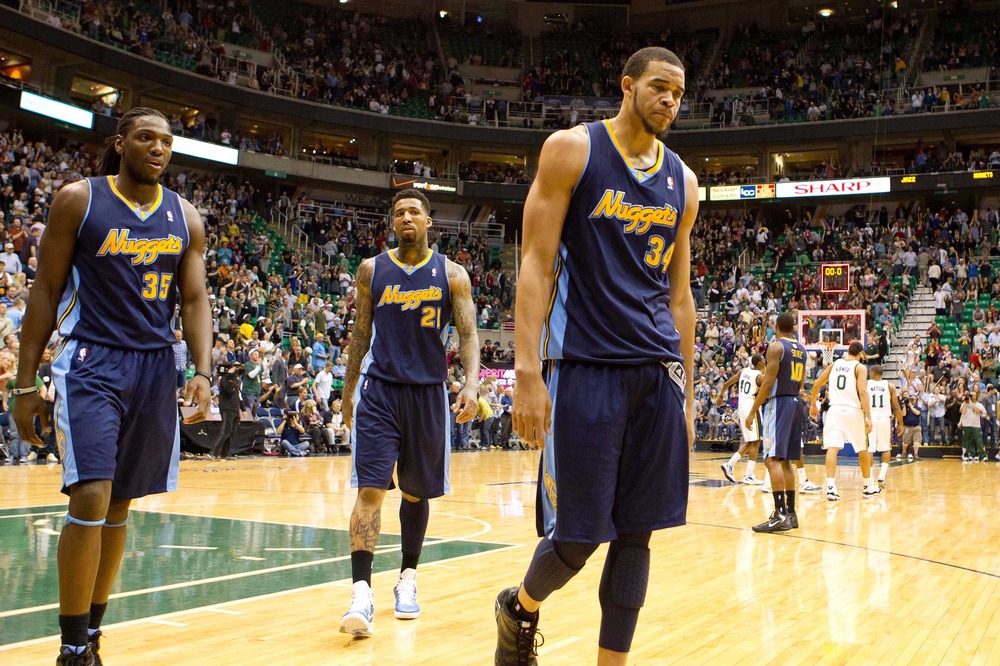
Now that the Thunder are set in their playoff seeding, it is time to look ahead and see how they match up with their potential opponents, both of whom are very familiar to the Thunder. The Denver Nuggets and Dallas Mavericks are both battling for the 6th seed. The Nuggets hold a ½ game lead over the Mavericks and have 2 games remaining, the first of which is against the Thunder, and the last of which is against the “nothing to lose” Minnesota Timberwolves. The Mavericks have one game remaining, on the road, against the Atlanta Hawks, who may still be battling the Orlando Magic for seeding. The Mavericks hold the tie breaker if the teams finish with identical records.

Denver

The Denver Nuggets have become the Thunder’s regular whipping boys these last two seasons. Including the playoffs, the Thunder are 9-2 in the teams’ last 11 meetings. When these two teams meet, points will definitely be scored as it features 2 of the top 3 scoring teams in the league. The Thunder’s rate of success against this team is surprising because the Nuggets have a deep collection of talent at all positions. They feature 6 players that average double figures and 4 other players that average at least 8.6 points per game. That’s 10 players that average at least 8 points per game! The crux to all the scoring, though, is that no one on the team averages more than 16.3 points per game. In crunch time, this team lacks a clearly defined offensive star to score that necessary bucket.

Defensively, the Nuggets are the 3rd worst team in the league, allowing 101.2 points per game. They are a lot like the SSOL (Seven Seconds Or Less) Suns of the early 00’s, focusing a lot of their energy on transition opportunities and increased offensive usage. With the acquisition of Javale McGee and the increased playing time of rookie Kenneth Faried, the Nuggets have become even more of a transition team. But when the Nuggets play another offensively potent team that plays good defense, such as the Thunder, the Nuggets eventually run out of gas in the 4th quarter. That’s been their M.O. in most games that they play against the Thunder.

Dallas

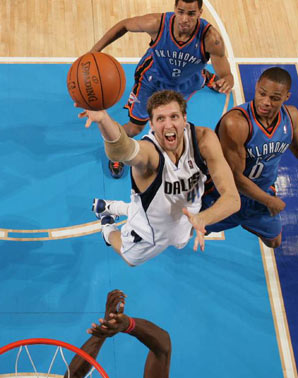
The defending champion Mavericks are a bit of an enigma this season. They lost their defensive anchor (Tyson Chandler), their offensive sparkplug off the bench (JJ Barea), and had a failed offseason acquisition (Lamar Odom). They have been consistently inconsistent this entire season, alternating winning streaks with losing streaks. The Mavs ended the Thunder’s season last year in the Western Conference Finals, defeating them in 5 games. This season has been a different story, though, with the Thunder winning the season series 3-1.

The Mavericks are still led by Dirk Nowitzki, but his scoring average has dipped this season from 23 points per game to 21.6 points per game. A lot of their core is a year older and a step slower. The young players (Rodrigue Beaubois, Ian Mahinmi, and Brendan Wright) are just now getting their feet wet and are playoff neophytes. This team is middle of the road in nearly every statistical category, but still has enough championship moxie to be considered dangerous. The defense has suffered with the departure of Chandler and DeShawn Stevenson, but is still in the top half of the league, allowing only 94.7 points per game.

So who do the Thunder want to face? They already dominated the Nuggets in the playoffs last season, and have continued that trend into this season. They were beat by the Mavs in 5 games last postseason, but held the lead in the 4th quarter in 3 of the 5 games, and have dominated the season series this year. Will we see a different Mavs team emerge in the playoffs? Will they be similar to the 1995 Houston Rockets team that won their second championship in a row as a 6th seed? The answer to both those question, in my opinion, is no. The Mavs team is a shell of what it was last season. They are building for the future (ahem, Deron Williams, ahem) by sacrificing a year of their present. The Thunder finish off both of these teams in 6 games tops. The real question becomes, who do the Mavs or Nuggets want to face; the Thunder or the Lakers?

WHO DOES THIS GUY THINK HE IS?

I am of the opinion that everyone should stick to what they know. Everybody has an expertise in something, not an expertise in everything. There are very few Renaissance men left. So when someone tries to venture into other arenas, this can rub people the wrong way. They will react one of two ways. They will either enjoy when you fail with the backdrop that they already knew you were going to fail. Or they will be completely surprised by the gall of someone trying to succeed at more than one thing……and actually doing it.   

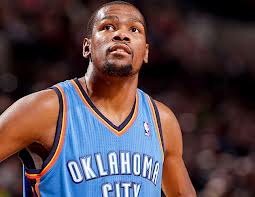
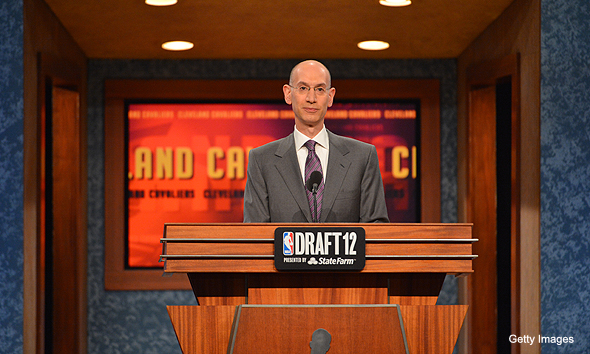
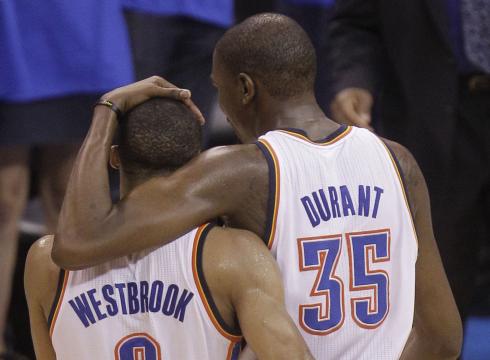
Which, of course, leads us to Kevin Durant. We thought last season was the summer of Durant. He started it by almost leading the upstart Thunder to a 7th game against the eventual champion Los Angeles Lakers in an extremely competitive 1st round series. Then he became the poster boy for the Anti-Lebron campaign, after quietly signing his extension with no pomp and circumstances other than a heartfelt tweet. He even signed an extension with no strings attached (fully guaranteed with no player options for the entire length of the contract). Then he made guest appearances at the NBA draft and at the Orlando Summer League to represent the Thunder and show how much of a great teammate he is (and, of course, to reiterate that he is the Anti-Lebron). Then, to top it off, he led Team USA to its first World Championship gold in 16 years with the “B-team”. He did so much that you could have had this guy working the drive thru line of his offseason.   

 Lead an overachieving team…

 And then????

 Represent the team at the draft…

 And then????

 Quietly sign a max extension….

 You get the picture.

 Now, most mortals would be satisfied with that type of offseason. But, oh no! Not Durantula. Apparently last offseason was just the appetizer. Something to whet our collective palates. With an offseason with little to no activity because of the lockout, what is an NBA player to do to stay on the conscious of the masses??? You could…
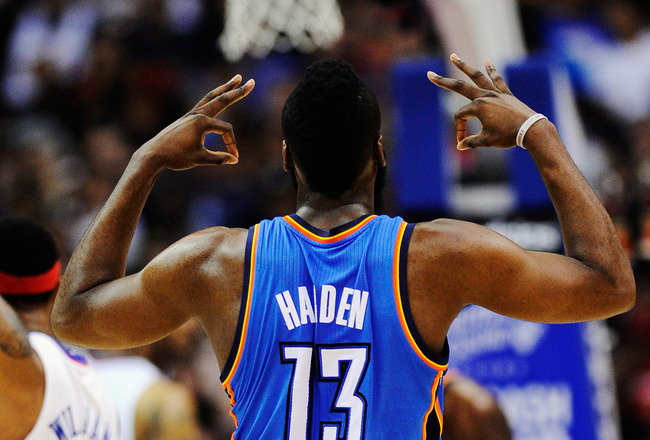
A)    Win your first championship (hello, Dirk).

B)     Lose your second championship in Houdini-like fashion (hello, Lebron)

C)    Make threatening statements that you are taking your talents outside of theUS(hello, ½ of the league).

D)    Become basketball’s version of a gypsy and preach the hoops gospel at every stop.

 Well, @KDTrey5 decided to choose D. After leading the Thunder to the Western Conference finals and starting a fashion revolution (I have my backpack on right now as we speak), No. 35 decided he was going to rest up a little bit and see the world (on Nike’s dime, of course). So he visited China, did a couple basketball camps, saw the Great Wall, took some pictures (1, 2, 3), and gained about 1 billion fans. After that, with no summer league basketball on the horizon, he decided to become a one man streetball show. He literally became an overnight street legend. The street tour he did in NYC (66 in Rucker Park, shutting down a shit-talker the next day with 44 and a game winner, and averaging about 50 ppg for the weekend). Wrecking up the Goodman League in D.C. Then leading the Goodman League past the Drew League in what I’m hoping will be a yearly summer classic.

To add to the streetball legend status, he further solidified his street cred with this picture  

That would usually be a good summer for most, but then he decided to pick up, of all things, cycling. Cycling? Really? Who the hell still rides a bike? When was the last time you rode a bike? You know who rides bikes….middle-aged white men who are ultra-competitive and need to get in 35-40 miles per week. There you go….another market KD has cornered.

 And now I hear that KD is going to star in a movie. A movie? I mean, I know he has an affable personality, but I never once thought he was thespian material. But, guess what else he does if he goes through with the project in OKC? He brings in more economy to OKC. If they film this movie in OKC, they’ll need hotel space for the crew, work permits for the sets, and food for all the employees. In a time where business might dip a little if the lockout cuts into the NBA season, KD could possibly serve as a small economical conduit to bridge the time between lockout and NBA season for some OKC businesses.

 If anyone can pull it off and be successful, I’m betting my money on KD. While some people may ask, “Who does this guy think he is?”, I, in turn, ask of you, “What have you done this summer?” And this is nothing compared to what KD is planning for next offseason. Curing cancer and world hunger in the same week, anyone?