Tag Archives: Tulsa 66ers

The Thunder and their tradeable assets

After the pomp and circumstances that was the NBA All-Star Weekend, it is now time to get to the meat of the NBA season. But before we even reach that point, there’s a little something called the trade deadline that can change the fates of aspiring championship teams. For the next 4 days, you will hear every sort of rumor, from the asinine to the very believable. And that is what makes this time of year one of my favorites.

nba_trade_machine_288

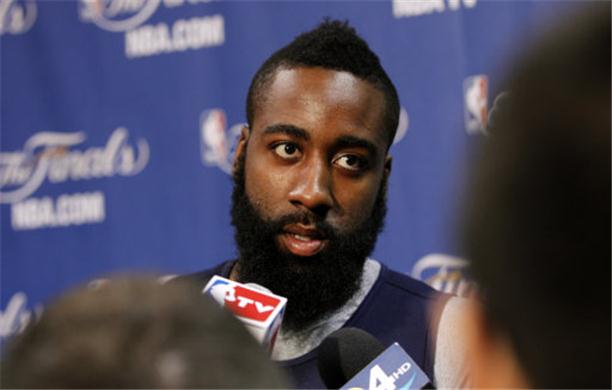
In the last two seasons, the Oklahoma City Thunder have made some sort of move at the trade deadline. In Feb. 2010, they traded Jeff Green and Nenad Krstic to the Boston Celtics for Kendrick Perkins and Nate Robinson. Last season, they eschewed a trade, instead choosing to sign veteran guard Derek Fisher for their playoff run that went all the way to the Finals. This season, the Thunder made their big splash before the season started, trading reigning 6th man of the year James Harden to the Houston Rockets for Kevin Martin, Jeremy Lamb, and 3 draft picks. The Thunder went from a team with hardly any assets to one brimming with them. Any one of those assets or combinations of assets could be used to make a bigger move to help the Thunder either in the short term or in the long term.

Here are the top 5 tradable assets for the Thunder in terms of their desirability from other teams.

5. Eric Maynor

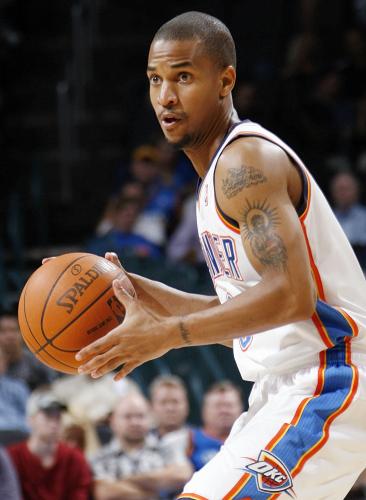
Two seasons ago, when the Thunder made a surprise run to the Western Conference Finals, Maynor was viewed as one of the top back-up point guards in the league. The fervor that is currently surrounding Los Angeles Clipper’s back-up point guard Eric Bledsoe was akin to what was being said about Maynor two seasons ago. A young floor general that was good enough to start for many other teams, and maybe even good enough to start ahead of Russell Westbrook. 
emaynor_648218153

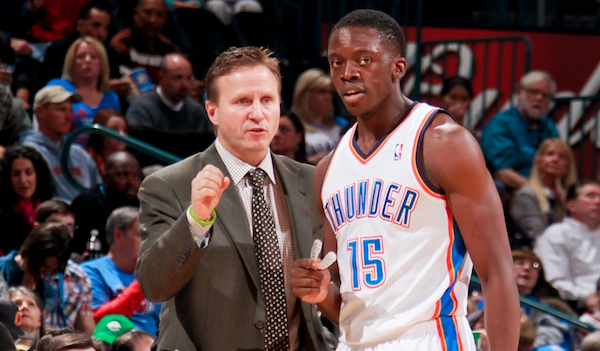
The Thunder, sensing that Maynor’s rising stock may make him difficult to keep, drafted guard Reggie Jackson in the 2011 NBA draft. At the beginning of last season, it became increasingly evident that Maynor’s game had stagnated and hadn’t really improved that much during the offseason. Then, before the season was even 10 games old, Maynor tore his ACL and was lost for the season. While Maynor was rehabbing, Jackson was receiving his baptism by fire and earning precious playing time on a championship contending team. When this season started, Maynor was given the opportunity to earn his spot back as back-up point guard. He played as the primary back-up point guard for the first 23 games of the season. What became evident was that the injury had sapped Maynor of what little athleticism he had, and the Harden trade had robbed Maynor of his greatest asset off the bench. Thunder coach Scott Brooks chose to go with the more athletic Reggie Jackson off the bench to anchor the 2nd team from there on out.
reggie jax

Maynor is in the final year of his rookie contract that owes him $2.34 million. He has value as a cheap rental for a team looking to scout point guards for next season. Maynor has recently shed his bulky knee brace and is moving around a lot better than he did at the beginning of the season. He is just 14 months removed from major knee surgery and may be getting back to being healthy again.

Percentage the Thunder move Maynor: 65% (The Thunder aren’t going to move Maynor just to move him. If they are able to acquire any value, such as a high 2nd rounder or a young player, they’ll make the move. If not, they’ll roll with Maynor for the rest of the season as the insurance point guard.)

4. Charlotte’s 2013 2nd round pick

Second round picks are usually tossed back and forth between teams in almost comedic fashion. Most players selected in the 2nd round usually never make it onto an NBA roster, instead spending most of their careers in the D-League or overseas. The beauty of 2nd round picks, though, is that their contracts aren’t guaranteed and don’t fall into the pay scale system of the 1st round picks.

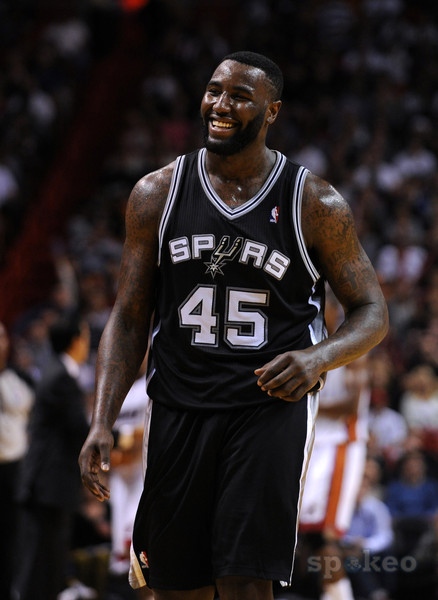
The valuable 2nd round picks are those that fall in the 31-35 range. In those picks, you can get a good player that has slipped into the 2nd round for a variety of reasons. A good example would be Dejuan Blair of the San Antonio Spurs, who slipped into the 2nd round because of injury concerns with his knees. Being that this pick belongs to Charlotte, who currently owns the worst record in the league, it could be a good asset as the first pick of the 2nd round.
dejuan_blair_2012_01_17

Percentage the Thunder moves this pick: 0.000001% (The Thunder fought long and hard to get this pick back. They initially obtained this pick in the trade that sent Byron Mullens to the Bobcats. The pick was later given to the Boston Celtics by the NBA as punishment for the deal involving Jeff Green, who had a heart condition that the Thunder may or may not have known about. Boston then sent the pick to the Houston Rockets in an off-season deal that sent Courtney Lee to the Celtics. And then the Thunder re-obtained the pick in the James Harden deal. I honestly think Thunder GM Sam Presti would have dealt Kevin Durant to get this pick back.)

3. Kevin Martin

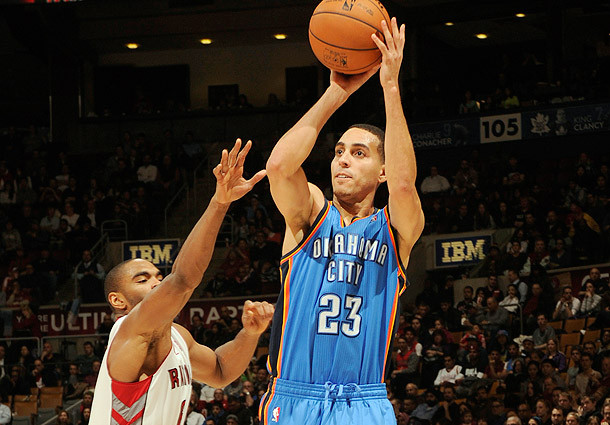
This was the player the Thunder got back in the James Harden trade that could be labeled as “of equal or comparable value”. Martin is one of those fringe All-Star players that can average 20 points per game in the NBA, but bring little else to the table. Martin has done a good job this season of reproducing the offensive production that Harden gave the Thunder last season. Martin’s trade value, though, comes in the fact that he has a $12 million expiring contract.
kevin-martin-thunder

Martin is still a really good player that could still average 20 points per game if he were on a bad team. He’s one of the top players in free throw percentage and 3-point FG percentage and averages 15 points per game off the bench. He had done a good job of assimilating himself to his role on the Thunder and assimilating himself to the culture of the city. He has made it known that he would like to stay in Oklahoma City and sounds like he would be willing to take a pay cut to stay. (Annnd, cue Thunder fans saying “We’ve heard that before”).  

Percentage the Thunder move Martin: 12.5% (Having already made a major trade to start the season, I doubt the Thunder make another major trade in the middle of the season. They have the 2nd best record in the league and Martin has been a willing participant in his bench role. Unless the Thunder are able to acquire 2 players for the price of one, I think the Thunder head into the playoffs with Martin as their 6th man.

2. Jeremy Lamb/Perry Jones III

When you are a rookie on a championship contending team, playing time can be at a premium. This is where the Thunder and their rookies currently find themselves. Besides end of blowout situations, Lamb and Jones III have gotten most of their playing time with the Thunder’s D-League affiliates, the Tulsa 66ers. Their lack of playing time is not indicative of their potential, though. On a bad to mediocre team, these two would be logging major minutes. But on this team, their major function this season is in developing their game.  

lamb-jones

The league still views them as rookies dripping with potential. And that is where their value lies. I’m pretty sure many trade proposals have started with Eric Maynor and ended with one or both of these rookies. Young players on rookie deals are like gold in the NBA, and the Thunder have 2 bars in their safe.

Percentage the Thunder move either of these players: 10% (With their future salary cap situation (2 max players in Westbrook and Durant, Ibaka’s upcoming extension, Perkins’ contract, and Martin possibly resigning), the Thunder place optimum value on young players on rookie scale contracts. Both of these players emulate the Thunder model (athletic, long, and able to play multiple positions) and have performed well in their time in Tulsa.  

1. Toronto’s protected 1st round pick (2013 – Top 3 and 15-30 protected, 2014,2015 – Top 2 and 15-30 protected, 2016,2017 – Top 1 and 15-30 protected, 2018 – unprotected)

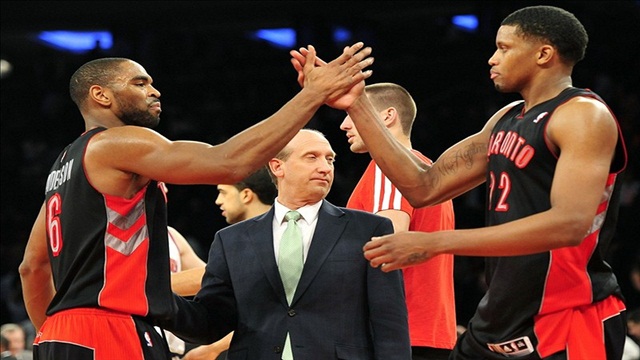
Before Toronto acquired Rudy Gay, this pick looked like it was going to be in the 6-8 range. Since the Gay trade, Toronto seems to be a much tougher out for opponents and reeled off 4 straight wins before the All-Star break. The Raptors currently sit 6 games out of the 8th spot in the Eastern Conference, so while it is not an impossibility for them to make a run at the playoffs, the hole they dug themselves before the trade may be too much to overcome this season.
Rudy-Gay-Raptors

For a team looking to rebuild, a pick in the lottery is a steal. Any draft pick is a gamble, but those in the lottery have a higher percentage of panning out than those outside of the lottery. The Raptors picks is now looking to be in the 10-14 range.

Percentage the Thunder deal this pick: 10% (The same logic that applies to the Thunder and why they probably won’t deal Lamb or Jones III, applies to this draft pick. Earlier this season, this pick looked like it was going to be in the 4-6 range. But even where it stands today, this pick probably has more value for the Thunder than for another rebuilding team, especially in a draft that is perceived to be weak.).

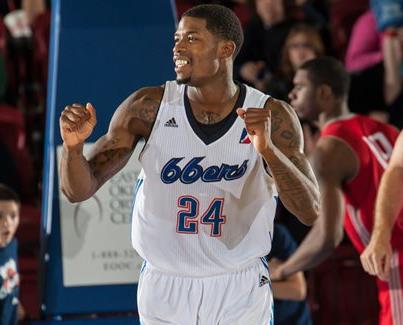
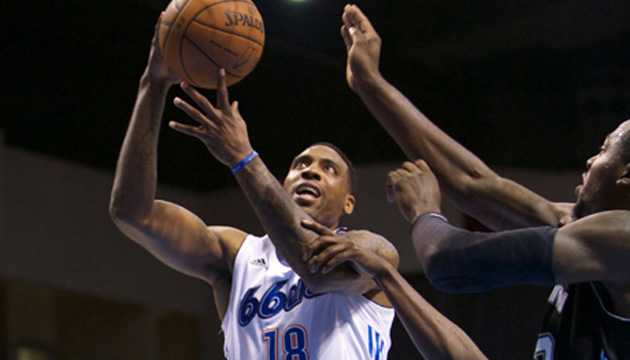
One thing to look out for is the empty roster spot the Thunder have. If they don’t fill this spot with someone in a trade, look for the Thunder to sign veteran forward Rasual Butler. Oklahoma City fans may remember Butler from his days with the New Orleans/Oklahoma City Hornets. He is currently playing for the Tulsa 66ers and may be what the Thunder need in a 3-point shooter and perimeter defender.
butler 66ers

The fact is that the Thunder have the 2nd best record in the league and are coming off of a Finals appearance. Sam Presti is not known to deal in haste or for a quick fix. He believes in sustainability and cap-flexibility, so any deal will have to work for the Thunder’s present and for their future. Needless to say, I don’t really see the Thunder making a move this trading deadline….but I’ll be watching.

 

Oklahoma City Thunder at Utah Jazz Preview (Game 52 of 82)

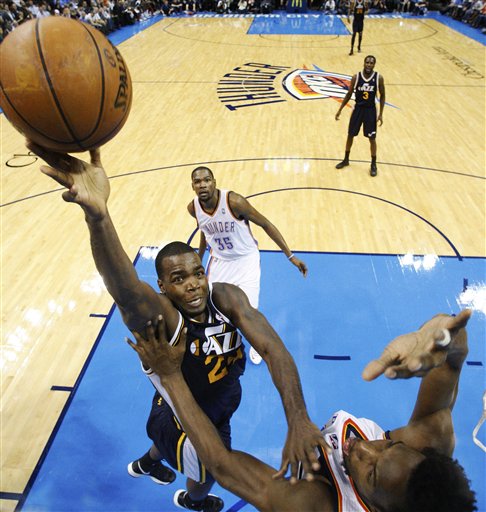
jazz thunder

  • When: Tuesday, 12 February 2013 at 8:00 CST
  • Where: EnergySolutions Arena, Salt Lake City, UT

It was great to watch the Tulsa 66ers play, what amounted to, an entire NBA game this past week. Whether it was Reggie Jackson making a nice dish, Daniel Orton carving out space and grabbing a rebound, Perry Jones III showing flashes of his crazy athleticism, or DeAndre Liggins playing full court defense when his team is up by 20, it was good to see that the Thunder’s youth movement in full effect. It’s a shame that Jeremy Lamb was out with a lower back strain during this four game blowout streak, because he would have had plenty of time to show off his 3-point stroke. But alas, all good things come to an end and I think the easy road ends tonight, when the Thunder play division rival Utah in Salt Lake City.

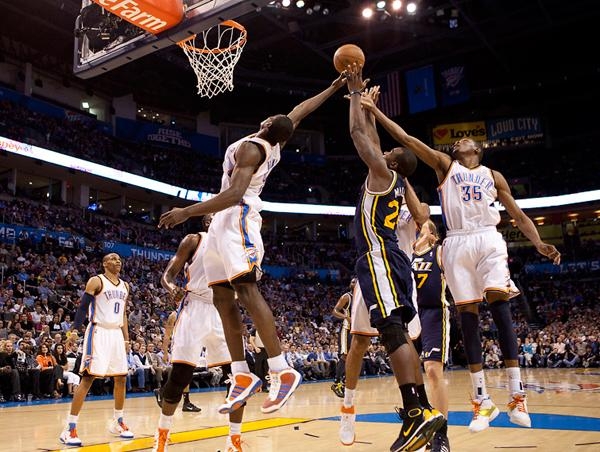
These two teams have previously met one time this season, in late November at the Chesapeake Energy Arena. The Thunder beat the Jazz by a score of 106 – 94, in a game that almost featured a quadruple double by Russell Westbrook who finished with 23 points, 13 rebounds, 8 assists, and 7 steals. After being down by 16 to start the 4th quarter, the Jazz got it down to a 5 point deficit, but eventually got a steady dose of Westbrook and Durant, and succumbed to the Thunder down the stretch.

The Opponent

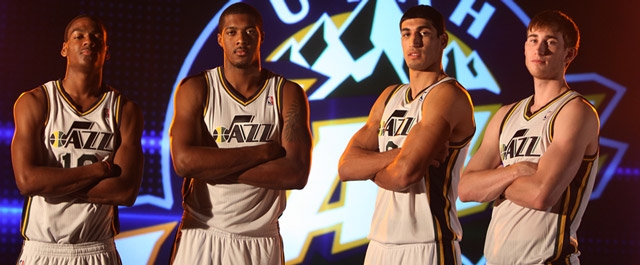
The Utah Jazz come into the game with a 28-24 record, good for 7th in the Western Conference. Statistically, they are a middle of the road team, averaging 98.1 ppg (11th in the league) and allowing 98.8 ppg (18th in the league). The Jazz are in the weird position where they are trying to jump start a youth movement, but are still good enough to get into the bottom seeds of the playoffs. They are led by their two big men, Al Jefferson and Paul Millsap, who are both on the trading block due to their cost and impending free agency. Together they average 32.3 points and 16.8 rebounds per game. Marvin Williams rounds out the front court. On the perimeter, the Jazz have had a revolving door of point guards, to include Earl Watson, Jamaal Tinsley, and Randy Foye. All have been effective for short stints and then get replaced by the next point guard in line. The intriguing players for the Jazz are the one coming off the bench. This is the youth movement that the Jazz is looking to unleash once it gets out of all of its long term contracts this offseason. The Jazz have to see what they have in Alec Burks, Enes Kanter, Derrick Favors, and Gordon Hayward.

jazz young

Probable Starter

Utah Jazz

  • PG – Jamaal Tinsley
  • SG – Randy Foye
  • SF – Marvin Williams
  • PF – Paul Millsap
  • C – Al Jefferson

Oklahoma City Thunder

  • PG – Russell Westbrook
  • SG – Thabo Sefolosha
  • SF – Kevin Durant
  • PF – Serge Ibaka
  • C – Kendrick Perkins

3 Keys to the Game

  • Russell Westbrook – None of the guards the Jazz have can contain Russell Westbrook. They are either too slow or too week to stay with him. In the last game, Westbrook almost had a quadruple double and I don’t see anything different in this game. Westbrook was the Western Conference player of the week last week, and will start his campaign to repeat this week.
  • Controlling the paint – Paul Millsap and Al Jefferson are dangerous players that can go off for double double games at any time. The Jazz offense runs through these two players when the starters are in, and the bench sets run through Enes Kanter and Derrick Favors when they are in. Kanter went off for a career high 18 points when he played against us last time. It is up to Perkins, Ibaka, Hasheem Thabeet, and Nick Collison to maintain the Jazz’s bigs and protect the paint. Paul Millsap, Hasheem Thabeet
  • Home vs. Road – The Jazz sport a .760 winning percentage at home and a .333 winning percentage on the road. Needless to say, they are a much better team in the confines of EnergySolutions Arena in Salt Lake City, UT. For a team looking to bolster its playoff odds, the Jazz will be seeing this game as a must win. Add the that the possibility that the Thunder may be looking ahead to their Finals rematch with the Miami Heat on Thursday, and this game is full of trap game implications. Sufficed to say, I think the Thunder starters will be playing in the 4th quarter of this game.

Liggsanity: Next Man Up

liggs

Last night was the real reason why we cheer for sports. We love watching athletes do things we can only imagine and dream of doing. But we truly relish when an athlete, who may not be as naturally talented as his superstar counterparts, finally gets his opportunity to perform after putting in work in hours and hours of practice. Now don’t get me wrong, every athlete works hard to get where they are at. Kevin Durant puts in just as much time in the gym as Daniel Orton. But we, as fans, probably relate more to Daniel Orton, than to Kevin Durant.

Which is what made last night’s game so special for us fans. Oklahoma City Thunder coach Scott Brooks constantly preaches about “the next man up.” But with the Iron Man lineup that we have, that saying barely has a chance to be put into practice. When the television broadcast for the game started, it was already a given that Serge Ibaka was going to be out with a bruised sternum. What wasn’t known until basically tipoff, was that Thabo Sefolosha would also be out with a strained neck (hotel pillows suck!). So the quick question was who would be inserted into the starting line-up at shooting guard? Would it be Kevin Martin? Would Jeremy Lamb finally be unleashed?

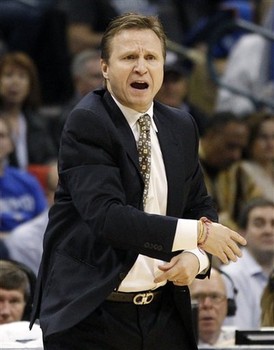
Scott Brooks

The blueprint to who would start was put into play last season. When Sefolosha missed 23 games due to a leg injury, Brooks started by inserting James Harden into the starting lineup. Harden, who had been the Thunder’s 6th man for 3 seasons, struggled in his role as a starter. At the same time, the Thunder’s bench struggled to score points. Brooks adjusted the next game by inserting Daequan Cook into the starting lineup and keeping Harden on the bench. The transition became a lot smoother after that until Sefolosha returned. With Kevin Martin being the Thunder’s 6th man this season and Brooks not wanting to mess with the team’s rotation too much, DeAndre Liggins got the start.

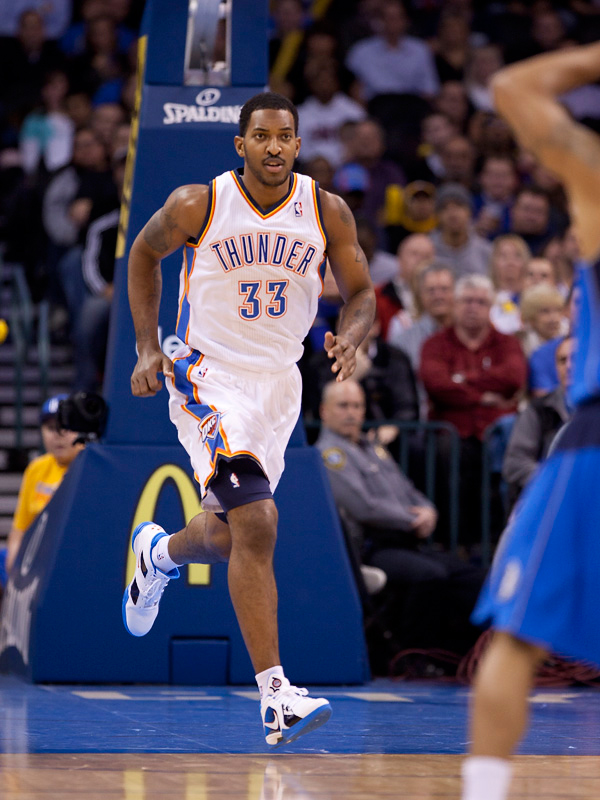
Liggins was a 2nd round pick of the Orlando Magic in the 2011 draft. After playing in 17 games his rookie season, Liggins was released by the Magic in an attempt to clear cap space and a roster spot for the eventual post-Dwight Howard rebuild. (Why Orlando would get rid of a cheap capable wing defender is beyond me.) Liggins was signed by the Thunder as a training camp invite to try out for the final 2 roster spots on the team. The team had 13 guaranteed contracts, and brought in a couple other players as training camp invites to battle for the remaining roster spots. In 5 preseason games (including 2 starts), Liggins averaged 20.8 minutes, 4.8 points, 4.2 rebounds, 1.4 assists, 1.4 steals, and 0.4 blocks per game. Based on his preseason performances and his propensity for energy and defense, Liggins willed his way onto the team as the final cut.

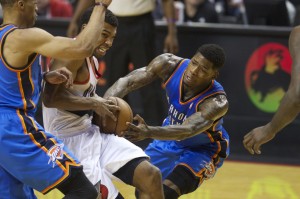
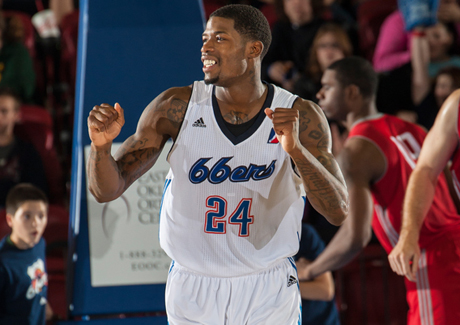
As a 2nd year player, Liggins was eligible to be assigned to the Thunder’s D-League affifiliate, the Tulsa 66ers, throughout the season. As I’ve written before, the Thunder take full advantage of their D-League usage. Liggins was sent down for a 3 game stint at the end of November and another 3 game stint at the end of December. In 6 games with the 66ers, Liggins has been the jack of all trades, averaging 10.2 points, 7.0 rebounds, 4.8 assists, and 1.8 steals per game. Since his last D-League game on December 29th, Liggins has been logging regular minutes off the bench for the Thunder.

d liggs

Liggins took full advantage of his first career start. He played nearly 40 minutes and almost had a double double with 11 points and 9 rebounds. He played suffocating defense on Wesley Matthews and made life miserable for anyone that was around him when he was on the defensive end. Most importantly, he played the entire 4th quarter in a close game without looking nervous at all. In other words, he played like he belonged.

dean

Liggins is just another example of what hard work and perseverance can do for an individual. These are the type of players that the organization is looking for. These are the types of players that relate to us, the fans. Thabo could start tonight against the Phoenix Suns and may not miss another game for the entire season. But for this one game, the Thunder mantra of, “next man up” held firm and true with DeAndre Liggins.

The Thunder and their D-League usage

Rio Grande Vipers v Tulsa 66ers

The NBA’s new collective bargaining agreement brought changes to how teams could use their D-League affiliates. As NBADL president Dan Reed said, “The new CBA will deepen the level of integration between NBA D-League and NBA teams, and marks the next stage of our league’s evolution as the official minor league for the NBA. By encouraging more robust use of our league to accelerate the development of NBA players and prospects, over time we believe this agreement will lead to more NBA teams operating their own NBA D-League affiliate, an increased number of NBA players that develop in our league, and an even better in-arena experience for our fans.” In other words, the NBA felt the restrictions placed on player movement from the D-League to the NBA were hindering the D-League’s ability to reach its full potential as a true developmental/minor league for the NBA. 

In the previous CBA, a team could only assign a player to the D-League up to three times per season. This lack of flexibility made it difficult for teams to assign players because the assigned player still counted on their 15 man roster. Normally, a team would assign a player to the D-League and leave them there for a three to five game stints, if not longer. While this allowed for some consistency with the player, it became an issue for the team if they had to recall said player due to injuries on the NBA roster. It didn’t matter whether it was a 1 game stint or a 10 game stint, it still counted as a D-League assignment. In the new CBA, a team has no limit as to how many times it can assign a player with 3 years or less experience in the league.

 This new rule becomes very advantageous to teams that have their own D-League affiliate. Currently, there are 11 teams in the league that have their own D-League team. The rest of the 19 teams have to divide their assigned players amongst the remaining 5 D-League teams. The teams that have their own D-League affiliates are able to run the same system throughout their NBA and minor league teams. This leads to a level of consistency in all facets of the organization. Even though the players may not be the same on either level, the defensive and offensive systems can be consistent throughout. On these 11 teams, players that are shuffled back and forth between the “farm” team and the NBA team don’t have to learn new terminology or new schematics between the different teams. The schema remains the same and the confidence that usually accompanies consistency starts to show through.

darko

 This has been very evident with the Thunder’s young players. Oklahoma City is in strange position of being a contending team with young players to develop. Most contending teams have veteran-laden rosters and don’t have the time to develop young talent. Though the Thunder’s roster is young throughout, the main core is veteran enough, having gone through 3 successive playoff runs that culminated with a loss in the Finals last season. With great players comes the cost of paying these superstar players. The Thunder currently have $54.2 million allotted to its top 5 players (Kevin Durant, Russell Westbrook, Serge Ibaka, Kevin Martin, and Kendrick Perkins). That number jumps up to $54.3 million with Ibaka’s extension kicking in, but that is without Martin, as he becomes an unrestricted free agent at the end of this season. Assuming that the Thunder re-sign Martin, the Thunder are looking at $60+ million in salary for 5 players next season. The need for cheap labor (rookies and young players) becomes very necessary as a team tries to balance being a contender with balancing the proverbial NBA checkbook.

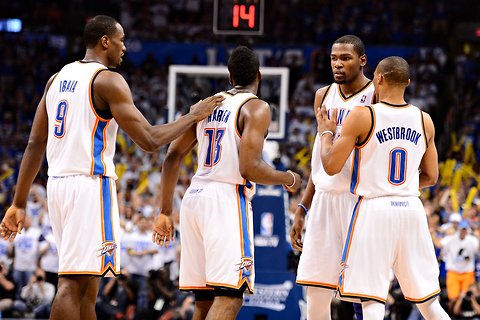
kd rw

 When you are battling for playoff positioning throughout the season, there aren’t many opportunities to develop young talent. Every game counts when a team is looking to secure home court advantage. A slip up here or there can be the difference between a team playing a deciding game at home or on the road. Non-playoff teams have all the time and patience in the world to develop young talent at an NBA level. The Thunder experienced a little bit of this last season when they were forced to play then rookie guard Reggie Jackson heavy minutes as the back-up point guard after Eric Maynor went down 9 games into the season with a torn ACL. Jackson struggled throughout the season in this role and was relegated to the end of the bench by the end of February after the Thunder signed Derek Fisher. With Maynor back this season, the Thunder have been able to send Jackson back and forth between the D-League and the Thunder.

 One of the advantages of this system is that it allows young players to build their muscle memory and confidence. Athletes, especially basketball players, live off of muscle memory. Muscle memory is defined as a form of procedural memory that involves consolidating a specific motor task into memory through repetition. When a movement is repeated over time, a long-term muscle memory is created for that task, eventually allowing it to be performed without conscious effort. An example of muscle memory would be typing. Once you learn where the letters are on the keyboard, you can begin typing at your heart’s content without looking at the keyboard. Basketball involves a lot of fast-twitch muscularity due to the read and react nature of the sport. You see a defender leaning in one direction and you react by driving in the opposite direction in a split second. This type of muscle memory can only be duplicated in in-game settings. During the season, teams cannot scrimmage during every practice to replicate in-game situations. The only way to develop this type of muscle memory is to actually play in the games. If a team is not willing to let its young players develop on the NBA floor, the next best option is in the D-League.

lamb

 That muscle memory is extremely important when a player a called upon to give you 5-6 good minutes in a game. When Jeremy Lamb was put into a game against the Detroit Pistons at the beginning of the season, he played 3 minutes, committed 1 turnover and 2 fouls. He played and looked like every bit of the rookie that he was. But after a couple of games in the D-League in which he averaged 23 ppg, 4.9 rpg, and 3.3 apg, Lamb’s number was called again against the Atlanta Hawks. This time, he performed beautifully in his 5 minutes, scoring 5 points, grabbing 1 rebound, and getting 1 steal, all while effectively guarding Josh Smith, who had 5 inches and 40 pounds on him. I can’t definitively state that there is a direct correlation between Lamb’s time in the D-League and his performance in that one game, but the confidence he played with definitely had something do with his time in Tulsa.

jackson

 Reggie Jackson is another one of those players that has benefitted from his time in Tulsa. After providing a spark off the bench in a game versus the New Orleans Hornets as an energy player, Jackson was sent to the D-League for a 2 game stint in which he averaged 32 ppg, 8 rpg, and 7 apg. Jackson logged significant minutes in the game prior to his 2 game stint and then logged 13 minutes in the prime time game against the Miami Heat on Christmas day. While he didn’t come anywhere close to averaging the number he put up in Tulsa in those two games, the confidence he played with shows a maturation to his game. Even more significant in the Miami game is that he played the back-up point guard role, while Maynor received a DNP-CD.

 The Thunder have also been sending rookie Perry Jones III to the D-League, along with 2nd year wingman DeAndre Liggins and 3rd year center Daniel Orton. While these players have yet to have a breakout moment in the NBA this season, the ability to play in the D-League and then practice with the NBA team will only improve the skill-set and their confidence. Jones III’s development is of utmost importance to the Thunder, as his skill set as a tweener forward will give the Thunder a serious weapon in the front court as they move forward. 

jones iii

 Confidence and playing time are two of the most important things in the development of a young player. While NBA teams may not be able to provide the young players with copious amounts of playing time, they can provide them with an avenue (the D-League) to continue developing and improving, all while playing basketball in real game situations. The Thunder hope that the pipeline from Tulsa to OKC will provide them with cheap, young talent that will allow them to maintain their championship contending core.

Seize The Day

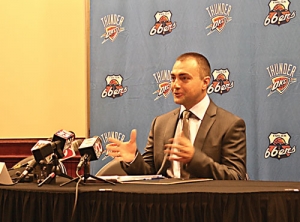
During Sam Presti’s “opening of training camp” press conference last week, he mentioned that starting center Kendrick Perkins would be out for the entire preseason, recovering from the 2 offseason surgeries he had on his groin and wrist. Being that Perkins is a 10 year veteran and a consummate professional, I am not at all worried about his conditioning, or whether he’ll be ready to play once the season starts. As an aside, can you believe that Perkins has already been in the league a full decade? But, in a way, I’m ecstatic that our younger centers now have a chance to prove themselves in some real game action before the season begins.

Oklahoma City’s trainer Joe Sharp and his medical staff have done a great job of keeping the Thunder players healthy, for the most part. And to their credit, the players’ quick healing and sheer stubbornness have also played a part in them hardly missing any games. With that said, I’ve always wondered how Eric Maynor would fare as the starting point guard for the Thunder in a couple games. We all know how he performed in the 4th quarter of Game 2 of the Western Conference Finals in the 2011 playoffs. Was that an aberration or was it really how Maynor would perform with top notch talent consistently around him?  Not that I necessarily want to see Maynor as a starter for an extended period of time, but if Russell Westbrook were to sit out a game or two in the preseason, I wouldn’t mind at all. In fact, I would welcome it.

The biggest detriment to a young player’s development is lack of playing time. Would Darko Milicic be a better player today had he played for a lottery bound team that immediately needed him to develop, instead of being the human victory cigar for the Eastern Conference runners-up Detroit Pistons? We will never know that answer, but it serves as a cautionary tale in how teams handle their young players’ minutes. In the case of the Pistons, there just wasn’t enough room on the team for Milicic to develop on the floor. With Mehmet Okur, Ben Wallace, Tayshaun Prince, Rasheed Wallace, and Antonio McDyess manning the front line for Detroit at different times during a 5 year championship window, there simply wasn’t enough minutes in a game to help develop a young center while still contending.

Which brings us to the three young centers on the Thunder’s preseason roster. Cole Aldrich, Hasheem Thabeet, and Daniel Orton are all trying to find their spots in the NBA. Three different stories that lead to the same two things: playing time and development. Aldrich would seem to hold the upper hand amongst the 3 centers, as he has been with the organization the longest. The 11th overall selection in the 2010 NBA draft, Aldrich has been entrenched as the team’s 3rd center behind Perkins and Nazr Mohammed. He’s shown enough in D-League stints and garbage time to keep the team intrigued with his defensive potential. With Mohammed’s departure to the Chicago Bulls in the offseason, the back-up center position is his to lose.

Sometimes, an opportunity presents itself that you just have to try out. Sam Presti has always been intrigued by Hasheem Thabeet, going all the way back to the 2009 NBA draft. Thabeet was off the board by the time the Thunder selected James Harden with the 3rd pick, but Presti kept close tabs on him after that. There were always rumors of OKC trying to obtain Thabeet during the trading deadline. After 3 disappointing seasons, in which Thabeet had stints on three NBA teams and two D-League teams, the Portland Trailblazers decided not to pick up his 4th year option, thus allowing him to become an unrestricted free agent going into this offseason. Seeing the potential for a low risk, high reward player, Presti signed him to a 2 year, vet-minimum contract. The center, who is pretty mobile, despite being the tallest player in the league (7’3”), has the potential to be a disruptive force on the defensive end. The question is whether he can put all his physical attributes and talent together to be an effective NBA player.

Sometimes injuries play a part in negating a young player’s time on the court. Daniel Orton was drafted in the same year as Aldrich by the Orlando Magic as a possible back-up to Dwight Howard. After suffering a torn ACL during his senior season in high school, Orton once again suffered a season ending knee injury during his rookie season while in the D-League. After recovering in the 2010-11 season, Orton finally saw some game action in the 2011-12 season. The Magic decided not to pick up his 3rd year option, thus allowing him to enter unrestricted free agency. The Thunder decided to bring Orton in as a training camp invite to see how he fits into their system. He probably has the most untapped potential out of the 3 young centers on the team. Rumor has it that if the Thunder don’t sign Orton to a contract, they may try to keep him in their system through the Tulsa 66ers, their D-League affiliate.

The preseason will be a great opportunity for these three young players to show what they got. It may actually be their last chance to prove they are NBA-caliber players. The NBA is a league of “what have you done for me lately?” If a player hasn’t shown anything in his allotted time in the league, you can bet there is another player somewhere looking to seize the day and take that spot.

OKC Thunder: Training Camp Roundtable

Special thanks to the contributions by Zebulun Benbrook of Welcome To Loud City (WTLC) and by one of the smartest basketball minds I know, Max Trueblood (MTB). 

With the turning of the seasons, there are two things you can always look forward to: colder weather and the start of NBA training camps (unless there’s a lockout). Most of the players are already setting up shop in their NBA cities, preparing for the upcoming season. No matter how familiar you are with your team, a new season always brings about new questions. Here are a couple of questions in regards to the beginning of training camp for the Oklahoma City Thunder:  

  • 1)      With the recently finished strike shortened season, a trip to the Finals, and involvement in an Olympic tournament, how do you think Scott Brooks will handle Kevin Durant, Russell Westbrook, James Harden, and Serge Ibaka during training camp?

NTTB: I think they will limit their availability in preseason games, but I don’t think they will limit their training camp practice time. Last season, teams hardly got any practice time due to the compacted schedule. Less practice time meant less time to try new schemes and less time to build cohesion. Luckily for the Thunder, they brought back their entire core and all of their coaching staff from the previous season and didn’t need the practice time in training camp to indoctrinate new players or learn new schemes. This year it’s more of the same, but with more time for practice. Despite their age, the Thunder are a veteran team and the extra practice time will be invaluable to the younger Thunder players, such as Reggie Jackson, Cole Aldrich, Perry Jones III, and Hasheem Thabeet.

WTLC: Once players get to a certain point of their careers, I think you’ve gotta give them room to breathe. Durant and company have proven themselves in the context of the NBA, and while they have room for improvement, they’re pretty much known quantities in the sense of what they can and can’t do. My thought is that Training Camp will focus on the younger guys on the team, like Cole Aldrich, PJ III, and Reggie Jackson. And I’d like to think that it will focus on trying to get them adjusted to the team, rather than improving a certain skill. The Summer League and D-League are more focused on personal improvement, in my opinion.

As for the stars, I’ve gotta think Scott Brooks will make it business as usual. Everybody’s extra motivated after the Finals loss, and they are coming off of a break, even if it is shorter than normal. The NBA season is a long grind, and if you can’t make it through training camp, you probably won’t be able to make it through the dog days of January, either. I think what’s important to remember is that part of the reason Tim Duncan is so successful is that, even in his old age, he still allows Gregg Popovich to coach him like he was a rookie. It sends a message to the rest of the team about how to act, and what it takes to make it to the top. If Durant, Westbrook, Harden, and Ibaka act the same way, then we’re in for a long road of success.

MTB: I’m usually not a fan of preferential treatment for superstar players but given the busy off season for the “Big 4”, I wouldn’t have a problem with them getting a few days off here and there.

 Let’s not forget, this has basically been 3 straight busy off seasons for KD. He had the World Championships in 2010, then played in just about every street ball game imagineable last summer and of course the Olympics this time. 

  • 2)      Out of Daniel Orton, Hollis Thompson, DeAndre Liggins, and Andy Rautins, who earns the coveted 15th spot on the team, and why?

NTTB: I’d say it’s a two man battle between Hollis Thompson and DeAndre Liggins. These two players are both long, which fits into the Thunder’s DNA, with Liggins being more defensive minded, and Thompson being more of a 3-point shooter. With so much of the offense being predicated on dribble penetration, the team would probably benefit from another shooter on the team. So, I would give the nod to Thompson, with Orton, Liggins, and Rautins leading the Tulsa 66ers the NBDL title. 

WTLC: Well, that’s a tough one. I haven’t seen too much of Hollis Thompson, but he’s pretty much the Perry Jones of the second round. He was considered a legitimate prospect and worked out for several teams, but a lot of teams decided to draft and stash Europeans with their later picks, letting him fall off the board. It really depends on how well he can return from his groin injury, and whether he’s really enough of a scorer to be considered better than Daequan Cook, or Andy Rautins. Rautins will be a good litmus test to see how good Thompson really is. Rautins is an excellent shooter, but he’s not very dynamic, which is why he’s never really caught on in the NBA. I’d only see him making the roster is Thompson doesn’t really pan out.

The strongest candidate, aside from Thompson, to make the roster is DeAndre Liggins. He didn’t get too much time with the Magic last year, but he was very efficient in how he played. He never took an unreasonable shot, and he he has good defensive awareness. He’s kind of like Kyle Weaver, but with a bit less energy. The big knocks on him are that his shot is extremely inconsistent (he’s airballed open threes) and that he works best under a slow pace, which doesn’t help when you’re playing with a fast breaking team like the Thunder.

The other guy on the list is Daniel Orton, but I think he’s really only there for the hometown appeal, as he went to Bishop McGuiness. When you see how many big men the Thunder have stockpiled, and the fact that Orlando didn’t re-sign him despite being really thin at center, seeing him make the roster seems like a pipe dream.

MTB: I’m going to roll with Andy Rautins on this one. I think the Thunder have tons of athleticism so an athlete like Liggins or Thompson isn’t really needed but with the team possibly cutting back on bench payroll in anticipation of retaining Harden at a max salary, I could see Presti seeing if Cook has a short term replacement and that would be a shooter. Rautins is the best of the group.

  • 3)      Heading into training camp, how will Perry Jones IIII fit into the rotation, if at all?

NTTB: With Kendrick Perkins coming back from two offseason surgeries and Nick Collison bound to suffer from one of his yearly training camp injuries (sore groin, sore ankle, sore knee, etc), I’m pretty sure we’ll get some idea how he will fit into the rotation right away. He’ll get a lot of reps in practice in our small ball lineups and that’s primarily where I see him being used in the rotation during the season.

WTLC: He won’t be a rotation guy. There’s too few minutes to split with Cole Aldrich, and Thabeet is probably ahead of him due to his previous NBA experience. It really all depends on how he does in training camp, but I don’t think he’ll see regular minutes unless there’s an injury or Cole Aldrich doesn’t live up to expectations.

MTB: I wouldn’t mind seeing Perry get some time in the D league this year. If Serge or Collison get hurt, he can always be called up from Tulsa.

I don’t know enough about Jones to really gauge where his confidence is but lots of young players lose confidence when they get drafted well below where they were expected to be taken. Of course, there are exceptions. Rashard Lewis and Deandre Jordan come to mind. But getting big minutes and success on the D league level could wind up being what’s best in the long run for him. 

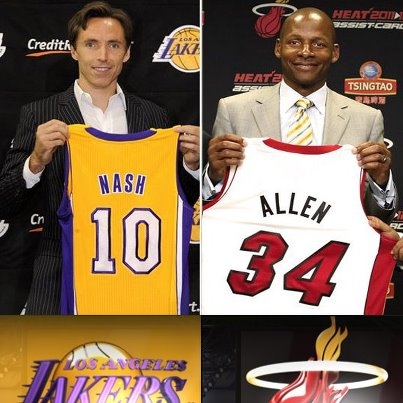
  • 4)      With other teams making significant moves to get better (Lakers acquiring Dwight Howard and Steve Nash / Miami acquiring Ray Allen and Rashard Lewis), is there any way that the Thunder got better without making any major moves? 

NTTB: I think we’ll get better organically because of our youth, but the line on the organic improvement line graph is probably starting to plateau. There’s probably not much more that these guys can do, besides averaging a triple double for a season, that would register as far as team improvement goes. Getting Perry Jones III in the draft negated any necessity to obtain a scoring big. I expect the Thunder to be a big player after the trading deadline, though, for a veteran big man.

WTLC: Well, we got better in the sense that we’ll have another year under our belts to develop. How much that will translate into next year remains to be seen. The Thunder were really sputtering late in the season, dropping a lot of winnable matchups and letting non-playoff teams come back from huge deficits. But when you get right down to it, the Thunder have the talent to beat the Heat and the Lakers. What they need to do is come up with more creative solutions for their obvious flaws.

But on a tangible level, there is improvement in sight. Cole Aldrich might be more of an offensive threat than Nazr Mohammed was, and he was working on a hook shot while in the Summer League. Kendrick Perkins will be fully recovered from his injury. Eric Maynor will be returning, offering a steady offense and a refreshing break from Derek Fishers’ 0fers and terrible defense. Serge Ibaka’s jumpers are getting come consistent. And, of course, James Harden will have had the experience of being on a boat.

MTB: I think the Thunder got better just based on the fact that their star players haven’t hit their prime years yet. It’s rare that All star caliber players take a step back before they hit their prime so I see the Thunder getting better via the internal improvement route. 

  • 5)      Are the Thunder now this season’s participant in the reality show drama known as the “player vs team negotiation” game that the media will incessantly babble about for possibly the next 300 days?

 NTTB: I don’t think so. There are two players out in LA that will be causing a bigger stir with their impending free agency (Dwight Howard and Chris Paul). Plus, the Thunder organization is very hierarchal in nature, and if the top (owner Clay Bennett and GM Sam Presti) remains quiet, you can bet the bottom (players and coaches) will remain quiet. This will not be an issue at all this season. It wasn’t an issue when Westbrook’s extension was in play and it won’t be an issue with Harden’s being in play.   

WTLC: Yes, 100 times yes. If there’s one thing the media love to babble on about, its’ contract negotiations. Nevermind the fact that the Thunder are a title threat now, what are we going to do when Kevin Durant comes off of contract in 2016?! Aye aye aye. Just bring on the basketball, man. I’ll worry about the size of James Harden’s penthouse later. 

MTB: I sincerely hope not. I’m really hoping that Presti and Harden’s representation can just come out and say that they will table negotiations until next summer. That will take the media out of the picture and will simultaneously take the pressure of Harden. Let’s see what type of numbers he can put up and then negotiate a contract based on production.

In conclusion…..one more week!!!!!!!

Summer League: Hope Springs Eternal

One of my favorite things about the offseason is Summer League. Everything is so optimistic during this time of year. That late 2nd rounder you got from another team for cash considerations? Of course he’s going to become a 3-time All Star for you. The combo guard you took with the 27th pick? You’d be crazy not to think he’s isn’t going to average 20 ppg this upcoming season. The 2nd year player who sat at the end of the bench all of his rookie season, and was the team’s honorary “human victory cigar”? Yep, he’s going to make the leap. Everything about Summer League is based on potential and hope.

In reality though, 80% of the players in Summer League will never get a whiff of the NBA. If you follow your team as voraciously as I do, you’ll learn the players’ names and then forget them just as quickly when Summer League ends. The only ones that stick in my mind are the ones that actually make the team, and the ones that end up with the Thunder’s D-League team, the Tulsa 66ers. And it truly is a shame, because for 99% of us fans, these players are just advancing to a point in their basketball careers that we could only dream of advancing to. There really are some good basketball players in Summer League, but like any other situation in life, if they are not cultivated in the right system, they go to waste. 

That’s why I love cheering for the Thunder during Summer League. This is a team that takes pride in cultivating players and rewarding them for their hard work and dedication. In 2011, Robert Vaden, our 2009 2nd round pick, was signed to play the final week of the season and was added to the playoff roster for the Thunder. Did he ever play an actual game for the Thunder? No, but he got to practice with the team, sit on the bench in a suit,  and cash a couple paychecks signed by Clayton Bennett and David Stern. Last season, our 2nd round pick from 2010, a little known forward from Florida State named Ryan Reid was signed at the beginning of the season. He actually played in a couple games and averaged 1.6 points. 

This year’s squad features a guy the team is grooming to become the back-up center (Cole Aldrich), a guy they are grooming to possibly become the back-up point guard one day (Reggie Jackson), a guy who could be an asset if injuries ravage the team (Lazar Hayward), and a rookie they are grooming to possibly become a rotational big someday (Perry Jones III). These players are locks to be on the opening day roster, barring any trades. They are in town to either sharpen their skills or test new skills. 

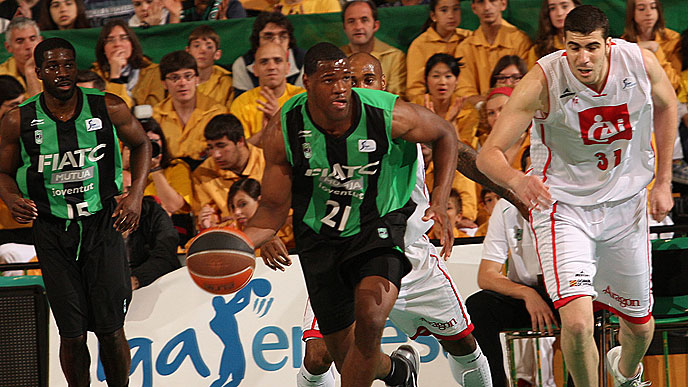
The other guys, the ones I like to call the Fringers, are usually just on the outside looking in. Back on the Thunder squad is Ryan Reid, trying to make it back to the NBA after being cut in the middle of last season to make room for seasoned veteran Derek Fisher. Another guy battling for a roster spot is Latavious Williams. This athletic forward made a bit of history in 2009, becoming the first high schooler to be drafted straight out of high school into the NBA Developmental League. The next season, when he became eligible to be drafted into the NBA, he was selected by the Miami Heat in the 2nd round, and was immediately traded to the Thunder. After playing one more season in the D-League, Williams signed to play for FIATC Joventud in Spain last season, winning Most Spectacular Player of the ACB League. Another player trying to get back into the league is Morris Almond, who is something of an NBDL superstar, but has never quite put it all together in the NBA. Basically, 3 guys possibly battling for one roster spot. 

Then, there are the Dreamers. The guys we should all be cheering for, because they remind us of our short lived hoop dreams. Kent Bazemore, Dwight Buycks, Marquez Haynes, John Holland, James Mays, Gary McGhee, and Garrett Temple. Remember those names, because you probably won’t hear of them ever again. Is there a chance some of them will make it as end of the bench guys in the league? Sure. And they’ll probably have a great story to tell about their journey to the NBA. But for the most parts, these guys will fade into overseas and D-League rosters. 

Such is the life of most professional basketball players. Always remember, that professional doesn’t just mean NBA. The players that play in the Philippines for pay are also considered professionals. As are the ones that play in Iran. And the ones in Mexico. The road in the journey to do something you love isn’t always paved in gold and silver. And it very rarely is a straight line. So I commend and salute the Fringers and the Dreamers for doing what they love, even if the road is full of potholes and roadblocks. So keep on hooping, gentlemen, because if many of us were given that opportunity, we’d be doing the same thing.