Tag Archives: Seattle Supersonics

2013 OKC Thunder Draft: A Postscript

2013 NBA Draft

The NBA draft to me is a time of hope. Whether your team has the first pick or the last pick in the draft, there’s always a sense of optimism that the guy your team drafted is destined for great things. And that’s why I’ve always enjoyed the draft. When the Thunder started becoming one of the better teams in the league, their position on the draft board started rising into the late first round. Their draft position from the last 5 seasons went as followed: 4th (still as the Seattle Supersonics), 3rd, 18th, 24th, and 28th. Even with those high draft numbers though, we’ve been able to get good players late in the draft, namely Reggie Jackson and Perry Jones III.

Flash back to October 28th, 2012. As soon as the details of the James Harden trade came out, and I saw that we got a first round pick from what was almost guaranteed to be a lottery team (Toronto) and a 2nd round pick, which was almost guaranteed to be in the lower to mid 30’s (Charlotte), I started paying more attention than usual to the 2013 NBA draft. I would visit sites dedicated specifically to the draft (NBADraft.net and DraftExpress.com) and would study up on the prospects. I knew how to spell Giannis Adetokunbo before he Greek-a-nized his last name to Antetokounmpo.

For a team that was on the cusp of a championship the season before, the lottery pick could have been the final piece in the championship puzzle. While it is true that the Thunder gave up a big piece in Harden, having a possible lottery pick may have made finding his replacement a bit easier. Also, the possibility of drafting a good player on a rookie salary for, at least, 4 seasons is like manna from heaven for a team teetering on the luxury tax line.

Needless to say, when the Thunder were eliminated in the 2nd round of the playoffs, my focus quickly switched to the NBA draft. With two picks in the first round, No. 12 and 29, and one early pick in the second round, No. 32, in what was deemed to be a weak draft, my expectations were that we weren’t going to be using all the picks. By most accounts, the teams in the top 5 weren’t necessarily exalting the selection of prospects at the top of the board. I thought the Thunder were going to do something big (i.e. trade up or trade for good veteran player).

It’s a funny thing about expectations, though. They can sometimes cloud your vision. When the picks started coming in, and guys that I thought were high on the Thunder’s draft board (Alex Len, Nerlens Noel, Ben McLemore, and CJ McCollum) started dropping, I thought it was prime time to make a trade and move up. But as those players started getting drafted, and every “We have a trade,” from David Stern yielded nothing for the Thunder, I started to feel disappointment.
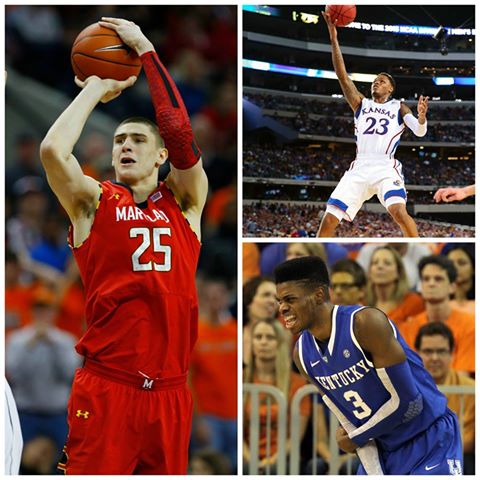
len, noel, mclemore

As the draft went along and we only made minor moves, I literally had a feeling of utter dejection about this draft. I mean, this was the “Harden redemption” draft. We were supposed to get ourselves a blue chip prospect to join with Jeremy Lamb in order to have a feeling of success when it came to the James Harden trade. And it didn’t necessarily have anything to do with the players we drafted. It just felt like we let a golden opportunity go by without even trying to do anything.

But, alas, a little bit of sleep and a little bit of retrospect usually puts things into perspective. The more I thought about the players we got in this draft, the more I liked it. First off, this was not your draft if you are into instant gratification. This was a developmental draft, just like the last two drafts for the Thunder have been developmental drafts (Jackson, Lamb, and Jones III). As I analyzed this draft, I saw that we obtained players that will greatly help us in the future.


No. 12 – Steven Adams – C, University of Pittsburgh
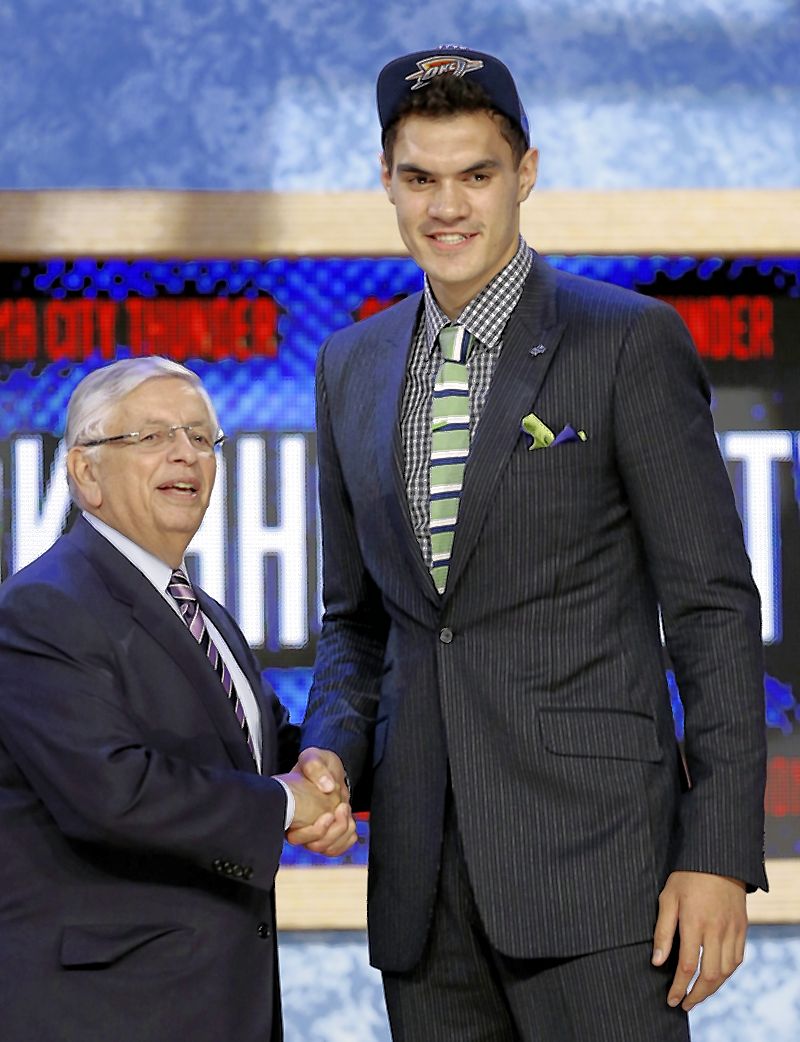
adams draft

The Thunder don’t necessarily have a good track record with it comes to centers. Since they’ve arrived in Oklahoma City, the Thunder have drafted two flame-outs and one Eurostash: Byron Mullens, Cole Aldrich, and Tibor Pleiss. The carryovers from the Seattle days (Mouhamed Sene, Robert Swift, and Johan Petro) were 21 feet of nothingness, and the current placeholder, Kendrick Perkins, just posted a negative PER in the playoffs. To say that the center position is a position of need is an understatement.

The 7 footer from New Zealand is a late bloomer, but has the tools to be successful in the NBA. He’s an athletic big man with quick feet known for his defense. He won’t be asked to contribute immediately and may spend a good deal of his rookie season in Tulsa playing for the Tulsa 66ers. With two of the top 10 players in the NBA in Kevin Durant and Russell Westbrook, the Thunder don’t necessarily need an offensive savant in the middle. What they do need is someone that can move around, play defense, grab rebounds, catch a pass, and finish when they are within 5 feet of the basket. I have no doubt that Adams will be able to do that.


No. 26 – Andre Roberson – SF-PF, University of Colorado
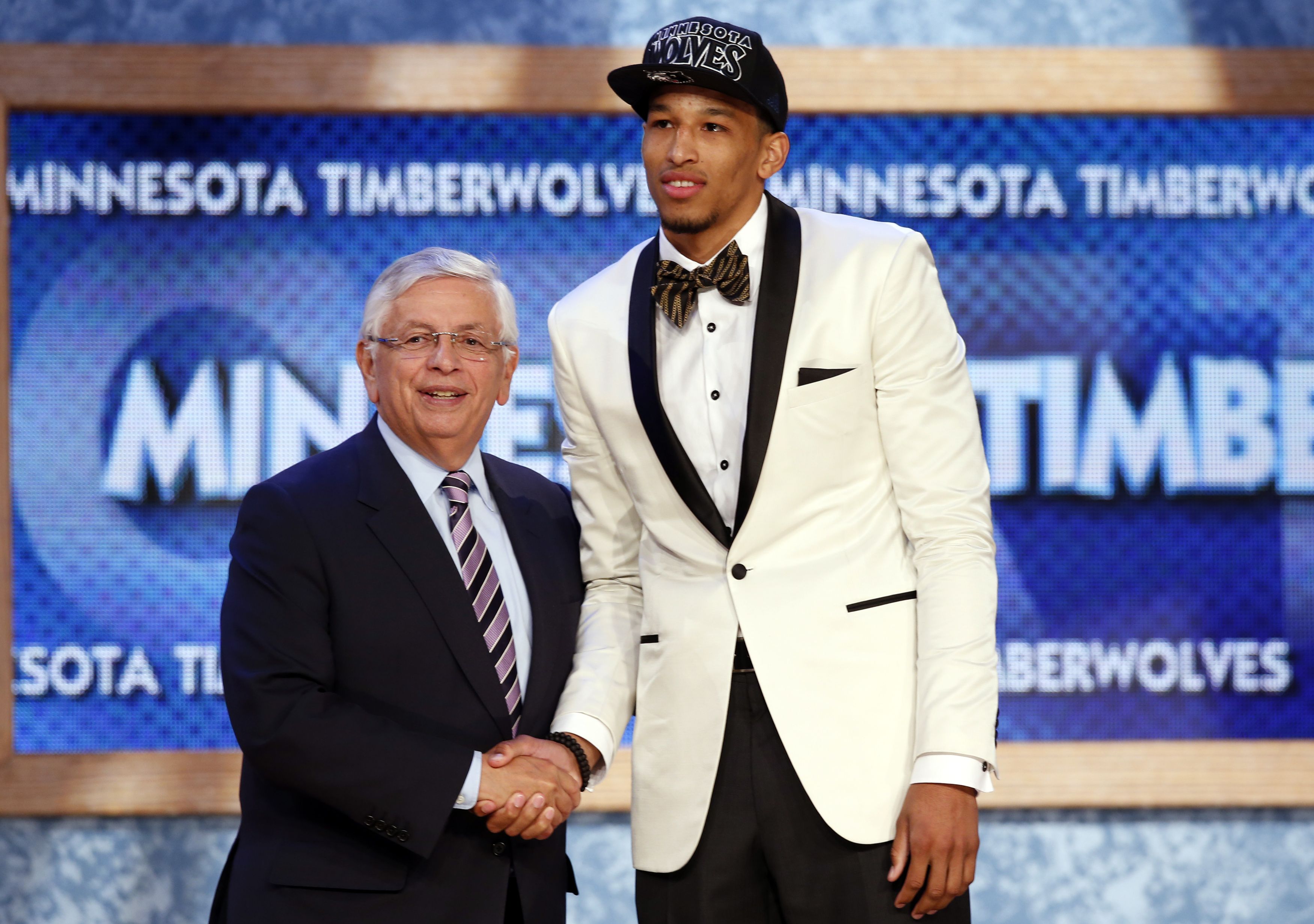
Roberson from the University of Colorado shakes hands with NBA Commissioner Stern after being selected by the Timberwolves as the 26th overall pick in the 2013 NBA Draft in Brooklyn

This pick was a bit of head-scratcher to me. Not necessarily the pick itself, but the fact that the Thunder moved up 3 spots (albeit just for cash) to make the selection. Roberson was creeping up on every mock drafts, but wasn’t in line to be picked in the first round. Every mock draft had him falling to the beginning of the second round. Why the Thunder felt the need to move up to grab him? We may never know. Being that he is a Kawhi Leonard-like player, maybe the Thunder caught wind that the San Antonio Spurs were looking to draft him with the 28th pick.

Roberson is a bit of an enigma. He’s 6’7, but has a 6’11 wingspan and was second in the NCAA in rebounding at 11.2 per game. Also, he’s one of the premier defenders in college. Those traits usually translate very well to the pro game. His offensive game is a different story. He struggles for consistency on the perimeter, but excels if he gets close to basket on dribble drives, cuts, and offensive put back. Because of this, he is often compared to Hall of Famer Dennis Rodman.
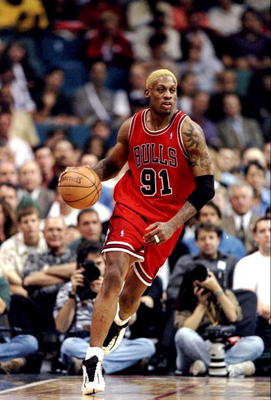
rodman

In a system and on a team that values players that can guard multiple positions, Roberson should eventually find a spot in the rotation as a defender. It wouldn’t surprise me if Roberson saw the most minutes with the Thunder of all the Thunder rookies.


No. 32 – Alex Abrines – SG-SF, FC Barcelona (Spanish ACB League)
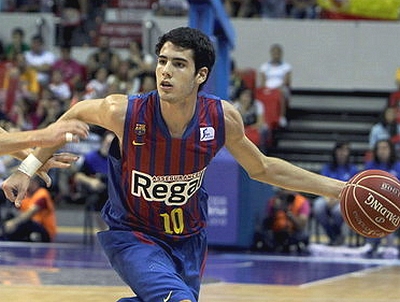
alex abrines

Abrines is a stash pick that will probably stay in Europe for 1-2 more seasons. He asked teams not to drat him late in the first round, as the guaranteed money would be less and he would probably have to fit some of the bill for his buyout. The Thunder took a chance and drafted him with the second pick of the second round. He is a smooth shooting wing player with a flair for the dramatic that many have compared to Rudy Fernandez and Drazen Petrovic.

At 19 years of age, Abrines will have to improve his game and strengthen his body before he’ll be able to compete in the NBA. The only negative for the Thunder is that Abrines is young enough to improve to the point where going the NBA would not make financial sense, causing him to stay in Europe for the rest of his professional career.


No. 40 – Grant Jerrett – PF, University of Arizona (selected by Portland, traded to Oklahoma City for cash considerations)

grant jerrett

Just when I thought there was no way we would draft three rookies to actually play on the team this upcoming season, the team goes and acquires a shooting big man in the 2nd round. At 6’10, Jerrett showed great potential as a shooter and as a stretch 4 in the NBA. At this point though, perimeter shooting is his only noticeable strength. Jerrett has a tool the team needs, but will need to put in a lot of work to make the opening day roster. He may be a Ryan Anderson-type player, but he may have benefited from another season in college. If his strengths don’t outweigh his weaknesses in Summer League and during the preseason, Jarrett, as a second rounder, is a good candidate to not make the team.
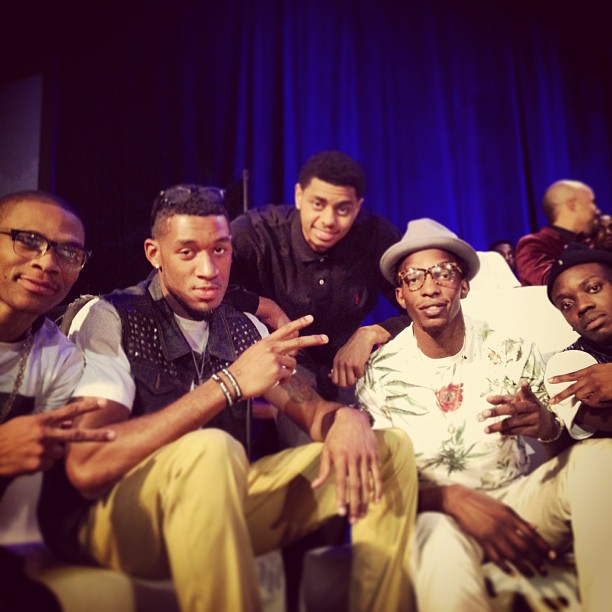
thunder team

Surprisingly, this draft said more about the players already on the team than those that were drafted. The team’s unwillingness to part with Jackson, Lamb, or Jones III to move up showed the confidence the team has in the young guys, and shows how the team values cohesiveness and development. With three rookies on the roster, look for the team to try to sign one or two veteran free agents to even out the youth on the bench.

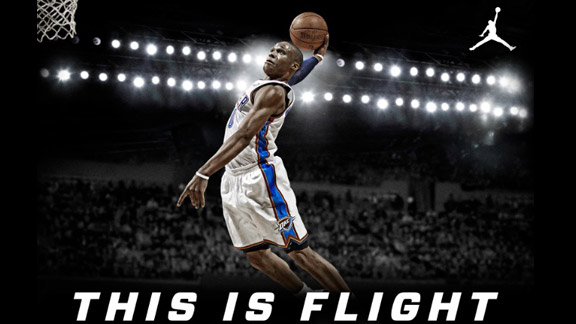
Westbrook and The Boost

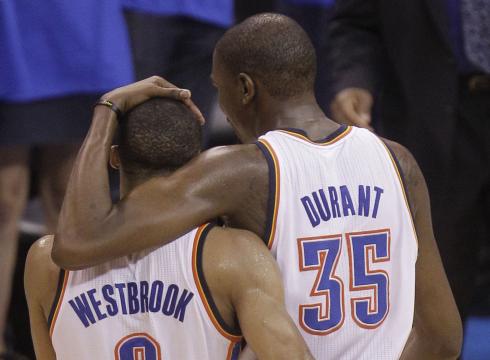
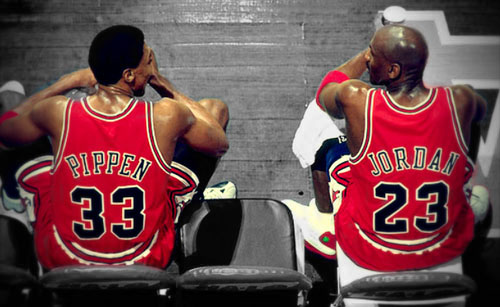
This past week, Russell Westbrook signed with Jordan Brand, after being with Nike for the first 4 years of his career. While Westbrook has carved out his own following of fans, he’s always been known as Kevin Durant’s sidekick. The Robin to Durant’s Batman. This generation’s ultimate second banana. There hasn’t been a sidekick this good since Scottie Pippen. But, Pippen never received the boost in popularity that Westbrook is about to receive.

What qualifies for a sidekick? A sidekick has to be a rookie or a very young player that is brought in after the primary player is established to specifically fill the needs the team is missing. Another qualification is that the pairing has to be together for 5+ seasons. For example, Scottie Pippen was obtained by the Chicago Bulls in a draft day deal, while already having an established superstar in Michael Jordan. Russell Westbrook was drafted by the Seattle Supersonics (Oklahoma City Thunder) after they already had an established young star in Kevin Durant. Anfernee Hardaway almost made it to great sidekick status, but injuries and Shaquille O’Neal’s departure to the Los Angeles Lakers negated that possibility. The Lebron James/Dwayne Wade/Chris Bosh mash-up wouldn’t qualify as sidekicks because they were all alpha males on their respective teams before they joined forces. Kobe Bryant and the aforementioned O’Neal made a great duo, but they were brought onto the Lakers the same year and often quibbled over who was the alpha male. 

To understand the road Westbrook is on, it is important to see what happened to Pippen throughout his career. When Pippen first started college at the University of Central Arkansas, he was a 6’1” walk-on that needed to moonlight as the team’s manager to pay his tuition costs. After 3 more collegiate seasons, a 7 inch growth spurt, and consensus All-NAIA player honors, Pippen was drafted with the 5th overall pick in the 1987 NBA draft to the Seattle Supersonics (who subsequently traded him to the Chicago Bulls). The scouting report on him read as follows:

  • 7’4” wingspan and a 41” vertical
  • Strong outside, but needs work inside
  • Not bad driving to the hoop, but doesn’t look to drive
  • Good foul shooter
  • Can make a three
  • Terrific passer at that position
  • Won’t give you much of anything on the offensive glass, and is a so-so defensive rebounder
  • Excellent defensively and a disruptive force in the passing lanes
  • Good ball handler, but commits a ton of turnovers
  • Could start on most teams

Not necessarily the sexiest of scouting reports for someone who would eventually become one of the top 50 players in league history. While Pippen built his legacy on defense, he was also an apt offensive player, becoming the archetype for the point forward position. During his prime (1989-1999), Pippen had per game averages of 19.1 points, 7.1 rebounds, 5.9 assists, 2.2 steals, and 0.9 blocks. Not necessarily the offensive prowess that Larry Bird possessed, but with a stat line like that, Pippen should have been heralded as his generation’s defensive Larry Bird. Instead, he was teamed up with arguably the greatest player of any generation in Michael Jordan. There usually isn’t a lot of spotlight left when you are playing with the greatest. Ask 100 people who the lead singer of Aerosmith is, and most will answer Steven Tyler. Ask them who the drummer is, and not many will know the answer.

Pippen’s play on the court should have spurred him to more shoe deals, more advertisement contracts, and more widespread popularity. And yet, when his career was all said and done, you couldn’t help but wonder whether Pippen got everything that was owed to him. There were the stories of how Pippen felt he wasn’t getting paid what he deserved (which he wasn’t). There were the rumors that he felt slighted being outside of the limelight, when he provided so much to the team. While he did have his own shoe line (the PIPs) from Nike, they only lasted about two series. So, needless to say, not many companies bought into Scottie Pippen.

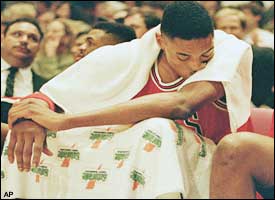
It wasn’t Jordan’s fault, though. Most of the blame lies squarely on Pippen. He didn’t have the same tact with the media that Jordan did. He was dismissive and defensive at times with reporters. Then there were the crunch time situations. Those critical times in games that live in lore and become mythologized. It’s not that Pippen didn’t perform well during those times. On the contrary, he performed great during crunch time. But he’s instead remembered for the times he quit on his team in the most critical of moments. There was the time he sat out Game 7 of the 1990 Eastern Conference Finals against the Detroit Pistons with a migraine headache. The Bulls eventually lost that game. Probably the most damning, though, was the one where he sat out the final 1.8 seconds of Game 3 of the 1994 Eastern Conference Semifinals against the New York Knicks because Phil Jackson drew up a play for Toni Kukoc to take the final shot, instead of Pippen. To make matters worse, Kukoc actually hit the game winner. This one was the most damaging because it came at a time when the Bulls were his team due to Jordan’s hiatus into baseball. When you are known to quit on your team during crucial periods, your popularity takes a big hit.

Which brings us to the best sidekick of this generation, Oklahoma City Thunder guard Russell Westbrook. Like Pippen, Westbrook was not highly decorated coming out of college. Like Pippen, Westbrook was drafted by a team that already had a young star in Kevin Durant. Like Pippen, Westbrook is seen as not being very media friendly. Coincidentally, Durant, much like Jordan, is viewed as a media favorite. And, while not by his own doing, Russell was also involved in a critical game snafu, when Thunder coach Scott Brooks sat an ineffective Westbrook for the entire 4th quarter of Game 2 of the 2011 Western Conferences Finals.

But, not everything is negative when it comes to Pippen and Westbrook. Both of these players are insanely loyal to their teams and teammates. Pippen had a couple opportunities to seek greener pastures during the championship run, but decided to sign for less to stay with the Bulls. Westbrook could have done the same last season, but decided to sign for the allowable max. Both players are highly competitive, with possible chips on their shoulders from being labeled second bananas. Both players are very team oriented, as evidenced by them sacrificing a little of their own games to coexist with two great players. The good severely outweighs the bad when it comes to Westbrook and Pippen, but the bad usually has more advertising power.

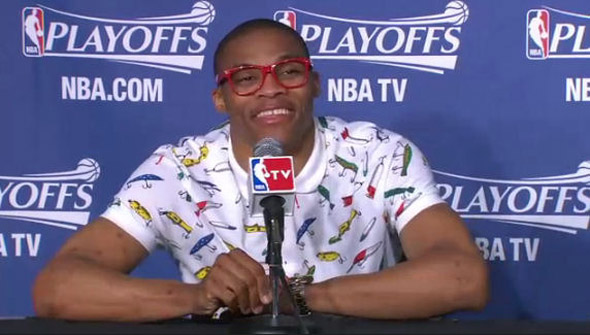
Which is why I found the signing of Westbrook to Jordan brand to be a bit ironic. Not ironic in the sense that he doesn’t deserve it. But ironic in the sense that a move like this will probably propel Westbrook into superstar territory, as far as media exposure goes. Into a territory that Scottie Pippen unfortunately never reached. With an endorsement team that includes Carmelo Anthony, Derek Jeter, Chris Paul, and Michael Jordan, himself, Russell Westbrook will have plenty of opportunity to expand his brand. He already has a slogan in place (WhyNot?), and already has a following outside of basketball because of his unique fashion sense. In a way, Jordan is helping this generation’s top sidekick become what his sidekick should have become.

The Thunder and their Manchurian Candidate

During the offseason, the Oklahoma City Thunder did something very unconventional. Instead of hiring a scout to serve as their video coordinator/analyst, they, instead, hired premier basketball video blogger Sebastian Pruiti. For those of you who don’t know who Pruiti is, he ran a website called nbaplaybook.com, in which he used clips of games to break down film and explain why a team may or may not have been successful in certain sets. Pruiti did a great job of explaining the content in a way that even the average NBA fan could understand.

His understanding of the game was not without any background. He served as a volunteer assistant coach for the New Jersey Institute of Technology Highlanders. Then, he served as an assistant coach for the Fort Wayne Mad Ants of the D-League. Needless to say, the man is an astute basketball mind. One of the best basketball writers of our generation, Bill Simmons, noticed this and decided to hire Pruiti for his newly formed Grantland multimedia conglomerate. In fact, Simmons was the one that broke the news on Twitter that Pruiti had been hired by the Thunder.

The thought of a Simmons’ disciple going to the Thunder, though, got my conspiracy  mind thinking. On the one hand, Simmons has written about his disdain for how the Seattle Supersonics eventually became the Oklahoma City Thunder. Not that he necessarily carries any ill regard for the team itself, but more for the process that eventually landed the team in the Great Plains. As punishment, he has yet to call the team by its current moniker in any of his writings, instead referring to them as the Zombie Sonics. On the other hand, Simmons’ crowning achievement in life would be to someday become an NBA GM. It’s a dichotomous train of thought that is one part Manchurian Candidate and one part Great Expectations.

Think about it. Before Simmons hired Pruiti, he probably kept tabs on him for years like a spy cultivating an asset. He was the best video blogging analyst in the game and worked on several basketball-related sites. As a basketball junkie, Simmons had to immediately recognize his work and his talent. One of Simmons’ most important traits as a writer is his ability to read situations before they occur. He has correctly predicted the “Ewing Theory” on many occasions, and has a keen understanding of how people will react to certain situations. These are all characteristics of a great point guard; someone who sets things in motion, directs the traffic, sees things before they happen, and makes proper adjustments whenever necessary.

I could see Simmons playing chess, while everyone else plays checkers. He knew that Thunder GM Sam Presti is very analytical and values statistics as a means to better answer questions. He also knew that Presti is young and probably very in tune with the basketball blogosphere and advanced cybermetrics. In terms of probability, there’s a lot better chance that someone like Presti or Houston Rockets GM Daryl Morey would hire Pruiti, than someone like Detroit Pistons GM Joe Dumars or Indiana Pacers GM Donnie Walsh.

Eventually, Presti finally took the bait and hired Pruiti. And with that, Simmons finally had his Manchurian candidate in place. As George W. Bush would say, “Mission (half-way) accomplished!” As a video coordinator/analyst, Pruiti’s job is to break down every one of the Thunder’s possessions (both offensive and defensive), looking to see what works and what doesn’t work for the team. If coaching were compared to another Charles Dickens classic, A Christmas Carol, Pruiti would be the Ghost of Coaching Past and Future, while Scott Brooks would be the Ghost of Coaching Present. The information Pruiti garners from game film will help steer how the team plays in the future.

With Pruiti in the door, does he begin to show skewed video evidence to the Thunder front office suggesting a Keith Bogans for James Harden trade would be beneficial to the team? Does he show slanted video proof that Kendrick Perkins should get the ball more in late game situations? Does he systematically try to derail the team’s ascension from the inside out?

Or perhaps, the motive is completely selfish on Simmons’ part. Let’s say Pruiti climbs up the coaching ranks and gets in good with the owner of a struggling team. Who’s to say that Pruiti won’t put in a good word to the owner that Simmons is a master capologist (via ESPN’s Trade Machine, of course), a burgeoning talent evaluator, and a great judge of character? With those qualifications, which struggling team wouldn’t hire Simmons as their GM?

That would literally make Simmons, Mr. Magwich, to Pruiti’s Pip. While Simmons may have assisted Pruiti in the past and present, Pruiti may some day perform the quid pro quo for Simmons in the future. In life it’s all about your contacts and the more connections you make, the more possibilities you have. Who knows, maybe one day Sebastian Pruiti will be the Thunder’s head coach and Bill Simmons will be the Thunder’s (gulp!) GM. That would be the irony of all ironies. At least then, he would probably have to mention the Thunder by name.

It Was All A Dream

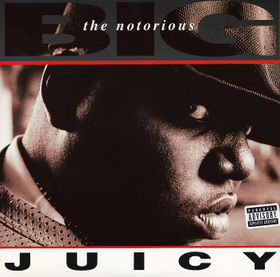
“It was all a dream…” The opening line to “Juicy”, one of the greatest rap songs ever written. Christopher “Notorious B.I.G” Wallace’s opening salvo into our collective consciousness was, perhaps, the greatest conveyment of a musical rags-to-riches story. Great things always have a way of starting off small. Facebook started off as a social network for only Ivy League students and had the word ‘the’ in its original title. Microsoft started off as two friends who were great computer programmers. The Oklahoma City Thunder started off as a 23 win franchise that was in the running to be the worst team in league history for much of the season. But, oh, how things have changed. 

From a fan’s perspective, this was a celebration of the Thunder’s first trip to the NBA Finals. From the outside, this just looked like the finality of a four year run that started off very slow, but has been on a uphill trek ever since. But from the inside, this wasn’t just about the last 4 years. That collective cheer that you heard from the Chesapeake Energy Arena on June 06, 2012 at about 10:30 PM was a roar of passion. Passion, not only for the team, but for the state. A roar for ourselves. Not for each collective ‘me’, but instead, for the collective ‘we’. 

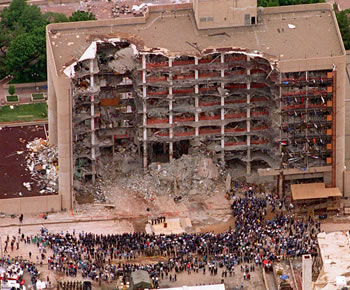
 When you are from Oklahoma, you always hark back to THAT day. April 19, 1995. The day innocence was ripped from the hearts of Oklahomans of all ages. The day we learned about evil and heartbreak. But, on April 20, 1995, we got up and started using a new vernacular. We started to live by words like RESILIENCY, COMMUNITY, SACRIFICE, TOGETHER, HUMILITY, HARDWORK. We knew the trek ahead was tough, but we knew it was a trek we would take together. 

If that wasn’t bad enough, 4 years later, the city was struck by what has been called the Monster of all tornadoes. An F5 tornado with multiple vortices, ripped through the southern part of Oklahoma City, destroying the suburb of Moore, Ok and the city of Bridge Creek, Ok. Once again, probably because of the hard lessons learned from the Murrah Building Bombing, we knew how to react to this tragedy and pulled together.  

City leaders, construction workers, politicians, and citizens all stepped up to the plate to improve the namesake city of the state. What was once a warehouse district was transformed into a sprawling entertainment district in the span of 20 years. With those improvements, came a 20,000 seat indoor sports arena originally known as the Ford Center. This would become the hub of our professional sports dream. 

Of course, with any dream, there are obstacles that stand in the way of achieving the ultimate goal. First, was the fact that we were the 44th largest TV market in the United States. While that sounds great in comparing it to the other 25,000 cities in the United States, that doesn’t bode well for any professional sports league looking for an expansion city. Secondly, was that fact that the professional sports leagues weren’t necessarily looking to expand at that time. The NBA last expanded in 2004, MLB in 1998, NFL in 2002, and the NHL in 2000. 

There’s a saying that goes, “When opportunities comes a’knocking, you better open the door.” When the tragedy of Hurricane Katrina happened in September 2005, the New Orleans Hornets were left with no place to play and hardly a populance to play for. Looking to lend a helping hand AND prove our worth as a big league city, Mayor Mick Cornett and city officials lobbied the NBA’s front office for the opportunity to host the Hornets for as long as necessary. While initially down playing the idea, the NBA decided to give Oklahoma City this opportunity of a lifetime and allow the Hornets to play at the Ford Center for what would eventually become 2 seasons. 

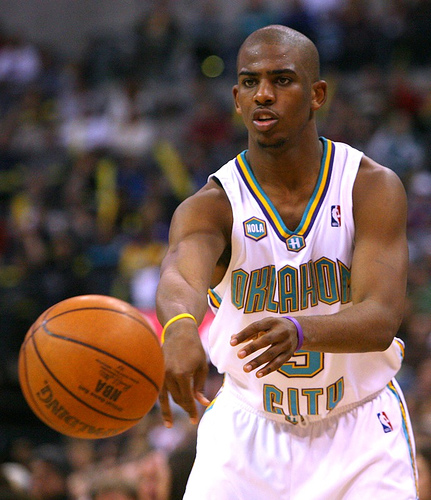
And Oklahoma City proved its worth, quickly growing a reputation as one of the loudest fan bases in the league for its adopted team. For those two seasons, the Hornets became synonymous with having a distinct home court advantage. It became OKC’s first foray into professional sports. Chris Paul won Rookie of the Year in his first season in OKC and David West became a burgeoning All-Star. Tyson Chandler became known as one of the best defensive big men in the league and Peja Stojakovic became known as one of the biggest free agency busts in his one season in OKC. And after two seasons, the music stopped. 

It was a bit disappointing when the Hornets left. Its like being in a 2-year relationship with someone that still had ties to their ex, and then being single again when your significant other goes back to their ex. We always knew the Hornets were going back to New Orleans, but the hope of them some how staying in OKC long-term was still in the back of most our minds. But this was no time to hold our heads down. Their was another opportunity to be had, and another team in the horizon. 

Regardless of what you think of the way OKC got the Thunder, the fact still remained that as of July 2008, the Seattle Supersonics ceased to exist and the Oklahoma City Thunder came into existence. Civic pride will make you argue the move until you are blue (Thunder blue, of course) in the face, but Oklahoma City had its team and it was time to show and prove. That first season was brutal, though. We knew we were getting a skeleton crew of a team with some young, unproven talent, but we didn’t know it was going to be this bad. 

The morning after another of our home losses, I called to the local morning sports talk radio show and just vented. I didn’t know if I could do this anymore. Living 90 miles from OKC and having to drive more than an hour each way, made driving back from the mounting losses excruciating. It’s almost like the team was stuck in a rut when it first got here and you had to wonder whether there wasn’t some karmic justice at play at how we had obtained the team. Thankfully, a coaching change and the general improvement of the young players led to a good finish and a hope for the next season. 

We all know what has happened the last two seasons. After a meteoric rise in their second season in OKC, the Thunder made the playoffs as an 8th seed and took the eventual champion Los Angeles Lakers to the brink of a 7th game in a riveting first round series. The team’s young stars (Kevin Durant and Russell Westbrook) went on to be the main components for a Team USA squad that won gold in the 2010 World Championships. In the next season, we finished with the 4th seed and made it all the way to the Western Conference Finals, losing in a close 5-game series to the eventual champion Dallas Mavericks. Suffice to say, expectations were definitely mounting.

Finally this year, in a season that was on the brink of not happening at all due to labor strife, the team exerted its dominance on most of the league and finished with the 2nd seed in the West. Two things became apparent as we marched towards this point. Number 1: This team was mature beyond its years and eschewed the notion that youth has to wait. Number 2: The home crowd was actually beginning to affect the play of the young Thunder. 

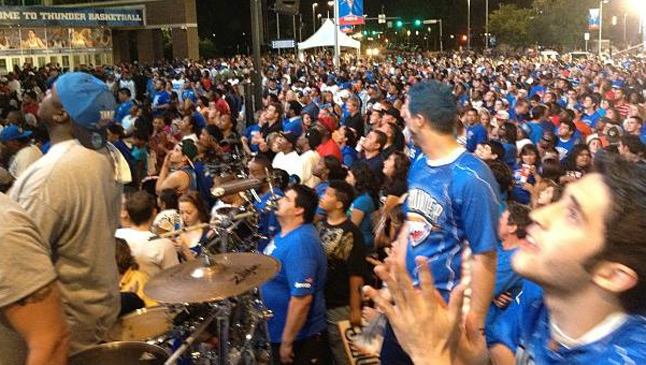
While last season, the Thunder players were the ones being criticized in the postseason, it was our turn, as fans, to be criticized this postseason. It started when the organization began playing games on the huge jumbotron TV outside of the stadium. What became famously known as Thunder Alley started as a small gathering (1000-2000) of fans that could not get tickets to the game, but wanted to experience, first-hand, the atmosphere of being at the playoff game. Eventually that small gathering turned into an all-out block party that some reports say reached as high as 10,000 + spectators in Thunder Alley. When you get that many people in a small space, bad things are bound to happen. Violence erupted after the clinching game of the 2nd round, and the postseason form of Thunder Alley was shut down. It is pretty sad when real fans have to suffer at the expense of a couple knuckleheads. Some people aren’t fortunate enough to be able to afford playoff tickets, but still want to be in the playoff atmosphere. 

Then there were the complaints that we actually wear our free t-shirts that the team supplies to each fan during playoff games. The travesty that fans would wear those shirts and cheer together as one. Who does that? Who cheers every great play and jeers every questionable call? I thought this was the norm for fans. I thought it was par for the course. But, just like everything else, we do things just a little different. We actually feel emotionally attached to our team. I saw grown men and women crying tears of joy for our trip to the Finals. People from the outside will never understand. As we venture into the unknown world of the NBA Finals, we will move forward the only way we know how: Together as one team. #TeamIsOne

End of a Rivalry

As the Oklahoma City Thunder set up for their game tonight against the New Orleans Hornets, I’m reminded that this is the first Hornets team completely absolved of any of its Oklahoma City history. What started as a response to an SOS from the league after one of the country’s worst national disasters has evolved into a love affair with a team that was formally from the Pacific Northwest. Who would have ever thought that the actions put forth from the response to Hurricane Katrina would have impacted 3 cities and 2 NBA franchises?

They say you never forget your first love. For someone who never thought he’d see a professional team in his home state, the arrival of the New Orleans Hornets was one of the best days of my life. I got on the phone as soon as I heard the news and was calling everywhere trying to find out where I could purchase season tickets. Novemeber 1st, 2005, was one of the most surreal days of my life. I was sitting there watching a regular season NBA game in Oklahoma City, with a team that was partially known as the OKC somethings. Needless to say, the New Orleans Hornets quickly became Oklahoma City’s first love when it came to professional sports.

We got to see the infancy of a point god, as we hosted Chris Paul during his rookie of the year campaign. We got to see the progression of David West from disappointing young player to “on the brink” All Star. We got to see JR Smith go from young, budding star to knucklehead. We saw game winners! We got to live the NBA experience. In return, Oklahoma City got showered with praise that it had never seen in such a positive light. We had been previously showered with praise before, namely in April 1995 and May 1999, but those were in response to tragedies that happened on our soil. But this was the national media heaping praise on us for our support of this nomadic franchise, and we started to kind of like it.

But alas, we knew it probably wouldn’t last. After that first season, there were inklings of hope among the populace that the Hornets may actually stay in Oklahoma City. And they did….for one more season. In hindsight, that was just foolish thinking from someone being in love. In the back of our minds, we knew that the NBA would never abandon New Orleans in its darkest hour. The NBA wanted to be there to celebrate New Orleans’s greatest triumph. But it still hurt when they officially returned back to the N.O. after the 2006-2007 season.

Fast-forward to the beginning of the 2008-2009 season. Through all the waiting and legal proceedings, the Seattle Supersonics became the Oklahoma City Thunder. OKC finally had its team and were revving up with Thunder fever. But most of us still had a very soft spot for our first love, the New Orleans Hornets. It was very apparent to me during the first Thunder game, when the ref signaled that a loose ball belonged to us and the PA announcers asked, “Who’s ball is it??????” That was the most difficult question I’ve ever had to answer in my life. My mind kept saying, “Remember to say Thunder ball, not Hornets ball!”.

Then the moment that we had been waiting for happened. On November 21st, 2008, OKC’s old team went up against OKC’s new team in OKC. It was like watching your ex-girlfriend fighting against your current wife. You want your current wife to win, but you don’t want her to slaughter your ex. We applauded when they introduced CP3, David West, Tyson Chandler, and even, Peja. Then they went out there and kicked our ass. They kicked it so bad that the coach was fired after the game.

Of course, the roles have reversed a bit as of late. The Thunder are one of the top teams in the league, and the Hornets have been on the brink of a rebuild for awhile, now. February 2nd, 2011 was the last time OKC got to experience the love-struck rivalry that was OKC vs. New Orleans. The last two remaining members of the OKC Hornets team were Chris Paul and David West. After suffering an ACL tear, David West never received an extension from New Orleans, and instead, chose to sign with the Indianapolis Pacers. Chris Paul went on to be traded to the Clippers in a blockbuster deal that transformed to junior varsity Clippers into Lob City.

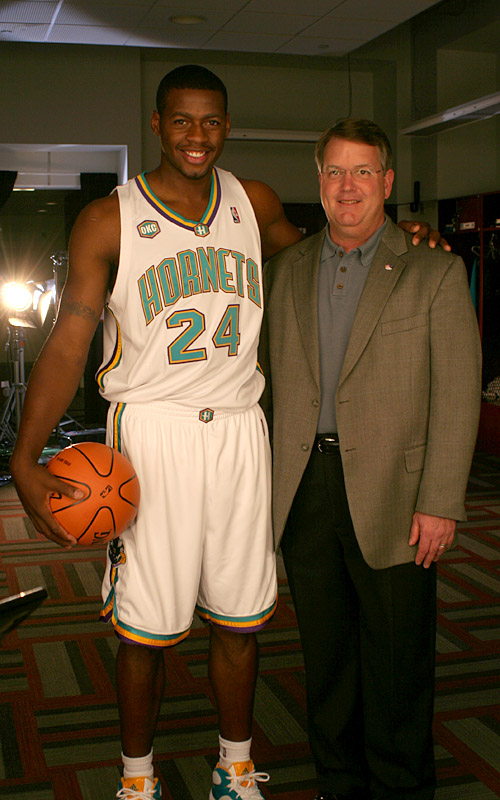
So when the two teams meet up tonight, it will just be another game for me. I knew the day would come where the Thunder would face a Hornets team that had no connections to OKC at all. I just never thought it would get here so quickly. But such is the revolving door of NBA rosters. The only relic that still remains on the New Orleans team from its time in OKC is a HoneyBee by the name of Christina (pictured above). Other than that, its just another game in January. It has truly been a short, but strange ride.

Top Five Point Guards in Oklahoma City History

So, I was perusing through the internets and came across this article from Yahoo!Sports, http://sports.yahoo.com/nba/news?slug=ycn-10388361 . In the article, written by William Menna, it talks about the top 5 point guards in Oklahoma City Thunder history. Before even reading the article, I thought to myselft, “Wow, 3 years in, and we already have a Top 5 point guards in franchise history article. Let me see, Westbrook, Maynor, Watson, Ivey, and Ollie.” Kind of scraping the bottom of the barrell at the end of that list. But then I started reading the article and starting seeing names like Gary Payton, Lenny Wilkens, Gus Johnson, etc. It is then that I realized, “Crap, they are including the Seattle Sonics’s stats also.”

I’m one of those people that has a problem with the combining of Sonics and Thunder history. Its like going through an acrimonious divorce and having your new wife constantly bring up things about your old wife. You just don’t want to listen to it. Let it be known, though, that I have no problem with the emotions being felt by true Sonics fans. Those guys were left without a team and that part of the equation, in my opinion, is just wrong. Especially when its the little guys (a.k.a the fans) that suffer the most. In the 5 years that this team has been on OKC’s radar, I’ve felt every range of emotion towards Seattle and its fans. But, if this lockout has taught me anything, its that, in the grand scheme of things, we’re quite inconsequential. The other thing that it has made me realize is that missing basketball games sucks ass.

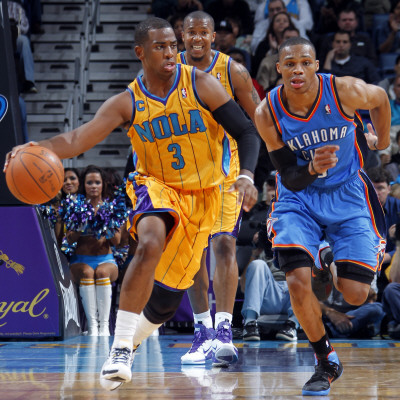
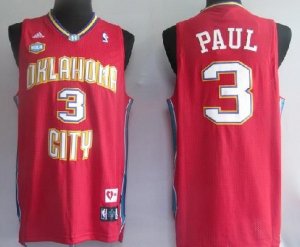
In reading this article, I realized the list of OKC Thunder point guards may be quite small, but the list of combined OKC Hornets and Thunder point guards can be enough to make a respectable Top 5 list. Yeah, you remember those OKC Hornets teams, right? The ones that played a combined 71 of 82 home games in the state of Oklahoma in 2 seasons spanning from November 2005 to April 2007. Here’s some pictures to remind you:

Using these 5 seasons of Oklahoma City basketball, here’s the list of the Top 5 point guards in OKC basketball history.

Disclaimer: Combo guards will also be included as point guards. They are just point guards that primarily score, anyways.

5. Speedy Claxton (OKC Hornets ’05-’06):

In his one season in Oklahoma City, Claxton provided good veteran leadership off the bench while mentoring the rookie Chris Paul. He averaged 12.3 points, 4.8 assists, and 1.5 steals per game. Though about 4 inches shorter than Chris Paul, he was sometimes inserted in the lineup as the shooting guard in small ball situations.

4. Eric Maynor (OKC Thunder ’09-’10 – present):

Maynor has been the guiding touch for the second unit off the bench in each of his seasons with the Thunder.  He is the antithesis to Russell Westbrook and provides a nice semblance of change when in the game. He has averaged 4.5 points and 3.1 assists in his 2 seasons with the Thunder and continues to improve and build upon his national acclaim as best back-up point guard in the game.

3. Bobby Jackson (OKC Hornets ’06-’07):

Brought in to replace Speedy Claxton, Bobby Jackson brought an instant spark off the bench as one of the premier combo guards in the league. Used primarily as a point guard, Jackson’s quickness helped the Hornets whether the storm of losing their best 3 players for the 1st quarter of the season to stay afloat for enough time to contend for a playoff spot until the final week of the season. His averages of 10.6 points and 2.5 assists don’t measure how valuable Jackson was for that team that season.

2. Russell Westbrook (OKC Thunder ’08-’09 – present):

One of the most dynamic players in the league, Westbrook (along with Derrick Rose and John Wall) is redefining what a point guard is in the league. This is what the game envisioned when it inserted the Hand Check rule before the ’04-’05 season. Someone that constantly puts pressure on the defense, while working his way into the lane. While still a work in progress, Westbrook has averaged 17.8 points, 7.1 assists, 4.8 rebounds, and 1.5 steals per game in his career, increasing his points, assists, and steals averages every season.  In his young career, he has already made an All Star game, been named to 2nd team All-NBA, won a World Championship gold medal, and led a team to the Western Conference finals. Although he is still learning the nuances of the position, there is no doubt that if his career trajectory continues in a similar fashion, he may undoubtly wrestle the No. 1 spot from this guy…

1. Chris Paul (OKC Hornets ’05-’06 – ’06-’07)

The current gold standard for NBA point guards, Chris Paul started off his career as a member of Your Hometown Hornets, becoming Oklahoma City’s only Rookie of the Year recipient. While still in the traditional point guard mold, Chris Paul was the beginning in a breed of point guards that do most of their damage driving to the hole and breaking the defense down while in the paint. Owning, probably, the best court vision in the league, Paul has led the league in assists twice and averaged close to double figures for his career. In it, he has averaged 18.7 points, 9.9 assists, 4.6 boards, and 2.4 steals in 6 seasons. He is the only player in league history to lead the league in assists and steals in the same season for 2 consecutive seasons. That’s John Stockton territory right there. He’s been named to 4 All Star games, 1 All-NBA team, 1 All-Defensive First team, has won 1 Olympic gold medal, and has been to 1 Western Conference Championship. Although injuries derailed Paul the last few seasons, he seems to be getting over that and getting back to his elite form.

The only negative part to most “Top 5 Whatevers Within the same Franchise” is that you’ll probaby never see any of the players on the list play against each other. You’ll never get to see Rajon Rondo vs. Bob Cousy. Or Yao Ming vs. Hakeem Olajuwon. But the great thing about this list is that you will hopefully see Westbrook and Paul duke it out for the better part of their primes for the next decade. And the only reason they’ll be duking it out, is for OKC point guard supremacy, right?