Tag Archives: Russell Westbrook

Introducing the Future King

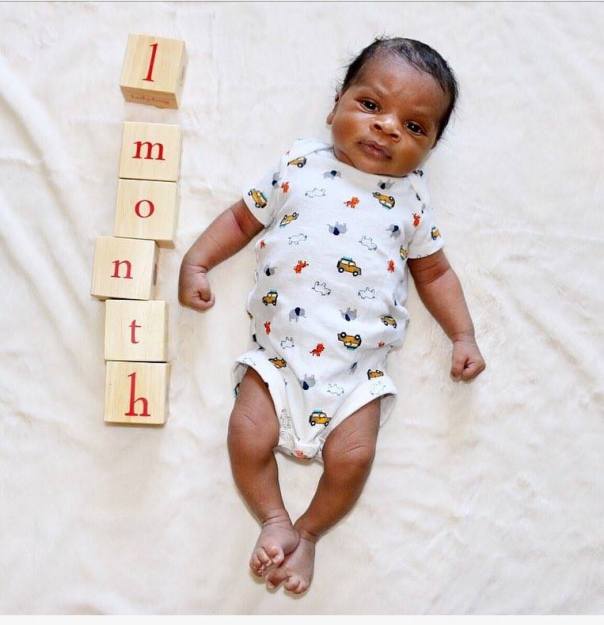
baby russ

Noah Russell Westbrook is officially one month old. The Westbrooks finally felt comfortable enough to unleash Noah onto the world’s eyes. With his fists clenched, Noah wasn’t happy about it. Already following in his father’s footsteps.

Even his attire was Russell-like.

Daily Thunder Rumblings – 13 June 2017


Here are the rumblings for Tuesday.

He may have won a title, but Kevin Durant will never be able to escape his decision. Never change, Alex Trebek. Thank you, Jeopardy!

Rumble visited Rohan Rajeev, a 14 year old Edmond kid who finished second in the lastest national spelling bee. Continue reading Daily Thunder Rumblings – 13 June 2017

Daily Thunder Rumblings – 12 June 2017

This is DTR and here’s your Thunder news for this Monday.

Brett Dawson wrote a great article on the 365-day scouting process that culminates on draft night: “There was no shot at the kid from Indiana. Oklahoma City held the 12th pick in the 2013 NBA Draft, and he would be off the board long before that. By the second pick, as it turned out. There was never a chance he’d fall so far. But at the Draft Combine in Chicago that spring, the Thunder met with Victor Oladipo anyway. “Because you never really know what’s going to happen down the line,” said Will Dawkins, OKC’s director of college player personnel.” Continue reading Daily Thunder Rumblings – 12 June 2017

Daily Thunder Rumblings – 09 June 2017

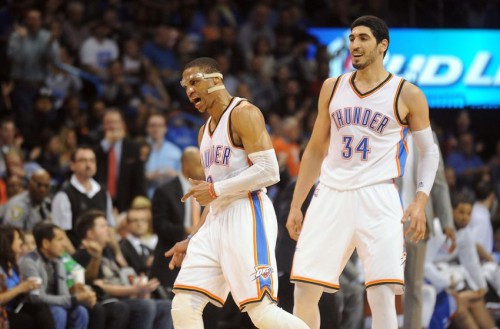
Forbes ranks the world’s highest paid athletes: Russell Westbrook comes in as the 13th richest athlete and the 5th richest in the NBA. Who said you couldn’t get paid if you played in Oklahoma City?

Apparently, the Westbrooks finally got a night out on the town. As a veteran of several children, I know how appreciative new parents can be of their “we” time.

Steven Adams is back in New Zealand. And his beloved camo jacket is back on Steven Adams.  Continue reading Daily Thunder Rumblings – 09 June 2017

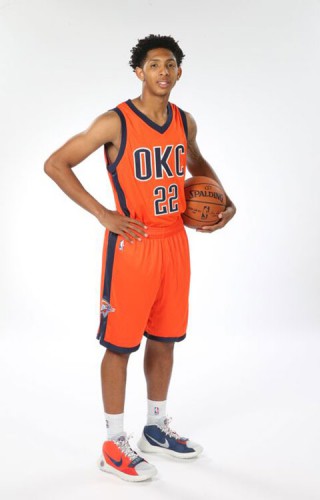
Thunder sign Semaj Christon

christon

On Saturday, the Oklahoma City Thunder signed guard Semaj Christon. The 2014 2nd rounder played last season with Consultinvest VL Pesaro of Lega Basket Serie A, the top professional league in Italy. While there, he averaged 14.3 points, 3.7 assists, 3.3 rebounds, and 1.6 steals in 33.2 minutes of playing time. Previous to that, he spent his first two professional seasons with the Thunder’s D-League affiliate, the Blue. In addition, he has also been a member of the Thunder’s summer league team the last three seasons.

The 6’3″ point guard out of Xavier has shown a penchant for getting into the lane and causing havoc once he gets there. His sturdy frame and long arms allow him to finish in traffic, while his floor game allows him to find teammates for higher percentage shots. His jumper, while not the best, has improved over the past 3 seasons to the point where he has a pretty solid mid-range game.

With the signing of Ronnie Price earlier this offseason, the Thunder’s roster currently sits at 15 guaranteed contracts, with 3 of those contracts belonging to point guards (Russell Westbrook, Cameron Payne, and Price). So why did the Thunder sign Christon, if their roster is already at max capacity with contracts and points guards? The reasoning for that could be two-fold. Number one, the Thunder don’t appear to be done wheeling and dealing. The roster, as it currently stands, is a weird mixture of bruising big men, offensively challenged wings, and athletic guards who aren’t great at shooting. They have a sizable expiring contract in Ersan Ilyasova, and a young big they may be ready to move on from in Mitch McGary. If the right deal comes along, they could also feature Payne, who could net something substantial from a point guard starved team.

The second reason for signing Christon is to play the long game with him. While his contract can’t be guaranteed because of the Thunder’s 15 other commitments, there could be guaranteed money attached to it if he gets waived before the season starts. Then the Thunder could sign Christon to the Blue and see how the season plays out in terms of roster moves. If the trade deadline leaves the Thunder with an open roster spot, you can almost guarantee that spot will go to Christon. Another issue that is clouding the water in terms of Christon’s future is whether Price’s 2nd year is fully guaranteed.

If anything, the Thunder have secured themselves another weapon to throw at guard happy teams, while maintaining roster flexibility. Christon’s strength and wing-span could make him an asset on the defensive end of the floor, similar to what the Thunder saw from Dion Waiters in the playoffs last season. And while Christon’s offensive repertoire may not necessarily be what the Thunder need, it’s not like he’s offensively challenged. In the end, his contract is not currently guaranteed, and the Thunder have time to see how everything plays out in these next two months before the season starts.

The Oklahoma City Thunder debut their new orange alternates

westbrook collison durant ibaka orange alternates

For years, Oklahoma City Thunder fans have been clamoring for an alternate uniform that featured more than a blue palette. Maybe something with a bright color to it, or an artistic rendition to the Thunder shield, or a play on the Oklahoma City moniker (OKC). Instead, they have been treated to alternates that have been bland and a bit too safe. The purpose of an alternate jersey is to feature something that is different than the original.

The Thunder’s home uniforms have always been there best. The classic blue lettering with the orange trim lends itself very nicely to most color schemes (jeans, khakis, etc) and looks very good on HD TV screens. The away blue jersey have a classic coloring to them, but the 12 white letters on the front of the jersey (OKLAHOMA CITY) are a bit much in terms of style.

Three years ago the Thunder debuted their first alternate jersey. The navy blue jersey looked retro in nature with the team name written down right side. The jersey had mixed reactions, with many liking the simplicity of the jersey, while also criticizing that simplicity for being too safe for the franchise’s first alternate jersey.

Last season, the Thunder introduced their shirt-jersey (“shirsey”). Used exclusively at home, the shirt-jersey finally made use of the OKC moniker, placing it in front of the Thunder shield. The shirt-jersey borrows from the classic-ness of the home whites, but suffers from the fact that it’s a shirt-jersey.

cameron payne thunder

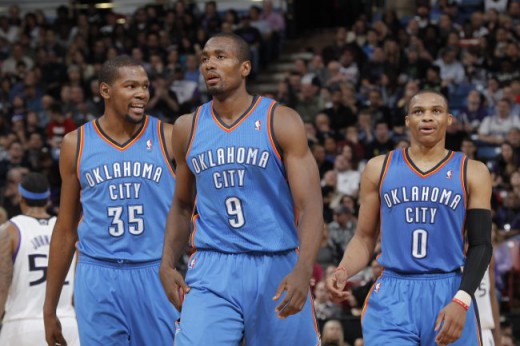
Throughout the summer, there have been rumors of an orange alternate in the brewing for the Thunder. Uniform hawks began doing their sleuthing and discovered possible rendering of the orange alternates. Finally, three days before training camp began for the Thunder, the team and players started dropping clues through social media. Kyle Singler shared a photo through his Instagram account in Friday morning showing a piece of orange jersey fabric. The Thunder shared an Instagram photo showing an orange jersey with the number 0 on it. Finally, the team shared a photo through all of their medias showing Kevin Durant, Russell Westbrook, Serge Ibaka, and Nick Collison sporting the new orange alternates.

Brian Byrnes, Thunder senior vice president of Sales and Marketing, stated, “This new uniform not only features another of our primary team colors, it also reinforces the strong connection our team has to our hometown and home state.” The jersey, given the nickname “Sunset”, will have the OKC moniker written on the front in navy blue. The Thunder will debut the jersey at home on November 1ST against the Denver Nuggets, and will wear them 17 more times this upcoming season. They’ll be worn 10 times at home and 8 times on the road.

The Three That Will Never Be: The Legacies of Scott Brooks, Kendrick Perkins, and Derek Fisher

ibaka perkins durant fisher thunder

As the Oklahoma City Thunder embark on a new season, some of the same things from the past still remains. First off, Kevin Durant, Serge Ibaka, and Russell Westbrook should all be back and healthy. Secondly, the expectations of winning a championship will also be there. But for some reason this season feels different. Not a bad different, just a “lack of familiarity” type different. Something was missing, and that something was three component that had been a part of the Thunder for all or parts for their 7 seasons in Oklahoma City. Those three components were Derek Fisher, Kendrick Perkins, and Scott Brooks.

For 7 seasons prior, one or more of those pieces were always there to provide an anchor of calmness even in the most choppiest of seas. For the first time since the Thunder moved to Oklahoma City, neither of those three will be a part of the Thunder organization. From the time Scott Brooks took over for PJ Carlesimo on November 22, 2008, the organization has relied on his calming demeanor and almost fatherly-like approach to the development of the stars of the team. That approach to coaching is one of the reasons Brooks will be highly sought after once he decides to return to coaching. Teams are always in one of three phases in their developments: rebuilding, learning how to win consistently, and contending for a championship. Brooks mastered the first two phases of that process with relative ease, taking the Thunder from one of the worst teams in the league to championship contending in a four year span. That type of ascension is almost unheard of without the help of a superstar free agent being signed by the team.

What Brooks lacked in coaching acumen, he made up for with his interpersonal relationships with his players. Say what you want about his late-game play calling, but the players on the team would run through a wall for Brooks. Many in the media heap praise upon Phil Jackson for his career, but Jackson was never known as a great X’s and O’s coach. He had great assistants (Tex Winters, Jim Cleamons), and more importantly, great players. But he was also one of the best at managing superstar egos, which falls under the realm of interpersonal relationships. Brooks could have had a Jackson-like career, but lacked great assistants, and his great players were just coming into their prime during his tenure. Instead, Brooks will likely have a Doug Collins-like career as a coach that could have been one of the greats, but just happened to be the coach at the wrong time.

When the Thunder were starting their ascension, most of the upper echelon teams in the Western Conference had All-Star or near All-Star level centers and power forwards. The Los Angeles Lakers had Pau Gasol and Andrew Bynum. San Antonio had Tim Duncan and Tiago Splitter. Memphis had Marc Gasol and Zach Randolph. Dallas had Tyson Chandler, Dirk Nowitzki, and Brendan Haywood. Utah had Al Jefferson and Paul Millsap. To contend in the Western Conference at that time, a team needed a big body in the middle that could defend and rebound. In their early run, the Thunder had a front line of Nenad Krstic, Jeff Green, and an “even skinnier than he is now” Kevin Durant. They had Serge Ibaka on the bench, but he was still pretty raw during that time and had trouble keeping his fouls under control. It wasn’t until the Thunder met the Lakers in the inaugural playoff run in 2010 that they realized what they needed to continue the upward trend of the team’s development.

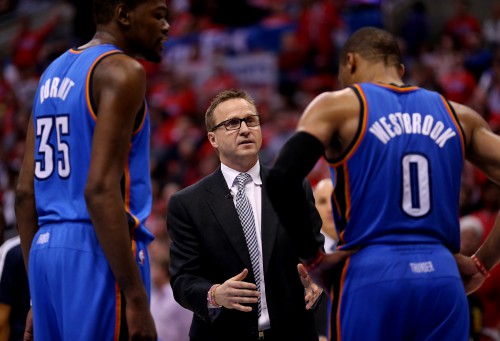
LOS ANGELES, CA - MAY 09: Head coach Scott Brooks of the Oklahoma City Thunder talks with Russell Westbrook #0 and Kevin Durant #35 against the Los Angeles Clippers in Game Three of the Western Conference Semifinals during the 2014 NBA Playoffs at Staples Center on May 9, 2014 in Los Angeles, California. The Thunder won 118-112. NOTE TO USER: User expressly acknowledges and agrees that, by downloading and or using this photograph, User is consenting to the terms and conditions of the Getty Images License Agreement. (Photo by Stephen Dunn/Getty Images)

At the trade deadline the next season, the Thunder traded Green and Krstic to the Boston Celtics for Kendrick Perkins and Nate Robinson. Even though Perkins was coming off a serious knee injury he suffered in the previous season’s Finals, he was the defensive anchor the team so badly needed. A couple weeks after arriving in Oklahoma City, the Thunder extended Perkins for four more seasons. Perkins immediately became the veteran presence the Thunder’s young players needed. He graciously helped in the development of Ibaka, taking his own experience from when Kevin Garnett took him under his wing in Boston and applying that to Ibaka. He gave the team a mean streak they didn’t have before his arrival. He quickly became the locker room buffering agent between all the Thunder’s young players as they learned how to succeed in the NBA individually and as a team (a major downfall of many young, up and coming teams in the past).

He was a great locker room presence. And if he was getting paid $5 million or less, that would have been fine. But in actuality, he was one of the highest paid players on the team and his performance on the court, especially on the offensive end, was often one of the most polarizing themes in sports. The knee injury he suffered while with the Celtics in the Finals the year before sapped the little bit of athleticism Perkins had going for him. While he was one of the best post defenders in the league, he was often a net negative on offense. As the NBA’s moved towards smaller, more skilled line-ups that could space the floor, the effectiveness of Perkins on the floor became more and more muted with each passing season.  When athletic power forwards started masquerading as centers, the need for a hulking presence down low became almost non-existant.

Compounding the polarization of Perkins was the trade of James Harden to Houston. Many thought the reason the Thunder traded Harden was purely financial, as they couldn’t afford to have 4 players on max or near max salaries (Harden, Durant, Westbrook, and Ibaka), along with Perkins’ $9 million annual salary. In addition to the trade itself, the fact the Thunder had the opportunity to waive Perkins under the amnesty provision, provided the framework for the “Thunder choosing Perkins over Harden” frame of thought that many in the media portrayed. In reality, the Harden trade had little to nothing to do with Perkins. Harden wanted to have his cake and eat it too, wanting max money and the opportunity to run his own team.

In the end, Perkins was relegated to being a back-up big in his final season with the Thunder before being traded to Utah for Enes Kanter. His tenure with the Thunder will forever be remembered for his defensive chops, menacing scowl, and “Shaq-tin a fool” moments. But his presence on the team forever shaped the maturation of Durant, Westbrook, and Ibaka. He helped navigate them through their first few seasons of success and kept them even-keeled.

The signing of a veteran is a rite of passage for a team that is moving into championship contending status. A veteran that has been where the players on the team want to be and has played a big part in previous championship games. That veteran for the Thunder was Derek Fisher. At the beginning of the lockout-shortened 2011-12 season, the Thunder lost back-up point guard Eric Maynor to a torn ACL. The only other point guard on the roster, besides Westbrook, was rookie Reggie Jackson. The Thunder managed for half a season with the rookie taking on back-up point guard duties, but when the opportunity arose to sign a waived Fisher, they pounced on the opportunity. Fisher paid almost immediate dividends as a calming, veteran presence and as a floor spacer.

Fisher went on to be part of the Thunder for the next two seasons after that one. He basically played the same role in each of the seasons as he attempted to capture that elusive 6th championship ring. Fisher never got that ring, but became, a lot like Perkins, a revered and respected figure in the locker room. A championship point guard his entire career, Fisher went on to retire and immediately became the head coach of the New York Knicks who were being run by Fisher’s former coach, Phil Jackson.

There’s a point in every player’s maturation where they eventually become the veteran. They become the guy that “has been there before” or “has seen it all before”. The Thunder brass probably felt like Durant, Westbrook, and Ibaka were ready to take the next leg of their journey on their own. They had grown under the watchful guise of Brooks, under the sturdy hand of Perkins, and under the guiding presence of Fisher to become what they are today. Sure they’ve faced some injury difficulties along the way, but those also have a way of toughening up a players’ resolve.

As fans, we always cheer for the superstars. But true fans cheer for the guys who make it despite their obvious flaws. The guys who are the bedrock over which championship sod is laid upon. There’s a sense of commonality between those players and someone who works a 9-5 and goes home everyday to a family and a mortgage. There’s a very real possibility the Thunder win a championship without any of those three guys within the organization. If that does occur, three of those championship rings better be sealed in a box and delivered to New York, NY (Fisher), Beaumont, TX (Perkins), and northern California (Brooks), because the DNA of any Thunder championship will definitely have the imprint of those three on it.

Russell Westbrook on Live! with Kelly and Michael

Russell Westbrook showed up on Live! with Kelly and Michael and talked about his injuries, his All-Star game MVP, and played some Pop-A-Shot. It was a very Westbrookian appearance in nature.

D-Day: Decision Day for the Oklahoma City Thunder and Enes Kanter

kanter thunder

Why do people save money? There are usually two reasons why people save money. The first is to be prepared for an emergency. If the car breaks down or the air conditioner goes out, you have the funds necessary to replenish this item without digging into the budget. The second reason people usually save money is to purchase an item of great worth. Be it shoes, a house, or a boat, these are the items where patience becomes a virtue. Too many times, people head into a situation where they want to save, but end up either getting a cheaper knockoff or end up purchasing the item too quickly on credit, which leads to future budgeting issues.

The Oklahoma City Thunder have been saving for the past 6 seasons. Emergencies happen all the time in sports. These emergencies usually involves a catastrophic injury to a key player or two. Having that salary cap flexibility of not being in the luxury tax is key to recovering quickly if your main player(s) go down. But the true essence of why the Thunder have been saving money can be traced back to October 27, 2012. That was the day the Thunder avoided going into the luxury tax by trading James Harden to the Houston Rockets.

On the surface, the trade has been a disaster for the Thunder. Harden finished 2nd in the MVP voting this past season and led his team to the Western Conference Finals. The Thunder, on the other hand, have seen the last 3 seasons end in disappointment due to various injuries to key players. The players obtained in the Harden trade are known as the pennies in the saying “pennies on the dollar”. Kevin Martin was a great 6th man for one season, but signed with Minnesota the next season. Jeremy Lamb was a marginal bench player his entire Thunder career and was recently traded to the Charlotte Hornets for a 2nd round pick. Steven Adams and Mitch McGary were first round picks obtained in the trade and have been the most valuable commodities from the trade. And Alex Abrines was drafted with the 2nd round pick obtained in the trade and has yet to step foot in the United States. But the most important asset to come out of the trade was the salary cap flexibility.

To the casual NBA fan, talks of salary cap flexibility, luxury tax and repeater tax concerns, max contracts, market size, so on and so forth are the minutiae that makes the NBA offseason so boring. The casual fan only pays attention from November to June (scratch that, April to June). All they see is players, their stats, and how much they make. They don’t take into account that NBA teams have to budget and balance their checkbooks like normal people do. While its true that their budgets likely feature many more commas than ours do, the fact still remains that NBA teams have to run their organization within certain boundaries. Spend too frivolously, and your organization will likely lose money.  Don’t spend enough, and your organization is likely destined for failure. Finding the balance is the key to success in the NBA. And sometimes, in that balance, difficult decisions have to be made.

westbrook kanter thunder

The Thunder made that difficult decision when they traded Harden. They eschewed paying the luxury tax in preparation for this moment. The harsh reality is that James Harden was never going to be James Harden if he stayed in Oklahoma City. He was a redundancy on a team that already featured two great ball handlers. He knew this and, if reports are true, made the ultimatum that he either get paid max money or get traded to a team where he could receive max money. The split between OKC and Harden was a mutual split. Both parties got what they wanted in the end. What Oklahoma City got, in addition to the players and draft picks that came over in the trade, was the comfort in knowing that they could safely go into the luxury tax when the perfect opportunity arose.

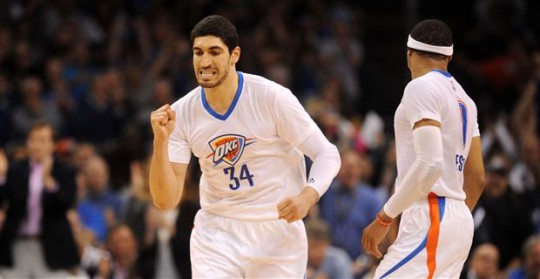
On February 19th, 2015, the Thunder traded Kendrick Perkins, Grant Jerrett, the rights to Tibor Pliess, and a future first round pick to the Utah Jazz for Enes Kanter and Steve Novak. Kanter was in his 4th season, which meant that, with the trade, the Thunder owned his Bird Rights as he headed into restricted free agency in the offseason. In the 26 games Kanter played for OKC, he was a double/double machine, averaging 18.7 points and 11.0 rebounds per game. He provided something the Thunder had never seen before since they moved to the Great Plains, an inside scoring presence. Kanter and Russell Westbrook quickly became familiar with each other in the pick and roll game. With Kevin Durant and Serge Ibaka out for much of the 2nd half of the season, Kanter stepped in as that 2nd scorer behind Westbrook. While his defense was deplorable, some of that may have been an effect of Durant and Ibaka not being there to help him out defensively.

After not reaching an agreement with the Thunder when free agency began on July 1st, Kanter decided signed a 4 year/$70 million dollar offer sheet with the Portland Trailblazers, who were one of three teams who still had the cap space to sign Kanter. Reports were the Thunder offered Kanter $15.5 million per season for 4 seasons. Kanter’s representatives instead chose to wait on the market to see if a max contract was offered, which Portland did on July 9th. The max contract features a player option for the 4th year and a trade kicker. Portland tried to add all the poison pills they could to make the contract as unattractive as possible for the Thunder.

So here’s where the Thunder stand. They have until midnight tonight to match Portland’s offer sheet. This is what all the saving was for. The Thunder sacrificed a lot in the past to be in the position they are today. The beautiful thing about it is that they still have options. If they feel Kanter is not worth this contract, they can walk away from the table, and the Thunder would still be one of the top teams in the league, health permitting. But, if they feel Kanter is the final piece to their championship puzzle, they will gladly match the offer sheet with a smile on their face, knowing full well this was the moment they were waiting for.

Ten Prospects for the Thunder in the 2015 NBA Draft

ibaka durant westbrook thunder

After a disappointing 2014-15 season that was riddled with injuries, the Oklahoma City Thunder enter the 2015 NBA Draft with a sense of optimism. If Kevin Durant, Russell Westbrook, and Serge Ibaka can remain relatively healthy next season, then this team is still a championship contender. With that said, the Thunder are basically playing with house money when it comes to this draft. Will they be drafting an integral piece to the present championship puzzle? Maybe. Or maybe they’ll be drafting a piece that won’t pay dividends for another year or two. Or maybe they won’t be drafting anyone at all. There are a ton of options at the Thunder’s disposal and this draft is shaping up to be one of the most active for the team. Here’s a look at 10 prospects the Thunder may draft at different stages in the draft.

The Trade-Up Prospects

There have already been rumors that the Thunder are looking to trade Jeremy Lamb, Perry Jones, and Steve Novak ahead of the draft. While this group of players isn’t necessarily attractive to most teams, to a team needing perimeter shooting, this haul may be a steal. There are two teams in the draft that are desperate for shooting and have already made moves this offseason to shore up that need. Detroit, under the direction of Stan Van Gundy, is looking to surround Reggie Jackson and Andre Drummond with perimeter shooters, a la Dwight Howard in his Magic days. While Detroit already obtained Ersan Ilyasova from Milwaukee, they may want some more shooting at a cheap price. A likely deal would be Lamb, Jones, and No. 14 & 48 for Anthony Tolliver (who has a partially guaranteed contract) and No. 8. Detroit could use a wing defender and may be able to find one at 14.

Conversely, Charlotte is another team in serious need of perimeter shooting. The Hornets finished with the worst 3-point shooting percentage in the league. Earlier in the offseason, they traded Lance Stephenson for Matt Barnes and Spencer Hawes. But if they can get more perimeter shooting, it may completely transform the dynamic of their team. A likely deal would be Lamb, Jones, Novak, and No. 14 for Gerald Henderson (1 year at $6 million) and No. 9.

Edit: The Hornets traded Gerald Henderson and Noah Vonleh to the Portland Trailblazers for Nic Batum. And, according to Rick Bonnell of the Charlotte Observer, the Thunder traded Jeremy Lamb to the Hornets for Matt Barnes. So there goes that theory!

So if the Thunder move, who do they take?

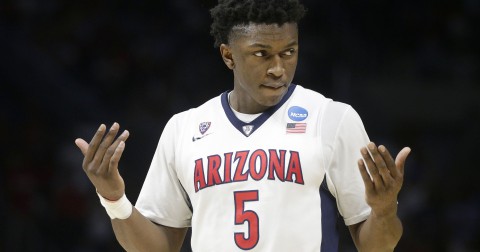
1. Stanley Johnson – Arizona/Freshman/6’7″ (6’11” wingspan)/240 lbs

One of the best two-way wings in the draft. Compares favorably to Jimmy Butler of the Chicago Bulls. Great size for a wing, and has shown the ability to score in a variety of ways (transition, 3-point shooting, shooting out of the pick and roll). Needs some seasoning. Struggles with finishing at the rim. Likely won’t contribute too much in rookie season.
stanley johnson arizona

2. Devin Booker – Kentucky/Freshman/6’6″ (6’8″ wingspan)/210 lbs

One of the best, if not the best, shooter in the draft. Shot over 40% from 3-point land on 3.7 attempts per game. Great from deep and from mid-range. Compares favorably to Eric Gordon of the New Orleans Pelicans. Good size for  a wing. Youngest player in the draft. Not a high flyer or overly athletic. Extremely low steal rate. Likely won’t contribute too much in rookie season.

3. Mario Hezonja – International/FC Barcelona/6’8″ /210 lbs

Doubtful Super Mario falls to the No. 8 or 9 spot. But if he’s there and the Thunder have traded up, they may seriously consider drafting Hezonja. Gifted with a great jump shot, athleticism, and unabashed confidence, Hezonja plays a lot like the Thunder’s own Russell Westbrook. He has great size for a wing and has the potential to be good on the defensive end. Consistency is the biggest issue with Hezonja. He’s had games where he looks like the best player on the floor, and then he has games where he disappears for long stretches.

Prospects at 14

There could be a possibility that the Thunder like a player they can draft at the 14th spot. The draft has a weird way of shaking out sometimes, and players that you thought wouldn’t be available at your spot, suddenly become available. Here are the prospects the Thunder could pick at their spot.

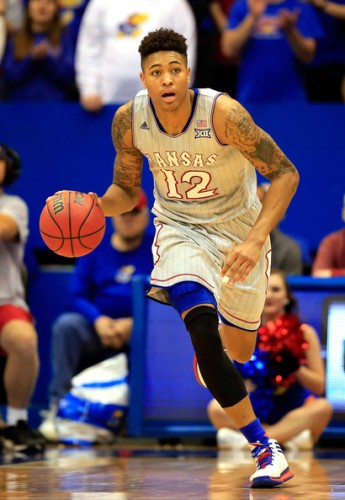
1. Kelly Oubre Jr. – Kansas/Freshman/6’7″ (7’2″wingspan)/205 lbs

GREAT size for a wing. Can likely develop into a good defensive player based on his physical attributes alone. Compares favorably to James Posey or Giannis Antetokounmpo. Shot the ball well from 3-point territory in his freshman year (36% on 2.6 attempts per game). Good mid-range game. Solid defensive rebounder from the wing, with an ability to keep balls alive on the offensive end. Strong, wiry frame that can easily add 10-15 lbs of muscle. Struggles with creating offensive (only 0.8 assists per game) and consistency. Likely won’t contribute immediately, and may benefit from some time in the D-League.
kelly oubre kansas

2. Cameron Payne – Murray State/Sophomore/6’2″ (6’7″ wingspan)/185 lbs

Playmaking point guard that can score in a variety of ways. Compares favorably to Jeff Teague of the Atlanta Hawks. Has good size for a point guard with a wingspan that will help him immensely on the defensive end (nearly 2 steals per game in college). Does a great job of changing speeds to keep defenses off balance. Did a great job of balancing his playmaking and scoring, dishing out 6 assists per game, while scoring 20 points. Has a good, but not great shot. Needs to put on more weight. Struggles finishing at the rim, instead choosing to shoot floaters (nearly 3 per game,which led all college players). Small school competition stigma.

3. Bobby Portis – Arkansas/Sophomore/6’10.5″ (7’2″ wingspan)/245 lbs

A high energy player with a relentless motor, Portis reminds me of Draymond Green of the Golden State Warriors. The SEC Player of the Year led the Razorbacks in points (17.5) and rebounds (8.9) per game. He gets most of his points off his energy in transition and put backs. But he is a very skilled all-around player, shooting 53.6% from the field overall and 46.7% from 3-point territory on nearly one attempt per game. His major downfall is that he isn’t overly athletic. His game stays closer to the ground than most NBA scouts would like. He is actually my darkhorse for this pick.

4. Sam Dekker – Wisconsin/Junior/6’9″ (6’11.5″ wingspan)/220 lbs

Dekker is an all-around talent that is good at most things, but not necessarily great at any specific skill. He has great role player potential and can play multiple position (naturally a 3, but can likely play small-ball 4 also). Defensively, Dekker can guard multiple positions. His size and strength allow him to guard bigger players, and his lateral quickness allows him to keep up with wings. He will likely be able to compete immediately on the pro level. He’ll need to hit his 3’s more consistently at the next level to be an elite contributor. May be a bit redundant for the Thunder if they re-sign Kyle Singler.

Trade Down Prospects

Another possibility for the Thunder is to trade down later into the first round, while possibly picking up another asset. If the Thunder have a player in mind that they can possibly be taken lower than 14, they’ll likely look to move down. Remember, as you get deeper into the first round, the cost of the player goes down. And with the Thunder likely to be in the luxury tax, anything that can bring the price tag of the tax bill down will be a relief.

1. RJ Hunter – Georgia State/Junior/6’6″ (6’10.5″ wingspan)/185 lbs

Three-point specialist that shot only 30% from deep this past season, as defenses keyed in on him as the focal point of their attention. Compares favorably to Jeremy Lamb. He also averaged 3.5 assists which highlighted his playmaking ability. Good mid-range shooter. Can be a bit streaky as we saw in the Georgia State’s first game in the NCAA tournament against Baylor. His length allows him to be a menace on the defensive end, as he averaged 2.1 steals and 1 block per game. Body frame doesn’t seem like it can pack on too much more weight. Small school competition stigma.
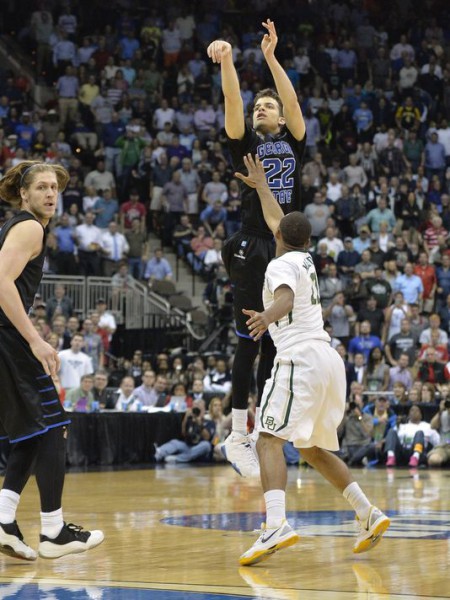
rj hunter georgia state

2. Jerian Grant – Notre Dame/Senior/6’4″ (6’7.5″ wingspan)/200 lbs

Combo playmaking guard that led Notre Dame in points (16.5) and assists (6.6). Compares favorably to former Thunder guard Reggie Jackson. Does a real good job of changing speeds and has a quick first step. Good upper body strength that allows him to get to the rim and score through contact. Good, not great, shooter. Solid defensively. Strength allows him to not be too affected by screens and his lateral quickness allows him to keep up with guards. Can take bad shots early in the shot clock. Can be a bit inconsistent at times. Will be 23 years of age at the beginning of the season. Likely ready to contribute right now, but does not have a ton of upside.

3. Rondae Hollis-Jefferson – Arizona/Sophomore/6’7″ (7’2″ wingspan)/210 lbs

One of the better wing defenders in the draft. Compares favorably to Tony Allen and Michael Kidd-Gilchrist. Length, strength, and athleticism give him the potential to be a top-flight perimeter defender in the league. Scores most of his points in transition and straight line drives to the basket. Rebounds well for his position, especially on the offensive end (2 offensive rebounds per game). Hollis-Jefferson’s biggest weakness is his jump-shot. He just under 21% from 3-point territory. With the Thunder already having an elite defender that struggles with his jumper (Andre Roberson), it may be a bit redundant to draft a similar player that will be a net negative on the offensive end.

The Thunder have a ton of options in this draft. They could take one of these 10 players, or they could surprise everyone and draft a complete unknown (hello, Josh Huestis). Thunder GM has plenty of cards up his sleeves, and will pull the one he feels will make the Thunder a better team for next season and for seasons after that.