Tag Archives: Los Angeles Lakers

5 for 5: The Run

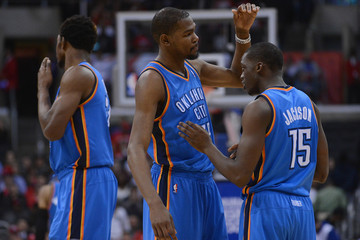
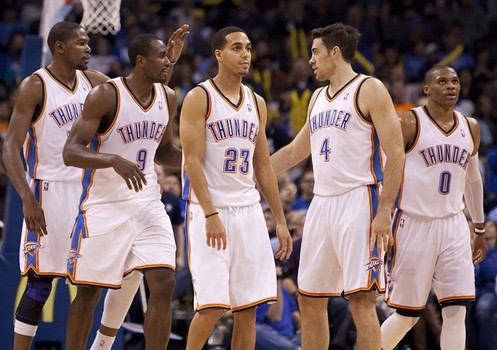
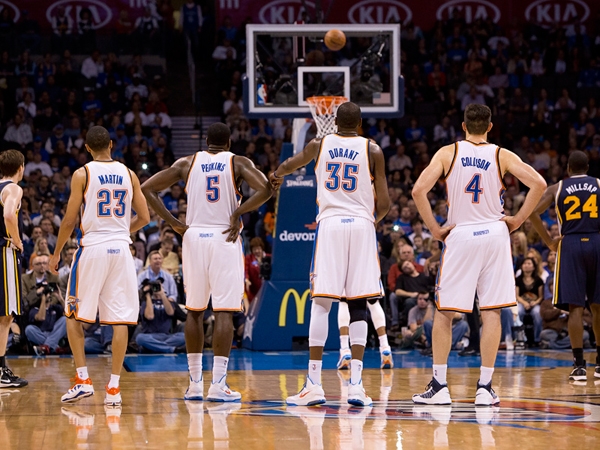
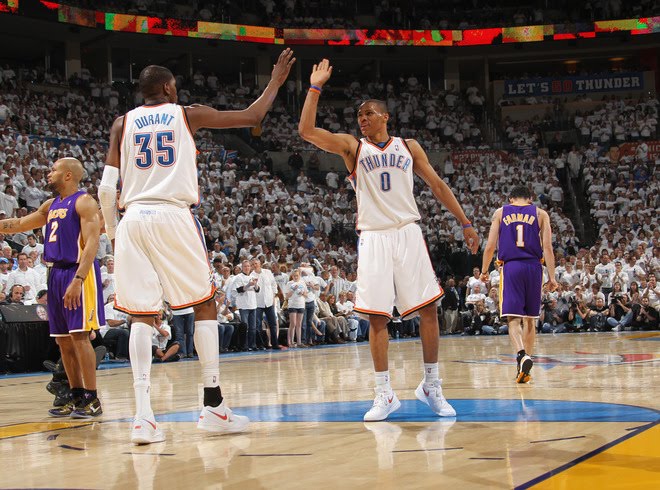
durant westbrook thunder lakers fisher farmer

5 for 5: The Longest Shortest Season  |  5 for 5: Tragedies, Courtrooms, and Beginnings  |  5 for 5: The Rivalries  |  5 for 5: The Thunder’s Godfather

This past season, the Oklahoma City Thunder completed their 5th season in the state of Oklahoma. In a world dominated by round numbers, getting to the midway point is always a cause for celebration. In any relationship, you look back at key moments that made it possible to arrive at certain anniversary marks. In the next few weeks heading into training camp, I’ll be looking at 5 defining moments that made it possible for the Thunder to not only roar into the Plains, but also to do it in winning fashion.

When the Thunder went into the 2009-10 season, their expectations weren’t that high. They were coming off a 23-win season that saw them change coaches mid-season and continued cultivating the young talent that would eventually become their core. They drafted James Harden with the 3rd pick in that year’s draft and ushered in Serge Ibaka, who was drafted in the previous year’s draft, but stayed in Europe for an extra season of development. With the coaching staff firmly entrenched under Scott Brooks and a full year after the Seattle to Oklahoma City transition, the team was looking for tangible improvements on the floor and in the win column.

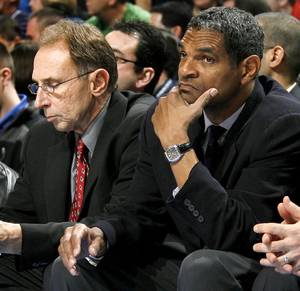
Hindsight being what it is, the most important addition to the Thunder that season didn’t even don a jersey. After Scott Brooks took over for PJ Carlismo in late November of the previous season, the team also fired Carlismo’s number one assistant Paul Westhead. On December 31st, probably in response to Brooks’ inexperience as a head coach, the team hired veteran assistant coach Ron Adams, whose specialty was defense. The teachings of Adams didn’t immediately pay dividends as the team saw their opponents’ scoring average go from 102.2 ppg before his arrival to 103.7 after his arrival. But the seeds of his defensive principles started to take root after the team had an entire offseason and training camp with Adams.

ron adams mo cheeks thunder

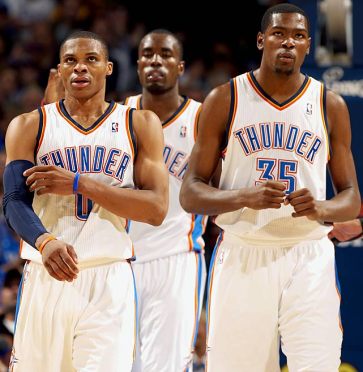
The team came out the next season with a defensive mindset that immediately showed results not only in the stat column, but also in the win column. They improved their defensive rating from 20th to 9th in the league, and held opponents to 98.0 ppg, which was a 5 point improvement from the previous season. The continued evolution of Kevin Durant and Russell Westbrook into All-NBA stewards also helped in the improvement process, as well. The result was a 27 win improvement that netted the Thunder the 8th seed in the Western Conference playoffs. Their opponent in wait were the defending champion Los Angeles Lakers. Continue reading 5 for 5: The Run

5 for 5: The Rivalries

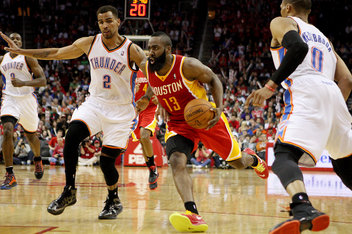
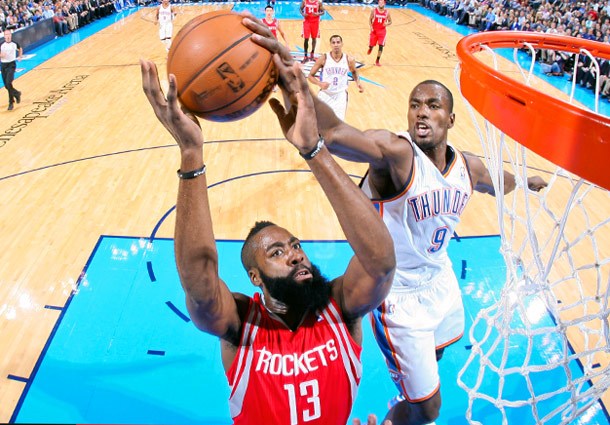
harden sefolosha durant thunder rockets

5 for 5: The Longest Shortest Season  |  5 for 5: Tragedies, Courtrooms, and Beginnings  |  5 for 5: The Run  |  5 for 5: The Thunder’s Godfather

This past season, the Oklahoma City Thunder completed their 5th season in the state of Oklahoma. In a world dominated by round numbers, getting to the midway point is always a cause for celebration. In any relationship, you look back at key moments that made it possible to arrive at certain anniversary marks. In the next few weeks heading into training camp, I’ll be looking at 5 defining moments that made it possible for the Thunder to not only roar into the Plains, but also to do it in winning fashion.

For the third part in this series, I wanted to focus on the rivalries. Sports are only as good as the competition they incite. Playing driveway basketball against your kids when they are 5 years of age can quickly get boring (although palming misdirected shots in midair like you’re Serge Ibaka can be entertaining for at least an hour or so). But, try playing your kids when they are 18 years old and have had 12 years of playing experience. Then it becomes an entirely different ballgame.

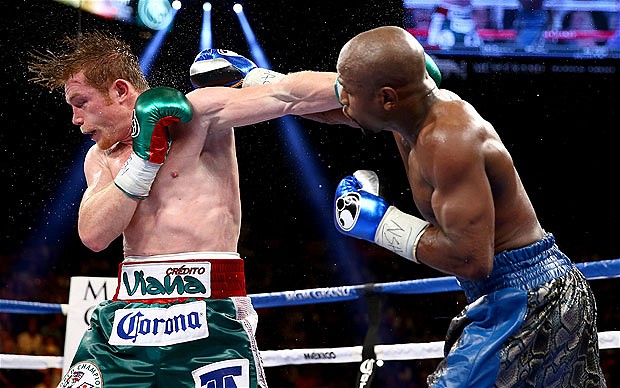
When it comes to competition, I’ve always looked at the career of Floyd Mayweather Jr. with a sliver of disappointment. That he’s a great boxer with arguably the best defense in the history of boxing is without question. The issue that I’ve had with his career has been the level of competition of his opponents. Now, I’m not saying that falls squarely on Mayweather. The guys in his weight classes have not been particularly consistent in the past decade. He’s also “luckily” scheduled the right fights at the right times, choosing to fight boxers that were either on the downward slide of their career (Oscar De La Hoya and Shane Mosley) or fighters that were too inexperienced to compete with him at the time of their fight (Canelo Alvarez and Victor Ortiz). He’s never had that one opponent that defined him. Mike Tyson had Evander Holyfield. Arturo Gatti had Mickey Ward. Mayweather has…… (and therein lies the problem with his career).

mayweather alvarez boxing

If fans are the life blood of sports, then rivalries are the engines that keep them running.  You naturally root against your opponent because they are competing against you and you want to win. Pretty simple concept. But if you add something more to that competitive fire, it can act like an accelerant, creating an even bigger blaze. Rivalries, and the differing reasons for them, can be that spark. When it comes to the Thunder, I’ve categorized their rivals under 4 different categories.

1. Regional Foes

Geography and competition are probably the easiest ways to breed a rivalry. Whether it’s an intracity game between two high schools or a game between professional sports teams 200 miles apart, that desire to be superior to those closest to you is an innate characteristic of the human psyche. Even if the two teams aren’t on equal footing at the time of the game, the rivalry aspect of the game often lends it to be a close affair. Continue reading 5 for 5: The Rivalries

5 for 5: The Longest Shortest Season

thunder western conference champs

5 for 5: Tragedies, Courtrooms, and Beginnings | 5 for 5: The Rivalries  |  5 for 5: The Run  |  5 for 5: The Thunder’s Godfather

This past season, the Oklahoma City Thunder completed their 5th season in the state of Oklahoma. In a world dominated by round numbers, getting to the midway point is always a cause for celebration. In any relationship, you look back at key moments that made it possible to arrive at certain anniversary marks. In the next few weeks heading into training camp, I’ll be looking at 5 defining moments that made it possible for the Thunder to not only roar into the Plains, but also to do it in winning fashion.

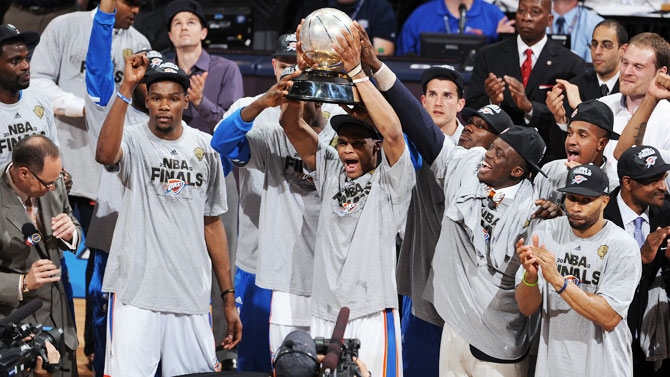
The first part of this series focused on the beginnings of the Thunder organization in Oklahoma  City. For the second part of the series, I want to focus on what was the apex for these first five years of Thunder basketball, the 2012 NBA Finals. For a little comparative perspective, there are 9 NBA teams (in their current city/team format) that have never reached the NBA Finals. The Toronto Raptors, Atlanta Hawks, Sacramento Kings, Memphis Grizzlies, Charlotte Bobcats, Minnesota Timberwolves, Los Angeles Clippers, Denver Nuggets, and New Orleans Hornets/Pelicans have never tasted the fine champagne of a conference championship. I’m excluding the Brooklyn Nets from the list because they’ve only been in Brooklyn for one season and went to the Finals as the New Jersey Nets twice. The proximity of Brooklyn, NY to Newark, NJ (about 15 miles apart) negates a huge change of fan base because of distance. I’m also excluding the Washington Wizards because they made it to the Finals as the Bullets, but decided to change the team’s name in 1997 due to the negative connotation between actual bullets and WashingtonDC being mentioned in the 90’s as the murder capital of the US.

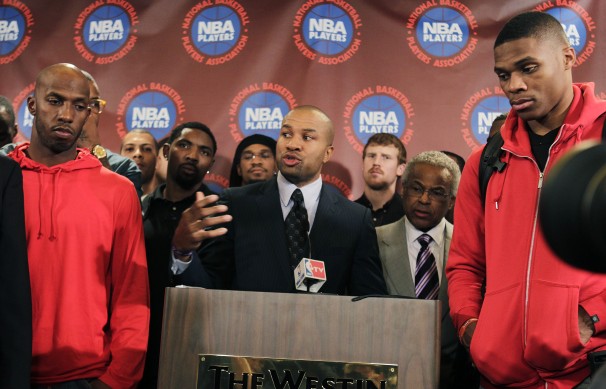
The road to the Finals that season was like the Grateful Dead’s greatest hits album; that is to say a long, strange trip. To begin with, it was a season that almost never was. Although this lockout never reached the DEFCON 4 levels the ’98-‘99 lockout did, it was still nerve-wracking to watch every labor meeting end with the two sides having separate press conferences to disparage the other side. It was like watching your parents, after a nasty divorce, arguing over your custody.

nba lockout

When you are a fan of a team that is drastically improving and just entering the prime of its championship window, the last thing you want is a work stoppage. Anything that cuts into a year of your team’s development when you are close to becoming a perennial contender is the ultimate of detriments. The chemistry built from the previous seasons basically gets thrown out the window if players are allowed to sit for 15-18 months with no access to team coaches or trainers. Not to mention, the veteran players would be a year older and there would be a ton of questions regarding roster moves.

But alas, on November 26th, 2011, after months of hearing about BRI, luxury tax, hard caps, and mid-level exceptions, cooler heads prevailed and an agreement was reached between the NBA and the players’ union. Instead of playing an entire 82 game schedule, the regular season would be trimmed to 66 games with the first day of the season beginning on Christmas. If seeing your team in the NBA Finals is Christmas in June, then seeing the NBA come back from a lockout was, literally, Christmas on Christmas. Continue reading 5 for 5: The Longest Shortest Season

Oklahoma City Thunder: Ballin’ on a budget

westbrookdurantibaka

Growing up, there were two things I was heavily into other than girls: hip-hop and basketball. I grew up in a time when hip-hop was having an internal war within itself. What started off as a rebellious outlet of expression for the poor and struggling turned into an over-expression of opulence and decadence. Hip-hop went from being mostly underground in the 80’s to completely mainstream in the 90’s. That entrance into mainstream pop culture led to many rappers getting rich quick. But as quickly as the money came, it left, leaving many rappers bankrupt and back to where they started.

During this same time period, many of my friends and I were just starting to work. And work means money management, right? Considering I have no idea where my teenage money went, I would say I did a poor job of managing my money. But it’s funny what sticks with you from your teenage years. One of my real good friends, Ryan Rivera, came up with a phrase that still resonates to this day, not only with myself, but also with my team, the Oklahoma City Thunder. The phrase was, “Ballin’ on a budget”.

Basically, it’s finding ways to live good without destroying your bank account or credit score. It’s not easy and it takes a lot of work. A person wanting to ball on a budget has to have patience and self control. The urge to “keep up with the Joneses” can completely destroy any plan to stay within a budget. Many people in the world live outside of their means in order to put on the face of success. Nice shiny things equates to success in the minds of many. Ballin’ on a budget also takes a lot of work. You can either go to Dillards and pay $80 for a Gucci shirt, or you can bargain hunt at Ross and pay $14.99 for the same or similar looking shirt. The work comes in looking for the right bargain. You almost have to become a hustler to succeed in this venture. Bargain deals may not be sexy, but they’ll get the job done with less overhead.
presti

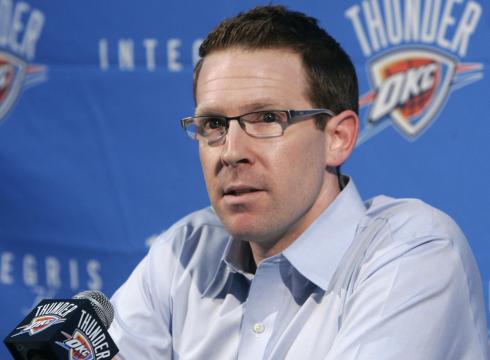
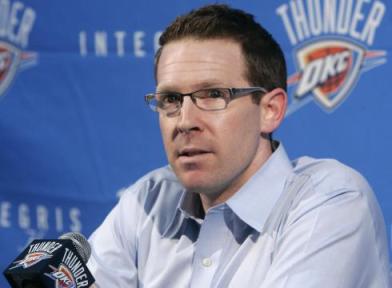
It’s the position where the Thunder find themselves at this juncture. With two trips to the Western Conference Finals, one trip to the NBA Finals, and one number 1 seeding in the Western Conference within the last 3 seasons, this team is definitely ballin’. But they’ve been doing it on a budget to this point. Thunder GM Sam Presti has built a championship contending team through great drafting, salary wheelings and dealings, and difficult decision making.

The current collective bargaining agreement has made things a bit difficult for small market teams that are toeing the line between being tax payers and non-tax payers. What was intended to be a punitive rule to defend against overspending by big market teams, has turned into another instance of “the more things change, the more they remain the same”. The Brooklyn Nets have gone into this offseason acting like a cancer patient that just won the lottery screaming YOLO! at everyone he sees. The Nets are projected to pay upwards of $80 million dollars in luxury tax this season, but they have an owner who seems hellbent on winning a title, no matter the cost. The Los Angeles Lakers, New York Knicks, and Miami Heat have also been consistent payers of the luxury tax for the past 3 seasons.
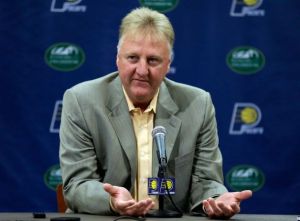
bird

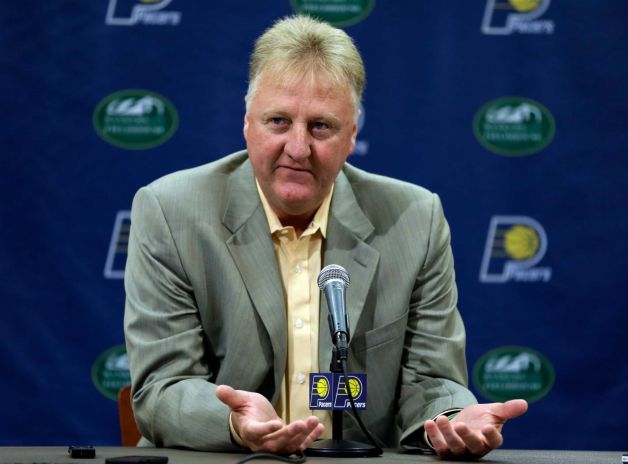
This brings up the difficult question: How are small market teams supposed to compete? In a recent interview with Darnell Mayberry of The Oklahoman, Indiana Pacers president Larry Bird made no qualms about the state of his team and how it compares to the Oklahoma City Thunder,

“Our owners went out and have done everything they could this year so we could be up close to the tax. We just can’t fight the tax. It’s always going to be a disadvantage for us. I feel bad for Oklahoma. They had a great team and they had to make a trade (James Harden trade). They were right there. But we’re going to have to do the same in the future. We’re always fighting an uphill battle with revenues. But that’s part of who we are. And we do the best we can with what we have.”

The key to competing in sports as a small market is to remain patient and look for the right deals. The goal of a big market team is to win at any cost. But the goal of a small market team is to remain consistently sustainable. Teams like the San Antonio Spurs, Pacers, and Thunder thrive on being able to compete year in and year out. I believe that’s part of the reason why the Spurs, who have won 4 championships since 1999, have never been able to repeat. They’ve remained consistently great, but have never been able to consistently spend like the bigger market teams to continuously improve their team on a yearly basis with no regard for payroll. There comes a point every couple of seasons where the Spurs have to retool with younger, less expensive players. Eventually those younger players gain the necessary experience to perform in pressure filled moment, but the team suffers in those “learning seasons”.
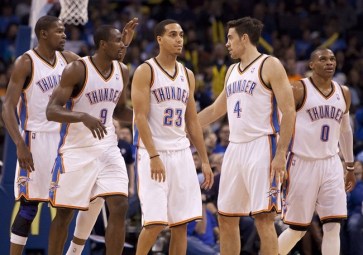
a thunder

That’s what I call last season for the Thunder. It was a learning season. After the Harden trade, the team didn’t really hit a consistent rhythm until the end of the season. And with all that, they still ended up with the No. 1 seed in the Western Conference and were probably a Russell Westbrook knee injury away from making it to a 3rd consecutive Western Conference Final. Next season will probably be another learning season, as the bench lost its leading scorer when Kevin Martin signed with the Minnesota Timberwolves. With many fans clamoring for the Thunder to make a move to replace the scoring lost by Martin’s departure, the team has remained steadfast in trusting the young players they already have. Reggie Jackson showed last year in the playoffs what he is capable of after replacing Westbrook when he went down with his injury. Jeremy Lamb has performed well in Summer League and is expected to be a key contributor off the bench next season. And centers Steven Adams and Daniel Orton have performed surprisingly well in Summer League as rim protectors and, dare I say, offensive threats.

To many, this may seem like a cheap move by the owners of the team. With how good the team looked at the end of the regular season, it seemed like they were a resigned Martin and another bench scorer away from being an even stronger contender than they were when they made it to the Finals. With Martin’s bird rights in hand and the full MLE at their disposal, many thought the Thunder were finally going to jump into the deep end of the pool and join the other tax-paying teams. Instead, they allowed Martin to go to Minnesota in a sign and trade (that netted the Thunder a $6.6 million dollar traded player exception) and haven’t touched any of their available pre-tax cap space, which comes out to about $1.28 million dollars. That’s at least enough to sign someone to the veteran minimum. While the pool of free agents has gotten significantly smaller since July1st, there are still viable players available for the taking. So the question becomes: What are the Thunder waiting for?
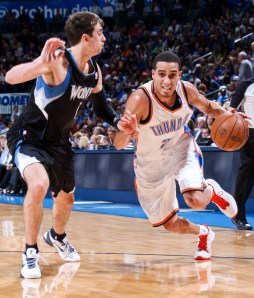
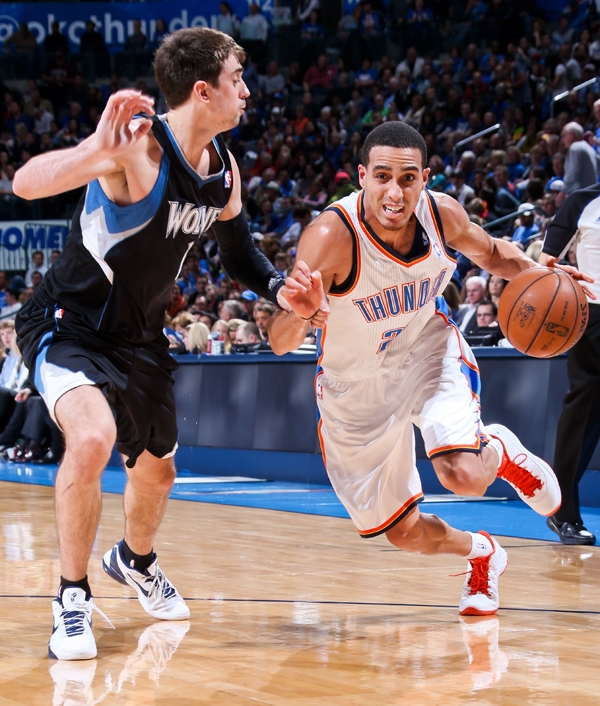
martin_wolves_lm1_130109

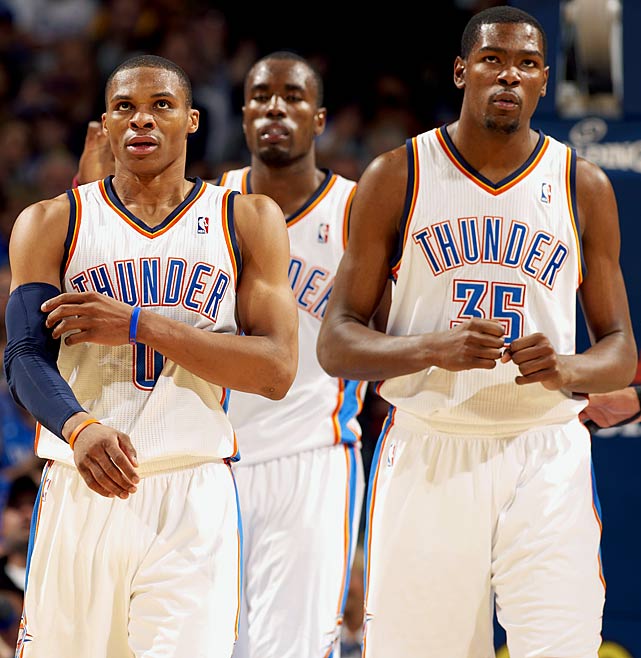
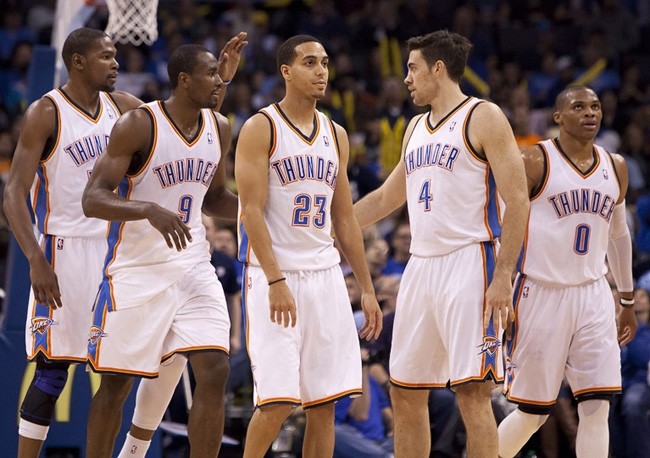
That is where the virtue of patience comes into play. For one thing, it’s only July. Many fans are panicking because of the moves made by other organizations, especially within the Western Conference. The Los Angeles Clippers resigned Chris Paul, traded for Jared Dudley and JJ Reddick, and hired a much better coach in Doc Rivers. The new “it” team, the Houston Rockets won the Dwight Howard sweepstake and landed a couple other veteran free agents. But, championships aren’t won in July; they are won in June. A team can stack a roster full of great players in July that may amount to nothing more than a first round exit the next April. Secondly, the organization has never said that they won’t pay the tax. They know that to be competitive, you may have to eventually pay the tax. But if you don’t have to pay the tax yet, why pay it? Along with more punitive luxury tax restrictions, the new CBA also instituted a repeater tax for teams that have paid the luxury tax for 3 consecutive seasons. With the escalating salaries of Kevin Durant, Russell Westbrook, and Serge Ibaka, the longer you can hold off on being a tax-payer, the more financially competitive you’ll be. And lastly, you still have Kevin Durant, Russell Westbrook, and Serge Ibaka. As long as those three guys are healthy, I think the Thunder have a fighter’s chance in any game.

The Thunder aren’t cheap. They’re just smart about how they manage their money. They already have a large percentage of the cap space allotted to the 3 players they deem the most important to the franchise. The reason the Thunder are perceived as cheap, though, is because they never had to “buy” any of those players in free agency. They drafted and developed them, and luckily, they turned out to be superstars. But sometimes, difficult decisions need to be made in order to maintain the financial flexibility that is tantamount to small market team success. That’s what happened in the Harden trade. The Thunder had 4 great players, but couldn’t pay 4 near max to max contracts. Ibaka helped the team by taking what is perceived to be a less than market value contract. Hoping that Harden would do the same, the Thunder drew a line in the sand, and said “here’s our final offer, take it or leave it”. When Harden rejected the offer, the team made the decision to move Harden to Houston. The situation was never a choice between Ibaka or Harden. But to make the numbers work, the team needed Harden to leave some money on the table, and for a young guy heading into his first foray into free agency, he just couldn’t do that.
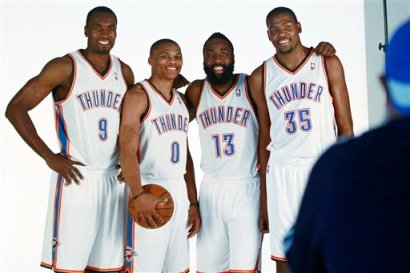
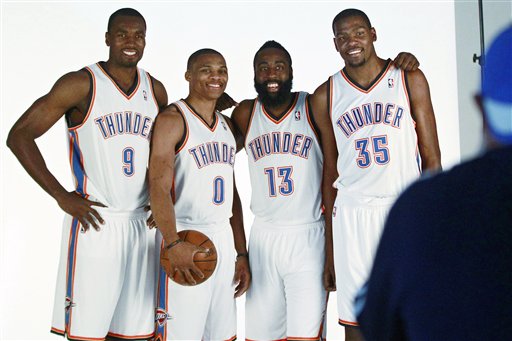
Serge Ibaka, Russell Westbrook, James Harden, Kevin Durant

Being a money conscious team is not sexy at all. Following a team that is run on the principles of patience and bargain shopping is not for the faint of heart. You watch other teams stack their teams with what you perceive to be good to great players, while you’re constantly having to hope that your players continue to improve in the offseason and that the veteran minimum center you signed actually can play the game of basketball. It’s a tough life, I know. But I wonder how Miami Marlins’ fans really feel about their two championships. The Marlins organization went all in for two runs at a title, and then completely dismantled the team after each title. While the feeling of winning a championship can never be replaced, I wonder what the feeling of watching your championship team be completely dismantled the following offseason feels like. Luckily, I don’t think I’ll ever have to know what that feels like.
Houston Rockets vs. Oklahoma City Thunder Series Preview

james-harden-rockets-thunder

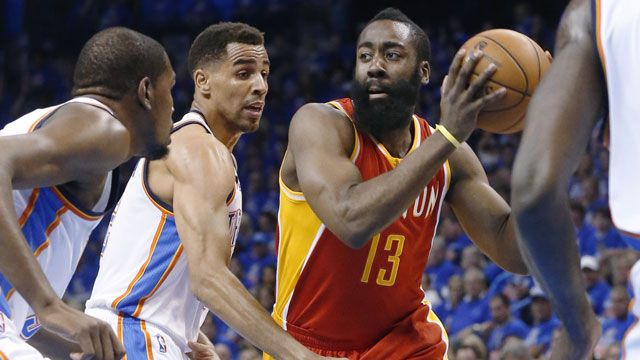
It’s a funny thing about fate. You usually see the final product taking shape from a mile away, but when it happens, you’re completely surprised by the end result. All season long the Oklahoma City Thunder have hovered around the top two spots in the Western Conference and the Houston Rockets have hovered around the 6-8 spot. It shouldn’t have come to surprise anyone that these two teams might actually meet in the first round of the playoffs. But when it happened, after the final game of the final day of the season, there was a collective, “Wow, we’re playing James Harden in the first round” train of thought.
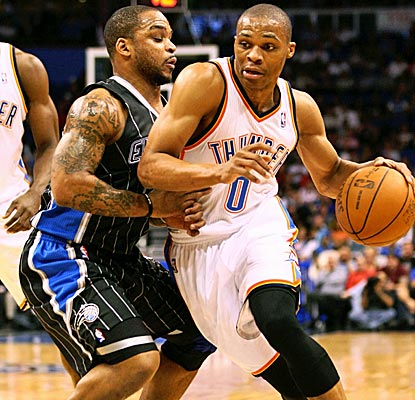
Everyone will want to turn this into James Harden vs. the Oklahoma City Thunder. I see that, but we all know, that in reality, this is going to be the Kevin Martin vs. the Houston Rockets series, right? (Crickets, crickets) Well, as fate would have it, these two teams will meet in the first round of the Western Conference playoffs. The top seeded Thunder versus the 8th seeded Rockets. The young, rambunctious upstarts against the grizzled veteran team (how funny is it that the Thunder are a grizzled, veteran, playoff tested team?). It wasn’t long ago that the Thunder were the young upstarts wanting to gain some respect against the defending champion Los Angeles Lakers. Now, the Thunder are the defending Western Conference champs and everyone will be gunning for their crown.

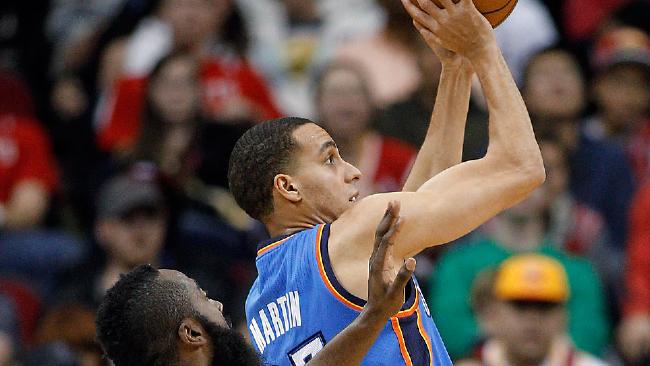
martin harden

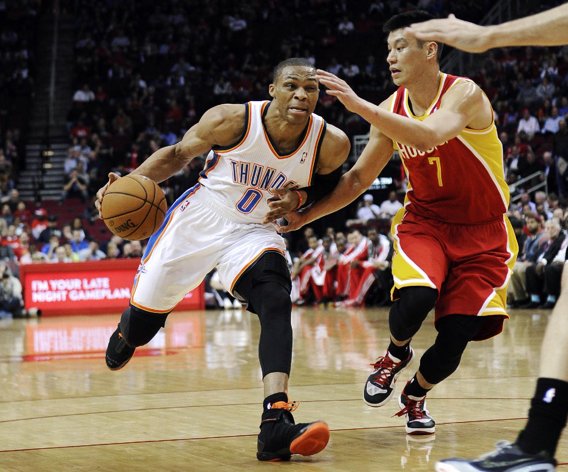
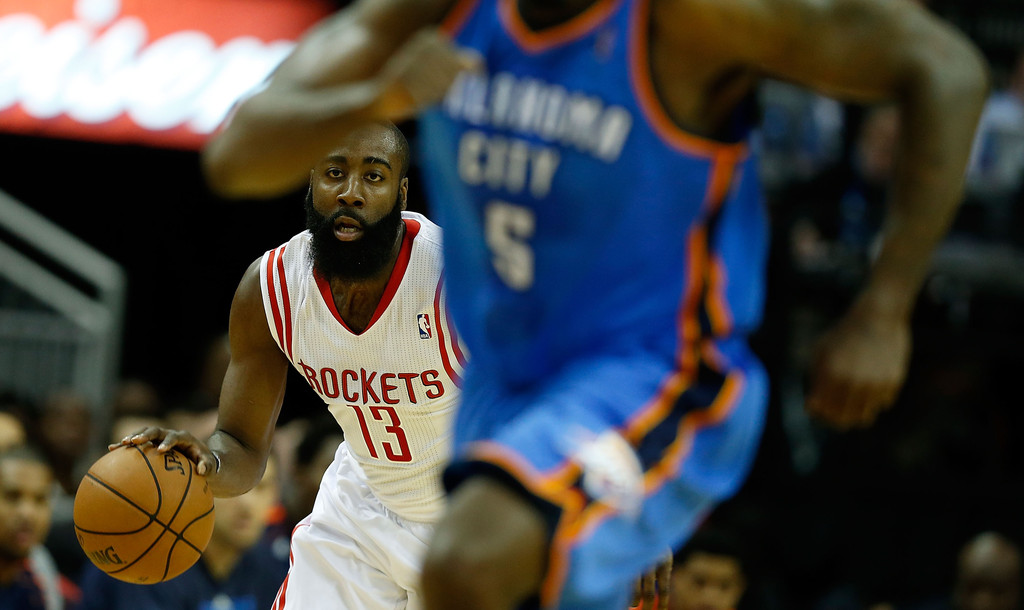
These two teams played 3 games during the regular season. The Thunder took the first two by an average margin of 26 points. In those two games, Harden struggled mightly, while the Thunder basically got anything they wanted on the offensive side of the ball. The third game was a different story. In that game, the Thunder were up by 14 points with less than 7 minutes left to play in the 4th quarter. And then, Harden (and Lin) happened. The Rockets proceeded to outscore the Thunder 29-12 from that point to garner a 3 point win. James Harden scored 14 of his career high 46 points in the final 6:30, and Jeremy Lin chipped in with 9 points in those final 6 minutes. But that game highlighted the reason why this will probably be a short series. 

Schedule

  • Game1 – Sunday, 21 April 2013 at 8:30 PM CST (Chesapeake Energy Arena, Oklahoma City, OK)
  • Game 2 – Wednesday, 24 April 2013 at 6:00 PM CST (Chesapeake Energy Arena, Oklahoma City, OK)
  • Game 3 – Saturday, 27 April 2013 at 8:30 PM CST (Toyota Center, Houston, TX)
  • Game 4 – Monday, 29 April 2013 TBD (Toyota Center, Houston, TX)
  • Game 5 – Wednesday, 01 May 2013 TBD (Chesapeake Energy Arena, Oklahoma City, OK)*
  • Game 6 – Friday, 03 May 2013 TBD (Toyota Center, Houston, TX)*
  • Game 7 – Sunday, 05 May 2013 TBD (Chesapeake Energy Arena, Oklahoma City, OK)*

* – If necessary

Probable Starters

Houston Rockets

  • PG – Jeremy Lin
  • SG – James Harden
  • SF – Chandler Parsons
  • PF – Greg Smith
  • C – Omer Asik

Oklahoma City Thunder

  • PG – Russell Westbrook
  • SG – Thabo Sefolosha
  • SF – Kevin Durant
  • PF – Serge Ibaka
  • C – Kendrick Perkins

3 Keys to the Series

1. Pick and Roll Defense – This is the Rockets’ bread and butter. Lin and Harden are great at breaking the PnR defense down and either finding the open man or driving and drawing fouls. Thabo Sefolosha is great at going under the pick, but can sometimes get caught in the mess of a pick and roll, allowing the ball handler to get to the basket. On the other hand, Westbrook is known to go over screens, which allow the ball handler a sliver of daylight to get a shot off. But the key to the PnR defense will be Kevin Durant and Serge Ibaka. Chandler Parsons led the Rockets in 3-point % and will make Durant pay if he tries to help on defense. Ibaka is going to have to stay out of foul trouble if the ball handlers get past the initial line of defense. 

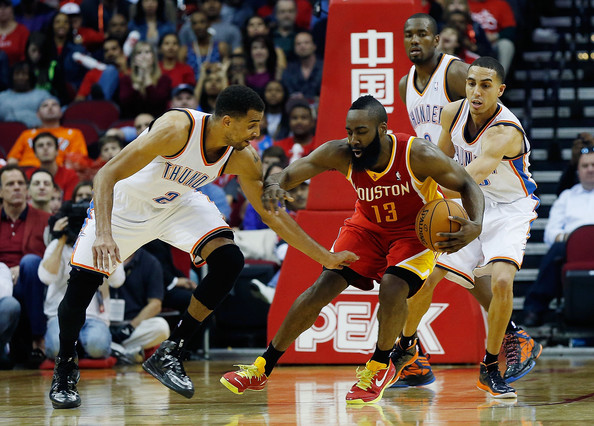
NBA: Oklahoma City Thunder at Houston Rockets

2. Pace – These are the number 2 and 3 scoring teams in the league. But Houston likes a much faster pace than the Thunder. In their two wins against the Rockets, the Thunder kept the Rockets under 100 points. In their lone loss, the Rockets scored 122 points. Houston’s offense is predicated on transition baskets and pick and roll offense. If the Thunder are to win, they are going to have to slow the pace down and make the Rockets a half court team.

3. Russell Westbrook – The Rockets have no one on their roster that can come close to guarding Westbrook. Lin is too weak, Aaron Brooks and Patrick Beverly are too short, and Carlos Delfino is too slow. Westbrook should be able to get whatever he wants on the offensive end.

russ rockets

  • X-Factor: Thabo Sefolosha – His defense on James Harden will go a long way to determining how these games will go. If he gets into foul trouble early, look for Harden to be in attack mode for the entire game. Also, his shooting will be key to keeping the turnovers down. If Harden has to stay on Sefolosha, that will negate him from helping out and  jumping into passing lanes to get steals. 

How this will play out: Thunder in 5

Full Circle: Harden trade revisited

james harden

There’s a reason why teams don’t like to trade core players within their own conference. The fact that you not only have to face them more times during the season, but also possibly in a playoff series, causes many teams to take lesser deals in order to trade a core player to another conference. That scenario now becomes a reality for the Oklahoma City Thunder. In their first round match-up with the 8th seeded Houston Rockets, the team will meet up with former 6th man extraordinaire James Harden. While the teams have already met three times before during the regular season, the stakes will undoubtedly be higher for these next 4-7 games.

The trade essentially comes full circle within the same season. When Harden was traded to the Rockets 4 days before the season started, many media pundits saw this as the first step back in a franchise that had progressed forward since it first stepped foot in the Great Plains in 2008.  Many wondered whether the team that many people had tabbed as the next great dynasty was finally beginning to succumb to the many ills that small market teams face. The new collective bargaining agreement, which was supposed to help small market teams with the concept of increased “player-sharing,” had actually robbed the model small market team of one of its superstars. Even the fans, those crazy, loyal, Oklahoma City fans, questioned whether the billionaire owners were crying cheap in the wake of a possible dynastic-like run.

durant jackson

In reality, the trade turned into a win-win situation for both parties involved. The Thunder front office and scouting team puts a premium on player development. It helps that they have drafted extremely well in the last 5 seasons. For every dud that’s ever gotten drafted by the Thunder, there are two studs in their place. For every Cole Aldrich the team drafts, there’s a Serge Ibaka or a Reggie Jackson. For every Byron Mullens, a Russell Westbrook or James Harden. The team not only looks at skill, but also character. They don’t just want players with specific skill sets; they want players that want to use those skill sets to reach their maximum potential, and then want get better from there. That’s what we’ve seen from the Thunder players when adversity hits. Many people wondered where the scoring would come from when the Thunder traded Jeff Green and Nenad Krstic to the Boston Celtics for Kendrick Perkins in February 2010. They were trading two double figure scoring starters for a center that struggled to average 8 points a game and was coming off of major knee surgery. After the trade, the Thunder adapted and Kevin Durant and James Harden increased their scoring to offset any loss of scoring on the offensive end. At the same token, with Ibaka getting a lot more minutes, the defense improved. The team ended that season with a trip to the Western Conference Finals.

Many wondered whether that same type of internal improvement could happen after the Harden trade. Seriously, what more could Durant and Westbrook do to improve their games? They were already 2 of the top 10 players in the league. The fact that Durant and Westbrook improved their games this season came as no surprise. They knew that they would not only have to replace the scoring of Harden, but also the playmaking. While the superstar duo’s scoring remained consistent from the previous season, it’s their assist numbers that made the team better. Durant averaged a career high 4.6 assists (up from 3.5 the previous season), while Westbrook upped his assist mark by nearly 2 assists per game. Not only did the assist go up, but the turnovers between the two went down (even if slightly). In addition, the duo became very efficient with their scoring. Durant became the newest member of the 180 shooting club (50% FG, 40% 3pt FG, and 90% FT), and Westbrook chose his spots a bit more technically this season.

But what of the other Thunder players? Incremental improvements from Durant and Westbrook alone wouldn’t be enough to replace Harden’s production. Enter Ibaka and Thabo Sefolosha. Ibaka’s scoring average jumped up over 4 points, but it’s in the matter in which he scored that assisted the team the most. Ibaka became one of the best mid-range shooting big men in the league. Where that helps the Thunder is in floor spacing for Westbrook and Durant. With opposing big men not being able to cheat off of Ibaka, the lanes opened up for the scoring duo. In addition to Ibaka, Sefolosha became a consistent 3-point threat and increased his scoring by nearly 3 points a game. For a team that performs optimally when the floor is spaced, the improvement of these two players has lessened the departure of Harden.

kmart

In addition, the Thunder got a comparable player in Kevin Martin. While the season has, at times, been a bit rough for Martin and his transition as a 6th man, he has filled the role seamlessly enough to lessen the blow of the trade. The bench role transition was made more difficult by the fact that the Thunder not only traded Harden, but also 3 other members of the Thunder’s bench. The Thunder were, in essence, bringing in an entirely new bench unit. On a team that finds comfort in continuity, this was a shock to the system. It took about 65 games, but the coaching staff finally found a rotation off the bench that works for the team. What once seemed like a weakness after the trade, has, once again, turned into a strength for the team.

As mentioned above, the trade was a win-win for both organizations. The Rockets finally got the superstar player that they had been trying to acquire for the past few seasons. In an attempt to acquire a superstar player, that Rockets had been loading up on assets and freeing up cap space. When they failed to acquire Dwight Howard in the offseason, the team shifted its sights onto Harden, who was in a contract squabble with the Thunder. With their combination of Martin (expiring contract/comparable player), Jeremy Lamb (lottery talent), and draft picks, the Rockets finally acquired what they hope is the first piece of their successful puzzle. Not only do the Rockets now have a good young core in Harden, Jeremy Lin, Omer Asik, Chandler Parsons, and Thomas Robinson, but they also have the cap space to go after another premium free agent this offseason.

rockets

And what about our old friend, James Harden? I’ve always thought that sometimes, in life, you have to get pushed out of your comfort zone to achieve your utmost potential. The reality is that Harden was too talented to be a third option on any team, regardless of who the first two options were. He was a highly efficient scorer that got to the line in droves and was a top notch playmaker, to boot. He had shown that he could perform in high pressure situations and was beginning to be one of the most noticeable faces in the NBA (and its most noticeable beard). He was ready to be a superstar, and was ready to get paid like a superstar. The Thunder offered what they thought was a respectable offer, but also knew that Harden (and his agent) may be looking for something more. The market dictates what a player is worth. If a player begins to hear that he is worth the max, he’ll be looking for that type of money. The Thunder knew this and made a decision: either Harden sacrifices by taking a lesser than market value offer to stay on the team or the Thunder had to pounce on the best deal available. The rest is history. Harden was traded, got a super max extension, and became a superstar. End of story, right?

Ibaka-Harden_original

Wrong. Much like the Thunder versus the Los Angeles Lakers in the 2010 playoffs, the Rockets are now the hungry, young upstarts trying to take the crown from the defending Western Conference champion Thunder. In a way, the CBA’s concept of player-sharing actually worked out this time. The reality is that when you draft enough talent, you’ll eventually run out of money to pay them all. It’s not a bad dilemma to deal with if you have the right brain trust guiding the team. In the end, after coming full circle, one team got better in this trade and the other team improved. I’ll let you decide which is which.

Kobe Bryant’s Impact on the Thunder

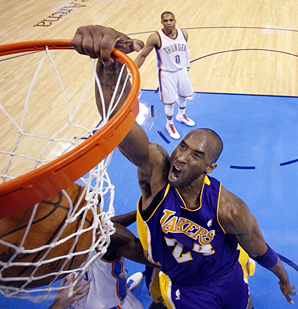
kobe durant

There’s something to be said about big brothers. I never had one growing up, and, honestly, most of the people I associated with while growing up were the oldest children in their families. But in the examples that I did see while growing up, big brothers can help shape and mold younger brothers into something better than what they themselves are. As we’ve seen with the Big Brothers Big Sisters of America, big brothers don’t even have to be related to their younger brethren to have an impact.

Big brothers serve two purposes in life: to frustrate and to motivate. The frustration part comes from the big brother’s ability to dominate over the little brother due to being older, bigger, and wiser. The motivation part comes from the little brother wanting to be better than the big brother. The thing about this big brother/little brother dynamic is that the little brother is able to take notes on how to best his big brother, while the big brother just has to wing being a big brother.

bryant perk

In a lot of ways, with all due respect to Kendrick Perkins, Nazr Mohammed, Royal Ivey, Kevin Ollie, and Desmond Mason, the best example of a big brother to the Oklahoma City Thunder has been Los Angeles Lakers guard Kobe Bryant. With his recent season-ending (and hopefully, not career ending) Achilles tendon tear, I was forced to evaluate Bryant’s legacy when it comes to the Thunder.

If there is one word to describe my feelings towards Bryant’s basketball ability, it’s respect. Off the court, though, Bryant is one of those people that I would try to avoid like the plague. His arrogance and A-type personality, combined with a penchant to place blame on others when things don’t go his way, would be a package that I would completely avoid, if possible, in real life. But on the court, those personality traits, and the fact that he plays for the most polarizing franchise in NBA history, make for must see TV. Bryant is a five tool player that has a lethal 6th tool: the overwhelming need to completely decimate his opponent night in and night out, year after year. Michael Jordan had this 6th tool. Larry Bird had this 6th tool. Bill Russell had this 6th tool. Russell Westbrook HAS this 6th tool.

To view Bryant as an opponent is to respect someone out of fear. Fear for what he could do against your team. Fear that he’ll conjure up some bulletin board material for his mental bulletin board, and go off on your team for no particular reason. Fear that he could miss 10 shots in a row, but the 11th shot, with the game on the line, will go in without hesitation. That’s the kind of respect that Kobe Bryant garners. And yet, it’s a fear that keeps you staring in awe. He’s the type of player that fans say, “I hate what he does to my team, but I love to watch him play.”

kobe-bryant-lakers

Every successful up and coming team has that one hurdle they set their sights on. If you’re a team that is coming out of the dredges of the draft lottery, you mark successes in increments. First step is to be competitive on a nightly basis. Then the next step is to get into the playoffs. Then the next step is to be successful in the playoffs. You keep going until, hopefully, eventually, you win a championship. But along the way, especially in the early stages of the success journey, you always target that one team that’s been there and done that. For the Chicago Bulls in the late 80’s and early 90’s, it was the Detroit Pistons. For the Orlando Magic in the mid 90’s, it was the New York Knicks. And for the Thunder, it was the defending champion Los Angeles Lakers.

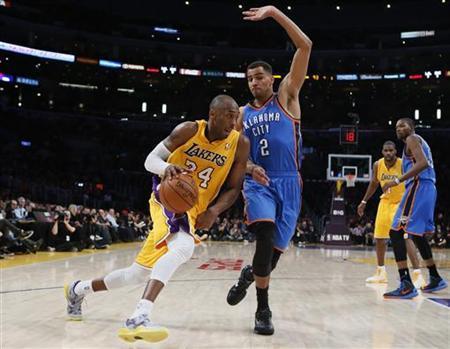
kobe_thunder

As fate would have it, that 2010 playoff series that pitted the No. 1 seeded Lakers vs. the No. 8 seeded Thunder was probably the best thing for the development of the Thunder. The fact that they were able to give the eventual champion Lakers a fight in the first round did wonders for the confidence of the young Thunder. But if you broke it down to its simplest form, the Thunder didn’t give the Lakers a test. They gave Kobe a test. They planted the seed in Kobe’s head that we would be a force to be reckoned with for the foreseeable future. When the crowd would chant, “Beat LA”, they were actually chanting “Beat Kobe”. Nobody feared Pau Gasol. Or Andrew Bynum. Or Derek Fisher (hehe!). We knew that Kobe had received the message. And that was both awesome and fearful (respectful) at the same time.

As the Thunder’s two superstars, Kevin Durant and Russell Westbrook, progressed in the NBA world, they would eventually come in contact more often with Kobe Bryant. On Western Conference All-Star teams and, most importantly, the Olympics, Thunder fans can only hope that our superstars soaked up any of the psychological warfare that Bryant uses on a daily bases. Those blurbs that you hear from media members about Bryant talking trash to Durant, Westbrook, and at the time, James Harden during the Olympics, when they heard that the Lakers had acquired Dwight Howard and Steve Nash, is just classic mental warfare from Bryant. It’s the equivalent of how the military drops leaflets into countries they are warring with stating how their government is endangering them, the common citizen.

Kobe+Bryant

So with that, I say, thank you to Kobe Bean Bryant. He has as much a stake in the Thunder’s ascension and success as does any of the veterans that played for the team. He was the target that we went after when we wanted to be successful. Much like an older brother, he frustrated us. But he also motivated us. And we learned much from facing him and defeating him. Here’s hoping that Bryant does come back, while, realistically realizing, that the Bryant we knew, may have gone down in a heap in the Staples Center on Friday night. Whatever the future holds for Kobe, just realize that the future of the Oklahoma City Thunder was shaped, in part, by the man in the Lakers uniform that we feared and respected the most.

Oklahoma City Thunder vs. Utah Jazz preview (Game 78 of 82)

jazz_team_rr11_121130

  • When: Tuesday, 09 April 2013 at 8:00 PM CST
  • Where: Energy Solutions Arena, Salt Lake City, UT

One of the most dangerous things to face in the final week of a season is a team fighting to get into the playoffs. Their “win or go home” mentality surfaces with every game leading to the playoffs. Most playoff bound teams are on cruise control in the final week of the season. Some may be battling for playoff positioning, but if you are a team that has an end of alphabet letter (X,Y,Z) by your name in the standings, you’re usually pretty content. But for teams like the Utah Jazz, Los Angeles Lakers, or even, Dallas Mavericks, these final few games are their play-in games to get into the NBA post-season tournament.

I don’t know if the Oklahoma City Thunder are indifferent as to whether they get the No.1 seed in the Western Conference or not. Both the Thunder and San Antonio Spurs seem pretty content with their position in the conference, and are probably both confident they can win the conference whether they have home court advantage or not. With that said, the Thunder will be facing a desperate team trying to put space between themselves and the Los Angeles Lakers for the final playoff spot.

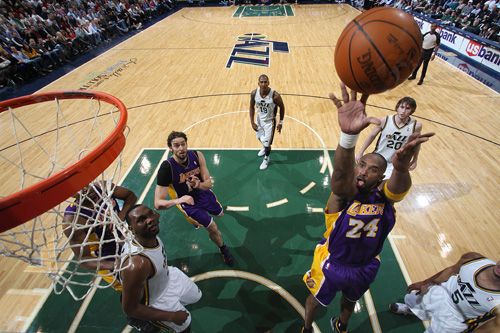
Los Angeles Lakers v Utah Jazz

The Jazz come into the game surging, having won 7 of their last 8 games. With Mo Williams finally healthy and Derrick Favors beginning to live up to his potential, the Jazz seem to finally have found their groove. They’ve settled into a consistent rotation of 8-9 players that attacks with balanced offense (inside with Paul Millsap, Al Jefferson, and Favors and on the wings with Williams, Gordon Hayward, and Alec Burks) and consistent work on the boards.

For the season, it has been a home court advantage type of series between these teams with the Thunder dominating their two games in Oklahoma City and the Jazz dominating in their one game in Salt Lake City.

Probable Starting Line-ups

Utah Jazz

  • PG – Randy Foye
  • SG – Mo Williams
  • SF – Gordon Hayward
  • PF – Paul Millsap
  • C – Al Jefferson

Oklahoma City

  • PG – Russell Westbrook
  • SG – Thabo Sefolosha
  • SF – Kevin Durant
  • PF – Serge Ibaka
  • C – Kendrick Perkins

3 Keys to the Game

1. Control the paint – This is a team that the Thunder can actually sag off the shooters a bit and help out in the paint. The Jazz only make about 6.2 threes per game, which puts them in the bottom quarter of the league in 3-point makes per game. Kendrick Perkins has had a fair amount of success defending his former Boston battery mate, Al Jefferson.  And Ibaka and Collison have had success against Millsap and Favors. But those three can collectively change the game with the rebounding ability and offensive production in the paint.

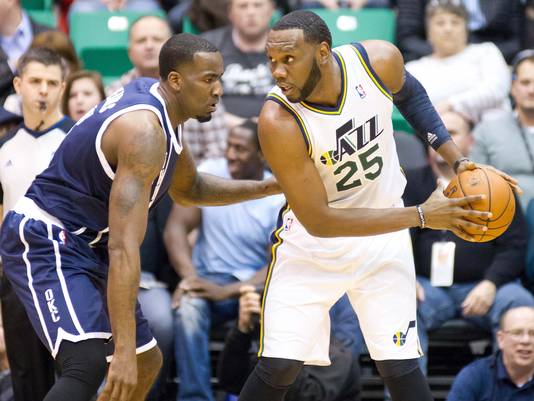
al perk

2. Shooters – As in, Oklahoma City shooters. Kevin Martin, Thabo Sefolosha, Derek Fisher, and Ibaka should all be on high alert as they should receive their fair amount of opportunities to attempt open jumpers. The Jazz always have trouble defending Kevin Durant and Russell Westbrook. Look for the Jazz to shade a defender over, leaving someone open on the perimeter.

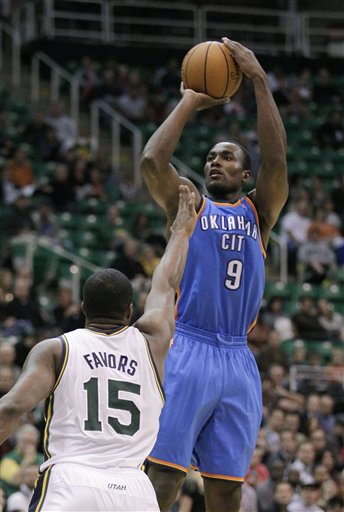
Serge Ibaka, Derrick Favors

3. Durant and Westbrook – Hey, no one on the Jazz can guard you guys. Begin CDI (Complete Dominance Initiative).

Orlando Magic vs. Oklahoma City Thunder preview (Game 66 of 82)

magic thunder

  • When: Friday, 15 March 2013 at 7:00 PM CST
  • Where: Chesapeake Energy Arena, Oklahoma City, OK

If you are an established small market team that builds through the draft and smart, cost-effective moves, you are said to be using the San Antonio model of team building. But if you are a rebuilding team, collecting draft picks and young players, you are said to be using the Oklahoma City model of team building. The Oklahoma City Thunder are using the San Antonio blueprint, while battling the Spurs for Western Conference supremacy. The Orlando Magic, on the other hand, are using the OKC model to rebuild after Dwight Howard napalmed the team for two consecutive seasons.

Two years after making it to the Finals, the Magic were struggling to remain relevant in an Eastern Conference that now boasted a super team in Miami, a wunderkind point guard in Chicago, and a scoring title threat in New York. Howard could see the writing on the wall, but waffled between staying with the team and wanting to be traded. The indecision on the part of both parties (Howard and the Magic’s) delayed the inevitable, frustrating both the Magic front office and the fan base for 2 seasons. Howard was eventually traded this past offseason to the Los Angles Lakers in a four team deal that included 12 players and 5 draft picks.

Orlando Magic v Los Angeles Clippers

Heading into this meeting with the Thunder, the Magic find themselves at 18-47, good for 14th in the Eastern Conference. After surprisingly starting the season with a 12-13 record, the Magic proceeded to lose 34 of their next 40 games. This will be the first of two meeting between these two teams. The Thunder swept the season series last season in two tightly contested games.

Probable Starting Line-ups

Orlando Magic

  • PG – Jameer Nelson
  • SG – Arron Afflalo
  • SF – Moe Harkless
  • PF – Tobias Harris
  • C – Nikola Vucevic

Oklahoma City Thunder

  • PG – Russell Westbrook
  • SG – Thabo Sefolosha
  • SF – Kevin Durant
  • PF – Serge Ibaka
  • C – Kendrick Perkins

3 Keys to the Game

Protect the ball – Orlando is an extremely young, athletic team that feasts on turnovers. If the Thunder get too careless with the ball, the Magic will make them pay in transition. There’s no need to give a young team momentum to think they can win at your place.

ibaka and perk

Rebounding – The Magic are 15th in the league in rebounding, but have a double-double machine in athletic center Nikola Vucevic. With Vucevic patrolling the paint and Mo Harkless/Tobias Harris keeping Serge Ibaka outside of the paint, it will be up to Kevin Durant and the guards to help out in the rebounding department.

durant posting

Kevin Durant and Russell Westbrook: Post up offense – Both Westbrook and Durant will have significant height advantages on their defenders. Look for them to post up early and often.

Utah Jazz vs. Oklahoma City Thunder preview (Game 65 of 82)

NBA: Oklahoma City Thunder at Utah Jazz

  • When: Wednesday, 13 March 2013 at 7:00 PM CST
  • Where: Chesapeake Energy Arena, Oklahoma City, OK

It’s getting to that point in the season where mostly every game carries some sort of importance, either for playoff seeding or draft lottery probabilities. The Oklahoma City Thunder are coming off a road loss to the San Antonio Spurs, where they had the opportunity to overtake the Spurs for the top seed in the Western Conference. The Utah Jazz, on the other hand, are on the opposite end of the playoff spectrum. The Jazz held onto the 7th seed in the West as recently as one week ago, but losses in 7 of their last 9 games has the Jazz looking up at the hard charging Los Angeles Lakers for the final playoff spot in the West. With that said, there are heavy playoff implications for both teams in this game.

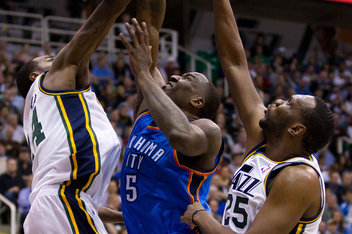
This is the 3rd meeting of the season between these two Northwest division rivals. The Thunder easily won the first game at home, 106-94. In that game, Russell Westbrook nearly notched a quadruple double with 23 points, 13 rebounds, 8 assists, and 7 steals. Kevin Durant chipped in with 25 points and Kevin Martin added 19 points off the bench. In the 2nd meeting of the season, the Jazz basically flipped the score while playing in Salt Lake City, 109-94. In that game, the Jazz dominated the paint, with Al Jefferson and Paul Millsap combining for 41 points and 17 rebounds (9 offensive).

Probable Starters

Utah Jazz

  • PG – Randy Foye
  • SG – Mo Williams
  • SF – DeMarre Carroll
  • PF – Paul Millsap
  • C – Al Jefferson

Oklahoma City Thunder

  • PG – Russell Westbrook
  • SG – Thabo Sefolosha
  • SF – Kevin Durant
  • PF – Serge Ibaka
  • C – Kendrick Perkins

3 Keys to the Game

Post Defense – It can’t be said enough against teams that have two functional big men how important it is to control the paint defensively. In the first game between these two teams, Jefferson and Millsap were held to 29 points on 12-29 FG shooting (41.4%). In the second game, a Thunder loss, the Jazz duo combined for 41 points on 19-36 FG shooting (52.8%). It’s up to Perkins, Ibaka, and Nick Collison to contain these two.

NBA: Oklahoma City Thunder at Utah Jazz

Defensive Rebounding – Related to the post defense, defensive rebounding is extremely key when dealing with the Jazz. The Jazz grabbed 21 and 16 offensive rebounds, respectively, in the two games against the Thunder. Offensive rebounds lead to extended offensive possessions and more shots for the opposition. The Jazz shot 17 and 19 more shots, respectively, than the Thunder in the two games they played against them.

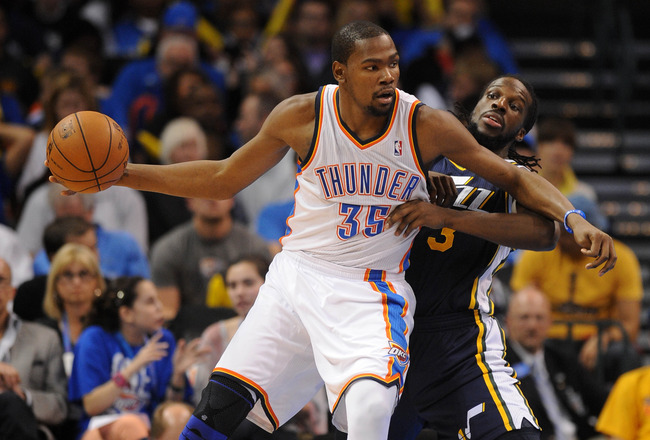
durant carroll

Durant – The Jazz don’t really have any answers for guarding Durant. DeMarre Carroll will attempt to get physical with Durant, but will eventually succumb to foul trouble and Durant’s speed. And Durant is usually a horrible match-up for Gordon Hayward. I expect Durant to get at least 30 points in this game.