Tag Archives: Kevin Durant

Mr. Harden’s Opus

So I had this blog detailing why I didn’t think the Oklahoma City Thunder would sign James Harden by the October 31st deadline. I was going to work on it this weekend and publish it on Monday. I was hoping Harden and the team would still be in negotiations by the time I finished said blog. I truly believed the negotiations would be an issue that would be shelved until next offseason when the front office had more information (an entire season’s worth) to make more of an informed decision. Instead, with the OU/Notre Dame tied at 13 in the 4th quarter, I checked my twitter feed and saw this inconspicuous tweet:

Wow #Harden

I don’t remember who the tweet was from. But it piqued my curiosity and I clicked on the hash tag. I thought it was going to be a person that was surprised Harden had turned down a 4 year/ $52 million dollar contract extension. Instead, to my complete and utter surprise/horror, I started seeing the all the tweets about Harden being traded to the Houston Rockets for Kevin Martin and Jeremy Lamb. The “Whhhhaaaatttttt???!!!” I let out startled my wife into rushing out of the kitchen to see what the hell was going on. The rest of the OU game was a blur to me after that. I went into Twitter frenzy mode and didn’t stop until after midnight. Once the shock and awe of it wore off (which most of it hasn’t), I was able to process the trade and evaluate it.

Here are the details from the trade:

Houston gets SG James Harden, C Cole Aldrich, SG Daequan Cook, and SF Lazar Hayward

Oklahoma City gets SG Kevin Martin, G/F Jeremy Lamb, 2013 first round pick (from Toronto, top 3 protected), 2013 first round pick (from Dallas), and 2013 second round pick (from Charlotte)

Here are some of the thoughts I have about it. I call this my “Mr. Harden’s Opus.”

The Good

My first option would have been to keep the Thunder nucleus together. But if you are going to trade Harden, this was probably the perfect batch of expiring contract, promising rookie, and draft picks galore. Let’s start with the big name from Houston: Kevin Martin. If you are going to find a substitute teacher for Harden, Martin is probably the best one year prospect available. An effective scorer who has averaged 18.4 points per game for his career, with a great mid-range game and an effective 3-point shot (38%). Someone who goes to the free throw line 6.6 times per game for his career. Defensively, Martin may not be as big as Harden, but it isn’t like Harden was in line for the All-Defense team, either. Both are sieves on the perimeter, but Harden is able to bang with bigger bodies like Kobe Bryant and Stephen Jackson. The one thing Harden really has on Martin is his play-making ability.

If the Thunder plan on bringing Martin off the bench, this plays out perfectly for them. With Eric Maynor back, Martin won’t need to take Harden’s place as a play-maker on the second team. Martin could be the gunner off the bench and the Thunder could use him in late game situations if offense is needed. For all the talk about Martin being a selfish player, he has never played with players of the caliber of Kevin Durant, Russell Westbrook, and Serge Ibaka. The focus will be off Martin and he can do what he does best, which is score from the perimeter and get to the line.

The second, lesser known name in the trade was rookie Jeremy Lamb. This, in my opinion, will determine whether this trade will be viewed as a success or a failure. Lamb has the skill set and potential to be that dual threat shooting guard that the Thunder have been coveting in their championship run. Someone, potentially, with the length, athleticism, and defensive ability of Thabo Sefolosha, but also with the scoring and shooting ability of James Harden. Jeremy Lamb could prove to be that kind of player. With Martin in the mix for at least one season, Lamb can sit and learn this season without the pressure of being a starter.

The draft picks were probably what sealed the deal on this trade. Getting a good veteran with an expiring contract like Martin, and a rookie dripping with potential, like Lamb are things that many teams could have offered. But not many teams could have offered that and a slew of draft picks like Houston could. The Thunder, as weird as this sounds, are a championship contending team that got younger and obtained great assets. The Toronto pick will be a great trade chip going forward, as the Raptors are not expected to improve much from where they were last season. The 2nd round pick from Charlotte will also be valuable as it will probably be one of the first few picks from the 2nd round.

The Bad

According to sources, the final offer the Thunder made to Harden was in the 4 years / $55.5 million dollar range. Harden will probably end up signing with Houston for 4 years / $60 million dollars. You mean to tell me the difference between a potential dynasty with an established core, and completely blowing up a team 5 days before its season opener is $4.5 million dollars. That difference amounts to $1.125 million per season. The ownership group, which has made a commitment to all of its core players, could not come up with $4.5 million dollars more? This group of multi-millionaires and billionaires were panicking over an extra $1.125 million per year. Don’t get me wrong, though. I understand it is their money and not mines. But, keeping this core intact for at least another 4 years would almost certainly guarantee runs to the Western Conference Finals and NBA Finals in that allotted time. Those extra games means about $20-40 million dollars extra in profit for the ownership group. You can talk about cap flexibility and assets until you are blue in the face, but when you have the potential to win championships in the here and now, AND you’re making money, you take those chances.

The scariest part about this trade is that a championship contending team was blown up less than a week before the start of the season when it didn’t need to be. We just went through 7 preseason games with our normal core intact, and now we only have 4 days worth of practice time to integrate 2, and possibly more, pieces to our team. When, in the minds of the front office personnel, did they say, “You know, this sounds like a great idea.” While the linchpin of this trade may have been Harden, Cole Aldrich may prove to be a big loss for the Thunder. He seemed ready to assume the role of back up center, getting 2 double-doubles in the preseason. Now, we are heading into the season with Hasheem Thabeet as our backup center. Granted, Nick Collison, Serge Ibaka, and possibly, Perry Jones III can all play the 5 in a pinch. But in a future playoff series against the Memphis Grizzlies, Los Angeles Clippers, or Los Angeles Lakers, having an inexperienced and oft maligned center as a back up could prove to be detrimental.

The Ugly

Can someone tell me why the hell we had a lockout last season? All I heard during the lockout was about the percentage of the revenue that the players got and how salaries had gotten out of hand. Some even tabbed it as the “Rashard Lewis” lockout, with Lewis being the best example of a 2nd or 3rd tier player that received a max extension, thus limiting the cap flexibility of that team for up to 5 seasons. Basically, it was a lockout to keep the owners from actually overspending their profitabilities. So, then, why are teams paying players like Eric Gordon, Roy Hibbert, and James Harden max extension money. I thought max money was for top 10 players like Lebron James, Kobe Bryant, and Kevin Durant. Instead teams are throwing around stupid money for 2nd tier players. There’s 5 years left until the owners and players can revisit the CBA, and believe me, it will be revisited again, and this time, I fear, with dire consequences.

WWJD – What would James do?

Do you know who I’m not mad at for this trade? James Harden. Before the OU game on Saturday, I spent the whole afternoon thinking about University of South Carolina running back Marcus Lattimore, who had just suffered a gruesome right knee injury. If you haven’t seen it, just think of Shaun Livingston’s knee injury from 5 years ago. Reports are coming out that Lattimore tore a couple ligaments and completely dislocated his kneecap. To make matters worse for Lattimore, he was coming back from a torn ACL in his left knee suffered the previous season. If Lattimore was a stock and NFL teams were the buyers, he would currently be considered a toxic asset.
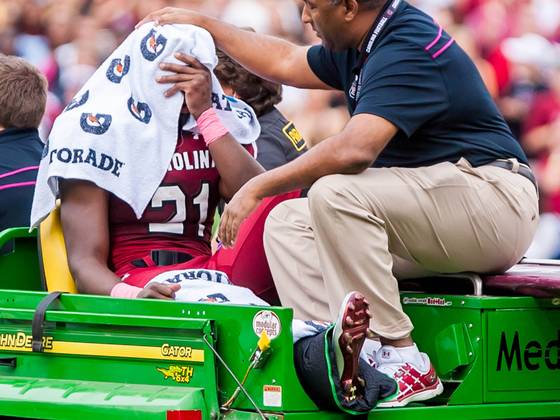
In a profession where your best years are in your mid to late 20’s, your earning potential is contingent on 5-7 years of performance and luck. If you suffer an injury or get involved in a legal scandal, your earning potential will go down. You, as an athlete, cannot dictate what the market will pay for you. If the market wants to pay you max money, then that’s what they pay. If they want to pay you veteran minimum money, then that is what you will get paid. I don’t blame Harden for taking what the market gives him.

As I wrote in my Pippen/Westbrook column, Pippen consistently took less than his market value to keep the core of the Bulls team together. Where did that leave him? Broke (most of it his fault, but still) and bitter. Harden could have taken a couple million less than what the market had placed his value at, but why. While we like to moralize athletics into this great teaching tool where you sacrifice for the greater good, at the end of the day, its a business. If a player can’t perform anymore, the owner is going to let that player go and move onto the next able body. It’s a business and a player would be a fool to leave money on the table.

I’m the Oklahoma City Thunder blogger for the blogging network called Hoops Talk Nation through the website www.thebreakdownshow.com. I currently blog on there for free. But if ESPN, YahooSports, or CBSSports ever called to offer me a spot on their blogging network for cash, I would take it in a heart beat. While I love the opportunity that Audley Stephenson and Dave Mendonca have afforded me, I wouldn’t be able to turn down the possibility of blogging AND earning cash to do it. Regardless of how I fancy myself as a blog writer, I would never turn down the opportunity to move up on the pay scale.
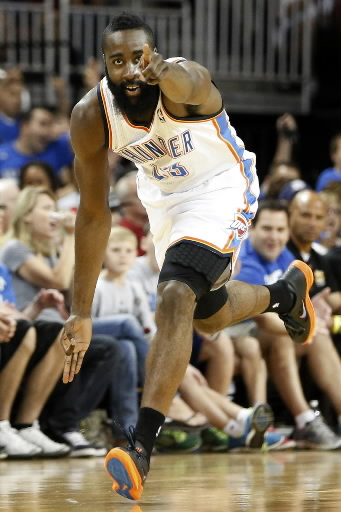
OKC fans should not hold this against James Harden. This is a business, and him turning down less money is a business decision. He is doing what he feels is best for himself and his family. Not unlike what we do everyday, but with less zeroes attached to it. Many will be mad for what they perceive was a lie from Harden with all the “sacrifice and brotherhood” talk. What did you expect from him? To come out and say, “I don’t give a shit what you think I’m worth. If the market says I’m a max player, I want max money!”

Being a fan is an emotional experience. When you mix emotion and money, you don’t make sound decisions. So, if you take the emotion out of the equation, you’d realize that James Harden did the same thing you and I would’ve done, which is to never leave 7.5% of a raise on the table.

The Trade and the Thunder

Well, what’s done is done. The NBA is not going to step in and rescind this trade, as Harden does not suffer from any pre-existing toe injuries or heart ailments. He is a Houston Rocket. And so are Daequan Cook, Cole Aldrich, and Lazar Hayward. We cannot worry about them anymore.

What we do have are two unique players and 2 roster spots to fill. I think Kevin Martin will slide in seamlessly into Harden’s role off the bench. His efficient scoring and knack for getting to the line will have Thunder fans wondering whether James Harden shaved his beard, lost some weight, and slightly bleached his skin. The real prize in this trade could be Jeremy Lamb. If, in an alternate basketball universe, the basketball DNAs of James Harden and Thabo Sefolosha were interwoven, the result could be a player like Lamb. A 6’5” shooting guard with a 7’0 wing span and the ability to knock down long jumpers and play in transition. If you thought the Thunder were good with the Sefolosha/Harden SG platoon, imagine if only one player supplied most of those needs. There’s still a lot of development that needs to take place, but the skill set is already in place.

The open roster spots are a different story. The Thunder not only traded their 6th man of the year, but also their back up center, their designated 3-point specialist, and their designated end of the bench guy. While Hayward won’t be that difficult to replace, Aldrich and Cook could. I fully expect the Thunder to sign Daniel Orton to a minimum deal to compete with Hasheem Thabeet for back-up center minutes. The final roster spot is a bit of a mystery, though. Before training camp started, the Thunder signed Georgetown sharp shooter Hollis Thompson to a non-guaranteed 3 year contract. After playing in only 2 preseason games, he was one of the final roster cuts by the Thunder. They could sign him as a future replacement for Cook. Or, they could leave that roster spot open for future options, such as taking on a salary in a trade, or signing a veteran free agent (Derek Fisher, anyone?).

As for the core players, I’m curious to see how Nick Collison will react. He and Harden had one of the top 5 pick and roll combos in the league. Collison is one of the consummate professionals in the league and will be fine no matter what situation he is placed in. I think the onus of this transition will fall mainly on Russell Westbrook. If Westbrook continues to be consistent, as he was this preseason, then the Thunder should be fine. But if there was one player that helped Russell when he got into Honey Badger mode, it was Harden. Harden would take over the point guard duties and become the primary play-maker, especially at the end of games. That role now falls primarily in the hands of Westbrook, and to a lesser extent, Eric Maynor. While Maynor could fill the role of play-maker at the end of games, no defense will respect Maynor’s ability to drive and draw fouls like they did Harden’s. Martin could always be inserted at the end of games, but his play-making ability may be less than Westbrook’s.

How does this change affect the Thunder? They have never had to deal with a core-rattling trade like this one. The Jeff Green for Kendrick Perkins trade shook the tree, but it was necessary given that Green was out of position at the 4 spot and affecting the team’s post defense. This trade wasn’t necessary for anything on the floor. Instead, it was a financial deal the team made to avoid paying costs in the future. The biggest negative in all of this is that it happened 5 days before the first game of the regular season. There will be no preseason games to indoctrinate the new players. Only a couple practices and then on to the season. The only positive I see in this situation is that our biggest threat, the Los Angeles Lakers, are also having to work out chemistry issues, after bringing in 2 main cogs (Dwight Howard and Steve Nash) in the offseason. The Western Conference may come down to whoever vibes first.

I do think this affects us this season. These guys just went from going to the Finals, then to the Olympics, then through training camp and preseason thinking they were going to defend their Western Conference title without a hitch. Then, BOOM!!! Over a quarter of the team gone, with 2 new pieces coming back. This is a team that is used to consistency. This consistency is what fostered to current Thunder culture. Consistency leads to comfort. Comfort leads to confidence. If you were part of the culture, you were part of the brotherhood. Now a shred of that is gone. I do think it will take the team a while to adjust from this one. Has their championship window closed? No, it hasn’t closed, but somebody definitely threw a baseball through it. The Thunder may come out stronger in the end, but I think it will be a case of one step backwards, two steps forward.

 In Memoriam

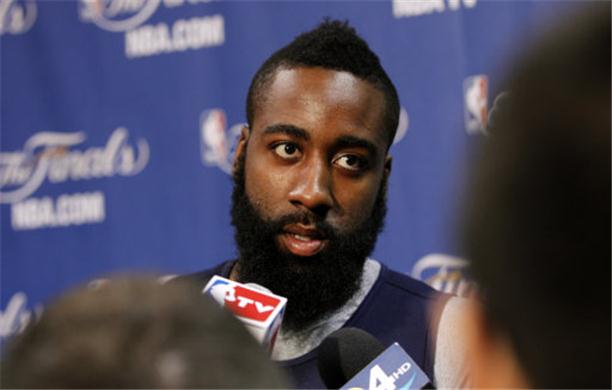
I will miss the Beard. Harden became a part of the fan culture. When you mentioned the characters on the team, you always had to mention Harden and his Beard. If the Thunder had a Teenage Mutant Ninja Turtles-like quartet, Harden was definitely Michaelangelo (the party dude!). I wish him nothing but the best in Houston. But if we are being honest, Harden was but a great role player. He scored when called upon, drove and drew fouls when needed, and made plays at will. But I never considered him to have the “it” to be The Man. Westbrook has that dogged “it” to be The Man. Durant is The Man. But Harden just seemed happy doing what needed to be done. So if Harden wants to see how his life will be post-Thunder, he need look no further than the man he was traded for.

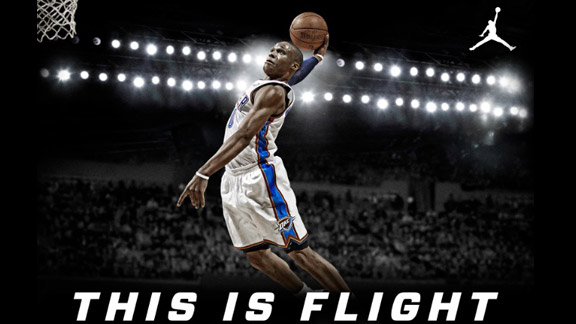
Westbrook and The Boost

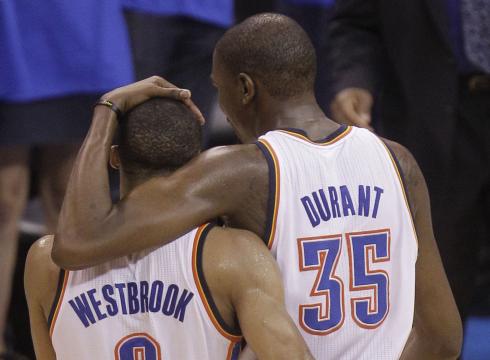
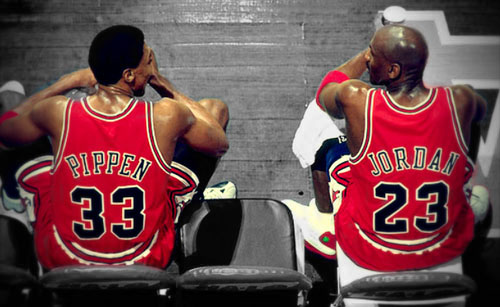
This past week, Russell Westbrook signed with Jordan Brand, after being with Nike for the first 4 years of his career. While Westbrook has carved out his own following of fans, he’s always been known as Kevin Durant’s sidekick. The Robin to Durant’s Batman. This generation’s ultimate second banana. There hasn’t been a sidekick this good since Scottie Pippen. But, Pippen never received the boost in popularity that Westbrook is about to receive.

What qualifies for a sidekick? A sidekick has to be a rookie or a very young player that is brought in after the primary player is established to specifically fill the needs the team is missing. Another qualification is that the pairing has to be together for 5+ seasons. For example, Scottie Pippen was obtained by the Chicago Bulls in a draft day deal, while already having an established superstar in Michael Jordan. Russell Westbrook was drafted by the Seattle Supersonics (Oklahoma City Thunder) after they already had an established young star in Kevin Durant. Anfernee Hardaway almost made it to great sidekick status, but injuries and Shaquille O’Neal’s departure to the Los Angeles Lakers negated that possibility. The Lebron James/Dwayne Wade/Chris Bosh mash-up wouldn’t qualify as sidekicks because they were all alpha males on their respective teams before they joined forces. Kobe Bryant and the aforementioned O’Neal made a great duo, but they were brought onto the Lakers the same year and often quibbled over who was the alpha male. 

To understand the road Westbrook is on, it is important to see what happened to Pippen throughout his career. When Pippen first started college at the University of Central Arkansas, he was a 6’1” walk-on that needed to moonlight as the team’s manager to pay his tuition costs. After 3 more collegiate seasons, a 7 inch growth spurt, and consensus All-NAIA player honors, Pippen was drafted with the 5th overall pick in the 1987 NBA draft to the Seattle Supersonics (who subsequently traded him to the Chicago Bulls). The scouting report on him read as follows:

  • 7’4” wingspan and a 41” vertical
  • Strong outside, but needs work inside
  • Not bad driving to the hoop, but doesn’t look to drive
  • Good foul shooter
  • Can make a three
  • Terrific passer at that position
  • Won’t give you much of anything on the offensive glass, and is a so-so defensive rebounder
  • Excellent defensively and a disruptive force in the passing lanes
  • Good ball handler, but commits a ton of turnovers
  • Could start on most teams

Not necessarily the sexiest of scouting reports for someone who would eventually become one of the top 50 players in league history. While Pippen built his legacy on defense, he was also an apt offensive player, becoming the archetype for the point forward position. During his prime (1989-1999), Pippen had per game averages of 19.1 points, 7.1 rebounds, 5.9 assists, 2.2 steals, and 0.9 blocks. Not necessarily the offensive prowess that Larry Bird possessed, but with a stat line like that, Pippen should have been heralded as his generation’s defensive Larry Bird. Instead, he was teamed up with arguably the greatest player of any generation in Michael Jordan. There usually isn’t a lot of spotlight left when you are playing with the greatest. Ask 100 people who the lead singer of Aerosmith is, and most will answer Steven Tyler. Ask them who the drummer is, and not many will know the answer.

Pippen’s play on the court should have spurred him to more shoe deals, more advertisement contracts, and more widespread popularity. And yet, when his career was all said and done, you couldn’t help but wonder whether Pippen got everything that was owed to him. There were the stories of how Pippen felt he wasn’t getting paid what he deserved (which he wasn’t). There were the rumors that he felt slighted being outside of the limelight, when he provided so much to the team. While he did have his own shoe line (the PIPs) from Nike, they only lasted about two series. So, needless to say, not many companies bought into Scottie Pippen.

It wasn’t Jordan’s fault, though. Most of the blame lies squarely on Pippen. He didn’t have the same tact with the media that Jordan did. He was dismissive and defensive at times with reporters. Then there were the crunch time situations. Those critical times in games that live in lore and become mythologized. It’s not that Pippen didn’t perform well during those times. On the contrary, he performed great during crunch time. But he’s instead remembered for the times he quit on his team in the most critical of moments. There was the time he sat out Game 7 of the 1990 Eastern Conference Finals against the Detroit Pistons with a migraine headache. The Bulls eventually lost that game. Probably the most damning, though, was the one where he sat out the final 1.8 seconds of Game 3 of the 1994 Eastern Conference Semifinals against the New York Knicks because Phil Jackson drew up a play for Toni Kukoc to take the final shot, instead of Pippen. To make matters worse, Kukoc actually hit the game winner. This one was the most damaging because it came at a time when the Bulls were his team due to Jordan’s hiatus into baseball. When you are known to quit on your team during crucial periods, your popularity takes a big hit.

Which brings us to the best sidekick of this generation, Oklahoma City Thunder guard Russell Westbrook. Like Pippen, Westbrook was not highly decorated coming out of college. Like Pippen, Westbrook was drafted by a team that already had a young star in Kevin Durant. Like Pippen, Westbrook is seen as not being very media friendly. Coincidentally, Durant, much like Jordan, is viewed as a media favorite. And, while not by his own doing, Russell was also involved in a critical game snafu, when Thunder coach Scott Brooks sat an ineffective Westbrook for the entire 4th quarter of Game 2 of the 2011 Western Conferences Finals.

But, not everything is negative when it comes to Pippen and Westbrook. Both of these players are insanely loyal to their teams and teammates. Pippen had a couple opportunities to seek greener pastures during the championship run, but decided to sign for less to stay with the Bulls. Westbrook could have done the same last season, but decided to sign for the allowable max. Both players are highly competitive, with possible chips on their shoulders from being labeled second bananas. Both players are very team oriented, as evidenced by them sacrificing a little of their own games to coexist with two great players. The good severely outweighs the bad when it comes to Westbrook and Pippen, but the bad usually has more advertising power.

Which is why I found the signing of Westbrook to Jordan brand to be a bit ironic. Not ironic in the sense that he doesn’t deserve it. But ironic in the sense that a move like this will probably propel Westbrook into superstar territory, as far as media exposure goes. Into a territory that Scottie Pippen unfortunately never reached. With an endorsement team that includes Carmelo Anthony, Derek Jeter, Chris Paul, and Michael Jordan, himself, Russell Westbrook will have plenty of opportunity to expand his brand. He already has a slogan in place (WhyNot?), and already has a following outside of basketball because of his unique fashion sense. In a way, Jordan is helping this generation’s top sidekick become what his sidekick should have become.

OKC Thunder: Training Camp Roundtable

Special thanks to the contributions by Zebulun Benbrook of Welcome To Loud City (WTLC) and by one of the smartest basketball minds I know, Max Trueblood (MTB). 

With the turning of the seasons, there are two things you can always look forward to: colder weather and the start of NBA training camps (unless there’s a lockout). Most of the players are already setting up shop in their NBA cities, preparing for the upcoming season. No matter how familiar you are with your team, a new season always brings about new questions. Here are a couple of questions in regards to the beginning of training camp for the Oklahoma City Thunder:  

  • 1)      With the recently finished strike shortened season, a trip to the Finals, and involvement in an Olympic tournament, how do you think Scott Brooks will handle Kevin Durant, Russell Westbrook, James Harden, and Serge Ibaka during training camp?

NTTB: I think they will limit their availability in preseason games, but I don’t think they will limit their training camp practice time. Last season, teams hardly got any practice time due to the compacted schedule. Less practice time meant less time to try new schemes and less time to build cohesion. Luckily for the Thunder, they brought back their entire core and all of their coaching staff from the previous season and didn’t need the practice time in training camp to indoctrinate new players or learn new schemes. This year it’s more of the same, but with more time for practice. Despite their age, the Thunder are a veteran team and the extra practice time will be invaluable to the younger Thunder players, such as Reggie Jackson, Cole Aldrich, Perry Jones III, and Hasheem Thabeet.

WTLC: Once players get to a certain point of their careers, I think you’ve gotta give them room to breathe. Durant and company have proven themselves in the context of the NBA, and while they have room for improvement, they’re pretty much known quantities in the sense of what they can and can’t do. My thought is that Training Camp will focus on the younger guys on the team, like Cole Aldrich, PJ III, and Reggie Jackson. And I’d like to think that it will focus on trying to get them adjusted to the team, rather than improving a certain skill. The Summer League and D-League are more focused on personal improvement, in my opinion.

As for the stars, I’ve gotta think Scott Brooks will make it business as usual. Everybody’s extra motivated after the Finals loss, and they are coming off of a break, even if it is shorter than normal. The NBA season is a long grind, and if you can’t make it through training camp, you probably won’t be able to make it through the dog days of January, either. I think what’s important to remember is that part of the reason Tim Duncan is so successful is that, even in his old age, he still allows Gregg Popovich to coach him like he was a rookie. It sends a message to the rest of the team about how to act, and what it takes to make it to the top. If Durant, Westbrook, Harden, and Ibaka act the same way, then we’re in for a long road of success.

MTB: I’m usually not a fan of preferential treatment for superstar players but given the busy off season for the “Big 4”, I wouldn’t have a problem with them getting a few days off here and there.

 Let’s not forget, this has basically been 3 straight busy off seasons for KD. He had the World Championships in 2010, then played in just about every street ball game imagineable last summer and of course the Olympics this time. 

  • 2)      Out of Daniel Orton, Hollis Thompson, DeAndre Liggins, and Andy Rautins, who earns the coveted 15th spot on the team, and why?

NTTB: I’d say it’s a two man battle between Hollis Thompson and DeAndre Liggins. These two players are both long, which fits into the Thunder’s DNA, with Liggins being more defensive minded, and Thompson being more of a 3-point shooter. With so much of the offense being predicated on dribble penetration, the team would probably benefit from another shooter on the team. So, I would give the nod to Thompson, with Orton, Liggins, and Rautins leading the Tulsa 66ers the NBDL title. 

WTLC: Well, that’s a tough one. I haven’t seen too much of Hollis Thompson, but he’s pretty much the Perry Jones of the second round. He was considered a legitimate prospect and worked out for several teams, but a lot of teams decided to draft and stash Europeans with their later picks, letting him fall off the board. It really depends on how well he can return from his groin injury, and whether he’s really enough of a scorer to be considered better than Daequan Cook, or Andy Rautins. Rautins will be a good litmus test to see how good Thompson really is. Rautins is an excellent shooter, but he’s not very dynamic, which is why he’s never really caught on in the NBA. I’d only see him making the roster is Thompson doesn’t really pan out.

The strongest candidate, aside from Thompson, to make the roster is DeAndre Liggins. He didn’t get too much time with the Magic last year, but he was very efficient in how he played. He never took an unreasonable shot, and he he has good defensive awareness. He’s kind of like Kyle Weaver, but with a bit less energy. The big knocks on him are that his shot is extremely inconsistent (he’s airballed open threes) and that he works best under a slow pace, which doesn’t help when you’re playing with a fast breaking team like the Thunder.

The other guy on the list is Daniel Orton, but I think he’s really only there for the hometown appeal, as he went to Bishop McGuiness. When you see how many big men the Thunder have stockpiled, and the fact that Orlando didn’t re-sign him despite being really thin at center, seeing him make the roster seems like a pipe dream.

MTB: I’m going to roll with Andy Rautins on this one. I think the Thunder have tons of athleticism so an athlete like Liggins or Thompson isn’t really needed but with the team possibly cutting back on bench payroll in anticipation of retaining Harden at a max salary, I could see Presti seeing if Cook has a short term replacement and that would be a shooter. Rautins is the best of the group.

  • 3)      Heading into training camp, how will Perry Jones IIII fit into the rotation, if at all?

NTTB: With Kendrick Perkins coming back from two offseason surgeries and Nick Collison bound to suffer from one of his yearly training camp injuries (sore groin, sore ankle, sore knee, etc), I’m pretty sure we’ll get some idea how he will fit into the rotation right away. He’ll get a lot of reps in practice in our small ball lineups and that’s primarily where I see him being used in the rotation during the season.

WTLC: He won’t be a rotation guy. There’s too few minutes to split with Cole Aldrich, and Thabeet is probably ahead of him due to his previous NBA experience. It really all depends on how he does in training camp, but I don’t think he’ll see regular minutes unless there’s an injury or Cole Aldrich doesn’t live up to expectations.

MTB: I wouldn’t mind seeing Perry get some time in the D league this year. If Serge or Collison get hurt, he can always be called up from Tulsa.

I don’t know enough about Jones to really gauge where his confidence is but lots of young players lose confidence when they get drafted well below where they were expected to be taken. Of course, there are exceptions. Rashard Lewis and Deandre Jordan come to mind. But getting big minutes and success on the D league level could wind up being what’s best in the long run for him. 

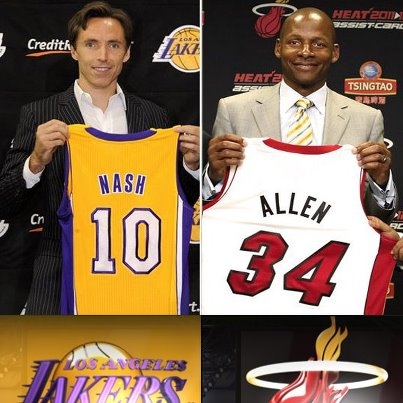
  • 4)      With other teams making significant moves to get better (Lakers acquiring Dwight Howard and Steve Nash / Miami acquiring Ray Allen and Rashard Lewis), is there any way that the Thunder got better without making any major moves? 

NTTB: I think we’ll get better organically because of our youth, but the line on the organic improvement line graph is probably starting to plateau. There’s probably not much more that these guys can do, besides averaging a triple double for a season, that would register as far as team improvement goes. Getting Perry Jones III in the draft negated any necessity to obtain a scoring big. I expect the Thunder to be a big player after the trading deadline, though, for a veteran big man.

WTLC: Well, we got better in the sense that we’ll have another year under our belts to develop. How much that will translate into next year remains to be seen. The Thunder were really sputtering late in the season, dropping a lot of winnable matchups and letting non-playoff teams come back from huge deficits. But when you get right down to it, the Thunder have the talent to beat the Heat and the Lakers. What they need to do is come up with more creative solutions for their obvious flaws.

But on a tangible level, there is improvement in sight. Cole Aldrich might be more of an offensive threat than Nazr Mohammed was, and he was working on a hook shot while in the Summer League. Kendrick Perkins will be fully recovered from his injury. Eric Maynor will be returning, offering a steady offense and a refreshing break from Derek Fishers’ 0fers and terrible defense. Serge Ibaka’s jumpers are getting come consistent. And, of course, James Harden will have had the experience of being on a boat.

MTB: I think the Thunder got better just based on the fact that their star players haven’t hit their prime years yet. It’s rare that All star caliber players take a step back before they hit their prime so I see the Thunder getting better via the internal improvement route. 

  • 5)      Are the Thunder now this season’s participant in the reality show drama known as the “player vs team negotiation” game that the media will incessantly babble about for possibly the next 300 days?

 NTTB: I don’t think so. There are two players out in LA that will be causing a bigger stir with their impending free agency (Dwight Howard and Chris Paul). Plus, the Thunder organization is very hierarchal in nature, and if the top (owner Clay Bennett and GM Sam Presti) remains quiet, you can bet the bottom (players and coaches) will remain quiet. This will not be an issue at all this season. It wasn’t an issue when Westbrook’s extension was in play and it won’t be an issue with Harden’s being in play.   

WTLC: Yes, 100 times yes. If there’s one thing the media love to babble on about, its’ contract negotiations. Nevermind the fact that the Thunder are a title threat now, what are we going to do when Kevin Durant comes off of contract in 2016?! Aye aye aye. Just bring on the basketball, man. I’ll worry about the size of James Harden’s penthouse later. 

MTB: I sincerely hope not. I’m really hoping that Presti and Harden’s representation can just come out and say that they will table negotiations until next summer. That will take the media out of the picture and will simultaneously take the pressure of Harden. Let’s see what type of numbers he can put up and then negotiate a contract based on production.

In conclusion…..one more week!!!!!!!

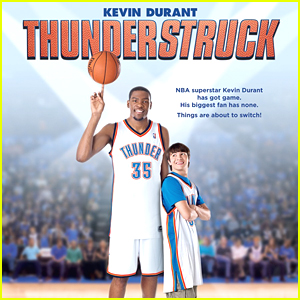
Thunderstruck:The Review

There’s a saying that goes musicians and actors want to be athletes, and athletes want to be musicians and actors. Call it what you may; a mutual respect for each others’ crafts or the need to test one’s self. But when that person ventures into the other crafts, the results are usually forgettable and regrettable. We see how entertainers perform in celebrity basketball games. The basketball players in those games, almost always retired players, have to play at 50% just to make the game even a little bit enjoyable. Basketball players are born to play basketball. While some try other ventures, they rarely achieve the success known to them on the basketball court. When it comes to music, many ball players have tried, but only two have had any form of success: Wayman Tisdale, who went on to become a world renowned bass player, and Shaquille O’Neal, who, regardless of what you think of his skills as a rapper, released 4 studio albums, with one going gold, and another going platinum.

When it comes to basketball players and acting, the list of successes is even smaller. The greatest role for an athlete is as an athlete, especially if they are playing themselves. If you take them outside of that element, the results are extremely varied with a very high “hit or miss” potential. Kareem Abdul-Jabbar did a great job as co-pilot Roger Murdock on Airplane. John Salley did a good job in his small role as Fletcher, the computer hacker, on the two Bad Boys films. Outside of those two roles, I can’t really think of a successful acting venture for a basketball player that does not involve dribbling a basketball.

Now, if the role involves playing a little basketball, then the athlete can go ahead and ease into his comfort zone. Shaq’s best acting role was as Neon Boudeaux, the “out-of-nowhere” star recruit in the movie ‘Blue Chips’. Honestly, though, that’s not really saying much when compared to such classics as ‘Kazaam’ and ‘Steel’, but you get the picture. When an athlete is able to do the thing that comes naturally to them, it makes the unnatural thing (acting) come that much easier. So when I heard that Kevin Durant was starring in his own movie, I was a little worried to say the least. He wasn’t a big personality like Shaq was in his heyday, and his advertisement portfolio, while growing, wasn’t necessarily anything that would indicate we had a burgeoning thespian on our hands. Also, when I heard the synopsis of the film, basically ‘Like Mike, part 8,’ I was a bit concerned that the cheesiness factor would be too much.

With all that said, I thought this would be a good RedBox rental in a couple of months. Then, out of the (Thunder) blue, my ticket rep called me asking if I wanted to attend the red carpet premiere of KD’s movie. Like any good Hollywood socialite, I told him I would have to check my schedule. Two seconds later, I told him I would go, and I would be bringing 5 guests with me (my entourage).

So, when the day came, we all got suited up and made our way to the premiere. We got there about an hour and a half early and watched as they vacuumed the red carpet. I vacuum my carpet all the time, but this was a RED carpet. Awesome, to say the least. We finally got our tickets and walked into the theatre, on the newly vacuumed red carpet. After getting our popcorn and drinks, we waited for the VIP’s to arrive.

First through the red carpet was the always lovable Rumble, in a tux only a bison could wear. He, of course, had two Thunder girls draped on his arms. When I die, I want to come back as a hooved mascot. They get all the perks. Next up, it was the always exquisite Wanda Pratt, who rocked her aquamarine dress to a tee. “You go girl!” was all I could think in my mind. Mama Durant basically became part of the family as she bear hugged my sister twice on her walk down the red carpet. At that very moment, I turned around and legendary Oklahoma Sooners coach Barry Switzer was behind me about to walk into the theatre.

Co-star Taylor Gray was the next one through the red carpet. I didn’t really know who he was, but all the pre-teen girls knew who he was. So, I figured he was somebody in the film. Then, the love child of Marty McFly and Breckin Meyer walked through the red carpet. Its always good to see Coach Scott Brooks in his offseason’s best, hair and beard both grown out. Finally, the star of the film came through. Kevin Durant looked dashing as ever in his brownish checkered vest and black undershirt, completely owning the red carpet. After a small introduction by the director of the film, it was finally time to see some movie magic.

Without giving too much away in this review, I initially went into the film wondering how many cringe-worthy, cheesy moments there would be in the film. Brian (Taylor Gray) is a high school student who has aspirations of playing basketball, but is only good enough to be the water boy on the team. A huge fan of the Oklahoma City Thunder, Brian gets a chance to shoot a half court shot at halftime of a game. His shot falls way short, hitting Rumble on the head, and he ends up in the tunnel with Kevin Durant, who sympathizes with the kid and signs a ball for him. As he is handing the ball to Brian, his basketball skills are transferred to Brian in a weird cosmic mix up. The teenager ends up joining the basketball team and becoming its star, while Durant struggles with having the skills of a water boy.

Through his struggles, Durant’s agent, Alan (Brandon T. Jackson), keeps looking for reasons and solutions to Durant’s dismal slump. He finally sees a mirror of Durant’s talent in this scrawny little high school kid and realizes that Durant’s talent must have been stolen. Alan approaches Brian and levels with him about his new found talent. Brian soon realizes that Alan is right and must decide whether he wants to continue with his new found fame or do the right thing and find a way to return Durant’s talents back.

Are there some corny moments in his film? Of course. But, to my surprise, there weren’t any cringe-worthy, “I’m too old for this crap” moments. The surprising comedic performances of Jim Belushi, as the coach of the high school team, and Doc Shaw, as Brian’s best friend, provide enough comedy to keep you laughing out loud from time to time. Taylor Gray actually carries the movie pretty well as the lead actor, and Kevin Durant does a good job as Kevin Durant. John  Whitesell, the director, does a good job of showing off Durant’s strength (basketball ability), while not trying to overdo his still burgeoning acting ability.

For what I was expecting, this movie turned out to be a pleasant surprise. It had a good flow to it and didn’t lull you in the middle of the movie. My kids, 7 and 5 years old, loved it, and it held their interest throughout the entire movie. A solid ‘B’ in my book and a highly recommendable family movie.

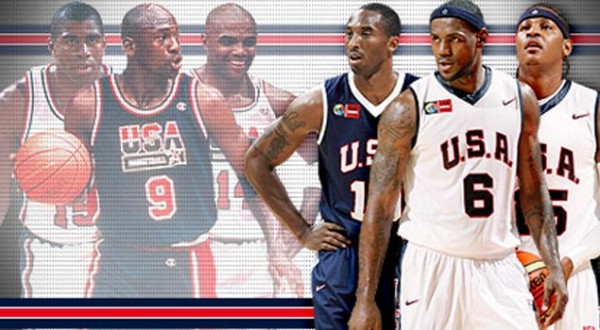
Alternate Reality – Dream Team vs. 2012 Team USA

In collaboration with Akeli Jackson of DYST Media, Steve Person of Hooptalk365.com and Jon Midget of SLCDunk.com.

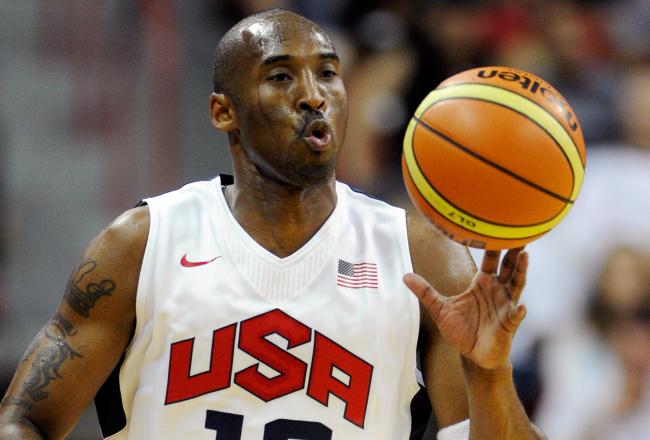
The debate has been raging all summer long about which team is better: the 1992 Dream Team or the 2012 US Men’s Olympic basketball team. Members from both teams have spoken publically and most have said that the Dream Teamers would be the victors. But the tally hasn’t been 100% on the side of the Dream Teamers. Kobe Bryant, in an interview, stated, “If you’re asking me, ‘Can you beat them one game?’ Hell yeah, we can beat them in one game. You didn’t ask me if we could beat them in a 7-game series. In one game, we can beat them. No question about it.” This discussion was presented for each of the subsequent “Dream Team” teams after the ’92 team, but the discussion usually died down pretty quickly. For some reason, though, the debate for the 2012 team has lingered on longer than it did for any of its predecessors. Maybe it’s Twitter, where the in your face, non-stop commentary sometimes leads to a paradigm shift in thought, even if it’s just for a moment. Maybe, people see a 2012 team that is loaded with a combination of great players and potential great players. Sadly, though, these types of debates usually remain as they are….figments of our statistical imagination. 


Fortunately, I have more money than I know what to do with. So I decided to call a buddy of mine who works at an anti-aging clinic. He told me he would be able to revert the older Dream Teamers back to their 1992 form using hormone replacement and gene therapy. Of course, the players on the ’92 squad would have to agree with this. So, that’s where their ego and my money came into play. I got all the players from the Dream Team to sign on by offering them $10 million each and telling them that the 2012 team would wipe the floor with them. Christian Laettner even asked my buddy if he had anything that would bring his “Duke-swag” back. My buddy told him he didn’t have anything to cure failed potential. Surprisingly, Larry Bird required the least amount of work. His body is basically in the same physical shape now as it was then. Unfortunately, the anti-aging clinic didn’t have anything to bring Chuck Daly back from the after-life, so Lenny Wilkens, who was an assistant on the Dream Team, agreed to be the coach. The fine folks at Coachella kindly declined when we asked them if they could have Hologram Chuck Daly walk back and forth on the Dream Team sideline. 


After 2 weeks of intense anti-aging therapy, and a month of “training camp”, the Dream Team was looking like its old self again. Magic Johnson was passive-aggresively talking trash, Larry Bird was sinking flat footed 3 pointers, and Michael Jordan was dunking on Patrick Ewing. The game was set up to happen the night before the gold medal game of this year’s Olympics. Only a few writers were privy to the game. Everyone who was witness to the game was CIA-scanned for electronic devices, meaning no photos or video of the game would ever exist. The 4 writers who were invited were each assigned a quarter to write about in detail. No one was allowed to release any information until after the gold medal game. This, is what transpired: 

Pre-Game 

The game would be played using a mixture of FIBA and NBA rules. The quarters would be 10 minutes in length to maximize the athletic potential of all the participants in the game. The FIBA 3-point line would be used, and the painted area used was the standard rectangular NBA format. Players wouldn’t be able to touch the ball on the rim like in international play. It would be counted as a goaltend, if the ball is touched while still on the rim. A team would have 8 seconds to bring the ball up past the half court line. The style of refereeing would be more international, allowing the players to be a little bit more physical on the perimeter and on the inside. The officials would be Ken Mauer, Dan Crawford, and Dick Bavetta. And, finally, a game like this wouldn’t be right without the use of an official David-Stern signed, NBA Spalding ball.  

One of the most amazing sights to see on a basketball court are the pre-game antics of the different players. Some have customary handshakes and dances that they do. Some have a specific routine of stretching and warming up. One thing that stood out while watching these two teams warm up was the gawking and wide-eyed fandom that was apparent on the 2012 team’s side of the court. It is easy to think of athletes as robotic in nature, while forgetting that they were once young fans wanting to be like they hardwood idols. Especially when their idols are on the other side of the court with their deity-like skills on hand for display. But, just as quickly as they were star-struck, they were just as quickly snapped back into reality by Kobe Bryant, and, surprisingly, by Russell Westbrook. The Dream Team squad was all business on their end. 

The referees called out the captains of each team (Johnson and Bird for the Dream Team and Bryant and James for Team USA). The Dream Team was in their classic whites and the 2012 squad in their new look blues. They all shook hands, the referees explained their expectations of the game, and each team went to their sidelines. Game time!!! 

1st Quarter

 Coach Lenny Wilkens trotted out Magic Johnson, Michael Jordan, Patrick Ewing, Scottie Pippen, and Charles Barkley as his starting five. Coach Mike Krzyzewski countered with Chris Paul, Kobe Bryant, Tyson Chandler, Lebron James, and Carmelo Anthony. And, just like that, 10 of the greatest basketball players were on the court exchanging pleasantries and shaking hands. Chandler and Ewing would be jumping at center court. Bavetta tossed the jump ball, and it is controlled by Ewing. Both teams started off by missing their first shot attempts. On the Dream Team’s 2nd trip down the floor, Kobe snuck into the passing lane and intercepted a pass from Pippen to Jordan leading to a breakaway dunk by Lebron James. The first two points were officially on the board. On their next trip down, Magic Johnson found Ewing on a no-look bounce pass for an and-1 layup. The teams exchanged makes and misses pretty consistently for the first 5 minutes. 

After a timeout, Wilkens substituted Larry Bird and David Robinson for Pippen and Ewing. For Team USA, their first substitutions saw Kevin Durant and Deron Williams coming in for Chris Paul and Carmelo Anthony. On the first trip down for Team USA after the timeout, Durant made a 3 pointer off an offensive rebound from Chandler. Barkley gave Durant a shoulder check as he turned to go to the other side of the floor. Durant pushed Barkley and both players were given a double technical. On the next possession, Pippen, playing point guard, found Michael Jordan on the baseline for a jumper. 12-11 Dream Team at the half way point of the 1st quarter. After a Deron Williams layup, the Dream Team went on a 10-2 run, with Larry Bird supplying two 3-pointers and Tyson Chandler picking up his 2nd foul during that run. 

After a run-stopping timeout, Coach K trotted out a line of Kevin Durant, Carmelo Anthony, Kevin Love, Deron Williams, and Russell Westbrook. Wilkens brought in Bird, Karl Malone, Robinson, John Stockton, and Clyde Drexler. Anthony and Malone exchanged buckets in the next two possessions. On the next Team USA possession, Westbrook lost possession of the ball, which was stolen by Stockton, who found a streaking Drexler for an easy 2. Another turnover, this time, by Kevin Love, led to a mid-range jumper by Malone. 28-17 Dream Team, with under two minutes left in the quarter. After a missed jumper by Durant, the Dream Team brought the ball up the court looking to add to their double digit lead. Stockton passed it to Bird, who is wide open for a corner 3, but missed it, leading to a transition 3 by Carmelo Anthony. On the next Dream Team possession, Williams poked the ball from Robinson as the shot clock expired, which led to a thunderous (pun intended) dunk by Westbrook on the other end. After a Stockton miss, Williams brought the ball up for the final possession of the quarter. Durant got the ball above the 3-point line, dribbled a little while jabbing towards the basket, and let loose a 28-foot dead on three that splashed through the net as time expires. 28-25 Dream Team, after one quarter. 

2nd Quarter 

The Dream Team came out to begin the 2nd quarter with Stockton, Drexler, Mullin, Bird, andEwing. Team USA squad went with Deron Williams, Kobe, Durant, Lebron, and Love. Team USA took advantage of the Dream Team’s limited defense, and scored on their first four possessions. However, the Dream Team extended their lead at the same time with three from downtown: two from Bird and one from Mullin. 

On the Dream Team’s fourth possession, Lebron nearly steals the ball by knocking it out of Ewing’s hands, but it goes out of bounds instead. In a surprising display,Ewing thumped his chest several times, telling everyone in a loud voice, “I am a WARRIOR!” over and over. Mullin looks stunned for a moment as he wonders what his team would actually be like if Ewing really were a (GoldenState) Warrior. The Dream Team inbounded it toEwing, who immediately shows off his WARRIOR-ness by throwing up a running 18-foot fadeway that clanks off the rim (he was, admittedly, intimidated by the perpetual shut-down defense of Kevin Love). 

Still, the Dream Team led 37-33 as Team USA calls a timeout. 

Out of the timeout, The Dream Team came out with the same lineup. The 2012’ers let Lebron rest a bit and replaced him with Carmelo. Williams drove past Stockton to get an and-1. Stockton, one of the better defenders in NBA history, takes it personally, scowls, and on the next inbounds, rushes up the court and dropped a pull-up 3 right in Deron’s face. Realizing that Carmelo had Bird and Mullin taking turns “guarding” him, the 2012 squad goes to him on the next three trips down the court, with Carmelo hitting a 2 and a 3 (and having a missed 3 tipped in by Love). During that same time frame, the Dream Team goes on a bit of a cold streak from the field, and Team USA takes the lead 41-40, prompting the Dream Team to call a timeout.

One of the most amazing things to witness in a game like this is the interactions in the timeout huddle. While Team USA was all high-fives and laughs, it was all business in the Dream Team huddle. Lenny suggested putting in Laettner, but nobody even blinked. The players all knew they were old enough and wise enough to be coaches themselves. They noticed the 2012 squad trotting out Paul, Williams, Carmelo, Lebron, and Love. In response, Pippen tells Wilkens he’ll guard Carmelo so “they won’t have to worry about him touching the ball again”. Jordan says he and Stockton can take Paul and Williams. One of the funnier moments was when the Dream Teamers decided to put David Robinson in on Love, knowing that the Admiral would completely take advantage of the shorter, less athletic Love. The only person left to guard was Lebron, so they decided that, even though he can’t match LeBron’s total athleticism, the Mailman is the guy who can best match his speed and strength. So in came Malone. 

On the first play, Pippen ran Carmelo through a beautiful “elbows-out-I’m-going-to-send-you-to-the-floor-weeping” screen set by Stockton. Anthony gets up a little wobbly and goes back to the bench, replaced by Durant. Pippen smiles. 

At this point in the game, the Dream Team asserted themselves offensively and defensively. They continuously went inside to the Admiral, who routinely dunked it, probably wondering whether it was Kevin Love or a fruit fly he felt along the way. On the defensive side of the court, Chris Paul could barely make it past midcourt with Jordan hounding him. Paul passed to Deron Williams, who was being bumped and maimed by Stockton. Williams probably began to wonder why his team only had four guys on the court since he could not find Durant under that Pippen defensive blanket.   

On Team USA’s next possession, Williams found Love with a nifty pass. Unfortunately David Robinson shoved the layup down Love’s throat. It seemed for a moment, while Love looked at Robinson in awe, that he was wondering if he was looking at a Greek God incarnate, or just the most ripped athletic specimen to ever walk the earth. Fortunately, Lebron wasn’t as impressed with Robinson’s physique, as he picked up the loose ball and put in the score. 

The Dream Team continued to put on an offensive clinic in the next few possessions, going inside to David Robinson and running the 2012 defenders through a series of cuts and screens that sends everybody on Team USA into at least one Stockton screen. Chris Paul and Deron Williams, taking the brunt of the physicality, start to vehemently complain about the screens. As a writer, it’s crazy when the crowd noise is taken out of the equation and you can hear almost every conversation on the court. In response to the complaining about the screens, Dick Bavetta told the two 2012 guards, “Hey, if you want to try to knock down guys 50 to 100 pounds heavier than you 10 to 12 times every game, I’ll let you do it too.” Paul and Williams suddenly realized they were nowhere as tough as the guy with the short shorts.   

On the other end of the floor, Paul and Williams were getting picked apart by Jordan’s defense and Durant was made to seem like he didn’t even exist on the floor anymore. Love kept looking to the bench, wondering why Coach K hadn’t noticed that David Robinson has 5 more inches and 8 times the athleticism on him. Lebron, realizing that he is only player that can do anything at this moment, begins to try to take over the game. He got past Malone on a couple of occasions, but the veteran power forward either stripped Lebron or knocked him off balance on his jumpers. 

In all, it was a 16-6 run by the Dream Teamers that put them up 56-47 with two minutes to go in the half. 

Time out for Team USA.   

The 2012 team put in their small ball line-up for the final two minutes of the half: Chris Paul, Deron Williams,Kobe, Durant, and Lebron. The Dream Teamers decided to show the young guys that they can also go fast AND big at the same time. They trotted out Magic, Jordan, Pippen, Barkley, and the Admiral.

 After the timeout, the 2012 squad looked to take advantage of their small ball lineup, especially at point guard with Magic being in the game. Heading into the game, one of the main headlines was the Kobe vs. Michael matchup. How would the player most compared to Jordan fare against him? In a couple words, not very well (in the first half, at least). Kobe tried to challenge Jordan in the final two minutes, but instead ended up costing his team.Kobe went 0-2 with two turnovers during that time-span.

 Those turnovers and missed jumpers allowed the Dream Team to basically turn every defensive possession into a fast break opportunity. Magic was at his “Showtime” best, setting up Jordan, Pippen, and Robinson for dunks. On the final possession of the half for Team USA, Pippen deflected a Deron Williams pass that ended up in the hands of Charles Barkley who had a full head of steam with 5 seconds left. The only person back for the 2012 squad was Lebron, but even he realized that he’d rather fight another day than try to challenge Barkley with a full head of steam. Two-handed slam, buzzer, and that was the 1st half. 66-51 Dream Team.  

 3rd Quarter

 Coming out of halftime, the 2012 squad looked to get back in the groove, down by 15. Coach K decided at halftime to throw caution to the wind and go with a more assertive lineup to combat these NBA greats. He turned the reigns of point guard over to Lebron, with Kobe alongside in the backcourt, Durant and Carmelo on the wings, and Chandler in the post. The Dream Team decided to start the 2nd half with Stockton, Jordan, Pippen, Malone, and Ewing in the paint.

 Again, one of the great things about eliminating the crowd noise is that you can hear the different conversations going on between the players and coaches. At the scorer’s table, Jordan walked up to Kobe and tells him, “You may be able to sit at many players’ tables, but you still can’t sit at my table, rook.” Kobe, in turn, responded, “We’ll see about that. I still got a couple years left”, while he powdered his hands. On the sideline, Ewing, looking as refreshed as someone with a jersey soaked in sweat could look, barked at Chandler, saying “this my paint, you ready to bang?” Chandler responded with a smirk as Dick Bavetta handed him the ball. Chandler passed it toKobe and the second half began. 

With Lebron controlling the ball at point, Team USA jumped out on a 6-0 run. On their first two possessions, on what looked like to be the same play, Lebron found a wide open Anthony who connected on back to back 3’s. Kack kaack!! “String music” yelled Carmelo. Jordan, disgusted by Pippen’s defensive effort, screams at his Bulls teammate, “get your man, Scottie!!!” Immediate timeout called by Coach Wilkens in an attempt to get the Dream Team’s focus back. The run, got the 2012 squad within single digits early in the 3rd quarter. 

After the timeout, the Dream Team makes the necessary defensive adjustments. The two teams continue to battle back and forth throughout the quarter. Jordan would score, then Lebron would respond. The two teams began to trade baskets in an offensive display like none other. The 2012 squad continued to hang close, only down by 9 points. On the next possession, Kobe swiped the ball from Stockton with a chance to cut the lead to 7, but inexplicably dribbled the ball off his knee. From that point on, the Dream Team turned up their defensive intensity, which seemed to stifle Team USA’s offensive production in the middle of the 3rd. Jordan was all on top of Kobe, giving him a real headache. When Kobe drove left, Jordan was there. When Kobe drove right, Jordan was there. It was his Airness at his defensive best. Malone and Ewing were being savages in the paint, giving Chandler and Carmelo more than they could handle. But no one was stopping Durant, who kept the 2012 team treading water with a couple jumpers. The 2012 team remained down by 9, midway through the 3rd quarter, heading to an officials’ timeout. 

The two teams made line up changes and exchanged baskets and misses for the next 3 minutes. With only a minute and a half left in the 3rd, the lead for the Dream Team was still 9, at 82-73. Lebron knew if something was going to happen, it had to happen now. One of the things that he learned in his championship season was to pick and choose when to take over, especially on a team full of superstars. It was go time. He knew it. Coach K knew it. Everyone on that 2012 bench knew it. After exchanging misses, Lebron drove to the basket using his strength to get an and-1 lay-up after a hard foul by Malone. After sinking the free-throw, Lebron blocked a last second shot attempt by Jordan to end the quarter. As the clock expired, both team walked to their respective sides knowing that the 4th would be a pure dogfight. With three quarters in the books, the Dream Team led 90-84.

 4th Quarter 

At the beginning of the 4th stanza, both teams decided to rest their main guys knowing that in order to win this dog fight, sustaining energy for the long haul was absolutely paramount.  The Dream Team entered the quarter with Stockton, Mullin, Drexler, Malone, and Robinson, while Team USA countered with Williams, Westbrook, Iguodala, Carmelo, and Love.  Team USA wasted their first two possessions on ill-advised 3-pointers by Russell Westbrook, while the Dream Team played much more efficient basketball, getting two easy buckets inside from Karl Malone. With that, the Dream Team took back control of the game, pushing their lead to 10, 94-84, a minute and a half into the fourth quarter. 

On their next possession, Iguodala lets a tipped pass get by his finger tips out of bounds, leading to a turnover. On their way back to the other side of the court, Barkley gets up off the bench and starts barking at Carmelo, “You can’t hold the Mailman!” Carmelo looked back, replying, “Don’t talk too soon Chuck, still a long way to go.” Not even a minute later, Williams was able to strip the ball from Drexler while he was driving to the basket, leading to a 3 on 1 fast break which Williams converted to a layup to cut the lead down to 8. With that, Coach K got off the Team USA bench with two clinched fists in the air, signaling for a full court press. Realizing that Stockton was the only legitimate ball handler on the court for the Dream Teamers, Coach K put Westbrook, and his ravenous ball pressure skills on Stockton, while the other four Team USA defenders went into heavy man to man denial mode. Westbrook’s defensive pressure works as Stockton picked up his dribble near midcourt. Chris Mullin comes to the half court as a pressure release as Stockton passes the ball, but Iguodala is a half second quicker in the passing lane, leading to a fast break opportunity for TeamUSA. Iguodala got the ball to Westbrook, who penetrated to the basket only to have his shot rejected by David Robinson, who came from the other side of the court. Kevin Love (as always) was in the right position to corral the loose ball, drop step, and finish a layup to bring Team USA within 6 points, 94-88. 

With 8 minutes and some change left in this heavyweight matchup, Dream Team coach Lenny Wilkens inserts Scottie Pippen in place of Mullin, while Coach K completes the chess match by substituting Durant and Paul for Iguodala and Williams. Before play begins, Krzyzewski calls Love over and whispers a brief 2-3 second order into his ear, to which Love gives a nod of agreement. After the teams exchange misses, the Dream Team was looking to utilize their advantage in the post. Stockton brings the ball up and passes it to Drexler on the wing. Drexler takes one dribble to the right, but passes it to Pippen who is coming off a Malone screen. Pippen zips a pass into the post to Robinson who has positioned himself for a quick shot. The Admiral goes up for a 3-foot hook shot, but is immediately fouled by Love. Coach K’s message to Love was to foul Robinson on his next shot attempt and make him earn those points due to the fact that Robinson was a 59% FT shooter in the ‘92 Olympics. The plan works as Robinson misses both free throws. Carmelo grabs the rebounds, dribbles up past the half court line as Coach K calls timeout with Team USA down 6. The coach knows that the next few minutes could be very important and wants to discuss strategy with the team.

 And so it begins……. 

6:43 left and both teams bring back their heavy hitters. The Dream Team 5 consists of Magic, Jordan, Barkley, Malone, and Ewing, while Team USA counters with Lebron, Kobe, Durant, Carmelo, and Chandler.

 As expected, Jordan comes out of the timeout hitting a 2 pointer off a flare screen by Barkley, which, in the NBA, would’ve been illegal, but since the refs are allowing a more physical game, it was allowed to happen. On Team USA’s next possession, Lebron, using Kobe as a decoy, was able to complete a give and go in which Lebron backdoors Magic for the 3 point play, giving Team USA a chance to cut the lead to 5.  Lebron completes the 3-point play with the free throw and cuts the lead to 96-91 with 5:44 to go in the 4th quarter.

 After a failed possession by each team, and a costly turnover by Chandler in the post, the Dream Team has the ball with 3:37 to go. Kobe gets a ticky tack foul called on him, as he slightly bumps Barkley while attempting a double team. Barkley looks at Kobe and yells, “I know you’re not double-teaming me with the guy that is guarding Michael!” Barkley gets the ball out of bounds and gets it to Jordan, who raises up for a 17 ft jumper that bounces off the back of the rim. Durant grabs the rebound and quickly gets the ball out to Kobe. Kobe gets the ball up the court and quickly passes to Lebron who finds Durant trailing on the play for a wide open 3….good!  Team USAonly down two, 96-94, much to the dismay of Coach Wilkens. 

 With 2 minutes to play, Coach Wilkens makes what is perhaps the coaching move of the game. He substitutes Pippen for Barkley, whose defensive lapses on the perimeter had cost the Dream Team most their lead. That move pays dividends as the defensive pressure from Jordan and Pippen limits Kobe to 1-4 shooting in the final 2 minutes, and keeps the ball out of Lebron’s hands by double teaming him every time he caught the ball in the perimeter. On the offensive end, the veteran leadership of the Dream Team took over. Magic Johnson showed poise in running the point, managing the shot clock, and finding Karl Malone for two back breaking 20 footers as the shot clock was expiring. The perimeter-oriented offense of Team USA proved to be their demise as they could not get anything easy going late in the game. When the final buzzer sounded, it was 100-96, Dream Team.

 Both teams hugged and congratulated each other like it was the end of a hard fought playoff series. All the Dream Teamers were grabbing their younger counterparts and dispelling small nuggets of wisdom. And, of course, the Team USA members were all ears, soaking it all in like sponges. At center court, Michael Jordan hugged Kobe Bryant and talked with him for about a minute. What was said? Only those two know. But I would bet it would have something to do with respect and love for the game, for these two teams exemplify what being a basketball player and being a basketball team is to us fans. In a game that would seem only to occur in the imagination, this was an incredible display of basketball at its finest.

What offseason? Basketball Never Stops!

As a fan of the game, I’ll watch any basketball game you have on the television, especially playoff games. But there’s a slight disconnect when your team is not involved. It’s not as emotionally taxing. With that said, I’ve never enjoyed basketball as a connected fan all the way into mid-June. Though I’m disappointed that we lost in the Finals, its fun to look at the calendar and know that in 3 months, training camps should begin to open up. I’ve forgotten what it feels like for the season to be over in mid-April. But this all leads us to the offseason. Time to rest and recover from the grind of the season. Oh, I forgot we have the draft coming up. And then we have Summer League. And all the offseason moves and transactions. All the while, we have the national team gearing up to defend its gold medal in this summer’s Olympics. What the hell does the off in offseason mean?

There’s a saying that the NBA season is a marathon, not a sprint. The things that happen after the All Star break, such as trades and the signing of recently released players, can have a big impact on the rest of the season and the postseason. The Thunder have been the beneficiary of both of these player transaction moves in the past two season. Two seasons ago, at the trading deadline, the Thunder traded Jeff Green and Nenad Krstic to the Boston Celtics for starting center Kendrick Perkins and ultimate cheerleader Nate Robinson. Then, last season, they signed point guard Derek Fisher off waivers after he was released from the Houston Rockets. Due to the team’s stability, the Thunder usually remain pretty quiet during the offseason, though.

2012 NBA Draft

This offseason, though, the moves have been quiet, but plentiful. Heading into the draft, the Thunder’s only draft pick was the 28th pick in the first round. When you are picking this late in the draft, this usually means your team already has the necessary players to succeed. For a team as set as the Thunder, there wasn’t an immediate need that any player chosen this late was going to provide. One of the biggest needs the Thunder had was a big that was agile enough to defend other athletic bigs while being able to score from the outside and inside. Players with this skill set don’t usually last this long in the draft. The thinking was that the team would draft either an athletic wing or an overseas player that would be stashed in Europe for a couple of seasons.

Sometimes, though, the stars and planets align, and a player you were needing all along falls into your lap. There was always concern about Perry Jones III’s work ethic. The word ‘motor’ usually came up when his draft status was discussed. But, no one could deny the potential he had. The description of a 6’11” athletic forward that could score from outside and inside is the type of player that usually has teams salivating for his services. But a day before the draft, they were reports that many teams were concerned with the condition of his knees. After the recent knee concerns of Greg Oden and Blake Griffin proved to be true, not many teams were willing to spend a lottery pick on a player whose work ethic AND knees were called into question. Surprisingly though, 11 other teams outside of the lottery chose to pass on Jones III also. So when the Thunder’s name came up, Thunder general manager Sam Presti never hesitated, and went with the best player available, which coincidentally also filled a need. The best thing about it, though, is that it comes at an extremely cheap price.

Orlando Summer League

After the draft, the focus turned to the Orlando Summer League, where the Thunder were participating with 7 other NBA teams. As I wrote previously, the Summer League is full of good young players, Fringers, and Dreamers. Some of the players are already guaranteed a spot on an NBA roster and just want to mix in some team-oriented scrimmages and practices during the offseason. Most of the players though, are clawing and scratching for an opportunity to get onto an NBA roster. The Thunder’s roster consisted of 4 guys that, barring a trade, will be on the Thunder’s opening day roster (Perry Jones III, Reggie Jackson, Lazar Hayward, and Cole Aldrich). The rest of the players were probably not going to make it onto the Thunder’s roster, but could make an impression on another team depending on how they played.

The Thunder finished the Orlando Summer League 3-2. Reggie Jackson played like the most seasoned guy on the team controlling the tempo of the offense and attacking the basket at will. He even gave 2012 NBA Dunk champ Jeremy Evans a taste of his own medicine. Lazar Hayward showed why he’ll be at the end of an NBA bench for the next couple of years. He does a lot of things good, but nothing great. Cole Aldrich’s play was mediocre, at best. For a player that is looking to step up and be the back up center, his lack of improvement was a bit alarming. But, I would ask people to please step off the ledge when it comes to Aldrich’s development. Summer league games are made for wing players. They are glorified street games with refs and NBA assistant coaches on the sidelines. Aldrich will be asked to defend the paint, set picks, and put up a couple hook shots in the regular season. He will be fine. Perry Jones III suffered a sprained ankle in the 2nd half of the 2nd game, but not before impressing with his array of inside/outside skills. He will be in the Thunder’s regular rotation, if not in the 2nd half of this season, then definitely in the 2013-14 season. Other notables were forward Latavious Williams, who needs to be on an NBA roster somewhere, and Garrett Temple, whose play was almost veteran-like.

Off-season Moves

The Thunder has never been a big player in free-agency in their time in Oklahoma City. But in reality, they’ve never had to be a big player. Their main focus has always been on player development. When you have players like Kevin Durant, Russell Westbrook, James Harden, and Serge Ibaka, that’s what you put most of your focus on. That came to fruition in the last two seasons with consecutive trips to the Western Conference Finals and a trip to the NBA Finals this past season. The Thunder had 3 players that were coming up on free agency and all of them were veterans. Nazr Mohammed, Derek Fisher, and Royal Ivey could have all been signed to cheap veteran deals. But due to their years of employment in the league, even their minimum salaries would have been upwards of $1.5 million. The Thunder chose instead to let those vets walk, and focus on cheaper, younger alternatives. With Perry Jones III signing his rookie contract, that left 2 more spots on the roster.

The Thunder signed much maligned center Hasheem Thabeet to a 2-year veteran minimum contract. Now the difference between Thabeet’s veteran minimum deal and any of the other 3 Thunder players that were up for an extension, is that Thabeet has only been in the league for 3 seasons. For the final roster spot, the Thunder signed undrafted free agent Hollis Thompson from Georgetown to a 3 year contract. Thompson is a sharp-shooter in the Thunder mold (tall and long) that could be a cheap replacement for Daequan Cook in upcoming seasons.

The two signings sent Thunder nation into a tizzy, and not for good reasons. Most were questioning the “lackluster” moves by the team, while the team that beat us in the Finals picked up former All-Stars Ray Allen and Rashard Lewis, and one of our biggest threats in the West, the Lakers, picked up a former 2-time MVP (Steve Nash) in their biggest position of weakness (point guard) without giving up a single player. The thinking was that the curse of the small market team was starting to take hold of the Thunder. That the ideology that small market teams can’t attract free agents and can’t spend money like the big boys was starting to rear its ugly head.

I, for one, completely disagree with that thinking. While it would be nice to sign former All-Stars ad-nauseam every offseason, the reality is that that would be bad business in this new NBA. The goal is to try and keep cost down while maintaining a competitive team. If your team does spend into the luxury tax territory, it better be winning. The Thunder have the right components in place to continue winning. The moves they made this offseason were made to keep those components in place. When you start talking about the luxury tax, every dollar counts. And if the Thunder are truly looking to keep both James Harden and Serge Ibaka on the same team as Durant and Westbrook, they are going to have to continue making these cost effective moves. Both Harden and Ibaka will demand deals that get them at least $10+ million per season. And, rightfully so. We’ll be in the luxury tax no matter what, if we keep these 4 players. The payments get more feasible, though, if you are competing for and winning championships.

Another thing that these signings do is maintain the flexibility that Presti loves. These signings not only have low cost-high reward potential, but they are also short term deals. That way, the team isn’t saddled with long-term contracts if the player, in question, either gets injured or doesn’t produce. Also, if someone better comes along, you could cut your losses with the player and attempt to obtain the better option. Cap flexibility is a commodity in the NBA, and Presti is one of the best at maintaining it.

Team USA

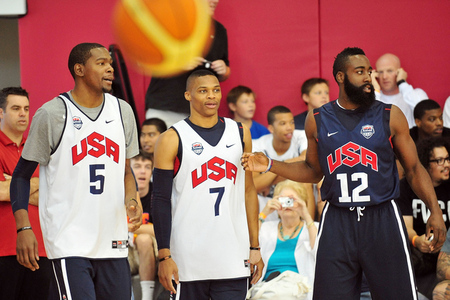
As if this offseason hasn’t been crazy enough, you have Team USA preparing for the Olympics in London. Not only that, but the Thunder has 4 representatives in the Olympics (Kevin Durant, Russell Westbrook, and James Harden for Team USA, and Serge Ibaka for Spain). Durant and Westbrook were near locks to make the team, but Harden was actually a surprise addition after players like Dwayne Wade and Derrick Rose bowed out because of injury. The team torched the Dominican Republic and eeked out a victory against a tough Brazil squad in the US leg of pre-tournament games. After this, it’s across the pond for a couple friendlies and then the real thing. Durant has a possibility of leading the team in scoring, while Westbrook will be the defensive pitbull/offensive sparkplug off the bench. Harden will probably play a role similar to what he does with the Thunder, but to a smaller degree.

As a fan of the game, I love this. Before NBA-TV, the offseason was usually a time to hear about a trade or two, and wait for football season to start. So, even though, this has been a whirlwind offseason, I still appreciate it. When this offseason gets too crazy, I always hark back to the 2011 offseason. Oh, you don’t remember the 2011 offseason? Oh, thats right, because there wasn’t an offseason that year.

It Was All A Dream

“It was all a dream…” The opening line to “Juicy”, one of the greatest rap songs ever written. Christopher “Notorious B.I.G” Wallace’s opening salvo into our collective consciousness was, perhaps, the greatest conveyment of a musical rags-to-riches story. Great things always have a way of starting off small. Facebook started off as a social network for only Ivy League students and had the word ‘the’ in its original title. Microsoft started off as two friends who were great computer programmers. The Oklahoma City Thunder started off as a 23 win franchise that was in the running to be the worst team in league history for much of the season. But, oh, how things have changed. 

From a fan’s perspective, this was a celebration of the Thunder’s first trip to the NBA Finals. From the outside, this just looked like the finality of a four year run that started off very slow, but has been on a uphill trek ever since. But from the inside, this wasn’t just about the last 4 years. That collective cheer that you heard from the Chesapeake Energy Arena on June 06, 2012 at about 10:30 PM was a roar of passion. Passion, not only for the team, but for the state. A roar for ourselves. Not for each collective ‘me’, but instead, for the collective ‘we’. 

 When you are from Oklahoma, you always hark back to THAT day. April 19, 1995. The day innocence was ripped from the hearts of Oklahomans of all ages. The day we learned about evil and heartbreak. But, on April 20, 1995, we got up and started using a new vernacular. We started to live by words like RESILIENCY, COMMUNITY, SACRIFICE, TOGETHER, HUMILITY, HARDWORK. We knew the trek ahead was tough, but we knew it was a trek we would take together. 

If that wasn’t bad enough, 4 years later, the city was struck by what has been called the Monster of all tornadoes. An F5 tornado with multiple vortices, ripped through the southern part of Oklahoma City, destroying the suburb of Moore, Ok and the city of Bridge Creek, Ok. Once again, probably because of the hard lessons learned from the Murrah Building Bombing, we knew how to react to this tragedy and pulled together.  

City leaders, construction workers, politicians, and citizens all stepped up to the plate to improve the namesake city of the state. What was once a warehouse district was transformed into a sprawling entertainment district in the span of 20 years. With those improvements, came a 20,000 seat indoor sports arena originally known as the Ford Center. This would become the hub of our professional sports dream. 

Of course, with any dream, there are obstacles that stand in the way of achieving the ultimate goal. First, was the fact that we were the 44th largest TV market in the United States. While that sounds great in comparing it to the other 25,000 cities in the United States, that doesn’t bode well for any professional sports league looking for an expansion city. Secondly, was that fact that the professional sports leagues weren’t necessarily looking to expand at that time. The NBA last expanded in 2004, MLB in 1998, NFL in 2002, and the NHL in 2000. 

There’s a saying that goes, “When opportunities comes a’knocking, you better open the door.” When the tragedy of Hurricane Katrina happened in September 2005, the New Orleans Hornets were left with no place to play and hardly a populance to play for. Looking to lend a helping hand AND prove our worth as a big league city, Mayor Mick Cornett and city officials lobbied the NBA’s front office for the opportunity to host the Hornets for as long as necessary. While initially down playing the idea, the NBA decided to give Oklahoma City this opportunity of a lifetime and allow the Hornets to play at the Ford Center for what would eventually become 2 seasons. 

And Oklahoma City proved its worth, quickly growing a reputation as one of the loudest fan bases in the league for its adopted team. For those two seasons, the Hornets became synonymous with having a distinct home court advantage. It became OKC’s first foray into professional sports. Chris Paul won Rookie of the Year in his first season in OKC and David West became a burgeoning All-Star. Tyson Chandler became known as one of the best defensive big men in the league and Peja Stojakovic became known as one of the biggest free agency busts in his one season in OKC. And after two seasons, the music stopped. 

It was a bit disappointing when the Hornets left. Its like being in a 2-year relationship with someone that still had ties to their ex, and then being single again when your significant other goes back to their ex. We always knew the Hornets were going back to New Orleans, but the hope of them some how staying in OKC long-term was still in the back of most our minds. But this was no time to hold our heads down. Their was another opportunity to be had, and another team in the horizon. 

Regardless of what you think of the way OKC got the Thunder, the fact still remained that as of July 2008, the Seattle Supersonics ceased to exist and the Oklahoma City Thunder came into existence. Civic pride will make you argue the move until you are blue (Thunder blue, of course) in the face, but Oklahoma City had its team and it was time to show and prove. That first season was brutal, though. We knew we were getting a skeleton crew of a team with some young, unproven talent, but we didn’t know it was going to be this bad. 

The morning after another of our home losses, I called to the local morning sports talk radio show and just vented. I didn’t know if I could do this anymore. Living 90 miles from OKC and having to drive more than an hour each way, made driving back from the mounting losses excruciating. It’s almost like the team was stuck in a rut when it first got here and you had to wonder whether there wasn’t some karmic justice at play at how we had obtained the team. Thankfully, a coaching change and the general improvement of the young players led to a good finish and a hope for the next season. 

We all know what has happened the last two seasons. After a meteoric rise in their second season in OKC, the Thunder made the playoffs as an 8th seed and took the eventual champion Los Angeles Lakers to the brink of a 7th game in a riveting first round series. The team’s young stars (Kevin Durant and Russell Westbrook) went on to be the main components for a Team USA squad that won gold in the 2010 World Championships. In the next season, we finished with the 4th seed and made it all the way to the Western Conference Finals, losing in a close 5-game series to the eventual champion Dallas Mavericks. Suffice to say, expectations were definitely mounting.

Finally this year, in a season that was on the brink of not happening at all due to labor strife, the team exerted its dominance on most of the league and finished with the 2nd seed in the West. Two things became apparent as we marched towards this point. Number 1: This team was mature beyond its years and eschewed the notion that youth has to wait. Number 2: The home crowd was actually beginning to affect the play of the young Thunder. 

While last season, the Thunder players were the ones being criticized in the postseason, it was our turn, as fans, to be criticized this postseason. It started when the organization began playing games on the huge jumbotron TV outside of the stadium. What became famously known as Thunder Alley started as a small gathering (1000-2000) of fans that could not get tickets to the game, but wanted to experience, first-hand, the atmosphere of being at the playoff game. Eventually that small gathering turned into an all-out block party that some reports say reached as high as 10,000 + spectators in Thunder Alley. When you get that many people in a small space, bad things are bound to happen. Violence erupted after the clinching game of the 2nd round, and the postseason form of Thunder Alley was shut down. It is pretty sad when real fans have to suffer at the expense of a couple knuckleheads. Some people aren’t fortunate enough to be able to afford playoff tickets, but still want to be in the playoff atmosphere. 

Then there were the complaints that we actually wear our free t-shirts that the team supplies to each fan during playoff games. The travesty that fans would wear those shirts and cheer together as one. Who does that? Who cheers every great play and jeers every questionable call? I thought this was the norm for fans. I thought it was par for the course. But, just like everything else, we do things just a little different. We actually feel emotionally attached to our team. I saw grown men and women crying tears of joy for our trip to the Finals. People from the outside will never understand. As we venture into the unknown world of the NBA Finals, we will move forward the only way we know how: Together as one team. #TeamIsOne

Round 2: Lakers vs. Thunder

Redemption road. First it was the defending champions Dallas Mavericks. Now it’s the Los Angeles Lakers. The two teams that have knocked the Oklahoma City Thunder from the playoffs the last two postseasons. The two teams that have gone on to win the championship after they dispatched the Thunder. Oklahoma City did what they had to do in the first round, sweeping the Mavericks in a hard fought first round battle. Now, after a week of rest, they await the Lakers who defeated the Denver Nuggets in a surprising 7 game first round series.

If you want to know what this series will be like, go to your local city gym and observe the basketball court for about 3 hours. You’ll usually find at least one game pitting teenagers (ages 16-22) versus middle aged men (ages 35+). You’ll see the teenagers try to use their athleticism, but the middle aged guys will usually counter with smart basketball and mid-range jumpers. The game usually ends up being close and competitive. The Lakers, of course, are the middle aged guys and the Thunder are the teenagers.

The Thunder won the season series 2-1 in what has turned out to be one of the most contested matchups during the regular season. In the first matchup, in Oklahoma City, the Thunder turned a tight game in the first half into a blowout in the second half, taking the game 100-85. Kevin Durant had one of his better all-around games scoring 33 points on 12/22 shooting, grabbing 4 boards, and dishing out 6 assists. In the second meeting, in Los Angeles, the Lakers held a big lead in the first quarter, but got outscored 84-63 the rest of the way, losing 102-93. Russell Westbrook led the way this time around with 36 points and 5 assists. The 3rd game, also in Los Angeles, was known more for a body part than for a game. Aside from the whole ‘Metta World Peace’s elbow to the side of James Harden’s head’ incident, this was actually a really close game and the Lakers needed overtime to defeat the Thunder 114-106. The real story in this game was the Thunder’s inability to get going offensively in the second half once Harden was sidelined with the concussion.

The Opponent

The Los Angeles Lakers come into the game having won a hard fought 7 game series against the up-start Denver Nuggets. Six of the seven games were played without Metta World Peace, who was serving his 7 game suspension following the elbowing incident against the Thunder. Everyone knows the engine that still pushes the Lakers is Kobe Bryant, who averaged 29 points per game in their 1st round series. Most importantly though, Bryant called out his teammates for their lackadaisical effort following their performance in Game 6. The two teammates he was probably referring to the most after Game 6 were Pau Gasol and Andrew Bynum, who both were very inconsistent in the Denver series, interspersing great games with horrible games. Ramon Sessions had an average series in his first tryst into the playoffs, perhaps showing the signs of someone who hasn’t consistently started in the league. The bench, which  has been shortened to three players, is probably the weakest one left in the playoffs. Matt Barnes, Steve Blake, and Jordan Hill all have the ability to provide good minutes, but due to the short bench, can be overused and therefore rendered less effective.

Keys to the series:

1)      How healthy is Kendrick Perkins? The Thunder have said all the right things regarding Perkins’ condition. But sometimes, with a muscle like those around the hips, its takes longer for them to heal completely. It’s one of those muscles that you don’t think about at all unless it gets hurt. With the amount of lateral movement involved in basketball, one can only hope that the hip strain is completely healed and doesn’t rear its ugly head anymore in the playoffs. Look for plenty of pick and rolls involving Andrew Bynum early in Game 1.

2)      Who guards Russell Westbrook? The Lakers got their Kevin Durant defender back in Metta World Peace. But their biggest issue has always been defending Russell Westbrook. Put a slower guard on Westbrook, and he blows right by them and does his damage in the paint. Put a smaller guard on him, and he’ll post them up. Look for Ramon Sessions to start the game guarding Westbrook. But as was seen in the Denver series, quick guards can get by Sessions pretty consistently. Look for the Lakers to regularly deploy hedge defenders towards Westbrook, especially the player guarding Sefolosha. Or look for Bryant to take on the task of guarding Westbrook himself.

3)      Remember that Metta World Peace is the Lakers’ 4th best player, at best. A lot will be made about World Peace’s first game in OKC since “The Elbow”. But the focus of the game needn’t not be on the man formally known as Ron Artest. World Peace will be on his “best” behavior and will not do anything to jeopardize the Lakers’ chances. Will he push, grab, annoy, and attempt to intimidate? Does the sun rise in the East? Of course he will do all that. But the Thunder need not involve themselves in revenge plots and try to take cheap shots at World Peace. What MWP is doing in the media is classic instigation techniques. Hopefully the Thunder players don’t take the bait.

4)      How will the extended rest affect the Thunder? In the 9 days since the Thunder last played, France elected a new president, another underwear bombing plot was foiled, Portugal got rid of four holidays due to cost cutting measures, new data leads scientists to believe that the Maya really didn’t think the world would end in 2012, and President Barack Obama supported gay marriage. That’s a very long time to not be playing any type of competitive basketball. You can practice all you want, but you’ll never be able to replicate the intensity of a real game against a real opponent. The Thunder had a 3 day rest between the first and second round last year, and looked completely flat in the first game of their second round matchup against the Memphis Grizzlies. A rest this long is completely new territory for the young Thunder and may be a factor early in the series.

5)      Which Lakers team shows up? The Lakers will be all-in in this series. It’s Kobe’s nature to be completely tuned-in to every game he plays, whether it’s a pre-season game against the Washington Wizards or a Finals game against the Boston Celtics. It’s Andrew Bynum and Pau Gasol that can sometimes suffer from bouts of Adult OnSet Attention Deficit Disorder (AOADD). Against the Nuggets, both these players shut it down in Games 5 and 6, thinking that the will of the Nuggets would wilt and they would have an easy road to the second round. But in this series, both these players know what’s at stake and will be fully focused. Metta World Peace won’t be the MWP of earlier this season. He’ll be playing like Ron Artest from Queensbridge. And that could be a game-changer. The wild card for the Lakers may be Ramon Sessions. If for any reason he shrinks in the pressure of the playoffs, the Lakers may be in trouble.

Conclusion:

This series will be a hard fought battle in which home court advantage will win out. Thunder in 7.

Let’s Not Get All Defensive Now

In remembering these past 2 weeks, and watching the first 6 minutes of the first quarter in the Phoenix game, I’m reminded that, even though the Oklahoma City Thunder are athletically superior to most teams, their defense will be the tell-tale sign whether they reach glorious heights this postseason. A lot of the defensive breakdowns they had last season, are back again this season. The cast of characters is the same, so the fact that improvements have not been made, is really worrisome for their future postseason success.

 Two seasons ago, when the Thunder had Ron Adams as an assistant coach, they were near the top of the league in defensive efficiency and used that to propel them to the postseason for the first team since moving to Oklahoma City. Since Adam’s departure after that postseason, there has been a lack of defensive focus that is being masked and hidden by the team’s improved offensive efficiency. When the team struggles offensively, this lack of defensive focus can have adverse effects on the Thunder’s ability to win, especially in the playoffs.

The thing about defensive breakdowns is that they are usually a combination of several defensive breakdowns in one series. It’s not just one play in a possession that causes this. It’s usually a chain reaction of defensive lapses. The first thing the Thunder struggle with is their pick-n-roll defense. The Thunder guards, Russell Westbrook, in particular, have a tendency to go over the pick, instead of fighting through it to stay in front of their man. The problem with this is if the big man doesn’t hedge over a bit, the opposing guard just blows right by them and past their primary defender.

It’s a play like this where you have to know your opponent’s tendencies. If the scenario is guarding a slower guard (i.e. Jason Kidd or Mike Conley), then the Thunder guard can go over the screen as there is no threat of a blow-by. The only threat is if the guard is a competent 3-point shooter. The big man in this situation has to know who he is guarding and decide whether to hedge or stay with his man. In this case, if we are talking about Dirk Nowitzki or Zach Randolph, then it would probably be best for the defending big man to stay on his man.

If the situation is changed to a speedier guard, such as Ty Lawson or Tony Parker, then the big will have to hedge to allow the defending guard a chance to stay in front of his man. The worst thing that can happen in this situation is a switch, where the big is guarding a speedy guard, and the defending guard is on the offensive big. This opens up a ton of options for the offense and puts a lot of pressure on the defense.

The primary goal of the pick-n-roll is to allow movement towards the rim. But, against the Thunder, this is also achieved through dribble penetration. When he was drafted out of UCLA, Russell Westbrook was advertised as a defensive guard, having just won Pac-10 defensive player of the year. But what worked in college (gambling on steals, using other-worldly athleticism to pressure opponents) hasn’t worked quite as well in the NBA where the world’s best basketball players play. A lot of what makes defense work is where you are positioned. If you are not in the correct defensive position, an NBA player will blow by you in a heartbeat.

Where Thabo Sefolosha is more of a technical defender, using his length to make the opposition adjust their play, Westbrook is more an instinctual defender, always trying to go after the steal. But don’t mistake steals for good defense. When you constantly gamble for steals, you put pressure on the rest of the defense to play 4 on 5 defensively. Eventually, the open man will be located, and its usually on the 3-point line or for an easy bucket.

This, then leads to the next defensive issue for the Thunder, which is closing out shooters. After the acquisition of Kendrick Perkins and the insertion of Serge Ibaka into the starting lineup last season, the Thunder went from squishy soft interior presence to hardcore interior presence. One would surmise, with that kind of support in the interior (to also include Nick Collison and Nazr Mohammed), the Thunder wings would trust their bigs more and not sink in every time the ball gets into the paint. Instead, it’s become commonplace for the entire defense to sag into the paint when a breach occurs which leads to wide open three point shots. Teams like San Antonio and Dallas feast on this and always give the Thunder problems.

Once the defense has been breached and the ball is in the paint, then the advantage goes to the offense. When big men have to move around, it takes them out of their comfort zone. Our big men like to battle until the shot goes up and then box out for a rebound. But if ball is penetrated into the paint, then the bigs have to move around to defend the paint. Even with Ibaka leading the league in blocked shots, this still puts the defense at a disadvantage. If Ibaka leaves his man and whiffs on a blocked shot attempt, then his man is in position for the offensive rebound and put back. Much like steals, blocked shot don’t automatically equate to good defense. But if you are going to have Ibaka play free safety in the paint, then KD needs to slide down on defense and help out on the boards. While it may seem like this has been happening, as evidenced by Durant averaging a career high 7.9 rebounds per game, it also needs to be taken into account that the Thunder have played a lot more small ball with Durant at the 4 this season.

The most important issue with the Thunder’s lack of defensive intensity is their will. A lot of their deficiencies can be overcome by focusing more on the defensive end and working smarter. Ron Adams may have been a great defensive strategist. But even more important was that he held the players accountable for their actions on the defensive end. Once he left, there was a general sense of apathy concerning smart defensive basketball. The Thunder were content with just being good enough defensively and letting their athleticism dictate their defensive schemes. This is especially evident in the 4th quarter of close games. When the Thunder are focused, they can play great defensively and use that close out games.

It’s not all bad though. Due to their athleticism, length, and youth, the Thunder are one of the better teams at defending the fast break. They are constantly stifling transition opportunities for the opposition and cause a good number of turnovers defending the fast break. As we saw in the 4 game stretch from March 25th thru April 1st, where the Thunder played the Heat, Trailblazers, Lakers, and Bulls, the Thunder can put together a string of great defensive games. The question becomes, will that translate to the playoffs?

The Key: Game Planning against James Harden

The competition for the Thunder’s third banana is in full swing between James Harden and Serge Ibaka. Harden provides on the offensive end what Ibaka provides on the defensive end. What I have begun to notice, though, is that teams, especially playoff teams, are starting to aggressively scout James Harden and his tendencies. Serge Ibaka is still a wild card, in that his untapped potential lends an air mystery surrounding how to guard him. The way Ibaka played at the beginning of the season is completely different from the way he is playing now. Eventually, Serge’s evolution as a player will plateau and teams will have a checklist on how to guard Ibaka. But for right now, the man receiving the opposing team’s attention on the defensive end is the Bearded One.

When teams play the Oklahoma City Thunder, they have an idea of how to counter Kevin Durant and Russell Westbrook. They either have a physical defender for Durant or they hope that he has an off-night in the FG department. Regarding Westbrook, they either play him with a bigger player (a la Lebron James or Kobe Bryant), force him into the heart of the defense, or hope he has one of those high turnover, low FG percentage nights. Either way, it’s a classic case of pick your poison. But with so much of the offense coming from those two players alone, many teams are content with letting them get their numbers, and instead focusing their defensive attention on the rest of the players, especially James Harden.

Great games by Durant and Westbrook usually net around 55 – 65 points. If you maintain Harden and shut down his attack with the 2nd unit, you can probably beat the Thunder with 95 points. Using that wisdom, teams are starting to focus a lot of their defensive attention on Harden. When the second unit is in, the Thunder usually runs the same 3 or 4 sets. But their favorite, by far, is the Nick Collison/James Harden pick and roll on the 3-point wing. One of 4 things happens on this play:

  1. Nick completely screens the defenders and Harden backs up for an uncontested 3-pointer.
  2. Nick screens the defender just enough for Harden to split the double team and use his patented Euro-step to get into the lane.
  3. The two defenders pays so much attention to Harden that it leaves Collison either open for a midrange jumper or a roll to the basket
  4. The defenders switch creating a mismatch that either Harden or Collison can exploit.

This James Harden mix shows all the ways that the Harden/Collison pick and roll works:


With about a season and half worth of film on Harden and Collison, good teams are starting to do a couple things to stymie this effective offensive attack. First off, they are putting their hands up in the passing lanes. While Harden is an effective passer, he has a tendency to be predictable and, in essence, choreograph his no-look passes. The second thing that defenses are doing is closing up the lane between the two defenders in the pick and roll. This negates the ability for Harden to split the double team and get into the lane. This was very evident in the Heat game, when the 8 – 0 Heat run in the 4th quarter was spearheaded by two consecutive turnovers by Harden in this pick and roll scenario. Great defensive teams will choose Collison to beat them offensively, instead of Harden.

Harden has been the key to OKC’s offensive efficiency. Durant and Westbrook are going to get theirs. When you have the 2nd and 5th leading scorers in the league, they will find ways to put the ball through the basket. When Harden is allowed to be effective, he adds an entirely different dimension to the Thunder offense that makes the defense feel like the attack is coming in continuous waves. When he protects the ball and manages the second team, the team usually wins. In their 12 losses, Harden is averaging 3.5 turnovers per game. In the wins in which he has played, he’s averaging just under 2 turnovers per game (1.9).

The predictability of Harden’s offense has allowed teams to start making defensive game plans against Harden. While the increase in turnovers over the past 10 games (3.4, as compared to 2.0 in the first 39 games) can be attributed to an increase in usage and minutes, there’s no denying that an efficient Harden is the key to the Thunder advancement this season and beyond.