Business transactions are always about needs versus assets. And that’s what trades in professional sports are. A GM will assess their team and see what is needed and what can be given up. Sam Presti, the GM for the Oklahoma City Thunder, has made his bread and butter in the previous 5 seasons by taking advantage of other teams’ needs for financial relief. It’s how he obtained Thabo Sefolosha, Eric Maynor, Kendrick Perkins, Daequan Cook, and the draft pick that became Serge Ibaka. He did this by meticulously managing his cap space and not making hasty free agent/trade decisions.
Now that the Thunder are done with the rebuilding process, and are currently in the championship building phase of their development, some of the things that Presti used to swing advantageous deals are no longer available. The Thunder are currently $900K over the salary cap, meaning that they can’t absorb contracts, and must instead match salaries up to 125%. As ironic as it sounds, a negative of being frugal and careful with your spending, is that the Thunder are not saddled with any bad contract, which can become very advantageous in their expiring years.
Needs
With the loss of Eric Maynor earlier in the season, the Thunder lost one of the best game managers (backup or starting) in the game. He was the ultimate yin to Russell Westbrook’s yang, and provided the Thunder with a stabilizing force at the point guard position whenever necessary. Now, in his place, is a rookie, Reggie Jackson, who has looked every bit the part of a rookie. His play, while improving, has been inconsistent, as he is still trying to find his comfort zone on this championship caliber team. Kind of a tall order for someone who wasn’t expected to be thrust into such an important position at this moment in his young career. Because of Jackson’s inconsistent play, a quality backup point guard has suddenly become a need for the Thunder.
The thing about a wing oriented team is that if the shots aren’t falling and the “box and 1” defense is working, it makes it nearly impossible to consistently score points. The Thunder are lucky to have such dynamic scorers like Kevin Durant, James Harden, and Westbrook. These players have made their careers by consistently hitting shots with hands in their faces. But in basketball, the closer you are to the basket, the more efficient and easier your scoring becomes. And the Thunder have never had a low post scoring threat. It’s one of those things that makes scoring in the playoffs a whole lot easier.
Realistic Assets
Nazr Mohammed – $3.75 Million – Veteran big man that could fit in on a contender that needs size.
Cole Aldrich – $2.29 Million – 2nd year big man that has shown improvement and could be a good rotational big, if not for the Thunder, than for another team.
Thabo Sefolosha – $3.3 Million – Veteran wing who is still one of the better wing defenders in the league.
Royal Ivey – $1.2 Million – Veteran guard who provides good energy off the bench.
Charlotte’s 2013 2nd round pick (obtained in the Byron Mullens trade) – Charlotte probably isn’t going to get much better next season and that pick will probably be in the 30-35 range, where a good player can still be picked up.
OKC’s 2012 1st round pick – Will probably be in the 25 – 30 range of the first round. Late in the first, but still useful for stashing an overseas pick or rebuilding.
Possible trade partners (based on need and cost of transaction):
Boston – Keyon Dooling ($2.25 M) and Marquis Daniels ($854 K) for Nazr Mohammed. Boston is in desperate need for big men after the losses of Jeff Green, Jermaine O’Neal, and Chris Wilcox. Keyon would provide a veteran point guard that has played in the playoffs before. Daniels would more than likely be cut.
New Jersey – Sundiata Gaines ($854 K) for Charlottes 2013 2nd round pick – Gaines has quietly put up a good season as a backup point guard for the New Jersey Nets.
New York – Mike Bibby ($854 K) for OKC’s 2013 2nd round pick – With the emergence of Jeremy Lin and the return of Baron Davis from injury, Mike Bibby is no longer necessary in New York.
Cleveland – Ramon Sessions ($4.3 M) for Nazr Mohammed and Charlotte’s 2013 2nd round pick – Compared to other teams’ offers, this is probably a “No” for Cleveland, but it’s still worth a try.
Milwaukee – Andrew Bogut ($12 M) for Kendrick Perkins, Daequan Cook, and OKC’s 2012 1st round pick – Bogut is just as good defensively as Perkins, while providing a lot more offense, if necessary. The Bucks will probably want either Harden or Serge Ibaka, which would make this a deal breaker for the Thunder.
New Orleans – Greivis Vasquez ($1.11 M) for Lazar Hayward and Charlotte’s 2013 2nd round pick – New Orleans is in full rebuild mode and looking to acquire quality draft picks. A very high 2nd round pick would do just that. The question becomes how does New Orleans view Vasquez?
Charlotte – DJ Augustine ($3.2 M) for Nazr Mohammed and Lazar Hayward – I don’t understand Charlotte’s desire to trade Augustine, as Kemba Walker is still a rookie and is more undersized SG than starting PG at this point in his career. But, if they want to, we’ll participate if the cost is not too much.
Free Agent – Anthony Carter (formerly of the Toronto Raptors) was recently waived to give him the opportunity to sign with a contender. Using our Disabled Player Exception from the Maynor injury, which comes out to $758,340, we could sign Carter for the rest of the season.
And just for fun:
Orlando – Dwight Howard ($18.1 M) and Ish Smith ($762 K) for Kendrick Perkins, James Harden, Eric Maynor, Cole Aldrich, OKC’s 2012 1st round pick, and Charlotte’s 2013 2nd round pick. I don’t know if Orlando gets a better infusion of young talent and draft picks from any other team.
What does the team look like on Thursday at 3:01 PM?
I think we stay pat. Making reactionary moves is not Presti’s style. He knows we still have Maynor next season and Jackson will have gained an invaluble amount of experience in his rookie season. A smaller scale signing, like Anthony Carter will be possible, though.
CLUTCH. A word that can define careers in the NBA, especially if you are labeled a superstar. A word that can make you the most feared player on the court for the opponent, or the biggest liability for your team. It’s a term that has no gray area. Either you are clutch or you are not. When Lebron James passed the ball to Udonis Haslem for the game-winning shot against the Utah Jazz a week ago, we didn’t anticipate that Haslem would make that shot. Not that Haslem is a horrible player. He usually sinks those mid-range jumpers. But he’s not a superstar. The guy that passed him the ball is a superstar and it has been his modus operandi for the past 2 seasons to shrink in those high pressure situations during those waning seconds of close games. The words “not clutch” have been following James around for the past few seasons like the stench when you unknowingly step in dog poop. And yet, his team has succeeded to the point where they reached the NBA Finals last season, and are one of the top 3 teams in the league this season. But that loss in the Finals, which kept the Heat from starting their string of winning, “not 5, not 6, not 7…” titles, can be partially blamed on James’s lack of “clutchness”.
It’s easy to see how not being clutch can be a detrimental to team success. But can being too clutch also be a detriment? Now, mind you, I understand how oxymoronic that sounds. How can being able to perform in high pressure situations be a detriment to a team? If a team constantly performs when all the chips are on the table, then that team should be in pretty good shape. Case in point: the Oklahoma City Thunder and their last 5 games.
As Steven Tyler of Aerosmith would say, the Thunder are literally “living on the edge” in the last 5 games. Its one of those runs where the team could easily be 0 – 5, just like it could be 5 – 0. Instead, the Thunder find themselves at 4 – 1 since the All Star Break and building on their lead at the top of the Western Conference. Here’s a look at the key 2nd halves in each of those games and how the Core 4 (Kevin Durant, Russell Westbrook, James Harden, and Serge Ibaka) performed:
Opponent
Largest Deficit/Quarter/Score at the time of deficit
Durant’s 4th qtr Stat Line
Westbrook’s 4th qtr Stat Line
Harden’s 4th qtr Stat Line
Ibaka’s 4th qtr Stat Line
@ Philly
8 / 4th /66 – 74
10 pts / 3 rebs / 1 ast /1 stl
2 pts / 2 rebs /1 ast
7 pts / 3 rebs
2 pts / 2 rebs /1 blk /1 stl
@ Orlando
11 / 4th / 72 – 83
18 pts / 5 rebs
4 pts / 2 asts
8 pts / 3 rebs / 2 asts
Donuts
@ Atlanta (L)
8 / 4th /79 – 87
6 pts / 2 rebs
2 pts / 1 ast
3 pts / 2 rebs /1 ast
1 reb / 1 blk
Dallas
7 / 3rd / 45 – 52
6 pts /2 rebs
5 pts / 2 rebs
14 pts / 2 asts
2 pts / 2 rebs / 1 blk
Phoenix(W)
16 / 3rd / 68 – 84
12 pts / 2 rebs / 1 asts / 2 stls
9 pts / 1 ast
8 pts / 1 reb / 1 ast
2 pts / 8 rebs /1 blk
While this style of basketball makes for great fun as a fan, especially if you are winning most of the time, it also paints a conflicted picture in the Thunder’s outlook for the postseason. Two trains of thoughts come into play when a team is winning in this fashion. The first is that the team is learning how to win close games and is showing the ability to come back from 2nd half deficits. The second is that, come playoff time, constantly falling behind in the first half to elite teams will be the coup de grace to this year’s championship aspirations. Which train of thought is correct?
The answer, as usual, lies somewhere in the middle. As a young team, it’s necessary to build the fortitude to be able to come from behind and win. If you’ve never experienced having to recover from a sizeable deficit, then you may choke if the situation arises in the playoffs. But you also don’t want to make it a habit of constantly falling behind your opponents in the first half. It’s almost like the team goes into a mode where they say, “let’s keep the score somewhere around 10 entering the 4th quarter and we have a chance.” While it’s a luxury to have not one, but two great clutch players (Durant and Westbrook), there can come a time where the natural effect of statistics takes hold and they both have a bad second half. You just hope it isn’t in an elimination game in the playoffs
Any time I hear the word halftime, this is the first thing I think about.
We’ve reached the half-way point in this strike-shortened season. Half time, baby! Everyone to the locker room, or as it’s called in the NBA, All-Star Weekend. Coming into the season, I didn’t know what to expect. We were bringing back our entire 10 man rotation, plus a couple young guys that had potential. But with a very short training camp, no summer league, and only 2 preseason games against the same team, it was a little difficult to gauge how the team would come out the gates. Conventional wisdom would say that in a shortened season, a team that experienced hardly any change would benefit the most early in the season.
That thought has not proven to be incorrect when it comes to the Oklahoma City Thunder. They are currently tied for the best record in the league at 25 – 7 and have a 2 game lead in the hyper-competitive Western Conference. If natural progression is the law of the land, then the Thunder are right where they are supposed to be. After finishing 4th in the conference last season and making it all the way to the Western Conference Finals, the Thunder are poised to take the next step in their natural progression.
Individual Grades (alphabetical order): I take into account what was expected of the player before the season started and how that player has fared in this first half of the season.
After spending last season shuffling between the Thunder and the Tulsa 66ers of the D-League, Aldrich was expected to continue developing into a rotational big man. When Nazr Mohammed was re-signed before the beginning of the lockout, it was an indication that the organization wanted Cole to continue to develop. In the 12 games that he has gotten in, Cole has shown a knack for causing havoc on the defensive end with his long wingspan and penchant for blocking or altering shots. On the offensive end, he has shown flashes of a nice post-up game (hooks, drop step, put back dunks), but has yet to fully assert himself and ask for the ball on the block consistently. He tends to be a bit over zealous on the defensive end and is prone to picking up fouls pretty quickly, especially on pump fakes. Aldrich shows great heart on the floor, though, constantly diving for loose balls. #FreeCole!
The No-Stats MVP. The ultimate glue guy. Collison was expected to continue being the first big man off the bench. A key cog that can be plugged in seamlessly if foul trouble or defensive lapses rear their ugly heads. Collison has not disappointed in his role. He is basically the same guy from last season with more of a willingness to unleash the soul crushing 12-15 foot jumper. A charge magnet, the 2nd unit gets their defensive identity from Collison. One of the smartest players in the league that is usually in the right place, at the right time (and not by coincidence). Future coach potential.
One of the wild cards coming into the season, Cook started last season in a rut that eventually led to him getting over 30 DNP-CD’s in the first half of the season. When finally given an opportunity to play, Cook became the deep threat that the Thunder had hoped for when they traded for him on draft night in 2010. Cook has continued to provide the deep threat for the Thunder this season and has also become a more integral part of the rotation, even starting 12 games in place of injured SG Thabo Sefolosha. He has improved his man on man defense and has involved himself more on the boards.
Expected Grade – C+ Mid-Term Grade – B-
Kevin Durant (Stat line: 32 GP (32 GS), 37.8 mpg, 8.2 rpg, 3.3 apg, 1.3 blks, 1.3 stls, 27.7 ppg)
A candidate for MVP coming into the season, Durant has not disappointed. While his scoring may have gone down just a tad bit, his rebounding, assists, and blocks are at career high levels. He is scoring at the most efficient rate in his career and he is starting to be relevant defensively, especially on the boards. He is learning how to get the ball in better spots and how to position himself to get better shots in crunch time. The only negative I can see in his game is the turnovers. The athletic part of Durant is starting to mesh with the cerebral part. And that is a scary reality for the rest of the league.
The glue that holds the “feuding” yin and yang that is Kevin Durant and Russell Westbrook together. We all know that the “feuding” part of that statement has proven to be false as this season has progressed. What started as an improvement over the 2nd half of the season last year morphed into calls for Harden to be the starting 2-guard as the new season began. Coach Scott Brooks kept Harden on the bench and he has turned into arguably the best 6th man in the league, providing instant offense off the bench, ala Jason Terry or Jamal Crawford. Along with being the unquestioned leader of the bench unit, he’s also in the game with the starters to close it out in most games. His playmaking ability and penchant for getting foul calls make Harden an offensive weapon to be marveled. While steadily improving defensively, he can still be had by good 2-guards, especially if quickness is a factor. Also, the home/road splits were an issue in the beginning of the season, but have normalized since then. Hopefully that doesn’t come up in the playoffs.
Expected Grade – B+ Mid-Term Grade – B+
James Harden’s Beard (Stat line: No stats can measure the greatness)
Seriously, this needed its own section. We’ve seen this thing grow from when Harden first joined the Thunder in June 2009. It started off so small and has blossomed into something so much greater. Olympic gods now bow in the presence of the Beard.
Expected Grade – A+ Mid-Term Grade – Infinity on a 4 point scale
Haywardwas obtained in a deal with the Timberwolves before the season. Hayward’s presence on the team is more as a practice player than as a regular rotation player. I believe, the bigger bodied Hayward has allowed Durant to simulate what its like to go against a stronger defender and to see what works against these types of defenders and what doesn’t. In his time on the floor,Hayward has shown to be a good transition player. He needs to be more consistent with his shot, especially from the 3-point line. Defensively, Hayward is an average defender.
Just like James Harden (and Kevin Durant and Russell Westbrook before them), Ibaka was expected to make the big 3rd year leap that we’ve seen from developing Thunder players. At the beginning of the season though, Ibaka seemed a bit out of sync. He wasn’t as aggressive and was settling for jumpers, instead of trying to do his damage from the inside. But over the last month, we’ve seen the Ibaka that we love and that opposing teams hate. In the last 3 weeks, we’ve seen 3 double digit block games, a man’s triple double (points, boards, blocks), and a disruptive defensive force not seen since the heydays of Ben Wallace. He still leaves a lot to be desired on the offensive end of the court as an inside presence. Though he sometimes leave us salivating with Olajuwon like post moves, he still prefers the 15 footer, which he is starting to hit with more consistency lately. His penchant for going for blocks usually leaves a gaping hole in the middle for offensive rebounders.
Ivey’s role on the team is that of veteran point guard. He’s a defensive minded player that probably pushes Russell Westbrook and Eric Maynor in practice. When he has received playing time, Ivey has made a couple 3 pointers and played good defense. He has recently been called to duty a lot earlier in games because of some injuries to players. His defense keeps him in games, but his lack of a true identity (not really a point guard, but not very consistent with his jumper) can be a detriment if the team starts to struggle offensively.
My expectation for the rookie was that he would split time between the Thunder and the Tulsa 66ers of the D-League, gaining valuable experience against lesser competition in preparation to possibly be a regular rotation player next season. But with the injury to Maynor, Jackson was thrust into the rotation as the primary back up point guard. The results have been par for the course for a late first round rookie point guard. Some flashes of decent play sandwiched between lessons from the school of hard knocks. They say that experience is the best teacher, so hopefully this is a blessing in disguise for the future. But in the present, Reggie has shown that he has the athletic ability to play in this league, but is still trying to figure out the nuances of the point guard position. If he is on the floor with one of the three main ball handlers (Westbrook, Durant, or Harden), he immediately defers to them to run the offense. Also, defenses have learned to pressure the rookie into making bad decisions. With all that said, though, I like what I see in Jackson and believe this experience will help him immensely in the future.
As a third year player, I fully expected Maynor to make that leap from okay player to good player. Already labeled by some to be the best back-up point guard in the league, Maynor’s steady hand at point made him the quarterback of one of the best bench units in the league. Like many players in this condensed season, Maynor’s play at the beginning was a bit careless, as he was averaging less assists and more turnovers. Nine games into the season though, Maynor suffered a torn ACL and was lost for the season. For all intents and purposes, Maynor’s recovery seems to be going ahead of schedule and he will be ready for training camp next season.
Expected Grade – B Mid-Term Grade – Inc.
Nazr Mohammed (Stat line: 31 GP (1 GS), 12.4 mpg, 3.0 rpg, 0.3 apg, 0.6 blks, 3.1 ppg)
The old man of the crew. In a room full of 20-somethings, Mohammed is the revered veteran. Mohammed’s role is that of back up center. Last season, he was invaluable as a stop gap until Kendrick Perkins came back from injury and as Perkins’s backup. There have been times this season where Mohammed has looked as spry as a spring chicken. And then there’s been blocks of game where Mohammed has literally looked like he has cement shoes on. That’s what you get with a 14 year vet. You take the good with the bad.
One of the most polarizing players on the team. Last year, Perkins was coming off major knee surgery and was slowed by bulky knee braces and the weight he put on while recovering. Vowing to come into camp more in shape, Kendrick came in 30-40 pounds lighter and shed the knee braces. But it’s been the same ol’ Perkins; a good post defender who does well against traditional centers, but gets lost if a team has an athletic and/or undersized center. Offensively, Perkins is a turnover waiting to happen. I don’t know if he lost some coordination during his recovery from surgery, but when he puts the ball on the floor, he usually loses it. When he attempts a shot, it’s usually a flat jump hook that is easily rejected. I don’t like to blast on Perkins since the Thunder’s record is so good with him in the lineup, but his biggest asset to the team is that he frees up Ibaka on the defensive end to be the NBA’s version of a roaming free safety. Another negative is the boneheaded technicals that Perkins picks up. He putting himself in a position to get suspended and miss time because of his hard-headedness.
Every year there’s that one guy that you, as a fan, attach your heart strings to. The underdog. The runt of the litter. Ever since the Thunder drafted Reid in the 2nd round of the 2010 draft, I’ve followed his career in the D-League. I was pleasantly surprised when the Thunder offered Reid the final roster spot for this season. This organization rewards “those” types of players that work hard to pursue their dream, even if everyone else has told them they have no chance. Last season it was Robert Vaden. Next season it may be Latavious Williams or Tibor Pleiss. When Reid finally got some run on the Valentine’s Day game, I was texting my brother in law in all caps. Literally, this was my text, “RYAN REID SCORED!!!!!!!!!” Honestly, in his limited game time, he has shown a good mid-range jumper and has shown the potential to be a future glue guy.
Another polarizing player on the team. While he is one of the best wing defenders in the league, his offensive inefficiencies can sometimes lead to the Thunder playing “a man down” on the offensive side of the court. The clamoring for a change in the starting line-up only got louder as last season’s playoffs pushed forward, and teams began corralling Durant and Westbrook. The thinking was that Harden, as a floor spreader, would allow Durant and Westbrook more room to operate on the offensive end. Hypothetically, this would seem like the correct way to go. But, as this season has shown, the value of a great wing defender should never be lost in the search for more efficient offense. The game is played on both ends of the court. As an added bonus, Sefolosha had shown signs of being more offensively efficient this season. He had begun to drive the ball more to the basket and was shooting the 3-pointer at a 48% clip. Not that he shot that many, but of the few that he did shoot, he was making almost half of them. I still cringe when I see him lead a fast-break, though. Unfortunately though, Sefolosha has been battling foot issues and has been limited this season and is expected to miss one more month.
Expected Grade – B- Mid-Term Grade – B+
Russell Westbrook (Stat line: 32 GP (32 GS), 4.8 rpg, 5.5 apg, 1.9 stls, 23.4 ppg)
Probably the most polarizing player on the Thunder. Last season, ironically, Westbrook’s 3rd, he went from good player to superstar. He, along with Derrick Rose, became the new standard for point guards: hybrids that could score 25 ppg and dish out 8 assists per game, while constantly breaking down a defense and doing their damage from the paint. You knew that Durant could score and that all he needed to do was refine the finer points of his game (rebounding, playmaking, etc). But you didn’t know where the learning curve would take you with Westbrook. Because of the criticism that Westbrook was receiving in last season’s playoffs and in the off-season, and the upcoming contract extension, I didn’t know what to expect from Westbrook. In the first 2 weeks of the season, it seemed like Westbrook was in the funk of all funks. His shot wasn’t falling, his assists were down, and there were rumblings of a true feud between he and Durant. Thankfully, things seemed to turn around in the middle of January (coincidentally once Russell signed his new contract) and Russell has been playing great ever since, garnering a couple Western Conference Player of the Week awards along the way. With Derrick Rose’s injury woes this season, Russell Westbrook has taken the role of premier point guard with his driving ability and consistent mid-range jumper. He still turns the ball over way too much and doesn’t always work to involve his teammates, but what I’m seeing from Russell this season is surprising because he’s still improving at a tremendous clip.
Expected Grade – A- Mid-Term Grade – A
Surprises:
It’s amazing how important a real training camp and 4+ preseason games are to players in their preparation for a season. I noticed that in many of the Thunder players’ performances. They didn’t really take off until after the 2nd week of the season, which in actuality, would be the same amount of time as training camp and preseason games in a normal regular season.
I kept hearing about how injuries would shape this season because of the condensed schedule. But I had no idea it would be this bad. The Thunder have never experienced many injuries in their 4 season in Oklahoma City. An ankle sprain here. A pulled hamstring there. But this season, we’ve seen Maynor go out with a torn ACL, Sefolosha miss significant time with foot issues, and other players miss 1-2 games with general soreness.
Looking ahead:
The schedule gets tougher from here on out. We play the Lakers 3 more times, Miami and the Clippers twice, Chicago, Philly, Dallas, and San Antonio once each, and 6 more games against division rivals. We have a 3 game East coast trip after the All-Star break and a 5 game West Coast trip close to the end of the season. Needless to say, if we stay at the top the Western Conference, we would have definitely earned it.
Possible trade targets – Since the trading deadline is on March 15, I looked a possible trade targets for the Thunder and their struggles on the bench:
One word to describe this week: FUN!!!! Yeah, we had that one hiccup in Houston, but had a nail-biter and two blowouts in the other 3 games.
Games played:
February 14th – vs. Utah
Valentine’s Day Massacre. I could only wish that we could play the Utah Jazz for every game the rest of the way. The issue with the Jazz is that they aren’t in full rebuild mode yet, but still have some good veteran players. So they have blocks of the schedule where they look good and then blocks of the schedule where they look bad.
And OKC just happen to play them twice in a block where they looked bad. All you needed to know about this game is that Kendrick Perkins had 6 assists and no turnovers. If you follow the Thunder any, you know that Perkins is a turnover machine when he gets his hands on the ball. But in this game, he channeled his inner John Stockton and went all ‘team basketball’ on the Jazz. The Core 4 (Durant, Westbrook, Ibaka, and Harden) all had yeoman-like efforts in the game and got to rest in the 4th quarter of a 111 – 85 blowout.
February 15th – @ Houston
Oh, the roller coaster that is a condensed season. One day you’re fawning over your past successes and the next you’re wondering what the hell happened. After throwing up on ourselves in the first quarter (29-13), the Thunder made a valiant effort to catch up and actually had a 3 point lead with 1:01 left in the game. But we didn’t score anymore from that point and lost the game 95-96.
Other than the horrible first quarter, two things doomed the Thunder: turnovers and Kevin Martin. The Thunder and Rockets were nearly identical in FG’s made, 3-pt FG’s made, and FT’s made. But the Thunder had 21 turnovers compared to the Rockets’ 13. When you leave that many opportunities on the table in such a close game, you’re bound to lose. Kevin Martin going off for a season-high 32 points on 10-18 shooting shows the value of Thabo Sefolosha on this team. While Thabo may not provide much offensively, it’s what he takes away from the opposing team that shows his true value to the Thunder.
February 17 – vs. Golden State
The team that takes years off my life. These two teams usually play each other close, and because of the Warrior’s style of play, they are usually high scoring affairs. After keeping the M.O. of this series with a close first quarter, the Thunder blew the lid off the game, outscoring the Dubs 64 – 41 in the 2nd and 3rd quarter. James Harden had a game high 25 points, while Kevin Durant poured in 23. Every Thunder player that was active scored on their way to a 110 – 87 victory. My heart thanks the Thunder.
February 19 – vs. Denver
The greatest regular season game I’ve ever seen live. To see 3 feats of excellence in one game was awesome. To have all 3 of those feats performed by members of the team you cheer for was great. To see it live with your kids in tow was priceless. For some reason, whenever my kids go to the game, the Thunder win in dramatic fashion. Last season was the Knicks game winner. And this season it was this game.
I don’t even know where to start. Kevin Durant’s career high 51 points. Russell Westbrook scoring 40 points and having 9 assists. Serge Ibaka getting a man’s triple double with 14 points, 15 boards, and 11 blocks. KD and Russ combining for 91 points on 35/57 FG shooting (61%), 8/12 3pt shooting (67%), and 13/15 FT shooting (87%). Or everyone not named Durant, Westbrook, or Ibaka only combining for 19 points.
That’s the beauty of this game. Every point that Westbrook and Durant poured in was necessary. There was not a cheap basket anywhere. Sometimes, when a player is trying to reach their career high, they tend to just hog the ball in order to reach that plateau. But because of our horrible transition defense and no one on our team, not named Westbrook or Durant, being able to buy a bucket, every single point from these two was needed.
As for the game, it was a one of runs. OKC patched together a 20-0 run from the 2nd to the 3rd quarter. Denver patched together a couple 12-1 runs throughout the game. No lead was safe in this one. The only difference was we had two closers and they had none. We applied the clamps in overtime and rode out to a 124 – 118 victory.
Player of the Week: Kevin Durant
Both Kevin Durant and Russell Westbrook played great this week. But Westbrook had a bit of a stinker, in terms of point guard play, in Houston (4 assists, 6 turnovers), and Durant scored a career high 51 points in last night’s game. It’s sometimes so difficult to choose between these two, but for this week, Durant beats Westbrook to the finish line by a head.
Stat line for the week: 32 pts, 8 rebounds, 2.8 assists, 1.5 steals, and 0.75 blocks per game.
3 In the Paint
I’m loving Serge Ibaka’s progression. He started off a bit slow this season, and I was beginning to wonder whether his ceiling was going to be much lower than his actual production. Silly me. Like many other players, the first 15 games of this season were being treated like the training camp, preseason, and first 2 weeks of a normal regular season. We are starting to see many players round into form and Serge Ibaka can certainly be included in this group. That 3rd year leap that happened to Durant and Westbrook, is beginning to take hold of Ibaka. He has become the defensive player of the year candidate we all expected him to become at the beginning of the season.
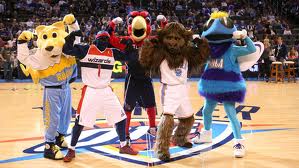
Rumble the Bison should have a birthday every game. Last season, his birthday game was the game winner versus the New York Knicks. This year it was probably the greatest regular season game I’ve ever seen. For those who aren’t familiar with this, when a mascot has a birthday, it’s a game where about 8 other mascots from other teams come and have fun with the “home” mascot. It’s a great game to bring the kids to.
The turnovers need to go down. There has been a straight forward correlation between the number of turnovers and the effects on whether it is a close game that we could potentially lose, or whether its an easy victory for us. Smart basketball usually leads to wins with this team.
One word to describe this week: tiring. With a 4 game West-Coast trip, every game usually finished around midnight, our time. And all 4 games were close enough that you had to watch them in their entirety. No blow-outs this week.
Games played:
Feb 6th – @ Portland
There comes a game in every season where you just sit back and say, “Wow, the refs got that all wrong.” Two years ago, in a tightly contested overtime thriller against the Utah Jazz, they got the benefit of a no-call at the final horn to escape with a 1 point victory at home. It was very apparent that Kevin Durant was hacked as he attempted the last second 3-pt heave. But the refs swallowed their whistles and the game went down in the record books as a Jazz victory. A day later, the NBA apologized because it had gotten the call wrong.
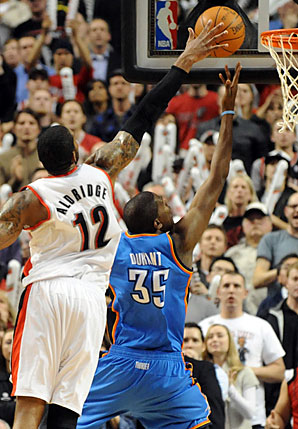
Fast forward to the Portland game on Monday. With 7 seconds left, KD drove to the basket with the Thunder down by 2. At the same time that the ball hit the backboard, LaMarcus Aldridge swatted the ball from behind. A close call, but the refs called a goal-tend and awarded the two points to Durant to tie the game. After a failed attempt by the Trailblazers at the end of regulation, the Thunder used timely scoring from their big three (Durant, Russell Westbrook, and James Harden) and great defense by Kendrick Perkins on LaMarcus Aldridge to pull out a 111 – 107 victory. A day later, the NBA apologized for the blown call by the refs in awarding the goal-tending call to Durant. Sometime you’re the hammer, and sometimes you’re the nail.
Feb 7th – @ Golden State
Golden State games are the only games that give me heartburn, especially if they are in Oakland. Hypothetically, looking at the records, we should be able to clamp down defensively on this team and cruise to an easy victory. But for some reason, be that style of play or the fact that our defensive weaknesses match up so poorly with their offensive strengths, we can never quite have a comfortable lead against this team. We usually end up winning, but it a very close affair all the way until the end. In the last four seasons, including this one, we are 9 – 4 against the Warriors, but the average score has been a “too close for comfort” 111 – 109. And why would Tuesday night by any different?
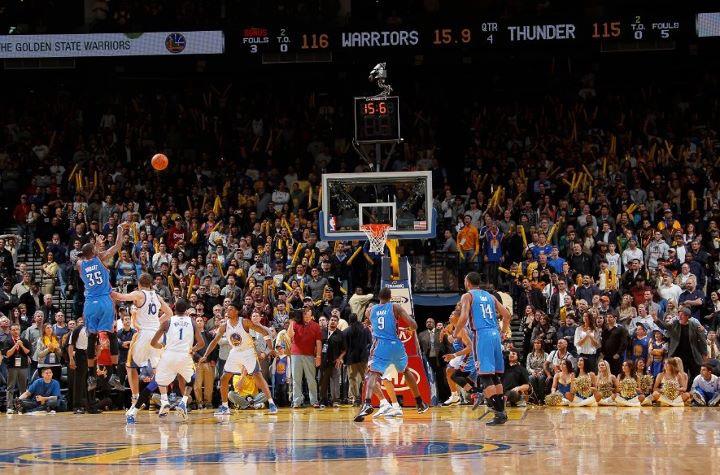
The game was actually a microcosm of the games these teams have played in the last 4 seasons. Every time someone pushed a lead to 7 points, the other team went a 12-1 run to capture the lead. No lead was safe. The torrid pace was fun, but many Thunder fans lost at least 1 year of their lives because of this game. The Warriors were led by Monta Ellis who had a career high 48 points and by David Lee who notched his 2nd career triple-double with 25 points, 11 boards, and 10 assists. But while the Dubs had 2 great players, the Thunder relied on 4 players who between them scored 100 points (Durant (33), Westbrook (31), Harden (19) and Cook (17)). The 4th quarter was the Big 3 with a Cook show. All 4 players provided timely baskets to keep the Thunder within striking distance throughout the 4th quarter. With 17 seconds to go and the Thunder down by 1, they went to ol’ reliable (Durant), who went to the bank and put the Thunder up by 1. The Warriors didn’t score the rest of the way. 119-116 Thunder.
Feb 8th – Off day
And on the middle day of a back to back West Coast sandwich, Thunder Nation rested.
Feb 9th – @ Sacramento
If there was one game in this set where you said to yourself, “This is going to be an easy game,” this was definitely it. A young, inconsistent team who had fired their coach earlier in the season and had 2 mercurial young stars (Tyreke Evans and DeMarcus Cousins). On paper, this was a gimme. But, as the saying goes, this is why you play the game. The Thunder pulled the same M.O. from their 2 games; keep it close, apply the clamps at the end, and make timely shots. The only problem was that the Kings shook the clamps off late in the 4th quarter and those timely shots weren’t falling for the Thunder in this game. In their only nationally televised game, with a playoff atmosphere that hadn’t been seen since the glory days of Chris Webber and Vlade Divac, and a raucous crowd that was all blacked-out, the young Kings rose to the occasion and outlasted the Thunder 106-101. Was there any reason to think that the Thunder would win when Chris Webber shows up to call a game and ends up putting a Kings jersey on?
Feb 10 – @ Utah
There are just some games where everything works out for you. In a game where Durant deferred offensively, Russell Westbrook happily stepped up and scored 28 points on 10 – 20 shooting. It just felt like one of those games where we held the Jazz at bay, but knew that they could string together a 10-1 run at any point. It never materialized, in part to the double doubles posted by each Kendrick Perkin and Serge Ibaka, which negated anything from the Jazz’s front court duo of Al Jefferson and Paul Millsap. The Thunder coasted in the second half to a 101 – 87 victory.
Player of the Week: Serge Ibaka
In a week where Durant and Westbrook averaged nearly 30 ppg each and hit timely shots, this week’s award is going to someone on the defensive end. If there was a picture next to the words ‘interior defender’, it would be of Serge Ibaka. For the week, his ridiculous stat line was as follows – 4 games played (10.3 ppg on 55% FG shooting and 82% FT shooting, 9.8 boards per game (with 4 per game coming offensively), and 4 blocks per game). He single handily kept us in games with his offensive rebounding and paint protection.
3 In The Paint
1. Russell Westbrook’s assist numbers (or lack thereof) are really starting to worry me. I completely understand that our offense is iso-oriented and Durant and Harden’s assist numbers are going up. But I think a lot of our early game struggles are due to the fact that we are not finding a groove offensively with the first unit and instead have to wait until the 2nd unit gets in to find any kind of cohesiveness on the offensive end. If Russell would think involvement instead of attack when the game starts, I think that would make a lot more things open up for the starters earlier in the game.
2. Some teams have no closers. Some teams only have one. But we have the luxury of having 2. Durant and Westbrook were mostly great in their late game executions this week. Westbrook had the mid-range game working late in games and Durant hit the big shot when it needed to be hit (even if he had a little help from the refs on one of those occasions).
3. Turnovers, turnovers, turnovers. A lot of the reason why teams are able to hang around till the end with us is because of our penchant for turning the ball over. If this number goes down, the number of close games will probably go down to.
In a season where you have the best record in the league after 25 games, a lot of things have to go right as far as player development is concerned. Your young guys have to keep developing, while the veterans have to either add new wrinkles to their games or maintain the status quo from the previous season. While a big part of our success this season is due to the continued development of our young core (Kevin Durant, Russell Westbrook, James Harden, and Serge Ibaka), one of the biggest developments this season has been the evolution of Daequan Cook.
Mind you, Cook has always been a talented player. Though he was overshadowed for most of his high school career by OJ Mayo in Ohio, he was still considered a great player in his own right, and was a highly touted prospect that landed in Ohio State’s vaunted 2006 recruiting class, which also included Greg Oden and Mike Conley. For his one and only college season, he averaged just under 10 points per game as the Buckeye’s main outside threat on a team that made it all the way to the national championship game.
Coming off his freshman season, many thought Cook needed another year of seasoning at the college level to continue building his game. Instead, he chose to go the NBA route with his freshman brethren Conley and Oden. Here are some of the online scouting reports that were written about Cook:
“Unlike many young players he possesses an excellent mid-range game. Moves well without the ball, and understands how to fully utilize the entire floor to get his shot off. Has an NBA ready body that has shown development from his senior year of high school. Explosive scorer who can reel off big points in a hurry…Possesses legit three point range on his jumper. Unselfish and shows solid court vision to get teammates involved in the offense. Is a good athlete who contributes on the boards nightly. Has the ball handling ability and quick first step to break his man down on drives. Excellent finisher in transition and can end plays in dramatic fashion. Has a tremendous amount of confidence in his ability, rarely does he get rattled by the moment. Has all the physical gifts needed to emerge as a defensive presence…Defensively Cook has a habit of gambling too much and being impatient This exposes him to pick up quick fouls by reaching in or defending his man too aggressively”
“Cook already can score the ball at an NBA level, and with the trend towards undersized shooting guards of late, he has a very good chance to make significant contributions for a team in his future. The most notable thing about his scoring ability is how he can hit a shot with a hand in his face and how he’s so strong and able to hit shots nearly effortlessly from long range, as easy as he does from 10-15 feet out…In terms of things Cook brings to the table other than scoring, he’s not really going to wow you in any other area just yet…Cook did a solid job on the defensive end, but at 6’4, he’ll be at a bit of a disadvantage at the next level, even with his good physical tools.”
From the scouting reports, it appeared that Cook was going to be a good offensive player with the ability to develop other facets of his game (i.e. defense and playmaking).
After being chosen with the 21st pick in the 2007 NBA draft by the Philadelphia 76ers, and then promptly traded to the Miami Heat, Cook showed great promise in his rookie season. He averaged 8.8 points on 33% shooting from the 3 point line, but gave little else in the form of rebounds, playmaking, or defense. In his second season, he increased his scoring average to 9.1 points per game, but saw a decrease in every other major category. On a positive note, though, he won the 3-point shooting contest at the All-Star game. In his 3rd season, nagging injuries and a falling out of favor with his coach led to Daequan playing in the least amount of games in his professional career and saw his scoring average dip to 5 points per game. After being an integral member of the Heat’s young core, Daequan’s position on the team could best be summed up by blogger Albert Random of www.heathoops.com :
“Daequan Cook: No surprise here. He’s playing at a D-League level yet he’s set to make $2.2 million next season, after Riley inexplicably picked up his option. He is shooting 29% from the field, and 29% from beyond the arc. Need I say more? The hope is that he turns things around, because he will be on the Heat roster in 2010/11. Grade: F”
With the impending free-agent frenzy of the summer of 2010, the Heat positioned themselves into being able to offer 3 max contracts to the likes of Dwayne Wade, Lebron James, Carlos Boozer, Amare Stoudemire, or Chris Bosh. In one of their final cost cutting moves, they traded Daequan Cook and their No. 18 pick to Oklahoma City for the Thunder’s second round pick (No.32).
Daequan was allotted a new start on a young, up and coming team. Not too different from the situation he was in while playing for Miami. He came in as a necessary sharp shooter, but had to find his spot in the rotation on a playoff team that returned its entire rotational roster from the previous season. Daequan was kind of force-fed into the rotation in the first 8 games of the season, and the results looked a lot like the 2nd half of the previous season with Miami. He struggled, averaging 1.9 points per game while shooting just 19% from the 3-point line. But the coup de grace was in what else he provided…which was basically nothing. He gave the Thunder 5 boards, 3 assists, and 2 steals TOTAL in those 8 games. Not to mention he had a -7 differential in those early season games.
Scott Brooks did what any good coach with a struggling young player would do. He sat him down and told him to earn his spot in the rotation through his performance and effort in practice. In coachspeak, that basically means, “Everyone struggles offensively in the NBA at some point. It’s what you can provide other than the scoring that can keep you on the floor.” If you are a one trick pony who isn’t performing your one trick, while giving little else, the NBA machine will chew you up and spit you out pretty quickly. Some players crumble under this pressure and are never to be heard from again in NBA circles.
Daequan decided to put in work. He could’ve cried and complained to his agent that he wanted out of Oklahoma City. Instead, he sat for 36 of the next 37 games honing his craft in practice and adapting to the Thunder way. Daequan had always been a good offensive player with the “potential” to become a good all-around player. When he finally got his opportunity to perform in late December, he relished that opportunity and played with effort every night. He notched a couple double-digit scoring games and became an integral part of the rotation as a sharp-shooter and floor spacer. But the important thing was that he was invested on the defensive side of the floor and gave effort in the other facets of the game (rebounding, making smart plays). Did he have overly impressive numbers? No, but he impressed with his effort as the season played out.
In the offseason, Daequan re-upped with the Thunder for 2 years. His role on the team would remain the same, but, hopefully, without the whole transition period. He has not disappointed in this early season run, providing 3 point shooting at a 41% clip, while being solid defensively and a great help on the defensive glass. In the past 5 games, he has started for the injured Thabo Sefolosha, and has averaged 9.2 points, 4 rebounds, and 1.2 blocks on 46% shooting from the 3-point line. This has provided a stop-gap to keep James Harden on the bench where he is much more effective coming in with the second unit. The Thunder are 4-1 in these past 5 games.
Every championship team has a guy or two like this; specialists that perform a specific job. It necessitates that a role player perform one act greatly. Usually that is all the player is asked to do. But if that one player can also provide other things to the team other than his skill, then he becomes an invaluable asset. And that is what Daequan Cook has become to the Thunder. “All Dae, Er’r Dae!”
Oklahoma CityThunder: Week in Review (Jan 2nd – Jan 8th)
Record for the week – 3-2
Overall record – 8-2
Games played:
Jan 2nd (@ Dallas)
After starting the season winning their first 5 games, the Thunder were looking to stay on pace with the Miami Heat to remain the only unbeatens in the league. This was the 4th meeting between these two teams within a 2 week period, and started to take on the feel of a playoff series. With the Mavs looking to get their season on track, the Thunder came out flat and ultimately lost the game 100 – 87. The Mavs bench dominated the Thunder’s, outscoring them 47-25. The only good news of the night came with the fact thatMiami also lost their first game, and lost it, chronologically speaking, before the Thunder game was over.
Jan 3rd (vs.Portland)
Looking to get back on track after their first loss of the season, the Thunder went back home to face division rival Portland. With starting SG Thabo Sefolosha out with an injured foot and flu-like symptoms, 6th man of the year candidate James Harden was inserted into the starting lineup. The teams played pretty evenly in the first half, with the Thunder taking a 2 point lead into halftime. Behind the great play of Lamarcus Aldridge and Kevin Durant’s shooting struggles,Portland took over in the second half and won the game 103 – 93. With Harden starting, the bench scored an anemic 14 points and could not muster much when they were in the game.
Jan 6th (vs.Houston)
Looking to get back on the winning track, the Thunder took on the Houston Rockets, who were 0-4 on their previous road games. With Thabo Sefolosha returning to the lineup, the rotation normalized and the Thunder jumped out of the gate to finish the 1st quarter up by 10 and never looked back, eventually winning 109 – 94. The starters rested in the 4th quarter, and every player that was active played.
Jan 7th (@ Houston)
If games were played purely on paper, then this game wasn’t worth playing. The Thunder had beat the team by 15 on the previous night. The only difference was the locale. Well, the Rockets came out and gave the Thunder a good game, matching them bucket for bucket for much of it until late in the 4th quarter. The Thunder got a couple timely stops late in the game and Kevin Durant and Russell Westbrook worked the two man game in the 4th to perfection with Durant scoring the Thunder’s last 13 points. The Thunder escaped with a 3 point victory 98 – 95. The only blemish in the game was the loss of back up PG Eric Maynor to a torn ACL in the 4th quarter.
Jan 8th (vs.San Antonio)
The dreaded 3rd game in as many nights. The strange thing is that every team that has played a back to back to back, has won the 3rd game. So why should the Thunder be any different? While the first half stayed pretty close, the 3rd quarter belonged to the Thunder who blew the lid off the game, outscoring the Spurs 37-21 in the quarter. The Thunder had a 22 point lead heading into the 4th quarter and the starters sat for the entire period. Rookie Reggie Jackson saw his first extended action of the season, replacing the injured Eric Maynor as the Thunder’s backup PG, and scored 11 points on 4-9 shooting with 4 assists.
My Takes:
The loss of Eric Maynor could prove to be big. If you’re are looking at it, strictly, from a statistical point of view, then Maynor’s 4 points and 2 assists per game may seem inconsequential. But from a game manager point of view, his loss could have major ramifications on the Thunder’s bench play. Maynor set the tone on the 2nd unit, and provided a change of pace to the starters whenever necessary. There will be games where this aspect of what he brought to the table will be sorely missed. Here’s to sending a get well wish to Eric Maynor.
Its amazing how the return of a defensive minded SG could have such a positive effect on the offense. In the two losses, the offense seemed out of sync with the loss of Sefolosha. The players, especially Durant and Westbrook, seemed unsure of themselves and the bench suffered with Harden’s insertion into the starting line-up. Here’s to Scott Brooks not messing with the lineup unless he has to.
Durant seems to be efficiently scoring again and Westbrook seems to be returning back to form after starting the season in a bit of a funk. Here’s to realizing that this is a weird season, and players (even superstars) will probably have more ups and downs than an oscillating wave.
Player of the Week:
While Durant and Westbrook both struggled a bit in the beginning of the week, James Harden remained consistent throughout the week, averaging 19.5 points on 51% shooting from the field and 43% shooting from 3 point land, while contributing 3.8 boards, 3.8 assists, and 1.3 steals. If the Bearded One continues this, I don’t just see a 6th Man of the Year award in his future, but also an All Star nomiation.
In late February of last season, when the Oklahoma City Thunder first acquired Kendrick Perkins, one of the biggest changes occurred on the offensive end of the floor. The lanes that were once open with the spacing provided by the perimeter games of Nenad Krstic and Jeff Green were no longer there. In its place, those lanes were replaced by “box and 1” defenses with defenders hedging off of Perkins and Thabo Sefolosha.
Mainly used for his defense, Sefolosha’s inability to consistently hit jumpers limited the first team’s offensive production. The opposing shooting guard, usually one of the better ball hawks on the floor, was able to play off of Sefolosha and help defend throughout the floor, whether it was doubling down on Kevin Durant or Russell Westbrook, or plugging up an open lane in the interior. In addition, the team replaced one of the better shooting centers in the league with one of the more offensively-challenged centers in the league. Perkins does all of his work in the interior. While he may step out and try a 15 footer from time to time, his best play is no more than 5 feet from the basket. Krstic’s biggest offensive impact wasn’t necessarily his shooting; instead, it was in keeping the opposing center away from the basket. Also, Serge Ibaka’s midrange game had yet to develop any type of consistency. In essence, the team seemed like it was playing 2 on 5 on the offensive end with this line-up most of the time.
This had the biggest effect on the play of point guard Russell Westbrook, whose game is predicated on using those lanes to drive to the basket. Westbrook’s stat line for the regular season remained consistent at 22 ppg on 44% FG shooting to along with 8.2 assists. But when the game slowed down as it usually does in the playoffs, his scoring increased to 23.8 ppg, but it was on 39% FG shooting to go along with 6.2 assists and 4.6 turnovers per game. Westbrook became less efficient in the playoffs and the offense, as a whole, became less efficient because of this. It was during these playoffs that the glaring need for a spacer became very evident.
Once the season ended, the consensus was that the next step in the evolution of this team was to replace Sefolosha with 6th man James Harden in the starting 5. Harden was a much better shooter and creator than Sefolosha, which would’ve added another dimension to the starting 5. No longer would the wing defender be able to help by hedging off of Sefolosha, as Harden’s ability to consistently hit 3’s would negate this. This would’ve opened at least one extra lane for Durant and Westbrook to drive through. Add this to Ibaka’s improving midrange game, and this should have brought the offense back to where it was pre-trade, with good spacing and perimeter options. Seemed simple enough.
But the devil’s advocate to this move has always been to ask where the bench scoring was going to come from once Harden was lifted off the bench. Every great team has at least one player from the bench that is able to take over when the bench unit is in there. The Mavs had Jason Terry and JJ Barea. The Lakers had Lamar Odom and Shannon Brown. The Spurs had Manu Ginobili. The Bulls had BJ Armstrong (first 3-peat) and Toni Kukoc (second 3-peat). And who could forget the Bad Boy Pistons and Vinnie “The Microwave” Johnson. Due to the Thunder’s great durability and good luck, we’ve never had to see what the second unit would look like without James Harden for an extended period of time.
The Thunder’s bench unit has been a well-oiled machine for the past 2 seasons. With point guard Eric Maynor running the show, Harden doing the scoring, Daequan Cook providing spacing, and forward Nick Collison providing the muscle, the Thunder bench has been one of the most efficient in the league during that time. This season, the bench averaged 39 points per game in the first 5 games, with Harden doing the most damage at 16 ppg. Where the starting line-up falters, the bench usually picks up.
Then the last two games happened. With Sefolosha dealing with a sore foot and flu-like symptoms and Cook also dealing with flu-like symptoms, the Thunder’s usual 10 man rotation was shortened to 8, with rookie Reggie Jackson and second year player Lazar Hayward filling in the missing pieces. With Harden in the starting line-up for the second half of the Dallas Mavericks game and starting outright in the Portland Trailblazers game, Thunder fans got a glimpse of what life would be like with Harden in the starting lineup.
In the second half of the Mavericks game, the trio of Durant, Harden, and Westbrook scored a combined 31 points with 3 assists while trying to come back from a second half deficit. The rest of the team scored 9 points in the second half with only 5 coming from one bench player (Maynor). In thePortlandgame, the trio combined for 64 points and 16 assists, but struggled from the field, shooting only 40% from the floor combined. The bench, on the hand, had only 14 points on 6/17 shooting.
While the trio figure themselves out, the bench is left to fend for itself without a valid scorer on tap. This is where an acquisition like Jamal Crawford, Vince Carter, or Tracy McGrady could’ve come in handy. While I like what I see from the future starting line-up, I also think the team is incomplete without a scorer off the bench. Which leads me to the weirdest thing I’ve said this young year: Damn, I miss Thabo Sefolosha.
If you are like me, you are growing tired of the weekly late night sessions by the players’ union and owners. The meetings always seem to start off with a hint of hope, only to be crushed when we finally see the sides emerge into their separate press conferences after the meeting. Its almost like getting set up on a blind date. The anticipation builds, you’ve heard all the good reviews from your friends, and then when you see her, she looks like a close up shot from one of the Ren and Stimpy cartoons.
When I started this blog, I intended it to be solely an OKC Thunder blog. But as is the case with many of my ventures, my AOADD (adult onset attention deficit disorder) won’t allow me to concentrate on just one aspect of something. I have to try to encompass everything about that subject. Since the Thunder are a part of the NBA, and the NBA, as a whole, is the story of the moment, I’ve kind of shifted my writings from strictly Thunder subjects to more NBA (read:lockout) subjects. But I’ve decided, enough with all this lockout madness (for now). While there isn’t much to write about since there is a lockout, there is no better time than the present to start using the creative side of my brain. I mean, I am a lefty, so we are supposed to be more in tune with the creative, artistic part of our brain. Key word being “supposed to be”.
When there was an NBA season with some Thunder games, we constantly heard about the sacred 9-man rotation. That rotation sometimes got bumped up to a 10-man rotation when everyone was healthy, but usually stayed at the comfortable number of 9. Now, I bring this up, because my favorite rap group, the Wu-Tang Clan, consists of 9 core members (generals) but also, usually, includes an extra 1-2 associated rappers that round things out (you know, in case someone dies or gets arrested, which is the sports equivalent of someone being injured (arrested) or out for the season (dead)). I’ve always associated the Thunder’s 9-man rotation with the Wu’s 9 generals and thought it would be fun to do a comparative piece about the 2 groups.
Before I get started, let me introduce you to the Wu-Tang Clan if you are not a fan of rap or were born before 1975. The Wu is a 9-man rap group from Staten Island NY consisting of the RZA, the GZA/Genius, Method Man, Ghostface Killah, Raekwon, Ol’ Dirty Bastard, Inspectah Deck, U-God, and Masta Killa. In addition, Cappadonna and Streetlife usually appear on the group’s albums and are considered unofficial members of the group. The unique thing about this group is that even though each rapper has his own style, they usually mesh seamlessly on their group albums to produce good music.
The RZA is……….Russell Westbrook. The RZA is usually the main and only producer on the group albums. He’s the one that makes the beats and arranges the album. He would be akin to a table-setter where the rest of the rappers just put their platters (rhymes) on said table. He’s the creator, just like Russell is the creator on the floor. While not as wildly popular as other members of the group, the RZA is very well known and respected in the entainment industry. Which almost sounds a lot like Russell Westbrook. While not the most popular on the team nationally, he is well respected by most and shows the potential to be an alpha dog on most teams.
Method Man is………Kevin Durant. Method Man is, by far, the most popular member of the Wu. His witty, humerous lines and strong cadence make him an easy rapper to follow and like. He’s also the first of the group to try other ventures such as acting (How High, anyone?) and directing. His charismatic personality and sense of humor makes it very easy for him to gain mass appeal. This relates very well to Kevin Durant. Without a question, the most popular player on the Thunder, KD is the unquestioned offensive leader of this team. At the same time, his affable personality and yeoman-like work ethic make it very easy for people to relate to him and admire him. In terms of production, everyone wants to see KD perform, just like everybody at a Wu concert wants to see Meth perform.
GZA/Genius is ………. Nick Collison. The veteran of the group, he’s the one that is always consistent with his flow. He never gets too high or too low. You know with the Genius what you are going to get every time out. Same thing with Collison. The veteran leader of this young crew, he keeps an even keel and you usually know what he’s going to provide night in and night out. And just like Collison is our no-stats MVP, if you ask any Wu fan who there no-stats MVP is, they would say it’s the GZA.
Ghostface Killah is……… James Harden. A mystery when the group first came on the scene, Ghost has come along as probably the 2nd most productive emcee of the group. Constantly working, he has carved out his own niche and has a huge following in the rap industry. With his witty word-play and rapid fire delivery, Ghost has made himself into a heavy-weight in the rap game. As our first lottery pick, Harden’s arrival on our team provided a bit of mystery. Would he supplant Thabo Sefolosha as the starting SG? Or would he be our main offensive weapon off the bench? Honestly, those questions are still a mystery 3 years in. But, Harden has acclimated himself very well in the league and is well on his way to becoming one of the top SG’s in the game.
Raekwon is……….Serge Ibaka. Raekwon is a lunch pail rapper. He puts in his work and goes home. When it comes to a rap group of 9, not everybody can rap on every song. But the guy that puts in the most work and has appeared on the most songs is definitely Rae. His ability to tell stories in rhyme form are what set him apart. Serge is one of the harder workers on the team, especially on the defensive end of the floor. His ability to guard the paint have made him a menace to opposing teams. Plus, his journey to the NBA is a great story that should be told.
Inspectah Deck is……….. Eric Maynor. Deck is the ultimate glue guy on the Wu-Tang roster. His verses can sometimes blow you away, but they can also, at times, leave you underwhelmed. This describes Eric Maynor at this point in his career. There are times where Maynor’s play leaves you awestruck and salivating for more (Game 2 of the WCF’s), but then there are games where you wonder if Maynor will ever shed the “back-up” tag.
U-God is……….Thabo Sefolosha. Don’t get me wrong. I love me some Uey. He brings some rough and rugged raps that hype you up. But his cadence and word play sometimes leave you wanting more. Which brings up to Thabo Sefolosha. Sef is primarily a great defensive player, but leaves you wanting a lot on the offensive end. He sometimes has a gem of a game, but he usually stays in the background and doesn’t add much other than defense.
Masta Killa is……..Kendrick Perkins. Were you really expecting anyone else to be compared with a guy who goes by the name of Masta Killa? Mostly a witty battle rapper, MK is usually good to drop a verse that will get the crowd hyped, but loses himself when he tries to venture into autobiographical or story-telling lyrics. If you want someone on the team to go to battle with, who else would you choose other than Perk? He’s our intimidator and presence on the interior. When he tries to do anything else other than be an intimidator, he usually ends up getting himself and the team in trouble.
Ol’ Dirty Bastard is ………..Nate Robinson and Reggie Jackson. The only guy in the group crazy enough to have two players compared to him. Before his death, ODB was the resident idiot savant of the group. Someone who rapped in outlandish ways, but somehow, it made sense in an ODB kind of way. In a room full of hyped rappers, he’s the one that brought the energy. To that respect, he’s very much like Nate Robinson. Watching Nate cheer the team on from the bench is a joy to watch as a spectator. The energy derived from him has to account for at least an extra 0.2 points per game. But ODB was also a mystery. As much information as he put out to his public, there was always an air of mystery surrounding Dirt McGirt. Which brings us to our 2011 draft pick, Reggie Jackson. What can this guy bring to the table for us? Based on his tools and style of play, he seems like a poor man’s Russell Westbrook. But will he play that way once the season starts?
Cappadonna is ………..Daequan Cook. Cappadonna is the Wu-Tang Clan’s unofficial 10th member. He usually on every album, but also fills in to form the core 9 whenever one of the members is missing (see: ODB’s incarceration and ODB’s death). Like Cappa, Daequan is our official 9th or 10th member off the bench. He does his job, and tries his hardest not to get in the way.
Streetlife is ………Nazr Mohammed. Streetlife is a protégés of Method Man who has found a niche as the Wu’s unofficial 11th member. He’s appeared on most Wu-related albums and comes up with very energetic verses. While not very energetic, Nazr does provide some scoring up in the post off the bench that sometimes comes in very handy.
The Wu-Tang Clan have been going strong in the rap business for almost 20 years now. They’ve had their ups and downs. They’ve faced triumphs and tragedies. But through it all, they’ve remained together. I know that sports teams will never remain together for that long, but if there is a suitable sports equivalent (> 7 years?), I would hope that the Thunder can achieve that and be successful in the process.















 Now That's Thunder Basketball