Tag Archives: Greg Oden

Oklahoma City Thunder at Miami Heat preview (Game 47 of 82)

lebron james kevin durant thunder heat

  • When: Wednesday, 29 January 2014 at 6:00 PM CST
  • Where: American Airlines Arena, Miami, FL

Game 47 of 82. Just another game, right? WRONG! All the players and coaches will say the same clichéd “this game is no different than the rest of them”. But they are lying to you. This game is very important for a myriad of reasons for both teams. The Oklahoma City Thunder are the hottest team in the league right now and the Miami Heat are the hottest team in the NBA this decade.

The NBA always prides itself in pitting the best players (and their teams) against each other. Unfortunately, a rash of injuries have prevented that from happening consistently this season. But here is where the NBA finds itself a few weeks before the All-Star break. The Pacers and Trailblazers both have great underdog stories. The Spurs are like that old guy at the YMCA that consistently drains mid-range jumpers while sporting 2 knee braces and goggles. But the NBA knows what it wants…the two best players pitted against each other. Luckily, the two best players are also possibly on the two best teams and have a possibility of meeting in late May/early June (health permitting, of course).

This is the first meeting of year between these two championship contenders. Dating back to Game 2 of the 2012 NBA Finals, the Thunder have lost 6 straight games to the Heat. Taking Game 5 of the Finals out of the equation, each game has come down to the final minutes of the 4th quarter. The two teams will meet again the Thursday after the All Star break.

The Opponent
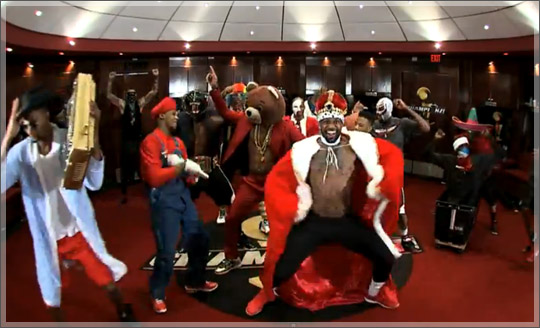
miami heat harlem shake

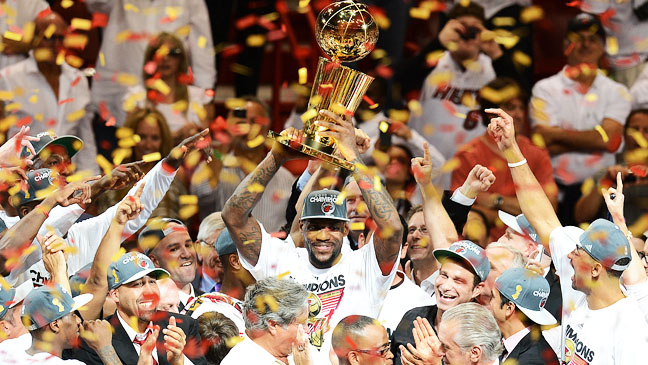
The Miami Heat find themselves at 32-12, two and a half games behind the Indiana Pacers for the top seed in the Eastern Conference. They, of course, are the winners of the last two NBA championship and feature the winner of the last 4 of 5 MVP awards, Lebron James. Many have said that the Heat are currently coasting and not necessarily playing their best ball. I honestly don’t blame Miami, though. They’ve played in the last 3 NBA Finals, so their extended schedule may feel like they’ve played 4 seaons in 3 years. Add to that the fact that the major players on the team also participated in the Olympics during that span, and you can see why they might be coasting a bit this season. Regardless of coasting, the Heat are still in the top 10 in points scored and points allowed. Their Achilles heel may be rebounding where they rank dead last in the league. The Heat are led by their big 3 of James, Chris Bosh, and Dwayne Wade. All three are performing at high levels with Wade having to implement a resting plan due to knee issues. Their offense depends greatly on dribble penetration and 3-point shooting. The Heat are in the top half of the league in made 3-pointers (8.1 makes/game), and make them at a high clip (37.4%, good for 7th in the league). James and Wade are usually the dribble penetrators who dish out to a bevy of shooters in Ray Allen, Shane Battier, and Mario Chalmers. The bench is veteran-laden and can be dangerous at times, with Norris Cole, Michael Beasley, and Chris Andersen providing the relief.

Probable Starting Line-ups

Miami Heat

  • PG – Mario Chalmers
  • SG – Dwayne Wade
  • SF – Lebron James
  • PF – Shane Battier
  • C – Chris Bosh

Oklahoma City Thunder

  • PG – Reggie Jackson
  • SG – Thabo Sefolosha
  • SF – Kevin Durant
  • PF – Serge Ibaka
  • C – Kendrick Perkins

3 Keys to the Game

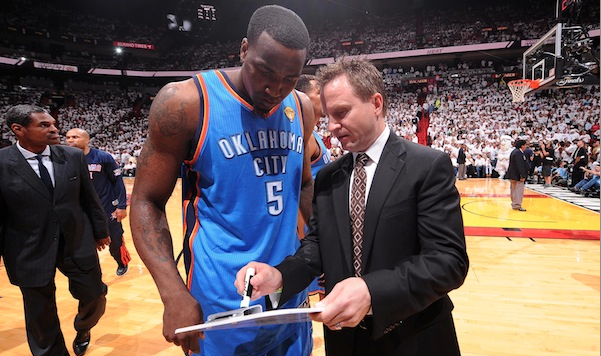
1. Scott Brooks – Will he adjust his line-up accordingly to combat Miami’s use of space or will he stubbornly stick with the line-up he’s always used? That will be the question heading into the game. I have no doubt that Brooks will adjust his line-up throughout the game after the first 6 minutes of the 1st quarter and the first 6 minutes of the 3rd quarter. But, the starting unit has had its issues with the Heat coming out of the gate. In the past six games against the Heat, the Thunder have yielded 31 points to the Heat in the time it takes from Perkins to be substituted out of the game. That’s an average of over 5 points that the team has to continuously claw their way back from early on. That’s takes a toll on a team heading into the final quarter.
perkins brooks thunder

And let me reiterate…I’m not putting this on Perkins. He is great against traditional post players and that may come into play if the Heat begin to use Greg Oden more often. But putting Perk on Bosh is just a bad match up and causes the defense to over correct and compensate for defensive lapses leading to open threes and blown coverages.

2. Picking your poison defensively – The Heat are going to do one of two things: either drive the basketball or dish it out for a perimeter shot. James and Wade are great at getting into the lane and sucking in the defense. Once in the lane, their options open up like a Golden Corral buffet. They are extremely adept at finishing (even with contact) or they can pass it out to one of their 3-point shooter or to Bosh for the mid-range shot.

The key is to try to stay in front of James. Kevin Durant is the best defender against James as his length bothers him, but that sometimes means that you are exposing KD to foul trouble. To combat this, the Thunder will shuffle defenders against Lebron, sending Sefolosha, Ibaka, or maybe even Perry Jones to guard James in order to ease the load on Durant.

When the ball is kicked out, the Thunder need to hustle back to the 3-point line and use their long wingspans to their advantage. This is where it may be advantageous to have Jackson on the floor due to his wingspan.

3. MVP – Will the MVP race be decided today? Probably not. It is currently Durant’s to lose. But if James defeats Durant, the national narrative will probably begin to change in favor of James. The stats mean nothing if your team is constantly losing to the team the competitor is on. If Durant truly is tired of coming in 2nd, tonight will go a long way to changing that narrative.
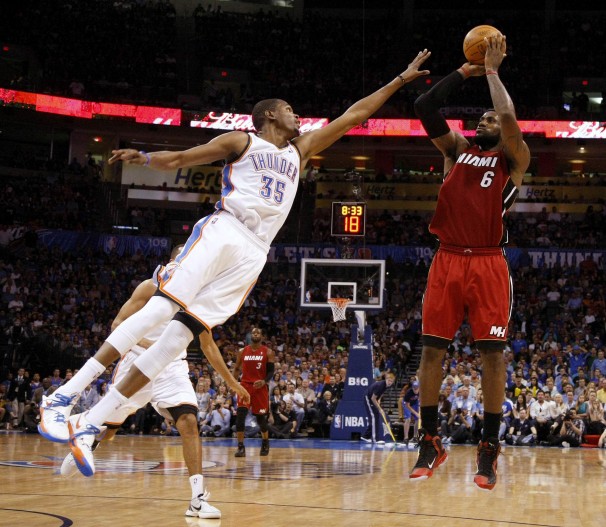
durant james thunder heat

(Bonus) 4. Getting the gorilla off the Thunder’s back – Even though it doesn’t count until June, the Thunder need to exorcise some demons in regards to their futility against the Heat. Regardless of whether the Thunder are missing their second best player or not, they’ve been playing in a fashion that if they do lose this game, it will still be a disappointment. For the psyche of the team moving forward, they have to win one of these next two games against Miami.

Hasheem Thabeet:ReHashing a Journey

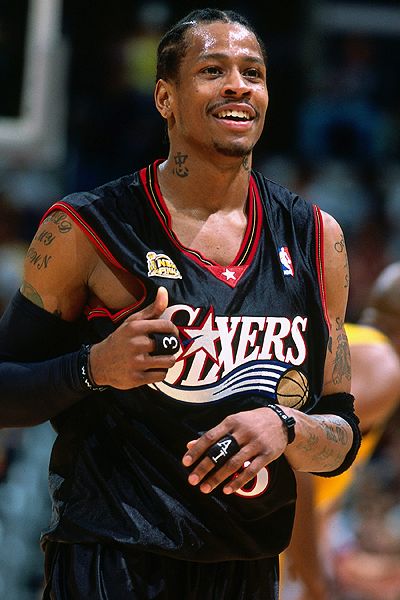
How exactly do you measure a man’s worth? Is it by his successes? If so, everyone looks great when they are succeeding. But, it’s what happens whenever a person has tasted success, fails, and then gets back up that shows the true character of that man. Some people aren’t able to come back once they have failed. Allen Iverson could have been a great redemption story. Here was a man who had tasted nothing but success since coming into the league. A man whose Frank Sinatra-like demeanor (“I did it my way”) garnered him many fans and many enemies, many of whom were in the league’s front office. A man whose ego eventually surpassed his usefulness to the point that NBA teams basically shut him out of the league. His is an example of a person who could not adapt to the slightest bit of failure.

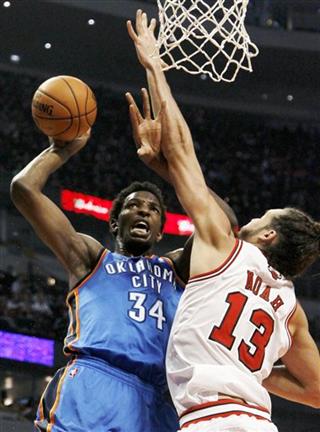
One of the worst things in sports is to be labeled a bust. It is the apex of failure. There are two ways to be labeled a bust: either you were a high draft pick that didn’t live up to your expected potential or you were signed to a big contract that you could never live up to. Once given this label, it’s very difficult for a player to shake it off. Regardless of whether the player is injured or not, fan forgiveness is not usually a word related to the bust label. Just ask Greg Oden. Sometimes, though, a player is either too oblivious or too hard-headed to care about the bust label and continues to truck on.

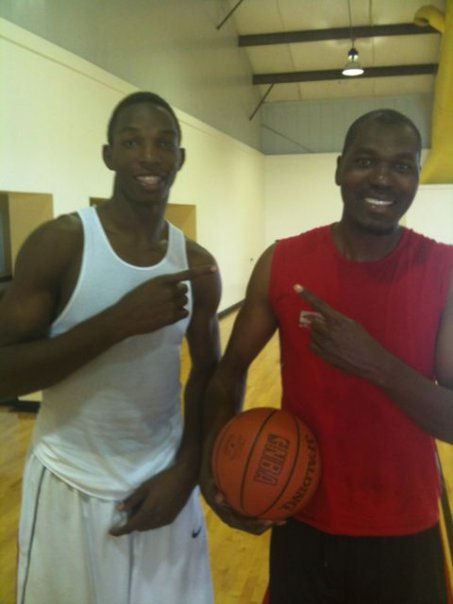
Hasheem Thabeet is one of those players. A player, who by all accounts and purposes, should have just said, “Forget this (alternate words, of course)”, and taken his millions and retired on an island. With all the criticism and embarrassment that was heaped onto him in his first 3 seasons in the league, it would have been easy to walk away with whatever money he had in hand and move on to the next phase of his life. But that just isn’t Thabeet’s style. Here’s a man who, at the age of 14, lost his father to diabetes and decided at that point that he had to become the man of the house. To assert himself into manhood, Thabeet decided to drop his father’s last name of Manka, and instead use his middle name as his last name. Mind you, this was not a move to forget his father or his past. Instead, it was a symbolic gesture towards a new start. One that Thabeet could have never imagined would turn out the way it has.

One of Thabeet’s first decisions as the man of the house was to quit school and get a job. For about a year, Thabeet worked odd jobs as a model and as a bouncer at a club. With his imposing height, he could definitely look the part of a mean bouncer, but Thabeet never took part in the fights. He was too afraid to. His mother eventually convinced him to go back to school to continue his education. It was in this second go-around in school that a coach coaxed him into playing basketball. It was only a matter of time before Thabeet’s tall frame and go-go gadget arms were introduced to the game where those attributes are strengths. At first hesitant, he eventually adapted to the game and began to flourish.

The road to the NBA is not always a linear path. When you think of basketball hotbeds in Africa, you think of countries like Angola, Zaire, and Congo. You definitely don’t think of a country like Tanzania where soccer reigns supreme. Thabeet took the proactive approach and began filling out applications for every university he could find via Google. Eventually, his talents took him to a prep school in Nairobi, Kenya, where French businessman Oliver Noah took notice of Thabeet and asked to send the kid to the US for further prepping. Thabeet’s mother obliged and he was on his way to the USA to attend high school. Of course, not everything went as planned, as it is sometimes difficult to compare African school standards to American school standards. Transcript issues arose, and what should have been one stop in Los Angeles, turned into stops in Picayune, Mississippi and Houston, Texas.

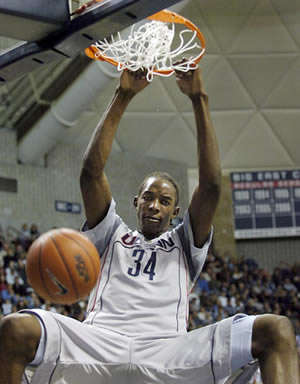
After graduating from Cypress Christian School in Houston, Thabeet made his way to Storrs to attend the University of Connecticut. For the first time in five years, Thabeet finally had some semblance of stability. He could finally be what he really was: a 19 year old freshman. He flourished under Jim Calhoun’s tutelage, becoming a dominant force on the defensive end, while holding his own on the offensive end. Thabeet went on to win 2 consecutive Big East Defensive Player of the Year awards, and shared the Big East Player of the Year award in his junior season with Pittsburgh’s Dejuan Blair.

Needless to say, expectations were definitely high when Thabeet declared for the 2009 NBA Draft. Names like Dikembe Mutombo and Samuel Dalembert were being tossed around as comparisons. The consensus was that Thabeet would be great defensively, but would need time to develop offensively. As is the standard with most big men, Thabeet was considered to be a high risk, high reward project that would need a lot of development.

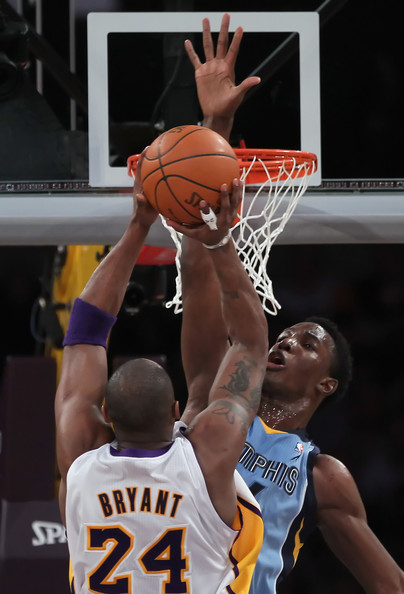
The funny thing about expectations is that it’s a two way street. On one hand you have the player, of whom the results are expected from. On the other hand, you have the basketball mind (usually a front office personnel or scout) that acknowledges that the skills seen in the lower level of basketball will translate to the highest level of basketball. In this case, it was former Memphis Grizzlies GM Chris Wallace who selected the center with the No.2 pick in the draft. Usually, when a team drafts that high, they are looking for an impact player at a position of need. But the Grizzlies already had two young centers that they were developing in Marc Gasol and Hamed Haddadi. The leash was short in Memphis and when Thabeet struggled to adjust to the speed of the game, he was sent to the D-League, earning the dubious record of being the highest draft pick ever sent down.

The next season, Thabeet battled with Haddadi for back up minutes throughout the season. At the trading deadline, Thabeet was traded to Houston Rockets for Shane Battier. In Houston, Thabeet only appeared in 2 games for the Rockets, spending most of the rest of the season in the D-League. In the next season, Hasheem was once again dealt at the trading deadline, this time to the Portland Trailblazers. At the end of the season, the Blazers chose not to pick up Thabeet’s 4th year rookie option, and the center became an unrestricted free agent.

There had been rumors that Oklahoma City Thunder GM Sam Presti was very intrigued with the possibility of drafting Thabeet with the No.3 pick in the 2009 draft. As we know, that opportunity never materialized and the Thunder selected James Harden, instead. There were also rumors that Presti had tried to pull off a couple trading deadline deals to obtain Thabeet, but those, again, never materialized. So when Thabeet became an unrestricted free agent this past offseason, Presti pounced on the opportunity to sign the center for the league minimum.

Brimming with a confidence not seen since his UConn days, Thabeet is flourishing in his role as the Thunder’s back-up center. No longer burdened by his draft position, Thabeet is going out there and playing the role that he has earned. Though his numbers aren’t that gaudy through 8 games, you can tell Hasheem has learned a lot about the game in these last 3 seasons and is only now starting to put it all together. He is no longer needed to save a franchise. Instead, he can be part of a team and contribute

Not unlike a young quarterback who has struggled through numerous coaching and system changes, Thabeet was never allowed to develop in one system for any amount of time. Instead, he has been shuffled from one team to another in his first 3 seasons and never was able to develop his game or his confidence. His move to OKC probably feels like his move to Storrs, Connecticut seven years ago. A sense of stability is coming and Thabeet is just now scratching the surface of his potential. On this team, he doesn’t need to be Dikembe Mutombo or Hakeem Olajuwon. He just needs to be Hasheem.

What offseason? Basketball Never Stops!

As a fan of the game, I’ll watch any basketball game you have on the television, especially playoff games. But there’s a slight disconnect when your team is not involved. It’s not as emotionally taxing. With that said, I’ve never enjoyed basketball as a connected fan all the way into mid-June. Though I’m disappointed that we lost in the Finals, its fun to look at the calendar and know that in 3 months, training camps should begin to open up. I’ve forgotten what it feels like for the season to be over in mid-April. But this all leads us to the offseason. Time to rest and recover from the grind of the season. Oh, I forgot we have the draft coming up. And then we have Summer League. And all the offseason moves and transactions. All the while, we have the national team gearing up to defend its gold medal in this summer’s Olympics. What the hell does the off in offseason mean?

There’s a saying that the NBA season is a marathon, not a sprint. The things that happen after the All Star break, such as trades and the signing of recently released players, can have a big impact on the rest of the season and the postseason. The Thunder have been the beneficiary of both of these player transaction moves in the past two season. Two seasons ago, at the trading deadline, the Thunder traded Jeff Green and Nenad Krstic to the Boston Celtics for starting center Kendrick Perkins and ultimate cheerleader Nate Robinson. Then, last season, they signed point guard Derek Fisher off waivers after he was released from the Houston Rockets. Due to the team’s stability, the Thunder usually remain pretty quiet during the offseason, though.

2012 NBA Draft

This offseason, though, the moves have been quiet, but plentiful. Heading into the draft, the Thunder’s only draft pick was the 28th pick in the first round. When you are picking this late in the draft, this usually means your team already has the necessary players to succeed. For a team as set as the Thunder, there wasn’t an immediate need that any player chosen this late was going to provide. One of the biggest needs the Thunder had was a big that was agile enough to defend other athletic bigs while being able to score from the outside and inside. Players with this skill set don’t usually last this long in the draft. The thinking was that the team would draft either an athletic wing or an overseas player that would be stashed in Europe for a couple of seasons.

Sometimes, though, the stars and planets align, and a player you were needing all along falls into your lap. There was always concern about Perry Jones III’s work ethic. The word ‘motor’ usually came up when his draft status was discussed. But, no one could deny the potential he had. The description of a 6’11” athletic forward that could score from outside and inside is the type of player that usually has teams salivating for his services. But a day before the draft, they were reports that many teams were concerned with the condition of his knees. After the recent knee concerns of Greg Oden and Blake Griffin proved to be true, not many teams were willing to spend a lottery pick on a player whose work ethic AND knees were called into question. Surprisingly though, 11 other teams outside of the lottery chose to pass on Jones III also. So when the Thunder’s name came up, Thunder general manager Sam Presti never hesitated, and went with the best player available, which coincidentally also filled a need. The best thing about it, though, is that it comes at an extremely cheap price.

Orlando Summer League

After the draft, the focus turned to the Orlando Summer League, where the Thunder were participating with 7 other NBA teams. As I wrote previously, the Summer League is full of good young players, Fringers, and Dreamers. Some of the players are already guaranteed a spot on an NBA roster and just want to mix in some team-oriented scrimmages and practices during the offseason. Most of the players though, are clawing and scratching for an opportunity to get onto an NBA roster. The Thunder’s roster consisted of 4 guys that, barring a trade, will be on the Thunder’s opening day roster (Perry Jones III, Reggie Jackson, Lazar Hayward, and Cole Aldrich). The rest of the players were probably not going to make it onto the Thunder’s roster, but could make an impression on another team depending on how they played.

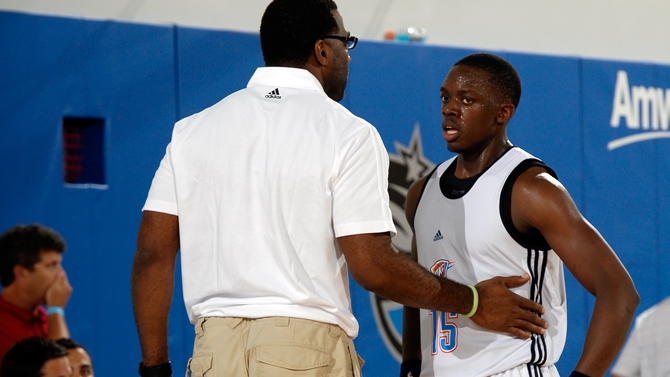
The Thunder finished the Orlando Summer League 3-2. Reggie Jackson played like the most seasoned guy on the team controlling the tempo of the offense and attacking the basket at will. He even gave 2012 NBA Dunk champ Jeremy Evans a taste of his own medicine. Lazar Hayward showed why he’ll be at the end of an NBA bench for the next couple of years. He does a lot of things good, but nothing great. Cole Aldrich’s play was mediocre, at best. For a player that is looking to step up and be the back up center, his lack of improvement was a bit alarming. But, I would ask people to please step off the ledge when it comes to Aldrich’s development. Summer league games are made for wing players. They are glorified street games with refs and NBA assistant coaches on the sidelines. Aldrich will be asked to defend the paint, set picks, and put up a couple hook shots in the regular season. He will be fine. Perry Jones III suffered a sprained ankle in the 2nd half of the 2nd game, but not before impressing with his array of inside/outside skills. He will be in the Thunder’s regular rotation, if not in the 2nd half of this season, then definitely in the 2013-14 season. Other notables were forward Latavious Williams, who needs to be on an NBA roster somewhere, and Garrett Temple, whose play was almost veteran-like.

Off-season Moves

The Thunder has never been a big player in free-agency in their time in Oklahoma City. But in reality, they’ve never had to be a big player. Their main focus has always been on player development. When you have players like Kevin Durant, Russell Westbrook, James Harden, and Serge Ibaka, that’s what you put most of your focus on. That came to fruition in the last two seasons with consecutive trips to the Western Conference Finals and a trip to the NBA Finals this past season. The Thunder had 3 players that were coming up on free agency and all of them were veterans. Nazr Mohammed, Derek Fisher, and Royal Ivey could have all been signed to cheap veteran deals. But due to their years of employment in the league, even their minimum salaries would have been upwards of $1.5 million. The Thunder chose instead to let those vets walk, and focus on cheaper, younger alternatives. With Perry Jones III signing his rookie contract, that left 2 more spots on the roster.

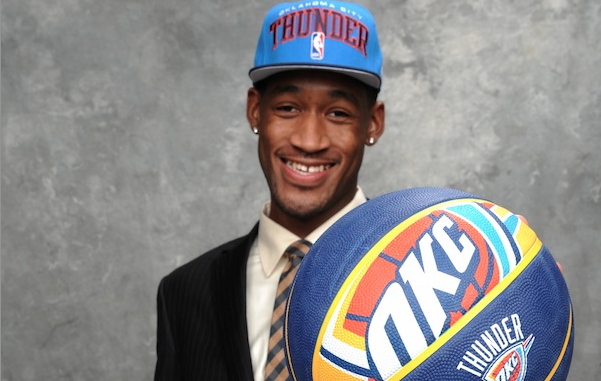
The Thunder signed much maligned center Hasheem Thabeet to a 2-year veteran minimum contract. Now the difference between Thabeet’s veteran minimum deal and any of the other 3 Thunder players that were up for an extension, is that Thabeet has only been in the league for 3 seasons. For the final roster spot, the Thunder signed undrafted free agent Hollis Thompson from Georgetown to a 3 year contract. Thompson is a sharp-shooter in the Thunder mold (tall and long) that could be a cheap replacement for Daequan Cook in upcoming seasons.

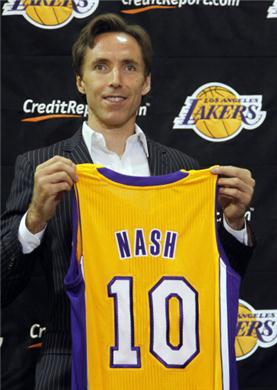
The two signings sent Thunder nation into a tizzy, and not for good reasons. Most were questioning the “lackluster” moves by the team, while the team that beat us in the Finals picked up former All-Stars Ray Allen and Rashard Lewis, and one of our biggest threats in the West, the Lakers, picked up a former 2-time MVP (Steve Nash) in their biggest position of weakness (point guard) without giving up a single player. The thinking was that the curse of the small market team was starting to take hold of the Thunder. That the ideology that small market teams can’t attract free agents and can’t spend money like the big boys was starting to rear its ugly head.

I, for one, completely disagree with that thinking. While it would be nice to sign former All-Stars ad-nauseam every offseason, the reality is that that would be bad business in this new NBA. The goal is to try and keep cost down while maintaining a competitive team. If your team does spend into the luxury tax territory, it better be winning. The Thunder have the right components in place to continue winning. The moves they made this offseason were made to keep those components in place. When you start talking about the luxury tax, every dollar counts. And if the Thunder are truly looking to keep both James Harden and Serge Ibaka on the same team as Durant and Westbrook, they are going to have to continue making these cost effective moves. Both Harden and Ibaka will demand deals that get them at least $10+ million per season. And, rightfully so. We’ll be in the luxury tax no matter what, if we keep these 4 players. The payments get more feasible, though, if you are competing for and winning championships.

Another thing that these signings do is maintain the flexibility that Presti loves. These signings not only have low cost-high reward potential, but they are also short term deals. That way, the team isn’t saddled with long-term contracts if the player, in question, either gets injured or doesn’t produce. Also, if someone better comes along, you could cut your losses with the player and attempt to obtain the better option. Cap flexibility is a commodity in the NBA, and Presti is one of the best at maintaining it.

Team USA

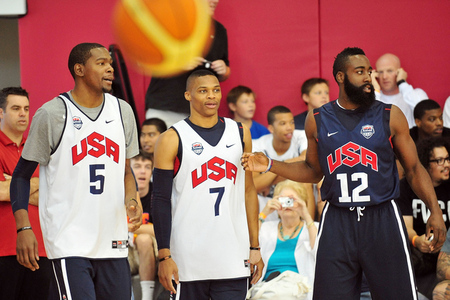
As if this offseason hasn’t been crazy enough, you have Team USA preparing for the Olympics in London. Not only that, but the Thunder has 4 representatives in the Olympics (Kevin Durant, Russell Westbrook, and James Harden for Team USA, and Serge Ibaka for Spain). Durant and Westbrook were near locks to make the team, but Harden was actually a surprise addition after players like Dwayne Wade and Derrick Rose bowed out because of injury. The team torched the Dominican Republic and eeked out a victory against a tough Brazil squad in the US leg of pre-tournament games. After this, it’s across the pond for a couple friendlies and then the real thing. Durant has a possibility of leading the team in scoring, while Westbrook will be the defensive pitbull/offensive sparkplug off the bench. Harden will probably play a role similar to what he does with the Thunder, but to a smaller degree.

As a fan of the game, I love this. Before NBA-TV, the offseason was usually a time to hear about a trade or two, and wait for football season to start. So, even though, this has been a whirlwind offseason, I still appreciate it. When this offseason gets too crazy, I always hark back to the 2011 offseason. Oh, you don’t remember the 2011 offseason? Oh, thats right, because there wasn’t an offseason that year.

The Evolution of Daequan Cook

In a season where you have the best record in the league after 25 games, a lot of things have to go right as far as player development is concerned. Your young guys have to keep developing, while the veterans have to either add new wrinkles to their games or maintain the status quo from the previous season. While a big part of our success this season is due to the continued development of our young core (Kevin Durant, Russell Westbrook, James Harden, and Serge Ibaka), one of the biggest developments this season has been the evolution of Daequan Cook.

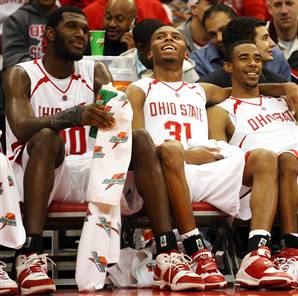
Mind you, Cook has always been a talented player. Though he was overshadowed for most of his high school career by OJ Mayo in Ohio, he was still considered a great player in his own right, and was a highly touted prospect that landed in Ohio State’s vaunted 2006 recruiting class, which also included Greg Oden and Mike Conley. For his one and only college season, he averaged just under 10 points per game as the Buckeye’s main outside threat on a team that made it all the way to the national championship game.

Coming off his freshman season, many thought Cook needed another year of seasoning at the college level to continue building his game. Instead, he chose to go the NBA route with his freshman brethren Conley and Oden. Here are some of the online scouting reports that were written about Cook:

Matthew Mauer of www.thedraftreview.com wrote:

“Unlike many young players he possesses an excellent mid-range game. Moves well without the ball, and understands how to fully utilize the entire floor to get his shot off. Has an NBA ready body that has shown development from his senior year of high school. Explosive scorer who can reel off big points in a hurry…Possesses legit three point range on his jumper. Unselfish and shows solid court vision to get teammates involved in the offense. Is a good athlete who contributes on the boards nightly. Has the ball handling ability and quick first step to break his man down on drives. Excellent finisher in transition and can end plays in dramatic fashion. Has a tremendous amount of confidence in his ability, rarely does he get rattled by the moment. Has all the physical gifts needed to emerge as a defensive presence…Defensively Cook has a habit of gambling too much and being impatient This exposes him to pick up quick fouls by reaching in or defending his man too aggressively”

Joseph Treutlein of www.draftexpress.com wrote:

“Cook already can score the ball at an NBA level, and with the trend towards undersized shooting guards of late, he has a very good chance to make significant contributions for a team in his future. The most notable thing about his scoring ability is how he can hit a shot with a hand in his face and how he’s so strong and able to hit shots nearly effortlessly from long range, as easy as he does from 10-15 feet out…In terms of things Cook brings to the table other than scoring, he’s not really going to wow you in any other area just yet…Cook did a solid job on the defensive end, but at 6’4, he’ll be at a bit of a disadvantage at the next level, even with his good physical tools.”

From the scouting reports, it appeared that Cook was going to be a good offensive player with the ability to develop other facets of his game (i.e. defense and playmaking).

After being chosen with the 21st pick in the 2007 NBA draft by the Philadelphia 76ers, and then promptly traded to the Miami Heat, Cook showed great promise in his rookie season. He averaged 8.8 points on 33% shooting from the 3 point line, but gave little else in the form of rebounds, playmaking, or defense. In his second season, he increased his scoring average to 9.1 points per game, but saw a decrease in every other major category.  On a positive note, though, he won the 3-point shooting contest at the All-Star game. In his 3rd season, nagging injuries and a falling out of favor with his coach led to Daequan playing in the least amount of games in his professional career and saw his scoring average dip to 5 points per game. After being an integral member of the Heat’s young core, Daequan’s position on the team could best be summed up by blogger Albert Random of www.heathoops.com :

Daequan Cook: No surprise here. He’s playing at a D-League level yet he’s set to make $2.2 million next season, after Riley inexplicably picked up his option. He is shooting 29% from the field, and 29% from beyond the arc. Need I say more? The hope is that he turns things around, because he will be on the Heat roster in 2010/11. Grade: F” 

With the impending free-agent frenzy of the summer of 2010, the Heat positioned themselves into being able to offer 3 max contracts to the likes of Dwayne Wade, Lebron James, Carlos Boozer, Amare Stoudemire, or Chris Bosh. In one of their final cost cutting moves, they traded Daequan Cook and their No. 18 pick to Oklahoma City for the Thunder’s second round pick (No.32).

Daequan was allotted a new start on a young, up and coming team. Not too different from the situation he was in while playing for Miami. He came in as a necessary sharp shooter, but had to find his spot in the rotation on a playoff team that returned its entire rotational roster from the previous season. Daequan was kind of force-fed into the rotation in the first 8 games of the season, and the results looked a lot like the 2nd half of the previous season with Miami. He struggled, averaging 1.9 points per game while shooting just 19% from the 3-point line. But the coup de grace was in what else he provided…which was basically nothing. He gave the Thunder 5 boards, 3 assists, and 2 steals TOTAL in those 8 games. Not to mention he had a -7 differential in those early season games.

Scott Brooks did what any good coach with a struggling young player would do. He sat him down and told him to earn his spot in the rotation through his performance and effort in practice. In coachspeak, that basically means, “Everyone struggles offensively in the NBA at some point. It’s what you can provide other than the scoring that can keep you on the floor.” If you are a one trick pony who isn’t performing your one trick, while giving little else, the NBA machine will chew you up and spit you out pretty quickly. Some players crumble under this pressure and are never to be heard from again in NBA circles.

Daequan decided to put in work. He could’ve cried and complained to his agent that he wanted out of Oklahoma City. Instead, he sat for 36 of the next 37 games honing his craft in practice and adapting to the Thunder way. Daequan had always been a good offensive player with the “potential” to become a good all-around player. When he finally got his opportunity to perform in late December, he relished that opportunity and played with effort every night. He notched a couple double-digit scoring games and became an integral part of the rotation as a sharp-shooter and floor spacer. But the important thing was that he was invested on the defensive side of the floor and gave effort in the other facets of the game (rebounding, making smart plays). Did he have overly impressive numbers? No, but he impressed with his effort as the season played out.

In the offseason, Daequan re-upped with the Thunder for 2 years. His role on the team would remain the same, but, hopefully, without the whole transition period. He has not disappointed in this early season run, providing 3 point shooting at a 41% clip, while being solid defensively and a great help on the defensive glass. In the past 5 games, he has started for the injured Thabo Sefolosha, and has averaged 9.2 points, 4 rebounds, and 1.2 blocks on 46% shooting from the 3-point line. This has provided a stop-gap to keep James Harden on the bench where he is much more effective coming in with the second unit. The Thunder are 4-1 in these past 5 games.

 Every championship team has a guy or two like this; specialists that perform a specific job. It necessitates that a role player perform one act greatly. Usually that is all the player is asked to do. But if that one player can also provide other things to the team other than his skill, then he becomes an invaluable asset. And that is what Daequan Cook has become to the Thunder. “All Dae, Er’r Dae!”

The Future Economics of the Lockout

When the owners first started complaining, we were in the beginning of a recession. You started to hear the whispers from the owners that big changes were needed about 3 seasons ago. And the players actually played along with that and actually stated that, “Yes, in this economy, some concessions would need to be made on their parts.” But, I’m pretty sure, their thinking was that by the time the players and the owners actually had to start negotiating (basically 3 years later) that the economy would have been fixed (or at least recovering) by then.

Fast forward to where we are now, and there are actually rumblings that we are entering an even worser recession. So instead of things improving, economically, they will probably begin to get worse for us fans in terms of disposable income. As an owner, if I see that the same system is being kept in place, and I want to stay competitive and get into or stay in the black, I may have to increase ticket prices. And that’s where this starts to affect me, as a John Q. Public fanatic.

You can talk about smart spending (in terms of a team) all you want. But, if you are completely honest with your self, you’ll know that we (the Thunder) got extremely lucky. Portland and OKC basically had the same formula. Tank for a couple seasons. Trade away horrible contracts for draft picks. Try to get lucky in the draft. We picked KD and Russ. They picked Oden and Roy. A couple knee surgeries later, and we are on the brink of becoming dynastic and Portland is on the brink of becoming one of those middle of the road teams (good enough to lose in the first round, but not bad enough to get a significant draft pick).

My question is, should Portland fans have to pay for the bad luck that has been bestowed on their team. Fans eventually tire of middle of the road teams. Once that happens, then those season ticket numbers start to decrease. Once that happens, an owner may be forced to increase ticket prices to meet his/her bottom line. Remember, this could have been OKC’s fate in some alternate universe.

Are you willing to continue paying (paying more) for a system that is broken? Do you know how much quicker Portland could bounce back, if they could’ve either cut Roy/Oden or restructured their deals? And remember, I’m not asking this because I necessarily want to see Portland become elite. I’m asking this because it could easily happen to OKC. As a small market team, you need to ride the highs for as long as possible and stay out of the middle to the lows for as long as possible. In this current system, a tweak of a knee here or a tweak of a back there, and we may be in the same boat.

Oh, and here’s one more thing about this recession talk. Its affecting the whole world, especially Europe. And that’s where it becomes bad for the players. There’s no other league in the world that can offer what the NBA offers. There are rumors that Kobe is looking to sign in Italy for $6.5 million. Do you know how much Kobe made last season? $25 million. And if you sign in China, you have to stay there for the entire season. So, while the “we can play and get paid overseas” thing sounded like a game-changer for the players, its actually enhancing the owners’ position.

So while I may love the NBA and may miss the game if some of the season is missed, I want a deal that keeps ticket prices as low as possible. I haven’t gotten a raise in 3 years at my job. If, for any reason, the owners were forced to hike up ticket prices in the near future, I’m screwed. If the owners and players were really progressive thinkers, they would sign a deal that tilts in the owners’ favor for the first half of the deal, and then tilts back in favor of the players towards the back end of the deal, with the option to revisit the results in the middle of the deal.