Tag Archives: Dwayne Wade

5 for 5: The Rivalries

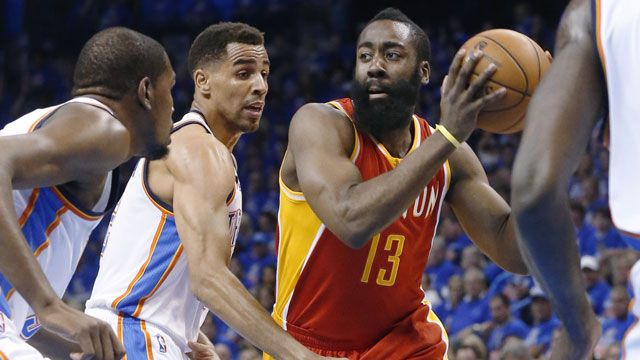
harden sefolosha durant thunder rockets

5 for 5: The Longest Shortest Season  |  5 for 5: Tragedies, Courtrooms, and Beginnings  |  5 for 5: The Run  |  5 for 5: The Thunder’s Godfather

This past season, the Oklahoma City Thunder completed their 5th season in the state of Oklahoma. In a world dominated by round numbers, getting to the midway point is always a cause for celebration. In any relationship, you look back at key moments that made it possible to arrive at certain anniversary marks. In the next few weeks heading into training camp, I’ll be looking at 5 defining moments that made it possible for the Thunder to not only roar into the Plains, but also to do it in winning fashion.

For the third part in this series, I wanted to focus on the rivalries. Sports are only as good as the competition they incite. Playing driveway basketball against your kids when they are 5 years of age can quickly get boring (although palming misdirected shots in midair like you’re Serge Ibaka can be entertaining for at least an hour or so). But, try playing your kids when they are 18 years old and have had 12 years of playing experience. Then it becomes an entirely different ballgame.

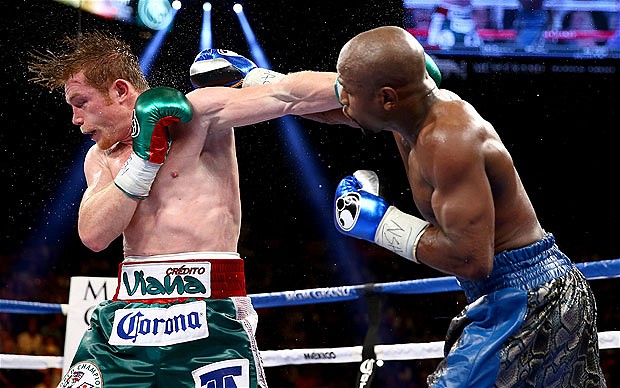
When it comes to competition, I’ve always looked at the career of Floyd Mayweather Jr. with a sliver of disappointment. That he’s a great boxer with arguably the best defense in the history of boxing is without question. The issue that I’ve had with his career has been the level of competition of his opponents. Now, I’m not saying that falls squarely on Mayweather. The guys in his weight classes have not been particularly consistent in the past decade. He’s also “luckily” scheduled the right fights at the right times, choosing to fight boxers that were either on the downward slide of their career (Oscar De La Hoya and Shane Mosley) or fighters that were too inexperienced to compete with him at the time of their fight (Canelo Alvarez and Victor Ortiz). He’s never had that one opponent that defined him. Mike Tyson had Evander Holyfield. Arturo Gatti had Mickey Ward. Mayweather has…… (and therein lies the problem with his career).

mayweather alvarez boxing

If fans are the life blood of sports, then rivalries are the engines that keep them running.  You naturally root against your opponent because they are competing against you and you want to win. Pretty simple concept. But if you add something more to that competitive fire, it can act like an accelerant, creating an even bigger blaze. Rivalries, and the differing reasons for them, can be that spark. When it comes to the Thunder, I’ve categorized their rivals under 4 different categories.

1. Regional Foes

Geography and competition are probably the easiest ways to breed a rivalry. Whether it’s an intracity game between two high schools or a game between professional sports teams 200 miles apart, that desire to be superior to those closest to you is an innate characteristic of the human psyche. Even if the two teams aren’t on equal footing at the time of the game, the rivalry aspect of the game often lends it to be a close affair. Continue reading 5 for 5: The Rivalries

Trains of Thought: Thunder and the 2013 Draft

NBA: NBA Draft

Approaching a draft, there are always differing trains of thought as to whom a team should choose. A team has to analyze what their needs are and if they can realistically draft a player that will fill said need(s). This is especially true if you are holding one of the lottery picks. Teams picking in these first 14 slots usually have a plethora of needs to address. But for a championship contending team like the Oklahoma City Thunder, who have many of the necessary cogs already in place, a pick in the lottery can be the final piece of the puzzle to get the team over the hump. 

darko

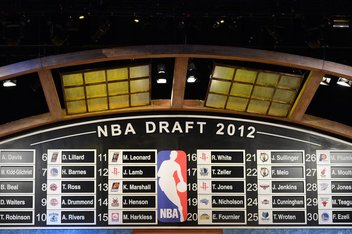
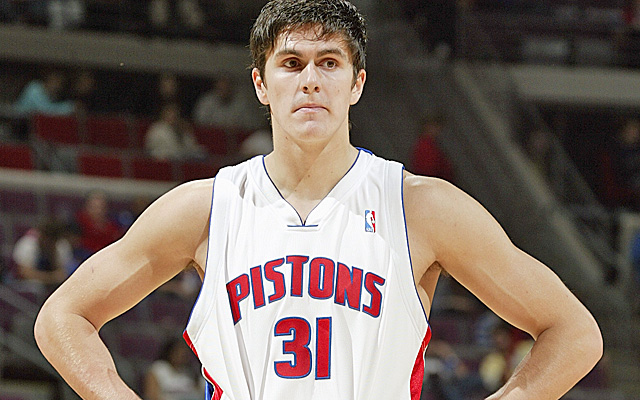
Drafting a final piece is not always guaranteed to get a team over the hump, though. In the summer of 2003, the Detroit Pistons had just come off a trip to the Eastern Conference Finals and also held the No. 2 pick in the upcoming draft, which was loaded at the top. Easy pickings, right? Get the 2nd best player available and you should be set for the next 5 years. But success and good fortune can sometimes make you think you are smarter than you really are. In a draft where the Pistons could have chosen any of Carmelo Anthony, Dwayne Wade, or Chris Bosh, they instead decided to go with the experimental Euro-project named Darko Milicic. Even though the Pistons won the championship the next season, it had nothing to do with Milicic, who was famously tagged as the “human victory cigar” due to the bulk of his playing time coming at the end of blowout victories. The Pistons went on to lose in the NBA Finals in the next season and played in 3 consecutive Eastern Conference Finals after that. Add that up, and in a 6 year span, the Pistons played in 6 consecutive ECFs, went to the Finals twice, and won one championship. Nothing is guaranteed, but I think the number of championships would have increased if the Pistons had drafted one of the other players mentioned above. 

Granted, this draft is not as loaded as the 2003 draft was. But the Thunder find themselves in a position to draft a position of need, instead of having to pay for it through free agency or trade for it. There are probably two trains of thought for what type of the player the Thunder should draft with the 12th pick: either a defensive minded big man capable of developing some semblance of an offensive game or a scoring wing adept at making perimeter shots. In other words, either a replacement for Kendrick Perkins or a replacement for James Harden. The big man pick is more targeted towards future success, while the perimeter wing would be for more immediate results.

pacers

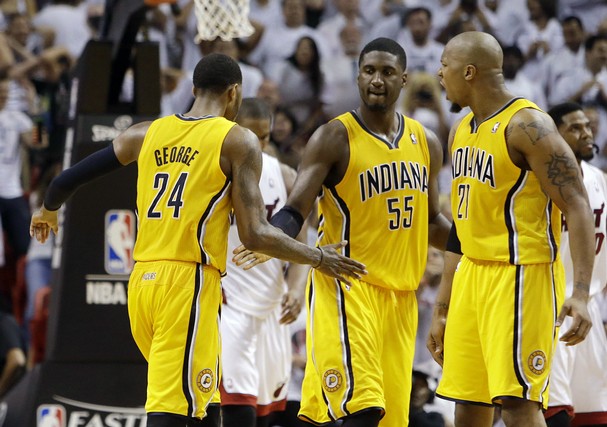
The conference finals and NBA Finals have given the Thunder a blueprint as to what they need for sustained success. In the Eastern Conference Finals, the Indiana Pacers showed what two competent big men can do against the Miami Heat. David West and Roy Hibbert gobbled up offensive rebounds and scored in the paint, almost at will. In the Finals, the San Antonio Spurs have shown that playing the same brand of basketball as the Heat (dribble penetration and 3-point shooting) can befuddle and frustrate them, especially if the opponent is hitting 3-pointers at a 45% clip.

Train of Thought No. 1 – Big Man

perk ii

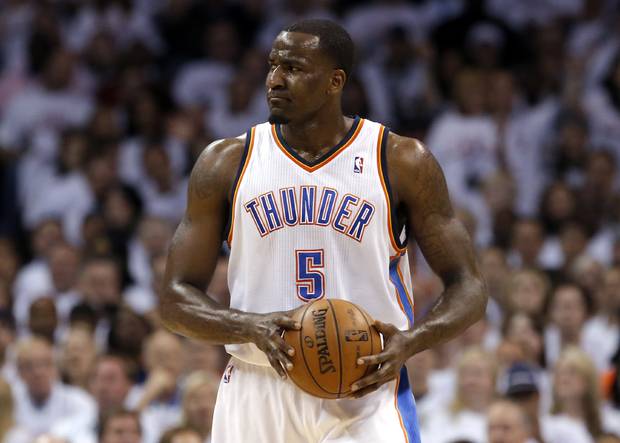
Everybody knows I love crazy uncle Perk (Kendrick Perkins). For a person who grew up on 90’s basketball, Perkins’ style of play harks back to that physical era. But, truth be told, he laid a complete goose egg in the playoffs this season. He surprisingly had a better run last post season when he played with a torn groin and a torn ligament in his wrist. That Perkins has no semblance of an offensive game is a known fact. But that is usually masked by constant attacking nature of Kevin Durant and Russell Westbrook. When Westbrook went out with his knee injury in the first round of the playoffs, that lack of an offensive game led to the further stagnation of an offense that was already compromised. It wasn’t just that Perkins couldn’t get the ball in the basket, it’s that he was a walking turnover. He had a negative PER in the playoffs and was a liability not just on the offensive end, but also on the defensive end. I didn’t even know negative PERs existed.

Needless to say, with 2 seasons left on Perkins’ contract, it may be time to start looking for his replacement sooner rather than later. Picking up a big man at this slot would be a pick for the future, as big men generally take longer to develop and no post player in this draft has that “ready to play now” look to them.

Before deciding what type of big man could be drafted, it’s important to see what is already in the cupboard. Besides Perkins, the other starter is Serge Ibaka, one of the most versatile power forwards in the NBA. In addition to leading the league in blocks for the 2nd consecutive season, Ibaka also has a deadly midrange game that occasionally stretches out to the 3-point line. His next stage of development should be to learn a post move or two. Off the bench, Nick Collison is a heady post player who plays good defense, can score inside, and can occasionally hit a midrange jumper. The only negative with Collison is that he is getting long in the tooth and starting to show signs of that. Hasheem Thabeet is an average center who is just now learning how to contribute 10-12 solid minutes per game. Perry Jones III is still in the initial stages of his development, but has the physical tools to become a solid contributor. And Daniel Orton is probably the odd man out in the game of big man roulette.

adams noel

Any post player selected will be drafted with the intent to eventually be the starting center. The Thunder tried that 3 seasons ago with Cole Aldrich, but he never panned out. If the Thunder’s system remains similar for the next 3-5 seasons, a player with Perkins’ toughness and defensive chops, but better offensive potential would probably be the selection. Players that fall in that category would be Alex Len, Steven Adams, Mason Plumlee, and Gorgui Dieng. If the Thunder decides to go for an offensive-minded big man, look for them to select Kelly Olynyk or Cody Zeller.

Train of Thought No. 2 – Perimeter Wing

harden

The Thunder have a little more flexibility here than with the center position. When the Thunder made the trade with Houston, they not only traded Harden, but also Daequan Cook. These floor spacers are very important when the bulk of your offense is dependent on two perimeter oriented players. The drive and dish becomes a lot more driving into defensive walls if the dishees aren’t reliable 3-point shooters, especially in the playoffs.

Seeing as the NBA is becoming more of a drive and dish league, having penetrators and 3-point shooters is tantamount to a team’s success. It used to be that if you had a great big man, you were almost guaranteed a deep playoff run. That began to change with the elimination of hand checking. Once that happened, it unshackled quick wing players to have a more prominent role in the offense. No longer were defenders able to keep quicker players at an arm’s length, thus eliminating their speed advantage. Now, defenses had to converge on the quicker players, which opened up shooters on the perimeter, especially on the 3-point line. And, as any kindergartener will tell you, 3 is more than 2 any day of the week.

Looking at the Thunder’s inventory when it comes to wing players, the Thunder already have two of the best dribble penetrators in the league, in Durant and Westbrook. Add to that Reggie Jackson, and the team has their fair share of attackers on the offensive end. What’s lacking on the team is the amount of shooters. Thabo Sefolosha has improved his 3-point shooting to the point where he’s effective, but his slow release make him a liability against teams with long defenders. Kevin Martin was, for the most part, an effective perimeter shooter, but his inconsistency and disappearing act in key games, proved to be a big problem for the Thunder. DeAndre Liggins is on the team for defensive purposes, and Jeremy Lamb was never given a chance to show his shooting chops on the NBA level, though he was very effective in the D-League.

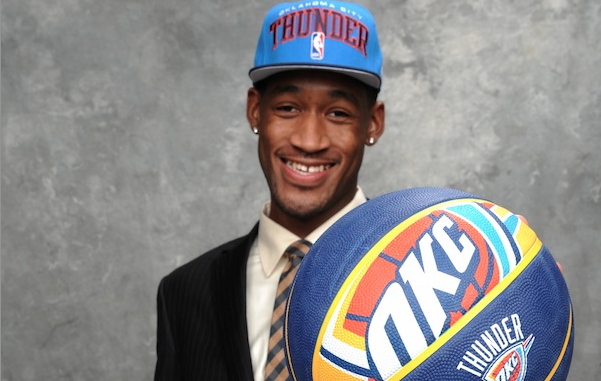
ben-mclemore-dunk

There are two choices for where the team wants to go with this train of thought. One choice is an instant offense type player off the bench. If this is the way the Thunder may be leaning, then look for them to choose CJ McCollum or Shabazz Muhammad. If the Thunder are looking for more of a complete player to eventually take over the shooting guard spot, then the options become Ben McLemore, Victor Oladipo, and Kentavious Caldwell-Pope.

The Thunder will go into draft day with a couple players in mind and counter moves for each situation. In my opinion, the Thunder are extremely high on about 5 players: McLemore, Len, McCollum, Adams, and Oladipo. I think it’ll all be dependent on where the players fall. If McLemore or Len slip down to the 4-6 range, I think the Thunder will throw every possible trade, not involving Durant, Westbrook, or Ibaka, at those teams in that range.

The good thing is that the Thunder have options. Their high 2nd round pick affords them the possibility of obtaining an extra first round pick from a team looking to involve themselves in this year’s free agency. The ability to put a package together with multiple 1st round picks and young players can be very enticing to a team that is rebuilding. Soon enough, it’ll be draft day and Thunder GM Sam Presti will be able to put his plan into play.

The Thunder and the 32nd pick

draft pj 3

The Oklahoma City Thunder hold 3 draft picks in this upcoming draft. They have two in the first round, No.12 and 29, and one in the second round, No. 32.  While people are usually enamored by the first round picks, it’s the early second round picks (No. 31-35) that hold more value to teams. It’s an opportunity to grab first round talent without the constriction of a guaranteed contract. Here’s a list of notable players that have been drafted in the 31-35 range in the last 5 season: Nikola Pekovic, Mario Chalmers, DeAndre Jordan, Kyle Singler, Jeffery Taylor, Jae Crowder, Draymond Green. The difference in talent from the last 5 picks of the first round and the first 5 picks of the second round is infinitesimal.

For teams holding a slot in those first 5 picks of the 2nd round, it is an opportunity not only to draft a talented player, but also to procure a trade for an asset. The fact that a team can take a flyer on a player without having to offer a guaranteed contract, makes these picks more valuable than those in the lower end of the first round. These picks becomes doubly valuable before the beginning of a maddening free agency season. When teams vying for free agents want to clear cap space and/or not take on anymore guaranteed salary, they dump players and first round picks in exchange for high second round picks.

presti

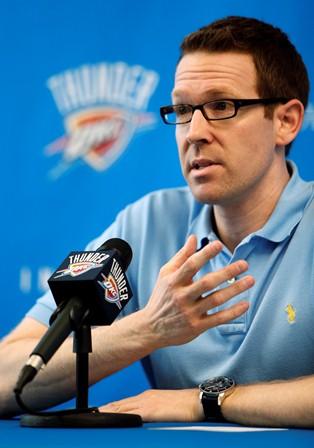
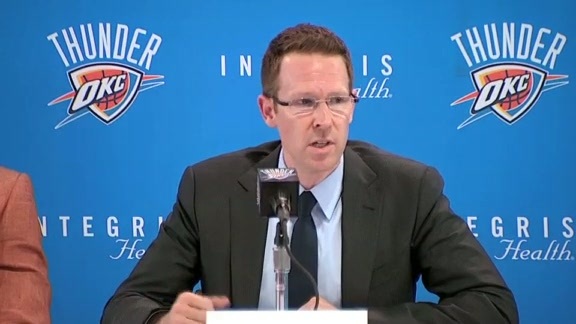
Thunder general manager Sam Presti took advantage of this during the last frenzied free agency class, where he also owned the 32nd pick. We arm-chair GM’s love to talk about the would’ves, could’ves, and should’ves. But we have that beautiful thing called hind-sight in our back pockets. Real NBA GM’s don’t have that advantage, but those few great  GM’s have a little thing called foresight. While we focus on our team in the present tense, great GM’s look at the health of other franchises and plot how they can take advantage of their needs. Presti is great at this and seems to be on the prowl again in this draft.

On July 27th, 2009, the Thunder traded Damien Wilkins and Chucky Atkins to the Minnesota Timberwolves for Etan Thomas and 2 second round picks. Most people thought this was just one of those offseason trades where a team trades 2 bench players for another bench player. But the haul in that trade was actually the 2nd round pick that turned into No. 32 in the 2010 NBA draft.

Etan Thomas, Andrew Bynum

The 2010 offseason was known for one thing and one thing only….the summer of Lebron. That was the offseason where most of the bumper crop from the 2003 draft class was coming up on their 2nd extensions, while other players like Amare Stoudemire, Carlos Boozer, and Joe Johnson were also coming up on unrestricted free agency. If you were a team that believed in quick fixes, this was the summer for you. While a handful of teams were trying their hardest to unload as much salary as possible, the other teams were more than willing to take on decent players (salary) and first round picks.

The Thunder had assets galore in the 2010 draft with 3 picks in the first round (18, 21, and 26) and 2 picks in the second round (32 and 51). The consensus with most teams is that you don’t head into training camp with five rookies. So, the Thunder knew they had to wheel and deal to get what they wanted in this draft, which was a defensive minded big man and more assets. Their first move was to trade the 32nd pick to Miami for the 18th pick and Daequan Cook. Miami was looking to cut salary to position themselves for the summer of Lebron. The Thunder knew they couldn’t get what they wanted at 18, so they traded it to the Clippers for a future first rounder. They eventually traded up to the 11th pick where they picked Cole Aldrich. The future first rounder from the Clippers helped to facilitate the trade with the Boston Celtics for Kendrick Perkins at the trading deadline that following season.

benchmob

There are a lot of similarities between this offseason and the 2010 offseason. First off, the top tier in this free agency class includes some franchise players, such as Chris Paul, Dwight Howard, Andrew Bynum, and Josh Smith. Secondly, these free agents are available and willing to hear out every offer on the table. Thirdly, there are team already vying to dump salary and 1st round draft picks to clear cap space. And, fourthly, the Thunder have the 32nd pick.

The story behind the 32nd pick is akin to the story of Hebrews wandering in the desert for 40 years in the book of Exodus. A little bit of controversy, a little bit of disobedience, and finally back to where it ultimately needed to be. On December 19, 2011, the Thunder traded Byron Mullens to the Charlotte Bobcats for their unprotected 2013 2nd round pick. Simple, right? Wrong! When the Thunder traded for Perkins, they sent Nenad Krstic and Jeff Green to Boston along with that Clippers draft pick. Everything was going good until doctors discovered the following season that Green was suffering from an aortic aneurysm, would need immediate surgery, and would miss the entire 2011-12 season. Boston contended that Oklahoma City knew of this condition previous to the trade. On June 16, 2012, the NBA decided to give Boston the Charlotte pick as compensation for the Green debacle. On July 20, 2012, the Celtics traded the pick to the Houston Rockets as part of a three team trade for guard Courtney Lee. Finally, on October 27, 2012, the pick was sent back to Oklahoma City as part of the James Harden trade. I’ve joked that, to everyone outside of Oklahoma City, the trade between OKC and Houston will be known as the James Harden trade. But to the people in Oklahoma City, the trade will be known as the “reacquisition of the Charlotte 2nd round pick” trade.

Oklahoma City is in prime position to make a significant move to improve their team in this draft. The rumor mill is already rampant with teams wanting to dump salary and picks for a chance at one of the top tier free agents. Adrian Wojnarowski of Yahoo!Sports reported that Houston is looking to unload the No. 5 pick from last season’s draft, Thomas Robinson, in order to clear further cap space. Chad Ford of ESPN.com reported that the Dallas Mavericks were looking to trade away the No. 13 pick in order to avoid the $1.6 million cap hold that the pick carries. Also, Atlanta has picks 17 and 18, but are also looking to throw their hat in the free agency fray. There will be plenty of opportunities to nab a necessary piece on this draft day.

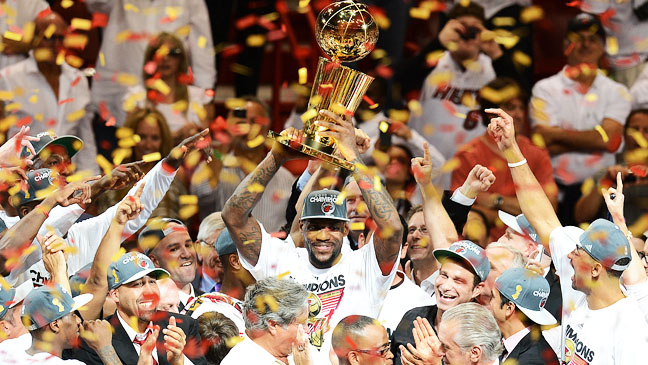
Chris Bosh, LeBron James, Dwyane Wade, Carmelo Anthony

Also, there is one more thing to look out for in this draft. There might be an epic free agency class coming up next offseason. Lebron James, Carmelo Anthony, Chris Bosh, and Dwayne Wade all have early termination options to become free agents in 2014. Add to that, the 2014 NBA draft is predicted to be a lot stronger than this draft class, and you have the perfect storm for further wheelings and dealings. Look for the Thunder to not only get what they need in this draft, but also to pick up assets for the 2014 draft. Let the madness begin!

The OKC Thunder and their trade deadline moves

presti-sam

After so much speculation and rumor, this was just about the most anti-climactic trading deadline ever. Other than the Sacramento Kings unloading Thomas Robinson in a “scratch your head” trade to Houston, most teams played it safe and kept their assets. This is probably the first visible sign of how the new CBA will affect how teams view their assets moving forward.  The name of the game is cap space and most teams stuck with what they had instead of taking on salary and risk.

The Oklahoma City Thunder were a microcosm of the trading deadline, itself. The Thunder had one player who was a virtual lock to get traded, in Eric Maynor. The rumors were that teams were interested in Maynor as a solid back-up point guard, but were unwilling to unload a first round pick in exchange for him, which was the asking price from the Thunder. Then on Wednesday, a big rumor sprang up involving the Thunder and the Phoenix Suns. In the proposed trade, Phoenix would send Marcin Gortat and PJ Tucker to the Thunder for Kendrick Perkins, Jeremy Lamb, and a 1st rounder. Though the rumor died down as the day went along, it gained a little bit of momentum late Wednesday when Perkins was a late scratch in the Thunder’s game because of a knee sprain. By Thursday, though, the deal was all but dead. In the end, the Thunder traded Maynor, kept the asset train rolling, and obtained a veteran lock-down defender for virtually nothing.

Deal 1 : Oklahoma City sends Eric Maynor to the Portland Trailblazers for a $2.35 million trade exception and the rights to Georgios Printezis

Eric_Maynor_20130221145500_320_240

One of the greatest things in the world is receiving an extension to a deadline. The Thunder were facing the possibility of losing Maynor for nothing this offseason. While the Thunder didn’t receive the 1st round pick they were initially looking for, they did receive an asset that could help them immensely in the future. The trade exception is actually a little more than Maynor’s actual salary. In essence, the Thunder got a 1 year reprieve on Maynor’s expiring contract, without having a live body taking up a roster spot.

For a player that many fans thought wouldn’t garner anything of value, the Thunder made the best of the situation and got themselves a valuable asset. With possibly 3 draft picks (2 first rounders and a 2nd rounder) in the upcoming draft, look for Oklahoma City to put a package together to get something of high value on draft night.

georgios-printezis-olympiacos-piraeus-eb12-42058

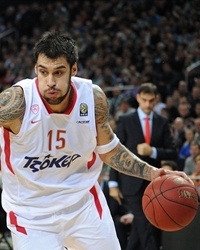
As for Georgios Printezis, he’s a 6’9” PF that currently plays for Olympiacos in the Euroleague. His game is similar to that of Luis Scola of the Phoenix Suns, but with a little more range on his jumper. He is best known for hitting the game winning shot in the Euroleague finals against CSKA Moscow. The 28 year old recently signed a 3 year extension with Olympiacos that will probably keep him in Europe for the rest of his career.

Deal 2: Oklahoma City receives Ronnie Brewer from the New York Knicks for a 2014 2nd round pick.

One of Sam Presti’s tenants is that he never deals for a player with just one team in mind. When he dealt for Kendrick Perkins, many people thought he did that with only the Los Angeles Lakers (who had Andrew Bynum and Pau Gasol) in mind. But the entire Western Conference is full of skilled big men, especially the playoff teams. Teams like Memphis (Marc Gasol and Zach Randolph), Utah (Al Jefferson and Paul Millsap), San Antonio (Tim Duncan and Tiago Splitter), and the Los Angeles Clippers (DeAndre Jordan and Blake Griffin) all pose a threat on the inside to the Thunder.

With our recent struggles against the Miami Heat, many Thunder fans were clamoring for a big wing defender like Luc Richard Mbah a Moute of the Milwaukee Bucks or Jared Dudley of the Suns to be that mythical being called a “Lebron stopper”. The truth is, when you play a team that plays inside/out like the Heat or the Spurs, a big wing defender is tantamount when it comes to recovering on 3-point shooters. Players like Tony Parker, Manu Ginobili, Dwayne Wade, and James are great at dribble penetrating, breaking down a defense, and finding the open guy on the perimeter. While the Thunder already have a great perimeter defender in Thabo Sefolosha, an extra set of long arms and active hands would not hurt.

02212013_ronnie_brewer

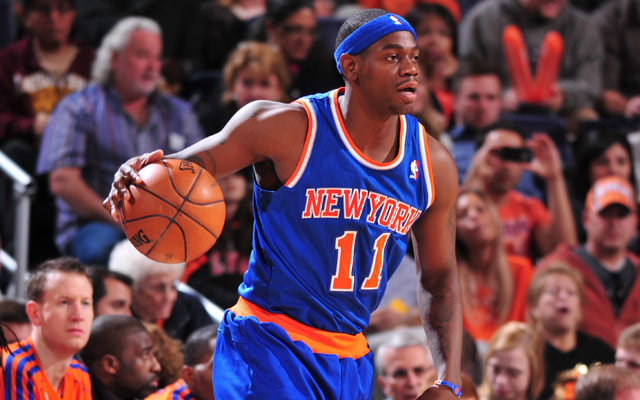
The New York Knicks, in an effort to slash some payroll and open up a roster spot, were looking to unload one of their perimeter defenders. The early rumor was that they were trying to trade Iman Shumpert for an offensively minded guard like Orlando’s  J.J. Reddick. Instead, the Knicks made Brewer available and the Thunder swung the deal for him. Brewer is regarded as one of the toughest big wing defenders in the league. He’ll be especially helpful to Kevin Martin and the bench unit as their best wing defender. Also, if necessary, in small ball line-ups, Brewer can be put in at SF or SG to help on the defensive end.

An added bonus is that Brewer’s salary is nearly half of what Maynor’s was ($2.3 million for Maynor compared to $1.2 million for Brewer). That saved money could be used to get a veteran free agent for the final roster spot, similar to what the Thunder did in obtaining Derek Fisher last season.

okc lbj

Overall, I think these moves made the Thunder slightly better in the present and made them even more dangerous on the draft/trade front in the future. Whether Brewer proves to be of any use is still to be seen. But it’s better to have a player like that on your team than on your opponent’s team. With the more punitive luxury tax looming next season, many teams will be looking to dump some salary in the offseason. With all their assets they’ve accrued, the Thunder should feel pretty good about themselves as we move forward under the guise of this new CBA.

Miami Heat vs. Oklahoma City Thunder Preview (Game 53 of 82)

okc miami

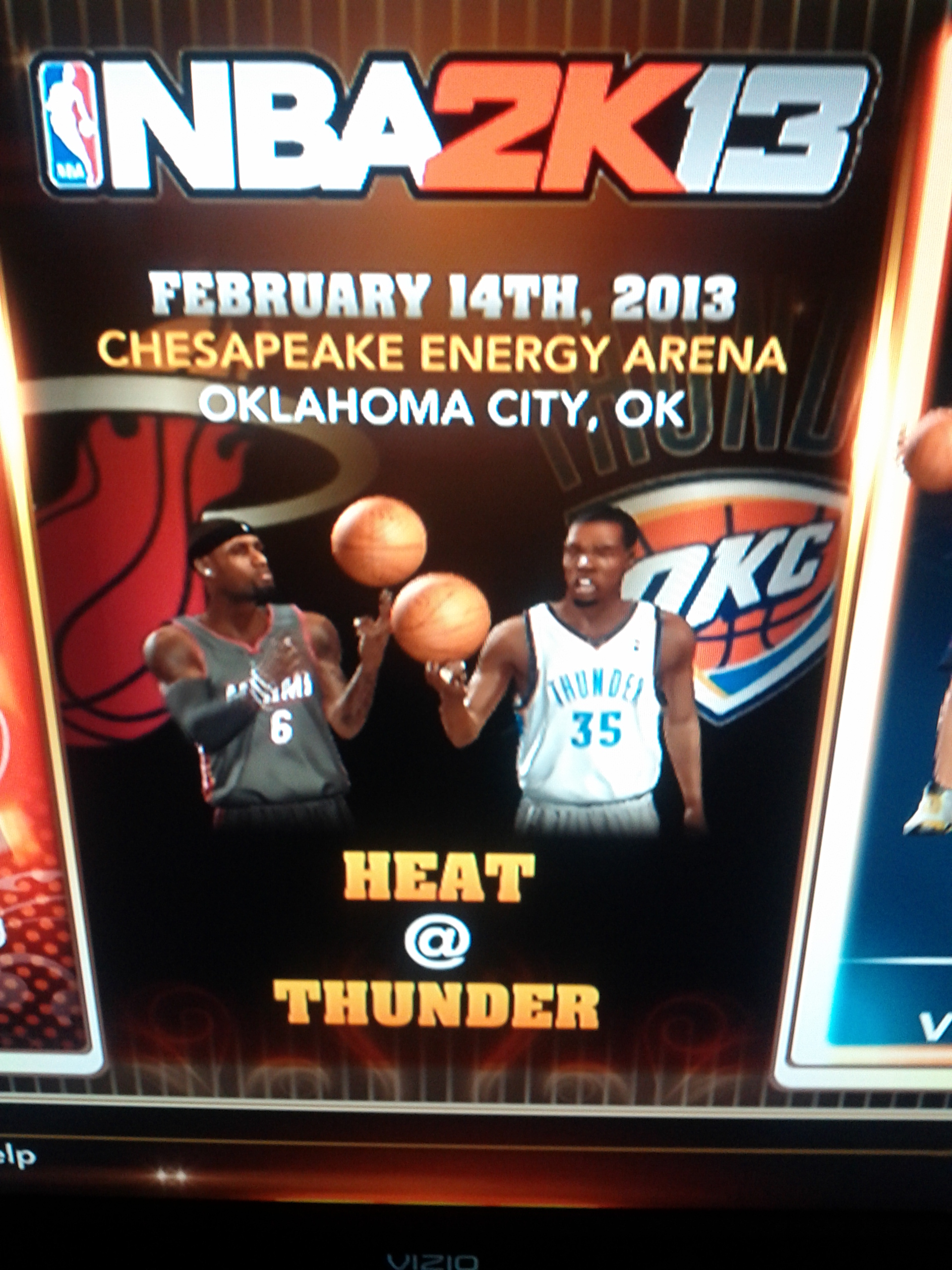
  • When: Thursday, 14 February 2013 at 7:00 PM CST
  • Where: Chesapeake Energy Arena, Oklahoma City, OK

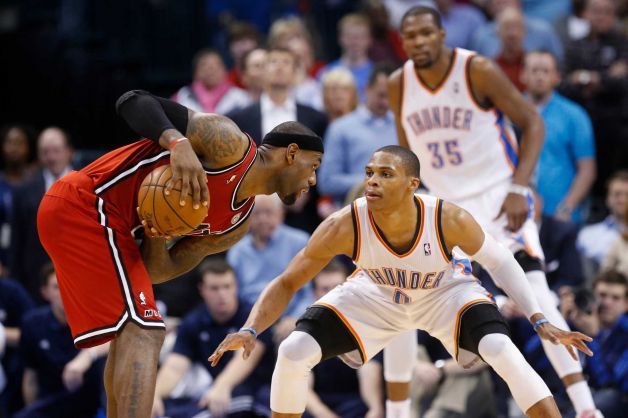
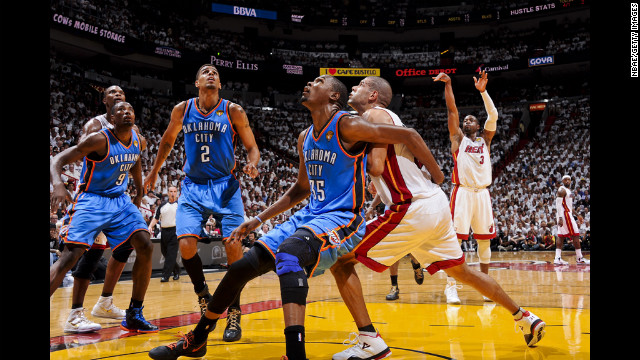
This game brings to it a sense of deja vu. The last time the Oklahoma City Thunder played the Miami Heat, the Thunder were coming off a loss. The Thunder ended up losing that game to the Heat on Christmas day for their only consecutive game losing streak of the season. This time the Thunder are coming off a loss to the Utah Jazz, and would love nothing more than to get a victory against last season’s Finals opponent before heading into the All-Star break. Remember, Kevin Durant and Russell Westbrook has to swallow the bitter pill of playing with Lebron James in the Olympics after their NBA Finals loss. The last thing they want is to lose to Lebron and the Heat again, when they’ll probably have to link up for NBA-related activities during the All-Star break.

In their last meeting, the Thunder and Heat played in a game that met expectation. While the Heat held the lead for most of the 4th quarter, the game was tight with Durant and Westbrook both having chances to tie the game in the closing seconds. The main characters performed well, with Durant and Westbrook leading the Thunder with 33 and 21 points, respectively, and James and Dwayne Wade leading the Heat with 29 and 21 points, respectively. The main difference were the role players, where Kevin Martin and Serge Ibaka each had 15 points for the Thunder, while Chris Bosh and Mario Chalmers had 21 and 20, respectively, for the Heat.

The Opponent

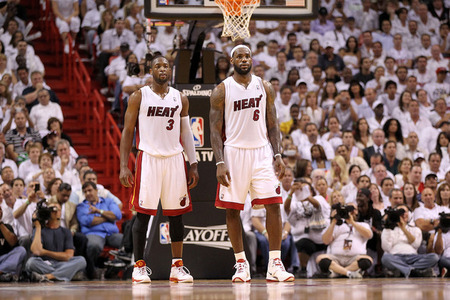
miami heat starting 5

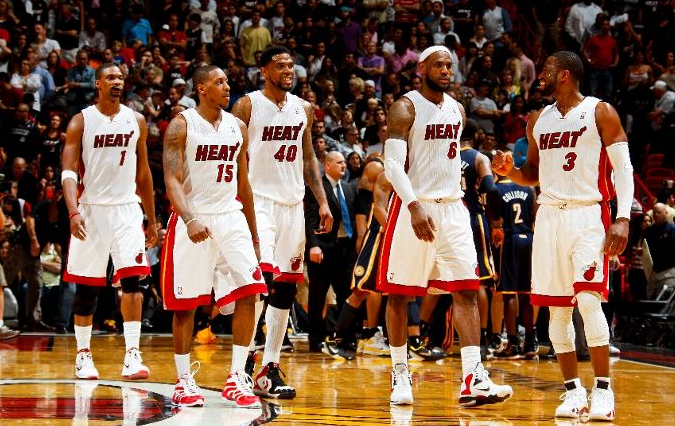
The Miami Heat come into the game with a 35-14 record, good for 1st in the Eastern Conference. They are currently riding a 6-game winning streak. Their offense is top-5 in the league (103.1 ppg, 5th in the league) and their scoring defense is in the top half of the league (96.7 ppg allowed, 12th in the league). The Heat are led by all-world forward Lebron James, who is having one of the best seasons the league has ever seen. He is leading the Heat in 4 statistical categories (scoring, rebounds, assists, and steals), while leading the NBA in Player Efficiency Rating (PER). The backcourt consists of Mario Chalmers and All-Star Dwayne Wade, who is also having a great season, averaging 21 points, nearly 5 rebound, and nearly 5 assists per game.  The front court consists of rugged PF Udonis Haslem and All-Star Chris Bosh. The bench is full of 3-point shooters (Ray Allen, Shane Battier, Norris Cole, Mike Miller) and the recently signed Chris Andersen.

Probable Starters

Miami Heat

  • PG – Mario Chalmers
  • SG – Dwayne Wade
  • SF – Lebron James
  • PF – Udonis Haslem
  • C – Chris Bosh

Oklahoma City Thunder

  • PG – Russell Westbrook
  • SG – Thabo Sefolosha
  • SF – Kevin Durant
  • PF – Serge Ibaka
  • C – Kendrick Perkins

3 Keys to the Game

  • Perimeter Defense – Its the rock and the hard place that defenses face when they play the Miami Heat. Do you allow James and Wade to penetrate into the lane, but stay home on the shooters? Or do you collapse the defense to protect the paint, while exposing yourself on the perimeter? The Thunder always seem to get burned a one of the Heat’s role players (Battier in the Finals, Miller in Game 5, Chalmers in the Christmas game) on the perimeter. rebound
  • Rebounding – The Heat are last in the league in rebounding at 38.7 rebounds per game, which is completely unheard of for a championship contender. The Thunder bigs need to control the paint and not allow the Heat to get extra opportunities on offense. Kevin Durant needs to slide down and help out on the glass, especially when he is playing the 4, which I feel will be often in this game. brooks2
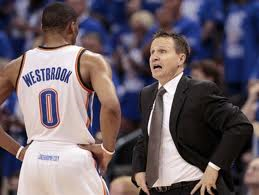
  • Scott Brooks and match-ups – This is probably one of the biggest subplots in the game. The Heat don’t play a tradition center (big, always in the paint, post presence). This negates the effectiveness of Kendrick Perkins, but Brooks always seems to have Perkins out on the floor when the Heat are playing small (usually in the 4th quarter). Will Brooks switch it up this time, or will he stay with the same defensive line-up when the Heat go small? Also, who guards Lebron James? Do you put KD on Lebron and risk Durant being in foul trouble? Or do you go with Sefolosha or Liggins? Whatever the decision is, it will probably a case of picking your poison.

Westbrook and The Boost

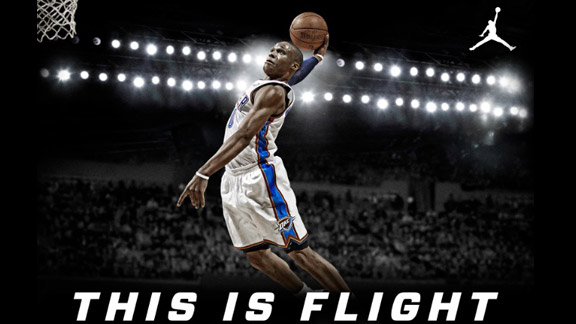
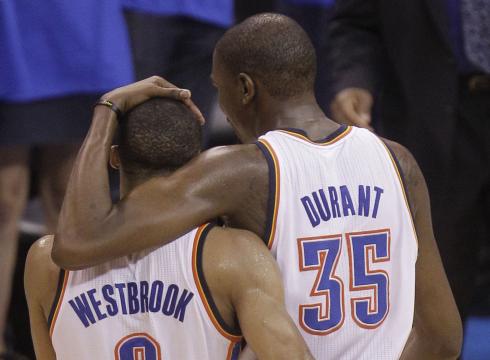
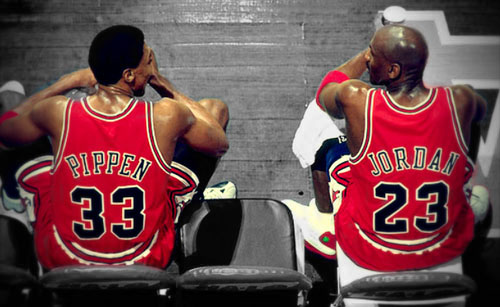
This past week, Russell Westbrook signed with Jordan Brand, after being with Nike for the first 4 years of his career. While Westbrook has carved out his own following of fans, he’s always been known as Kevin Durant’s sidekick. The Robin to Durant’s Batman. This generation’s ultimate second banana. There hasn’t been a sidekick this good since Scottie Pippen. But, Pippen never received the boost in popularity that Westbrook is about to receive.

What qualifies for a sidekick? A sidekick has to be a rookie or a very young player that is brought in after the primary player is established to specifically fill the needs the team is missing. Another qualification is that the pairing has to be together for 5+ seasons. For example, Scottie Pippen was obtained by the Chicago Bulls in a draft day deal, while already having an established superstar in Michael Jordan. Russell Westbrook was drafted by the Seattle Supersonics (Oklahoma City Thunder) after they already had an established young star in Kevin Durant. Anfernee Hardaway almost made it to great sidekick status, but injuries and Shaquille O’Neal’s departure to the Los Angeles Lakers negated that possibility. The Lebron James/Dwayne Wade/Chris Bosh mash-up wouldn’t qualify as sidekicks because they were all alpha males on their respective teams before they joined forces. Kobe Bryant and the aforementioned O’Neal made a great duo, but they were brought onto the Lakers the same year and often quibbled over who was the alpha male. 

To understand the road Westbrook is on, it is important to see what happened to Pippen throughout his career. When Pippen first started college at the University of Central Arkansas, he was a 6’1” walk-on that needed to moonlight as the team’s manager to pay his tuition costs. After 3 more collegiate seasons, a 7 inch growth spurt, and consensus All-NAIA player honors, Pippen was drafted with the 5th overall pick in the 1987 NBA draft to the Seattle Supersonics (who subsequently traded him to the Chicago Bulls). The scouting report on him read as follows:

  • 7’4” wingspan and a 41” vertical
  • Strong outside, but needs work inside
  • Not bad driving to the hoop, but doesn’t look to drive
  • Good foul shooter
  • Can make a three
  • Terrific passer at that position
  • Won’t give you much of anything on the offensive glass, and is a so-so defensive rebounder
  • Excellent defensively and a disruptive force in the passing lanes
  • Good ball handler, but commits a ton of turnovers
  • Could start on most teams

Not necessarily the sexiest of scouting reports for someone who would eventually become one of the top 50 players in league history. While Pippen built his legacy on defense, he was also an apt offensive player, becoming the archetype for the point forward position. During his prime (1989-1999), Pippen had per game averages of 19.1 points, 7.1 rebounds, 5.9 assists, 2.2 steals, and 0.9 blocks. Not necessarily the offensive prowess that Larry Bird possessed, but with a stat line like that, Pippen should have been heralded as his generation’s defensive Larry Bird. Instead, he was teamed up with arguably the greatest player of any generation in Michael Jordan. There usually isn’t a lot of spotlight left when you are playing with the greatest. Ask 100 people who the lead singer of Aerosmith is, and most will answer Steven Tyler. Ask them who the drummer is, and not many will know the answer.

Pippen’s play on the court should have spurred him to more shoe deals, more advertisement contracts, and more widespread popularity. And yet, when his career was all said and done, you couldn’t help but wonder whether Pippen got everything that was owed to him. There were the stories of how Pippen felt he wasn’t getting paid what he deserved (which he wasn’t). There were the rumors that he felt slighted being outside of the limelight, when he provided so much to the team. While he did have his own shoe line (the PIPs) from Nike, they only lasted about two series. So, needless to say, not many companies bought into Scottie Pippen.

It wasn’t Jordan’s fault, though. Most of the blame lies squarely on Pippen. He didn’t have the same tact with the media that Jordan did. He was dismissive and defensive at times with reporters. Then there were the crunch time situations. Those critical times in games that live in lore and become mythologized. It’s not that Pippen didn’t perform well during those times. On the contrary, he performed great during crunch time. But he’s instead remembered for the times he quit on his team in the most critical of moments. There was the time he sat out Game 7 of the 1990 Eastern Conference Finals against the Detroit Pistons with a migraine headache. The Bulls eventually lost that game. Probably the most damning, though, was the one where he sat out the final 1.8 seconds of Game 3 of the 1994 Eastern Conference Semifinals against the New York Knicks because Phil Jackson drew up a play for Toni Kukoc to take the final shot, instead of Pippen. To make matters worse, Kukoc actually hit the game winner. This one was the most damaging because it came at a time when the Bulls were his team due to Jordan’s hiatus into baseball. When you are known to quit on your team during crucial periods, your popularity takes a big hit.

Which brings us to the best sidekick of this generation, Oklahoma City Thunder guard Russell Westbrook. Like Pippen, Westbrook was not highly decorated coming out of college. Like Pippen, Westbrook was drafted by a team that already had a young star in Kevin Durant. Like Pippen, Westbrook is seen as not being very media friendly. Coincidentally, Durant, much like Jordan, is viewed as a media favorite. And, while not by his own doing, Russell was also involved in a critical game snafu, when Thunder coach Scott Brooks sat an ineffective Westbrook for the entire 4th quarter of Game 2 of the 2011 Western Conferences Finals.

But, not everything is negative when it comes to Pippen and Westbrook. Both of these players are insanely loyal to their teams and teammates. Pippen had a couple opportunities to seek greener pastures during the championship run, but decided to sign for less to stay with the Bulls. Westbrook could have done the same last season, but decided to sign for the allowable max. Both players are highly competitive, with possible chips on their shoulders from being labeled second bananas. Both players are very team oriented, as evidenced by them sacrificing a little of their own games to coexist with two great players. The good severely outweighs the bad when it comes to Westbrook and Pippen, but the bad usually has more advertising power.

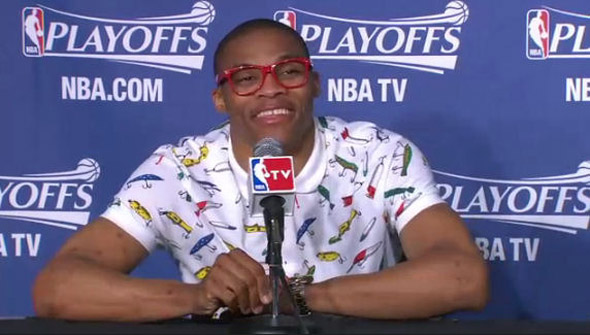
Which is why I found the signing of Westbrook to Jordan brand to be a bit ironic. Not ironic in the sense that he doesn’t deserve it. But ironic in the sense that a move like this will probably propel Westbrook into superstar territory, as far as media exposure goes. Into a territory that Scottie Pippen unfortunately never reached. With an endorsement team that includes Carmelo Anthony, Derek Jeter, Chris Paul, and Michael Jordan, himself, Russell Westbrook will have plenty of opportunity to expand his brand. He already has a slogan in place (WhyNot?), and already has a following outside of basketball because of his unique fashion sense. In a way, Jordan is helping this generation’s top sidekick become what his sidekick should have become.

What offseason? Basketball Never Stops!

As a fan of the game, I’ll watch any basketball game you have on the television, especially playoff games. But there’s a slight disconnect when your team is not involved. It’s not as emotionally taxing. With that said, I’ve never enjoyed basketball as a connected fan all the way into mid-June. Though I’m disappointed that we lost in the Finals, its fun to look at the calendar and know that in 3 months, training camps should begin to open up. I’ve forgotten what it feels like for the season to be over in mid-April. But this all leads us to the offseason. Time to rest and recover from the grind of the season. Oh, I forgot we have the draft coming up. And then we have Summer League. And all the offseason moves and transactions. All the while, we have the national team gearing up to defend its gold medal in this summer’s Olympics. What the hell does the off in offseason mean?
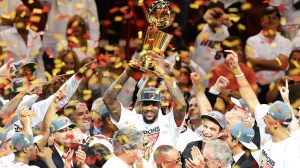
There’s a saying that the NBA season is a marathon, not a sprint. The things that happen after the All Star break, such as trades and the signing of recently released players, can have a big impact on the rest of the season and the postseason. The Thunder have been the beneficiary of both of these player transaction moves in the past two season. Two seasons ago, at the trading deadline, the Thunder traded Jeff Green and Nenad Krstic to the Boston Celtics for starting center Kendrick Perkins and ultimate cheerleader Nate Robinson. Then, last season, they signed point guard Derek Fisher off waivers after he was released from the Houston Rockets. Due to the team’s stability, the Thunder usually remain pretty quiet during the offseason, though.

2012 NBA Draft

This offseason, though, the moves have been quiet, but plentiful. Heading into the draft, the Thunder’s only draft pick was the 28th pick in the first round. When you are picking this late in the draft, this usually means your team already has the necessary players to succeed. For a team as set as the Thunder, there wasn’t an immediate need that any player chosen this late was going to provide. One of the biggest needs the Thunder had was a big that was agile enough to defend other athletic bigs while being able to score from the outside and inside. Players with this skill set don’t usually last this long in the draft. The thinking was that the team would draft either an athletic wing or an overseas player that would be stashed in Europe for a couple of seasons.
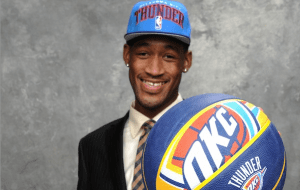
Sometimes, though, the stars and planets align, and a player you were needing all along falls into your lap. There was always concern about Perry Jones III’s work ethic. The word ‘motor’ usually came up when his draft status was discussed. But, no one could deny the potential he had. The description of a 6’11” athletic forward that could score from outside and inside is the type of player that usually has teams salivating for his services. But a day before the draft, they were reports that many teams were concerned with the condition of his knees. After the recent knee concerns of Greg Oden and Blake Griffin proved to be true, not many teams were willing to spend a lottery pick on a player whose work ethic AND knees were called into question. Surprisingly though, 11 other teams outside of the lottery chose to pass on Jones III also. So when the Thunder’s name came up, Thunder general manager Sam Presti never hesitated, and went with the best player available, which coincidentally also filled a need. The best thing about it, though, is that it comes at an extremely cheap price.

Orlando Summer League

After the draft, the focus turned to the Orlando Summer League, where the Thunder were participating with 7 other NBA teams. As I wrote previously, the Summer League is full of good young players, Fringers, and Dreamers. Some of the players are already guaranteed a spot on an NBA roster and just want to mix in some team-oriented scrimmages and practices during the offseason. Most of the players though, are clawing and scratching for an opportunity to get onto an NBA roster. The Thunder’s roster consisted of 4 guys that, barring a trade, will be on the Thunder’s opening day roster (Perry Jones III, Reggie Jackson, Lazar Hayward, and Cole Aldrich). The rest of the players were probably not going to make it onto the Thunder’s roster, but could make an impression on another team depending on how they played.
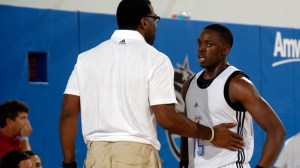
The Thunder finished the Orlando Summer League 3-2. Reggie Jackson played like the most seasoned guy on the team controlling the tempo of the offense and attacking the basket at will. He even gave 2012 NBA Dunk champ Jeremy Evans a taste of his own medicine. Lazar Hayward showed why he’ll be at the end of an NBA bench for the next couple of years. He does a lot of things good, but nothing great. Cole Aldrich’s play was mediocre, at best. For a player that is looking to step up and be the back up center, his lack of improvement was a bit alarming. But, I would ask people to please step off the ledge when it comes to Aldrich’s development. Summer league games are made for wing players. They are glorified street games with refs and NBA assistant coaches on the sidelines. Aldrich will be asked to defend the paint, set picks, and put up a couple hook shots in the regular season. He will be fine. Perry Jones III suffered a sprained ankle in the 2nd half of the 2nd game, but not before impressing with his array of inside/outside skills. He will be in the Thunder’s regular rotation, if not in the 2nd half of this season, then definitely in the 2013-14 season. Other notables were forward Latavious Williams, who needs to be on an NBA roster somewhere, and Garrett Temple, whose play was almost veteran-like.

Off-season Moves

The Thunder has never been a big player in free-agency in their time in Oklahoma City. But in reality, they’ve never had to be a big player. Their main focus has always been on player development. When you have players like Kevin Durant, Russell Westbrook, James Harden, and Serge Ibaka, that’s what you put most of your focus on. That came to fruition in the last two seasons with consecutive trips to the Western Conference Finals and a trip to the NBA Finals this past season. The Thunder had 3 players that were coming up on free agency and all of them were veterans. Nazr Mohammed, Derek Fisher, and Royal Ivey could have all been signed to cheap veteran deals. But due to their years of employment in the league, even their minimum salaries would have been upwards of $1.5 million. The Thunder chose instead to let those vets walk, and focus on cheaper, younger alternatives. With Perry Jones III signing his rookie contract, that left 2 more spots on the roster.

The Thunder signed much maligned center Hasheem Thabeet to a 2-year veteran minimum contract. Now the difference between Thabeet’s veteran minimum deal and any of the other 3 Thunder players that were up for an extension, is that Thabeet has only been in the league for 3 seasons. For the final roster spot, the Thunder signed undrafted free agent Hollis Thompson from Georgetown to a 3 year contract. Thompson is a sharp-shooter in the Thunder mold (tall and long) that could be a cheap replacement for Daequan Cook in upcoming seasons.

The two signings sent Thunder nation into a tizzy, and not for good reasons. Most were questioning the “lackluster” moves by the team, while the team that beat us in the Finals picked up former All-Stars Ray Allen and Rashard Lewis, and one of our biggest threats in the West, the Lakers, picked up a former 2-time MVP (Steve Nash) in their biggest position of weakness (point guard) without giving up a single player. The thinking was that the curse of the small market team was starting to take hold of the Thunder. That the ideology that small market teams can’t attract free agents and can’t spend money like the big boys was starting to rear its ugly head.
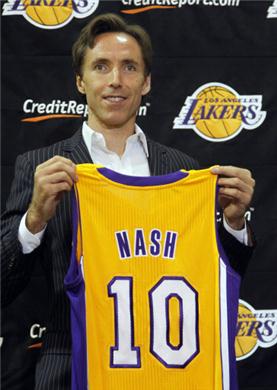
I, for one, completely disagree with that thinking. While it would be nice to sign former All-Stars ad-nauseam every offseason, the reality is that that would be bad business in this new NBA. The goal is to try and keep cost down while maintaining a competitive team. If your team does spend into the luxury tax territory, it better be winning. The Thunder have the right components in place to continue winning. The moves they made this offseason were made to keep those components in place. When you start talking about the luxury tax, every dollar counts. And if the Thunder are truly looking to keep both James Harden and Serge Ibaka on the same team as Durant and Westbrook, they are going to have to continue making these cost effective moves. Both Harden and Ibaka will demand deals that get them at least $10+ million per season. And, rightfully so. We’ll be in the luxury tax no matter what, if we keep these 4 players. The payments get more feasible, though, if you are competing for and winning championships.

Another thing that these signings do is maintain the flexibility that Presti loves. These signings not only have low cost-high reward potential, but they are also short term deals. That way, the team isn’t saddled with long-term contracts if the player, in question, either gets injured or doesn’t produce. Also, if someone better comes along, you could cut your losses with the player and attempt to obtain the better option. Cap flexibility is a commodity in the NBA, and Presti is one of the best at maintaining it.

Team USA

As if this offseason hasn’t been crazy enough, you have Team USA preparing for the Olympics in London. Not only that, but the Thunder has 4 representatives in the Olympics (Kevin Durant, Russell Westbrook, and James Harden for Team USA, and Serge Ibaka for Spain). Durant and Westbrook were near locks to make the team, but Harden was actually a surprise addition after players like Dwayne Wade and Derrick Rose bowed out because of injury. The team torched the Dominican Republic and eeked out a victory against a tough Brazil squad in the US leg of pre-tournament games. After this, it’s across the pond for a couple friendlies and then the real thing. Durant has a possibility of leading the team in scoring, while Westbrook will be the defensive pitbull/offensive sparkplug off the bench. Harden will probably play a role similar to what he does with the Thunder, but to a smaller degree.
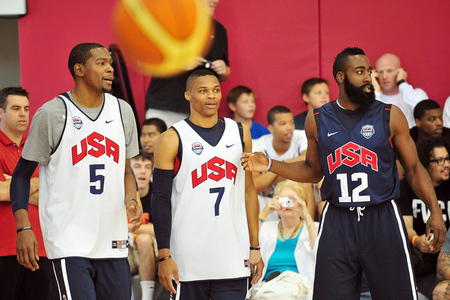
As a fan of the game, I love this. Before NBA-TV, the offseason was usually a time to hear about a trade or two, and wait for football season to start. So, even though, this has been a whirlwind offseason, I still appreciate it. When this offseason gets too crazy, I always hark back to the 2011 offseason. Oh, you don’t remember the 2011 offseason? Oh, thats right, because there wasn’t an offseason that year.
Top NBA Teams and Senior-itis

Ahh, yes. April. That time of year where the memories of Spring Break start to fade, and the doldrums of the final quarter of school starts to set in. This is when high school seniors start to really feel the effects of senior-itis. It’s this same disease that is beginning to affect some of the better teams in the NBA. For those teams that have already sewn up spots to the NBA’s Big Dance, this affliction is making them act like 8 years olds on a road trip. “Are we there yet?”

When it comes to this time of years, teams are in one of 4 modes. They are either completely out of the playoff hunt, fighting (realistically) for a playoff spot, fighting to move up in the playoff standings, or fighting off boredom from having clinched a playoff spot so early in the 2nd half of the season.  Of the 30 teams in the NBA:

  • 11 are completely out of the playoffs: Charlotte, Washington, New Orleans, TTFKATSK (the team formerly known as the Sacramento  Kings), Cleveland, Toronto, Golden State, New Jersey, Detroit, Minnesota, and Portland.
  • 7 are realistically fighting for playoff spots: Utah, Phoenix, Milwaukee(all currently out), Philadelphia, New York, Denver,  and Houston (all currently in).
  • 8 are securely in the playoffs and jockeying for positioning: Dallas, Memphis, LA Clippers, LA Lakers, Orlando, Atlanta, Boston, and Indiana.
  • 4 teams are entrenched in the playoffs and fighting for the top two spots in their respective conferences: Chicago and Miami (East) and Oklahoma City and San Antonio (West).

Of the 4 teams at the top,Chicago is trying to battle through injuries and maintain the best record in the league.San Antonio is blitzing anyone in their way and trying to take the top spot in the West. And apparently, OKC and Miami (to the enjoyment of all the fans not in Chicago or San Antonio) are ready to meet in the Finals, and are acting like it’s a forgone conclusion. But, honestly, for these four teams, is there anything to worry about besides injuries at this point in the season?

These four teams are treading water at this point in the season. Chicago is 4-3 since April started. Miami and OKC are both 5-4. And San Antonio, riding the hot hand, is 6-2. Are these records indicative of any shortcomings that decided to pop up in the final month of the season?

In Chicago’s losses this month, it is quite apparent that they need Derrick Rose to be completely healthy for their playoff run. But, perhaps, more importantly, the health of Rip Hamilton is of great importance to the offense. While Rose is the end all, be all of the offense, Hamilton provides a great release valve if the defense collapses too much on Rose. Getting those two healthy at this point of the season is the best thing that could have happened to the team. It’s almost like they got a trade deadline acquisition in Hamilton, who is just now starting to pay dividends on the team. The greatest positive to come out of the injury plagued seasons of Rose and Hamilton, is that the bench players have had to contribute and have done so in above average fashion.

In Miami’s losses this month, a lot of the problems that surfaced last season are starting to resurface this season. It’s the Big 3 and no one else on that team. The Big 3 moniker has taken a bit of a hit this season with injuries to Dwayne Wade, but the production from the role players that was so evident in the beginning of the season, has begun to decline to the detriment of the team. The size issue that was a problem last season is still a problem for the Heat. They got Ronny Turiaf after the trading deadline, and while it is a slight improvement over Joel Anthony, the move didn’t really register too much on the Richter scale. The big man rotation of Chris Bosh, Udonis Haslem, Anthony, and Turiaf does give the Heat a bit more flexibility as compared to the big man rotation last season (Zydrunas Ilgauskas, Juwan Howard, Bosh, Anthony, and an injury-recovering Haslem). The point guard position has been slumping for the last month and a half. Mario Chalmers has only been shooting 30% from 3-point territory since March 1st, after shooting about 48% from there in the first 2 1/2 months of the season. Norris Cole has hit the rookie wall and is not producing like he was in the beginning of the season, even being relegated to the bench in favor of James Jones, who is just now starting to find his shooting stroke. But, in the end, this team still has Lebron James and Dwayne Wade, and when those two are clicking, this team is still very difficult to defeat.

The Spurs have begun to streak after finally getting all their pieces back from injury. Its no coincidence that their 11 game win streak coincided with Manu Ginobili finally getting his rhythm back after being in and out of the lineup with a myriad of injuries for most of the season. The young players (Kawhi Leonard, Tiago Splitter, Gary Neal, Danny Green, and James Anderson) all know their roles and play them to a tee. This team is a well-oiled machine that is just now starting to hit its stride. The team still relies heavily on its trio of veterans, but Coach Popovich has made sure to limit their minutes in the regular season. The addition of veterans Stephen Jackson and Boris Diaw will help during their post-season run. This, in my opinion, is probably the most dangerous team heading in the playoffs.

The Thunder’s last 10 games have exhibited the same errors that have been plaguing them the entire season. They are 6-4 in those games, but those errors become very evident in the losses. Stagnant offense always hinders this team in the beginning of games. The team even has a punt play to start nearly every game: giving the ball to Kendrick Perkins in the low post. It very rarely ends in points for the Thunder. In their 4 losses in this 10 game run, the Thunder score an average of 22.3 points in the first quarter. In the 6 wins, that number jumps up to 27. That’s nearly a 5 point difference, which, in an NBA quarter, is a huge difference. Another stat that hinders the team in their losses is the number of turnovers. In that same 10 game span, they are averaging 16.5 turnovers per game in their losses, and 14 per game in their wins. That difference of 2.5 turnovers can, hypothetically, be equated to an extra 7 points for the other team. Which, again, in the NBA, is a game-changing amount.  Defensively, the team still has trouble with the pick and roll and guard penetration.

The good news for all these teams is that there is nothing new that can be labeled a negative. The deficiencies and errors that they have been exhibiting all season, are the same things that are afflicting them now. Even with all these issues, these teams are still the top 4 teams in the league and the leading contenders to win the championship. Are there darkhorses on the fringes that could slip in? Of course. The Los Angeles Lakers are starting to show some diversity in their offense with Andrew Bynum finally taking charge in the absence of Kobe Bryant. The Memphis Grizzlies are one of the deepest teams in the league, with 2 All-star caliber post players (Marc Gasol and Zach Randolph) and an All-star caliber wing (Rudy Gay). And the Boston Celtics will give it all they got for what appears to be their swan song together.

The thing about senior-itis is that, eventually, everyone graduates and moves on to the next level. In that next level is where your skills and abilities come out in full force. Some end up in college, some in a job, and some at home on the couch. In this crazy season, anything can happen. But if the playoffs play out anything like the regular season, then these 4 teams should be the cream that rises to the top.

B-ball Analogy – Russell Westbrook : point guards as Lebron James : small forwards

After watching Russell Westbrook’s recent performances this season, I can’t help but think that Russell Westbrook is the Lebron James of NBA point guards. The things that separate Lebron from everyone else are his skill set, size, strength, and freakish athletic ability. Some of these qualities are taught, while others are innate. These tools have given James the opportunity to earn 2 MVPs and twice lead his team to the NBA Finals. 

First off, comparing Russell to Lebron is not necessarily apples to oranges, but it is not what I’m intending to do here. While a one on one game between the two would be entertaining, I’m sure Lebron’s size and strength advantage would trump Russell’s athleticism and quickness. It is after all, basketball, where the player who is closest to the rim (taller) has the advantage most of the time. But, can the same things that give Lebron advantages, be the things that give Russell that extra edge and hopefully lead him to be one of the greats? 

3 S’s: Size, Strength, and Speed 

Individually, each of these characteristics can lead a player to have an advantage over another player. But if you possess an advantage in all 3 of these categories, the battle is already halfway won. That’s the thing about Lebron James. His size (6’8”) makes him above average for the small forward position. His speed can be matched by only a couple players at his position. But his strength is what completely makes him a match-up nightmare for the opposing player and defense. But when you put all 3 to work against the opponent, this is where Lebron overwhelms the opposition. 

Russell Westbrook is basically upper middle class when it comes to size in the point guard class. In looking at all the starting point guards in the league, the average height is about 6’3”, with Tyreke Evans being the tallest at 6’6” and Jameer Nelson and DJ Augustine/Kemba Walker coming in at about 5’11 ¾”. Russell is about 6’3 ½”. Nothing is going to overly separate him in this category. 

One of Russell’s main advantages is his strength. Only about 3 or 4 other point guards can compete with Westbrook in regards to strength. The factor that makes Russell different is in how his muscles distribute themselves on his body. The best comparison I can make is to Alfonso Soriano, the 2nd baseman who played for the New York Yankees, Washington Nationals, Chicago Cubs, and Texas Rangers this past decade. From 2002 to 2008, Soriano averaged 35.5 homeruns per season, a run unheard of for a 2nd baseman. What’s amazing about this run is in how Soriano’s musculature appears on his body. Soriano is all of 6’1” and 190 lbs. So a hulking Paul Bunyan he is not. Instead, Soriano has a wiry frame that packs muscle in an elongated fashion, instead of stacking muscle on muscle. This type of musculature is good for power and … 

Speed. In that same time frame, Soriano also averaged 29 stolen bases, which is pretty good for any baseball player that doesn’t necessarily specialize in speed, a la a pinch runner or lead off hitter. So, where Tyreke Evans and Deron Williams are bigger and stronger than Russell, his advantage at speed neutralizes that deficiency. Just ask Derek Fisher, one of the stronger, yet slower point guards in the NBA. 

Like James, Russell’s combination of these 3 characteristics (the 3 S’s) make him a load to handle for most point guards on a nightly basis. Knowing that you have these attributes leads to a person having….

 Freakish athletic ability 

The combination of the 3 S’s above, leads to having freakish athletic ability. Anybody who has high qualifications in the 3 S’s, is going to manifest itself in having this kind of athletic ability. The legendary, mythological stories of Lebron James grabbing a not so great lob with his hand nearly at the top of the square on the backboard and being so far above the rim that he couldn’t dunk it, but instead had to let it drop from above the rim are that of internet lore. Of course it happened in practice. Of course there were no cameras around. And of course, some teammates confirmed it. But, based on his athleticism, its something that we can consider possible. With Russell, it’s sort of the same way, but we get to see some of these things live in an NBA game. The dunk over Lamar Odom in their first playoff run against the Lakers in 2010. The lob that Earl Watson threw off the backboard, and Russell grabbed with one hand and dunked while skying over a Warriors player (we see you Marco Bellinelli). The facial he gave the Rockets last season. All tales of a book that is currently being written. 

Defensive ability 

The freakish athleticism also shows up on the defensive end of the floor if a player wants to work hard enough to show it. The same things that overwhelm defenders on the offensive side of the court, are also the things than can overwhelm an opponent on the defensive side of the court. Lebron is an average man defender, but a great help defender, getting into the passing lanes for steals, and coming up with self-esteem rattling blocks from the weak side or from behind. This is the only part of Russell’s game that leaves you longing a little. He was touted as a defensive guard coming out of college, but has only been an average defender in his young NBA career. But ask any of the international guards that he defended during the World Championships whether he can defend, and I’m sure you’ll get a resounding “YES” in whatever language they speak. 

Russell has the ability to be one of the better defenders in the league. The question is, does he want to be? He has shown more signs of being a shutdown defender this year. The aggressiveness that we saw in the World Championships is being shown more this season and that has led to a better defensive game plan from Russell. But that also leads to him gambling more and putting the rest of his team in 5 on 4 situations whenever his gambles don’t work. Through film-study, coaching, and experience, this part of his game can be fixed. The fact that he actually wants to be a better defensive player is the first step in becoming a better defender.    

Skill-set 

This may be the biggest difference between Lebron and Russell. While Lebron was your prototypical prodigy and came into the NBA with a deep skill-set, Russell had to learn a position that was not natural to him. And he had to learn it at the highest level of competition, night in and night out. So while Lebron has just had to refine and improve his skill set, Russell has had to constantly add more and more skills to his repertoire based on the learning curve. Organic growth at this level is very rarely seen from the point guard position. Yeah, you can have players learn a skill here or there, but to have a player go from where Russell was his rookie year to where he is now, is very rarely seen in professional sports. And this is what leads to the biggest difference between Lebron and Russell….. 
Will 

The will to constantly want to learn and get better is something that I think separates these two players. Russell’s meteoric rise is a manifestation of the hours of practice he has put in since his first day of minicamp in 2008. Great players usually take off in their 3rd season. This happened to Kevin Durant, Kobe Bryant, Dirk Nowitzki, Michael Jordan, etc. It’s the time when the game slows down for the player and their instincts begin to take over. All the stuff that Russell has learned and practiced these past 3 ½ years (refining his jump shot, knowing when to attack and when to pull up, learning how to run a team) are finally coming to fruition. Is he still a work in progress? Of course. What he showed in the first 2 weeks of the season, is where the learning comes into play. But what we’ve seen the last two weeks is the player that is destined for greatness. 

I don’t think Lebron has this will. Yes, he has all the talent in the world. But he basically came to the league a finished product. He just had to constantly get better at what he already knew he could do. He just now added a post-up game to his arsenal, and he’s 8 years into his career. With Russell, we don’t know what the ceiling is. We don’t know how far up he can go. Can he be a 25 points, 8 assists, 7 rebounds per game player? Based on his career arc so far, I wouldn’t put it past the realm of possibility. 

Closing ability 

Another thing that separates these two players is their mind-sets at the end of games. While Russell may make mistakes late in games, they are usually an effect of him needing to do something within the scope of the offense. When 3/5th of the offense is stagnant, and the main offensive weapon (Durant) is being heavily guarded, the only option is for Russell to somehow get off a shot. This is what leads to the bad shots and charge calls in close games. But the fact that he is willing to take these shots (and make some of them) shows a willingness to shine in pressure situations that is severely lacking in James’ game. As seen in last season’s Finals, when the pressure got hot, James usually deferred to Dwayne Wade and Chris Bosh. Russell seems to be learning what needs to get done to close games. Whether its hitting a couple 20 footers, getting the ball to the hot hand, grabbing the necessary rebound, driving the lane for a deuce, or, most importantly, hitting free throws consistently, he has been one of the main, if not the main, component in us winning close games. 

For all of his faults, Russell has always been a player that has wanted to improve in order to prove his detractors wrong. It’s what makes that cauldron of heat inside of him boil. It’s the reason he asks “Why not?”, instead of “Why?”.  It is because of this passion, that the Oklahoma City Thunder signed him to a max extension for the full 5 years. With this extension, the Thunder now have 2 of the top 15 players in the league signed for the next 5 seasons. So instead of comparing one player to the next, maybe it would be more apropos to compare the Thunder to what would seemingly be one of their main competitor should they win the West….the Miami Heat. But, hopefully, I’ll save that article for sometime in June.

Occupy NBA: How Twitter helped the fans have a voice in this lockout.

In watching some of the pointless Occupy ____(insert city)____ protests that have gone on for the past month and a half, I have sometimes wondered what it would look like if NBA fans staged their own Occupy NBA protest during the lockout. Would we march at the hotel that the players’ union and owners were meeting at in New York? Or at NBA HQ in New York? Or at the court house in Minnesota where the anti-trust lawsuits would be taking place at? Instead of hippies and out of work yuppies, I could see a whole bunch of middle-aged men with their basketball jerseys on, dribbling basketballs throughout the parking lot. I could see young men trucking in portable goals and holding 3 on 3 tournaments in protest of the lockout. I could see someone bringing out a boombox and jamming to John Tesh’s Roundball Rock. But alas, that takes too much time and money to protest like that, and NBA fans have to do something to pay for the season tickets and NBA League Pass that they have. Instead, NBA fans protested in a new manner. They took their protesting to Twitter. And you know what, it actually had an impact. 

Twitter and the NBA is a match made in heaven. In all of the sport leagues, NBA players are the most accessible. They don’t wear helmets so it’s easy to see and recognize the players. They don’t have heavy armor on, so it’s easy for fans to try and dissect the meaning of their tattoos and get deeper into the psyche of that player. Because of this, NBA fans develop more of a connection, whether real or fantasized, with players than do the fans of other sports leagues. I love the Oklahoma Sooners football team, but I couldn’t pick their center, Ben Habern, out of a lineup if I tried. But I could recognize Minnesota’s back up center (Nikola Pekovic) in a crowded mall if I saw him. 

Another thing that is instantly recognizable about the NBA and its players through Twitter, is that they are all friends. The basketball culture is completely different than the football culture and the baseball culture. Because these players have been playing together in AAU and cross country camps for the better part of their high school careers, there develops a strong common bond that unites these players together as they move on in their respective basketball journeys. And it becomes very apparent on Twitter, as players from different teams communicate with each other more often then they they probably do with their own mothers. 

When you add the fact that fans can now actually communicate with your favorite players, that brings NBA fandom to another level. So, it was only a matter of time before NBA fans would take to Twitter to a) express their displeasure with the lockout or b) express their support to the players. Most players dismissed anything the fans said, but some players, Thunder center Nazr Mohammed, in particular, took to the Twitter-waves to quell any misunderstandings and explain to fans exactly what the players had given up and why they were fighting so hard. For a while, this actually worked in the players’ favor, as they were getting most of the public sentiment. But as the lockout dragged on, fans, and even some players, grew more and more frustrated, and took to the Twitter-waves to express that angst. 

But not only were fans and players able to use Twitter to express their feelings, basketball sportswriters also became primetime commodities during the lockout, especially when there was a meeting between the two sides happening. What used to be interesting tidbits that would appear in books written 10 years after an event, became instant news once it happens (i.e. Dwayne Wade’s blow-up against David Stern, Stern going home with the flu, Michael Jordan going all Scarface on the players that adored him and playing “the bad guy”, the players’ “STAND” shirts, etc.). Howard Beck, David Aldridge, Marc Stein, Larry Coon, and Chris Sheridan all became my new best friends every time the two sides had one of their meetings. These sportswriters provided a riveting play by play of legal negotiations as they were happening. They gave the back drops to what was going on, like who stepped out and why they stepped out. I, for one, took it all in. I was entranced by these negotiations and found myself almost wanting the lockout to continue so that I could “hear” the play by play of the negotiations by the sportswriters. Plus it was fun to hear FalseHoop and his followers come up with #ReasonsForLongLockoutMeeting. 

This all led to instant fan reaction. There was no need for sportswriters to put up surveys or take polls. The pulse of the fans was on full display, live and direct, with their tweets of displeasure and support. After each meeting that ended in disappointment, the pulse of the fans became more and more frustrated. Even worse for the NBA, some of the fans were becoming more and more apathetic. Don’t discount for a second the impact this had on Stern and the owners. With all the talk of a nuclear winter, the NBA did not want to turn into the NHL and have to play games on ION or SiTV when they came back a year or two later. Instead, they went back to the table, made a couple concessions, made the players feel better, and came to an agreement. And guess where I heard it first…….on Twitter.