Tag Archives: Chris Paul

New Orleans Pelicans vs. Oklahoma City Thunder preview (Game 79 of 82)

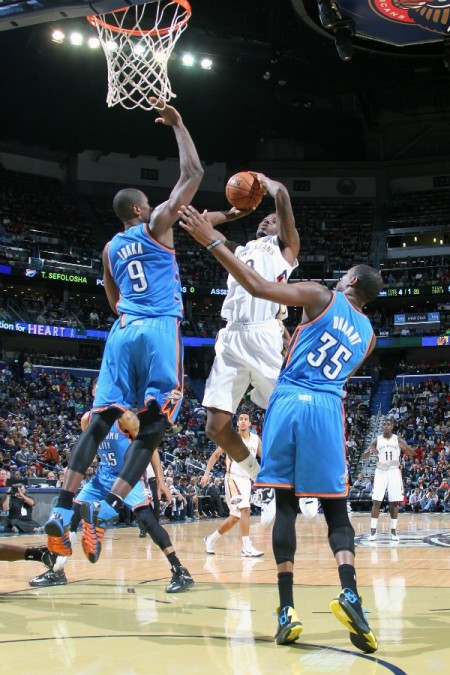
durant ibaka defense thunder pelicans

  • When: Friday, 11 April 2014 at 7:00 PM CST
  • Where: Chesapeake Energy Arena, Oklahoma City, OK

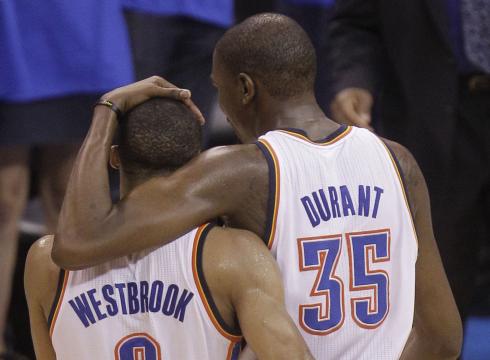
The magic number for the San Antonio Spurs to clinch the No. 1 seed throughout the playoffs is now 1, after their defeat of the Dallas Mavericks. While it is still mathematically possible for the Thunder to get the No. 1 seed from San Antonio, they would require a ton of help. Namely, for the Spurs to lose the rest of their games and for the Thunder to win the rest of theirs. Not impossible, but not entirely probable, either. Instead, with their position firmly entrenched in the No. 2 spot, look for the Thunder to start resting their players. This will be especially helpful for Kevin Durant, Reggie Jackson, and Serge Ibaka, who have had to shoulder the load  all season while Russell Westbrook and others have been out with injuries.

This will be the 2nd of 3 meeting between these two teams. The Thunder have won 9 in a row against the Pelicans, dating all the way back to the 2nd half of the 2010-11 season. You can say that the upsurge of the Thunder has coincided with the downslide of the Hornets/Pelicans since the Chris Paul trade.

The Opponent

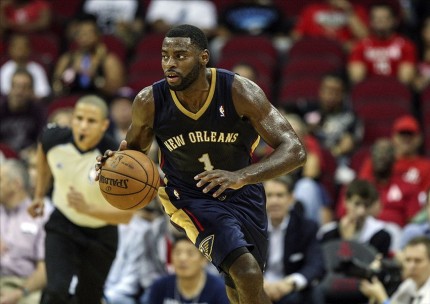
evans pelicans

The Pelicans are currently 32-46 and sit in the 12th spot in the West. While they’ve already improved from last season, injuries have derailed what may have been an even greater improvement. Point guard Jrue Holiday, who was obtained in a deal on draft day last June (and will probably cost the Pelicans a lottery pick in the next draft), has only suited up for 34 games. Anthony Davis, the foundation of the franchise, has played in 67 games and will not be available for the rest of the season. Ryan Anderson, the stretch four who was brought in to space the floor, played in only 22 games before a herniated disc killed his season. Injuries are one of those things that can kill a rebuild quick. With the possibility of the team having no first rounder in this next draft, the Pelicans will be dependent on their key players coming into next season healthy. Of the players who are still healthy, only Tyreke Evans averages in double figures (14.0 points per game).

Probable Starting Line-Ups

New Orleans Pelicans

  • PG – Brian Roberts
  • SG – Tyreke Evans
  • SF – Darius Miller
  • PF – Al-Farouq Aminu
  • C – Greg Stiemsma

Oklahoma City Thunder

  • PG – Russell Westbrook
  • SG – Thabo Sefolosha
  • SF – Kevin Durant
  • PF – Serge Ibaka
  • C – Kendrick Perkins

3 Keys to the Game

1. Reverse Obama – Don’t give them hope. Take it all away. Do it in the first quarter, if possible. I want the starters off the floor by the middle of the third quarter.

2. Continue working on rhythm – IF the regular starting line-up plays, use this game as a pre-season game and continue to work on rhythm and continuity.

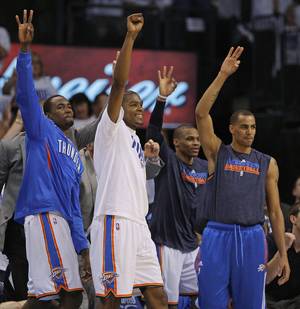
ibaka durant westbrook sefolosha

3. Bench – The Bench Mob should get plenty of run in this game. Here’s hoping newly signed rookie Grant Jerrett gets some reps in. He may have a future as a stretch 4 for the Thunder.

Oklahoma City Thunder vs. Los Angeles Clippers preview (Game 78 of 82)

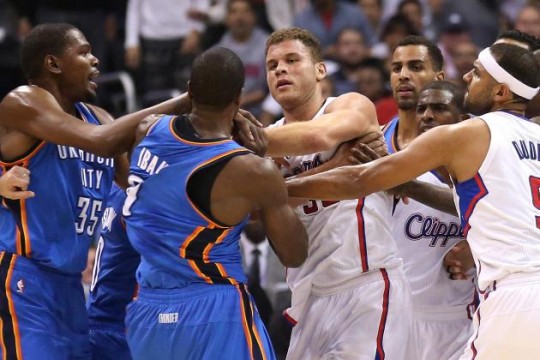
ibaka griffin durant dudley sefolosha paul clippers thunder

  • When: Wednesday, 09 April 2014 at 9:30 PM CST
  • Where: Staples Center, Los Angeles, CA

For the first time in nearly 2 months, the Oklahoma City Thunder could trot out a completely healthy roster. Now, the words “completely healthy” can be debated as Thabo Sefolosha and Kendrick Perkins are still working their ways back from injury. But the fact still remains that this will be the first time since February 20th, that the Thunder will have the ability to put out the same starting line-up that we’ve all grown accustomed to in the last 3.5 seasons.

Since February 20th, the Thunder have suffered from bouts of inconsistency and complacency, especially on the defensive end. With their two defensive stalwarts out and Russell Westbrook being held out in one of the two games on back to backs, the Thunder have had a difficulty time carving out any sort of rhythm. But now, hopefully, the Thunder are getting healthy when they need it the most.

This will be the fourth and final meeting of the year between these two teams. The Clippers lead the season series 2-1 and are 1.5 games behind the Thunder for 2nd place in the Western Conference.

The Opponent

griffin jordan crawford paul clippers

The Clippers are currently sit at 55-23. They are an offensive juggernaut, averaging 107.8 points per game, which is No. 1 in the league. Their attack is led by PG Chris Paul, who in his 9th season, leads the league in assists (10.8) and steals (2.5) per game, while also averaging 19 points. Blake Griffin has taken that next step and is now a bonafide MVP candidate. His game has become more diverse (better mid-range shooter, better play-making skills) and his free-throw shooting has improved. When defenses converge on either of these two players, they have a cornucopia of shooters around them to make the defense pay. Jamal Crawford, JJ Redick, Darren Collison, Matt Barnes, Danny Granger, Willie Green, and Jared Dudley are all shooting over 34% from 3-point territory. On the inside, DeAndre Jordan has been a defensive monster, averaging 13.8 rebounds and 2.4 blocks per game.

Probable Starting Line-Ups

Los Angeles Clippers

  • PG – Chris Paul
  • SG – JJ Redick
  • SF – Matt Barnes
  • PF – Blake Griffin
  • C – DeAndre Jordan

Oklahoma City Thunder

  • PG – Russell Westbrook
  • SG – Thabo Sefolosha
  • SF – Kevin Durant
  • PF – Serge Ibaka
  • C – Kendrick Perkins

* It’s been a while since I wrote that starting line-up down.

3 Keys to the Game

1. Perimeter Defense – As mentioned in the “The Opponent” section, the Clippers have 8 players that shoot over 34.1% from the arc. Luckily, Crawford and Granger, appear to be out for the rest of the regular season. In the last game these two teams played, Crawford and Barnes torched the Thunder for 60 points on 11-18 shooting from 3-point land. With a full compliment of players, look for the Thunder to stay more on the shooters and hope that whoever is guarding Paul (be it Westbrook, Sefolosha, or Reggie Jackson) can stay in front of him most of the night.

westbrook paul thunder clippers

2. Attack – Of the top five teams in the league (San Antonio, Miami, LAC, OKC, and Indiana), the Clippers are the worst defensively. They allow 100.7 points per game (14th in the league) and struggle defending the paint when Jordan is not in the game. While head coach Doc Rivers has made the team better defensively, they were still average, at best, to begin with.

3. Playoff Atmosphere – You smell that? It sure does smell like the playoffs. I have a feeling this game will be completely primed. I put the O/U on technicals being called at 5…..and I’m taking the over. This will probably be the last big game of the season for each team. With so much riding on it, I expect nothing less than a playoff atmosphere-type environment. April 19th cannot get here soon enough.

5 for 5: The Thunder’s Godfather

stern bennett oklahoma city thunder

5 for 5: The Longest Shortest Season  |  5 for 5: Tragedies, Courtrooms, and Beginnings  |  5 for 5: The Rivalries  |  5 for 5: The Run

This past season, the Oklahoma City Thunder completed their 5th season in the state of Oklahoma. In a world dominated by round numbers, getting to the midway point is always a cause for celebration. In any relationship, you look back at key moments that made it possible to arrive at certain anniversary marks. In the next few months, I’ll be looking at 5 defining moments that made it possible for the Thunder to not only roar into the Plains, but also to do it in winning fashion.

“What about Oklahoma City?”

Those four words are probably the most important words ever uttered when it comes to professional basketball in the state of Oklahoma. Those words were mentioned in a conversation then NBA Commissioner David Stern had with then New Orleans Hornets owner George Shinn. The context of the conversation occurred shortly after Hurricane Katrina ravaged New Orleans in September of 2005. With much of the city destroyed and many of its citizens in exile to different parts of the country, the city of New Orleans was in no position to support either of their pro teams (the Hornets and the Saints). As Stern and Shinn were going to a list of contingency plans, Stern uttered those fateful words to Shinn.

hurricane katrina

A lawyer by trade, Stern has always shown the chops to be prepared for any situation, and to be ready with a definitive solution. When he asked Shinn about Oklahoma City, it wasn’t asked as  inquiry. It was asked as rhetoric. Stern knew what cities were hypothetically viable to support an NBA franchise in the short term. People tend to think the only thing needed to support a pro-sports franchise is population and a venue. But there’s so much more to the equation than that. Of course, you have to have the numbers (citizens). The more people in a given area, the more it is likely that 19,000 people will purchase tickets and attend games. You have to have an arena that is technologically up to date (availability of HD cables), and able to produce revenue outside of the NBA product (in-arena restaurants, kiosks, box seats, etc.). The city has to have a business community that is willing to take risks to cover the team’s operational costs if things don’t go as planned. And you have to have a fan base that is starved to support a professional team, no matter what the circumstances or parameters are.

A few months before Katrina struck the Gulf Coast, then Oklahoma City mayor Mick Cornett made a trek to New York to discuss the possibilities of Oklahoma City someday being considered as an expansion or relocation site. He had a brand new state of the art arena and business leaders willing to assist with money and influence. But as Cornett later quipped in an interview with Marc J. Spears of Yahoo Sports, “…the prometrics weren’t in our favor. We had no track record of major pro sports. Stern couldn’t have been kinder, but he left us with no hope for a team.” But alas, every garden starts with but a single seed. Stern, in his due diligence, probably heeded Cornett’s request and did some research of his own.

Some of the businessmen in the Oklahoma City area had previously had dealings with Stern and the NBA, so it wasn’t like OKC was a complete anomaly to the Commissioner. One of those businessmen was Clay Bennett, who once was a principal owner of the San Antonio Spurs in the 90’s and was the team’s representative at the NBA’s Board of Governors. Bennett probably kept the words Oklahoma City within an earshot of Stern every time they spoke. Even though the “prometrics weren’t in (OKC’s) favor” as Mayor Cornett stated, the fact that Oklahoma City was trying (MAPS I and II, Ford Center, downtown renovation), and was constantly being mentioned by associates of Stern probably kept the city in the back of Stern’s mind.

stern shinn oklahoma city hornets

So when Stern proposed that question to Shinn, he knew that he would be met with some opposition. As soon as you mention Oklahoma, most people outside of the region think of 3 things:  The Dust Bowl, the musical, and the Murrah building bombing. A progressive city was probably not on the list of adjectives to describe Oklahoma City. But Stern had already done his research and knew that OKC already had most of the components in place to be a successful temporary relocation site. They had the venue, just enough citizens in the metro and surrounding areas, and the business leaders. All he needed to do was convince Shinn that this would be a viable relocation site.

As is the case with the spirit of Oklahoma, when we are given a chance, we usually shine. When Cornett and Bennett made their presentation to Shinn, he was blown aback with the viability of this option. The business leaders of the City, led by Bennett, provided Shinn with a revenue guarantee. Basically, the business leaders would foot the bill if certain revenue goals were not met. With a new arena, the backing of the City’s business leaders and Stern, and not many other viable options, the decision was made to grant Oklahoma City 35 guaranteed home games for the 2005-06 NBA season.

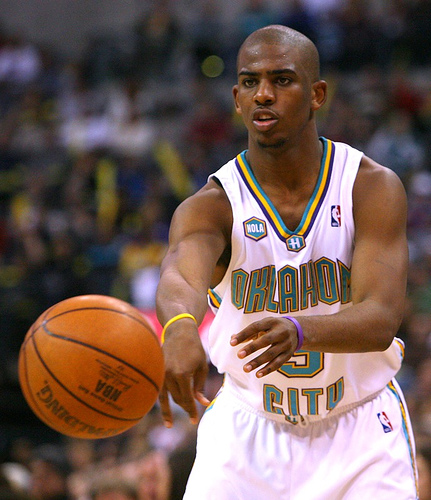
chris paul oklahoma city hornets

With that, OKC was welcomed into the professional sports brotherhood, even if it was only temporary. And Oklahomans voraciously ate it up. We had always wanted to eat at the big boy table, and now, from out of nowhere, this opportunity was bestowed upon us. Fans came in flocks to attend a New Orleans/Oklahoma City (NOK) Hornets game. The uncertainty of how long the team would stay kept some people from becoming too attached to the team. But even with that, the team sold out over half of its games that were played in Oklahoma City. The Hornets, who had finished last in attendance the previous season, went from averaging 14,221 fans to 18,168 fans, which was a 78% increase.

With the revenue goals, not only met, but vastly exceeded, and New Orleans still in rebuild mode, the team and the NBA decided that Oklahoma City would get another season of Hornets basketball. With that increase in revenue, the team decided to trade for defensive center Tyson Chandler and sign sharp-shooter Peja Stojakovic to a near max contract. OKC would get 35 home games, while New Orleans would get the remaining 6 home games.

Attendance started strong, with OKC selling out 6 of their first 10 home games. But when the word came that it was a certainty that the Hornets would return to New Orleans, attendance, understandably, waned a bit. But it was during that time frame, that another domino got put into place.

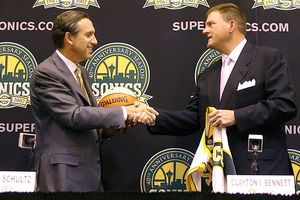
schultz bennett sonics thunder

After failing to buy a majority stake of the Hornets from Shinn, Clay Bennett decided to set his sights on the Seattle Supersonics. The Sonics, and Stern for that matter, had been embroiled in a bitter dispute with the city over the viability of their venue, Key Arena. After putting the money up for the baseball stadium and the football stadium, the city was not in the mood to pay over $500 million to subsidize another arena.

The team’s then owner Howard Schultz was losing money because of the team’s lease with the arena, and because of attendance issues. He sold the team to an outsider hoping that even the veiled threat of relocation would send the city into action to build a brand new arena. Instead, the city passed Initiative-91 which prohibited Seattle from supporting teams with city tax dollars. This initiative basically doomed any new stadium being built in the city of Seattle.

Clay Bennett gave the city an ultimatum of 12 months to approve a plan for a new arena. When that time ran its course, he put in motion plans to move the team to Oklahoma City. He was met with opposition and litigation, but in the end, the city felt it would be better if Bennett payed a hefty sum to get out of the lease instead of waiting the lease out and getting nothing in return.

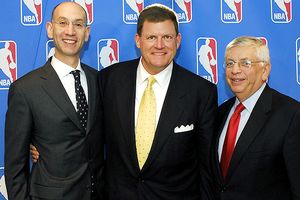
bennett silver stern nba thunder

Adam Silver took over for Stern as NBA Commissioner on February 1st, 2014. But much like the space between presidential election day and presidential inauguration day, the real Silver era doesn’t begin until after the All-Star break. This space in between from Feb 1st – 14th is more of a hybrid era where we praise the exiting commish and wonder what the new commish has in store.

So in this hybrid period, I just wanted to say to Mr. Stern, “Thank you.” Thank you for giving Oklahoma City a chance at proving it’s worth as a pro-sports city. The process of OKC getting a team was a messy mixture of tragedy, finances, and politics. A lot like Marlon Brando’s character in The Godfather, Stern acted as an objective facilitator to Oklahoma City and helped us step into the world of professional sports.

Trade Talk and the Importance of Jeremy Lamb

Utah Jazz v Oklahoma City Thunder

The trading deadline in the NBA may be February 20th, 2014, but the date that gets a lot of the movement started is December 15th, 2013. That is the date when most free agents who signed in the offseason become eligible to be traded. As that date approaches, the inevitable trade chatter starts to ramp up. If you are a team that holds many desirable assets such as good, young players on rookie pay scales, multiple first round picks, and expiring contracts, then your name is bound to show up in a lot of the trade talk.

And that is where the Oklahoma City Thunder currently find themselves. With young bench players on rookie scale contracts that are performing surprisingly well and a couple of semi-attractive expiring contracts (namely Kendrick Perkins and Thabo Sefolosha), that trade chatter has already started to rev up about the Thunder. Sam Amico of Fox Sports Ohio had the following quip on his NBA Notes from December 9th:

Multiple league sources have said the Oklahoma City Thunder are willing to deal second-year guard Jeremy Lamb if they can find a more experienced (and consistent) player to come off the bench. Lamb has already been traded once – from the Rockets as part of the James Harden deal before last season.

Then Bill Simmons on NBA Countdown suggested that the Thunder should trade Lamb, Perkins, and 2 first round picks to the Orlando Magic for Arron Afflalo. Now this would usually be seen as conjecture on the part of a media pundit, but a lot of fans around the country see Simmons as something of an NBA savant who is the end all/be all when it comes to NBA information/predictions.

Adding fuel to the trade talk fire, Reggie Jackson, who has been performing almost at ‘Harden as a 6th man’-like levels throughout the season, recently signed with powerhouse sports agency CAA. This is the same agency that represents Dwayne Wade, Tony Parker, Chris Paul, and Carmelo Anthony to name a few, and also partners with Roc-Nation, who represents Jackson’s teammate Kevin Durant. Did I mention that Jackson has a possible extension looming this offseason? Scary thought, especially when we all remember what happened the last time a great Thunder bench player was up for an extension.

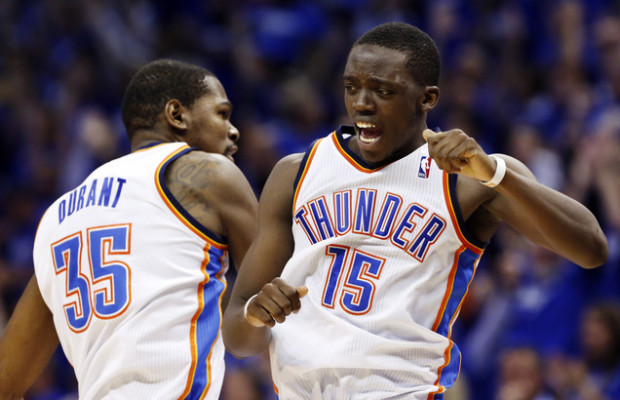
Kevin Durant, Reggie Jackson

Whenever these trade talks start to ratchet up in December, it’s always important to remember the previous 3 months when there were hardly any trade talks. That period from September through November is usually reserved for roster building and evaluation. Yes, big trades do happen during that time frame, as we saw with the Harden trade last season, but those types of transactions are usually reserved for February, June, and July. When the trade talk is quietest amongst media members is actually when the trade talk is loudest amongst GMs. It is during this roster building and evaluation period that GMs try to gauge the interest of the “tradeable” assets on their rosters. It is when the posturing and positioning of “GM chess” occurs.

When you hear phrases like “multiple league sources”  or “an Eastern/Western Conference GM said”, just know that the news coming from that report may not be current. Take for example Jeremy Lamb, who was a very attractive asset heading into this season. The Thunder probably did their due diligence in June during the NBA draft to see if there was anything of value that they could get for Lamb. Also, during the preseason, when Lamb was struggling with his shot, there was probably some probing by Thunder GM Sam Presti to see if anyone would bite in return for an experienced bench player. But that was when Lamb was an unknown commodity, not only on the court, but also to other teams. But now, after averaging 10.5 points and 2.5 rebounds on 53% FG shooting and 39% 3pt FG shooting over the past 12 games while playing good defense, Lamb is not only a known commodity, but also a key component for a championship contending team. While the rumors of the Thunder shopping Lamb may be true, they may also be 3-6 months old.

jeremy lamb thunder 2

If you follow the Thunder and are familiar with their salary cap structure, then you would know that they value production at a low cost. The ability to take one player and flip him into 2 or 3 players of great value while preserving their cap space was one of the main reasons the Thunder traded James Harden. Could history repeat itself with Reggie Jackson? That will be the most pressing issue for the Thunder moving forward. But, while there are similarities between the Harden/Jackson comparisons, there are also differences. The Thunder are a lot better equipped to handle a contract extension for Jackson now, than they were when it was time for Harden to be extended. By the time Jackson’s extension kicks in, Sefolosha, Perkins, and, (God forbid) Nick Collison’s contracts will all be expired. That’s almost $15 million in available salary to play with. The good thing is, Jackson won’t command a max or near max contract. When I think of Jackson, I don’t think of a top 5 player at his position. Two years ago, you could argue that Harden was the 3rd best shooting guard in the league, even if he was coming off the bench. You can’t say the same about Jackson at this point in his career. Also of note is that Harden was traded in the offseason, not in the middle of the season. The Thunder wouldn’t dare trade Jackson during the season when he is arguably their 4th best player. If anything, they’ll Harden-ize him during the offseason.

Which brings me back to Lamb. This is why it is completely asinine to think that the Thunder would want to trade Lamb. His most important asset to the Thunder at this moment is as an insurance policy. If the Thunder decide to either trade Sefolosha before the deadline or allow him to walk in the offseason, they can feel comfortable in the fact that they have a player in Lamb capable of starting for them either after the deadline or into next season. If the Thunder decide to trade Jackson in the offseason, they know that they have a player that can provide offense off the bench and can play with the starters during crunch time. In the grand scheme of things, Lamb may be the piece that makes other moves possible.

5 for 5: Tragedies, Courtrooms, and Beginnings

kd russ

5 for 5: The Longest Shortest Season  |  5 for 5: The Rivalries  |  5 for 5: The Run  |  5 for 5: The Thunder’s Godfather

This past season, the Oklahoma City Thunder completed their 5th season in the state of Oklahoma. In a world dominated by round numbers, getting to the midway point is always a cause for celebration. In any relationship, you look back at key moments that made it possible to arrive at certain anniversary marks. In the next few weeks heading into training camp, I’ll be looking at 5 defining moments that made it possible for the Thunder to not only roar into the Plains, but also to do it in winning fashion.

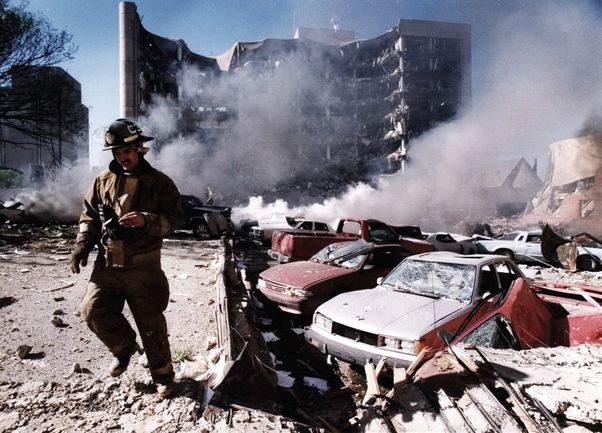
For the first defining moment, you have to, of course, start at the beginning. But, it’s not the beginning that you think. While the Thunder were established in 2008, the road to having them in OKC began in December 1994. It was during that time that Timothy McVeigh visited and decided that the Alfred P. Murrah Federal Building would be the site of his mayhem.

After meticulously planning and gathering the necessary materials, McVeigh, and his accomplice Terry Nichols, put their plan into action for April of 1995. They rented a Ryder moving truck on April 15th in Kansas and packed it with its deadly payload on the 17th and 18th. The next day, they drove down to Oklahoma City where, at 9:02 AM, they detonated the 4,800 pound monster that resided inside of the Ryder truck. The blast completely dismantled the north side of the building leaving countless people injured and 168 dead in its wake. It was the deadliest terroristic attack on US soil that the nation had seen up to that point.

okc bomb

Once the smoke cleared though, the choice was clear. We would not stand to be known by the evil of the tragedy, but by the fortitude with which we recovered. We chose to be known by the way we rose together, instead of by the way we momentarily got knocked down. That mindset, which comes naturally to Oklahomans, galvanized us to remember those lost, while also promising them that we would rise stronger than before. The possibilities were there, but the question was how would be we get there?

While the Metropolitan Area Projects Plan (MAPS) had already been approved for by the beginning of 1994, the bombing acted as a catalyst to make MAPS a rousing success. One of the things that MAPS brought with it was a state of the art arena called the Ford Center that could host concerts and sporting events, especially hockey and basketball. Opening in 2002, the Ford Center served its purpose hosting top notch concerts, preseason basketball games, and minor league hockey. Continue reading 5 for 5: Tragedies, Courtrooms, and Beginnings

Oklahoma City Thunder: Ballin’ on a budget

westbrookdurantibaka

Growing up, there were two things I was heavily into other than girls: hip-hop and basketball. I grew up in a time when hip-hop was having an internal war within itself. What started off as a rebellious outlet of expression for the poor and struggling turned into an over-expression of opulence and decadence. Hip-hop went from being mostly underground in the 80’s to completely mainstream in the 90’s. That entrance into mainstream pop culture led to many rappers getting rich quick. But as quickly as the money came, it left, leaving many rappers bankrupt and back to where they started.

During this same time period, many of my friends and I were just starting to work. And work means money management, right? Considering I have no idea where my teenage money went, I would say I did a poor job of managing my money. But it’s funny what sticks with you from your teenage years. One of my real good friends, Ryan Rivera, came up with a phrase that still resonates to this day, not only with myself, but also with my team, the Oklahoma City Thunder. The phrase was, “Ballin’ on a budget”.

Basically, it’s finding ways to live good without destroying your bank account or credit score. It’s not easy and it takes a lot of work. A person wanting to ball on a budget has to have patience and self control. The urge to “keep up with the Joneses” can completely destroy any plan to stay within a budget. Many people in the world live outside of their means in order to put on the face of success. Nice shiny things equates to success in the minds of many. Ballin’ on a budget also takes a lot of work. You can either go to Dillards and pay $80 for a Gucci shirt, or you can bargain hunt at Ross and pay $14.99 for the same or similar looking shirt. The work comes in looking for the right bargain. You almost have to become a hustler to succeed in this venture. Bargain deals may not be sexy, but they’ll get the job done with less overhead.

presti

It’s the position where the Thunder find themselves at this juncture. With two trips to the Western Conference Finals, one trip to the NBA Finals, and one number 1 seeding in the Western Conference within the last 3 seasons, this team is definitely ballin’. But they’ve been doing it on a budget to this point. Thunder GM Sam Presti has built a championship contending team through great drafting, salary wheelings and dealings, and difficult decision making.

The current collective bargaining agreement has made things a bit difficult for small market teams that are toeing the line between being tax payers and non-tax payers. What was intended to be a punitive rule to defend against overspending by big market teams, has turned into another instance of “the more things change, the more they remain the same”. The Brooklyn Nets have gone into this offseason acting like a cancer patient that just won the lottery screaming YOLO! at everyone he sees. The Nets are projected to pay upwards of $80 million dollars in luxury tax this season, but they have an owner who seems hellbent on winning a title, no matter the cost. The Los Angeles Lakers, New York Knicks, and Miami Heat have also been consistent payers of the luxury tax for the past 3 seasons.

bird

This brings up the difficult question: How are small market teams supposed to compete? In a recent interview with Darnell Mayberry of The Oklahoman, Indiana Pacers president Larry Bird made no qualms about the state of his team and how it compares to the Oklahoma City Thunder,

“Our owners went out and have done everything they could this year so we could be up close to the tax. We just can’t fight the tax. It’s always going to be a disadvantage for us. I feel bad for Oklahoma. They had a great team and they had to make a trade (James Harden trade). They were right there. But we’re going to have to do the same in the future. We’re always fighting an uphill battle with revenues. But that’s part of who we are. And we do the best we can with what we have.”

The key to competing in sports as a small market is to remain patient and look for the right deals. The goal of a big market team is to win at any cost. But the goal of a small market team is to remain consistently sustainable. Teams like the San Antonio Spurs, Pacers, and Thunder thrive on being able to compete year in and year out. I believe that’s part of the reason why the Spurs, who have won 4 championships since 1999, have never been able to repeat. They’ve remained consistently great, but have never been able to consistently spend like the bigger market teams to continuously improve their team on a yearly basis with no regard for payroll. There comes a point every couple of seasons where the Spurs have to retool with younger, less expensive players. Eventually those younger players gain the necessary experience to perform in pressure filled moment, but the team suffers in those “learning seasons”.

a thunder

That’s what I call last season for the Thunder. It was a learning season. After the Harden trade, the team didn’t really hit a consistent rhythm until the end of the season. And with all that, they still ended up with the No. 1 seed in the Western Conference and were probably a Russell Westbrook knee injury away from making it to a 3rd consecutive Western Conference Final. Next season will probably be another learning season, as the bench lost its leading scorer when Kevin Martin signed with the Minnesota Timberwolves. With many fans clamoring for the Thunder to make a move to replace the scoring lost by Martin’s departure, the team has remained steadfast in trusting the young players they already have. Reggie Jackson showed last year in the playoffs what he is capable of after replacing Westbrook when he went down with his injury. Jeremy Lamb has performed well in Summer League and is expected to be a key contributor off the bench next season. And centers Steven Adams and Daniel Orton have performed surprisingly well in Summer League as rim protectors and, dare I say, offensive threats.

To many, this may seem like a cheap move by the owners of the team. With how good the team looked at the end of the regular season, it seemed like they were a resigned Martin and another bench scorer away from being an even stronger contender than they were when they made it to the Finals. With Martin’s bird rights in hand and the full MLE at their disposal, many thought the Thunder were finally going to jump into the deep end of the pool and join the other tax-paying teams. Instead, they allowed Martin to go to Minnesota in a sign and trade (that netted the Thunder a $6.6 million dollar traded player exception) and haven’t touched any of their available pre-tax cap space, which comes out to about $1.28 million dollars. That’s at least enough to sign someone to the veteran minimum. While the pool of free agents has gotten significantly smaller since July1st, there are still viable players available for the taking. So the question becomes: What are the Thunder waiting for?

martin_wolves_lm1_130109

That is where the virtue of patience comes into play. For one thing, it’s only July. Many fans are panicking because of the moves made by other organizations, especially within the Western Conference. The Los Angeles Clippers resigned Chris Paul, traded for Jared Dudley and JJ Reddick, and hired a much better coach in Doc Rivers. The new “it” team, the Houston Rockets won the Dwight Howard sweepstake and landed a couple other veteran free agents. But, championships aren’t won in July; they are won in June. A team can stack a roster full of great players in July that may amount to nothing more than a first round exit the next April. Secondly, the organization has never said that they won’t pay the tax. They know that to be competitive, you may have to eventually pay the tax. But if you don’t have to pay the tax yet, why pay it? Along with more punitive luxury tax restrictions, the new CBA also instituted a repeater tax for teams that have paid the luxury tax for 3 consecutive seasons. With the escalating salaries of Kevin Durant, Russell Westbrook, and Serge Ibaka, the longer you can hold off on being a tax-payer, the more financially competitive you’ll be. And lastly, you still have Kevin Durant, Russell Westbrook, and Serge Ibaka. As long as those three guys are healthy, I think the Thunder have a fighter’s chance in any game.

The Thunder aren’t cheap. They’re just smart about how they manage their money. They already have a large percentage of the cap space allotted to the 3 players they deem the most important to the franchise. The reason the Thunder are perceived as cheap, though, is because they never had to “buy” any of those players in free agency. They drafted and developed them, and luckily, they turned out to be superstars. But sometimes, difficult decisions need to be made in order to maintain the financial flexibility that is tantamount to small market team success. That’s what happened in the Harden trade. The Thunder had 4 great players, but couldn’t pay 4 near max to max contracts. Ibaka helped the team by taking what is perceived to be a less than market value contract. Hoping that Harden would do the same, the Thunder drew a line in the sand, and said “here’s our final offer, take it or leave it”. When Harden rejected the offer, the team made the decision to move Harden to Houston. The situation was never a choice between Ibaka or Harden. But to make the numbers work, the team needed Harden to leave some money on the table, and for a young guy heading into his first foray into free agency, he just couldn’t do that.

Serge Ibaka, Russell Westbrook, James Harden, Kevin Durant

Being a money conscious team is not sexy at all. Following a team that is run on the principles of patience and bargain shopping is not for the faint of heart. You watch other teams stack their teams with what you perceive to be good to great players, while you’re constantly having to hope that your players continue to improve in the offseason and that the veteran minimum center you signed actually can play the game of basketball. It’s a tough life, I know. But I wonder how Miami Marlins’ fans really feel about their two championships. The Marlins organization went all in for two runs at a title, and then completely dismantled the team after each title. While the feeling of winning a championship can never be replaced, I wonder what the feeling of watching your championship team be completely dismantled the following offseason feels like. Luckily, I don’t think I’ll ever have to know what that feels like.

The Thunder and the 32nd pick

draft pj 3

The Oklahoma City Thunder hold 3 draft picks in this upcoming draft. They have two in the first round, No.12 and 29, and one in the second round, No. 32.  While people are usually enamored by the first round picks, it’s the early second round picks (No. 31-35) that hold more value to teams. It’s an opportunity to grab first round talent without the constriction of a guaranteed contract. Here’s a list of notable players that have been drafted in the 31-35 range in the last 5 season: Nikola Pekovic, Mario Chalmers, DeAndre Jordan, Kyle Singler, Jeffery Taylor, Jae Crowder, Draymond Green. The difference in talent from the last 5 picks of the first round and the first 5 picks of the second round is infinitesimal.

For teams holding a slot in those first 5 picks of the 2nd round, it is an opportunity not only to draft a talented player, but also to procure a trade for an asset. The fact that a team can take a flyer on a player without having to offer a guaranteed contract, makes these picks more valuable than those in the lower end of the first round. These picks becomes doubly valuable before the beginning of a maddening free agency season. When teams vying for free agents want to clear cap space and/or not take on anymore guaranteed salary, they dump players and first round picks in exchange for high second round picks.

presti

Thunder general manager Sam Presti took advantage of this during the last frenzied free agency class, where he also owned the 32nd pick. We arm-chair GM’s love to talk about the would’ves, could’ves, and should’ves. But we have that beautiful thing called hind-sight in our back pockets. Real NBA GM’s don’t have that advantage, but those few great  GM’s have a little thing called foresight. While we focus on our team in the present tense, great GM’s look at the health of other franchises and plot how they can take advantage of their needs. Presti is great at this and seems to be on the prowl again in this draft.

On July 27th, 2009, the Thunder traded Damien Wilkins and Chucky Atkins to the Minnesota Timberwolves for Etan Thomas and 2 second round picks. Most people thought this was just one of those offseason trades where a team trades 2 bench players for another bench player. But the haul in that trade was actually the 2nd round pick that turned into No. 32 in the 2010 NBA draft.

Etan Thomas, Andrew Bynum

The 2010 offseason was known for one thing and one thing only….the summer of Lebron. That was the offseason where most of the bumper crop from the 2003 draft class was coming up on their 2nd extensions, while other players like Amare Stoudemire, Carlos Boozer, and Joe Johnson were also coming up on unrestricted free agency. If you were a team that believed in quick fixes, this was the summer for you. While a handful of teams were trying their hardest to unload as much salary as possible, the other teams were more than willing to take on decent players (salary) and first round picks.

The Thunder had assets galore in the 2010 draft with 3 picks in the first round (18, 21, and 26) and 2 picks in the second round (32 and 51). The consensus with most teams is that you don’t head into training camp with five rookies. So, the Thunder knew they had to wheel and deal to get what they wanted in this draft, which was a defensive minded big man and more assets. Their first move was to trade the 32nd pick to Miami for the 18th pick and Daequan Cook. Miami was looking to cut salary to position themselves for the summer of Lebron. The Thunder knew they couldn’t get what they wanted at 18, so they traded it to the Clippers for a future first rounder. They eventually traded up to the 11th pick where they picked Cole Aldrich. The future first rounder from the Clippers helped to facilitate the trade with the Boston Celtics for Kendrick Perkins at the trading deadline that following season.

benchmob

There are a lot of similarities between this offseason and the 2010 offseason. First off, the top tier in this free agency class includes some franchise players, such as Chris Paul, Dwight Howard, Andrew Bynum, and Josh Smith. Secondly, these free agents are available and willing to hear out every offer on the table. Thirdly, there are team already vying to dump salary and 1st round draft picks to clear cap space. And, fourthly, the Thunder have the 32nd pick.

The story behind the 32nd pick is akin to the story of Hebrews wandering in the desert for 40 years in the book of Exodus. A little bit of controversy, a little bit of disobedience, and finally back to where it ultimately needed to be. On December 19, 2011, the Thunder traded Byron Mullens to the Charlotte Bobcats for their unprotected 2013 2nd round pick. Simple, right? Wrong! When the Thunder traded for Perkins, they sent Nenad Krstic and Jeff Green to Boston along with that Clippers draft pick. Everything was going good until doctors discovered the following season that Green was suffering from an aortic aneurysm, would need immediate surgery, and would miss the entire 2011-12 season. Boston contended that Oklahoma City knew of this condition previous to the trade. On June 16, 2012, the NBA decided to give Boston the Charlotte pick as compensation for the Green debacle. On July 20, 2012, the Celtics traded the pick to the Houston Rockets as part of a three team trade for guard Courtney Lee. Finally, on October 27, 2012, the pick was sent back to Oklahoma City as part of the James Harden trade. I’ve joked that, to everyone outside of Oklahoma City, the trade between OKC and Houston will be known as the James Harden trade. But to the people in Oklahoma City, the trade will be known as the “reacquisition of the Charlotte 2nd round pick” trade.

Oklahoma City is in prime position to make a significant move to improve their team in this draft. The rumor mill is already rampant with teams wanting to dump salary and picks for a chance at one of the top tier free agents. Adrian Wojnarowski of Yahoo!Sports reported that Houston is looking to unload the No. 5 pick from last season’s draft, Thomas Robinson, in order to clear further cap space. Chad Ford of ESPN.com reported that the Dallas Mavericks were looking to trade away the No. 13 pick in order to avoid the $1.6 million cap hold that the pick carries. Also, Atlanta has picks 17 and 18, but are also looking to throw their hat in the free agency fray. There will be plenty of opportunities to nab a necessary piece on this draft day.

Chris Bosh, LeBron James, Dwyane Wade, Carmelo Anthony

Also, there is one more thing to look out for in this draft. There might be an epic free agency class coming up next offseason. Lebron James, Carmelo Anthony, Chris Bosh, and Dwayne Wade all have early termination options to become free agents in 2014. Add to that, the 2014 NBA draft is predicted to be a lot stronger than this draft class, and you have the perfect storm for further wheelings and dealings. Look for the Thunder to not only get what they need in this draft, but also to pick up assets for the 2014 draft. Let the madness begin!

New Orleans Hornets vs. Oklahoma City Thunder preview (Game 57 of 82)

Austin Rivers, Robin Lopez, Kendrick Perkins, Russell Westbrook

  • When: Wednesday, 27 February 2013 at 7:00 PM CST
  • Where: Chesapeake Energy Arena, Oklahoma City, OK

Home, sweet home. After suffering their first 3-game losing streak since last season’s Finals, the Thunder were looking to rebound with three straight home games. And rebound they have, winning the first two games of the home stand by an average of 23 points. While Kevin Durant continues to be mired in a slight slump, Russell Westbrook has stepped his game up to the tune of 25.1 points, 6.4 assists, 4 rebounds, and 2 steals per game in the month of February, while shooting 50.6% from the field and 45.8% from the 3-point line. Serge Ibaka has also been much more impactful in his play during the home stand which has provided the Thunder with some semblance of a post presence.

Reggie Jackson, Xavier Henry

The Thunder and New Orleans Hornets have met 3 times this season, with OKC coming out on top in the first two games by an average of 18 points. In the third meeting, the Thunder needed a late second half spark from then seldom used point guard Reggie Jackson to come back and win a close game, 92-88. Since that game, Jackson has solidified himself as the back-up point guard for the team, supplanting Eric Maynor.

The Opponent

hornets

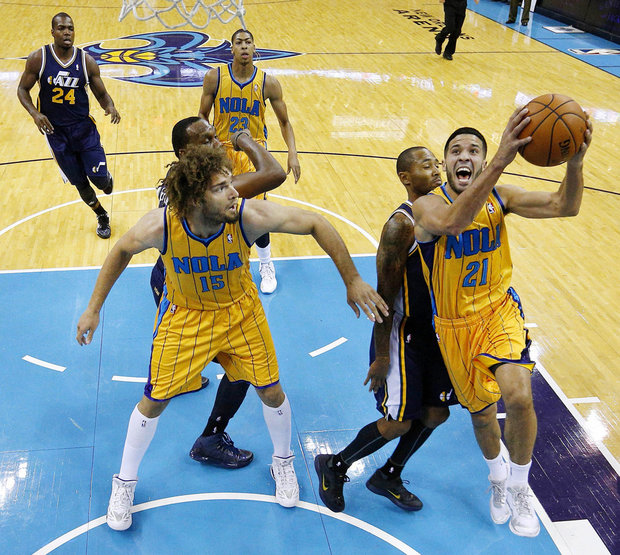
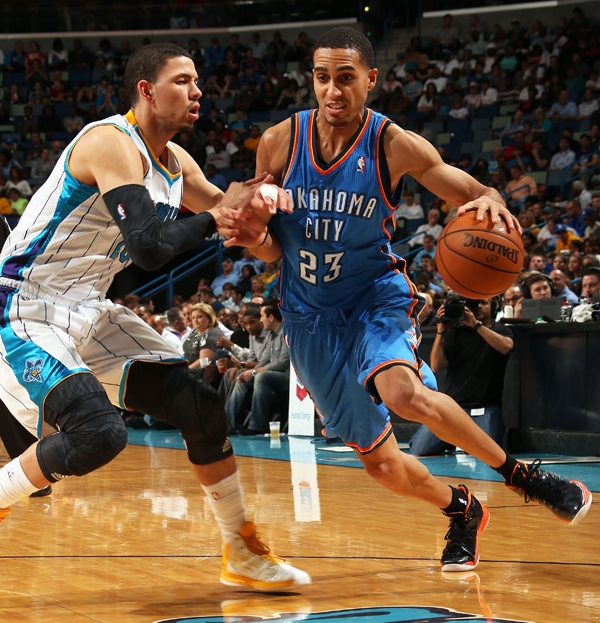
The New Orleans Hornets come into the game 20-38 record, good for 13th in the conference. The Hornets are in the midst of a rebuilding project following the Chris Paul/David West years. Statistically, they rank in the bottom half of the league in nearly every category. Offensively, they only score 94.5 points per game (22nd in the league), and defensively, they allow a respectable 97.3 points per game (13th in the league). They are paced by point guard Greivis Vasquez, who is averaging 13.7 points, 9.4 assists, and 4.6 rebounds per game. Shooting guard Eric Gordon, oft injured since being acquired from the Los Angeles Clippers last season, has come back in the past 20 games, and is averaging 16.7 points while working his way back from knee surgery. Although Al-Farouq Aminu is given a bad rap as having a low basketball IQ, he is the glue of the team, providing anything from points to boards to defense. Up front, the team depends on rookie Anthony Davis and center Robin Lopez who supply respectable post defense and rebounding. Off the bench, the Hornets are led by stretch power forward Ryan Anderson, one of the premier 3-point shooters in the league. The rest of the bench is inconsistent with rookies Austin Rivers and Brian Roberts being one of the focuses of the rebuilding project.

Probable Starter

New Orleans Hornets

  • PG – Greivis Vasquez
  • SG – Eric Gordon
  • SF – Al-Farouq Aminu
  • PF – Anthony Davis
  • C – Robin Lopez

Oklahoma City Thunder

  • PG – Russell Westbrook
  • SG – Thabo Sefolosha
  • SF – Kevin Durant
  • PF – Serge Ibaka
  • C – Kendrick Perkins

3 Keys to the Game

1. Tempo – With this being the 2nd game of a back to back for the Hornets, the Thunder need to push the pace, and get out in transition whenever possible. It’s very surprising that the Hornets, while being a very young team, do not push the tempo. They are very similar to the Memphis Grizzlies in that respect. Also, the 2nd team for the Thunder will be chopping at the bit with new additions Ronnie Brewer and Derek Fisher ready to play in their first game of the season for the Thunder.

brewer fisher

2. Perimeter defense – With Eric Gordon and Ryan Anderson on the floor, the Hornets have guys that can catch fire quickly from the perimeter. While Lopez and Davis are of some threat to score down low, the Thunder defense does not need to sink in on most possessions to help out.

martin hornets

3. Kevin Martin – For some reason, Martin loves playing against the Hornets. He averages 21 points, 4.3 rebounds, and 2 assists per game against the Hornets, by far, his best statistical team split of the season.

Westbrook and The Boost

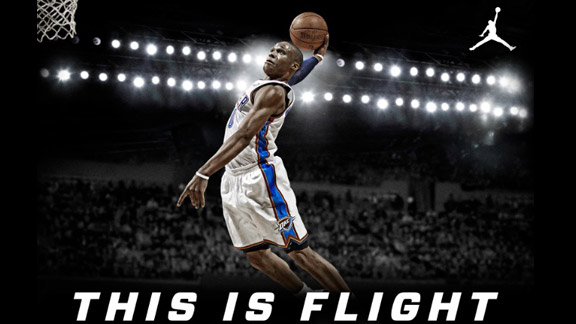
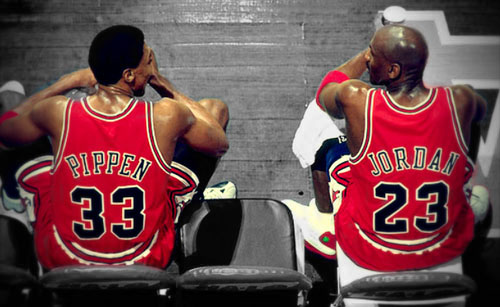
This past week, Russell Westbrook signed with Jordan Brand, after being with Nike for the first 4 years of his career. While Westbrook has carved out his own following of fans, he’s always been known as Kevin Durant’s sidekick. The Robin to Durant’s Batman. This generation’s ultimate second banana. There hasn’t been a sidekick this good since Scottie Pippen. But, Pippen never received the boost in popularity that Westbrook is about to receive.

What qualifies for a sidekick? A sidekick has to be a rookie or a very young player that is brought in after the primary player is established to specifically fill the needs the team is missing. Another qualification is that the pairing has to be together for 5+ seasons. For example, Scottie Pippen was obtained by the Chicago Bulls in a draft day deal, while already having an established superstar in Michael Jordan. Russell Westbrook was drafted by the Seattle Supersonics (Oklahoma City Thunder) after they already had an established young star in Kevin Durant. Anfernee Hardaway almost made it to great sidekick status, but injuries and Shaquille O’Neal’s departure to the Los Angeles Lakers negated that possibility. The Lebron James/Dwayne Wade/Chris Bosh mash-up wouldn’t qualify as sidekicks because they were all alpha males on their respective teams before they joined forces. Kobe Bryant and the aforementioned O’Neal made a great duo, but they were brought onto the Lakers the same year and often quibbled over who was the alpha male. 

To understand the road Westbrook is on, it is important to see what happened to Pippen throughout his career. When Pippen first started college at the University of Central Arkansas, he was a 6’1” walk-on that needed to moonlight as the team’s manager to pay his tuition costs. After 3 more collegiate seasons, a 7 inch growth spurt, and consensus All-NAIA player honors, Pippen was drafted with the 5th overall pick in the 1987 NBA draft to the Seattle Supersonics (who subsequently traded him to the Chicago Bulls). The scouting report on him read as follows:

  • 7’4” wingspan and a 41” vertical
  • Strong outside, but needs work inside
  • Not bad driving to the hoop, but doesn’t look to drive
  • Good foul shooter
  • Can make a three
  • Terrific passer at that position
  • Won’t give you much of anything on the offensive glass, and is a so-so defensive rebounder
  • Excellent defensively and a disruptive force in the passing lanes
  • Good ball handler, but commits a ton of turnovers
  • Could start on most teams

Not necessarily the sexiest of scouting reports for someone who would eventually become one of the top 50 players in league history. While Pippen built his legacy on defense, he was also an apt offensive player, becoming the archetype for the point forward position. During his prime (1989-1999), Pippen had per game averages of 19.1 points, 7.1 rebounds, 5.9 assists, 2.2 steals, and 0.9 blocks. Not necessarily the offensive prowess that Larry Bird possessed, but with a stat line like that, Pippen should have been heralded as his generation’s defensive Larry Bird. Instead, he was teamed up with arguably the greatest player of any generation in Michael Jordan. There usually isn’t a lot of spotlight left when you are playing with the greatest. Ask 100 people who the lead singer of Aerosmith is, and most will answer Steven Tyler. Ask them who the drummer is, and not many will know the answer.

Pippen’s play on the court should have spurred him to more shoe deals, more advertisement contracts, and more widespread popularity. And yet, when his career was all said and done, you couldn’t help but wonder whether Pippen got everything that was owed to him. There were the stories of how Pippen felt he wasn’t getting paid what he deserved (which he wasn’t). There were the rumors that he felt slighted being outside of the limelight, when he provided so much to the team. While he did have his own shoe line (the PIPs) from Nike, they only lasted about two series. So, needless to say, not many companies bought into Scottie Pippen.

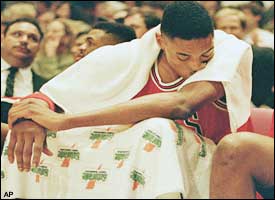
It wasn’t Jordan’s fault, though. Most of the blame lies squarely on Pippen. He didn’t have the same tact with the media that Jordan did. He was dismissive and defensive at times with reporters. Then there were the crunch time situations. Those critical times in games that live in lore and become mythologized. It’s not that Pippen didn’t perform well during those times. On the contrary, he performed great during crunch time. But he’s instead remembered for the times he quit on his team in the most critical of moments. There was the time he sat out Game 7 of the 1990 Eastern Conference Finals against the Detroit Pistons with a migraine headache. The Bulls eventually lost that game. Probably the most damning, though, was the one where he sat out the final 1.8 seconds of Game 3 of the 1994 Eastern Conference Semifinals against the New York Knicks because Phil Jackson drew up a play for Toni Kukoc to take the final shot, instead of Pippen. To make matters worse, Kukoc actually hit the game winner. This one was the most damaging because it came at a time when the Bulls were his team due to Jordan’s hiatus into baseball. When you are known to quit on your team during crucial periods, your popularity takes a big hit.

Which brings us to the best sidekick of this generation, Oklahoma City Thunder guard Russell Westbrook. Like Pippen, Westbrook was not highly decorated coming out of college. Like Pippen, Westbrook was drafted by a team that already had a young star in Kevin Durant. Like Pippen, Westbrook is seen as not being very media friendly. Coincidentally, Durant, much like Jordan, is viewed as a media favorite. And, while not by his own doing, Russell was also involved in a critical game snafu, when Thunder coach Scott Brooks sat an ineffective Westbrook for the entire 4th quarter of Game 2 of the 2011 Western Conferences Finals.

But, not everything is negative when it comes to Pippen and Westbrook. Both of these players are insanely loyal to their teams and teammates. Pippen had a couple opportunities to seek greener pastures during the championship run, but decided to sign for less to stay with the Bulls. Westbrook could have done the same last season, but decided to sign for the allowable max. Both players are highly competitive, with possible chips on their shoulders from being labeled second bananas. Both players are very team oriented, as evidenced by them sacrificing a little of their own games to coexist with two great players. The good severely outweighs the bad when it comes to Westbrook and Pippen, but the bad usually has more advertising power.

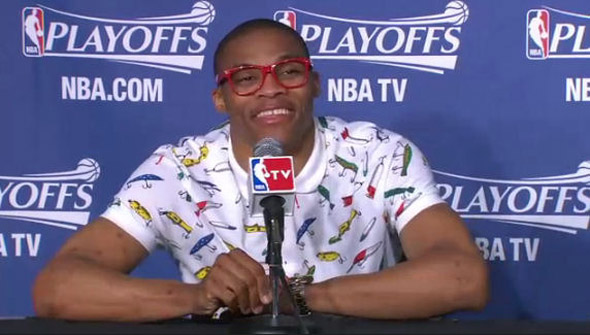
Which is why I found the signing of Westbrook to Jordan brand to be a bit ironic. Not ironic in the sense that he doesn’t deserve it. But ironic in the sense that a move like this will probably propel Westbrook into superstar territory, as far as media exposure goes. Into a territory that Scottie Pippen unfortunately never reached. With an endorsement team that includes Carmelo Anthony, Derek Jeter, Chris Paul, and Michael Jordan, himself, Russell Westbrook will have plenty of opportunity to expand his brand. He already has a slogan in place (WhyNot?), and already has a following outside of basketball because of his unique fashion sense. In a way, Jordan is helping this generation’s top sidekick become what his sidekick should have become.

OKC Thunder: Training Camp Roundtable

Special thanks to the contributions by Zebulun Benbrook of Welcome To Loud City (WTLC) and by one of the smartest basketball minds I know, Max Trueblood (MTB). 
With the turning of the seasons, there are two things you can always look forward to: colder weather and the start of NBA training camps (unless there’s a lockout). Most of the players are already setting up shop in their NBA cities, preparing for the upcoming season. No matter how familiar you are with your team, a new season always brings about new questions. Here are a couple of questions in regards to the beginning of training camp for the Oklahoma City Thunder:  

  • 1)      With the recently finished strike shortened season, a trip to the Finals, and involvement in an Olympic tournament, how do you think Scott Brooks will handle Kevin Durant, Russell Westbrook, James Harden, and Serge Ibaka during training camp?
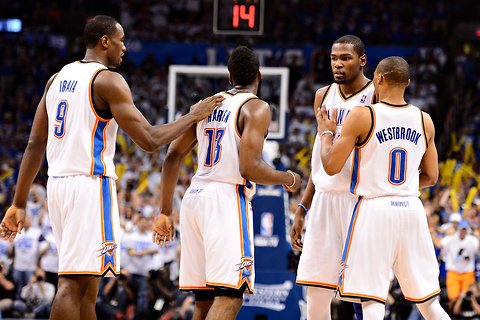
NTTB: I think they will limit their availability in preseason games, but I don’t think they will limit their training camp practice time. Last season, teams hardly got any practice time due to the compacted schedule. Less practice time meant less time to try new schemes and less time to build cohesion. Luckily for the Thunder, they brought back their entire core and all of their coaching staff from the previous season and didn’t need the practice time in training camp to indoctrinate new players or learn new schemes. This year it’s more of the same, but with more time for practice. Despite their age, the Thunder are a veteran team and the extra practice time will be invaluable to the younger Thunder players, such as Reggie Jackson, Cole Aldrich, Perry Jones III, and Hasheem Thabeet.

WTLC: Once players get to a certain point of their careers, I think you’ve gotta give them room to breathe. Durant and company have proven themselves in the context of the NBA, and while they have room for improvement, they’re pretty much known quantities in the sense of what they can and can’t do. My thought is that Training Camp will focus on the younger guys on the team, like Cole Aldrich, PJ III, and Reggie Jackson. And I’d like to think that it will focus on trying to get them adjusted to the team, rather than improving a certain skill. The Summer League and D-League are more focused on personal improvement, in my opinion.

As for the stars, I’ve gotta think Scott Brooks will make it business as usual. Everybody’s extra motivated after the Finals loss, and they are coming off of a break, even if it is shorter than normal. The NBA season is a long grind, and if you can’t make it through training camp, you probably won’t be able to make it through the dog days of January, either. I think what’s important to remember is that part of the reason Tim Duncan is so successful is that, even in his old age, he still allows Gregg Popovich to coach him like he was a rookie. It sends a message to the rest of the team about how to act, and what it takes to make it to the top. If Durant, Westbrook, Harden, and Ibaka act the same way, then we’re in for a long road of success.

MTB: I’m usually not a fan of preferential treatment for superstar players but given the busy off season for the “Big 4”, I wouldn’t have a problem with them getting a few days off here and there.

 Let’s not forget, this has basically been 3 straight busy off seasons for KD. He had the World Championships in 2010, then played in just about every street ball game imagineable last summer and of course the Olympics this time. 

  • 2)      Out of Daniel Orton, Hollis Thompson, DeAndre Liggins, and Andy Rautins, who earns the coveted 15th spot on the team, and why?
NTTB: I’d say it’s a two man battle between Hollis Thompson and DeAndre Liggins. These two players are both long, which fits into the Thunder’s DNA, with Liggins being more defensive minded, and Thompson being more of a 3-point shooter. With so much of the offense being predicated on dribble penetration, the team would probably benefit from another shooter on the team. So, I would give the nod to Thompson, with Orton, Liggins, and Rautins leading the Tulsa 66ers the NBDL title. 

WTLC: Well, that’s a tough one. I haven’t seen too much of Hollis Thompson, but he’s pretty much the Perry Jones of the second round. He was considered a legitimate prospect and worked out for several teams, but a lot of teams decided to draft and stash Europeans with their later picks, letting him fall off the board. It really depends on how well he can return from his groin injury, and whether he’s really enough of a scorer to be considered better than Daequan Cook, or Andy Rautins. Rautins will be a good litmus test to see how good Thompson really is. Rautins is an excellent shooter, but he’s not very dynamic, which is why he’s never really caught on in the NBA. I’d only see him making the roster is Thompson doesn’t really pan out.

The strongest candidate, aside from Thompson, to make the roster is DeAndre Liggins. He didn’t get too much time with the Magic last year, but he was very efficient in how he played. He never took an unreasonable shot, and he he has good defensive awareness. He’s kind of like Kyle Weaver, but with a bit less energy. The big knocks on him are that his shot is extremely inconsistent (he’s airballed open threes) and that he works best under a slow pace, which doesn’t help when you’re playing with a fast breaking team like the Thunder.

The other guy on the list is Daniel Orton, but I think he’s really only there for the hometown appeal, as he went to Bishop McGuiness. When you see how many big men the Thunder have stockpiled, and the fact that Orlando didn’t re-sign him despite being really thin at center, seeing him make the roster seems like a pipe dream.

MTB: I’m going to roll with Andy Rautins on this one. I think the Thunder have tons of athleticism so an athlete like Liggins or Thompson isn’t really needed but with the team possibly cutting back on bench payroll in anticipation of retaining Harden at a max salary, I could see Presti seeing if Cook has a short term replacement and that would be a shooter. Rautins is the best of the group.

  • 3)      Heading into training camp, how will Perry Jones IIII fit into the rotation, if at all?

NTTB: With Kendrick Perkins coming back from two offseason surgeries and Nick Collison bound to suffer from one of his yearly training camp injuries (sore groin, sore ankle, sore knee, etc), I’m pretty sure we’ll get some idea how he will fit into the rotation right away. He’ll get a lot of reps in practice in our small ball lineups and that’s primarily where I see him being used in the rotation during the season.

WTLC: He won’t be a rotation guy. There’s too few minutes to split with Cole Aldrich, and Thabeet is probably ahead of him due to his previous NBA experience. It really all depends on how he does in training camp, but I don’t think he’ll see regular minutes unless there’s an injury or Cole Aldrich doesn’t live up to expectations.

MTB: I wouldn’t mind seeing Perry get some time in the D league this year. If Serge or Collison get hurt, he can always be called up from Tulsa.

I don’t know enough about Jones to really gauge where his confidence is but lots of young players lose confidence when they get drafted well below where they were expected to be taken. Of course, there are exceptions. Rashard Lewis and Deandre Jordan come to mind. But getting big minutes and success on the D league level could wind up being what’s best in the long run for him. 

  • 4)      With other teams making significant moves to get better (Lakers acquiring Dwight Howard and Steve Nash / Miami acquiring Ray Allen and Rashard Lewis), is there any way that the Thunder got better without making any major moves? 
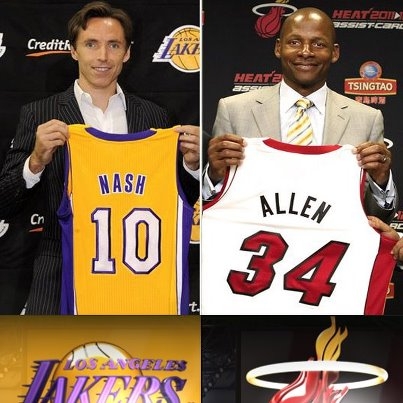
NTTB: I think we’ll get better organically because of our youth, but the line on the organic improvement line graph is probably starting to plateau. There’s probably not much more that these guys can do, besides averaging a triple double for a season, that would register as far as team improvement goes. Getting Perry Jones III in the draft negated any necessity to obtain a scoring big. I expect the Thunder to be a big player after the trading deadline, though, for a veteran big man.

WTLC: Well, we got better in the sense that we’ll have another year under our belts to develop. How much that will translate into next year remains to be seen. The Thunder were really sputtering late in the season, dropping a lot of winnable matchups and letting non-playoff teams come back from huge deficits. But when you get right down to it, the Thunder have the talent to beat the Heat and the Lakers. What they need to do is come up with more creative solutions for their obvious flaws.

But on a tangible level, there is improvement in sight. Cole Aldrich might be more of an offensive threat than Nazr Mohammed was, and he was working on a hook shot while in the Summer League. Kendrick Perkins will be fully recovered from his injury. Eric Maynor will be returning, offering a steady offense and a refreshing break from Derek Fishers’ 0fers and terrible defense. Serge Ibaka’s jumpers are getting come consistent. And, of course, James Harden will have had the experience of being on a boat.

MTB: I think the Thunder got better just based on the fact that their star players haven’t hit their prime years yet. It’s rare that All star caliber players take a step back before they hit their prime so I see the Thunder getting better via the internal improvement route. 

  • 5)      Are the Thunder now this season’s participant in the reality show drama known as the “player vs team negotiation” game that the media will incessantly babble about for possibly the next 300 days?
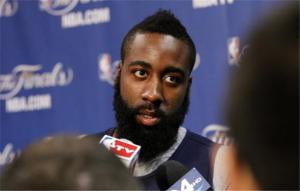
 NTTB: I don’t think so. There are two players out in LA that will be causing a bigger stir with their impending free agency (Dwight Howard and Chris Paul). Plus, the Thunder organization is very hierarchal in nature, and if the top (owner Clay Bennett and GM Sam Presti) remains quiet, you can bet the bottom (players and coaches) will remain quiet. This will not be an issue at all this season. It wasn’t an issue when Westbrook’s extension was in play and it won’t be an issue with Harden’s being in play.   

WTLC: Yes, 100 times yes. If there’s one thing the media love to babble on about, its’ contract negotiations. Nevermind the fact that the Thunder are a title threat now, what are we going to do when Kevin Durant comes off of contract in 2016?! Aye aye aye. Just bring on the basketball, man. I’ll worry about the size of James Harden’s penthouse later. 
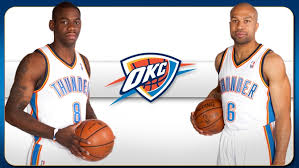
MTB: I sincerely hope not. I’m really hoping that Presti and Harden’s representation can just come out and say that they will table negotiations until next summer. That will take the media out of the picture and will simultaneously take the pressure of Harden. Let’s see what type of numbers he can put up and then negotiate a contract based on production.

In conclusion…..one more week!!!!!!!