Tag Archives: Carmelo Anthony

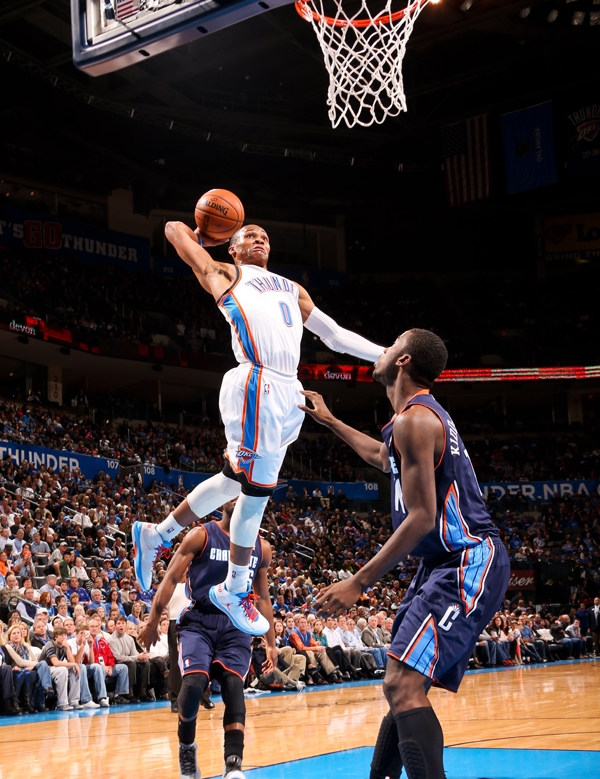
Oklahoma City Thunder at Charlotte Bobcats preview (Game 29 of 82)

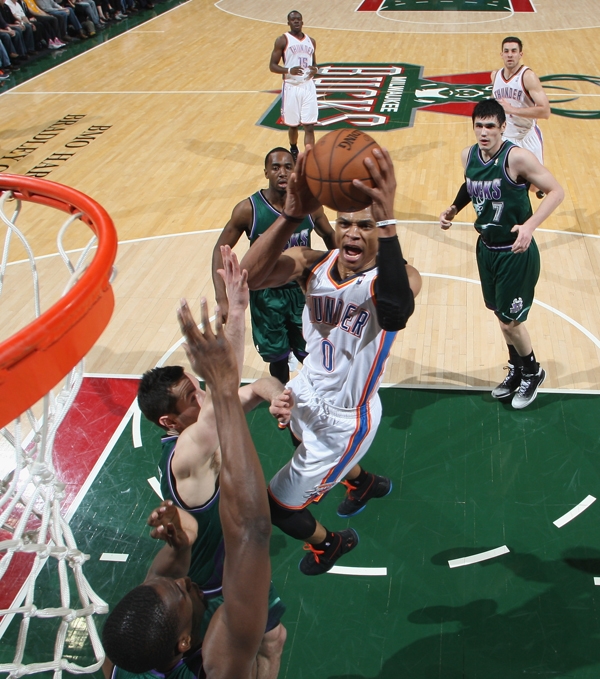
westbrook kidd gilchrist thunder bobcats

  • When: Friday, 27 December 2013 at 6:00 PM CST
  • Where: Time Warner Cable Arena, Charlotte, NC

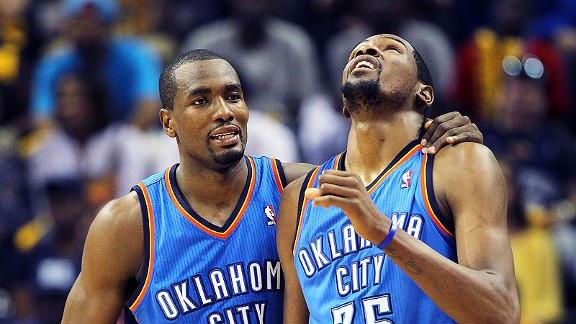
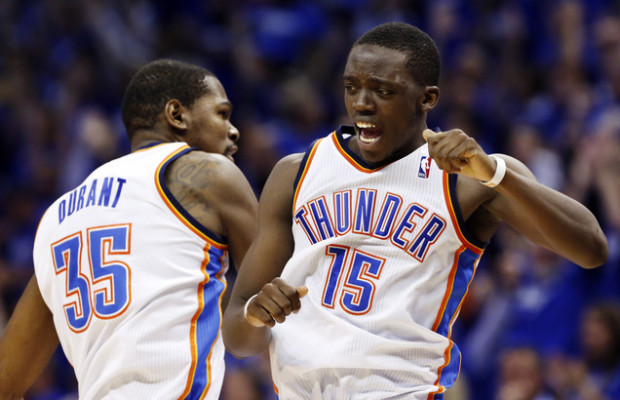
Coming off of a rousing performance in Madison Square Garden on Christmas, the Oklahoma City Thunder look to keep things going as they travel to Charlotte to take on the Bobcats. In that Knicks games, Russell Westbrook secured a triple double by the middle of the third quarter and Kevin Durant and Serge Ibaka combined for 53 points on 20/30 shooting. The bench played spectacularly and kept their foot on the pedal for all of the 4th quarter. Of course, the Thunder were aided by the fact that Carmelo Anthony and Raymond Felton were out because of injury.

The Thunder won the season series against the Bobcats last season 2-0. The most memorable of those games was the one played in Oklahoma City, where Charlotte came into the game with a 7-5 record and a little bit of a puffed up chest. The Thunder proceeded to take a 40 point lead into halftime and tacked on 5 more points by the end of the game. The loss was so severe that Charlotte didn’t win another game for over a month. The Thunder have won 5 straight meetings between the two teams encompassing the last 3 seasons.

The Opponent

zeller tolliver walker henderson jefferson bobcats

In the midst of all the carnage that is the Eastern Conference, it’s good to know that one of the teams with a losing record is actually improving from last season. Charlotte didn’t win their 14th game last season until March 12th, but already stand at 14-15 this season. The defense is much improved under new head coach Steve Clifford, and the team is finding ways to win close games. They’re the 2nd worst scoring team in the league, at 92.4 points per game, but combat that by being the 3rd best at opponent’s points per game, at 93.6. The Bobcats’ offense is initiated, and usually, finished by PG Kemba Walker. Joining him in the back court is Gerald Henderson, who is quietly one of the better 2-way guards in the Eastern Conference. Up front, free agent acquisition Al Jefferson has paid dividends, almost averaging a double double with averages of 16.7 points and 9.6 rebounds. Their bench depth has been decimated by injuries lately, with Jeff Taylor going down with an Achilles tear and Michael Kidd-Gilchrist still recovering from a broken hand.

Probable Starting Line-Ups

Charlotte Bobcats

  • PG – Kemba Walker
  • SG – Gerald Henderson
  • SF – Anthony Tolliver
  • PF – Josh McRoberts
  • C – Al Jefferson

Oklahoma City Thunder

  • PG – Russell Westbrook
  • SG – Thabo Sefolosha
  • SF – Kevin Durant
  • PF – Serge Ibaka
  • C – Kendrick Perkins

EDIT: Russell Westbrook had arthroscopic knee surgery and will be out for 6-8 weeks.

3 Keys to the Game

1. Force the issue – The Bobcats have depth issues due to injuries. Drive the ball inside and try to force fouls. The more fouls you force, the more the chances that someone like Jeff Adrien or Jannero Pargo will have to minutes.

2. Perimeter defense – Al Jefferson will do what he does. The key will be not completely collapsing on him and giving streak shooters like Walker and Ben Gordon the opportunity to heat up.

durant ibaka thunder

3. Small ball – We usually react to teams and play small ball in response to their line-up. I think this would be a good game to force the Bobcats to play small ball. A line-up where Jefferson and McRoberts would have to keep up with Ibaka and Durant would be wonderful for transition opportunities.

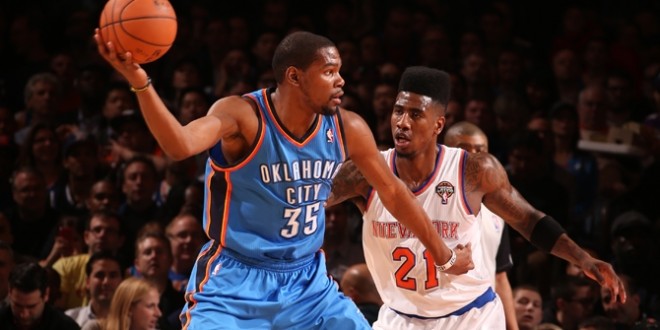
Oklahoma City Thunder at New York Knicks preview (Game 28 of 82)

durant shumpert knicks thunder

  • When: Wednesday, 25 December 2013 at 1:30 PM CST
  • Where: Madison Square Garden, New York, NY

One of the major storylines heading into this season was the Battle of New York. Who would take the Big Apple: the New York Knicks or the Brooklyn Nets. While there may still be a competition between the two teams, the two teams have woefully underachieved to the point where their meetings are only of regional importance, not national importance. The good news for both teams is that the Eastern Conference is so bad that they are still in the thick of things as far as playoff seeding goes.

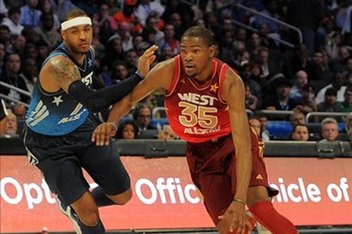
This Christmas match up is the first meeting of the season between the two teams. The teams split the season series last season as Kevin Durant and Carmelo Anthony battled for the scoring championship. Anthony ended up winning the scoring title 28.7 ppg to Durant’s 28.1 ppg.

The Opponent

iman-shumpert-knicks-carmelo-anthony-tyson-chandler

The Knicks come into the game with a 9-18 record, which surprisingly finds them only 2 games out of the 8th seed. The Knicks came into this season with high expectations, but the season started in turmoil after JR Smith was suspended for the first 5 games due to a substance abuse violation and Tyson Chandler came down with a broken leg a week into the season. Add to that the unknown that is Amare Stoudemire’s health and the seemingly frayed relationship between the team and SG Iman Shumpert, and you have a recipe for chaos…which has ensued. The Knicks, thought to be one of the more offensively minded teams with Anthony, Smith, and Raymond Felton at the helm, find themselves scoring only 95 ppg, good for 25th in the league. Surprisingly, they are one of the better defensive teams in the league, in terms of opponent’s ppg at 97.9 ppg, good for 8th in the league.

Probable Starting Line-Ups

New York Knicks

  • PG – Beno Udrih
  • SG – J.R. Smith
  • SF – Iman Shumpert
  • PF – Carmelo Anthony
  • C – Tyson Chandler

Oklahoma City Thunder

  • PG – Russell Westbrook
  • SG – Thabo Sefolosha
  • SF – Kevin Durant
  • PF – Serge Ibaka
  • C – Kendrick Perkins

3 Keys to the Game

1. Perimeter Defense – The Knicks are currently a jump shooting team that isn’t making their jump shots. That doesn’t mean that they don ‘t have gunners on their team that can’t catch fire on any given game. This will be key to the Thunder’s success in this game. Stay on the shooters and limit their opportunities at open looks.

westbrook smith thunder knicks

2. Bench play – With the Knicks bench being so decimated by injury, especially at the guard position, look for the Thunder to take advantage of this with Reggie Jackson, Jeremy Lamb, and Derek Fisher.

3. Wounded animal – Don’t discount the Knicks being at home and playing with a mentality of a wounded animal. Primetime game, MSG, prime Western Conference opponent. You can be sure the Knicks will be giving the Thunder their best shot. Hopefully, the Thunder remember the Toronto game and come out sharper for this one.

To all my readers – Thank you for your support and Merry Christmas. I hope you enjoy your day with friends and family, and as always, THUNDER UP!!

Trade Talk and the Importance of Jeremy Lamb

Utah Jazz v Oklahoma City Thunder

The trading deadline in the NBA may be February 20th, 2014, but the date that gets a lot of the movement started is December 15th, 2013. That is the date when most free agents who signed in the offseason become eligible to be traded. As that date approaches, the inevitable trade chatter starts to ramp up. If you are a team that holds many desirable assets such as good, young players on rookie pay scales, multiple first round picks, and expiring contracts, then your name is bound to show up in a lot of the trade talk.

And that is where the Oklahoma City Thunder currently find themselves. With young bench players on rookie scale contracts that are performing surprisingly well and a couple of semi-attractive expiring contracts (namely Kendrick Perkins and Thabo Sefolosha), that trade chatter has already started to rev up about the Thunder. Sam Amico of Fox Sports Ohio had the following quip on his NBA Notes from December 9th:

Multiple league sources have said the Oklahoma City Thunder are willing to deal second-year guard Jeremy Lamb if they can find a more experienced (and consistent) player to come off the bench. Lamb has already been traded once – from the Rockets as part of the James Harden deal before last season.

Then Bill Simmons on NBA Countdown suggested that the Thunder should trade Lamb, Perkins, and 2 first round picks to the Orlando Magic for Arron Afflalo. Now this would usually be seen as conjecture on the part of a media pundit, but a lot of fans around the country see Simmons as something of an NBA savant who is the end all/be all when it comes to NBA information/predictions.

Adding fuel to the trade talk fire, Reggie Jackson, who has been performing almost at ‘Harden as a 6th man’-like levels throughout the season, recently signed with powerhouse sports agency CAA. This is the same agency that represents Dwayne Wade, Tony Parker, Chris Paul, and Carmelo Anthony to name a few, and also partners with Roc-Nation, who represents Jackson’s teammate Kevin Durant. Did I mention that Jackson has a possible extension looming this offseason? Scary thought, especially when we all remember what happened the last time a great Thunder bench player was up for an extension.

Kevin Durant, Reggie Jackson

Whenever these trade talks start to ratchet up in December, it’s always important to remember the previous 3 months when there were hardly any trade talks. That period from September through November is usually reserved for roster building and evaluation. Yes, big trades do happen during that time frame, as we saw with the Harden trade last season, but those types of transactions are usually reserved for February, June, and July. When the trade talk is quietest amongst media members is actually when the trade talk is loudest amongst GMs. It is during this roster building and evaluation period that GMs try to gauge the interest of the “tradeable” assets on their rosters. It is when the posturing and positioning of “GM chess” occurs.

When you hear phrases like “multiple league sources”  or “an Eastern/Western Conference GM said”, just know that the news coming from that report may not be current. Take for example Jeremy Lamb, who was a very attractive asset heading into this season. The Thunder probably did their due diligence in June during the NBA draft to see if there was anything of value that they could get for Lamb. Also, during the preseason, when Lamb was struggling with his shot, there was probably some probing by Thunder GM Sam Presti to see if anyone would bite in return for an experienced bench player. But that was when Lamb was an unknown commodity, not only on the court, but also to other teams. But now, after averaging 10.5 points and 2.5 rebounds on 53% FG shooting and 39% 3pt FG shooting over the past 12 games while playing good defense, Lamb is not only a known commodity, but also a key component for a championship contending team. While the rumors of the Thunder shopping Lamb may be true, they may also be 3-6 months old.

jeremy lamb thunder 2

If you follow the Thunder and are familiar with their salary cap structure, then you would know that they value production at a low cost. The ability to take one player and flip him into 2 or 3 players of great value while preserving their cap space was one of the main reasons the Thunder traded James Harden. Could history repeat itself with Reggie Jackson? That will be the most pressing issue for the Thunder moving forward. But, while there are similarities between the Harden/Jackson comparisons, there are also differences. The Thunder are a lot better equipped to handle a contract extension for Jackson now, than they were when it was time for Harden to be extended. By the time Jackson’s extension kicks in, Sefolosha, Perkins, and, (God forbid) Nick Collison’s contracts will all be expired. That’s almost $15 million in available salary to play with. The good thing is, Jackson won’t command a max or near max contract. When I think of Jackson, I don’t think of a top 5 player at his position. Two years ago, you could argue that Harden was the 3rd best shooting guard in the league, even if he was coming off the bench. You can’t say the same about Jackson at this point in his career. Also of note is that Harden was traded in the offseason, not in the middle of the season. The Thunder wouldn’t dare trade Jackson during the season when he is arguably their 4th best player. If anything, they’ll Harden-ize him during the offseason.

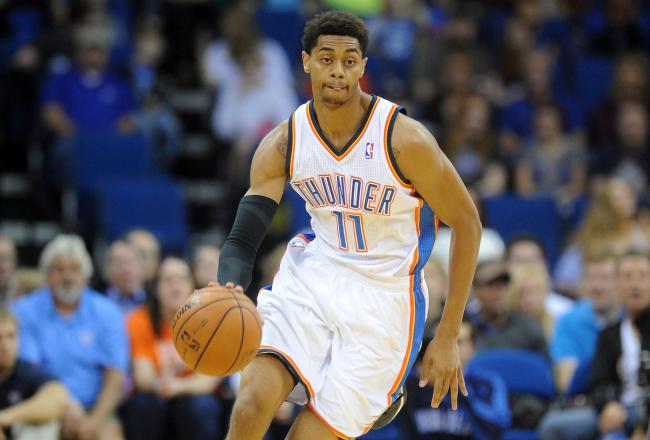
Which brings me back to Lamb. This is why it is completely asinine to think that the Thunder would want to trade Lamb. His most important asset to the Thunder at this moment is as an insurance policy. If the Thunder decide to either trade Sefolosha before the deadline or allow him to walk in the offseason, they can feel comfortable in the fact that they have a player in Lamb capable of starting for them either after the deadline or into next season. If the Thunder decide to trade Jackson in the offseason, they know that they have a player that can provide offense off the bench and can play with the starters during crunch time. In the grand scheme of things, Lamb may be the piece that makes other moves possible.

Trains of Thought: Thunder and the 2013 Draft

NBA: NBA Draft

Approaching a draft, there are always differing trains of thought as to whom a team should choose. A team has to analyze what their needs are and if they can realistically draft a player that will fill said need(s). This is especially true if you are holding one of the lottery picks. Teams picking in these first 14 slots usually have a plethora of needs to address. But for a championship contending team like the Oklahoma City Thunder, who have many of the necessary cogs already in place, a pick in the lottery can be the final piece of the puzzle to get the team over the hump. 

darko

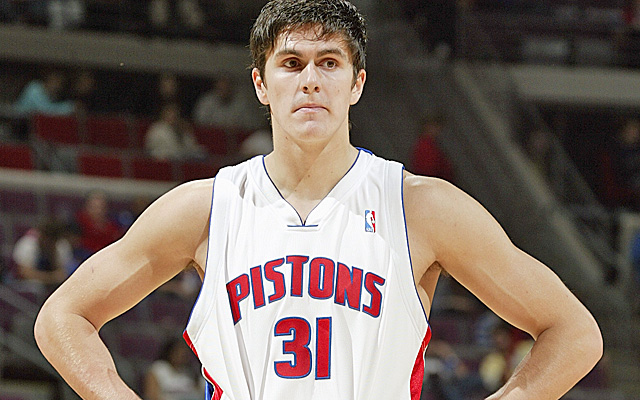
Drafting a final piece is not always guaranteed to get a team over the hump, though. In the summer of 2003, the Detroit Pistons had just come off a trip to the Eastern Conference Finals and also held the No. 2 pick in the upcoming draft, which was loaded at the top. Easy pickings, right? Get the 2nd best player available and you should be set for the next 5 years. But success and good fortune can sometimes make you think you are smarter than you really are. In a draft where the Pistons could have chosen any of Carmelo Anthony, Dwayne Wade, or Chris Bosh, they instead decided to go with the experimental Euro-project named Darko Milicic. Even though the Pistons won the championship the next season, it had nothing to do with Milicic, who was famously tagged as the “human victory cigar” due to the bulk of his playing time coming at the end of blowout victories. The Pistons went on to lose in the NBA Finals in the next season and played in 3 consecutive Eastern Conference Finals after that. Add that up, and in a 6 year span, the Pistons played in 6 consecutive ECFs, went to the Finals twice, and won one championship. Nothing is guaranteed, but I think the number of championships would have increased if the Pistons had drafted one of the other players mentioned above. 

Granted, this draft is not as loaded as the 2003 draft was. But the Thunder find themselves in a position to draft a position of need, instead of having to pay for it through free agency or trade for it. There are probably two trains of thought for what type of the player the Thunder should draft with the 12th pick: either a defensive minded big man capable of developing some semblance of an offensive game or a scoring wing adept at making perimeter shots. In other words, either a replacement for Kendrick Perkins or a replacement for James Harden. The big man pick is more targeted towards future success, while the perimeter wing would be for more immediate results.

pacers

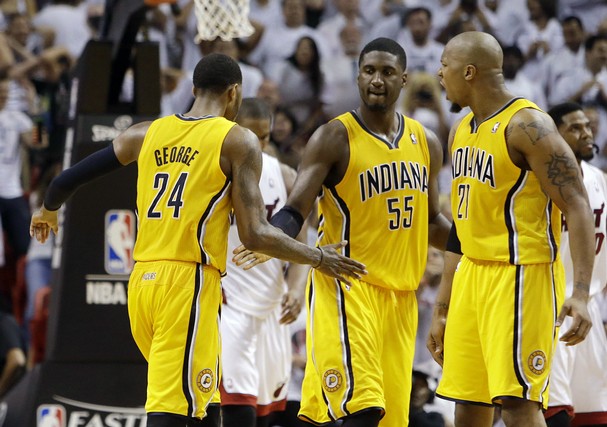
The conference finals and NBA Finals have given the Thunder a blueprint as to what they need for sustained success. In the Eastern Conference Finals, the Indiana Pacers showed what two competent big men can do against the Miami Heat. David West and Roy Hibbert gobbled up offensive rebounds and scored in the paint, almost at will. In the Finals, the San Antonio Spurs have shown that playing the same brand of basketball as the Heat (dribble penetration and 3-point shooting) can befuddle and frustrate them, especially if the opponent is hitting 3-pointers at a 45% clip.

Train of Thought No. 1 – Big Man

perk ii

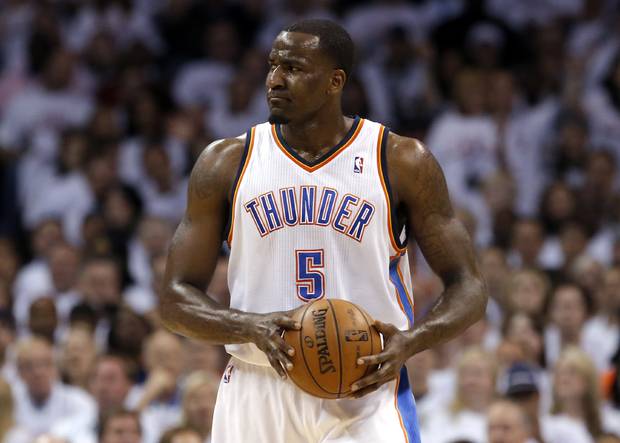
Everybody knows I love crazy uncle Perk (Kendrick Perkins). For a person who grew up on 90’s basketball, Perkins’ style of play harks back to that physical era. But, truth be told, he laid a complete goose egg in the playoffs this season. He surprisingly had a better run last post season when he played with a torn groin and a torn ligament in his wrist. That Perkins has no semblance of an offensive game is a known fact. But that is usually masked by constant attacking nature of Kevin Durant and Russell Westbrook. When Westbrook went out with his knee injury in the first round of the playoffs, that lack of an offensive game led to the further stagnation of an offense that was already compromised. It wasn’t just that Perkins couldn’t get the ball in the basket, it’s that he was a walking turnover. He had a negative PER in the playoffs and was a liability not just on the offensive end, but also on the defensive end. I didn’t even know negative PERs existed.

Needless to say, with 2 seasons left on Perkins’ contract, it may be time to start looking for his replacement sooner rather than later. Picking up a big man at this slot would be a pick for the future, as big men generally take longer to develop and no post player in this draft has that “ready to play now” look to them.

Before deciding what type of big man could be drafted, it’s important to see what is already in the cupboard. Besides Perkins, the other starter is Serge Ibaka, one of the most versatile power forwards in the NBA. In addition to leading the league in blocks for the 2nd consecutive season, Ibaka also has a deadly midrange game that occasionally stretches out to the 3-point line. His next stage of development should be to learn a post move or two. Off the bench, Nick Collison is a heady post player who plays good defense, can score inside, and can occasionally hit a midrange jumper. The only negative with Collison is that he is getting long in the tooth and starting to show signs of that. Hasheem Thabeet is an average center who is just now learning how to contribute 10-12 solid minutes per game. Perry Jones III is still in the initial stages of his development, but has the physical tools to become a solid contributor. And Daniel Orton is probably the odd man out in the game of big man roulette.

adams noel

Any post player selected will be drafted with the intent to eventually be the starting center. The Thunder tried that 3 seasons ago with Cole Aldrich, but he never panned out. If the Thunder’s system remains similar for the next 3-5 seasons, a player with Perkins’ toughness and defensive chops, but better offensive potential would probably be the selection. Players that fall in that category would be Alex Len, Steven Adams, Mason Plumlee, and Gorgui Dieng. If the Thunder decides to go for an offensive-minded big man, look for them to select Kelly Olynyk or Cody Zeller.

Train of Thought No. 2 – Perimeter Wing

harden

The Thunder have a little more flexibility here than with the center position. When the Thunder made the trade with Houston, they not only traded Harden, but also Daequan Cook. These floor spacers are very important when the bulk of your offense is dependent on two perimeter oriented players. The drive and dish becomes a lot more driving into defensive walls if the dishees aren’t reliable 3-point shooters, especially in the playoffs.

Seeing as the NBA is becoming more of a drive and dish league, having penetrators and 3-point shooters is tantamount to a team’s success. It used to be that if you had a great big man, you were almost guaranteed a deep playoff run. That began to change with the elimination of hand checking. Once that happened, it unshackled quick wing players to have a more prominent role in the offense. No longer were defenders able to keep quicker players at an arm’s length, thus eliminating their speed advantage. Now, defenses had to converge on the quicker players, which opened up shooters on the perimeter, especially on the 3-point line. And, as any kindergartener will tell you, 3 is more than 2 any day of the week.

Looking at the Thunder’s inventory when it comes to wing players, the Thunder already have two of the best dribble penetrators in the league, in Durant and Westbrook. Add to that Reggie Jackson, and the team has their fair share of attackers on the offensive end. What’s lacking on the team is the amount of shooters. Thabo Sefolosha has improved his 3-point shooting to the point where he’s effective, but his slow release make him a liability against teams with long defenders. Kevin Martin was, for the most part, an effective perimeter shooter, but his inconsistency and disappearing act in key games, proved to be a big problem for the Thunder. DeAndre Liggins is on the team for defensive purposes, and Jeremy Lamb was never given a chance to show his shooting chops on the NBA level, though he was very effective in the D-League.

ben-mclemore-dunk

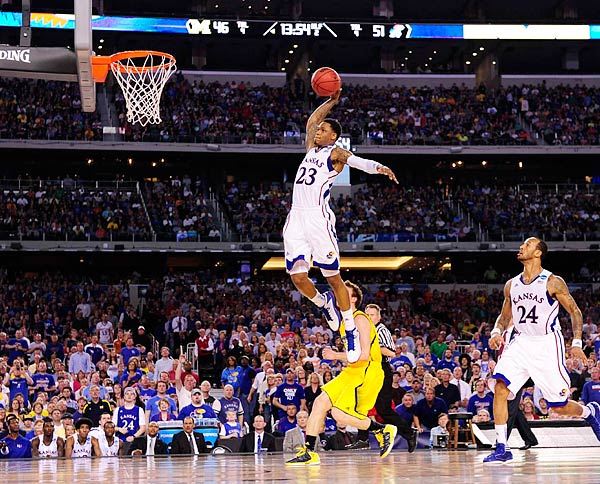
There are two choices for where the team wants to go with this train of thought. One choice is an instant offense type player off the bench. If this is the way the Thunder may be leaning, then look for them to choose CJ McCollum or Shabazz Muhammad. If the Thunder are looking for more of a complete player to eventually take over the shooting guard spot, then the options become Ben McLemore, Victor Oladipo, and Kentavious Caldwell-Pope.

The Thunder will go into draft day with a couple players in mind and counter moves for each situation. In my opinion, the Thunder are extremely high on about 5 players: McLemore, Len, McCollum, Adams, and Oladipo. I think it’ll all be dependent on where the players fall. If McLemore or Len slip down to the 4-6 range, I think the Thunder will throw every possible trade, not involving Durant, Westbrook, or Ibaka, at those teams in that range.

The good thing is that the Thunder have options. Their high 2nd round pick affords them the possibility of obtaining an extra first round pick from a team looking to involve themselves in this year’s free agency. The ability to put a package together with multiple 1st round picks and young players can be very enticing to a team that is rebuilding. Soon enough, it’ll be draft day and Thunder GM Sam Presti will be able to put his plan into play.

The Thunder and the 32nd pick

draft pj 3

The Oklahoma City Thunder hold 3 draft picks in this upcoming draft. They have two in the first round, No.12 and 29, and one in the second round, No. 32.  While people are usually enamored by the first round picks, it’s the early second round picks (No. 31-35) that hold more value to teams. It’s an opportunity to grab first round talent without the constriction of a guaranteed contract. Here’s a list of notable players that have been drafted in the 31-35 range in the last 5 season: Nikola Pekovic, Mario Chalmers, DeAndre Jordan, Kyle Singler, Jeffery Taylor, Jae Crowder, Draymond Green. The difference in talent from the last 5 picks of the first round and the first 5 picks of the second round is infinitesimal.

For teams holding a slot in those first 5 picks of the 2nd round, it is an opportunity not only to draft a talented player, but also to procure a trade for an asset. The fact that a team can take a flyer on a player without having to offer a guaranteed contract, makes these picks more valuable than those in the lower end of the first round. These picks becomes doubly valuable before the beginning of a maddening free agency season. When teams vying for free agents want to clear cap space and/or not take on anymore guaranteed salary, they dump players and first round picks in exchange for high second round picks.

presti

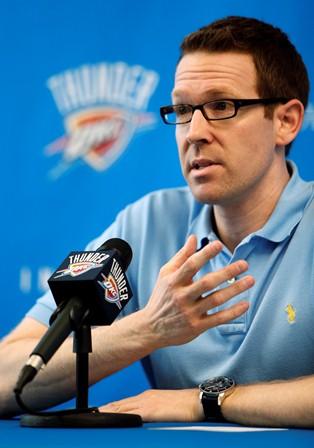
Thunder general manager Sam Presti took advantage of this during the last frenzied free agency class, where he also owned the 32nd pick. We arm-chair GM’s love to talk about the would’ves, could’ves, and should’ves. But we have that beautiful thing called hind-sight in our back pockets. Real NBA GM’s don’t have that advantage, but those few great  GM’s have a little thing called foresight. While we focus on our team in the present tense, great GM’s look at the health of other franchises and plot how they can take advantage of their needs. Presti is great at this and seems to be on the prowl again in this draft.

On July 27th, 2009, the Thunder traded Damien Wilkins and Chucky Atkins to the Minnesota Timberwolves for Etan Thomas and 2 second round picks. Most people thought this was just one of those offseason trades where a team trades 2 bench players for another bench player. But the haul in that trade was actually the 2nd round pick that turned into No. 32 in the 2010 NBA draft.

Etan Thomas, Andrew Bynum

The 2010 offseason was known for one thing and one thing only….the summer of Lebron. That was the offseason where most of the bumper crop from the 2003 draft class was coming up on their 2nd extensions, while other players like Amare Stoudemire, Carlos Boozer, and Joe Johnson were also coming up on unrestricted free agency. If you were a team that believed in quick fixes, this was the summer for you. While a handful of teams were trying their hardest to unload as much salary as possible, the other teams were more than willing to take on decent players (salary) and first round picks.

The Thunder had assets galore in the 2010 draft with 3 picks in the first round (18, 21, and 26) and 2 picks in the second round (32 and 51). The consensus with most teams is that you don’t head into training camp with five rookies. So, the Thunder knew they had to wheel and deal to get what they wanted in this draft, which was a defensive minded big man and more assets. Their first move was to trade the 32nd pick to Miami for the 18th pick and Daequan Cook. Miami was looking to cut salary to position themselves for the summer of Lebron. The Thunder knew they couldn’t get what they wanted at 18, so they traded it to the Clippers for a future first rounder. They eventually traded up to the 11th pick where they picked Cole Aldrich. The future first rounder from the Clippers helped to facilitate the trade with the Boston Celtics for Kendrick Perkins at the trading deadline that following season.

benchmob

There are a lot of similarities between this offseason and the 2010 offseason. First off, the top tier in this free agency class includes some franchise players, such as Chris Paul, Dwight Howard, Andrew Bynum, and Josh Smith. Secondly, these free agents are available and willing to hear out every offer on the table. Thirdly, there are team already vying to dump salary and 1st round draft picks to clear cap space. And, fourthly, the Thunder have the 32nd pick.

The story behind the 32nd pick is akin to the story of Hebrews wandering in the desert for 40 years in the book of Exodus. A little bit of controversy, a little bit of disobedience, and finally back to where it ultimately needed to be. On December 19, 2011, the Thunder traded Byron Mullens to the Charlotte Bobcats for their unprotected 2013 2nd round pick. Simple, right? Wrong! When the Thunder traded for Perkins, they sent Nenad Krstic and Jeff Green to Boston along with that Clippers draft pick. Everything was going good until doctors discovered the following season that Green was suffering from an aortic aneurysm, would need immediate surgery, and would miss the entire 2011-12 season. Boston contended that Oklahoma City knew of this condition previous to the trade. On June 16, 2012, the NBA decided to give Boston the Charlotte pick as compensation for the Green debacle. On July 20, 2012, the Celtics traded the pick to the Houston Rockets as part of a three team trade for guard Courtney Lee. Finally, on October 27, 2012, the pick was sent back to Oklahoma City as part of the James Harden trade. I’ve joked that, to everyone outside of Oklahoma City, the trade between OKC and Houston will be known as the James Harden trade. But to the people in Oklahoma City, the trade will be known as the “reacquisition of the Charlotte 2nd round pick” trade.

Oklahoma City is in prime position to make a significant move to improve their team in this draft. The rumor mill is already rampant with teams wanting to dump salary and picks for a chance at one of the top tier free agents. Adrian Wojnarowski of Yahoo!Sports reported that Houston is looking to unload the No. 5 pick from last season’s draft, Thomas Robinson, in order to clear further cap space. Chad Ford of ESPN.com reported that the Dallas Mavericks were looking to trade away the No. 13 pick in order to avoid the $1.6 million cap hold that the pick carries. Also, Atlanta has picks 17 and 18, but are also looking to throw their hat in the free agency fray. There will be plenty of opportunities to nab a necessary piece on this draft day.

Chris Bosh, LeBron James, Dwyane Wade, Carmelo Anthony

Also, there is one more thing to look out for in this draft. There might be an epic free agency class coming up next offseason. Lebron James, Carmelo Anthony, Chris Bosh, and Dwayne Wade all have early termination options to become free agents in 2014. Add to that, the 2014 NBA draft is predicted to be a lot stronger than this draft class, and you have the perfect storm for further wheelings and dealings. Look for the Thunder to not only get what they need in this draft, but also to pick up assets for the 2014 draft. Let the madness begin!

Milwaukee Bucks vs. Oklahoma City Thunder preview (Game 82 of 82)

bucks russ

  • When: Wednesday, 17 April 2013 at 7:00 PM CST
  • Where: Chesapeake Energy Arena, Oklahoma City, OK

The final regular season mission has been completed. While we didn’t obtain home court advantage throughout the playoffs, we did earn home court advantage throughout the Western Conference playoffs. This accomplishment has earned us the right to treat the final regular season game like a preseason game. Limited minutes for the regulars and heavy minutes for the young guys at the end of the bench.

Other than a feather in the cap, the Milwaukee Buck have nothing to gain by winning this game, either. I wouldn’t be surprised if their regulars got plenty of rest also. The game may turn into something similar to a D-League All-Star game with all the young guys out there. Reggie Jackson, Jeremy Lamb, Perry Jones III, Daniel Orton, and DeAndre Liggins may give a glimpse to what the Thunder bench may look like next season. The Thunder won the last meeting against the Bucks using a 19-2 run in the 4th quarter to erase a 5 point deficit.

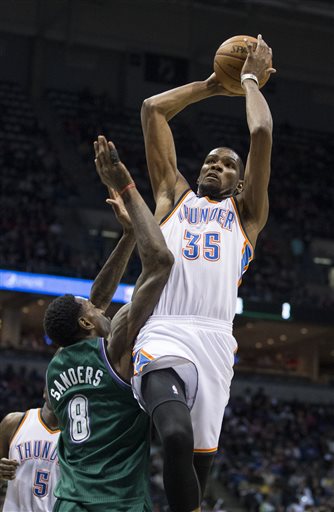
Kevin Durant, Larry Sanders

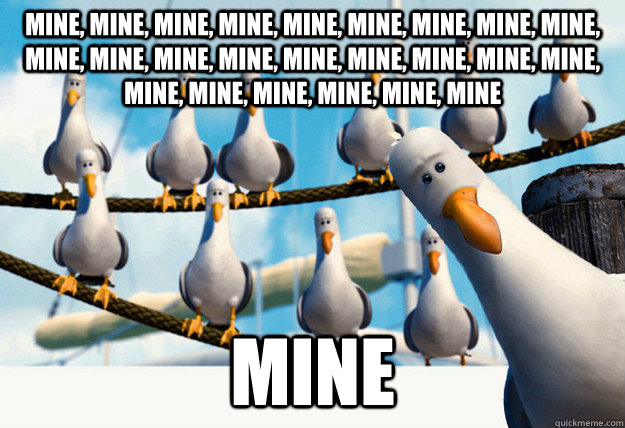
Fun note: If Carmelo Anthony sits out the New York Knicks’ final game as expected, Kevin Durant would need to score 70 points to win the scoring title. While this type of selfishness is not indicative of Durant’s character and team first approach, this wouldn’t be the first time that a guy of Durant’s moral ilk goes all Finding Nemo seagulls (Mine!Mine!Mine!) on an opponent to win a scoring title. Hall of Famer David Robinson of the San Antonio Spurs scored 71 points on the final day of the 1993-94 season to capture the scoring title from Shaquille O’Neal.

mine

Probable Starting Lineups

Milwaukee Bucks

  • PG – Brandon Jennings
  • SG – Monta Ellis
  • SF – Luc Richard Mbah a Moute
  • PF – Ersan Ilyasova
  • C – John Henson

Oklahoma City Thunder

  • PG – Russell Westbrook
  • SG – Thabo Sefolosha
  • SF – Kevin Durant
  • PF – Serge Ibaka
  • C – Hasheem Thabeet

3 Keys to the Game

1. Come out of the game healthy – Some of the guys on the team are already suffering from, what I like to call, grind of the season injuries. Kendrick Perkins is suffering from a strained hamstring, Kevin Martin is suffering from a sore back, and Derek Fisher is suffering from a sore foot. Whatever the outcome of this game is, I don’t want to add anymore names to that list.

brookies

2. Preview of next season’s bench mob – There should be plenty of time to go around for the Thunder’s D-League All-Stars. Jeremy Lamb, Perry Jones III, Reggie Jackson, DeAndre Liggins, and Daniel Orton should all get substantial minutes in this game. I fully expect a poster dunk from Jones III in this game.

kd_harden_return

3. Appreciate this regular season – This has been one of the most trying, but also, one of the most rewarding seasons in the Thunder’s history. To lose one of your main components in a core-shattering trade 4 days before the first game of the season had to weigh heavily on the returning group of players who were itching to get back to the NBA Finals for redemption. But they adapted, learned, and improved to the point where they had their best regular season since they became the Thunder, and got the No. 1 seed in the Western Conference, to boot. Thunder Up, indeed!

New York Knicks vs. Oklahoma City Thunder preview (Game 77 of 82)

knicks thunder

  • When: Sunday, 07 April 2013 at 12:00 PM CST
  • Where: Chesapeake Energy Arena, Oklahoma City, OK

Part of the mission has been accomplished. As I mentioned in this previous article, the goal of the Thunder in the last 5 games was to catch up to the Spurs and at least tie them for the Western Conference lead. Now that that has been achieved, the Thunder hold their Western Conference destiny in their hands. All the Thunder have to do now is keep stride with the Spurs, and head into the playoffs with the number 1 seed.

The first step to that begins against Carmelo Anthony and the New York Knicks. With the San Antonio Spurs’ win against the Atlanta Hawks yesterday, they sit a half game ahead of the idle Thunder. It’s your move, Oklahoma City. The Thunder are currently playing their best basketball of season since the 23-4 stretch that began in late November. They’ve beat the Spurs and the Indiana Pacers in convincing fashion with close-out 4th quarter performances from their superstar duo.

The New York Knicks come into the game playing their best basketball of the season, having won 11 in a row. The streak, which is the best current streak in the league, can be attributed to 2 things: Carmelo Anthony (32.4 ppg) and JR Smith (23.9 ppg on 49.2% shooting) efficiently attacking teams offensively, and Tyson Chandler and, new addition, Kenyon Martin providing the muscle on the interior. Their margin of victory during the streak has been 13 points.

ny_u_jr-smith2_mb_576

It’s a funny thing that happens when you write about important stretches in a season. I had the last 5 games tabbed as the most important stretch of the season for the Thunder. But after taking care of business, this game now becomes the most important game of the season. It’s important, not only because we accomplished the goal of catching up to the Spurs, but, because, now, New York is the hottest team in the league. And they are winning by using the same formula that has hurt the Thunder in the past: dribble penetration, 3-point shooting, and 1-2 offensive stars that perform within a system. New York has surprisingly become a lot like Miami during this streak, and it will be a good litmus test for the Thunder moving forward.

Probable Starting Line-ups

New York Knicks

  • PG – Pablo Prigioni
  • SG – Raymond Felton
  • SF – Iman Shumpert
  • PF – Carmelo Anthony
  • C – Tyson Chandler

Oklahoma City Thunder

  • PG – Russell Westbrook
  • SG – Thabo Sefolosha
  • SF – Kevin Durant
  • PF – Serge Ibaka
  • C – Kendrick Perkins

3 Keys to the Game

Perimeter defense – With the absence of Amare Stoudemire, Kenyon Martin, and Marcus Camby, the Knicks are hurting inside offensively. Anthony and Smith have actually pushed their games inwards during this streak, but are still very perimeter oriented. Felton is a lot like Andre Miller in that he does his damage by penetrating inside and uses his strength to power shots in. Steve Novak, Jason Kidd, and Prigioni are all ready to shoot 3-pointers at the hint of daylight. As is usually customary with Thunder coach Scott Brooks, when the Thunder get a player that was recently with another team, Brooks usually plays said player extended minutes when it’s against his old team. So, with that said, Ronnie Brewer, you’re up.

brewer

Match-up Land Mines – With the injuries to the Knicks’ front line, they have been forced to play small ball from the outset of games. With that said, do the Thunder really want Serge Ibaka guarding Carmelo Anthony at the start of the game? Or do they want Kevin Martin guarding JR Smith when the bench checks into the game? Or Derek Fisher guarding Raymond Felton? Knowing that Brooks has a very consistent substitution pattern, it will be very interesting to see how the Thunder adjust on defense. As I said before, this is a very good prelude to what Miami and Denver will do to us if we meet them in a future series.

anthony durant

Buckets – The elephant in the room. The scoring title may be up for grabs in this game. Kevin Durant leads Anthony by a tenth of a point (28.4 to 28.3, respectively). With Durant already saying that Anthony can have the scoring title, will team success have any bearing on whether any of these two players eases off the gas when it comes to scoring. Like Durant said, “I really wanted my first one (scoring title). Don’t get me wrong – – I never want to take stuff like that for granted. But if it happens, it happens. I’m just going to play my game. I’m not going to force it too much and think about it too much and try to get it.” The only thing for Durant, and Anthony as well, is that their games are about scoring. With as much as Durant has a tendency to stat-watch, will he try to get that extra point to one-up Anthony? Regardless, this game certainly reminds of the scoring title race in 1994, where David Robinson and Shaquille O’Neal went back and forth on the scoring title till the last game of the season, where Robinson scored 71 points to finally take the scoring title. We can only hope that one of these two players puts up 50 in the game.

Westbrook and The Boost

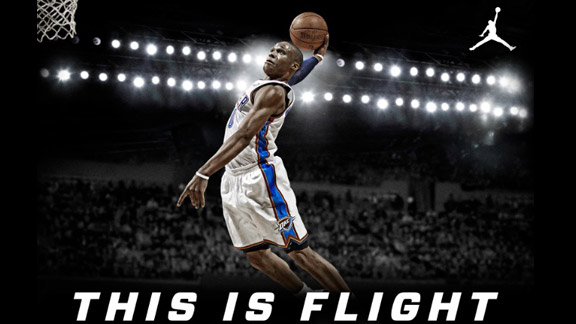
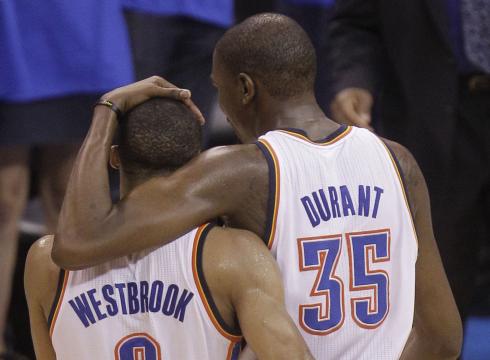
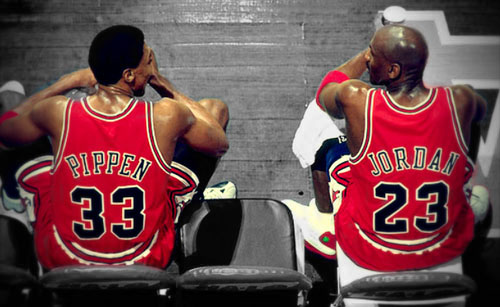
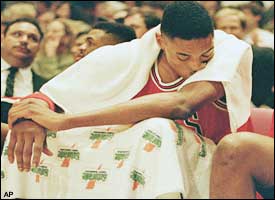
This past week, Russell Westbrook signed with Jordan Brand, after being with Nike for the first 4 years of his career. While Westbrook has carved out his own following of fans, he’s always been known as Kevin Durant’s sidekick. The Robin to Durant’s Batman. This generation’s ultimate second banana. There hasn’t been a sidekick this good since Scottie Pippen. But, Pippen never received the boost in popularity that Westbrook is about to receive.

What qualifies for a sidekick? A sidekick has to be a rookie or a very young player that is brought in after the primary player is established to specifically fill the needs the team is missing. Another qualification is that the pairing has to be together for 5+ seasons. For example, Scottie Pippen was obtained by the Chicago Bulls in a draft day deal, while already having an established superstar in Michael Jordan. Russell Westbrook was drafted by the Seattle Supersonics (Oklahoma City Thunder) after they already had an established young star in Kevin Durant. Anfernee Hardaway almost made it to great sidekick status, but injuries and Shaquille O’Neal’s departure to the Los Angeles Lakers negated that possibility. The Lebron James/Dwayne Wade/Chris Bosh mash-up wouldn’t qualify as sidekicks because they were all alpha males on their respective teams before they joined forces. Kobe Bryant and the aforementioned O’Neal made a great duo, but they were brought onto the Lakers the same year and often quibbled over who was the alpha male. 

To understand the road Westbrook is on, it is important to see what happened to Pippen throughout his career. When Pippen first started college at the University of Central Arkansas, he was a 6’1” walk-on that needed to moonlight as the team’s manager to pay his tuition costs. After 3 more collegiate seasons, a 7 inch growth spurt, and consensus All-NAIA player honors, Pippen was drafted with the 5th overall pick in the 1987 NBA draft to the Seattle Supersonics (who subsequently traded him to the Chicago Bulls). The scouting report on him read as follows:

  • 7’4” wingspan and a 41” vertical
  • Strong outside, but needs work inside
  • Not bad driving to the hoop, but doesn’t look to drive
  • Good foul shooter
  • Can make a three
  • Terrific passer at that position
  • Won’t give you much of anything on the offensive glass, and is a so-so defensive rebounder
  • Excellent defensively and a disruptive force in the passing lanes
  • Good ball handler, but commits a ton of turnovers
  • Could start on most teams

Not necessarily the sexiest of scouting reports for someone who would eventually become one of the top 50 players in league history. While Pippen built his legacy on defense, he was also an apt offensive player, becoming the archetype for the point forward position. During his prime (1989-1999), Pippen had per game averages of 19.1 points, 7.1 rebounds, 5.9 assists, 2.2 steals, and 0.9 blocks. Not necessarily the offensive prowess that Larry Bird possessed, but with a stat line like that, Pippen should have been heralded as his generation’s defensive Larry Bird. Instead, he was teamed up with arguably the greatest player of any generation in Michael Jordan. There usually isn’t a lot of spotlight left when you are playing with the greatest. Ask 100 people who the lead singer of Aerosmith is, and most will answer Steven Tyler. Ask them who the drummer is, and not many will know the answer.

Pippen’s play on the court should have spurred him to more shoe deals, more advertisement contracts, and more widespread popularity. And yet, when his career was all said and done, you couldn’t help but wonder whether Pippen got everything that was owed to him. There were the stories of how Pippen felt he wasn’t getting paid what he deserved (which he wasn’t). There were the rumors that he felt slighted being outside of the limelight, when he provided so much to the team. While he did have his own shoe line (the PIPs) from Nike, they only lasted about two series. So, needless to say, not many companies bought into Scottie Pippen.

It wasn’t Jordan’s fault, though. Most of the blame lies squarely on Pippen. He didn’t have the same tact with the media that Jordan did. He was dismissive and defensive at times with reporters. Then there were the crunch time situations. Those critical times in games that live in lore and become mythologized. It’s not that Pippen didn’t perform well during those times. On the contrary, he performed great during crunch time. But he’s instead remembered for the times he quit on his team in the most critical of moments. There was the time he sat out Game 7 of the 1990 Eastern Conference Finals against the Detroit Pistons with a migraine headache. The Bulls eventually lost that game. Probably the most damning, though, was the one where he sat out the final 1.8 seconds of Game 3 of the 1994 Eastern Conference Semifinals against the New York Knicks because Phil Jackson drew up a play for Toni Kukoc to take the final shot, instead of Pippen. To make matters worse, Kukoc actually hit the game winner. This one was the most damaging because it came at a time when the Bulls were his team due to Jordan’s hiatus into baseball. When you are known to quit on your team during crucial periods, your popularity takes a big hit.

Which brings us to the best sidekick of this generation, Oklahoma City Thunder guard Russell Westbrook. Like Pippen, Westbrook was not highly decorated coming out of college. Like Pippen, Westbrook was drafted by a team that already had a young star in Kevin Durant. Like Pippen, Westbrook is seen as not being very media friendly. Coincidentally, Durant, much like Jordan, is viewed as a media favorite. And, while not by his own doing, Russell was also involved in a critical game snafu, when Thunder coach Scott Brooks sat an ineffective Westbrook for the entire 4th quarter of Game 2 of the 2011 Western Conferences Finals.

But, not everything is negative when it comes to Pippen and Westbrook. Both of these players are insanely loyal to their teams and teammates. Pippen had a couple opportunities to seek greener pastures during the championship run, but decided to sign for less to stay with the Bulls. Westbrook could have done the same last season, but decided to sign for the allowable max. Both players are highly competitive, with possible chips on their shoulders from being labeled second bananas. Both players are very team oriented, as evidenced by them sacrificing a little of their own games to coexist with two great players. The good severely outweighs the bad when it comes to Westbrook and Pippen, but the bad usually has more advertising power.

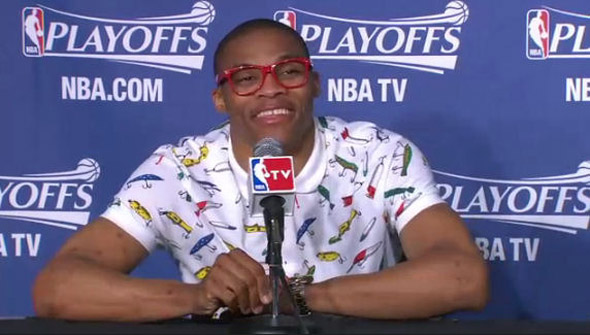
Which is why I found the signing of Westbrook to Jordan brand to be a bit ironic. Not ironic in the sense that he doesn’t deserve it. But ironic in the sense that a move like this will probably propel Westbrook into superstar territory, as far as media exposure goes. Into a territory that Scottie Pippen unfortunately never reached. With an endorsement team that includes Carmelo Anthony, Derek Jeter, Chris Paul, and Michael Jordan, himself, Russell Westbrook will have plenty of opportunity to expand his brand. He already has a slogan in place (WhyNot?), and already has a following outside of basketball because of his unique fashion sense. In a way, Jordan is helping this generation’s top sidekick become what his sidekick should have become.

Alternate Reality – Dream Team vs. 2012 Team USA

In collaboration with Akeli Jackson of DYST Media, Steve Person of Hooptalk365.com and Jon Midget of SLCDunk.com.
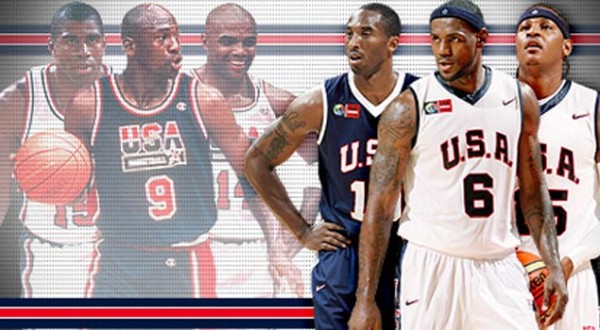
The debate has been raging all summer long about which team is better: the 1992 Dream Team or the 2012 US Men’s Olympic basketball team. Members from both teams have spoken publically and most have said that the Dream Teamers would be the victors. But the tally hasn’t been 100% on the side of the Dream Teamers. Kobe Bryant, in an interview, stated, “If you’re asking me, ‘Can you beat them one game?’ Hell yeah, we can beat them in one game. You didn’t ask me if we could beat them in a 7-game series. In one game, we can beat them. No question about it.” This discussion was presented for each of the subsequent “Dream Team” teams after the ’92 team, but the discussion usually died down pretty quickly. For some reason, though, the debate for the 2012 team has lingered on longer than it did for any of its predecessors. Maybe it’s Twitter, where the in your face, non-stop commentary sometimes leads to a paradigm shift in thought, even if it’s just for a moment. Maybe, people see a 2012 team that is loaded with a combination of great players and potential great players. Sadly, though, these types of debates usually remain as they are….figments of our statistical imagination. 
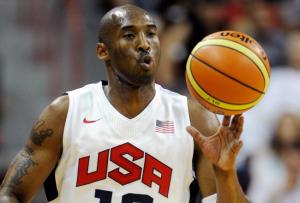
 

Fortunately, I have more money than I know what to do with. So I decided to call a buddy of mine who works at an anti-aging clinic. He told me he would be able to revert the older Dream Teamers back to their 1992 form using hormone replacement and gene therapy. Of course, the players on the ’92 squad would have to agree with this. So, that’s where their ego and my money came into play. I got all the players from the Dream Team to sign on by offering them $10 million each and telling them that the 2012 team would wipe the floor with them. Christian Laettner even asked my buddy if he had anything that would bring his “Duke-swag” back. My buddy told him he didn’t have anything to cure failed potential. Surprisingly, Larry Bird required the least amount of work. His body is basically in the same physical shape now as it was then. Unfortunately, the anti-aging clinic didn’t have anything to bring Chuck Daly back from the after-life, so Lenny Wilkens, who was an assistant on the Dream Team, agreed to be the coach. The fine folks at Coachella kindly declined when we asked them if they could have Hologram Chuck Daly walk back and forth on the Dream Team sideline. 


After 2 weeks of intense anti-aging therapy, and a month of “training camp”, the Dream Team was looking like its old self again. Magic Johnson was passive-aggresively talking trash, Larry Bird was sinking flat footed 3 pointers, and Michael Jordan was dunking on Patrick Ewing. The game was set up to happen the night before the gold medal game of this year’s Olympics. Only a few writers were privy to the game. Everyone who was witness to the game was CIA-scanned for electronic devices, meaning no photos or video of the game would ever exist. The 4 writers who were invited were each assigned a quarter to write about in detail. No one was allowed to release any information until after the gold medal game. This, is what transpired: 

Pre-Game 

The game would be played using a mixture of FIBA and NBA rules. The quarters would be 10 minutes in length to maximize the athletic potential of all the participants in the game. The FIBA 3-point line would be used, and the painted area used was the standard rectangular NBA format. Players wouldn’t be able to touch the ball on the rim like in international play. It would be counted as a goaltend, if the ball is touched while still on the rim. A team would have 8 seconds to bring the ball up past the half court line. The style of refereeing would be more international, allowing the players to be a little bit more physical on the perimeter and on the inside. The officials would be Ken Mauer, Dan Crawford, and Dick Bavetta. And, finally, a game like this wouldn’t be right without the use of an official David-Stern signed, NBA Spalding ball.  

One of the most amazing sights to see on a basketball court are the pre-game antics of the different players. Some have customary handshakes and dances that they do. Some have a specific routine of stretching and warming up. One thing that stood out while watching these two teams warm up was the gawking and wide-eyed fandom that was apparent on the 2012 team’s side of the court. It is easy to think of athletes as robotic in nature, while forgetting that they were once young fans wanting to be like they hardwood idols. Especially when their idols are on the other side of the court with their deity-like skills on hand for display. But, just as quickly as they were star-struck, they were just as quickly snapped back into reality by Kobe Bryant, and, surprisingly, by Russell Westbrook. The Dream Team squad was all business on their end. 

The referees called out the captains of each team (Johnson and Bird for the Dream Team and Bryant and James for Team USA). The Dream Team was in their classic whites and the 2012 squad in their new look blues. They all shook hands, the referees explained their expectations of the game, and each team went to their sidelines. Game time!!! 

1st Quarter

 Coach Lenny Wilkens trotted out Magic Johnson, Michael Jordan, Patrick Ewing, Scottie Pippen, and Charles Barkley as his starting five. Coach Mike Krzyzewski countered with Chris Paul, Kobe Bryant, Tyson Chandler, Lebron James, and Carmelo Anthony. And, just like that, 10 of the greatest basketball players were on the court exchanging pleasantries and shaking hands. Chandler and Ewing would be jumping at center court. Bavetta tossed the jump ball, and it is controlled by Ewing. Both teams started off by missing their first shot attempts. On the Dream Team’s 2nd trip down the floor, Kobe snuck into the passing lane and intercepted a pass from Pippen to Jordan leading to a breakaway dunk by Lebron James. The first two points were officially on the board. On their next trip down, Magic Johnson found Ewing on a no-look bounce pass for an and-1 layup. The teams exchanged makes and misses pretty consistently for the first 5 minutes. 

After a timeout, Wilkens substituted Larry Bird and David Robinson for Pippen and Ewing. For Team USA, their first substitutions saw Kevin Durant and Deron Williams coming in for Chris Paul and Carmelo Anthony. On the first trip down for Team USA after the timeout, Durant made a 3 pointer off an offensive rebound from Chandler. Barkley gave Durant a shoulder check as he turned to go to the other side of the floor. Durant pushed Barkley and both players were given a double technical. On the next possession, Pippen, playing point guard, found Michael Jordan on the baseline for a jumper. 12-11 Dream Team at the half way point of the 1st quarter. After a Deron Williams layup, the Dream Team went on a 10-2 run, with Larry Bird supplying two 3-pointers and Tyson Chandler picking up his 2nd foul during that run. 

After a run-stopping timeout, Coach K trotted out a line of Kevin Durant, Carmelo Anthony, Kevin Love, Deron Williams, and Russell Westbrook. Wilkens brought in Bird, Karl Malone, Robinson, John Stockton, and Clyde Drexler. Anthony and Malone exchanged buckets in the next two possessions. On the next Team USA possession, Westbrook lost possession of the ball, which was stolen by Stockton, who found a streaking Drexler for an easy 2. Another turnover, this time, by Kevin Love, led to a mid-range jumper by Malone. 28-17 Dream Team, with under two minutes left in the quarter. After a missed jumper by Durant, the Dream Team brought the ball up the court looking to add to their double digit lead. Stockton passed it to Bird, who is wide open for a corner 3, but missed it, leading to a transition 3 by Carmelo Anthony. On the next Dream Team possession, Williams poked the ball from Robinson as the shot clock expired, which led to a thunderous (pun intended) dunk by Westbrook on the other end. After a Stockton miss, Williams brought the ball up for the final possession of the quarter. Durant got the ball above the 3-point line, dribbled a little while jabbing towards the basket, and let loose a 28-foot dead on three that splashed through the net as time expires. 28-25 Dream Team, after one quarter. 

2nd Quarter 

The Dream Team came out to begin the 2nd quarter with Stockton, Drexler, Mullin, Bird, andEwing. Team USA squad went with Deron Williams, Kobe, Durant, Lebron, and Love. Team USA took advantage of the Dream Team’s limited defense, and scored on their first four possessions. However, the Dream Team extended their lead at the same time with three from downtown: two from Bird and one from Mullin. 

On the Dream Team’s fourth possession, Lebron nearly steals the ball by knocking it out of Ewing’s hands, but it goes out of bounds instead. In a surprising display,Ewing thumped his chest several times, telling everyone in a loud voice, “I am a WARRIOR!” over and over. Mullin looks stunned for a moment as he wonders what his team would actually be like if Ewing really were a (GoldenState) Warrior. The Dream Team inbounded it toEwing, who immediately shows off his WARRIOR-ness by throwing up a running 18-foot fadeway that clanks off the rim (he was, admittedly, intimidated by the perpetual shut-down defense of Kevin Love). 

Still, the Dream Team led 37-33 as Team USA calls a timeout. 

Out of the timeout, The Dream Team came out with the same lineup. The 2012’ers let Lebron rest a bit and replaced him with Carmelo. Williams drove past Stockton to get an and-1. Stockton, one of the better defenders in NBA history, takes it personally, scowls, and on the next inbounds, rushes up the court and dropped a pull-up 3 right in Deron’s face. Realizing that Carmelo had Bird and Mullin taking turns “guarding” him, the 2012 squad goes to him on the next three trips down the court, with Carmelo hitting a 2 and a 3 (and having a missed 3 tipped in by Love). During that same time frame, the Dream Team goes on a bit of a cold streak from the field, and Team USA takes the lead 41-40, prompting the Dream Team to call a timeout.

One of the most amazing things to witness in a game like this is the interactions in the timeout huddle. While Team USA was all high-fives and laughs, it was all business in the Dream Team huddle. Lenny suggested putting in Laettner, but nobody even blinked. The players all knew they were old enough and wise enough to be coaches themselves. They noticed the 2012 squad trotting out Paul, Williams, Carmelo, Lebron, and Love. In response, Pippen tells Wilkens he’ll guard Carmelo so “they won’t have to worry about him touching the ball again”. Jordan says he and Stockton can take Paul and Williams. One of the funnier moments was when the Dream Teamers decided to put David Robinson in on Love, knowing that the Admiral would completely take advantage of the shorter, less athletic Love. The only person left to guard was Lebron, so they decided that, even though he can’t match LeBron’s total athleticism, the Mailman is the guy who can best match his speed and strength. So in came Malone. 

On the first play, Pippen ran Carmelo through a beautiful “elbows-out-I’m-going-to-send-you-to-the-floor-weeping” screen set by Stockton. Anthony gets up a little wobbly and goes back to the bench, replaced by Durant. Pippen smiles. 

At this point in the game, the Dream Team asserted themselves offensively and defensively. They continuously went inside to the Admiral, who routinely dunked it, probably wondering whether it was Kevin Love or a fruit fly he felt along the way. On the defensive side of the court, Chris Paul could barely make it past midcourt with Jordan hounding him. Paul passed to Deron Williams, who was being bumped and maimed by Stockton. Williams probably began to wonder why his team only had four guys on the court since he could not find Durant under that Pippen defensive blanket.   

On Team USA’s next possession, Williams found Love with a nifty pass. Unfortunately David Robinson shoved the layup down Love’s throat. It seemed for a moment, while Love looked at Robinson in awe, that he was wondering if he was looking at a Greek God incarnate, or just the most ripped athletic specimen to ever walk the earth. Fortunately, Lebron wasn’t as impressed with Robinson’s physique, as he picked up the loose ball and put in the score. 

The Dream Team continued to put on an offensive clinic in the next few possessions, going inside to David Robinson and running the 2012 defenders through a series of cuts and screens that sends everybody on Team USA into at least one Stockton screen. Chris Paul and Deron Williams, taking the brunt of the physicality, start to vehemently complain about the screens. As a writer, it’s crazy when the crowd noise is taken out of the equation and you can hear almost every conversation on the court. In response to the complaining about the screens, Dick Bavetta told the two 2012 guards, “Hey, if you want to try to knock down guys 50 to 100 pounds heavier than you 10 to 12 times every game, I’ll let you do it too.” Paul and Williams suddenly realized they were nowhere as tough as the guy with the short shorts.   

On the other end of the floor, Paul and Williams were getting picked apart by Jordan’s defense and Durant was made to seem like he didn’t even exist on the floor anymore. Love kept looking to the bench, wondering why Coach K hadn’t noticed that David Robinson has 5 more inches and 8 times the athleticism on him. Lebron, realizing that he is only player that can do anything at this moment, begins to try to take over the game. He got past Malone on a couple of occasions, but the veteran power forward either stripped Lebron or knocked him off balance on his jumpers. 

In all, it was a 16-6 run by the Dream Teamers that put them up 56-47 with two minutes to go in the half. 

Time out for Team USA.   

The 2012 team put in their small ball line-up for the final two minutes of the half: Chris Paul, Deron Williams,Kobe, Durant, and Lebron. The Dream Teamers decided to show the young guys that they can also go fast AND big at the same time. They trotted out Magic, Jordan, Pippen, Barkley, and the Admiral.

 After the timeout, the 2012 squad looked to take advantage of their small ball lineup, especially at point guard with Magic being in the game. Heading into the game, one of the main headlines was the Kobe vs. Michael matchup. How would the player most compared to Jordan fare against him? In a couple words, not very well (in the first half, at least). Kobe tried to challenge Jordan in the final two minutes, but instead ended up costing his team.Kobe went 0-2 with two turnovers during that time-span.

 Those turnovers and missed jumpers allowed the Dream Team to basically turn every defensive possession into a fast break opportunity. Magic was at his “Showtime” best, setting up Jordan, Pippen, and Robinson for dunks. On the final possession of the half for Team USA, Pippen deflected a Deron Williams pass that ended up in the hands of Charles Barkley who had a full head of steam with 5 seconds left. The only person back for the 2012 squad was Lebron, but even he realized that he’d rather fight another day than try to challenge Barkley with a full head of steam. Two-handed slam, buzzer, and that was the 1st half. 66-51 Dream Team.  

 3rd Quarter

 Coming out of halftime, the 2012 squad looked to get back in the groove, down by 15. Coach K decided at halftime to throw caution to the wind and go with a more assertive lineup to combat these NBA greats. He turned the reigns of point guard over to Lebron, with Kobe alongside in the backcourt, Durant and Carmelo on the wings, and Chandler in the post. The Dream Team decided to start the 2nd half with Stockton, Jordan, Pippen, Malone, and Ewing in the paint.

 Again, one of the great things about eliminating the crowd noise is that you can hear the different conversations going on between the players and coaches. At the scorer’s table, Jordan walked up to Kobe and tells him, “You may be able to sit at many players’ tables, but you still can’t sit at my table, rook.” Kobe, in turn, responded, “We’ll see about that. I still got a couple years left”, while he powdered his hands. On the sideline, Ewing, looking as refreshed as someone with a jersey soaked in sweat could look, barked at Chandler, saying “this my paint, you ready to bang?” Chandler responded with a smirk as Dick Bavetta handed him the ball. Chandler passed it toKobe and the second half began. 

With Lebron controlling the ball at point, Team USA jumped out on a 6-0 run. On their first two possessions, on what looked like to be the same play, Lebron found a wide open Anthony who connected on back to back 3’s. Kack kaack!! “String music” yelled Carmelo. Jordan, disgusted by Pippen’s defensive effort, screams at his Bulls teammate, “get your man, Scottie!!!” Immediate timeout called by Coach Wilkens in an attempt to get the Dream Team’s focus back. The run, got the 2012 squad within single digits early in the 3rd quarter. 

After the timeout, the Dream Team makes the necessary defensive adjustments. The two teams continue to battle back and forth throughout the quarter. Jordan would score, then Lebron would respond. The two teams began to trade baskets in an offensive display like none other. The 2012 squad continued to hang close, only down by 9 points. On the next possession, Kobe swiped the ball from Stockton with a chance to cut the lead to 7, but inexplicably dribbled the ball off his knee. From that point on, the Dream Team turned up their defensive intensity, which seemed to stifle Team USA’s offensive production in the middle of the 3rd. Jordan was all on top of Kobe, giving him a real headache. When Kobe drove left, Jordan was there. When Kobe drove right, Jordan was there. It was his Airness at his defensive best. Malone and Ewing were being savages in the paint, giving Chandler and Carmelo more than they could handle. But no one was stopping Durant, who kept the 2012 team treading water with a couple jumpers. The 2012 team remained down by 9, midway through the 3rd quarter, heading to an officials’ timeout. 

The two teams made line up changes and exchanged baskets and misses for the next 3 minutes. With only a minute and a half left in the 3rd, the lead for the Dream Team was still 9, at 82-73. Lebron knew if something was going to happen, it had to happen now. One of the things that he learned in his championship season was to pick and choose when to take over, especially on a team full of superstars. It was go time. He knew it. Coach K knew it. Everyone on that 2012 bench knew it. After exchanging misses, Lebron drove to the basket using his strength to get an and-1 lay-up after a hard foul by Malone. After sinking the free-throw, Lebron blocked a last second shot attempt by Jordan to end the quarter. As the clock expired, both team walked to their respective sides knowing that the 4th would be a pure dogfight. With three quarters in the books, the Dream Team led 90-84.

 4th Quarter 

At the beginning of the 4th stanza, both teams decided to rest their main guys knowing that in order to win this dog fight, sustaining energy for the long haul was absolutely paramount.  The Dream Team entered the quarter with Stockton, Mullin, Drexler, Malone, and Robinson, while Team USA countered with Williams, Westbrook, Iguodala, Carmelo, and Love.  Team USA wasted their first two possessions on ill-advised 3-pointers by Russell Westbrook, while the Dream Team played much more efficient basketball, getting two easy buckets inside from Karl Malone. With that, the Dream Team took back control of the game, pushing their lead to 10, 94-84, a minute and a half into the fourth quarter. 

On their next possession, Iguodala lets a tipped pass get by his finger tips out of bounds, leading to a turnover. On their way back to the other side of the court, Barkley gets up off the bench and starts barking at Carmelo, “You can’t hold the Mailman!” Carmelo looked back, replying, “Don’t talk too soon Chuck, still a long way to go.” Not even a minute later, Williams was able to strip the ball from Drexler while he was driving to the basket, leading to a 3 on 1 fast break which Williams converted to a layup to cut the lead down to 8. With that, Coach K got off the Team USA bench with two clinched fists in the air, signaling for a full court press. Realizing that Stockton was the only legitimate ball handler on the court for the Dream Teamers, Coach K put Westbrook, and his ravenous ball pressure skills on Stockton, while the other four Team USA defenders went into heavy man to man denial mode. Westbrook’s defensive pressure works as Stockton picked up his dribble near midcourt. Chris Mullin comes to the half court as a pressure release as Stockton passes the ball, but Iguodala is a half second quicker in the passing lane, leading to a fast break opportunity for TeamUSA. Iguodala got the ball to Westbrook, who penetrated to the basket only to have his shot rejected by David Robinson, who came from the other side of the court. Kevin Love (as always) was in the right position to corral the loose ball, drop step, and finish a layup to bring Team USA within 6 points, 94-88. 

With 8 minutes and some change left in this heavyweight matchup, Dream Team coach Lenny Wilkens inserts Scottie Pippen in place of Mullin, while Coach K completes the chess match by substituting Durant and Paul for Iguodala and Williams. Before play begins, Krzyzewski calls Love over and whispers a brief 2-3 second order into his ear, to which Love gives a nod of agreement. After the teams exchange misses, the Dream Team was looking to utilize their advantage in the post. Stockton brings the ball up and passes it to Drexler on the wing. Drexler takes one dribble to the right, but passes it to Pippen who is coming off a Malone screen. Pippen zips a pass into the post to Robinson who has positioned himself for a quick shot. The Admiral goes up for a 3-foot hook shot, but is immediately fouled by Love. Coach K’s message to Love was to foul Robinson on his next shot attempt and make him earn those points due to the fact that Robinson was a 59% FT shooter in the ‘92 Olympics. The plan works as Robinson misses both free throws. Carmelo grabs the rebounds, dribbles up past the half court line as Coach K calls timeout with Team USA down 6. The coach knows that the next few minutes could be very important and wants to discuss strategy with the team.

 And so it begins……. 

6:43 left and both teams bring back their heavy hitters. The Dream Team 5 consists of Magic, Jordan, Barkley, Malone, and Ewing, while Team USA counters with Lebron, Kobe, Durant, Carmelo, and Chandler.

 As expected, Jordan comes out of the timeout hitting a 2 pointer off a flare screen by Barkley, which, in the NBA, would’ve been illegal, but since the refs are allowing a more physical game, it was allowed to happen. On Team USA’s next possession, Lebron, using Kobe as a decoy, was able to complete a give and go in which Lebron backdoors Magic for the 3 point play, giving Team USA a chance to cut the lead to 5.  Lebron completes the 3-point play with the free throw and cuts the lead to 96-91 with 5:44 to go in the 4th quarter.

 After a failed possession by each team, and a costly turnover by Chandler in the post, the Dream Team has the ball with 3:37 to go. Kobe gets a ticky tack foul called on him, as he slightly bumps Barkley while attempting a double team. Barkley looks at Kobe and yells, “I know you’re not double-teaming me with the guy that is guarding Michael!” Barkley gets the ball out of bounds and gets it to Jordan, who raises up for a 17 ft jumper that bounces off the back of the rim. Durant grabs the rebound and quickly gets the ball out to Kobe. Kobe gets the ball up the court and quickly passes to Lebron who finds Durant trailing on the play for a wide open 3….good!  Team USAonly down two, 96-94, much to the dismay of Coach Wilkens. 

 With 2 minutes to play, Coach Wilkens makes what is perhaps the coaching move of the game. He substitutes Pippen for Barkley, whose defensive lapses on the perimeter had cost the Dream Team most their lead. That move pays dividends as the defensive pressure from Jordan and Pippen limits Kobe to 1-4 shooting in the final 2 minutes, and keeps the ball out of Lebron’s hands by double teaming him every time he caught the ball in the perimeter. On the offensive end, the veteran leadership of the Dream Team took over. Magic Johnson showed poise in running the point, managing the shot clock, and finding Karl Malone for two back breaking 20 footers as the shot clock was expiring. The perimeter-oriented offense of Team USA proved to be their demise as they could not get anything easy going late in the game. When the final buzzer sounded, it was 100-96, Dream Team.

 Both teams hugged and congratulated each other like it was the end of a hard fought playoff series. All the Dream Teamers were grabbing their younger counterparts and dispelling small nuggets of wisdom. And, of course, the Team USA members were all ears, soaking it all in like sponges. At center court, Michael Jordan hugged Kobe Bryant and talked with him for about a minute. What was said? Only those two know. But I would bet it would have something to do with respect and love for the game, for these two teams exemplify what being a basketball player and being a basketball team is to us fans. In a game that would seem only to occur in the imagination, this was an incredible display of basketball at its finest.