Tag Archives: Summer League

Oklahoma City Thunder: Ballin’ on a budget

westbrookdurantibaka

Growing up, there were two things I was heavily into other than girls: hip-hop and basketball. I grew up in a time when hip-hop was having an internal war within itself. What started off as a rebellious outlet of expression for the poor and struggling turned into an over-expression of opulence and decadence. Hip-hop went from being mostly underground in the 80’s to completely mainstream in the 90’s. That entrance into mainstream pop culture led to many rappers getting rich quick. But as quickly as the money came, it left, leaving many rappers bankrupt and back to where they started.

During this same time period, many of my friends and I were just starting to work. And work means money management, right? Considering I have no idea where my teenage money went, I would say I did a poor job of managing my money. But it’s funny what sticks with you from your teenage years. One of my real good friends, Ryan Rivera, came up with a phrase that still resonates to this day, not only with myself, but also with my team, the Oklahoma City Thunder. The phrase was, “Ballin’ on a budget”.

Basically, it’s finding ways to live good without destroying your bank account or credit score. It’s not easy and it takes a lot of work. A person wanting to ball on a budget has to have patience and self control. The urge to “keep up with the Joneses” can completely destroy any plan to stay within a budget. Many people in the world live outside of their means in order to put on the face of success. Nice shiny things equates to success in the minds of many. Ballin’ on a budget also takes a lot of work. You can either go to Dillards and pay $80 for a Gucci shirt, or you can bargain hunt at Ross and pay $14.99 for the same or similar looking shirt. The work comes in looking for the right bargain. You almost have to become a hustler to succeed in this venture. Bargain deals may not be sexy, but they’ll get the job done with less overhead.
presti

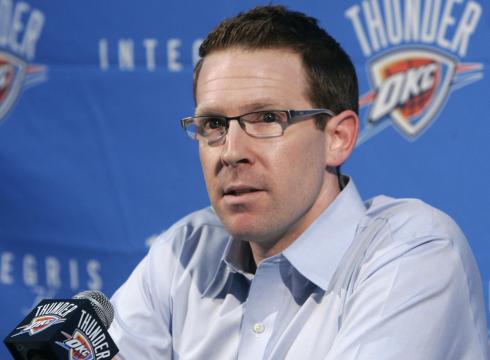
It’s the position where the Thunder find themselves at this juncture. With two trips to the Western Conference Finals, one trip to the NBA Finals, and one number 1 seeding in the Western Conference within the last 3 seasons, this team is definitely ballin’. But they’ve been doing it on a budget to this point. Thunder GM Sam Presti has built a championship contending team through great drafting, salary wheelings and dealings, and difficult decision making.

The current collective bargaining agreement has made things a bit difficult for small market teams that are toeing the line between being tax payers and non-tax payers. What was intended to be a punitive rule to defend against overspending by big market teams, has turned into another instance of “the more things change, the more they remain the same”. The Brooklyn Nets have gone into this offseason acting like a cancer patient that just won the lottery screaming YOLO! at everyone he sees. The Nets are projected to pay upwards of $80 million dollars in luxury tax this season, but they have an owner who seems hellbent on winning a title, no matter the cost. The Los Angeles Lakers, New York Knicks, and Miami Heat have also been consistent payers of the luxury tax for the past 3 seasons.
bird

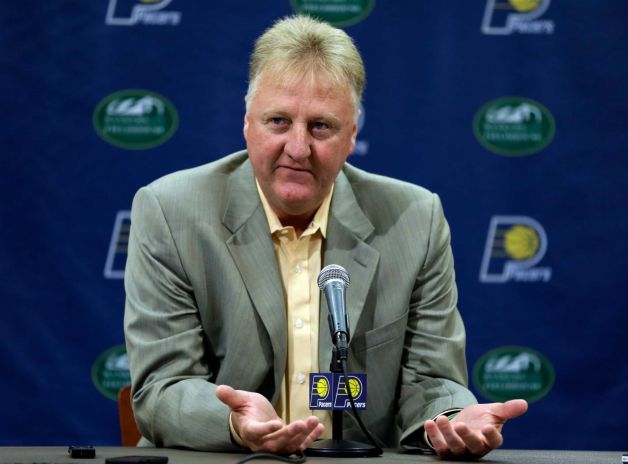
This brings up the difficult question: How are small market teams supposed to compete? In a recent interview with Darnell Mayberry of The Oklahoman, Indiana Pacers president Larry Bird made no qualms about the state of his team and how it compares to the Oklahoma City Thunder,

“Our owners went out and have done everything they could this year so we could be up close to the tax. We just can’t fight the tax. It’s always going to be a disadvantage for us. I feel bad for Oklahoma. They had a great team and they had to make a trade (James Harden trade). They were right there. But we’re going to have to do the same in the future. We’re always fighting an uphill battle with revenues. But that’s part of who we are. And we do the best we can with what we have.”

The key to competing in sports as a small market is to remain patient and look for the right deals. The goal of a big market team is to win at any cost. But the goal of a small market team is to remain consistently sustainable. Teams like the San Antonio Spurs, Pacers, and Thunder thrive on being able to compete year in and year out. I believe that’s part of the reason why the Spurs, who have won 4 championships since 1999, have never been able to repeat. They’ve remained consistently great, but have never been able to consistently spend like the bigger market teams to continuously improve their team on a yearly basis with no regard for payroll. There comes a point every couple of seasons where the Spurs have to retool with younger, less expensive players. Eventually those younger players gain the necessary experience to perform in pressure filled moment, but the team suffers in those “learning seasons”.
a thunder

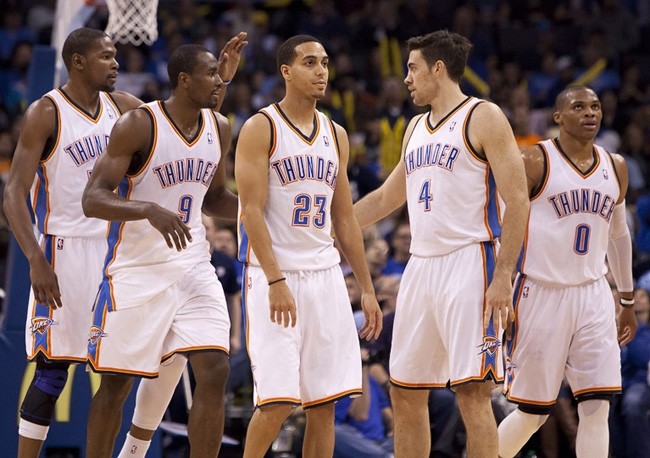
That’s what I call last season for the Thunder. It was a learning season. After the Harden trade, the team didn’t really hit a consistent rhythm until the end of the season. And with all that, they still ended up with the No. 1 seed in the Western Conference and were probably a Russell Westbrook knee injury away from making it to a 3rd consecutive Western Conference Final. Next season will probably be another learning season, as the bench lost its leading scorer when Kevin Martin signed with the Minnesota Timberwolves. With many fans clamoring for the Thunder to make a move to replace the scoring lost by Martin’s departure, the team has remained steadfast in trusting the young players they already have. Reggie Jackson showed last year in the playoffs what he is capable of after replacing Westbrook when he went down with his injury. Jeremy Lamb has performed well in Summer League and is expected to be a key contributor off the bench next season. And centers Steven Adams and Daniel Orton have performed surprisingly well in Summer League as rim protectors and, dare I say, offensive threats.

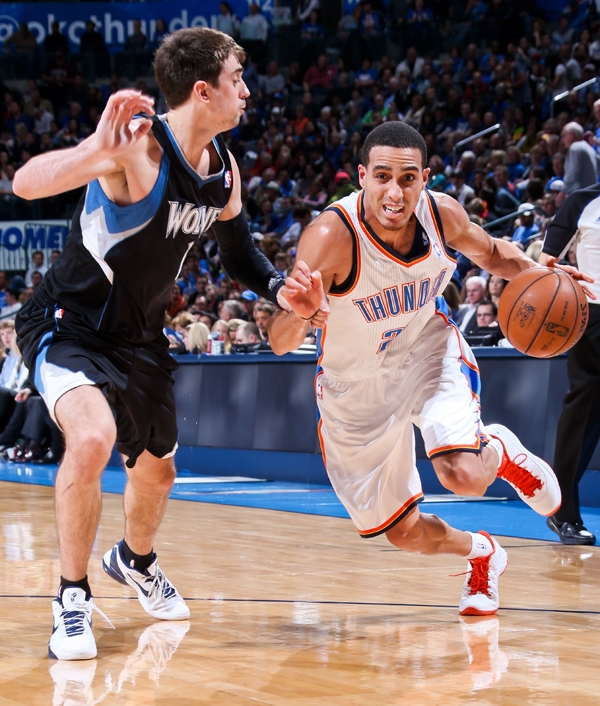
To many, this may seem like a cheap move by the owners of the team. With how good the team looked at the end of the regular season, it seemed like they were a resigned Martin and another bench scorer away from being an even stronger contender than they were when they made it to the Finals. With Martin’s bird rights in hand and the full MLE at their disposal, many thought the Thunder were finally going to jump into the deep end of the pool and join the other tax-paying teams. Instead, they allowed Martin to go to Minnesota in a sign and trade (that netted the Thunder a $6.6 million dollar traded player exception) and haven’t touched any of their available pre-tax cap space, which comes out to about $1.28 million dollars. That’s at least enough to sign someone to the veteran minimum. While the pool of free agents has gotten significantly smaller since July1st, there are still viable players available for the taking. So the question becomes: What are the Thunder waiting for?
martin_wolves_lm1_130109

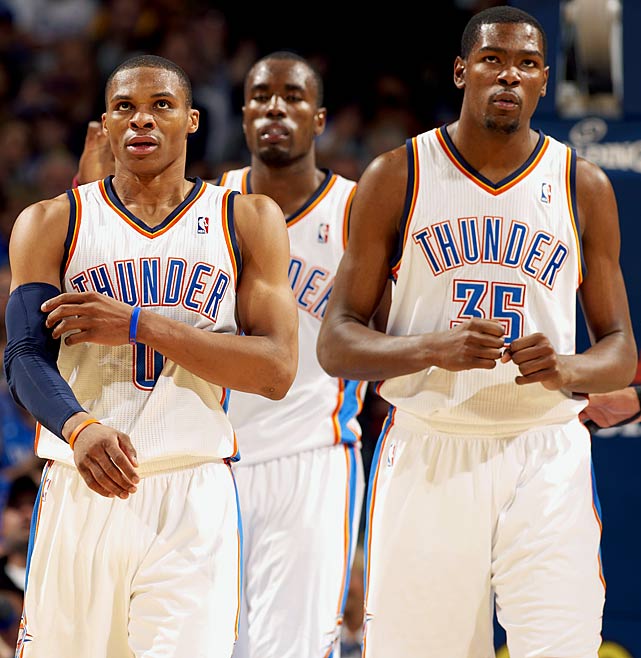
That is where the virtue of patience comes into play. For one thing, it’s only July. Many fans are panicking because of the moves made by other organizations, especially within the Western Conference. The Los Angeles Clippers resigned Chris Paul, traded for Jared Dudley and JJ Reddick, and hired a much better coach in Doc Rivers. The new “it” team, the Houston Rockets won the Dwight Howard sweepstake and landed a couple other veteran free agents. But, championships aren’t won in July; they are won in June. A team can stack a roster full of great players in July that may amount to nothing more than a first round exit the next April. Secondly, the organization has never said that they won’t pay the tax. They know that to be competitive, you may have to eventually pay the tax. But if you don’t have to pay the tax yet, why pay it? Along with more punitive luxury tax restrictions, the new CBA also instituted a repeater tax for teams that have paid the luxury tax for 3 consecutive seasons. With the escalating salaries of Kevin Durant, Russell Westbrook, and Serge Ibaka, the longer you can hold off on being a tax-payer, the more financially competitive you’ll be. And lastly, you still have Kevin Durant, Russell Westbrook, and Serge Ibaka. As long as those three guys are healthy, I think the Thunder have a fighter’s chance in any game.

The Thunder aren’t cheap. They’re just smart about how they manage their money. They already have a large percentage of the cap space allotted to the 3 players they deem the most important to the franchise. The reason the Thunder are perceived as cheap, though, is because they never had to “buy” any of those players in free agency. They drafted and developed them, and luckily, they turned out to be superstars. But sometimes, difficult decisions need to be made in order to maintain the financial flexibility that is tantamount to small market team success. That’s what happened in the Harden trade. The Thunder had 4 great players, but couldn’t pay 4 near max to max contracts. Ibaka helped the team by taking what is perceived to be a less than market value contract. Hoping that Harden would do the same, the Thunder drew a line in the sand, and said “here’s our final offer, take it or leave it”. When Harden rejected the offer, the team made the decision to move Harden to Houston. The situation was never a choice between Ibaka or Harden. But to make the numbers work, the team needed Harden to leave some money on the table, and for a young guy heading into his first foray into free agency, he just couldn’t do that.
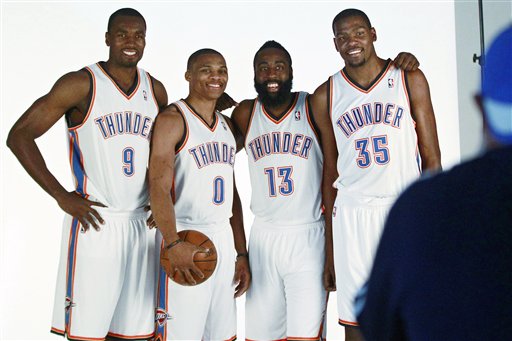
Serge Ibaka, Russell Westbrook, James Harden, Kevin Durant

Being a money conscious team is not sexy at all. Following a team that is run on the principles of patience and bargain shopping is not for the faint of heart. You watch other teams stack their teams with what you perceive to be good to great players, while you’re constantly having to hope that your players continue to improve in the offseason and that the veteran minimum center you signed actually can play the game of basketball. It’s a tough life, I know. But I wonder how Miami Marlins’ fans really feel about their two championships. The Marlins organization went all in for two runs at a title, and then completely dismantled the team after each title. While the feeling of winning a championship can never be replaced, I wonder what the feeling of watching your championship team be completely dismantled the following offseason feels like. Luckily, I don’t think I’ll ever have to know what that feels like.

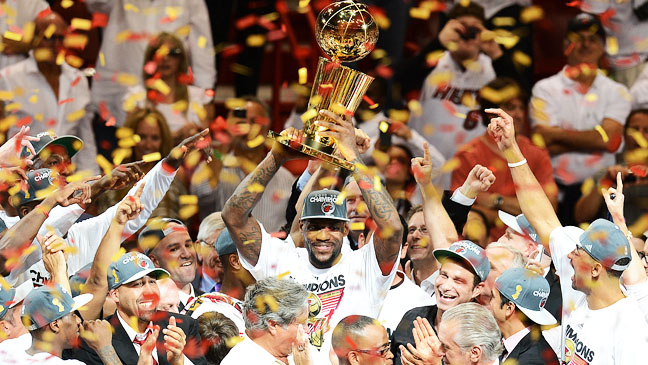
What offseason? Basketball Never Stops!

As a fan of the game, I’ll watch any basketball game you have on the television, especially playoff games. But there’s a slight disconnect when your team is not involved. It’s not as emotionally taxing. With that said, I’ve never enjoyed basketball as a connected fan all the way into mid-June. Though I’m disappointed that we lost in the Finals, its fun to look at the calendar and know that in 3 months, training camps should begin to open up. I’ve forgotten what it feels like for the season to be over in mid-April. But this all leads us to the offseason. Time to rest and recover from the grind of the season. Oh, I forgot we have the draft coming up. And then we have Summer League. And all the offseason moves and transactions. All the while, we have the national team gearing up to defend its gold medal in this summer’s Olympics. What the hell does the off in offseason mean?

There’s a saying that the NBA season is a marathon, not a sprint. The things that happen after the All Star break, such as trades and the signing of recently released players, can have a big impact on the rest of the season and the postseason. The Thunder have been the beneficiary of both of these player transaction moves in the past two season. Two seasons ago, at the trading deadline, the Thunder traded Jeff Green and Nenad Krstic to the Boston Celtics for starting center Kendrick Perkins and ultimate cheerleader Nate Robinson. Then, last season, they signed point guard Derek Fisher off waivers after he was released from the Houston Rockets. Due to the team’s stability, the Thunder usually remain pretty quiet during the offseason, though.

2012 NBA Draft

This offseason, though, the moves have been quiet, but plentiful. Heading into the draft, the Thunder’s only draft pick was the 28th pick in the first round. When you are picking this late in the draft, this usually means your team already has the necessary players to succeed. For a team as set as the Thunder, there wasn’t an immediate need that any player chosen this late was going to provide. One of the biggest needs the Thunder had was a big that was agile enough to defend other athletic bigs while being able to score from the outside and inside. Players with this skill set don’t usually last this long in the draft. The thinking was that the team would draft either an athletic wing or an overseas player that would be stashed in Europe for a couple of seasons.

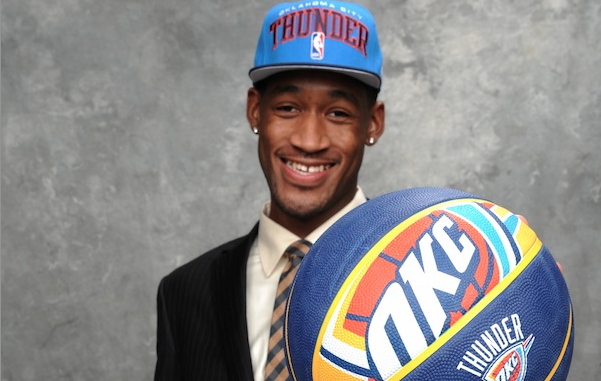
Sometimes, though, the stars and planets align, and a player you were needing all along falls into your lap. There was always concern about Perry Jones III’s work ethic. The word ‘motor’ usually came up when his draft status was discussed. But, no one could deny the potential he had. The description of a 6’11” athletic forward that could score from outside and inside is the type of player that usually has teams salivating for his services. But a day before the draft, they were reports that many teams were concerned with the condition of his knees. After the recent knee concerns of Greg Oden and Blake Griffin proved to be true, not many teams were willing to spend a lottery pick on a player whose work ethic AND knees were called into question. Surprisingly though, 11 other teams outside of the lottery chose to pass on Jones III also. So when the Thunder’s name came up, Thunder general manager Sam Presti never hesitated, and went with the best player available, which coincidentally also filled a need. The best thing about it, though, is that it comes at an extremely cheap price.

Orlando Summer League

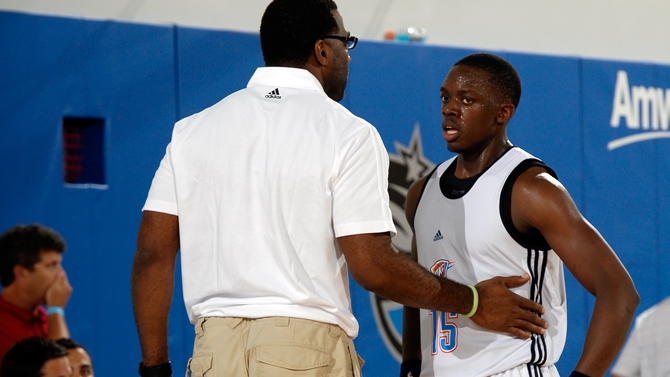
After the draft, the focus turned to the Orlando Summer League, where the Thunder were participating with 7 other NBA teams. As I wrote previously, the Summer League is full of good young players, Fringers, and Dreamers. Some of the players are already guaranteed a spot on an NBA roster and just want to mix in some team-oriented scrimmages and practices during the offseason. Most of the players though, are clawing and scratching for an opportunity to get onto an NBA roster. The Thunder’s roster consisted of 4 guys that, barring a trade, will be on the Thunder’s opening day roster (Perry Jones III, Reggie Jackson, Lazar Hayward, and Cole Aldrich). The rest of the players were probably not going to make it onto the Thunder’s roster, but could make an impression on another team depending on how they played.

The Thunder finished the Orlando Summer League 3-2. Reggie Jackson played like the most seasoned guy on the team controlling the tempo of the offense and attacking the basket at will. He even gave 2012 NBA Dunk champ Jeremy Evans a taste of his own medicine. Lazar Hayward showed why he’ll be at the end of an NBA bench for the next couple of years. He does a lot of things good, but nothing great. Cole Aldrich’s play was mediocre, at best. For a player that is looking to step up and be the back up center, his lack of improvement was a bit alarming. But, I would ask people to please step off the ledge when it comes to Aldrich’s development. Summer league games are made for wing players. They are glorified street games with refs and NBA assistant coaches on the sidelines. Aldrich will be asked to defend the paint, set picks, and put up a couple hook shots in the regular season. He will be fine. Perry Jones III suffered a sprained ankle in the 2nd half of the 2nd game, but not before impressing with his array of inside/outside skills. He will be in the Thunder’s regular rotation, if not in the 2nd half of this season, then definitely in the 2013-14 season. Other notables were forward Latavious Williams, who needs to be on an NBA roster somewhere, and Garrett Temple, whose play was almost veteran-like.

Off-season Moves

The Thunder has never been a big player in free-agency in their time in Oklahoma City. But in reality, they’ve never had to be a big player. Their main focus has always been on player development. When you have players like Kevin Durant, Russell Westbrook, James Harden, and Serge Ibaka, that’s what you put most of your focus on. That came to fruition in the last two seasons with consecutive trips to the Western Conference Finals and a trip to the NBA Finals this past season. The Thunder had 3 players that were coming up on free agency and all of them were veterans. Nazr Mohammed, Derek Fisher, and Royal Ivey could have all been signed to cheap veteran deals. But due to their years of employment in the league, even their minimum salaries would have been upwards of $1.5 million. The Thunder chose instead to let those vets walk, and focus on cheaper, younger alternatives. With Perry Jones III signing his rookie contract, that left 2 more spots on the roster.

The Thunder signed much maligned center Hasheem Thabeet to a 2-year veteran minimum contract. Now the difference between Thabeet’s veteran minimum deal and any of the other 3 Thunder players that were up for an extension, is that Thabeet has only been in the league for 3 seasons. For the final roster spot, the Thunder signed undrafted free agent Hollis Thompson from Georgetown to a 3 year contract. Thompson is a sharp-shooter in the Thunder mold (tall and long) that could be a cheap replacement for Daequan Cook in upcoming seasons.

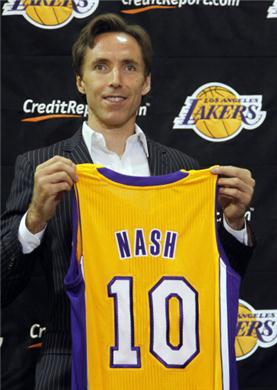
The two signings sent Thunder nation into a tizzy, and not for good reasons. Most were questioning the “lackluster” moves by the team, while the team that beat us in the Finals picked up former All-Stars Ray Allen and Rashard Lewis, and one of our biggest threats in the West, the Lakers, picked up a former 2-time MVP (Steve Nash) in their biggest position of weakness (point guard) without giving up a single player. The thinking was that the curse of the small market team was starting to take hold of the Thunder. That the ideology that small market teams can’t attract free agents and can’t spend money like the big boys was starting to rear its ugly head.

I, for one, completely disagree with that thinking. While it would be nice to sign former All-Stars ad-nauseam every offseason, the reality is that that would be bad business in this new NBA. The goal is to try and keep cost down while maintaining a competitive team. If your team does spend into the luxury tax territory, it better be winning. The Thunder have the right components in place to continue winning. The moves they made this offseason were made to keep those components in place. When you start talking about the luxury tax, every dollar counts. And if the Thunder are truly looking to keep both James Harden and Serge Ibaka on the same team as Durant and Westbrook, they are going to have to continue making these cost effective moves. Both Harden and Ibaka will demand deals that get them at least $10+ million per season. And, rightfully so. We’ll be in the luxury tax no matter what, if we keep these 4 players. The payments get more feasible, though, if you are competing for and winning championships.

Another thing that these signings do is maintain the flexibility that Presti loves. These signings not only have low cost-high reward potential, but they are also short term deals. That way, the team isn’t saddled with long-term contracts if the player, in question, either gets injured or doesn’t produce. Also, if someone better comes along, you could cut your losses with the player and attempt to obtain the better option. Cap flexibility is a commodity in the NBA, and Presti is one of the best at maintaining it.

Team USA

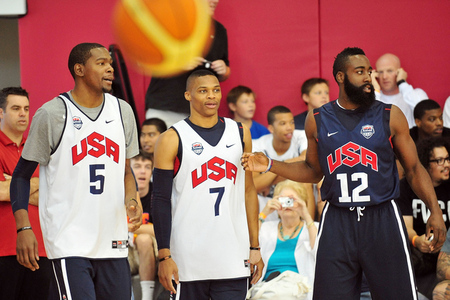
As if this offseason hasn’t been crazy enough, you have Team USA preparing for the Olympics in London. Not only that, but the Thunder has 4 representatives in the Olympics (Kevin Durant, Russell Westbrook, and James Harden for Team USA, and Serge Ibaka for Spain). Durant and Westbrook were near locks to make the team, but Harden was actually a surprise addition after players like Dwayne Wade and Derrick Rose bowed out because of injury. The team torched the Dominican Republic and eeked out a victory against a tough Brazil squad in the US leg of pre-tournament games. After this, it’s across the pond for a couple friendlies and then the real thing. Durant has a possibility of leading the team in scoring, while Westbrook will be the defensive pitbull/offensive sparkplug off the bench. Harden will probably play a role similar to what he does with the Thunder, but to a smaller degree.

As a fan of the game, I love this. Before NBA-TV, the offseason was usually a time to hear about a trade or two, and wait for football season to start. So, even though, this has been a whirlwind offseason, I still appreciate it. When this offseason gets too crazy, I always hark back to the 2011 offseason. Oh, you don’t remember the 2011 offseason? Oh, thats right, because there wasn’t an offseason that year.

Summer League: Hope Springs Eternal

One of my favorite things about the offseason is Summer League. Everything is so optimistic during this time of year. That late 2nd rounder you got from another team for cash considerations? Of course he’s going to become a 3-time All Star for you. The combo guard you took with the 27th pick? You’d be crazy not to think he’s isn’t going to average 20 ppg this upcoming season. The 2nd year player who sat at the end of the bench all of his rookie season, and was the team’s honorary “human victory cigar”? Yep, he’s going to make the leap. Everything about Summer League is based on potential and hope.

In reality though, 80% of the players in Summer League will never get a whiff of the NBA. If you follow your team as voraciously as I do, you’ll learn the players’ names and then forget them just as quickly when Summer League ends. The only ones that stick in my mind are the ones that actually make the team, and the ones that end up with the Thunder’s D-League team, the Tulsa 66ers. And it truly is a shame, because for 99% of us fans, these players are just advancing to a point in their basketball careers that we could only dream of advancing to. There really are some good basketball players in Summer League, but like any other situation in life, if they are not cultivated in the right system, they go to waste. 

That’s why I love cheering for the Thunder during Summer League. This is a team that takes pride in cultivating players and rewarding them for their hard work and dedication. In 2011, Robert Vaden, our 2009 2nd round pick, was signed to play the final week of the season and was added to the playoff roster for the Thunder. Did he ever play an actual game for the Thunder? No, but he got to practice with the team, sit on the bench in a suit,  and cash a couple paychecks signed by Clayton Bennett and David Stern. Last season, our 2nd round pick from 2010, a little known forward from Florida State named Ryan Reid was signed at the beginning of the season. He actually played in a couple games and averaged 1.6 points. 

This year’s squad features a guy the team is grooming to become the back-up center (Cole Aldrich), a guy they are grooming to possibly become the back-up point guard one day (Reggie Jackson), a guy who could be an asset if injuries ravage the team (Lazar Hayward), and a rookie they are grooming to possibly become a rotational big someday (Perry Jones III). These players are locks to be on the opening day roster, barring any trades. They are in town to either sharpen their skills or test new skills. 

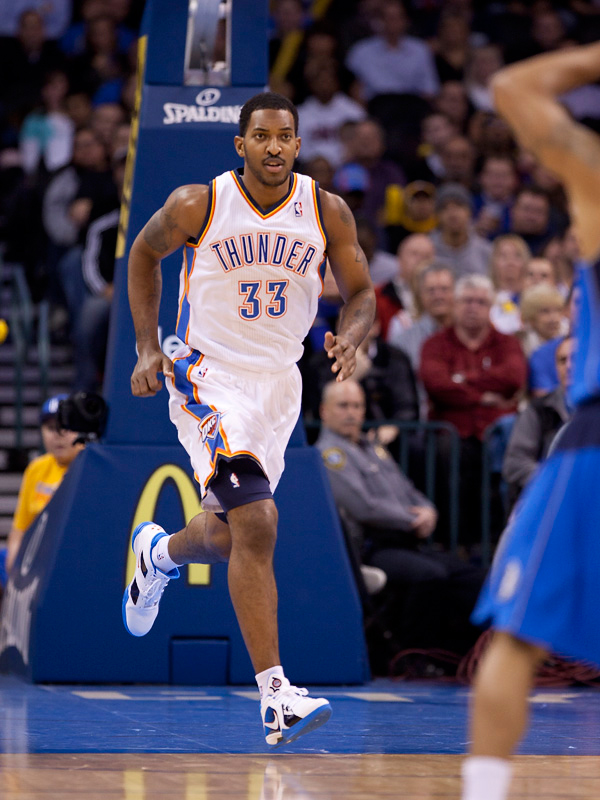
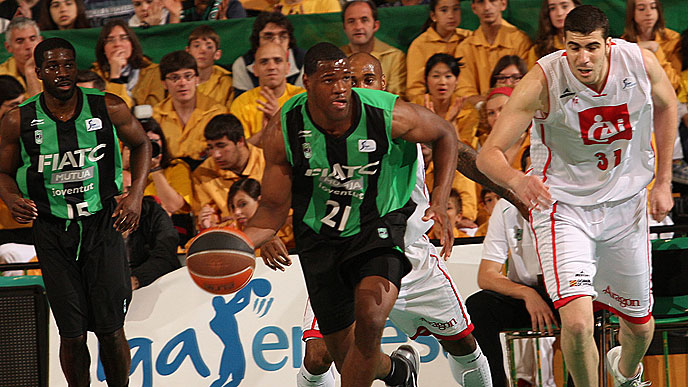
The other guys, the ones I like to call the Fringers, are usually just on the outside looking in. Back on the Thunder squad is Ryan Reid, trying to make it back to the NBA after being cut in the middle of last season to make room for seasoned veteran Derek Fisher. Another guy battling for a roster spot is Latavious Williams. This athletic forward made a bit of history in 2009, becoming the first high schooler to be drafted straight out of high school into the NBA Developmental League. The next season, when he became eligible to be drafted into the NBA, he was selected by the Miami Heat in the 2nd round, and was immediately traded to the Thunder. After playing one more season in the D-League, Williams signed to play for FIATC Joventud in Spain last season, winning Most Spectacular Player of the ACB League. Another player trying to get back into the league is Morris Almond, who is something of an NBDL superstar, but has never quite put it all together in the NBA. Basically, 3 guys possibly battling for one roster spot. 

Then, there are the Dreamers. The guys we should all be cheering for, because they remind us of our short lived hoop dreams. Kent Bazemore, Dwight Buycks, Marquez Haynes, John Holland, James Mays, Gary McGhee, and Garrett Temple. Remember those names, because you probably won’t hear of them ever again. Is there a chance some of them will make it as end of the bench guys in the league? Sure. And they’ll probably have a great story to tell about their journey to the NBA. But for the most parts, these guys will fade into overseas and D-League rosters. 

Such is the life of most professional basketball players. Always remember, that professional doesn’t just mean NBA. The players that play in the Philippines for pay are also considered professionals. As are the ones that play in Iran. And the ones in Mexico. The road in the journey to do something you love isn’t always paved in gold and silver. And it very rarely is a straight line. So I commend and salute the Fringers and the Dreamers for doing what they love, even if the road is full of potholes and roadblocks. So keep on hooping, gentlemen, because if many of us were given that opportunity, we’d be doing the same thing.