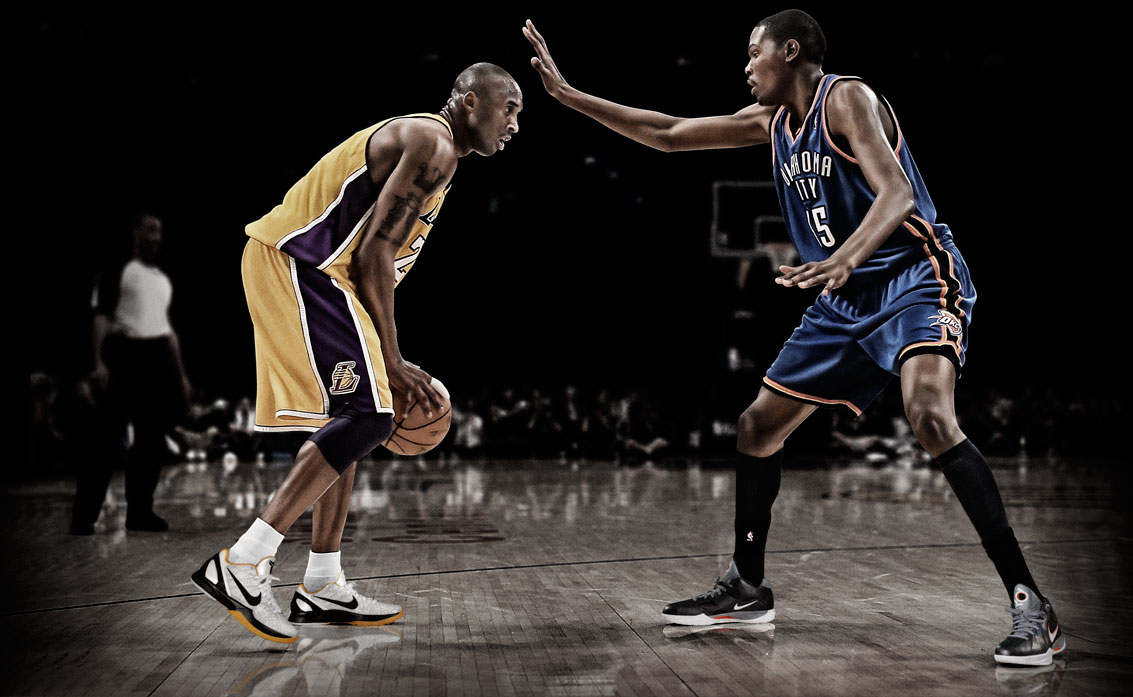
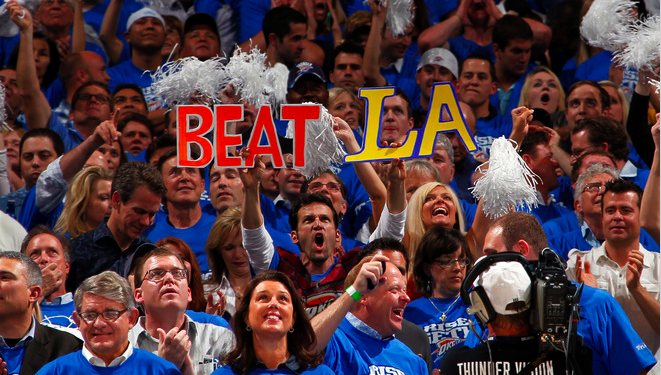
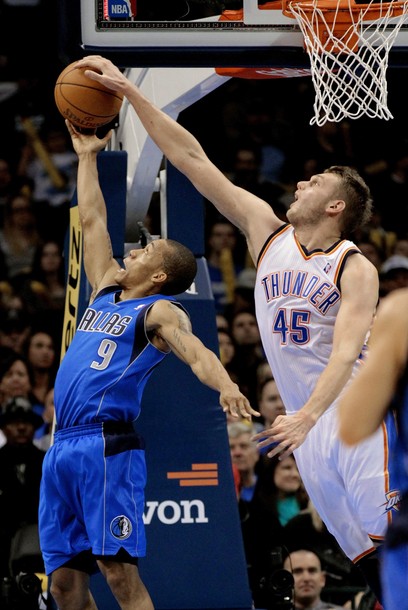
Redemption road. First it was the defending champions Dallas Mavericks. Now it’s the Los Angeles Lakers. The two teams that have knocked the Oklahoma City Thunder from the playoffs the last two postseasons. The two teams that have gone on to win the championship after they dispatched the Thunder. Oklahoma City did what they had to do in the first round, sweeping the Mavericks in a hard fought first round battle. Now, after a week of rest, they await the Lakers who defeated the Denver Nuggets in a surprising 7 game first round series.
If you want to know what this series will be like, go to your local city gym and observe the basketball court for about 3 hours. You’ll usually find at least one game pitting teenagers (ages 16-22) versus middle aged men (ages 35+). You’ll see the teenagers try to use their athleticism, but the middle aged guys will usually counter with smart basketball and mid-range jumpers. The game usually ends up being close and competitive. The Lakers, of course, are the middle aged guys and the Thunder are the teenagers.
The Thunder won the season series 2-1 in what has turned out to be one of the most contested matchups during the regular season. In the first matchup, in Oklahoma City, the Thunder turned a tight game in the first half into a blowout in the second half, taking the game 100-85. Kevin Durant had one of his better all-around games scoring 33 points on 12/22 shooting, grabbing 4 boards, and dishing out 6 assists. In the second meeting, in Los Angeles, the Lakers held a big lead in the first quarter, but got outscored 84-63 the rest of the way, losing 102-93. Russell Westbrook led the way this time around with 36 points and 5 assists. The 3rd game, also in Los Angeles, was known more for a body part than for a game. Aside from the whole ‘Metta World Peace’s elbow to the side of James Harden’s head’ incident, this was actually a really close game and the Lakers needed overtime to defeat the Thunder 114-106. The real story in this game was the Thunder’s inability to get going offensively in the second half once Harden was sidelined with the concussion.
The Opponent
The Los Angeles Lakers come into the game having won a hard fought 7 game series against the up-start Denver Nuggets. Six of the seven games were played without Metta World Peace, who was serving his 7 game suspension following the elbowing incident against the Thunder. Everyone knows the engine that still pushes the Lakers is Kobe Bryant, who averaged 29 points per game in their 1st round series. Most importantly though, Bryant called out his teammates for their lackadaisical effort following their performance in Game 6. The two teammates he was probably referring to the most after Game 6 were Pau Gasol and Andrew Bynum, who both were very inconsistent in the Denver series, interspersing great games with horrible games. Ramon Sessions had an average series in his first tryst into the playoffs, perhaps showing the signs of someone who hasn’t consistently started in the league. The bench, which has been shortened to three players, is probably the weakest one left in the playoffs. Matt Barnes, Steve Blake, and Jordan Hill all have the ability to provide good minutes, but due to the short bench, can be overused and therefore rendered less effective.
Keys to the series:
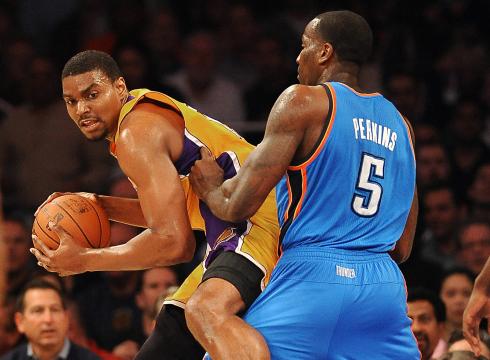
1) How healthy is Kendrick Perkins? The Thunder have said all the right things regarding Perkins’ condition. But sometimes, with a muscle like those around the hips, its takes longer for them to heal completely. It’s one of those muscles that you don’t think about at all unless it gets hurt. With the amount of lateral movement involved in basketball, one can only hope that the hip strain is completely healed and doesn’t rear its ugly head anymore in the playoffs. Look for plenty of pick and rolls involving Andrew Bynum early in Game 1.
2) Who guards Russell Westbrook? The Lakers got their Kevin Durant defender back in Metta World Peace. But their biggest issue has always been defending Russell Westbrook. Put a slower guard on Westbrook, and he blows right by them and does his damage in the paint. Put a smaller guard on him, and he’ll post them up. Look for Ramon Sessions to start the game guarding Westbrook. But as was seen in the Denver series, quick guards can get by Sessions pretty consistently. Look for the Lakers to regularly deploy hedge defenders towards Westbrook, especially the player guarding Sefolosha. Or look for Bryant to take on the task of guarding Westbrook himself.
3) Remember that Metta World Peace is the Lakers’ 4th best player, at best. A lot will be made about World Peace’s first game in OKC since “The Elbow”. But the focus of the game needn’t not be on the man formally known as Ron Artest. World Peace will be on his “best” behavior and will not do anything to jeopardize the Lakers’ chances. Will he push, grab, annoy, and attempt to intimidate? Does the sun rise in the East? Of course he will do all that. But the Thunder need not involve themselves in revenge plots and try to take cheap shots at World Peace. What MWP is doing in the media is classic instigation techniques. Hopefully the Thunder players don’t take the bait.
4) How will the extended rest affect the Thunder? In the 9 days since the Thunder last played, France elected a new president, another underwear bombing plot was foiled, Portugal got rid of four holidays due to cost cutting measures, new data leads scientists to believe that the Maya really didn’t think the world would end in 2012, and President Barack Obama supported gay marriage. That’s a very long time to not be playing any type of competitive basketball. You can practice all you want, but you’ll never be able to replicate the intensity of a real game against a real opponent. The Thunder had a 3 day rest between the first and second round last year, and looked completely flat in the first game of their second round matchup against the Memphis Grizzlies. A rest this long is completely new territory for the young Thunder and may be a factor early in the series.
5) Which Lakers team shows up? The Lakers will be all-in in this series. It’s Kobe’s nature to be completely tuned-in to every game he plays, whether it’s a pre-season game against the Washington Wizards or a Finals game against the Boston Celtics. It’s Andrew Bynum and Pau Gasol that can sometimes suffer from bouts of Adult OnSet Attention Deficit Disorder (AOADD). Against the Nuggets, both these players shut it down in Games 5 and 6, thinking that the will of the Nuggets would wilt and they would have an easy road to the second round. But in this series, both these players know what’s at stake and will be fully focused. Metta World Peace won’t be the MWP of earlier this season. He’ll be playing like Ron Artest from Queensbridge. And that could be a game-changer. The wild card for the Lakers may be Ramon Sessions. If for any reason he shrinks in the pressure of the playoffs, the Lakers may be in trouble.
Conclusion:
This series will be a hard fought battle in which home court advantage will win out. Thunder in 7.
I’ve never been the parent of a maturing teenager. My oldest is less than 10 years of age, so I have a few more years before I have to deal with hormones and rebellion. But as a newcomer to the 30 year old club, I still feel like I’m young enough to remember my teenage years, and remember the triumphs and pitfalls that my parents felt as I was coming up. I would figure that as a parent of a burgeoning adult, you would learn to take the good with the bad, and you would hope that for every bad decision, there would be a solution and a lesson learned. At the end of the journey, the ultimate goal would be to see a mature adult that is able to handle real life situations and is able to enjoy life to the fullest.
While extremely different, parenthood and fandom can also be very similar. Its takes time, money, and patience for the nourishment and development of both children and sports teams. While children usually mature in a linear chronological order, sports teams are constantly shifted and changed in an attempt to continually improve. Where the childhood of a kid may take between 18-21 years, the life of the core of a team usually never lasts more than 5 seasons. Teams like the San Antonio Spurs, whose core has been together for a decade plus, is the exception, not the rule.
Being a fan of the Oklahoma City Thunder, one of the things that have required the most patience has been the development of Russell Westbrook. Westbrook is the rare case of a player that came into the league initially with no expectations, blossomed into a bonified superstar with high expectations, and has taken the brunt of criticism because he has fallen just shy of those high expectations.
Westbrook’s skill set has never been a problem. If anything, his development over the last four seasons has taken most of the league by surprise. When he came out of UCLA, he was viewed as a defensive specialist, probably comparable to fellow UCLA alum Arron Afflalo. His ceiling was definitely nowhere close to being a top 5 scorer in the league. But a lot like Michael Jordan in 1984, when the shackles of the college game were taken off, the other-worldly athleticism took over. And in the right system, those gifts manifested themselves into what you see in Westbrook today.
But just like the trials and tribulations a parent faces when they are raising a teenager, Russell Westbrook’s ascension into a Top 10 player has not been without pitfalls. The path to get to where Westbrook is today has made a bit more difficult by the fact that he plays one of the most important and difficult positions in the game: point guard. As the team’s main distributor, any weakness on the offensive end is immensely exposed because of the position’s high usage rate. Throughout his career, Westbrook’s propensity for turnovers has always been a crux to an otherwise spectacular arsenal. It’s usually what supporters and detractors, alike, point to when looking for flaws in Westbrook’s game.
As the team’s main distributor, a point guard’s main purpose is to manage the game and direct the team’s offense. The thinking is that this is made a lot easier if there are plenty of weapons out there on the floor. But what happens if you have the No. 1 offensive weapon in the game on the floor with you? Most point guards would relish that and pad their stats. As great a player as Magic Johnson was, he was made even better by playing with Kareem Abdul Jabbar, Michael Cooper, James Worthy, and Byron Scott. Same applies to John Stockton and Karl Malone. But what if you, yourself, are a Top 5 offensive weapon in the game also? The art of knowing when to pass and when to score is something that most point guards don’t have to think about. Westbrook had to learn the trickiest part of the trade, while learning how to play the position.
The thing that makes raising teenagers most difficult isn’t the mistakes or the bad decisions. Those are expected. You don’t learn to drive without hitting a couple curbs. It’s the rebellion and attitude associated with the mistakes. The, “I can do this by myself, leave me the hell alone” attitude. It’s a right of passage that most people go through; their need to experience life on their own, rules be damned. But when your attitude is on display for millions to see and for thousands to tweet about, it can make the progress of your development that much more difficult. When the national media senses any angle to make a story, they flock to it like sharks to blood.
And that’s what happened in last season’s playoffs. You had the league’s leading scorer who is by all accounts, a media/NBA darling, and the non-conformist point guard who could care less about the media, on the same team. Success breeds attention, good and bad. Instead of focusing on one of the youngest teams in the league being in the conference finals, the media decided to focus on the fact that the point guard was taking shots late in close games, instead of passing it to the best scorer in the league. The players involved didn’t care. The coaches involved didn’t care. But the media ate it up and perception became most people’s reality.
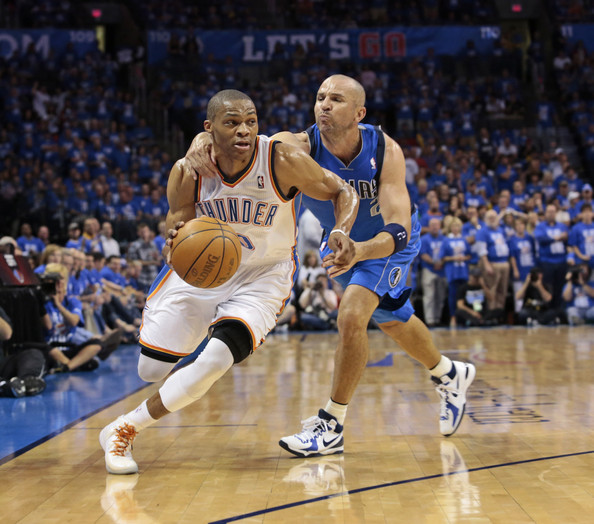
One of the triumphs of parenting is watching that child grow up to become a fully functional, independent adult. One of the triumphs of being a fan, is watching that young player finally take those steps to become that great veteran that teams need to win championships. Someone that, when the road gets tough, they create diamonds instead of wilting under the pressure. During the 4-game sweep of the Dallas Mavericks in the 2012 playoffs, Russell Westbrook finally became what we, as fans, were waiting for. He scored when he needed to (which was a lot in the first 2 games), managed the game, and protected the ball. He played lock down defense on Jason Terry and was a ball hawking free safety when ever it was needed.
But the biggest sign of his maturity (and that of the team, for that matter) was what happened in game 4 of the series. With the Thunder down by 13 entering the 4th quarter, the Thunder needed a spark on both ends of the floor. What had been a shooting clinic by the Mavericks guards in the 3rd quarter (5-7 FG overall (4-5 3ptFG)), turned into a dry well in the 4th quarter when Westbrook took his turn locking down the perimeter. Jason Terry, Jason Kidd, and Delonte West combined to go 1-6 FG in the 4th quarter. Also, Coach Scott Brooks, with the confidence that this would not affect Westbrook at all, decided to stick with the hot hand, and let James Harden run the point with Westbrook playing off the ball. What resulted was Harden getting 15 points and 3 assists in the 4th quarter, and propelling the Thunder to the victory.
Sometimes, the most difficult kids to raise are the non-conformist. The ones that don’t allow peer pressure to dictate their paths in life. The ones that march to their own drum. The ones that stay introverted. It’s difficult to know what someone thinks or what makes them tick, if they never let it be known. That’s Russell. The media is still baffled by this guy and that makes them uncomfortable. But, what we are seeing on the court is a sight to behold. We are seeing the non-conformist point guard turning into the best point guard in the game, right before our eyes. And that, as a fan and supporter of the Thunder, makes me extremely proud.
When I first started writing this piece, I didn’t know how to approach it or where to take it. I grew up a military brat, and when we lived overseas, our experience can be best described as sheltered due to living “behind the gates.” It’s this mindset, which I believe, has kept me from experiencing other teams and other team cultures. I honestly don’t feel the need to explore other teams as I have everything I need here in Oklahoma City. A great, young team, a fervent fan base, an excellent front office, and an ownership group, that for all intents and purposes, appears ready to break the bank in order to keep their young core together.
I know a lot about the Thunder. I know the players, their stats, their comforts, their weaknesses, etc. But as a blogger, I’ve learned to look at other things not related to players and stats. The recent lockout opened up a Pandora’s Box of knowledge, not entirely related to the game of basketball, but instead to the business of basketball. While I can’t say that I’ve become an expert on such things, I have begun to put the pieces together and observe things such as fan attendance, TV money, corporate sponsorships, the dynamic between the community and the team, and future projections.
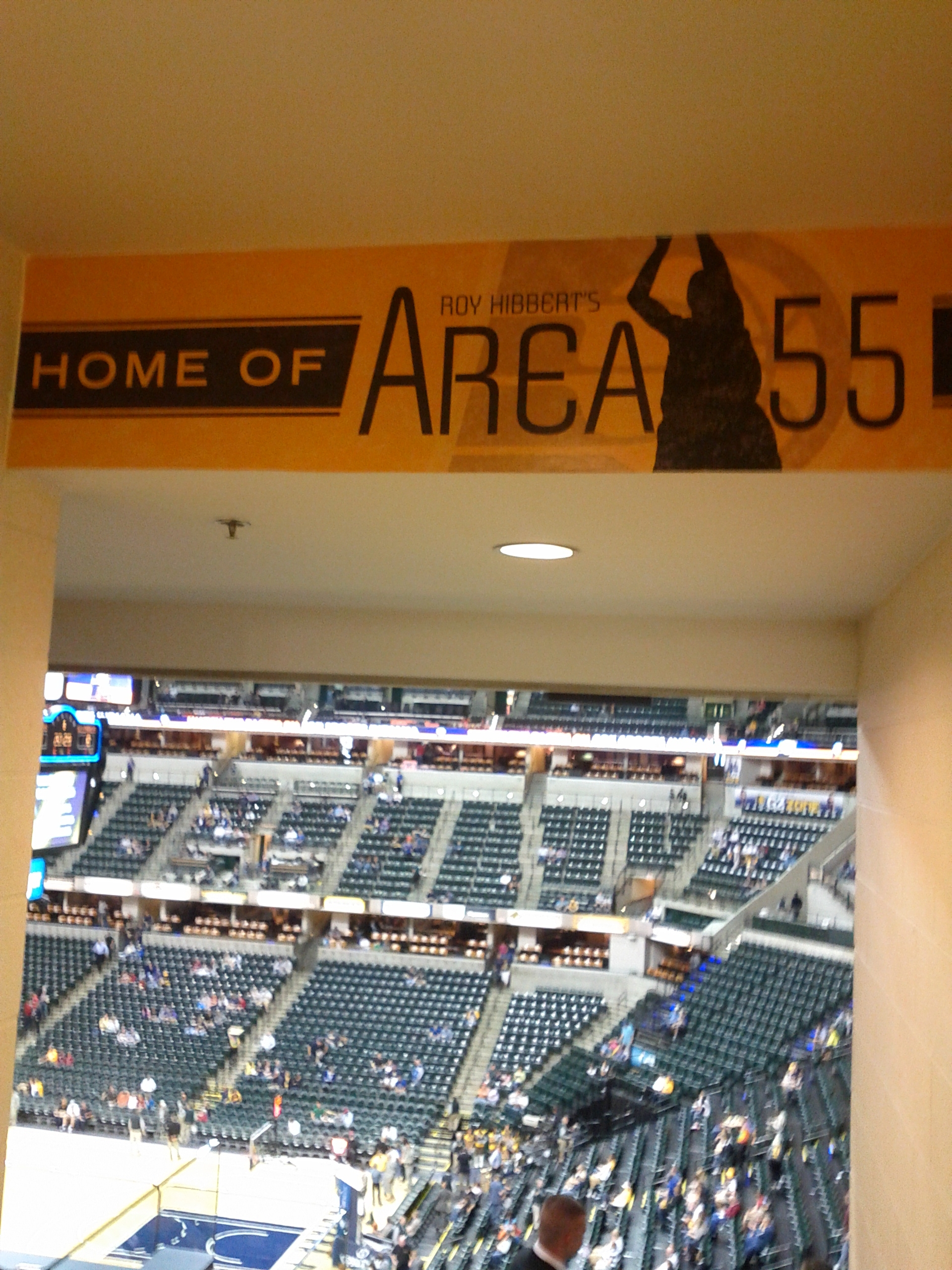
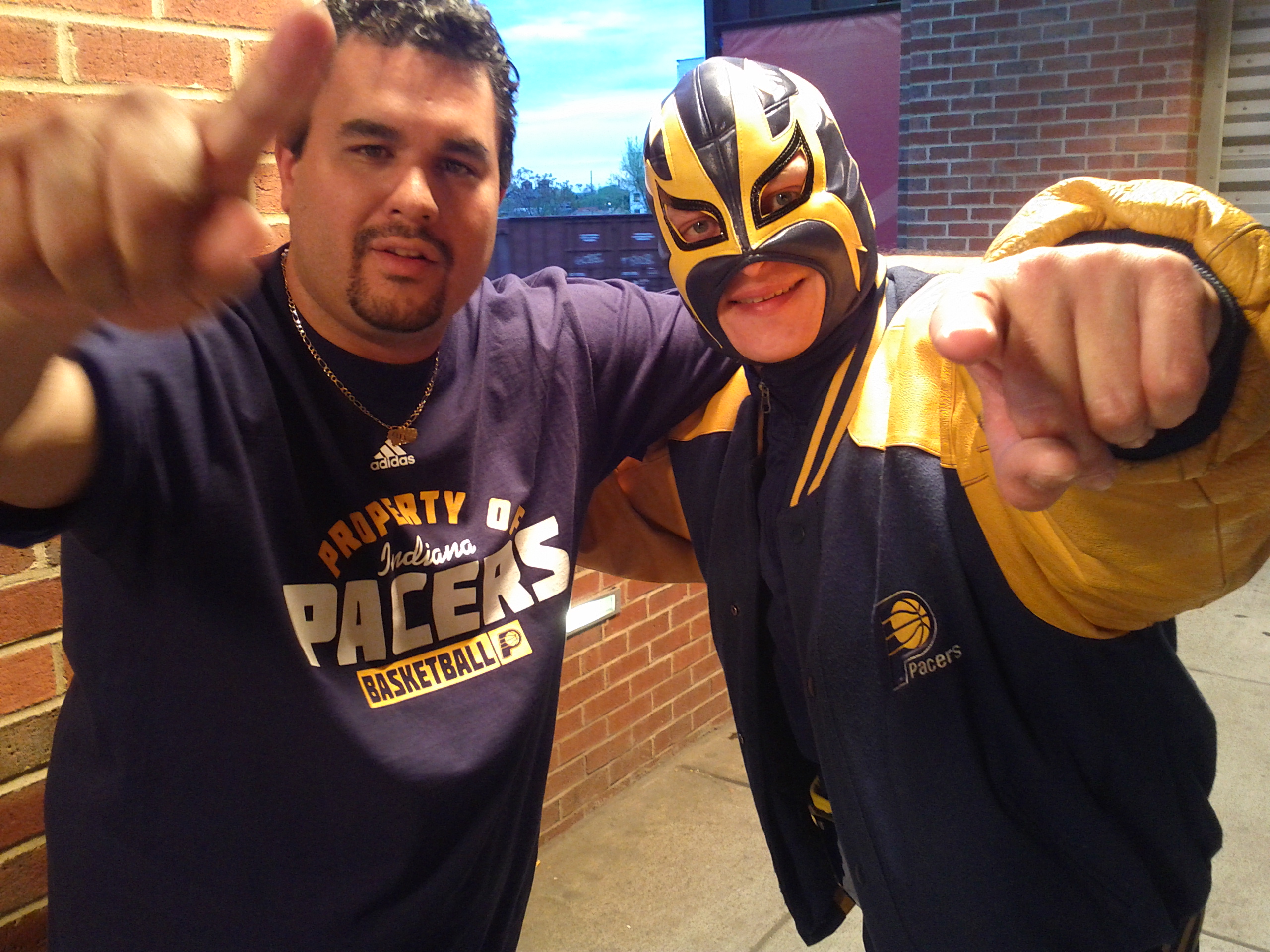
Recently, I had the opportunity to attend a game with two of my friends in Indianapolis, where the Pacers were playing the Washington Wizards. We got great seats from Pacers superfan, El Pacero, and were ready to became Pacers fans for a day. We were told to round up some Pacers gear before the game. We were staying in downtown Indy, 4 blocks from the arena. I figured, “how hard would it be to find some Pacers gear this close to the arena?” So I headed to the downtown mall and started looking around. Surely there would be some Pacers gear in an athletic store. Asked around and nothing. Next, I went to the Indianapolis Colts store and asked an employee if there were any places to get some Pacers gear in the mall. The employee thumbed his nose at me and said, “There’s no place in the mall to get Pacers’ gear since their store closed down last year.” One of my friends actually trekked it over to the Pacers store in Bankers Life Fieldhouse and got the gear we needed.
We finally got to the arena and were cheering for the team from Area 55, the cheer section authored by Roy Hibbert, where only the wildest and craziest fans sit. We learned the chants (“Whoomp, there it is” every time a Pacers free throw fell through), did the arm signals (X sign for David West), both hands opened and in the air for Hibbert (to signify his jersey number 55)), and had a great time in that first quarter.
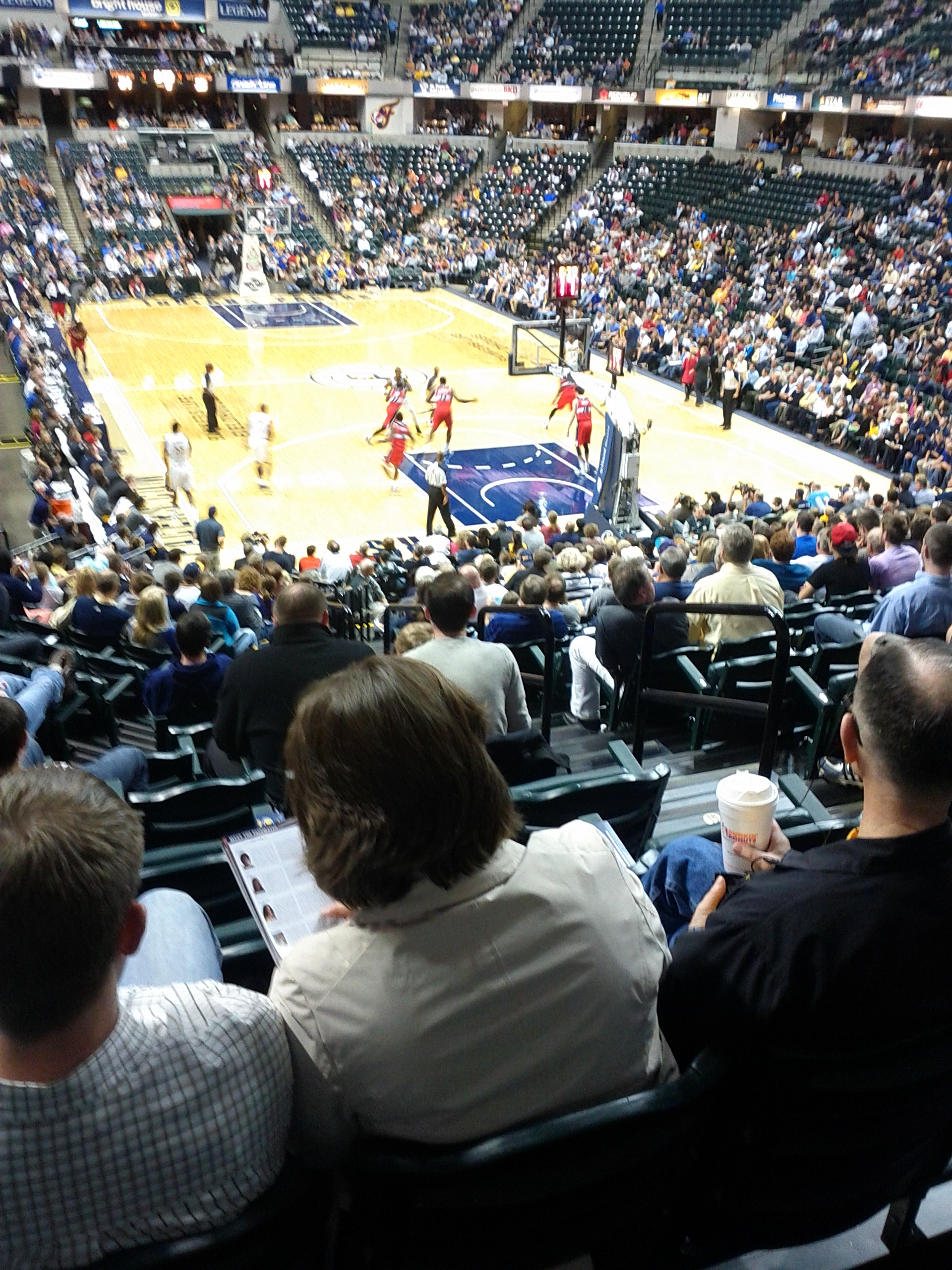
But we also noticed something else. More than 50% of the arena was empty. Now, mind you, I could have stood up and cheered with the Area 55 crazies for the entire game. But my friends, who are about 15 years my senior, have a life’s worth of old football and running injuries on their bodies and would have preferred to sit. So, with the arena so empty, we decided to make our way down to see if we could score some better seats. After an unfortunate alcohol accident (one the guys I was with fell and spilled his beer), we were sitting in the end seats on the lower bowl lamenting the loss of a full cup of golden brew, laughing our butts off, and enjoying the game.
After halftime, we tried our luck at heading to the sideline lower bowl seats. Everywhere we looked in the lower bowl, the upper half of the sections were completely empty. We slipped past the ushers and enjoyed the rest of the game 15 rows from the floor. And it turned out to be a pretty good game. It was a 2-point game with 8 seconds left. While the arena got a little loud, everyone in the arena was basically glued to their seats.
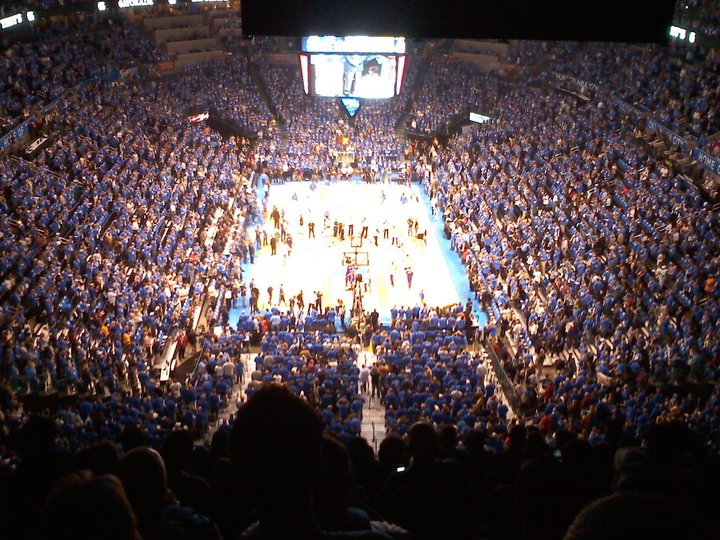
The experience was completely surreal to me. Not the game itself, but the arena experience was, surprisingly, a bit depressing. If the Thunder were ever involved in a 2 point game in the 4th quarter at the Chesapeake Arena, that place would be rocking and everyone would be on their feet making noise. It wouldn’t matter who the opponent was. That’s how it’s always been in Oklahoma City. Even when the Hornets were in town, we were known as Loud City. While that may have been a marketing ploy concocted by the Hornets’ arena staff, it worked for us and we ate it up. That slogan became us.
This is where I revert back to my military upbringing. I’ve “grown up” under the veil of OKC basketball. All I’ve ever known is to be loud and cheer like hell for my team. If we are up by 20, scream because we are winning. If we are down by 20, scream even louder, because that may provide the spark to uplift the team. So when the Pacers were up by two with 8 seconds left, and no one was on their feet, I didn’t know what to think.
So, I asked around town why the 2-14 football team (the Colts) is so wildly supported, while the basketball team that is playoff-bound is left to fend for itself. The most popular response was that the team hasn’t been good in a while. While that may be true, the Pacers gave the Bulls a helluva first round matchup last season in the playoffs and are currently 10 games over .500. The second most popular answer was that the city still hasn’t gotten over the Brawl and the Stephen Jackson night club shooting incident. That completely floored me because it has been over 7 years since the Brawl and 5 years since Captain Jack donned a Pacers uniform.
The fragile relationship between Indianapolis and the Pacers surprises me because Indiana is known for its love of hoops. No state is associated with the grassroots aspect of basketball like Indiana. Between the Hoosiers movie, French Lick being Larry Bird’s hometown, and the constant replays of the Bob Knight-led Hoosiers team, the last place I thought would be a struggling in terms of basketball fandom would be Indianapolis. But, apparently, such is the thin line between fanaticism and empathy.
And let me be clear. The piece is not, in any way, shape, or form, indicative of what may be the true situation in Indianapolis. I went to one game, in which they played against one of the worst teams in the league. Everybody has an off-day, even fan bases. The truth may be so different from my little one game sample, that I may have a couple Indianapolis fans mad at me for writing this blog. But in comparing this to the only thing I know (OKC), I still find it a bit puzzling that the arena was only half way full for a strong playoff team.
I hope I’m wrong concerning what I saw in Indianapolis. Maybe it was an aberration. A statistical anomoly in the world of numbers. I just saw the New York Knicks face the Pacers in the Fieldhouse and the place was packed. Good for you Indy. You have a good, up-and-coming team. I hope the Fieldhouse is full to the brim when the Thunder play the Pacers in Indy on Friday. I hope Area 55 is raising hell for the entire game and pumping that crowd up. I hope El Pacero dons the mask and drums the crowd into a frenzy. I hope it’s a close game. Annnnd, I hope the Thunder come out of there victorious.
The competition for the Thunder’s third banana is in full swing between James Harden and Serge Ibaka. Harden provides on the offensive end what Ibaka provides on the defensive end. What I have begun to notice, though, is that teams, especially playoff teams, are starting to aggressively scout James Harden and his tendencies. Serge Ibaka is still a wild card, in that his untapped potential lends an air mystery surrounding how to guard him. The way Ibaka played at the beginning of the season is completely different from the way he is playing now. Eventually, Serge’s evolution as a player will plateau and teams will have a checklist on how to guard Ibaka. But for right now, the man receiving the opposing team’s attention on the defensive end is the Bearded One.
When teams play the Oklahoma City Thunder, they have an idea of how to counter Kevin Durant and Russell Westbrook. They either have a physical defender for Durant or they hope that he has an off-night in the FG department. Regarding Westbrook, they either play him with a bigger player (a la Lebron James or Kobe Bryant), force him into the heart of the defense, or hope he has one of those high turnover, low FG percentage nights. Either way, it’s a classic case of pick your poison. But with so much of the offense coming from those two players alone, many teams are content with letting them get their numbers, and instead focusing their defensive attention on the rest of the players, especially James Harden.
Great games by Durant and Westbrook usually net around 55 – 65 points. If you maintain Harden and shut down his attack with the 2nd unit, you can probably beat the Thunder with 95 points. Using that wisdom, teams are starting to focus a lot of their defensive attention on Harden. When the second unit is in, the Thunder usually runs the same 3 or 4 sets. But their favorite, by far, is the Nick Collison/James Harden pick and roll on the 3-point wing. One of 4 things happens on this play:
Nick completely screens the defenders and Harden backs up for an uncontested 3-pointer.
Nick screens the defender just enough for Harden to split the double team and use his patented Euro-step to get into the lane.
The two defenders pays so much attention to Harden that it leaves Collison either open for a midrange jumper or a roll to the basket
The defenders switch creating a mismatch that either Harden or Collison can exploit.
This James Harden mix shows all the ways that the Harden/Collison pick and roll works:
With about a season and half worth of film on Harden and Collison, good teams are starting to do a couple things to stymie this effective offensive attack. First off, they are putting their hands up in the passing lanes. While Harden is an effective passer, he has a tendency to be predictable and, in essence, choreograph his no-look passes. The second thing that defenses are doing is closing up the lane between the two defenders in the pick and roll. This negates the ability for Harden to split the double team and get into the lane. This was very evident in the Heat game, when the 8 – 0 Heat run in the 4th quarter was spearheaded by two consecutive turnovers by Harden in this pick and roll scenario. Great defensive teams will choose Collison to beat them offensively, instead of Harden.
Harden has been the key to OKC’s offensive efficiency. Durant and Westbrook are going to get theirs. When you have the 2nd and 5th leading scorers in the league, they will find ways to put the ball through the basket. When Harden is allowed to be effective, he adds an entirely different dimension to the Thunder offense that makes the defense feel like the attack is coming in continuous waves. When he protects the ball and manages the second team, the team usually wins. In their 12 losses, Harden is averaging 3.5 turnovers per game. In the wins in which he has played, he’s averaging just under 2 turnovers per game (1.9).
The predictability of Harden’s offense has allowed teams to start making defensive game plans against Harden. While the increase in turnovers over the past 10 games (3.4, as compared to 2.0 in the first 39 games) can be attributed to an increase in usage and minutes, there’s no denying that an efficient Harden is the key to the Thunder advancement this season and beyond.
Business transactions are always about needs versus assets. And that’s what trades in professional sports are. A GM will assess their team and see what is needed and what can be given up. Sam Presti, the GM for the Oklahoma City Thunder, has made his bread and butter in the previous 5 seasons by taking advantage of other teams’ needs for financial relief. It’s how he obtained Thabo Sefolosha, Eric Maynor, Kendrick Perkins, Daequan Cook, and the draft pick that became Serge Ibaka. He did this by meticulously managing his cap space and not making hasty free agent/trade decisions.
Now that the Thunder are done with the rebuilding process, and are currently in the championship building phase of their development, some of the things that Presti used to swing advantageous deals are no longer available. The Thunder are currently $900K over the salary cap, meaning that they can’t absorb contracts, and must instead match salaries up to 125%. As ironic as it sounds, a negative of being frugal and careful with your spending, is that the Thunder are not saddled with any bad contract, which can become very advantageous in their expiring years.
Needs
With the loss of Eric Maynor earlier in the season, the Thunder lost one of the best game managers (backup or starting) in the game. He was the ultimate yin to Russell Westbrook’s yang, and provided the Thunder with a stabilizing force at the point guard position whenever necessary. Now, in his place, is a rookie, Reggie Jackson, who has looked every bit the part of a rookie. His play, while improving, has been inconsistent, as he is still trying to find his comfort zone on this championship caliber team. Kind of a tall order for someone who wasn’t expected to be thrust into such an important position at this moment in his young career. Because of Jackson’s inconsistent play, a quality backup point guard has suddenly become a need for the Thunder.
The thing about a wing oriented team is that if the shots aren’t falling and the “box and 1” defense is working, it makes it nearly impossible to consistently score points. The Thunder are lucky to have such dynamic scorers like Kevin Durant, James Harden, and Westbrook. These players have made their careers by consistently hitting shots with hands in their faces. But in basketball, the closer you are to the basket, the more efficient and easier your scoring becomes. And the Thunder have never had a low post scoring threat. It’s one of those things that makes scoring in the playoffs a whole lot easier.
Realistic Assets
Nazr Mohammed – $3.75 Million – Veteran big man that could fit in on a contender that needs size.
Cole Aldrich – $2.29 Million – 2nd year big man that has shown improvement and could be a good rotational big, if not for the Thunder, than for another team.
Thabo Sefolosha – $3.3 Million – Veteran wing who is still one of the better wing defenders in the league.
Royal Ivey – $1.2 Million – Veteran guard who provides good energy off the bench.
Charlotte’s 2013 2nd round pick (obtained in the Byron Mullens trade) – Charlotte probably isn’t going to get much better next season and that pick will probably be in the 30-35 range, where a good player can still be picked up.
OKC’s 2012 1st round pick – Will probably be in the 25 – 30 range of the first round. Late in the first, but still useful for stashing an overseas pick or rebuilding.
Possible trade partners (based on need and cost of transaction):
Boston – Keyon Dooling ($2.25 M) and Marquis Daniels ($854 K) for Nazr Mohammed. Boston is in desperate need for big men after the losses of Jeff Green, Jermaine O’Neal, and Chris Wilcox. Keyon would provide a veteran point guard that has played in the playoffs before. Daniels would more than likely be cut.
New Jersey – Sundiata Gaines ($854 K) for Charlottes 2013 2nd round pick – Gaines has quietly put up a good season as a backup point guard for the New Jersey Nets.
New York – Mike Bibby ($854 K) for OKC’s 2013 2nd round pick – With the emergence of Jeremy Lin and the return of Baron Davis from injury, Mike Bibby is no longer necessary in New York.
Cleveland – Ramon Sessions ($4.3 M) for Nazr Mohammed and Charlotte’s 2013 2nd round pick – Compared to other teams’ offers, this is probably a “No” for Cleveland, but it’s still worth a try.
Milwaukee – Andrew Bogut ($12 M) for Kendrick Perkins, Daequan Cook, and OKC’s 2012 1st round pick – Bogut is just as good defensively as Perkins, while providing a lot more offense, if necessary. The Bucks will probably want either Harden or Serge Ibaka, which would make this a deal breaker for the Thunder.
New Orleans – Greivis Vasquez ($1.11 M) for Lazar Hayward and Charlotte’s 2013 2nd round pick – New Orleans is in full rebuild mode and looking to acquire quality draft picks. A very high 2nd round pick would do just that. The question becomes how does New Orleans view Vasquez?
Charlotte – DJ Augustine ($3.2 M) for Nazr Mohammed and Lazar Hayward – I don’t understand Charlotte’s desire to trade Augustine, as Kemba Walker is still a rookie and is more undersized SG than starting PG at this point in his career. But, if they want to, we’ll participate if the cost is not too much.
Free Agent – Anthony Carter (formerly of the Toronto Raptors) was recently waived to give him the opportunity to sign with a contender. Using our Disabled Player Exception from the Maynor injury, which comes out to $758,340, we could sign Carter for the rest of the season.
And just for fun:
Orlando – Dwight Howard ($18.1 M) and Ish Smith ($762 K) for Kendrick Perkins, James Harden, Eric Maynor, Cole Aldrich, OKC’s 2012 1st round pick, and Charlotte’s 2013 2nd round pick. I don’t know if Orlando gets a better infusion of young talent and draft picks from any other team.
What does the team look like on Thursday at 3:01 PM?
I think we stay pat. Making reactionary moves is not Presti’s style. He knows we still have Maynor next season and Jackson will have gained an invaluble amount of experience in his rookie season. A smaller scale signing, like Anthony Carter will be possible, though.
CLUTCH. A word that can define careers in the NBA, especially if you are labeled a superstar. A word that can make you the most feared player on the court for the opponent, or the biggest liability for your team. It’s a term that has no gray area. Either you are clutch or you are not. When Lebron James passed the ball to Udonis Haslem for the game-winning shot against the Utah Jazz a week ago, we didn’t anticipate that Haslem would make that shot. Not that Haslem is a horrible player. He usually sinks those mid-range jumpers. But he’s not a superstar. The guy that passed him the ball is a superstar and it has been his modus operandi for the past 2 seasons to shrink in those high pressure situations during those waning seconds of close games. The words “not clutch” have been following James around for the past few seasons like the stench when you unknowingly step in dog poop. And yet, his team has succeeded to the point where they reached the NBA Finals last season, and are one of the top 3 teams in the league this season. But that loss in the Finals, which kept the Heat from starting their string of winning, “not 5, not 6, not 7…” titles, can be partially blamed on James’s lack of “clutchness”.
It’s easy to see how not being clutch can be a detrimental to team success. But can being too clutch also be a detriment? Now, mind you, I understand how oxymoronic that sounds. How can being able to perform in high pressure situations be a detriment to a team? If a team constantly performs when all the chips are on the table, then that team should be in pretty good shape. Case in point: the Oklahoma City Thunder and their last 5 games.
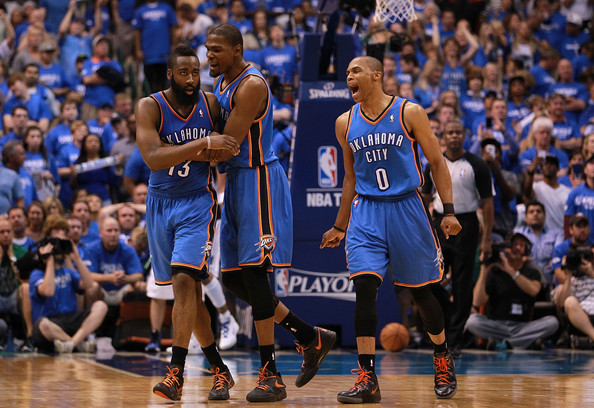
As Steven Tyler of Aerosmith would say, the Thunder are literally “living on the edge” in the last 5 games. Its one of those runs where the team could easily be 0 – 5, just like it could be 5 – 0. Instead, the Thunder find themselves at 4 – 1 since the All Star Break and building on their lead at the top of the Western Conference. Here’s a look at the key 2nd halves in each of those games and how the Core 4 (Kevin Durant, Russell Westbrook, James Harden, and Serge Ibaka) performed:
Opponent
Largest Deficit/Quarter/Score at the time of deficit
Durant’s 4th qtr Stat Line
Westbrook’s 4th qtr Stat Line
Harden’s 4th qtr Stat Line
Ibaka’s 4th qtr Stat Line
@ Philly
8 / 4th /66 – 74
10 pts / 3 rebs / 1 ast /1 stl
2 pts / 2 rebs /1 ast
7 pts / 3 rebs
2 pts / 2 rebs /1 blk /1 stl
@ Orlando
11 / 4th / 72 – 83
18 pts / 5 rebs
4 pts / 2 asts
8 pts / 3 rebs / 2 asts
Donuts
@ Atlanta (L)
8 / 4th /79 – 87
6 pts / 2 rebs
2 pts / 1 ast
3 pts / 2 rebs /1 ast
1 reb / 1 blk
Dallas
7 / 3rd / 45 – 52
6 pts /2 rebs
5 pts / 2 rebs
14 pts / 2 asts
2 pts / 2 rebs / 1 blk
Phoenix(W)
16 / 3rd / 68 – 84
12 pts / 2 rebs / 1 asts / 2 stls
9 pts / 1 ast
8 pts / 1 reb / 1 ast
2 pts / 8 rebs /1 blk
While this style of basketball makes for great fun as a fan, especially if you are winning most of the time, it also paints a conflicted picture in the Thunder’s outlook for the postseason. Two trains of thoughts come into play when a team is winning in this fashion. The first is that the team is learning how to win close games and is showing the ability to come back from 2nd half deficits. The second is that, come playoff time, constantly falling behind in the first half to elite teams will be the coup de grace to this year’s championship aspirations. Which train of thought is correct?
The answer, as usual, lies somewhere in the middle. As a young team, it’s necessary to build the fortitude to be able to come from behind and win. If you’ve never experienced having to recover from a sizeable deficit, then you may choke if the situation arises in the playoffs. But you also don’t want to make it a habit of constantly falling behind your opponents in the first half. It’s almost like the team goes into a mode where they say, “let’s keep the score somewhere around 10 entering the 4th quarter and we have a chance.” While it’s a luxury to have not one, but two great clutch players (Durant and Westbrook), there can come a time where the natural effect of statistics takes hold and they both have a bad second half. You just hope it isn’t in an elimination game in the playoffs
Let’s imagine a scenario. You go on a blind date with this girl (or guy, you make the scenario fit to your liking). When you finally meet her, you think, “Hey, she’s easy on the eyes.” The first date is exciting, but ultimately ends a little awkwardly. She has a youthful grace about her, but can be a little immature at times. Everything goes well enough, though, that you both agree to another date. You continue to date for that month, but you constantly think about what your ex is doing and how you guys had better chemistry. The dates are good; some end up great, some disappointing. But there’s enough of a spark to continue dating.
The next month things get even better. You start to hang out more and there are less and less “weird” moments. She even reveals to you that she trained as a world class chef before taking on her current job. She invites you over for a couple dates at her house to try out her culinary skills, and needless to say, she has “skillz”. The girl can throw down in the kitchen, and you know the saying referencing a man’s heart and his stomach. All those thoughts about your ex start to fade away and become non-existent.
In the 3rd month of dating, you feel like you are ready to make this an exclusive relationship. There are less dates and more time together. You start to synchronize your schedules to have more time together. You start to want to hang out with this girl. Then she gives you the surprise of your life and buys you a brand new sports car. You start to turn it down, but she insists that she has been saving up a lot of money and needs to spend it for “tax” purposes. The L-word even starts to get tossed around playfully.
In the 4th month, you hit a little hiccup in the beginning of the month. You bicker back and forth about “young-relationship” things. You begin to wonder whether you are even going to continue the relationship. But alas, you work through it and hopefully come out stronger in the end. And, this is where you are currently at.
For the past two months, she has surprised you with something big. You begin to wonder what she has in store for you this month. Then you realize how selfish that sounds. You have a great girl that has given of her heart in the short time you two have been together and now you are expecting something from her. You begin to see that you have been spoiled, and, just maybe, to the detriment of your ethics and expectations. You realize that you have devalued the past and the present with the expectations of the future.
Now, before you become concerned and think that my sports blog has turned into a self help or relationship blog, please realize that I used this scenario as an analogy. Change the word girl to team (namely the Oklahoma City Thunder) and change the word month to season. There you have Oklahoma City’s relationship with the Thunder in our 4 short years together. And I mean it when I say that we have been completely and utterly spoiled.
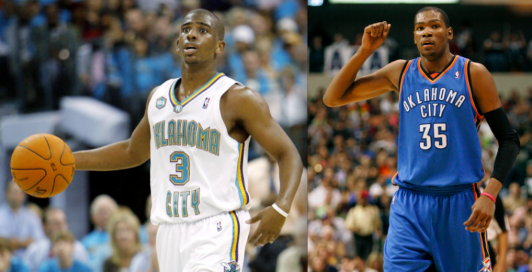
Oklahoma City’s situation has been so rare and unique that it is really difficult to find something comparable. First off, OKC had a tryout, of sorts, with the two seasons the Hornets played at the Ford Center after Hurricane Katrina. We proved that OKC was a viable market and took advantage of our surprising opportunity. This is back when we weren’t spoiled. This is back when we were a hungry market yearning for attention and respectability.
After a year hiatus from the NBA, we took full advantage when the Thunder came rumbling to town, selling out our season tickets in record time, and showing up in droves to the games. Then we realized we had a crappy team. Young, but still crappy, nonetheless. We longed for the days of the ever-improving Hornets who were quickly becoming the darlings of the Western Conference. But we stuck with it and started seeing results in the 2nd half of the season. At this point, we were still building a relationship with our new team.
That improvement from the 2nd half of the previous season continued into the 2nd season, where the Thunder finally took off and never looked back. They more than doubled their win total and made it into the playoffs, pushing the eventual champs to an unexpectedly tough 6 game series. We applauded our team and cheered them on, but always kept wondering when the other shoe was going to drop on our fairy tale story. At this point we were enjoying our successes, but wondering how fragile they are.
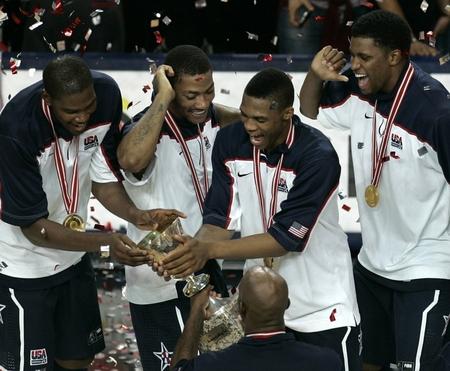
During that summer between our 2nd and 3rd seasons, we were overjoyed to see Kevin Durant and Russell Westbrook, two of our players, represent the country in their pre-Olympic tournament in which they were belittled by their own country’s media (“B-team”) and expected not to medal. Instead, led by the two Thunder players, the team took home the gold with nary a blemish on their record. We, as a fan base, puffed out our collective chests and walked around with pride in preparation for the next season.
Heading into the 3rd season, expectations were high, not only locally, but also nationally. With a big move at the trading deadline, the Thunder did not disappoint making it all the way to the Western Conference finals losing to the eventual NBA champs. Fans were beginning to become accustomed to winning because it is all they had known with this franchise.
Presently, the team sits tied for the best record in the league at the half-way point in a strike shortened season. We’ve seen Kevin Durant be named All Star game MVP, while Russell Westbrook performed exceedingly well in the same game. But what should be a feeling of joy and accomplishment is sometimes flipped into a feeling of anger and disgust whenever we do actually lose a game. It’s almost like we are expecting to win every game, while at the same time, expecting the clock to strike 12 and for this team to turn back into a big ugly pumpkin with some scurrying mice.
Are we spoiled? Hell yeah we’re spoiled. Our track record has been nothing but an upward trend. In a league that is cyclical in terms of team success, we’ve been a straight line in the positive direction. But, can you be spoiled, and still be appreciative of what you are watching? That’s what worries me about this fan base. What’s going to happen to it when we hit our first big bump in the road?
We’re an extremely young fan base that has grown with this team. You can say that we have experienced bumps in the road with the losses in the playoffs. But, expansion teams and rebuilding teams go through years of futility before they finally start to see the fruits of their labor. We haven’t had to go through the years of futility. We had one horrible year and the rest have been magical. My only fear is what happens when making it to the playoffs isn’t magical anymore.
And don’t get me wrong. I’m not trying to be a Debbie-downer (or is it a Dreary-Dougie?). I love and respect our fan base to no end. Many media pundits have called us the best home crowd in the league. And I agree whole-heartedly, as I’m one of the crazies screaming my ass off in the middle of the 2nd quarter. But, in taking in the last 3 ½ seasons, I want something malleable that I can compare it to. They say that history repeats itself, but sometimes it’s scary when you are the one making the history. I don’t know how this story will end and that’s the exciting part about all of this. We are the archetypes when it comes to a franchise that had to move while rebuilding and experienced quick success as soon as it arrived at its new location. With that said, let’s continue on with our magical season. There is still much to be written in this story.
Any time I hear the word halftime, this is the first thing I think about.
We’ve reached the half-way point in this strike-shortened season. Half time, baby! Everyone to the locker room, or as it’s called in the NBA, All-Star Weekend. Coming into the season, I didn’t know what to expect. We were bringing back our entire 10 man rotation, plus a couple young guys that had potential. But with a very short training camp, no summer league, and only 2 preseason games against the same team, it was a little difficult to gauge how the team would come out the gates. Conventional wisdom would say that in a shortened season, a team that experienced hardly any change would benefit the most early in the season.
That thought has not proven to be incorrect when it comes to the Oklahoma City Thunder. They are currently tied for the best record in the league at 25 – 7 and have a 2 game lead in the hyper-competitive Western Conference. If natural progression is the law of the land, then the Thunder are right where they are supposed to be. After finishing 4th in the conference last season and making it all the way to the Western Conference Finals, the Thunder are poised to take the next step in their natural progression.
Individual Grades (alphabetical order): I take into account what was expected of the player before the season started and how that player has fared in this first half of the season.
After spending last season shuffling between the Thunder and the Tulsa 66ers of the D-League, Aldrich was expected to continue developing into a rotational big man. When Nazr Mohammed was re-signed before the beginning of the lockout, it was an indication that the organization wanted Cole to continue to develop. In the 12 games that he has gotten in, Cole has shown a knack for causing havoc on the defensive end with his long wingspan and penchant for blocking or altering shots. On the offensive end, he has shown flashes of a nice post-up game (hooks, drop step, put back dunks), but has yet to fully assert himself and ask for the ball on the block consistently. He tends to be a bit over zealous on the defensive end and is prone to picking up fouls pretty quickly, especially on pump fakes. Aldrich shows great heart on the floor, though, constantly diving for loose balls. #FreeCole!
The No-Stats MVP. The ultimate glue guy. Collison was expected to continue being the first big man off the bench. A key cog that can be plugged in seamlessly if foul trouble or defensive lapses rear their ugly heads. Collison has not disappointed in his role. He is basically the same guy from last season with more of a willingness to unleash the soul crushing 12-15 foot jumper. A charge magnet, the 2nd unit gets their defensive identity from Collison. One of the smartest players in the league that is usually in the right place, at the right time (and not by coincidence). Future coach potential.
One of the wild cards coming into the season, Cook started last season in a rut that eventually led to him getting over 30 DNP-CD’s in the first half of the season. When finally given an opportunity to play, Cook became the deep threat that the Thunder had hoped for when they traded for him on draft night in 2010. Cook has continued to provide the deep threat for the Thunder this season and has also become a more integral part of the rotation, even starting 12 games in place of injured SG Thabo Sefolosha. He has improved his man on man defense and has involved himself more on the boards.
Expected Grade – C+ Mid-Term Grade – B-
Kevin Durant (Stat line: 32 GP (32 GS), 37.8 mpg, 8.2 rpg, 3.3 apg, 1.3 blks, 1.3 stls, 27.7 ppg)
A candidate for MVP coming into the season, Durant has not disappointed. While his scoring may have gone down just a tad bit, his rebounding, assists, and blocks are at career high levels. He is scoring at the most efficient rate in his career and he is starting to be relevant defensively, especially on the boards. He is learning how to get the ball in better spots and how to position himself to get better shots in crunch time. The only negative I can see in his game is the turnovers. The athletic part of Durant is starting to mesh with the cerebral part. And that is a scary reality for the rest of the league.
The glue that holds the “feuding” yin and yang that is Kevin Durant and Russell Westbrook together. We all know that the “feuding” part of that statement has proven to be false as this season has progressed. What started as an improvement over the 2nd half of the season last year morphed into calls for Harden to be the starting 2-guard as the new season began. Coach Scott Brooks kept Harden on the bench and he has turned into arguably the best 6th man in the league, providing instant offense off the bench, ala Jason Terry or Jamal Crawford. Along with being the unquestioned leader of the bench unit, he’s also in the game with the starters to close it out in most games. His playmaking ability and penchant for getting foul calls make Harden an offensive weapon to be marveled. While steadily improving defensively, he can still be had by good 2-guards, especially if quickness is a factor. Also, the home/road splits were an issue in the beginning of the season, but have normalized since then. Hopefully that doesn’t come up in the playoffs.
Expected Grade – B+ Mid-Term Grade – B+
James Harden’s Beard (Stat line: No stats can measure the greatness)
Seriously, this needed its own section. We’ve seen this thing grow from when Harden first joined the Thunder in June 2009. It started off so small and has blossomed into something so much greater. Olympic gods now bow in the presence of the Beard.
Expected Grade – A+ Mid-Term Grade – Infinity on a 4 point scale
Haywardwas obtained in a deal with the Timberwolves before the season. Hayward’s presence on the team is more as a practice player than as a regular rotation player. I believe, the bigger bodied Hayward has allowed Durant to simulate what its like to go against a stronger defender and to see what works against these types of defenders and what doesn’t. In his time on the floor,Hayward has shown to be a good transition player. He needs to be more consistent with his shot, especially from the 3-point line. Defensively, Hayward is an average defender.
Just like James Harden (and Kevin Durant and Russell Westbrook before them), Ibaka was expected to make the big 3rd year leap that we’ve seen from developing Thunder players. At the beginning of the season though, Ibaka seemed a bit out of sync. He wasn’t as aggressive and was settling for jumpers, instead of trying to do his damage from the inside. But over the last month, we’ve seen the Ibaka that we love and that opposing teams hate. In the last 3 weeks, we’ve seen 3 double digit block games, a man’s triple double (points, boards, blocks), and a disruptive defensive force not seen since the heydays of Ben Wallace. He still leaves a lot to be desired on the offensive end of the court as an inside presence. Though he sometimes leave us salivating with Olajuwon like post moves, he still prefers the 15 footer, which he is starting to hit with more consistency lately. His penchant for going for blocks usually leaves a gaping hole in the middle for offensive rebounders.
Ivey’s role on the team is that of veteran point guard. He’s a defensive minded player that probably pushes Russell Westbrook and Eric Maynor in practice. When he has received playing time, Ivey has made a couple 3 pointers and played good defense. He has recently been called to duty a lot earlier in games because of some injuries to players. His defense keeps him in games, but his lack of a true identity (not really a point guard, but not very consistent with his jumper) can be a detriment if the team starts to struggle offensively.
My expectation for the rookie was that he would split time between the Thunder and the Tulsa 66ers of the D-League, gaining valuable experience against lesser competition in preparation to possibly be a regular rotation player next season. But with the injury to Maynor, Jackson was thrust into the rotation as the primary back up point guard. The results have been par for the course for a late first round rookie point guard. Some flashes of decent play sandwiched between lessons from the school of hard knocks. They say that experience is the best teacher, so hopefully this is a blessing in disguise for the future. But in the present, Reggie has shown that he has the athletic ability to play in this league, but is still trying to figure out the nuances of the point guard position. If he is on the floor with one of the three main ball handlers (Westbrook, Durant, or Harden), he immediately defers to them to run the offense. Also, defenses have learned to pressure the rookie into making bad decisions. With all that said, though, I like what I see in Jackson and believe this experience will help him immensely in the future.
As a third year player, I fully expected Maynor to make that leap from okay player to good player. Already labeled by some to be the best back-up point guard in the league, Maynor’s steady hand at point made him the quarterback of one of the best bench units in the league. Like many players in this condensed season, Maynor’s play at the beginning was a bit careless, as he was averaging less assists and more turnovers. Nine games into the season though, Maynor suffered a torn ACL and was lost for the season. For all intents and purposes, Maynor’s recovery seems to be going ahead of schedule and he will be ready for training camp next season.
Expected Grade – B Mid-Term Grade – Inc.
Nazr Mohammed (Stat line: 31 GP (1 GS), 12.4 mpg, 3.0 rpg, 0.3 apg, 0.6 blks, 3.1 ppg)
The old man of the crew. In a room full of 20-somethings, Mohammed is the revered veteran. Mohammed’s role is that of back up center. Last season, he was invaluable as a stop gap until Kendrick Perkins came back from injury and as Perkins’s backup. There have been times this season where Mohammed has looked as spry as a spring chicken. And then there’s been blocks of game where Mohammed has literally looked like he has cement shoes on. That’s what you get with a 14 year vet. You take the good with the bad.
One of the most polarizing players on the team. Last year, Perkins was coming off major knee surgery and was slowed by bulky knee braces and the weight he put on while recovering. Vowing to come into camp more in shape, Kendrick came in 30-40 pounds lighter and shed the knee braces. But it’s been the same ol’ Perkins; a good post defender who does well against traditional centers, but gets lost if a team has an athletic and/or undersized center. Offensively, Perkins is a turnover waiting to happen. I don’t know if he lost some coordination during his recovery from surgery, but when he puts the ball on the floor, he usually loses it. When he attempts a shot, it’s usually a flat jump hook that is easily rejected. I don’t like to blast on Perkins since the Thunder’s record is so good with him in the lineup, but his biggest asset to the team is that he frees up Ibaka on the defensive end to be the NBA’s version of a roaming free safety. Another negative is the boneheaded technicals that Perkins picks up. He putting himself in a position to get suspended and miss time because of his hard-headedness.
Every year there’s that one guy that you, as a fan, attach your heart strings to. The underdog. The runt of the litter. Ever since the Thunder drafted Reid in the 2nd round of the 2010 draft, I’ve followed his career in the D-League. I was pleasantly surprised when the Thunder offered Reid the final roster spot for this season. This organization rewards “those” types of players that work hard to pursue their dream, even if everyone else has told them they have no chance. Last season it was Robert Vaden. Next season it may be Latavious Williams or Tibor Pleiss. When Reid finally got some run on the Valentine’s Day game, I was texting my brother in law in all caps. Literally, this was my text, “RYAN REID SCORED!!!!!!!!!” Honestly, in his limited game time, he has shown a good mid-range jumper and has shown the potential to be a future glue guy.
Another polarizing player on the team. While he is one of the best wing defenders in the league, his offensive inefficiencies can sometimes lead to the Thunder playing “a man down” on the offensive side of the court. The clamoring for a change in the starting line-up only got louder as last season’s playoffs pushed forward, and teams began corralling Durant and Westbrook. The thinking was that Harden, as a floor spreader, would allow Durant and Westbrook more room to operate on the offensive end. Hypothetically, this would seem like the correct way to go. But, as this season has shown, the value of a great wing defender should never be lost in the search for more efficient offense. The game is played on both ends of the court. As an added bonus, Sefolosha had shown signs of being more offensively efficient this season. He had begun to drive the ball more to the basket and was shooting the 3-pointer at a 48% clip. Not that he shot that many, but of the few that he did shoot, he was making almost half of them. I still cringe when I see him lead a fast-break, though. Unfortunately though, Sefolosha has been battling foot issues and has been limited this season and is expected to miss one more month.
Expected Grade – B- Mid-Term Grade – B+
Russell Westbrook (Stat line: 32 GP (32 GS), 4.8 rpg, 5.5 apg, 1.9 stls, 23.4 ppg)
Probably the most polarizing player on the Thunder. Last season, ironically, Westbrook’s 3rd, he went from good player to superstar. He, along with Derrick Rose, became the new standard for point guards: hybrids that could score 25 ppg and dish out 8 assists per game, while constantly breaking down a defense and doing their damage from the paint. You knew that Durant could score and that all he needed to do was refine the finer points of his game (rebounding, playmaking, etc). But you didn’t know where the learning curve would take you with Westbrook. Because of the criticism that Westbrook was receiving in last season’s playoffs and in the off-season, and the upcoming contract extension, I didn’t know what to expect from Westbrook. In the first 2 weeks of the season, it seemed like Westbrook was in the funk of all funks. His shot wasn’t falling, his assists were down, and there were rumblings of a true feud between he and Durant. Thankfully, things seemed to turn around in the middle of January (coincidentally once Russell signed his new contract) and Russell has been playing great ever since, garnering a couple Western Conference Player of the Week awards along the way. With Derrick Rose’s injury woes this season, Russell Westbrook has taken the role of premier point guard with his driving ability and consistent mid-range jumper. He still turns the ball over way too much and doesn’t always work to involve his teammates, but what I’m seeing from Russell this season is surprising because he’s still improving at a tremendous clip.
Expected Grade – A- Mid-Term Grade – A
Surprises:
It’s amazing how important a real training camp and 4+ preseason games are to players in their preparation for a season. I noticed that in many of the Thunder players’ performances. They didn’t really take off until after the 2nd week of the season, which in actuality, would be the same amount of time as training camp and preseason games in a normal regular season.
I kept hearing about how injuries would shape this season because of the condensed schedule. But I had no idea it would be this bad. The Thunder have never experienced many injuries in their 4 season in Oklahoma City. An ankle sprain here. A pulled hamstring there. But this season, we’ve seen Maynor go out with a torn ACL, Sefolosha miss significant time with foot issues, and other players miss 1-2 games with general soreness.
Looking ahead:
The schedule gets tougher from here on out. We play the Lakers 3 more times, Miami and the Clippers twice, Chicago, Philly, Dallas, and San Antonio once each, and 6 more games against division rivals. We have a 3 game East coast trip after the All-Star break and a 5 game West Coast trip close to the end of the season. Needless to say, if we stay at the top the Western Conference, we would have definitely earned it.
Possible trade targets – Since the trading deadline is on March 15, I looked a possible trade targets for the Thunder and their struggles on the bench:
The Oklahoma City Thunder finally got to sleep consecutive days in their own beds and will enjoy the confines of their abode from now until the All-Star break, sans one trip to Houston. This will be the second of 3 meetings between the two teams this season. The Thunder’s last game was against these Jazz, while for the Jazz, this will be their 3rd game in as many nights. The Thunder won the last meeting going away 101 – 87.
The Opponent
The Utah Jazz have the definition of consistently inconsistent. They started off the season losing 3 of their first 4. Then the reeled off 9 wins out of their next 11 games. And now they’ve lost 6 of their last 10 games. They currently sit at 14-13, good for 4th in the division and 9th in the conference. The Jazz are led by their front court of Al Jefferson and Paul Millsap. Together they are averaging 35 points and 18.6 rebounds per game. Though a bit undersized, they are one of the more formidable front courts in the league. Last season’s first round pick, Gordon Hayward, is rounding into a good role player providing more scoring, rebounding, and playmaking as the starting SF. The backcourt of Devin Harris and Raja Bell is veteran-laden, but a bit limited in all facets of the game. The bench for the Jazz can be inconsistent, with veterans CJ Miles, Josh Howard, and Earl Watson getting the bulk of the bench minutes. The Jazz’s defense is pretty suspect as they allow 97.2 points per game, which is 23rd best in the league. This will be the 3rd game in as many nights for the Jazz, while the Thunder haven’t laced them up since last Friday.
Probable Starting Line-ups
Oklahoma City
PG – Russell Westbrook
SG – Thabo Sefolosha
SF – Kevin Durant
PF – Serge Ibaka
C – Kendrick Perkins
Utah
PG – Devin Harris
SG – RajaBell
SF – GordonHayward
PF – Paul Millsap
C – Al Jefferson
Matchup to look out for
Russell Westbrook vs. Devin Harris
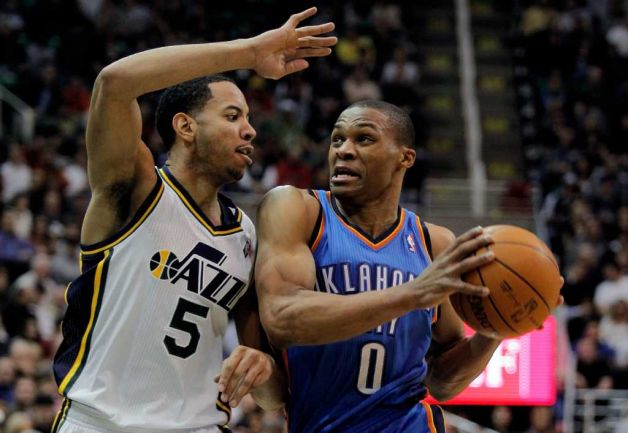
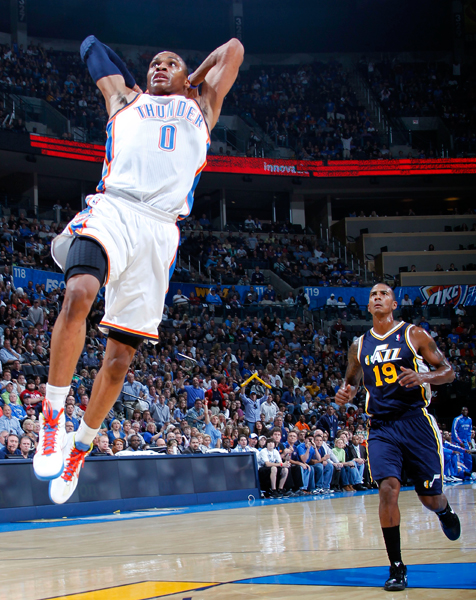
When the Utah Jazz chose their poison in the last game and decided to focus all their defensive attention on Kevin Durant, it freed up Westbrook to take advantage of the smaller Harris and score 28 points on 10/20 shooting from the field. It will be very interesting to see how the Jazz choose to defend Westbrook this time around and how Westbrook adjusts to this.
3 in the Lane
Turnovers. Please gentlemen, let’s keep these turnovers to a minimum. I don’t know a good number, but the more you turn it over, the more you give the other team opportunities to score on their end. Everyone on the court is an NBA player, and eventually, if given enough opportunities, even bad teams will score on their increased opportunities.
Interior defense. Millsap and Jefferson are very similar to Marc Gasol and Zach Randolph in that they aren’t overly athletic, but are very fundamentally sound and have good mid range games. For being undersized, Millsap is deceptively good on the interior. It’ll be very important that Ibaka, Perkins, Mohammed, and Collison stay with these guys at all times, as they have been know to drop 30 and 15 type games.
Offensive schema. There is no one on the Jazz that can consistently guard Kevin Durant or Russell Westbrook. Durant is so much bigger than Bell,Hayward, or Howard. And Westbrook is so much stronger than Harris and quicker than Watson. The key will be the shooters (Cook, Sefolosha, and Harden). If they are making their shots, the defense won’t be allowed to collapse on Durant and Westbrook, as their primary defenders will need help throughout the game.
The Oklahoma City Thunder are probably sick and tired of their decked out first class plane. I’m all for team bonding, and being on the road can accentuate this, but 8 road games out of 9 is a bit much in a 14 day span. Oklahoma City doesn’t have a circus in town, and when the rodeo comes, they only stay for a couple days. The last time they played at home, Jeremy Lin was still riding the pine in New York. Now, they hit the final leg of their tour, against division rival, the Utah Jazz. This will be the first of 3 meetings between the two teams this season. The Thunder won the season series last year 3-1, but the Thunder will find that this year’s Jazz team has a completely different look than last season’s.
The Opponent
The Utah Jazz have the definition of consistently inconsistent. They started off the season losing 3 of their first 4. Then the reeled off 9 wins out of their next 11 games. And now they’ve lost 6 of their last 9 games. They currently sit at 13-11, good for 3rd in the division and 8th in the conference. The Jazz are led by their front court of Al Jefferson and Paul Millsap. Together they are averaging 35 points and 18.6 rebounds per game. Though a bit undersized, they are one of the more formidable front courts in the league. Last season’s first round pick, Gordon Hayward, is rounding into a good role player providing more scoring, rebounding, and playmaking as the starting SF. The backcourt of Devin Harris and Raja Bell is veteran-laden, but a bit limited in all facets of the game. The bench for the Jazz can be inconsistent, with veterans CJ Miles, Josh Howard, and Earl Watson getting the bulk of the bench minutes. The Jazz’s defense is pretty suspect as they allow 97.2 points per game, which is 23rd best in the league.
Probable Starting Line-ups
Oklahoma City
PG – Russell Westbrook
SG – Daequan Cook
SF – Kevin Durant
PF – Serge Ibaka
C – Kendrick Perkins
Utah
PG – Devin Harris
SG – RajaBell
SF – GordonHayward
PF – Paul Millsap
C – Al Jefferson
Matchup to look out for
Al Jefferson vs. Kendrick Perkins
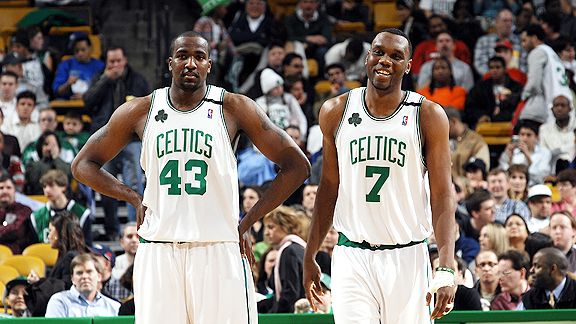
These two were supposed to be the future front court for the Boston Celtics in the early 2000’s. As both have attested to, they developed a great bond while in Boston and continue to be great friend off the court. Perkins tends to get up for games against rivals or old friends. He got Boston for 7 points, 5 boards, and 1 block earlier this season. And I know he’ll more than be up for this game tonight.
3 in the Lane
Turnovers. Please gentlemen, let’s keep these turnovers to a minimum. I don’t know a good number, but the more you turn it over, the more you give the other team opportunities to score on their end. Everyone on the court is an NBA player, and eventually, if given enough opportunities, even bad teams will score on their increased opportunities.
Interior defense. Millsap and Jefferson are very similar to Marc Gasol and Zach Randolph in that they aren’t overly athletic, but are very fundamentally sound and have good mid range games. For being undersized, Millsap is deceptively good on the interior. It’ll be very important that Ibaka, Perkins, Mohammed, and Collison stay with these guys at all times, as they have been know to drop 30 and 15 type games.
Offensive schema. There is no one on the Jazz that can consistently guard Kevin Durant or Russell Westbrook. Durant is so much bigger than Bell,Hayward, or Howard. And Westbrook is so much stronger than Harris and quicker than Watson. The key will be the shooters (Cook and Harden). If they are making their shots, the defense won’t be allowed to collapse on Durant and Westbrook, as their primary defenders will need help throughout the game.














 Now That's Thunder Basketball