Tag Archives: Lebron James

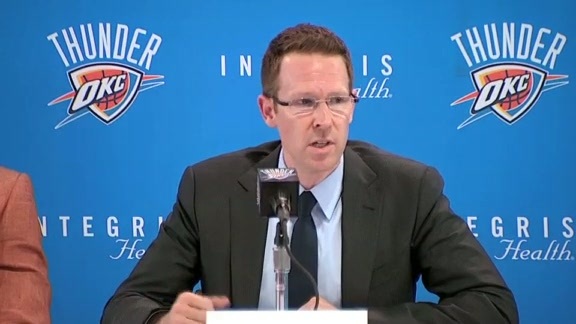
The OKC Thunder and their trade deadline moves

presti-sam

After so much speculation and rumor, this was just about the most anti-climactic trading deadline ever. Other than the Sacramento Kings unloading Thomas Robinson in a “scratch your head” trade to Houston, most teams played it safe and kept their assets. This is probably the first visible sign of how the new CBA will affect how teams view their assets moving forward.  The name of the game is cap space and most teams stuck with what they had instead of taking on salary and risk.

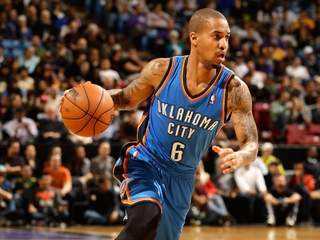
The Oklahoma City Thunder were a microcosm of the trading deadline, itself. The Thunder had one player who was a virtual lock to get traded, in Eric Maynor. The rumors were that teams were interested in Maynor as a solid back-up point guard, but were unwilling to unload a first round pick in exchange for him, which was the asking price from the Thunder. Then on Wednesday, a big rumor sprang up involving the Thunder and the Phoenix Suns. In the proposed trade, Phoenix would send Marcin Gortat and PJ Tucker to the Thunder for Kendrick Perkins, Jeremy Lamb, and a 1st rounder. Though the rumor died down as the day went along, it gained a little bit of momentum late Wednesday when Perkins was a late scratch in the Thunder’s game because of a knee sprain. By Thursday, though, the deal was all but dead. In the end, the Thunder traded Maynor, kept the asset train rolling, and obtained a veteran lock-down defender for virtually nothing.

Deal 1 : Oklahoma City sends Eric Maynor to the Portland Trailblazers for a $2.35 million trade exception and the rights to Georgios Printezis

Eric_Maynor_20130221145500_320_240

One of the greatest things in the world is receiving an extension to a deadline. The Thunder were facing the possibility of losing Maynor for nothing this offseason. While the Thunder didn’t receive the 1st round pick they were initially looking for, they did receive an asset that could help them immensely in the future. The trade exception is actually a little more than Maynor’s actual salary. In essence, the Thunder got a 1 year reprieve on Maynor’s expiring contract, without having a live body taking up a roster spot.

For a player that many fans thought wouldn’t garner anything of value, the Thunder made the best of the situation and got themselves a valuable asset. With possibly 3 draft picks (2 first rounders and a 2nd rounder) in the upcoming draft, look for Oklahoma City to put a package together to get something of high value on draft night.

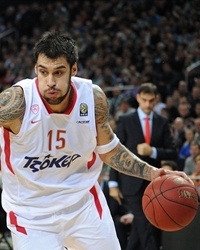
georgios-printezis-olympiacos-piraeus-eb12-42058

As for Georgios Printezis, he’s a 6’9” PF that currently plays for Olympiacos in the Euroleague. His game is similar to that of Luis Scola of the Phoenix Suns, but with a little more range on his jumper. He is best known for hitting the game winning shot in the Euroleague finals against CSKA Moscow. The 28 year old recently signed a 3 year extension with Olympiacos that will probably keep him in Europe for the rest of his career.

Deal 2: Oklahoma City receives Ronnie Brewer from the New York Knicks for a 2014 2nd round pick.

One of Sam Presti’s tenants is that he never deals for a player with just one team in mind. When he dealt for Kendrick Perkins, many people thought he did that with only the Los Angeles Lakers (who had Andrew Bynum and Pau Gasol) in mind. But the entire Western Conference is full of skilled big men, especially the playoff teams. Teams like Memphis (Marc Gasol and Zach Randolph), Utah (Al Jefferson and Paul Millsap), San Antonio (Tim Duncan and Tiago Splitter), and the Los Angeles Clippers (DeAndre Jordan and Blake Griffin) all pose a threat on the inside to the Thunder.

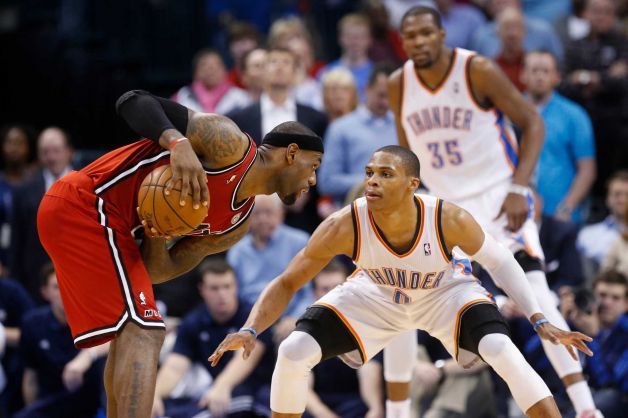
With our recent struggles against the Miami Heat, many Thunder fans were clamoring for a big wing defender like Luc Richard Mbah a Moute of the Milwaukee Bucks or Jared Dudley of the Suns to be that mythical being called a “Lebron stopper”. The truth is, when you play a team that plays inside/out like the Heat or the Spurs, a big wing defender is tantamount when it comes to recovering on 3-point shooters. Players like Tony Parker, Manu Ginobili, Dwayne Wade, and James are great at dribble penetrating, breaking down a defense, and finding the open guy on the perimeter. While the Thunder already have a great perimeter defender in Thabo Sefolosha, an extra set of long arms and active hands would not hurt.

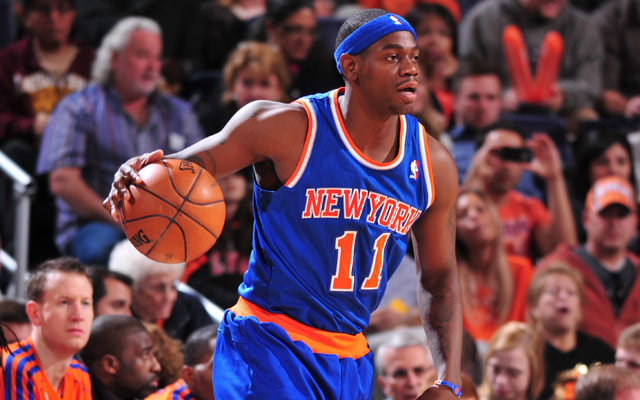
02212013_ronnie_brewer

The New York Knicks, in an effort to slash some payroll and open up a roster spot, were looking to unload one of their perimeter defenders. The early rumor was that they were trying to trade Iman Shumpert for an offensively minded guard like Orlando’s  J.J. Reddick. Instead, the Knicks made Brewer available and the Thunder swung the deal for him. Brewer is regarded as one of the toughest big wing defenders in the league. He’ll be especially helpful to Kevin Martin and the bench unit as their best wing defender. Also, if necessary, in small ball line-ups, Brewer can be put in at SF or SG to help on the defensive end.

An added bonus is that Brewer’s salary is nearly half of what Maynor’s was ($2.3 million for Maynor compared to $1.2 million for Brewer). That saved money could be used to get a veteran free agent for the final roster spot, similar to what the Thunder did in obtaining Derek Fisher last season.

okc lbj

Overall, I think these moves made the Thunder slightly better in the present and made them even more dangerous on the draft/trade front in the future. Whether Brewer proves to be of any use is still to be seen. But it’s better to have a player like that on your team than on your opponent’s team. With the more punitive luxury tax looming next season, many teams will be looking to dump some salary in the offseason. With all their assets they’ve accrued, the Thunder should feel pretty good about themselves as we move forward under the guise of this new CBA.

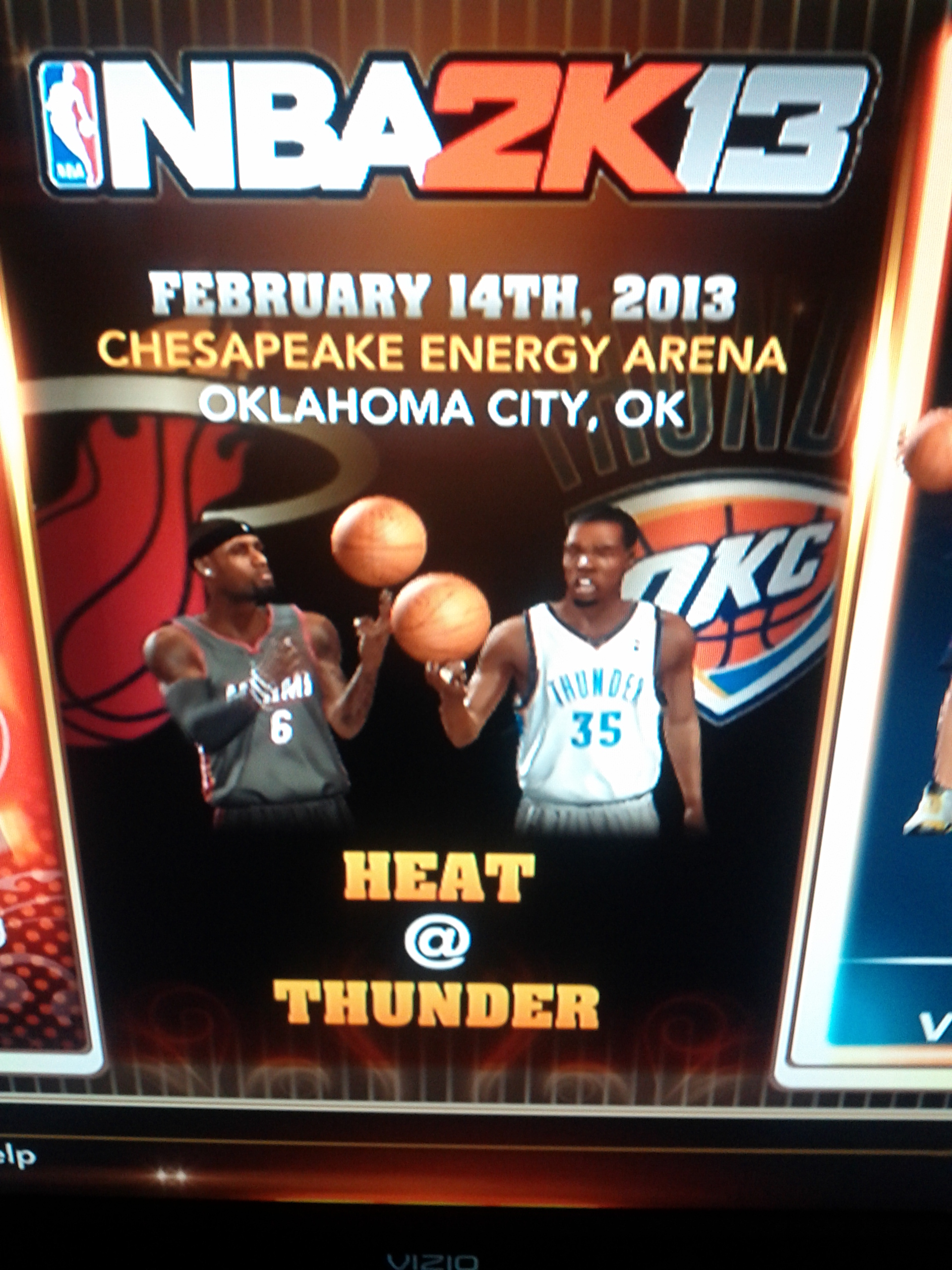
Miami Heat vs. Oklahoma City Thunder Preview (Game 53 of 82)

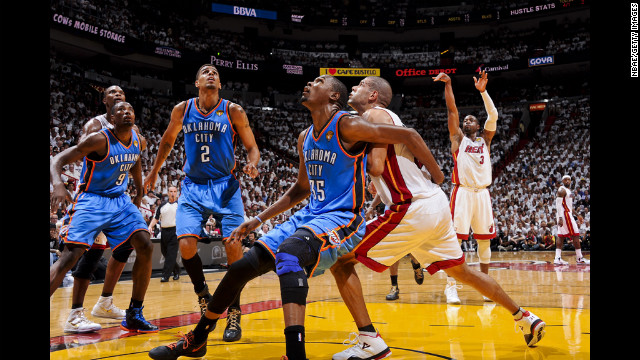
okc miami

  • When: Thursday, 14 February 2013 at 7:00 PM CST
  • Where: Chesapeake Energy Arena, Oklahoma City, OK

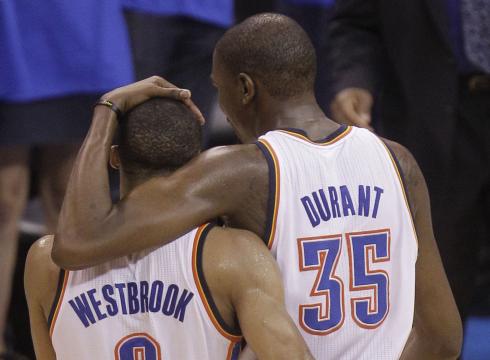
This game brings to it a sense of deja vu. The last time the Oklahoma City Thunder played the Miami Heat, the Thunder were coming off a loss. The Thunder ended up losing that game to the Heat on Christmas day for their only consecutive game losing streak of the season. This time the Thunder are coming off a loss to the Utah Jazz, and would love nothing more than to get a victory against last season’s Finals opponent before heading into the All-Star break. Remember, Kevin Durant and Russell Westbrook has to swallow the bitter pill of playing with Lebron James in the Olympics after their NBA Finals loss. The last thing they want is to lose to Lebron and the Heat again, when they’ll probably have to link up for NBA-related activities during the All-Star break.

In their last meeting, the Thunder and Heat played in a game that met expectation. While the Heat held the lead for most of the 4th quarter, the game was tight with Durant and Westbrook both having chances to tie the game in the closing seconds. The main characters performed well, with Durant and Westbrook leading the Thunder with 33 and 21 points, respectively, and James and Dwayne Wade leading the Heat with 29 and 21 points, respectively. The main difference were the role players, where Kevin Martin and Serge Ibaka each had 15 points for the Thunder, while Chris Bosh and Mario Chalmers had 21 and 20, respectively, for the Heat.

The Opponent

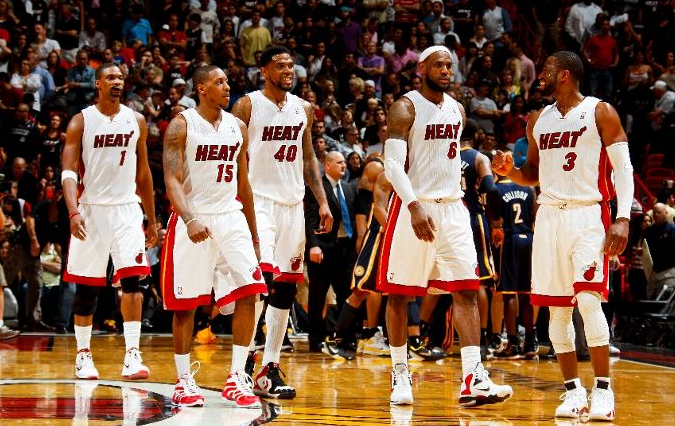
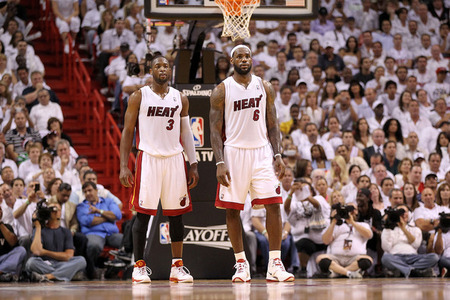
miami heat starting 5

The Miami Heat come into the game with a 35-14 record, good for 1st in the Eastern Conference. They are currently riding a 6-game winning streak. Their offense is top-5 in the league (103.1 ppg, 5th in the league) and their scoring defense is in the top half of the league (96.7 ppg allowed, 12th in the league). The Heat are led by all-world forward Lebron James, who is having one of the best seasons the league has ever seen. He is leading the Heat in 4 statistical categories (scoring, rebounds, assists, and steals), while leading the NBA in Player Efficiency Rating (PER). The backcourt consists of Mario Chalmers and All-Star Dwayne Wade, who is also having a great season, averaging 21 points, nearly 5 rebound, and nearly 5 assists per game.  The front court consists of rugged PF Udonis Haslem and All-Star Chris Bosh. The bench is full of 3-point shooters (Ray Allen, Shane Battier, Norris Cole, Mike Miller) and the recently signed Chris Andersen.

Probable Starters

Miami Heat

  • PG – Mario Chalmers
  • SG – Dwayne Wade
  • SF – Lebron James
  • PF – Udonis Haslem
  • C – Chris Bosh

Oklahoma City Thunder

  • PG – Russell Westbrook
  • SG – Thabo Sefolosha
  • SF – Kevin Durant
  • PF – Serge Ibaka
  • C – Kendrick Perkins

3 Keys to the Game

  • Perimeter Defense – Its the rock and the hard place that defenses face when they play the Miami Heat. Do you allow James and Wade to penetrate into the lane, but stay home on the shooters? Or do you collapse the defense to protect the paint, while exposing yourself on the perimeter? The Thunder always seem to get burned a one of the Heat’s role players (Battier in the Finals, Miller in Game 5, Chalmers in the Christmas game) on the perimeter. rebound
  • Rebounding – The Heat are last in the league in rebounding at 38.7 rebounds per game, which is completely unheard of for a championship contender. The Thunder bigs need to control the paint and not allow the Heat to get extra opportunities on offense. Kevin Durant needs to slide down and help out on the glass, especially when he is playing the 4, which I feel will be often in this game. brooks2
  • Scott Brooks and match-ups – This is probably one of the biggest subplots in the game. The Heat don’t play a tradition center (big, always in the paint, post presence). This negates the effectiveness of Kendrick Perkins, but Brooks always seems to have Perkins out on the floor when the Heat are playing small (usually in the 4th quarter). Will Brooks switch it up this time, or will he stay with the same defensive line-up when the Heat go small? Also, who guards Lebron James? Do you put KD on Lebron and risk Durant being in foul trouble? Or do you go with Sefolosha or Liggins? Whatever the decision is, it will probably a case of picking your poison.

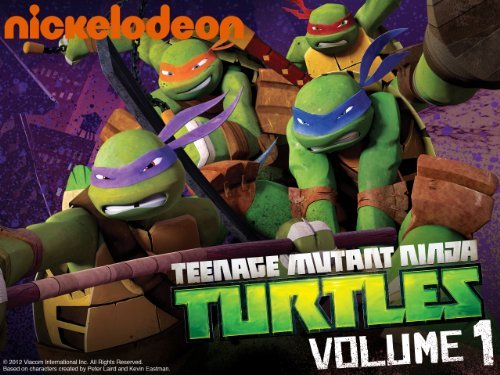
Teenage Mutant Ninja Thunder

sesame

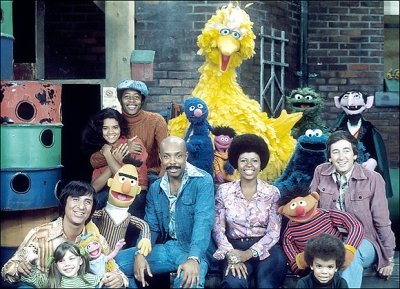
One of the greatest things about fatherhood is the ability to relive your childhood without having to feel one ounce of guilt or embarrassment. For example, when I was coming up, I grew up on the Street……Sesame Street, that is. So when my kids started reaching the age of noticing the moving objects on the television screen, one of the first things I put on the tube for them was Sesame Street. I would watch it with them and sing along, all while reminiscing about my own childhood. After growing too old for the Street, I progressed to the Teenage Mutant Ninja Turtles. That was my fad until my cousin showed me some shoes with the insignia of a man flying through the air with a basketball in his extended left hand and his legs spread apart. It was all over for cartoons after that.

Eventually, kids develop their own individual likes and drop old favorites into the dusty corners of their long term memory. So, it was a complete surprise to me when my kids were looking through the DVD collection and grabbed my Teenage Mutant Ninja Turtles: Season 1 DVD and said they wanted to watch it. So, of course, we sat down and watched it and they LOVED it. Luckily, Nickelodeon was coming out with a new Ninja Turtles series themselves, so it fit in with them nicely. Now they (and myself) are all about the Turtles. I watch the new cartoon with them on Saturday mornings (I know, I didn’t know Saturday morning cartoons existed anymore, either) and we sometimes have matches where I’m the Shredder and they take turns beating me with weapons (bruises go away, memories don’t).

tmnt

So, as I’m watching this new Ninja Turtles series, I can’t help but make comparisons to another team in my life, namely the Oklahoma City Thunder. If you’ve never seen or heard of the Teenage Mutant Ninja Turtles, let me give you a real quick overview. Four mutated turtles with humanoid features fight evil from their backdrop of their sewer lair where they are trained in ninjutsu by a mutated humanoid rat. The rat and turtles share a father/sons relationship, with the turtles coming into their teenage years. Hence, the Teenage Mutant Ninja Turtles. Of course, each turtle has his own personality traits, which lends to the parental struggles of Splinter, their rat sensei. Along with their human friends, April O’Neal and Casey Jones, they form a team and battle different foes.

This is not very different from any other professional team: different personalities all coming together to battle one common opponent. And that’s where I thought the similarities between the Ninja Turtles and the Oklahoma City Thunder crossed-over. The personality traits of the characters are very similar to the personality traits of some of the main component of the Thunder. So without further ado….

The Good Guys

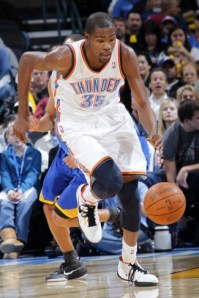
Leonardo is Kevin Durant – The unquestioned leader of the Turtles, Leonardo is an apt pupil and the apple of Splinter’s eyes. He exhibits strong leadership qualities, but also struggles in keeping harmony with all the different personalities on his team. Part of leadership is ability, and Leonardo is a master at the martial arts. Similarly, Kevin Durant is the unquestioned leader of the Thunder. Though words may not be his tool of choice, Durant’s actions on the court often dictate how his teammates react.

kdleo


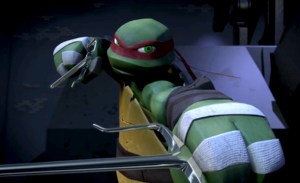
Raphael is Russell Westbrook – Was there ever really any question? I mean, if there is anyone in the cartoon world that fits Westbrook to a tee, it is Raphael. Raphael is the hot head of the group. He has the most attitude in comparison to the other turtles, but also has the most swag (confidence, if you don’t speak street). He’s good and he knows it. His quick temperedness can be a detriment as it clouds his judgment. Part of the reason for Raphael’s hot temper, though, is that he cares too much about situations and about others around him. Westbrook, the volatile point guard for the Thunder, and their unquestioned second in command, has always toed the line between beauty and disaster. He has an unwavering confidence in himself that can lead to astonishing displays of awe or to frustrating learning moments that leave you shaking your head. While many question his motives, those who are in tune with the Thunder know that Westbrook does the things that he does because all he cares about is winning. The bottom line, not individual stats, are the most important thing for Westbrook.

russ

raph

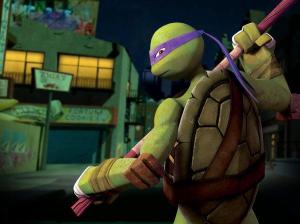
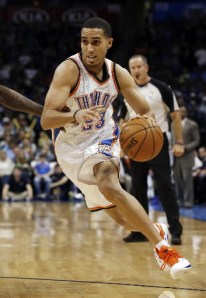
Donatello is Kevin Martin – Donatello is the scientific brains behind the whole operation. He’s mild-mannered and spends his free time building gizmos and gadgets for his turtle brethren that will be used in combat. He’s an adept fighter, but his intelligence is his biggest asset. Kevin Martin is probably one of the smartest offensive basketball players in the NBA in terms of floor spacing and angle awareness. His high basketball IQ help him find spaces on the floor where he can launch his automatic jumper. His mellow demeanor only masked the trained assassin that lurks inside the No. 23 jersey.

donny

kmart


Michelangelo is Serge Ibaka – Believe me, this was probably the most difficult one. Michelangelo is the fun-loving, “life of the party” of the turtle quartet. He’s very innocent and young-minded, and tends to see the good in everything. But he’s also very loyal and willing to fight for what he considers important (namely, family). Before the trade, James Harden was a shoo-in for the role of Michelangelo. But with Harden’s departure, Serge Ibaka becomes the representative for Michelangelo. He’s a fun loving guy who was probably very innocent and young-minded to the ways of the United States when he first got here. Now that’s he adjusted, though, he is the life of the party (well, parties with a lot of women in them). Due to his rough upbringing, he probably sees the positive in many things in life. But mess with his team (family), and you’ll have something else coming to you.

sergemikey


Splinter is Scott Brooks – Splinter is the sensei (teacher) of the turtles. He is much older than them and acts as their father figure. He is a mutated rat that has humanoid features. He has raised them from young turtles to where they are today, extolling values and morals onto them. He is ultra-protective of them, but like any parent of a teenager, knows that he must let up a bit to allow the turtles to explore the world on their own. Five years ago, Scott Brooks was tasked with taking an extremely young team, that had known nothing but losing. Through his teachings (“play defense with your heart”, “push it, push it, push it, “we’re not out of this”) the Thunder have improved upon themselves every season and are now one of the best teams in the league.

splinter


April O’Neal is Wanda Pratt – April is the human liaison for the Turtles. Since the NBA still does not have any female players (enter joke here about NBA player X whom you think is a female), super fan/mother Wanda Pratt would have to do for this comparison. She cheers on the team that her son plays for and treats them all like her kids.


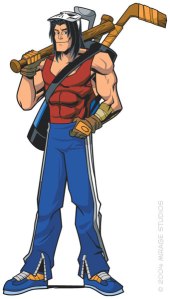
Casey Jones is Kendrick Perkins – Casey Jones is a male character in the series that is a vigilante and sometimes fights with the Turtles. He carries an assortment of weapons, such as hockey sticks and baseball bats, and wears a mask. If weapons were allowed on the court, Kendrick Perkins would probably be carrying the biggest bag. Thankfully, all he has on the court is his Scowl Mask. But like Casey Jones, he will extol justice whenever necessary.

CaseyJonesperk


The Bad Guys

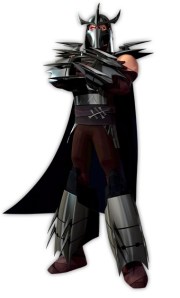
shredder

Shredder is Lebron James – The Shredder is the Turtle’s biggest enemy. He is a lifelong foe of Splinter, and would like nothing more than to destroy the Turtles and Splinter. Even though, Kevin Durant and Lebron James are all buddy-buddy off the court, there is no doubt in my mind that James is our biggest obstacle from attaining our prize. Like the Shredder, James has become ruthless when the game is on the line and is starting to come up big when it matters.

The Foot Clan are the Miami Heat – The ninja army put together by the Shredder. Need I say more how this relates to the Miami Heat. When you face Lebron, you also have to face The Foot.


pop

Krang is Gregg Popovich – Krang is an alien brain that brought technology from space to help the Shredder and his sinister plan. Extremely intelligent and cunning, Krang is only limited by a lack of a body. Gregg Popovich has only one thing on his mind…and that is winning. No matter what he has to do. Rest all his starters on a nationally televised game against the Foot Clan (Heat), and absorb a $250,000 fine? Check. Play rookies when other contenders wouldn’t even mess with young players? Check. Extremely meticulous, he details every plan and plans for every detail.


300px-Bebop_and_Rocksteady

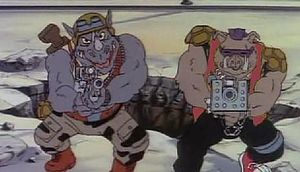
Bebop and Rocksteady are Marc Gasol and Zach Randolph – Bebop and Rocksteady are the evil mutant equivalent to the Turtles. A wart hog mutant and a rhino mutant, they punish objects using their physicality and brute strength. Gasol and Randolph are probably the best big man duo in the league and do not lack for size.

Tokka and Rahzar are Dwight Howard and Pau Gasol – The movie (Hollywood) equivalent to Bebop and Rocksteady, these guys were also very physically imposing, but were very intellectually limited. While not intellectually limited, the Lakers’ record with Howard and Gasol manning the middle is currently very limiting.

Baxter Stockman is Mike D’antoni – Stockman, a brilliant scientist, is transformed into a humanoid fly after a mutagen accident. D’antoni, a brilliant offensive strategist, was transformed into the Lakers’ head coach after the firing of Mike Brown. So far, the results have been a underwhelming, with a 4-7 start.

as-announcement_hp_players_1213_1

If you are reading this and are over the age of 35, I can understand if this may seem foreign to you. But remember any of your favorites quartets growing up (the O’Jays, the Beatles, the Four Horseman, the Seinfeld crew, etc.), and you’ll realize that the different personalities/talents actually made the whole better than the individual parts. Cartoons never seem to have a finality to them because the writers want to keep the story arcs going. But if I were to write the ending for the Thunder this season, it would end with a Western Conference playoff run that sees us vanquishing the Lakers, Spurs, and Grizzlies. Then, it would culminate with the Thunder defeating the Heat in 7 games in OKC, and the networks renewing us for another season.

Mr. Harden’s Opus

So I had this blog detailing why I didn’t think the Oklahoma City Thunder would sign James Harden by the October 31st deadline. I was going to work on it this weekend and publish it on Monday. I was hoping Harden and the team would still be in negotiations by the time I finished said blog. I truly believed the negotiations would be an issue that would be shelved until next offseason when the front office had more information (an entire season’s worth) to make more of an informed decision. Instead, with the OU/Notre Dame tied at 13 in the 4th quarter, I checked my twitter feed and saw this inconspicuous tweet:

Wow #Harden

I don’t remember who the tweet was from. But it piqued my curiosity and I clicked on the hash tag. I thought it was going to be a person that was surprised Harden had turned down a 4 year/ $52 million dollar contract extension. Instead, to my complete and utter surprise/horror, I started seeing the all the tweets about Harden being traded to the Houston Rockets for Kevin Martin and Jeremy Lamb. The “Whhhhaaaatttttt???!!!” I let out startled my wife into rushing out of the kitchen to see what the hell was going on. The rest of the OU game was a blur to me after that. I went into Twitter frenzy mode and didn’t stop until after midnight. Once the shock and awe of it wore off (which most of it hasn’t), I was able to process the trade and evaluate it.

Here are the details from the trade:

Houston gets SG James Harden, C Cole Aldrich, SG Daequan Cook, and SF Lazar Hayward

Oklahoma City gets SG Kevin Martin, G/F Jeremy Lamb, 2013 first round pick (from Toronto, top 3 protected), 2013 first round pick (from Dallas), and 2013 second round pick (from Charlotte)

Here are some of the thoughts I have about it. I call this my “Mr. Harden’s Opus.”

The Good

My first option would have been to keep the Thunder nucleus together. But if you are going to trade Harden, this was probably the perfect batch of expiring contract, promising rookie, and draft picks galore. Let’s start with the big name from Houston: Kevin Martin. If you are going to find a substitute teacher for Harden, Martin is probably the best one year prospect available. An effective scorer who has averaged 18.4 points per game for his career, with a great mid-range game and an effective 3-point shot (38%). Someone who goes to the free throw line 6.6 times per game for his career. Defensively, Martin may not be as big as Harden, but it isn’t like Harden was in line for the All-Defense team, either. Both are sieves on the perimeter, but Harden is able to bang with bigger bodies like Kobe Bryant and Stephen Jackson. The one thing Harden really has on Martin is his play-making ability.

If the Thunder plan on bringing Martin off the bench, this plays out perfectly for them. With Eric Maynor back, Martin won’t need to take Harden’s place as a play-maker on the second team. Martin could be the gunner off the bench and the Thunder could use him in late game situations if offense is needed. For all the talk about Martin being a selfish player, he has never played with players of the caliber of Kevin Durant, Russell Westbrook, and Serge Ibaka. The focus will be off Martin and he can do what he does best, which is score from the perimeter and get to the line.

The second, lesser known name in the trade was rookie Jeremy Lamb. This, in my opinion, will determine whether this trade will be viewed as a success or a failure. Lamb has the skill set and potential to be that dual threat shooting guard that the Thunder have been coveting in their championship run. Someone, potentially, with the length, athleticism, and defensive ability of Thabo Sefolosha, but also with the scoring and shooting ability of James Harden. Jeremy Lamb could prove to be that kind of player. With Martin in the mix for at least one season, Lamb can sit and learn this season without the pressure of being a starter.

The draft picks were probably what sealed the deal on this trade. Getting a good veteran with an expiring contract like Martin, and a rookie dripping with potential, like Lamb are things that many teams could have offered. But not many teams could have offered that and a slew of draft picks like Houston could. The Thunder, as weird as this sounds, are a championship contending team that got younger and obtained great assets. The Toronto pick will be a great trade chip going forward, as the Raptors are not expected to improve much from where they were last season. The 2nd round pick from Charlotte will also be valuable as it will probably be one of the first few picks from the 2nd round.

The Bad

According to sources, the final offer the Thunder made to Harden was in the 4 years / $55.5 million dollar range. Harden will probably end up signing with Houston for 4 years / $60 million dollars. You mean to tell me the difference between a potential dynasty with an established core, and completely blowing up a team 5 days before its season opener is $4.5 million dollars. That difference amounts to $1.125 million per season. The ownership group, which has made a commitment to all of its core players, could not come up with $4.5 million dollars more? This group of multi-millionaires and billionaires were panicking over an extra $1.125 million per year. Don’t get me wrong, though. I understand it is their money and not mines. But, keeping this core intact for at least another 4 years would almost certainly guarantee runs to the Western Conference Finals and NBA Finals in that allotted time. Those extra games means about $20-40 million dollars extra in profit for the ownership group. You can talk about cap flexibility and assets until you are blue in the face, but when you have the potential to win championships in the here and now, AND you’re making money, you take those chances.

The scariest part about this trade is that a championship contending team was blown up less than a week before the start of the season when it didn’t need to be. We just went through 7 preseason games with our normal core intact, and now we only have 4 days worth of practice time to integrate 2, and possibly more, pieces to our team. When, in the minds of the front office personnel, did they say, “You know, this sounds like a great idea.” While the linchpin of this trade may have been Harden, Cole Aldrich may prove to be a big loss for the Thunder. He seemed ready to assume the role of back up center, getting 2 double-doubles in the preseason. Now, we are heading into the season with Hasheem Thabeet as our backup center. Granted, Nick Collison, Serge Ibaka, and possibly, Perry Jones III can all play the 5 in a pinch. But in a future playoff series against the Memphis Grizzlies, Los Angeles Clippers, or Los Angeles Lakers, having an inexperienced and oft maligned center as a back up could prove to be detrimental.

The Ugly

Can someone tell me why the hell we had a lockout last season? All I heard during the lockout was about the percentage of the revenue that the players got and how salaries had gotten out of hand. Some even tabbed it as the “Rashard Lewis” lockout, with Lewis being the best example of a 2nd or 3rd tier player that received a max extension, thus limiting the cap flexibility of that team for up to 5 seasons. Basically, it was a lockout to keep the owners from actually overspending their profitabilities. So, then, why are teams paying players like Eric Gordon, Roy Hibbert, and James Harden max extension money. I thought max money was for top 10 players like Lebron James, Kobe Bryant, and Kevin Durant. Instead teams are throwing around stupid money for 2nd tier players. There’s 5 years left until the owners and players can revisit the CBA, and believe me, it will be revisited again, and this time, I fear, with dire consequences.

WWJD – What would James do?

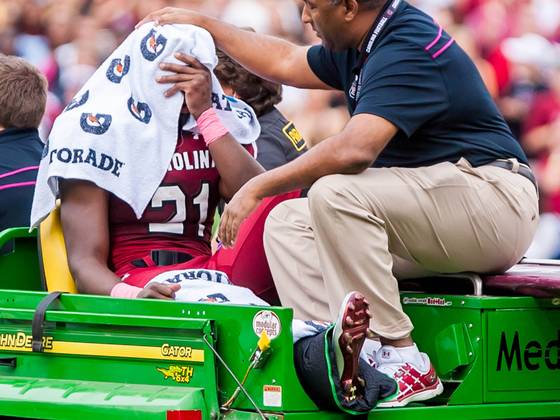
Do you know who I’m not mad at for this trade? James Harden. Before the OU game on Saturday, I spent the whole afternoon thinking about University of South Carolina running back Marcus Lattimore, who had just suffered a gruesome right knee injury. If you haven’t seen it, just think of Shaun Livingston’s knee injury from 5 years ago. Reports are coming out that Lattimore tore a couple ligaments and completely dislocated his kneecap. To make matters worse for Lattimore, he was coming back from a torn ACL in his left knee suffered the previous season. If Lattimore was a stock and NFL teams were the buyers, he would currently be considered a toxic asset.

In a profession where your best years are in your mid to late 20’s, your earning potential is contingent on 5-7 years of performance and luck. If you suffer an injury or get involved in a legal scandal, your earning potential will go down. You, as an athlete, cannot dictate what the market will pay for you. If the market wants to pay you max money, then that’s what they pay. If they want to pay you veteran minimum money, then that is what you will get paid. I don’t blame Harden for taking what the market gives him.

As I wrote in my Pippen/Westbrook column, Pippen consistently took less than his market value to keep the core of the Bulls team together. Where did that leave him? Broke (most of it his fault, but still) and bitter. Harden could have taken a couple million less than what the market had placed his value at, but why. While we like to moralize athletics into this great teaching tool where you sacrifice for the greater good, at the end of the day, its a business. If a player can’t perform anymore, the owner is going to let that player go and move onto the next able body. It’s a business and a player would be a fool to leave money on the table.

I’m the Oklahoma City Thunder blogger for the blogging network called Hoops Talk Nation through the website www.thebreakdownshow.com. I currently blog on there for free. But if ESPN, YahooSports, or CBSSports ever called to offer me a spot on their blogging network for cash, I would take it in a heart beat. While I love the opportunity that Audley Stephenson and Dave Mendonca have afforded me, I wouldn’t be able to turn down the possibility of blogging AND earning cash to do it. Regardless of how I fancy myself as a blog writer, I would never turn down the opportunity to move up on the pay scale.

OKC fans should not hold this against James Harden. This is a business, and him turning down less money is a business decision. He is doing what he feels is best for himself and his family. Not unlike what we do everyday, but with less zeroes attached to it. Many will be mad for what they perceive was a lie from Harden with all the “sacrifice and brotherhood” talk. What did you expect from him? To come out and say, “I don’t give a shit what you think I’m worth. If the market says I’m a max player, I want max money!”

Being a fan is an emotional experience. When you mix emotion and money, you don’t make sound decisions. So, if you take the emotion out of the equation, you’d realize that James Harden did the same thing you and I would’ve done, which is to never leave 7.5% of a raise on the table.

The Trade and the Thunder

Well, what’s done is done. The NBA is not going to step in and rescind this trade, as Harden does not suffer from any pre-existing toe injuries or heart ailments. He is a Houston Rocket. And so are Daequan Cook, Cole Aldrich, and Lazar Hayward. We cannot worry about them anymore.

What we do have are two unique players and 2 roster spots to fill. I think Kevin Martin will slide in seamlessly into Harden’s role off the bench. His efficient scoring and knack for getting to the line will have Thunder fans wondering whether James Harden shaved his beard, lost some weight, and slightly bleached his skin. The real prize in this trade could be Jeremy Lamb. If, in an alternate basketball universe, the basketball DNAs of James Harden and Thabo Sefolosha were interwoven, the result could be a player like Lamb. A 6’5” shooting guard with a 7’0 wing span and the ability to knock down long jumpers and play in transition. If you thought the Thunder were good with the Sefolosha/Harden SG platoon, imagine if only one player supplied most of those needs. There’s still a lot of development that needs to take place, but the skill set is already in place.

The open roster spots are a different story. The Thunder not only traded their 6th man of the year, but also their back up center, their designated 3-point specialist, and their designated end of the bench guy. While Hayward won’t be that difficult to replace, Aldrich and Cook could. I fully expect the Thunder to sign Daniel Orton to a minimum deal to compete with Hasheem Thabeet for back-up center minutes. The final roster spot is a bit of a mystery, though. Before training camp started, the Thunder signed Georgetown sharp shooter Hollis Thompson to a non-guaranteed 3 year contract. After playing in only 2 preseason games, he was one of the final roster cuts by the Thunder. They could sign him as a future replacement for Cook. Or, they could leave that roster spot open for future options, such as taking on a salary in a trade, or signing a veteran free agent (Derek Fisher, anyone?).

As for the core players, I’m curious to see how Nick Collison will react. He and Harden had one of the top 5 pick and roll combos in the league. Collison is one of the consummate professionals in the league and will be fine no matter what situation he is placed in. I think the onus of this transition will fall mainly on Russell Westbrook. If Westbrook continues to be consistent, as he was this preseason, then the Thunder should be fine. But if there was one player that helped Russell when he got into Honey Badger mode, it was Harden. Harden would take over the point guard duties and become the primary play-maker, especially at the end of games. That role now falls primarily in the hands of Westbrook, and to a lesser extent, Eric Maynor. While Maynor could fill the role of play-maker at the end of games, no defense will respect Maynor’s ability to drive and draw fouls like they did Harden’s. Martin could always be inserted at the end of games, but his play-making ability may be less than Westbrook’s.

How does this change affect the Thunder? They have never had to deal with a core-rattling trade like this one. The Jeff Green for Kendrick Perkins trade shook the tree, but it was necessary given that Green was out of position at the 4 spot and affecting the team’s post defense. This trade wasn’t necessary for anything on the floor. Instead, it was a financial deal the team made to avoid paying costs in the future. The biggest negative in all of this is that it happened 5 days before the first game of the regular season. There will be no preseason games to indoctrinate the new players. Only a couple practices and then on to the season. The only positive I see in this situation is that our biggest threat, the Los Angeles Lakers, are also having to work out chemistry issues, after bringing in 2 main cogs (Dwight Howard and Steve Nash) in the offseason. The Western Conference may come down to whoever vibes first.

I do think this affects us this season. These guys just went from going to the Finals, then to the Olympics, then through training camp and preseason thinking they were going to defend their Western Conference title without a hitch. Then, BOOM!!! Over a quarter of the team gone, with 2 new pieces coming back. This is a team that is used to consistency. This consistency is what fostered to current Thunder culture. Consistency leads to comfort. Comfort leads to confidence. If you were part of the culture, you were part of the brotherhood. Now a shred of that is gone. I do think it will take the team a while to adjust from this one. Has their championship window closed? No, it hasn’t closed, but somebody definitely threw a baseball through it. The Thunder may come out stronger in the end, but I think it will be a case of one step backwards, two steps forward.

 In Memoriam

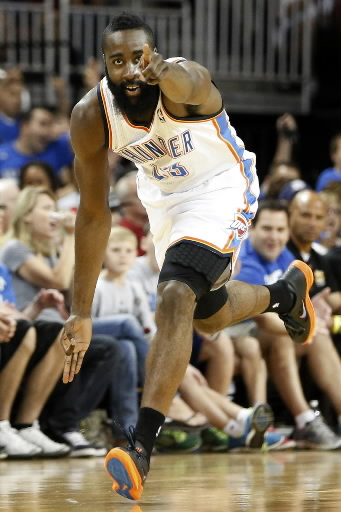
I will miss the Beard. Harden became a part of the fan culture. When you mentioned the characters on the team, you always had to mention Harden and his Beard. If the Thunder had a Teenage Mutant Ninja Turtles-like quartet, Harden was definitely Michaelangelo (the party dude!). I wish him nothing but the best in Houston. But if we are being honest, Harden was but a great role player. He scored when called upon, drove and drew fouls when needed, and made plays at will. But I never considered him to have the “it” to be The Man. Westbrook has that dogged “it” to be The Man. Durant is The Man. But Harden just seemed happy doing what needed to be done. So if Harden wants to see how his life will be post-Thunder, he need look no further than the man he was traded for.

Westbrook and The Boost

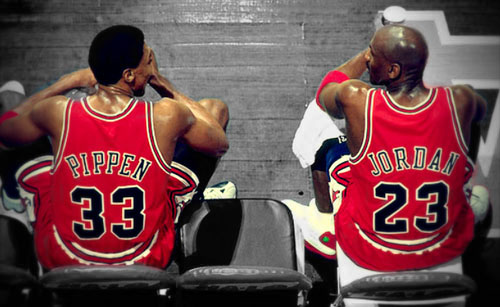
This past week, Russell Westbrook signed with Jordan Brand, after being with Nike for the first 4 years of his career. While Westbrook has carved out his own following of fans, he’s always been known as Kevin Durant’s sidekick. The Robin to Durant’s Batman. This generation’s ultimate second banana. There hasn’t been a sidekick this good since Scottie Pippen. But, Pippen never received the boost in popularity that Westbrook is about to receive.

What qualifies for a sidekick? A sidekick has to be a rookie or a very young player that is brought in after the primary player is established to specifically fill the needs the team is missing. Another qualification is that the pairing has to be together for 5+ seasons. For example, Scottie Pippen was obtained by the Chicago Bulls in a draft day deal, while already having an established superstar in Michael Jordan. Russell Westbrook was drafted by the Seattle Supersonics (Oklahoma City Thunder) after they already had an established young star in Kevin Durant. Anfernee Hardaway almost made it to great sidekick status, but injuries and Shaquille O’Neal’s departure to the Los Angeles Lakers negated that possibility. The Lebron James/Dwayne Wade/Chris Bosh mash-up wouldn’t qualify as sidekicks because they were all alpha males on their respective teams before they joined forces. Kobe Bryant and the aforementioned O’Neal made a great duo, but they were brought onto the Lakers the same year and often quibbled over who was the alpha male. 

To understand the road Westbrook is on, it is important to see what happened to Pippen throughout his career. When Pippen first started college at the University of Central Arkansas, he was a 6’1” walk-on that needed to moonlight as the team’s manager to pay his tuition costs. After 3 more collegiate seasons, a 7 inch growth spurt, and consensus All-NAIA player honors, Pippen was drafted with the 5th overall pick in the 1987 NBA draft to the Seattle Supersonics (who subsequently traded him to the Chicago Bulls). The scouting report on him read as follows:

  • 7’4” wingspan and a 41” vertical
  • Strong outside, but needs work inside
  • Not bad driving to the hoop, but doesn’t look to drive
  • Good foul shooter
  • Can make a three
  • Terrific passer at that position
  • Won’t give you much of anything on the offensive glass, and is a so-so defensive rebounder
  • Excellent defensively and a disruptive force in the passing lanes
  • Good ball handler, but commits a ton of turnovers
  • Could start on most teams

Not necessarily the sexiest of scouting reports for someone who would eventually become one of the top 50 players in league history. While Pippen built his legacy on defense, he was also an apt offensive player, becoming the archetype for the point forward position. During his prime (1989-1999), Pippen had per game averages of 19.1 points, 7.1 rebounds, 5.9 assists, 2.2 steals, and 0.9 blocks. Not necessarily the offensive prowess that Larry Bird possessed, but with a stat line like that, Pippen should have been heralded as his generation’s defensive Larry Bird. Instead, he was teamed up with arguably the greatest player of any generation in Michael Jordan. There usually isn’t a lot of spotlight left when you are playing with the greatest. Ask 100 people who the lead singer of Aerosmith is, and most will answer Steven Tyler. Ask them who the drummer is, and not many will know the answer.

Pippen’s play on the court should have spurred him to more shoe deals, more advertisement contracts, and more widespread popularity. And yet, when his career was all said and done, you couldn’t help but wonder whether Pippen got everything that was owed to him. There were the stories of how Pippen felt he wasn’t getting paid what he deserved (which he wasn’t). There were the rumors that he felt slighted being outside of the limelight, when he provided so much to the team. While he did have his own shoe line (the PIPs) from Nike, they only lasted about two series. So, needless to say, not many companies bought into Scottie Pippen.

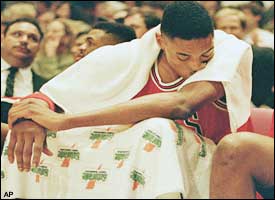
It wasn’t Jordan’s fault, though. Most of the blame lies squarely on Pippen. He didn’t have the same tact with the media that Jordan did. He was dismissive and defensive at times with reporters. Then there were the crunch time situations. Those critical times in games that live in lore and become mythologized. It’s not that Pippen didn’t perform well during those times. On the contrary, he performed great during crunch time. But he’s instead remembered for the times he quit on his team in the most critical of moments. There was the time he sat out Game 7 of the 1990 Eastern Conference Finals against the Detroit Pistons with a migraine headache. The Bulls eventually lost that game. Probably the most damning, though, was the one where he sat out the final 1.8 seconds of Game 3 of the 1994 Eastern Conference Semifinals against the New York Knicks because Phil Jackson drew up a play for Toni Kukoc to take the final shot, instead of Pippen. To make matters worse, Kukoc actually hit the game winner. This one was the most damaging because it came at a time when the Bulls were his team due to Jordan’s hiatus into baseball. When you are known to quit on your team during crucial periods, your popularity takes a big hit.

Which brings us to the best sidekick of this generation, Oklahoma City Thunder guard Russell Westbrook. Like Pippen, Westbrook was not highly decorated coming out of college. Like Pippen, Westbrook was drafted by a team that already had a young star in Kevin Durant. Like Pippen, Westbrook is seen as not being very media friendly. Coincidentally, Durant, much like Jordan, is viewed as a media favorite. And, while not by his own doing, Russell was also involved in a critical game snafu, when Thunder coach Scott Brooks sat an ineffective Westbrook for the entire 4th quarter of Game 2 of the 2011 Western Conferences Finals.

But, not everything is negative when it comes to Pippen and Westbrook. Both of these players are insanely loyal to their teams and teammates. Pippen had a couple opportunities to seek greener pastures during the championship run, but decided to sign for less to stay with the Bulls. Westbrook could have done the same last season, but decided to sign for the allowable max. Both players are highly competitive, with possible chips on their shoulders from being labeled second bananas. Both players are very team oriented, as evidenced by them sacrificing a little of their own games to coexist with two great players. The good severely outweighs the bad when it comes to Westbrook and Pippen, but the bad usually has more advertising power.

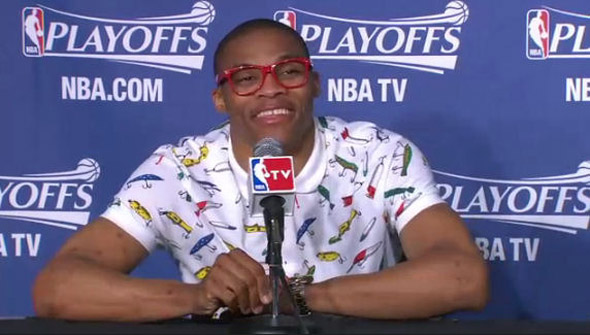
Which is why I found the signing of Westbrook to Jordan brand to be a bit ironic. Not ironic in the sense that he doesn’t deserve it. But ironic in the sense that a move like this will probably propel Westbrook into superstar territory, as far as media exposure goes. Into a territory that Scottie Pippen unfortunately never reached. With an endorsement team that includes Carmelo Anthony, Derek Jeter, Chris Paul, and Michael Jordan, himself, Russell Westbrook will have plenty of opportunity to expand his brand. He already has a slogan in place (WhyNot?), and already has a following outside of basketball because of his unique fashion sense. In a way, Jordan is helping this generation’s top sidekick become what his sidekick should have become.

Alternate Reality – Dream Team vs. 2012 Team USA

In collaboration with Akeli Jackson of DYST Media, Steve Person of Hooptalk365.com and Jon Midget of SLCDunk.com.
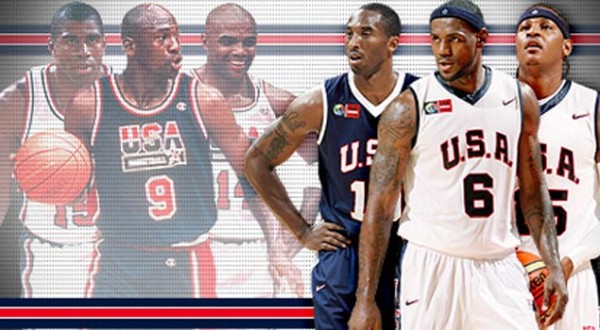
The debate has been raging all summer long about which team is better: the 1992 Dream Team or the 2012 US Men’s Olympic basketball team. Members from both teams have spoken publically and most have said that the Dream Teamers would be the victors. But the tally hasn’t been 100% on the side of the Dream Teamers. Kobe Bryant, in an interview, stated, “If you’re asking me, ‘Can you beat them one game?’ Hell yeah, we can beat them in one game. You didn’t ask me if we could beat them in a 7-game series. In one game, we can beat them. No question about it.” This discussion was presented for each of the subsequent “Dream Team” teams after the ’92 team, but the discussion usually died down pretty quickly. For some reason, though, the debate for the 2012 team has lingered on longer than it did for any of its predecessors. Maybe it’s Twitter, where the in your face, non-stop commentary sometimes leads to a paradigm shift in thought, even if it’s just for a moment. Maybe, people see a 2012 team that is loaded with a combination of great players and potential great players. Sadly, though, these types of debates usually remain as they are….figments of our statistical imagination. 
 

Fortunately, I have more money than I know what to do with. So I decided to call a buddy of mine who works at an anti-aging clinic. He told me he would be able to revert the older Dream Teamers back to their 1992 form using hormone replacement and gene therapy. Of course, the players on the ’92 squad would have to agree with this. So, that’s where their ego and my money came into play. I got all the players from the Dream Team to sign on by offering them $10 million each and telling them that the 2012 team would wipe the floor with them. Christian Laettner even asked my buddy if he had anything that would bring his “Duke-swag” back. My buddy told him he didn’t have anything to cure failed potential. Surprisingly, Larry Bird required the least amount of work. His body is basically in the same physical shape now as it was then. Unfortunately, the anti-aging clinic didn’t have anything to bring Chuck Daly back from the after-life, so Lenny Wilkens, who was an assistant on the Dream Team, agreed to be the coach. The fine folks at Coachella kindly declined when we asked them if they could have Hologram Chuck Daly walk back and forth on the Dream Team sideline. 


After 2 weeks of intense anti-aging therapy, and a month of “training camp”, the Dream Team was looking like its old self again. Magic Johnson was passive-aggresively talking trash, Larry Bird was sinking flat footed 3 pointers, and Michael Jordan was dunking on Patrick Ewing. The game was set up to happen the night before the gold medal game of this year’s Olympics. Only a few writers were privy to the game. Everyone who was witness to the game was CIA-scanned for electronic devices, meaning no photos or video of the game would ever exist. The 4 writers who were invited were each assigned a quarter to write about in detail. No one was allowed to release any information until after the gold medal game. This, is what transpired: 

Pre-Game 

The game would be played using a mixture of FIBA and NBA rules. The quarters would be 10 minutes in length to maximize the athletic potential of all the participants in the game. The FIBA 3-point line would be used, and the painted area used was the standard rectangular NBA format. Players wouldn’t be able to touch the ball on the rim like in international play. It would be counted as a goaltend, if the ball is touched while still on the rim. A team would have 8 seconds to bring the ball up past the half court line. The style of refereeing would be more international, allowing the players to be a little bit more physical on the perimeter and on the inside. The officials would be Ken Mauer, Dan Crawford, and Dick Bavetta. And, finally, a game like this wouldn’t be right without the use of an official David-Stern signed, NBA Spalding ball.  

One of the most amazing sights to see on a basketball court are the pre-game antics of the different players. Some have customary handshakes and dances that they do. Some have a specific routine of stretching and warming up. One thing that stood out while watching these two teams warm up was the gawking and wide-eyed fandom that was apparent on the 2012 team’s side of the court. It is easy to think of athletes as robotic in nature, while forgetting that they were once young fans wanting to be like they hardwood idols. Especially when their idols are on the other side of the court with their deity-like skills on hand for display. But, just as quickly as they were star-struck, they were just as quickly snapped back into reality by Kobe Bryant, and, surprisingly, by Russell Westbrook. The Dream Team squad was all business on their end. 

The referees called out the captains of each team (Johnson and Bird for the Dream Team and Bryant and James for Team USA). The Dream Team was in their classic whites and the 2012 squad in their new look blues. They all shook hands, the referees explained their expectations of the game, and each team went to their sidelines. Game time!!! 

1st Quarter

 Coach Lenny Wilkens trotted out Magic Johnson, Michael Jordan, Patrick Ewing, Scottie Pippen, and Charles Barkley as his starting five. Coach Mike Krzyzewski countered with Chris Paul, Kobe Bryant, Tyson Chandler, Lebron James, and Carmelo Anthony. And, just like that, 10 of the greatest basketball players were on the court exchanging pleasantries and shaking hands. Chandler and Ewing would be jumping at center court. Bavetta tossed the jump ball, and it is controlled by Ewing. Both teams started off by missing their first shot attempts. On the Dream Team’s 2nd trip down the floor, Kobe snuck into the passing lane and intercepted a pass from Pippen to Jordan leading to a breakaway dunk by Lebron James. The first two points were officially on the board. On their next trip down, Magic Johnson found Ewing on a no-look bounce pass for an and-1 layup. The teams exchanged makes and misses pretty consistently for the first 5 minutes. 

After a timeout, Wilkens substituted Larry Bird and David Robinson for Pippen and Ewing. For Team USA, their first substitutions saw Kevin Durant and Deron Williams coming in for Chris Paul and Carmelo Anthony. On the first trip down for Team USA after the timeout, Durant made a 3 pointer off an offensive rebound from Chandler. Barkley gave Durant a shoulder check as he turned to go to the other side of the floor. Durant pushed Barkley and both players were given a double technical. On the next possession, Pippen, playing point guard, found Michael Jordan on the baseline for a jumper. 12-11 Dream Team at the half way point of the 1st quarter. After a Deron Williams layup, the Dream Team went on a 10-2 run, with Larry Bird supplying two 3-pointers and Tyson Chandler picking up his 2nd foul during that run. 

After a run-stopping timeout, Coach K trotted out a line of Kevin Durant, Carmelo Anthony, Kevin Love, Deron Williams, and Russell Westbrook. Wilkens brought in Bird, Karl Malone, Robinson, John Stockton, and Clyde Drexler. Anthony and Malone exchanged buckets in the next two possessions. On the next Team USA possession, Westbrook lost possession of the ball, which was stolen by Stockton, who found a streaking Drexler for an easy 2. Another turnover, this time, by Kevin Love, led to a mid-range jumper by Malone. 28-17 Dream Team, with under two minutes left in the quarter. After a missed jumper by Durant, the Dream Team brought the ball up the court looking to add to their double digit lead. Stockton passed it to Bird, who is wide open for a corner 3, but missed it, leading to a transition 3 by Carmelo Anthony. On the next Dream Team possession, Williams poked the ball from Robinson as the shot clock expired, which led to a thunderous (pun intended) dunk by Westbrook on the other end. After a Stockton miss, Williams brought the ball up for the final possession of the quarter. Durant got the ball above the 3-point line, dribbled a little while jabbing towards the basket, and let loose a 28-foot dead on three that splashed through the net as time expires. 28-25 Dream Team, after one quarter. 

2nd Quarter 

The Dream Team came out to begin the 2nd quarter with Stockton, Drexler, Mullin, Bird, andEwing. Team USA squad went with Deron Williams, Kobe, Durant, Lebron, and Love. Team USA took advantage of the Dream Team’s limited defense, and scored on their first four possessions. However, the Dream Team extended their lead at the same time with three from downtown: two from Bird and one from Mullin. 

On the Dream Team’s fourth possession, Lebron nearly steals the ball by knocking it out of Ewing’s hands, but it goes out of bounds instead. In a surprising display,Ewing thumped his chest several times, telling everyone in a loud voice, “I am a WARRIOR!” over and over. Mullin looks stunned for a moment as he wonders what his team would actually be like if Ewing really were a (GoldenState) Warrior. The Dream Team inbounded it toEwing, who immediately shows off his WARRIOR-ness by throwing up a running 18-foot fadeway that clanks off the rim (he was, admittedly, intimidated by the perpetual shut-down defense of Kevin Love). 

Still, the Dream Team led 37-33 as Team USA calls a timeout. 

Out of the timeout, The Dream Team came out with the same lineup. The 2012’ers let Lebron rest a bit and replaced him with Carmelo. Williams drove past Stockton to get an and-1. Stockton, one of the better defenders in NBA history, takes it personally, scowls, and on the next inbounds, rushes up the court and dropped a pull-up 3 right in Deron’s face. Realizing that Carmelo had Bird and Mullin taking turns “guarding” him, the 2012 squad goes to him on the next three trips down the court, with Carmelo hitting a 2 and a 3 (and having a missed 3 tipped in by Love). During that same time frame, the Dream Team goes on a bit of a cold streak from the field, and Team USA takes the lead 41-40, prompting the Dream Team to call a timeout.

One of the most amazing things to witness in a game like this is the interactions in the timeout huddle. While Team USA was all high-fives and laughs, it was all business in the Dream Team huddle. Lenny suggested putting in Laettner, but nobody even blinked. The players all knew they were old enough and wise enough to be coaches themselves. They noticed the 2012 squad trotting out Paul, Williams, Carmelo, Lebron, and Love. In response, Pippen tells Wilkens he’ll guard Carmelo so “they won’t have to worry about him touching the ball again”. Jordan says he and Stockton can take Paul and Williams. One of the funnier moments was when the Dream Teamers decided to put David Robinson in on Love, knowing that the Admiral would completely take advantage of the shorter, less athletic Love. The only person left to guard was Lebron, so they decided that, even though he can’t match LeBron’s total athleticism, the Mailman is the guy who can best match his speed and strength. So in came Malone. 

On the first play, Pippen ran Carmelo through a beautiful “elbows-out-I’m-going-to-send-you-to-the-floor-weeping” screen set by Stockton. Anthony gets up a little wobbly and goes back to the bench, replaced by Durant. Pippen smiles. 

At this point in the game, the Dream Team asserted themselves offensively and defensively. They continuously went inside to the Admiral, who routinely dunked it, probably wondering whether it was Kevin Love or a fruit fly he felt along the way. On the defensive side of the court, Chris Paul could barely make it past midcourt with Jordan hounding him. Paul passed to Deron Williams, who was being bumped and maimed by Stockton. Williams probably began to wonder why his team only had four guys on the court since he could not find Durant under that Pippen defensive blanket.   

On Team USA’s next possession, Williams found Love with a nifty pass. Unfortunately David Robinson shoved the layup down Love’s throat. It seemed for a moment, while Love looked at Robinson in awe, that he was wondering if he was looking at a Greek God incarnate, or just the most ripped athletic specimen to ever walk the earth. Fortunately, Lebron wasn’t as impressed with Robinson’s physique, as he picked up the loose ball and put in the score. 

The Dream Team continued to put on an offensive clinic in the next few possessions, going inside to David Robinson and running the 2012 defenders through a series of cuts and screens that sends everybody on Team USA into at least one Stockton screen. Chris Paul and Deron Williams, taking the brunt of the physicality, start to vehemently complain about the screens. As a writer, it’s crazy when the crowd noise is taken out of the equation and you can hear almost every conversation on the court. In response to the complaining about the screens, Dick Bavetta told the two 2012 guards, “Hey, if you want to try to knock down guys 50 to 100 pounds heavier than you 10 to 12 times every game, I’ll let you do it too.” Paul and Williams suddenly realized they were nowhere as tough as the guy with the short shorts.   

On the other end of the floor, Paul and Williams were getting picked apart by Jordan’s defense and Durant was made to seem like he didn’t even exist on the floor anymore. Love kept looking to the bench, wondering why Coach K hadn’t noticed that David Robinson has 5 more inches and 8 times the athleticism on him. Lebron, realizing that he is only player that can do anything at this moment, begins to try to take over the game. He got past Malone on a couple of occasions, but the veteran power forward either stripped Lebron or knocked him off balance on his jumpers. 

In all, it was a 16-6 run by the Dream Teamers that put them up 56-47 with two minutes to go in the half. 

Time out for Team USA.   

The 2012 team put in their small ball line-up for the final two minutes of the half: Chris Paul, Deron Williams,Kobe, Durant, and Lebron. The Dream Teamers decided to show the young guys that they can also go fast AND big at the same time. They trotted out Magic, Jordan, Pippen, Barkley, and the Admiral.

 After the timeout, the 2012 squad looked to take advantage of their small ball lineup, especially at point guard with Magic being in the game. Heading into the game, one of the main headlines was the Kobe vs. Michael matchup. How would the player most compared to Jordan fare against him? In a couple words, not very well (in the first half, at least). Kobe tried to challenge Jordan in the final two minutes, but instead ended up costing his team.Kobe went 0-2 with two turnovers during that time-span.

 Those turnovers and missed jumpers allowed the Dream Team to basically turn every defensive possession into a fast break opportunity. Magic was at his “Showtime” best, setting up Jordan, Pippen, and Robinson for dunks. On the final possession of the half for Team USA, Pippen deflected a Deron Williams pass that ended up in the hands of Charles Barkley who had a full head of steam with 5 seconds left. The only person back for the 2012 squad was Lebron, but even he realized that he’d rather fight another day than try to challenge Barkley with a full head of steam. Two-handed slam, buzzer, and that was the 1st half. 66-51 Dream Team.  

 3rd Quarter

 Coming out of halftime, the 2012 squad looked to get back in the groove, down by 15. Coach K decided at halftime to throw caution to the wind and go with a more assertive lineup to combat these NBA greats. He turned the reigns of point guard over to Lebron, with Kobe alongside in the backcourt, Durant and Carmelo on the wings, and Chandler in the post. The Dream Team decided to start the 2nd half with Stockton, Jordan, Pippen, Malone, and Ewing in the paint.

 Again, one of the great things about eliminating the crowd noise is that you can hear the different conversations going on between the players and coaches. At the scorer’s table, Jordan walked up to Kobe and tells him, “You may be able to sit at many players’ tables, but you still can’t sit at my table, rook.” Kobe, in turn, responded, “We’ll see about that. I still got a couple years left”, while he powdered his hands. On the sideline, Ewing, looking as refreshed as someone with a jersey soaked in sweat could look, barked at Chandler, saying “this my paint, you ready to bang?” Chandler responded with a smirk as Dick Bavetta handed him the ball. Chandler passed it toKobe and the second half began. 

With Lebron controlling the ball at point, Team USA jumped out on a 6-0 run. On their first two possessions, on what looked like to be the same play, Lebron found a wide open Anthony who connected on back to back 3’s. Kack kaack!! “String music” yelled Carmelo. Jordan, disgusted by Pippen’s defensive effort, screams at his Bulls teammate, “get your man, Scottie!!!” Immediate timeout called by Coach Wilkens in an attempt to get the Dream Team’s focus back. The run, got the 2012 squad within single digits early in the 3rd quarter. 

After the timeout, the Dream Team makes the necessary defensive adjustments. The two teams continue to battle back and forth throughout the quarter. Jordan would score, then Lebron would respond. The two teams began to trade baskets in an offensive display like none other. The 2012 squad continued to hang close, only down by 9 points. On the next possession, Kobe swiped the ball from Stockton with a chance to cut the lead to 7, but inexplicably dribbled the ball off his knee. From that point on, the Dream Team turned up their defensive intensity, which seemed to stifle Team USA’s offensive production in the middle of the 3rd. Jordan was all on top of Kobe, giving him a real headache. When Kobe drove left, Jordan was there. When Kobe drove right, Jordan was there. It was his Airness at his defensive best. Malone and Ewing were being savages in the paint, giving Chandler and Carmelo more than they could handle. But no one was stopping Durant, who kept the 2012 team treading water with a couple jumpers. The 2012 team remained down by 9, midway through the 3rd quarter, heading to an officials’ timeout. 

The two teams made line up changes and exchanged baskets and misses for the next 3 minutes. With only a minute and a half left in the 3rd, the lead for the Dream Team was still 9, at 82-73. Lebron knew if something was going to happen, it had to happen now. One of the things that he learned in his championship season was to pick and choose when to take over, especially on a team full of superstars. It was go time. He knew it. Coach K knew it. Everyone on that 2012 bench knew it. After exchanging misses, Lebron drove to the basket using his strength to get an and-1 lay-up after a hard foul by Malone. After sinking the free-throw, Lebron blocked a last second shot attempt by Jordan to end the quarter. As the clock expired, both team walked to their respective sides knowing that the 4th would be a pure dogfight. With three quarters in the books, the Dream Team led 90-84.

 4th Quarter 

At the beginning of the 4th stanza, both teams decided to rest their main guys knowing that in order to win this dog fight, sustaining energy for the long haul was absolutely paramount.  The Dream Team entered the quarter with Stockton, Mullin, Drexler, Malone, and Robinson, while Team USA countered with Williams, Westbrook, Iguodala, Carmelo, and Love.  Team USA wasted their first two possessions on ill-advised 3-pointers by Russell Westbrook, while the Dream Team played much more efficient basketball, getting two easy buckets inside from Karl Malone. With that, the Dream Team took back control of the game, pushing their lead to 10, 94-84, a minute and a half into the fourth quarter. 

On their next possession, Iguodala lets a tipped pass get by his finger tips out of bounds, leading to a turnover. On their way back to the other side of the court, Barkley gets up off the bench and starts barking at Carmelo, “You can’t hold the Mailman!” Carmelo looked back, replying, “Don’t talk too soon Chuck, still a long way to go.” Not even a minute later, Williams was able to strip the ball from Drexler while he was driving to the basket, leading to a 3 on 1 fast break which Williams converted to a layup to cut the lead down to 8. With that, Coach K got off the Team USA bench with two clinched fists in the air, signaling for a full court press. Realizing that Stockton was the only legitimate ball handler on the court for the Dream Teamers, Coach K put Westbrook, and his ravenous ball pressure skills on Stockton, while the other four Team USA defenders went into heavy man to man denial mode. Westbrook’s defensive pressure works as Stockton picked up his dribble near midcourt. Chris Mullin comes to the half court as a pressure release as Stockton passes the ball, but Iguodala is a half second quicker in the passing lane, leading to a fast break opportunity for TeamUSA. Iguodala got the ball to Westbrook, who penetrated to the basket only to have his shot rejected by David Robinson, who came from the other side of the court. Kevin Love (as always) was in the right position to corral the loose ball, drop step, and finish a layup to bring Team USA within 6 points, 94-88. 

With 8 minutes and some change left in this heavyweight matchup, Dream Team coach Lenny Wilkens inserts Scottie Pippen in place of Mullin, while Coach K completes the chess match by substituting Durant and Paul for Iguodala and Williams. Before play begins, Krzyzewski calls Love over and whispers a brief 2-3 second order into his ear, to which Love gives a nod of agreement. After the teams exchange misses, the Dream Team was looking to utilize their advantage in the post. Stockton brings the ball up and passes it to Drexler on the wing. Drexler takes one dribble to the right, but passes it to Pippen who is coming off a Malone screen. Pippen zips a pass into the post to Robinson who has positioned himself for a quick shot. The Admiral goes up for a 3-foot hook shot, but is immediately fouled by Love. Coach K’s message to Love was to foul Robinson on his next shot attempt and make him earn those points due to the fact that Robinson was a 59% FT shooter in the ‘92 Olympics. The plan works as Robinson misses both free throws. Carmelo grabs the rebounds, dribbles up past the half court line as Coach K calls timeout with Team USA down 6. The coach knows that the next few minutes could be very important and wants to discuss strategy with the team.

 And so it begins……. 

6:43 left and both teams bring back their heavy hitters. The Dream Team 5 consists of Magic, Jordan, Barkley, Malone, and Ewing, while Team USA counters with Lebron, Kobe, Durant, Carmelo, and Chandler.

 As expected, Jordan comes out of the timeout hitting a 2 pointer off a flare screen by Barkley, which, in the NBA, would’ve been illegal, but since the refs are allowing a more physical game, it was allowed to happen. On Team USA’s next possession, Lebron, using Kobe as a decoy, was able to complete a give and go in which Lebron backdoors Magic for the 3 point play, giving Team USA a chance to cut the lead to 5.  Lebron completes the 3-point play with the free throw and cuts the lead to 96-91 with 5:44 to go in the 4th quarter.

 After a failed possession by each team, and a costly turnover by Chandler in the post, the Dream Team has the ball with 3:37 to go. Kobe gets a ticky tack foul called on him, as he slightly bumps Barkley while attempting a double team. Barkley looks at Kobe and yells, “I know you’re not double-teaming me with the guy that is guarding Michael!” Barkley gets the ball out of bounds and gets it to Jordan, who raises up for a 17 ft jumper that bounces off the back of the rim. Durant grabs the rebound and quickly gets the ball out to Kobe. Kobe gets the ball up the court and quickly passes to Lebron who finds Durant trailing on the play for a wide open 3….good!  Team USAonly down two, 96-94, much to the dismay of Coach Wilkens. 

 With 2 minutes to play, Coach Wilkens makes what is perhaps the coaching move of the game. He substitutes Pippen for Barkley, whose defensive lapses on the perimeter had cost the Dream Team most their lead. That move pays dividends as the defensive pressure from Jordan and Pippen limits Kobe to 1-4 shooting in the final 2 minutes, and keeps the ball out of Lebron’s hands by double teaming him every time he caught the ball in the perimeter. On the offensive end, the veteran leadership of the Dream Team took over. Magic Johnson showed poise in running the point, managing the shot clock, and finding Karl Malone for two back breaking 20 footers as the shot clock was expiring. The perimeter-oriented offense of Team USA proved to be their demise as they could not get anything easy going late in the game. When the final buzzer sounded, it was 100-96, Dream Team.

 Both teams hugged and congratulated each other like it was the end of a hard fought playoff series. All the Dream Teamers were grabbing their younger counterparts and dispelling small nuggets of wisdom. And, of course, the Team USA members were all ears, soaking it all in like sponges. At center court, Michael Jordan hugged Kobe Bryant and talked with him for about a minute. What was said? Only those two know. But I would bet it would have something to do with respect and love for the game, for these two teams exemplify what being a basketball player and being a basketball team is to us fans. In a game that would seem only to occur in the imagination, this was an incredible display of basketball at its finest.
Top NBA Teams and Senior-itis

Ahh, yes. April. That time of year where the memories of Spring Break start to fade, and the doldrums of the final quarter of school starts to set in. This is when high school seniors start to really feel the effects of senior-itis. It’s this same disease that is beginning to affect some of the better teams in the NBA. For those teams that have already sewn up spots to the NBA’s Big Dance, this affliction is making them act like 8 years olds on a road trip. “Are we there yet?”

When it comes to this time of years, teams are in one of 4 modes. They are either completely out of the playoff hunt, fighting (realistically) for a playoff spot, fighting to move up in the playoff standings, or fighting off boredom from having clinched a playoff spot so early in the 2nd half of the season.  Of the 30 teams in the NBA:

  • 11 are completely out of the playoffs: Charlotte, Washington, New Orleans, TTFKATSK (the team formerly known as the Sacramento  Kings), Cleveland, Toronto, Golden State, New Jersey, Detroit, Minnesota, and Portland.
  • 7 are realistically fighting for playoff spots: Utah, Phoenix, Milwaukee(all currently out), Philadelphia, New York, Denver,  and Houston (all currently in).
  • 8 are securely in the playoffs and jockeying for positioning: Dallas, Memphis, LA Clippers, LA Lakers, Orlando, Atlanta, Boston, and Indiana.
  • 4 teams are entrenched in the playoffs and fighting for the top two spots in their respective conferences: Chicago and Miami (East) and Oklahoma City and San Antonio (West).

Of the 4 teams at the top,Chicago is trying to battle through injuries and maintain the best record in the league.San Antonio is blitzing anyone in their way and trying to take the top spot in the West. And apparently, OKC and Miami (to the enjoyment of all the fans not in Chicago or San Antonio) are ready to meet in the Finals, and are acting like it’s a forgone conclusion. But, honestly, for these four teams, is there anything to worry about besides injuries at this point in the season?

These four teams are treading water at this point in the season. Chicago is 4-3 since April started. Miami and OKC are both 5-4. And San Antonio, riding the hot hand, is 6-2. Are these records indicative of any shortcomings that decided to pop up in the final month of the season?

In Chicago’s losses this month, it is quite apparent that they need Derrick Rose to be completely healthy for their playoff run. But, perhaps, more importantly, the health of Rip Hamilton is of great importance to the offense. While Rose is the end all, be all of the offense, Hamilton provides a great release valve if the defense collapses too much on Rose. Getting those two healthy at this point of the season is the best thing that could have happened to the team. It’s almost like they got a trade deadline acquisition in Hamilton, who is just now starting to pay dividends on the team. The greatest positive to come out of the injury plagued seasons of Rose and Hamilton, is that the bench players have had to contribute and have done so in above average fashion.

In Miami’s losses this month, a lot of the problems that surfaced last season are starting to resurface this season. It’s the Big 3 and no one else on that team. The Big 3 moniker has taken a bit of a hit this season with injuries to Dwayne Wade, but the production from the role players that was so evident in the beginning of the season, has begun to decline to the detriment of the team. The size issue that was a problem last season is still a problem for the Heat. They got Ronny Turiaf after the trading deadline, and while it is a slight improvement over Joel Anthony, the move didn’t really register too much on the Richter scale. The big man rotation of Chris Bosh, Udonis Haslem, Anthony, and Turiaf does give the Heat a bit more flexibility as compared to the big man rotation last season (Zydrunas Ilgauskas, Juwan Howard, Bosh, Anthony, and an injury-recovering Haslem). The point guard position has been slumping for the last month and a half. Mario Chalmers has only been shooting 30% from 3-point territory since March 1st, after shooting about 48% from there in the first 2 1/2 months of the season. Norris Cole has hit the rookie wall and is not producing like he was in the beginning of the season, even being relegated to the bench in favor of James Jones, who is just now starting to find his shooting stroke. But, in the end, this team still has Lebron James and Dwayne Wade, and when those two are clicking, this team is still very difficult to defeat.

The Spurs have begun to streak after finally getting all their pieces back from injury. Its no coincidence that their 11 game win streak coincided with Manu Ginobili finally getting his rhythm back after being in and out of the lineup with a myriad of injuries for most of the season. The young players (Kawhi Leonard, Tiago Splitter, Gary Neal, Danny Green, and James Anderson) all know their roles and play them to a tee. This team is a well-oiled machine that is just now starting to hit its stride. The team still relies heavily on its trio of veterans, but Coach Popovich has made sure to limit their minutes in the regular season. The addition of veterans Stephen Jackson and Boris Diaw will help during their post-season run. This, in my opinion, is probably the most dangerous team heading in the playoffs.

The Thunder’s last 10 games have exhibited the same errors that have been plaguing them the entire season. They are 6-4 in those games, but those errors become very evident in the losses. Stagnant offense always hinders this team in the beginning of games. The team even has a punt play to start nearly every game: giving the ball to Kendrick Perkins in the low post. It very rarely ends in points for the Thunder. In their 4 losses in this 10 game run, the Thunder score an average of 22.3 points in the first quarter. In the 6 wins, that number jumps up to 27. That’s nearly a 5 point difference, which, in an NBA quarter, is a huge difference. Another stat that hinders the team in their losses is the number of turnovers. In that same 10 game span, they are averaging 16.5 turnovers per game in their losses, and 14 per game in their wins. That difference of 2.5 turnovers can, hypothetically, be equated to an extra 7 points for the other team. Which, again, in the NBA, is a game-changing amount.  Defensively, the team still has trouble with the pick and roll and guard penetration.
The good news for all these teams is that there is nothing new that can be labeled a negative. The deficiencies and errors that they have been exhibiting all season, are the same things that are afflicting them now. Even with all these issues, these teams are still the top 4 teams in the league and the leading contenders to win the championship. Are there darkhorses on the fringes that could slip in? Of course. The Los Angeles Lakers are starting to show some diversity in their offense with Andrew Bynum finally taking charge in the absence of Kobe Bryant. The Memphis Grizzlies are one of the deepest teams in the league, with 2 All-star caliber post players (Marc Gasol and Zach Randolph) and an All-star caliber wing (Rudy Gay). And the Boston Celtics will give it all they got for what appears to be their swan song together.

The thing about senior-itis is that, eventually, everyone graduates and moves on to the next level. In that next level is where your skills and abilities come out in full force. Some end up in college, some in a job, and some at home on the couch. In this crazy season, anything can happen. But if the playoffs play out anything like the regular season, then these 4 teams should be the cream that rises to the top.

The Negative Effects of Clutch

CLUTCH. A word that can define careers in the NBA, especially if you are labeled a superstar. A word that can make you the most feared player on the court for the opponent, or the biggest liability for your team. It’s a term that has no gray area. Either you are clutch or you are not. When Lebron James passed the ball to Udonis Haslem for the game-winning shot against the Utah Jazz a week ago, we didn’t anticipate that Haslem would make that shot. Not that Haslem is a horrible player. He usually sinks those mid-range jumpers. But he’s not a superstar. The guy that passed him the ball is a superstar and it has been his modus operandi for the past 2 seasons to shrink in those high pressure situations during those waning seconds of close games. The words “not clutch” have been following James around for the past few seasons like the stench when you unknowingly step in dog poop. And yet, his team has succeeded to the point where they reached the NBA Finals last season, and are one of the top 3 teams in the league this season. But that loss in the Finals, which kept the Heat from starting their string of winning, “not 5, not 6, not 7…” titles, can be partially blamed on James’s lack of “clutchness”.

It’s easy to see how not being clutch can be a detrimental to team success. But can being too clutch also be a detriment? Now, mind you, I understand how oxymoronic that sounds. How can being able to perform in high pressure situations be a detriment to a team? If a team constantly performs when all the chips are on the table, then that team should be in pretty good shape. Case in point: the Oklahoma City Thunder and their last 5 games.

As Steven Tyler of Aerosmith would say, the Thunder are literally “living on the edge” in the last 5 games. Its one of those runs where the team could easily be 0 – 5, just like it could be 5 – 0. Instead, the Thunder find themselves at 4 – 1 since the All Star Break and building on their lead at the top of the Western Conference. Here’s a look at the key 2nd halves in each of those games and how the Core 4 (Kevin Durant, Russell Westbrook, James Harden, and Serge Ibaka) performed:

Opponent Largest   Deficit/Quarter/Score at the time of deficit Durant’s 4th   qtr Stat Line Westbrook’s   4th qtr Stat Line Harden’s 4th   qtr Stat Line Ibaka’s 4th   qtr Stat Line
@ Philly (W) 8 / 4th   /66 – 74 10 pts / 3 rebs / 1 ast /1 stl 2 pts / 2   rebs /1 ast 7 pts / 3   rebs 2 pts / 2 rebs /1 blk /1 stl
@ Orlando   (W) 11 / 4th   / 72 – 83 18 pts / 5   rebs 4 pts / 2   asts 8 pts / 3   rebs / 2 asts Donuts
@ Atlanta   (L) 8 / 4th   /79 – 87 6 pts / 2   rebs 2 pts / 1   ast 3 pts / 2   rebs /1 ast 1 reb / 1 blk
Dallas (W) 7 / 3rd   / 45 – 52 6 pts /2   rebs 5 pts / 2   rebs 14 pts / 2   asts 2 pts / 2   rebs / 1 blk
Phoenix(W) 16 / 3rd   / 68 – 84 12 pts / 2 rebs / 1 asts / 2 stls 9 pts / 1   ast 8 pts / 1   reb / 1 ast 2 pts / 8   rebs /1 blk


While this style of basketball makes for great fun as a fan, especially if you are winning most of the time, it also paints a conflicted picture in the Thunder’s outlook for the postseason. Two trains of thoughts come into play when a team is winning in this fashion. The first is that the team is learning how to win close games and is showing the ability to come back from 2nd half deficits. The second is that, come playoff time, constantly falling behind in the first half to elite teams will be the coup de grace to this year’s championship aspirations. Which train of thought is correct?

The answer, as usual, lies somewhere in the middle. As a young team, it’s necessary to build the fortitude to be able to come from behind and win. If you’ve never experienced having to recover from a sizeable deficit, then you may choke if the situation arises in the playoffs. But you also don’t want to make it a habit of constantly falling behind your opponents in the first half. It’s almost like the team goes into a mode where they say, “let’s keep the score somewhere around 10 entering the 4th quarter and we have a chance.” While it’s a luxury to have not one, but two great clutch players (Durant and Westbrook), there can come a time where the natural effect of statistics takes hold and they both have a bad second half. You just hope it isn’t in an elimination game in the playoffs

B-ball Analogy – Russell Westbrook : point guards as Lebron James : small forwards

After watching Russell Westbrook’s recent performances this season, I can’t help but think that Russell Westbrook is the Lebron James of NBA point guards. The things that separate Lebron from everyone else are his skill set, size, strength, and freakish athletic ability. Some of these qualities are taught, while others are innate. These tools have given James the opportunity to earn 2 MVPs and twice lead his team to the NBA Finals. 

First off, comparing Russell to Lebron is not necessarily apples to oranges, but it is not what I’m intending to do here. While a one on one game between the two would be entertaining, I’m sure Lebron’s size and strength advantage would trump Russell’s athleticism and quickness. It is after all, basketball, where the player who is closest to the rim (taller) has the advantage most of the time. But, can the same things that give Lebron advantages, be the things that give Russell that extra edge and hopefully lead him to be one of the greats? 

3 S’s: Size, Strength, and Speed 

Individually, each of these characteristics can lead a player to have an advantage over another player. But if you possess an advantage in all 3 of these categories, the battle is already halfway won. That’s the thing about Lebron James. His size (6’8”) makes him above average for the small forward position. His speed can be matched by only a couple players at his position. But his strength is what completely makes him a match-up nightmare for the opposing player and defense. But when you put all 3 to work against the opponent, this is where Lebron overwhelms the opposition. 

Russell Westbrook is basically upper middle class when it comes to size in the point guard class. In looking at all the starting point guards in the league, the average height is about 6’3”, with Tyreke Evans being the tallest at 6’6” and Jameer Nelson and DJ Augustine/Kemba Walker coming in at about 5’11 ¾”. Russell is about 6’3 ½”. Nothing is going to overly separate him in this category. 

One of Russell’s main advantages is his strength. Only about 3 or 4 other point guards can compete with Westbrook in regards to strength. The factor that makes Russell different is in how his muscles distribute themselves on his body. The best comparison I can make is to Alfonso Soriano, the 2nd baseman who played for the New York Yankees, Washington Nationals, Chicago Cubs, and Texas Rangers this past decade. From 2002 to 2008, Soriano averaged 35.5 homeruns per season, a run unheard of for a 2nd baseman. What’s amazing about this run is in how Soriano’s musculature appears on his body. Soriano is all of 6’1” and 190 lbs. So a hulking Paul Bunyan he is not. Instead, Soriano has a wiry frame that packs muscle in an elongated fashion, instead of stacking muscle on muscle. This type of musculature is good for power and … 

Speed. In that same time frame, Soriano also averaged 29 stolen bases, which is pretty good for any baseball player that doesn’t necessarily specialize in speed, a la a pinch runner or lead off hitter. So, where Tyreke Evans and Deron Williams are bigger and stronger than Russell, his advantage at speed neutralizes that deficiency. Just ask Derek Fisher, one of the stronger, yet slower point guards in the NBA. 

Like James, Russell’s combination of these 3 characteristics (the 3 S’s) make him a load to handle for most point guards on a nightly basis. Knowing that you have these attributes leads to a person having….

 Freakish athletic ability 

The combination of the 3 S’s above, leads to having freakish athletic ability. Anybody who has high qualifications in the 3 S’s, is going to manifest itself in having this kind of athletic ability. The legendary, mythological stories of Lebron James grabbing a not so great lob with his hand nearly at the top of the square on the backboard and being so far above the rim that he couldn’t dunk it, but instead had to let it drop from above the rim are that of internet lore. Of course it happened in practice. Of course there were no cameras around. And of course, some teammates confirmed it. But, based on his athleticism, its something that we can consider possible. With Russell, it’s sort of the same way, but we get to see some of these things live in an NBA game. The dunk over Lamar Odom in their first playoff run against the Lakers in 2010. The lob that Earl Watson threw off the backboard, and Russell grabbed with one hand and dunked while skying over a Warriors player (we see you Marco Bellinelli). The facial he gave the Rockets last season. All tales of a book that is currently being written. 

Defensive ability 

The freakish athleticism also shows up on the defensive end of the floor if a player wants to work hard enough to show it. The same things that overwhelm defenders on the offensive side of the court, are also the things than can overwhelm an opponent on the defensive side of the court. Lebron is an average man defender, but a great help defender, getting into the passing lanes for steals, and coming up with self-esteem rattling blocks from the weak side or from behind. This is the only part of Russell’s game that leaves you longing a little. He was touted as a defensive guard coming out of college, but has only been an average defender in his young NBA career. But ask any of the international guards that he defended during the World Championships whether he can defend, and I’m sure you’ll get a resounding “YES” in whatever language they speak. 

Russell has the ability to be one of the better defenders in the league. The question is, does he want to be? He has shown more signs of being a shutdown defender this year. The aggressiveness that we saw in the World Championships is being shown more this season and that has led to a better defensive game plan from Russell. But that also leads to him gambling more and putting the rest of his team in 5 on 4 situations whenever his gambles don’t work. Through film-study, coaching, and experience, this part of his game can be fixed. The fact that he actually wants to be a better defensive player is the first step in becoming a better defender.    

Skill-set 

This may be the biggest difference between Lebron and Russell. While Lebron was your prototypical prodigy and came into the NBA with a deep skill-set, Russell had to learn a position that was not natural to him. And he had to learn it at the highest level of competition, night in and night out. So while Lebron has just had to refine and improve his skill set, Russell has had to constantly add more and more skills to his repertoire based on the learning curve. Organic growth at this level is very rarely seen from the point guard position. Yeah, you can have players learn a skill here or there, but to have a player go from where Russell was his rookie year to where he is now, is very rarely seen in professional sports. And this is what leads to the biggest difference between Lebron and Russell….. 

Will 

The will to constantly want to learn and get better is something that I think separates these two players. Russell’s meteoric rise is a manifestation of the hours of practice he has put in since his first day of minicamp in 2008. Great players usually take off in their 3rd season. This happened to Kevin Durant, Kobe Bryant, Dirk Nowitzki, Michael Jordan, etc. It’s the time when the game slows down for the player and their instincts begin to take over. All the stuff that Russell has learned and practiced these past 3 ½ years (refining his jump shot, knowing when to attack and when to pull up, learning how to run a team) are finally coming to fruition. Is he still a work in progress? Of course. What he showed in the first 2 weeks of the season, is where the learning comes into play. But what we’ve seen the last two weeks is the player that is destined for greatness. 

I don’t think Lebron has this will. Yes, he has all the talent in the world. But he basically came to the league a finished product. He just had to constantly get better at what he already knew he could do. He just now added a post-up game to his arsenal, and he’s 8 years into his career. With Russell, we don’t know what the ceiling is. We don’t know how far up he can go. Can he be a 25 points, 8 assists, 7 rebounds per game player? Based on his career arc so far, I wouldn’t put it past the realm of possibility. 

Closing ability 

Another thing that separates these two players is their mind-sets at the end of games. While Russell may make mistakes late in games, they are usually an effect of him needing to do something within the scope of the offense. When 3/5th of the offense is stagnant, and the main offensive weapon (Durant) is being heavily guarded, the only option is for Russell to somehow get off a shot. This is what leads to the bad shots and charge calls in close games. But the fact that he is willing to take these shots (and make some of them) shows a willingness to shine in pressure situations that is severely lacking in James’ game. As seen in last season’s Finals, when the pressure got hot, James usually deferred to Dwayne Wade and Chris Bosh. Russell seems to be learning what needs to get done to close games. Whether its hitting a couple 20 footers, getting the ball to the hot hand, grabbing the necessary rebound, driving the lane for a deuce, or, most importantly, hitting free throws consistently, he has been one of the main, if not the main, component in us winning close games. 

For all of his faults, Russell has always been a player that has wanted to improve in order to prove his detractors wrong. It’s what makes that cauldron of heat inside of him boil. It’s the reason he asks “Why not?”, instead of “Why?”.  It is because of this passion, that the Oklahoma City Thunder signed him to a max extension for the full 5 years. With this extension, the Thunder now have 2 of the top 15 players in the league signed for the next 5 seasons. So instead of comparing one player to the next, maybe it would be more apropos to compare the Thunder to what would seemingly be one of their main competitor should they win the West….the Miami Heat. But, hopefully, I’ll save that article for sometime in June.

Now It Feels Real

01 November 2011

Dear NBA (Players, Owners, David Stern, Billy Hunter, Derek Fisher, Adam Silver, et al.),

What the hell is going on? It’s November 1st and I am not watching NBA Basketball. I should be watching the on-going rivalry between the Oklahoma City Thunder and Los Angeles Lakers. I should be watching Dirk Nowitzki and the world champion Dallas Mavericks receive their well deserved championship rings during what was sure to be a raucous ring ceremony at home. Instead, I’ll probably go home and watch the new episodes of NCIS and NCIS:Los Angeles that I DVR’ed.

For the past 4 months we’ve been hearing about the lockout. BRI this. 50/50 split that. System issues. Hard caps. Soft caps. Flex caps. Decertification. Amnesty. Blah, blah, blah, blah, blah, blah. I feel that, in that time, I have actually become pretty proficient in labor law. I’ve explained the lockout to numerous people and have sounded more and more knowledgeable everytime I explain it. But its always felt like I was reading up on something that wasn’t real. Like I was reading a Hitchcock novel or something. You read it. You begin to gain some insight. But you never really process it as real. Well, I checked the future schedule for TNT, and it didn’t have any NBA basketball games on. It has officially become real.

So, there you go NBA. On a night where I, and most basketball fans (hardcore or fair-weather), should have been glued to our TV sets watching these 2 great games (plus one other game that we would’ve gotten on the free, beginning of the season preview of NBA League Pass), we are instead looking for alternatives. Tonight was the perfect night for an opener. No meaningful football games. The hype over LSU/Alabama still has not reached a frenzied state. The World Series is over. And I still can’t find a hockey game on cable or satellite TV to save my life. You had the slate all to yourselves……….and you blew it. You literally puked all over yourself in front of your hot prom date. Ben Stiller’s teenage character on ‘Something About Mary’ is literally laughing at how bad you blew it, and we know what he did to himself on prom night.

Let’s take a look at 10 storylines that would have dominated on Tuesday, November 1st 2011:

1. Dallas receiving their championship rings in their home/NBA opener with Mark Cuban hugging David Stern.

2. Will the Bulls continue their torrid run that began in the 2nd half of last season?

3. How will MVP Derrick Rose improve upon last season?

4. After years of epic playoff failure, how did Dirk Nowitzki spend this offseason. (He usually retreats back to Germany and engages in soul-searching.)

5. Will this be the year that age will finally begin to affect Kobe’s game, or will he find new ways to dominate? (On a related note, how will his new German-engineered plasma help his game?)

6. Can the Lakers get back on top for one final dynastic run?

7. Can the Thunder finally break-through and take the West?

8. Can Kevin Durant and Russell Westbrook play their games and succeed on the same team?

9. How has KD, through his streetball tour offseason, improved his game.

10. How will a completely healthy Kendrick Perkins help the Thunder?

11. How will the rebuilding Jazz look, with rookies Alec Burk and Enes Kanter being the new faces in town?

12. The awesomeness of seeing “World Peace” on the back of someone’s jersey…..especially when that someone is crazy Uncle Ron-Ron.

13. Bonus – How did Hasheem Thabeet perform?

That’s 13 story lines about 3 games on a Tuesday night. A TUESDAY NIGHT, for goodness sakes! What other awesome thing is there to do on a Tuesday night? I’m a basketball junkie, so I’ll come back whenever it does. But, those fringe fans (the ones that actually debate whether to watch the game or Dancing With The Stars), those are the fans that the NBA will continue to lose as we move forward in this lockout. I should have been watching my team play their rivals this evening. Instead, I’m reading an article about Kevin Durant and Lebron James planning an exhibition flag football game, while watching NCIS. This is not how I envisioned my Novemeber 1st evening when the schedule first came out in mid-July. Gentlemen, we have our first real casualty of this fight. Let’s end this and bring peace to the land.

Signed,

A fan (not that you care that much)