Category Archives: Random Thoughts

Random Thoughts

Breaking Down the 2014-15 Thunder Schedule

nba schedule

It’s a rite of passage every August to look at the newly released NBA schedule and predict the record of your team. It’s usually a losing battle as many of the variables that come into play during the season (injuries, trades, chemistry issues) have yet to come to fruition. But we are fans and this is what we do. I always like to look at an 82 game schedule in chunks; no less than 10 games and no more than 25 games. In that amount of time, patterns tend to develop, momentum can be built, and the foundation for a successful season can be established. Unfortunately, as we saw with the Indiana Pacers’ second half last season, it can also work the other way around. Here’s a look at the Thunder’s upcoming season in chunks.

October 29, 2014 – November 14, 2014

I guess I would much rather start the season road-heavy, than end it road-heavy. The Thunder’s first four road games are against teams that made the playoffs last season, while the one home game is against a wild card team. Denver is a mystery to everyone. With so many players coming back from injury, Denver could either surprise everyone in a Phoenix Suns-like revival or they could be the same inconsistent bunch we saw last season. After those first five games, the Thunder host the team they dispatched in the first round last season, the Memphis Grizzlies. From there, it’s easy street as the Thunder face four lottery teams.

Possible Trap: Three back to backs.

  • Record through 10 games – 8-2

November 16, 2014 – December 7, 2014
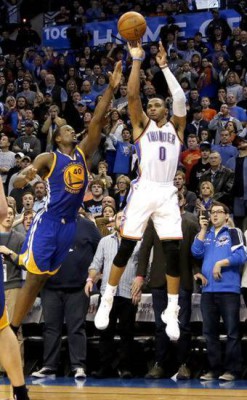
westbrook thunder barnes warriors

Houston’s depth (or as James Harden would call them “role players”) got depleted this offseason, but they still have Harden and Dwight Howard. After that, it’s a back to back roadie in the oxygen-deficient Rocky Mountains. A four game homestand follows as the Thunder face the Golden State Warriors for the first time in the season. If you remember the first two meetings between these two teams last season, then you’ll definitely have your DVR tuned in if you aren’t at the game. After the homestand, there’s a three game road trip that features 3 lottery teams.

Possible Trap: The Utah game between the Golden State and New York game.

  • Record through 20 games – 16-4

December 9, 2014 – December 23, 2014

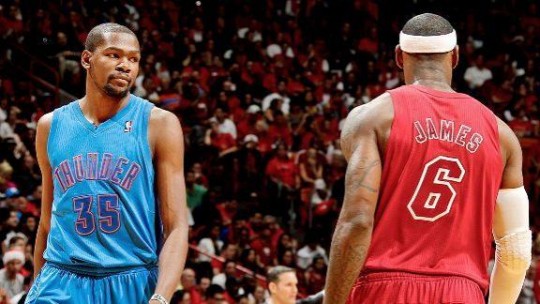
The prodigal son (LeBron James) makes his only regular season trip to OKC. How ironic is it the Thunder play James and the Cavs one game and then play Andrew Wiggins and the Minnesota Timberwolves the next? After that, it’s a 3-game West Coast swing that includes the Warriors and the Lakers. Finally, a sneaky difficult two game homestand follows against Anthony Davis and the Pelicans and the Trailblazers.

Possible Trap: At Sacramento. The Kings are one of those teams yearning for respect. They always seem to play lights out against the Thunder at home.

  • Record through 29 games – 23-6

December 25, 2014 – February 11, 2015

The toughest stretch of the season for the Thunder will probably be the 24 games from Christmas to the All-Star break. It was during this time last season, with Russell Westbrook recovering from his third knee surgery in 8 months, that Kevin Durant solidified his status as an MVP candidate. He led the Thunder on a 19-7 tear, against some of the top teams in the league, that had Oklahoma City heading into the All-Star break with the league’s best record.
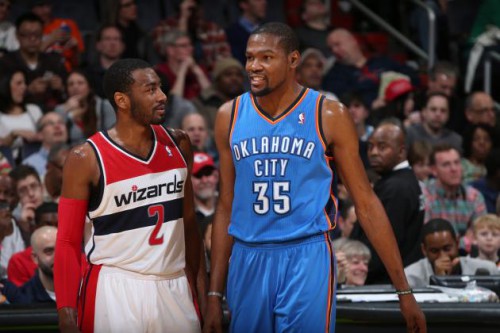
durant thunder wall wizards

The 24-game stretch can be broken down into two stretches: a 10-gamer and a 14-gamer. The 10-game stretch, from December 25, 2014 to January 16, 2015 features a tough, even-keeled run (five home, five away) against 7 playoff teams (and Phoenix). It starts with the Western Conference Finals rematch on Christmas against the Spurs in San Antonio. The next night its back to OKC to face the Charlotte Hornets. Two night later, it’s down to Dallas for a tussle with the Mavs. And then back home to face the Phoenix Suns to close out the year. The year begins with a home game against the Washington Wizards…you know, the team Thunder fans will be hearing about in their nightmares for the next two seasons. After that its back on the road to face the Warriors. The 10-game stretch finishes with the Rockets and the Warriors (again).

Side note: It feels like we play the Warriors 10 times this season.

The 14-game stretch that follows is probably more difficult because 9 of the 14 games are on the road, including a 5 game Eastern Conference romp. Of the 9 road games, four are against playoff teams from last season, one is against Cleveland, and another is against the mercurial Knicks. Of note on the road games, is one against Washington (yeah, that team again), where the Thunder have not won since the 2010-11 season. Washington DC has become a house of horrors for the Thunder of late.

Possible Trap: All the road games in a short time span.

  • Record through 53 games – 40-13

February 19, 2015 – March 5, 2015

After a week long All-Star break, the Thunder start the second half of the season at home against the Mavericks. They then travel to Charlotte to play the Hornets, and then return home the next night to play Denver. Oklahoma City is lucky in that they don’t have to make transcontinental treks on road trips, but they also suffer with these weird road/home back to backs that take them to one coast and then back home. After another home game (Indiana), it’s back to the West Coast to face Phoenix, Portland, and the Lakers. After a home reprieve (Philadelphia), it’s back on a plane for a prime time match-up against the Bulls in Chicago.

  • Record through 62 games – 46-16

March 8, 2015 – March 24, 2015

In this stretch, the Thunder play 8 of their next 9 games at home, while the road game is in Dallas (a one hour plane ride). Six of the nine opponents are playoffs teams, so it is by no means an easy stretch. It is also a non-tiring schedule, that features only one back to back. If there was ever a time in the schedule for the Thunder to either gain a little ground, or put some space between themselves and those teams under them, this would be it.

  • Record through 71 games – 53-18

March 25, 2015 – April 15, 2015
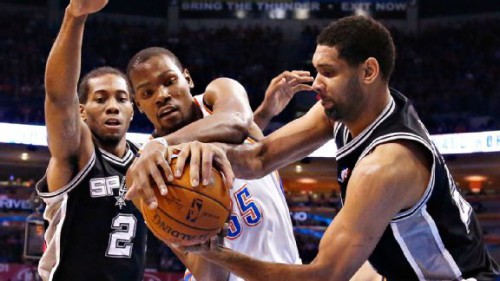
durant thunder duncan leonard spurs

The final 11 games of the season features 6 road games and 5 home games. In the last couple seasons, the end of the regular season has been road heavy for the Thunder. This season’s home heavy finish is a good reprieve from previous seasons. The Thunder play San Antonio twice during this stretch, so first place in the Western Conference may be up for grabs in these last few weeks of the season. The Thunder play the Texas trio at home during this stretch, while playing Phoenix and Memphis on the road. They finish the season in Minnesota, which may be important if the Thunder are still battling for a seeding.

  • Record through 82 games – 61-21

April 18, 2015 – mid June 2015

NBA champions!!!!! You heard it here first.

All in all, the schedule is pretty balanced. While the Thunder do play a lot of good teams (partly because they are in the Western Conference), there is a lot of time for rest, which should aid the Thunder in the playoffs.

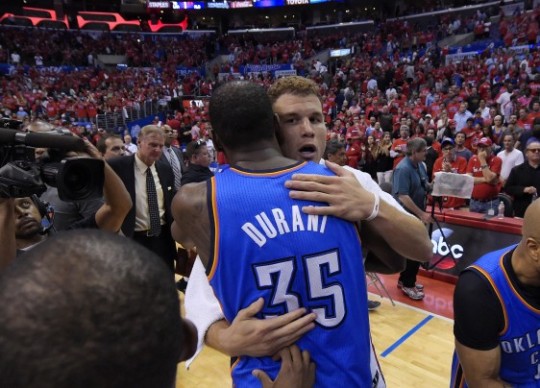
Five Thoughts from the Clippers Series

durant griffin thunder clippers

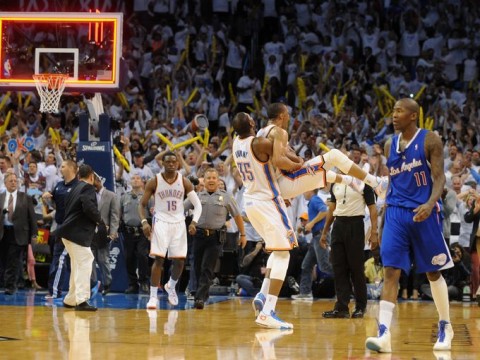
With a 104-98 win in Game 6 of their 2nd round playoff series against the Los Angeles Clippers, the Oklahoma City Thunder advanced to the Western Conference Finals for the 3rd time in four years. Before we look ahead to the San Antonio Spurs, here are 5 thoughts from the electrifying series that was.

1. Point Guard Supremacy

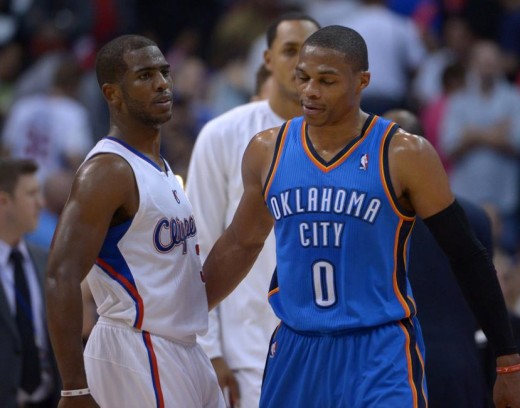
If there was a match-up that was going to determine how this series would play out, it was definitely this one. Chris Paul is widely considered to be the best point guard in the league, while Russell Westbrook is its most polarizing. One is a maestro, leading a meticulous concerto of dunks, alley-oops, and 3-point shots, while the other is the Looney Tunes’ Tasmanian Devil incarnate. The match-up basically came down to this: Would Paul be able to control Westbrook’s game. Defending Chris Paul means defending everyone on the floor. Yes, you have to stay in front of him. But it’s when the opponent strays away from one of the other players on the Clippers that Paul does his most damage.

westbrook paul thunder clippers

On the flip side, defending Westbrook is a completely different story. Due to the chaos he causes, a defender never knows how they are going to defend him. The best approach is to lay off of him, but even that has proven to be difficult as Westbrook will look for any opportunity to run in transition and is usually the quickest man on the floor. Add to that the fact that he’s had a couple games of double digit assists while scoring at least 20 points in the playoffs, and you are looking at a monster.

The numbers in the series basically cancel each other out:

  • Westbrook – 27.8 points / 6.0 rebounds / 8.8 assists / 1.8 steals on 49/35/88 shooting splits
  • Paul – 22.5 points / 3.7 rebounds / 12.0 assists / 2.5 steals on 51/46/75 shooting splits

While Paul assisted more and scored more efficiently, Westbrook scored more and grabbed more boards (over 2 offensive boards per game). The difference between the two floor general lied in the chaos they caused. More, specifically, in the free throw attempted. While Paul mainly settled for jump shots, Westbrook consistently challenged the defense by getting into the paint and looking for his own shot. Some may say that’s the staple of a scoring wing, not a prime time point guard. But with the way the rules favor dribble penetration, it may be time to stop looking at point guards as just facilitator and more as attackers. While I think Paul is still the best pure point guard in the game, Westbrook did a lot in this series in changing the way people think of the point guard position.

2. The Emergence of Steven Adams

When the Thunder made Adams the 12th pick in last season’s draft, many people envisioned a season of trips on I-44 between Oklahoma City and Tulsa. Adams was expected to be a project that would not pay dividends until, at the earliest, next season. But, as they say, that is why they play the game. Adams started the season as the Thunder’s back-up center and never wavered. He even started 20 games when Kendrick Perkins went out with a groin injury in the 2nd half of the season.

Thunder head coach Scott Brooks, in his infinite quest for veteran intangibles, barely played Adams in the first 5 games of the postseason. After averaging 14.8 minutes per game in the regular season, Adams was only notching 4 minutes a night (and 1 DNP-CD) against, of all teams, the Zach Randolph and Marc Gasol-led Memphis Grizzlies, in those first 5 games. With their backs against the wall and trailing 3-2 in their first round series, Brooks relented against his default settings, and played the rookie significant minutes (22.5/game) in the next two games (both wins).

A look at Adams’ numbers don’t explain his impact. Since Game 5 of the first round, Adams has averaged 21.8 minutes, 5 points, 5.1 rebounds, and 1.5 blocks per game. But it’s his combination of physicality and athleticism that has the most effect on the game. Usually, teams can do a lot of their damage in the paint when the starting big men are on the bench. In fact, James Harden made a living off of this when he played for the Thunder. Harden would come into the game and immediately begin attacking the other team’s back-up big. With Adams in the game, though, the other team has difficulty in scoring inside.

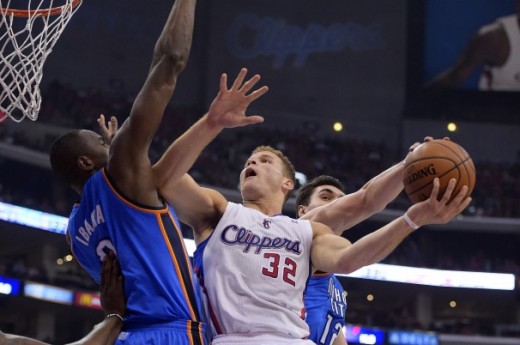
In the Clippers series, Adams was tasked with guarding all of the LA’s big men (Blake Griffin, DeAndre Jordan, and Glen Davis). Surprisingly, Adams probably struggled the most with Davis. Griffin wanted no part of backing down Adams in the post and settled for mid-range jumpers. And Jordan struggles with anything not resembling a lob pass. It’s almost as if Adams is a combination of Serge Ibaka and Perkins. Someone with the athleticism of Ibaka, but with the brute strength of Perkins. The only thing missing is the experience, which Adams is gathering in heaps this postseason.

3. Resiliency

durant westbrook jackson thunder

They say great teams win the close games. But, damn, does every game have to be an ESPN Instant Classic? After the “cardiology office visit inducing” series that was the Memphis series, my health didn’t need this series, especially games 4-6. But, that the Thunder made it to the Western Conference Finals speaks to the resiliency of this team.

There’s a comfort level that’s achieved when the core of a team has been together for a number of seasons. That’s what you see with the Thunder in late game situations. Everybody knows their roles and plays them to a T. Now, why they can’t do that in the first 45 minutes of a game? I have no idea. Being that they are still a young team, they probably play the game in a fashion similar to the thought process high school/college students have towards homework. When a student is given an assignment with a due date two weeks from then, 75% of those students will wait until the night before to start working on their assignment. That’s the Thunder in a nut shell right there.

4. Defense definitely wins playoff series (and championships too)

During the regular season, the Clippers averaged a league high 107.9 points per game. They upped the ante during the Golden State series, increasing their average by 3 points to 110.9 points per game. For the Thunder series, the Clippers averaged a paltry 106.3 points per game. Seriously though, that 1.5 point drop (and 4.6 point drop from the Warriors series) may have been the difference between the Thunder winning Games 5 and 6.

The Thunder did a great job defending Griffin and Jordan on the inside in the series. After posting up 12.1 points and 15.1 rebounds per game in the Warriors series, the Thunder limited Jordan to 6.7 points and 9.5 rebounds. Griffin’s points and rebounds went up slightly in the Thunder series, but his efficiency went down.

ibaka adams griffin thunder clippers

With the inside locked down, the only other options for the Clippers were Paul’s penetrations and their plethora of 3-point shooters. The Thunder did a great job of going under the screens and negating the driving lanes for Paul. With Paul not getting into the lane as much, the perimeter defenders were able to stay on the shooters for an extra bit longer. The trio of Matt Barnes, Jamal Crawford, and JJ Redick averaged 0.6 less 3-point FGs made in the Thunder series, and Crawford saw his 3-point percentage drop 8.4 percentage points from the Warriors series. All these factors combined made it difficult for the Clippers to do what they did best; which was to score at will.
5. Coming through in the clutch

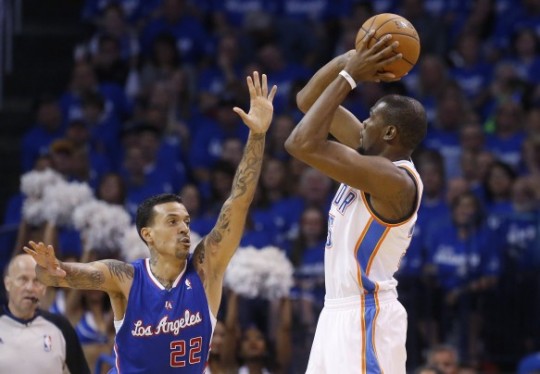
Many people will look at this postseason run and wonder whether Westbrook had a better postseason than Durant. The numbers suggest this is a very distinct possibility. All things being equal in the Memphis series (when Durant played bad, so did Westbrook, and visa versa), Westbrook has surprisingly been more efficient in the Clippers’ series. But in terms of making the necessary MVP-like plays in the final 3 minutes of games, Durant is still the man. In Games 4-6, in the final 3 minutes of play, Durant scored 16 points on 4-7 shooting (1-1 from long range), 7-8 FT, and only had 1 turnover. Conversly, Westbrook scored 11 points on 2-7 shooting and 7-7 from the line.

The mark of an MVP is not necessarily their stats throughout the game, but how they pull through in the clutch. Durant has proven time and time again that no matter how the first 40 minutes of the game play out, he’s usually there in the final few minutes when the team needs him the most.

Where the Thunder Stand After 4 Games (Round 2)

griffin clippers

Four games in: a blowout for each team and a close victory for each team. Series tied 2-2. Pretty much what you would expect from the 2 vs. 3 match-up in the Western Conference playoffs. The only caveat is how the Thunder lost Game 4. Up by 16 with a little more than nine minutes left should be a comfortable lead, even in the playoffs. But it’s how the Thunder lost the lead that has Thunder Nation in a bit of a tizzy. After a string of 4.75 out of 6 games where the Thunder looked like world-beaters, the Thunder reverted back to their bad habits in the fourth quarter relinquishing Game 4 to the Clippers.
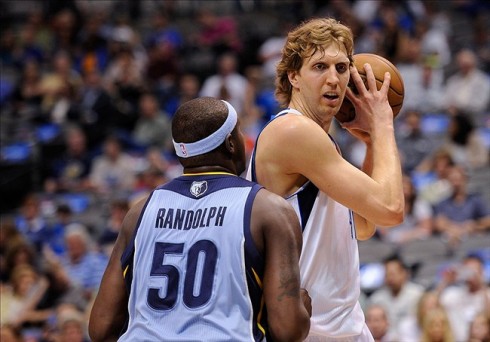
The offense became extremely vanilla, with most of it consisting of Russell Westbrook dribbling for 10 seconds, while Kevin Durant tried to get position on all 6 feet of Chris Paul (really, Chris Paul…c’mon Kevin). Once Durant got the ball, one of two things happened: either the Clippers sent a hard double team, with a soft third defender, which led to 3 turnovers in the quarter or Durant got the ball in the basket (4/5 FG, 10 points in the 4Q). While Durant’s “success” on offense would lead you to believe the Thunder were either maintaining their lead or building on it, the Thunder’s defense told a different story. With Westbrook and Serge Ibaka hampered by foul trouble in that 4th quarter, the Thuder weren’t able to be as aggressive on defense, which led to undisciplined overplays and unsuccessful reach-arounds as Paul and Darren Collison were able to get into the lane without much resistance.

Another little discussed faux pas was Scott Brooks’ inexcusable over-use of timeouts. At some point, when the other team is making their run, you have to hold onto to at least two timeouts in case the other team actually completes their run. This is the second time in these playoffs where Brooks’ mishandling of timeouts has put undue strain on the Thunder. The first time, in Game 5 of the Memphis series, Brooks was bailed out by the steal and subsequent game-tying dunk by Russell Westbrook with a few seconds left in the game. This time, though, the Thunder lucked into a hurried miss by Blake Griffin, but still could not capitalize on a last second shot by Russell Westbrook. A timeout and the ability to move the ball to halfcourt could have helped the Thunder in trying to tie the game. Oh, who am I kidding? It’s Scott Brooks we’re talking about. Anything less than five seconds left on the clock is usually accompanied by a 29 foot fall-away 3-point attempt by Durant with two defenders in his face.

Durant Barnes clippers thunder

In the end, the Thunder got a split in Los Angeles and wrestled back home court in the series. Mission accomplished? Maybe, maybe not. It depends on how you look at it. The narrative in these playoffs tends to change by the game. After the Game 1 blowout by the Clippers, most people were ready to shovel dirt on the Thunder’s grave. Then came two convincing victories after the galvanizing MVP speech by Durant, which led to people wondering whether the Thunder would lose again in these playoffs. Finally, the Game 4 collapse has allowed the pendulum to swing once again, this time back in the Clippers’ direction. Media fandom in the playoffs can be so fickle at times.

Five Thoughts from the Memphis Series

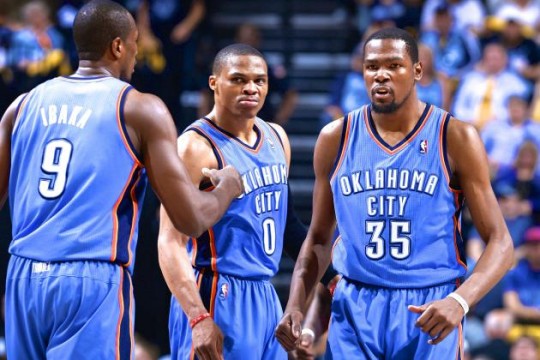
durant ibaka westbrook thunder

The Oklahoma City Thunder defeated the Memphis Grizzlies 120-109 on Saturday to move onto the 2nd round of the playoffs. But before we move on, here’s 5 thoughts about the series that was.

1. The Overtimes and the plays leading up to them.

Four consecutive overtime games. Let that sink in for a minute. Your adrenaline pumps and heart races for one overtime game. But four…..in a row. The life span of the average Oklahoman (and Memphian, for that matter) probably dropped by about 2.5 years in this series. But the overtimes only tell half of the story in those four games.

The mad dashes that led to the overtimes were even more impressive. Here’s a recap of the major plays that led to the 5th period in those games:

Game 2: Set-up – Thunder down by 5 with 18 seconds to go.

  • Fall away 3-pointer by Durant in the corner while being fouled by Marc Gasol. Free throw good. Thunder down 1.
  • Free throw by Mike Conley. Grizzlies up 2 with 12 second left.
  • Russell Westbrook 3-point miss rebounded by Kendrick Perkins who goes up for a put-back with no time on the clock. Tied game. And on to overtime.

Game 3: Set-up – Thunder down by 17 with 7:30 minutes left in the 4th quarter. Thunder go on a 17-0 run to tie the game at 81 with 57 seconds left.

  • Tony Allen lay-up to put the Grizzlies up by two with 45 seconds.
  • Tony Allen steal and lay-up puts the Grizzlies up by 4 with 33 seconds left.
  • Russell Westbrook 4-point play ties the game at 85 with 26 seconds left.
  • Each team misses their finals shots. And on to overtime.

Game 4: Set-up – Thunder down by 5 with 1:20 left, after starting the quarter with a 12 point lead.

  • Reggie Jackson (the only effective Thunder player the entire night) launches (and makes) a step-back three with 59 seconds left. Thunder down by two.
  • After stealing a pass off of Beno Udrih, Durant passes to Jackson who runs off of a pick and roll and scores on a floater with 30 seconds left to tie the game.
  • After a mad scramble on the defensive end in which the Grizzlies had 2 opportunities to tie the game, Jackson ends up with the ball with 4 seconds left, but inexplicably heaves a 60 footer that bounces inbounds as the clock expires. And on to overtime.

Game 5: Set-up – Thunder down by two after the first of Tony Allen’s two free throws goes down with 30 seconds left. (Of note: The Thunder have no timeouts left)

  • Allen misses the 2nd free throw, but Tayshaun Prince gets the offensive rebound. After almost getting the ball stolen, Memphis calls a time out.
  • After the time out, Mike Conley dribbles at the top of the key. With the shot clock running down, Conley makes a move towards the basket, but Westbrook reaches across Conley’s body, knocks the ball loose, and takes it the other way for a game-tying fast break dunk. And on to overtime.

In all honesty, the overtimes proved to be a bit anti-climatic in comparison to those crazy final minutes in the fourth quarters.

2. Interior Defense

When you play the Grizzlies, the one thing that has to be on point is your interior defense. If you don’t have a set of defensive bigs that can combat what Memphis throws at you, then you might as well pack it up. Last season, Zach Randolph and Marc Gasol bore through the Thunder’s interior defense like a hot knife through butter. It was so much of an embarrassment, that Kendrick Perkins felt the need to apology for his play after the series. But this time around, Perkins, Ibaka, and Steven Adams proved up to the task, essentially neutralizing the Grizzlies’ biggest offensive strength.

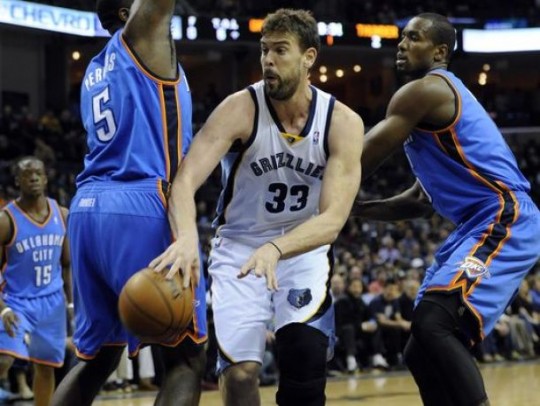
perkins jackson ibaka gasol thunder grizzlies

In last season’s playoff series, Gasol and Randolph shot 68/146 (47%). In this playoff series, the interior duo for Memphis shot 89-220 (40%). Everybody talks about the struggles that Westbrook and Durant experienced during the series, but equally as damning for their team, was the struggles that Gasol and Randolph had with scoring. And once Durant and Westbrook got going again in Games 6 and 7, it was too difficult for the the Memphis duo to keep up, especially with Randolph being suspended for the final game.

3. The Role Players

Many people wondered why Caron Butler decided to sign with the Thunder, instead of with the two-time champion Miami Heat. If Butler was title chasing, the easiest route would have been to latch on with Miami and probably be a 9th man for them. But Tuff Juice probably saw an opportunity with the Thunder to not only compete for a championship, but also be a regular part of the rotation.

Many people like to label Butler as a champion since he was a member of the Dallas Mavericks team that won the championship in 2011. What many people fail to mention is that Butler had a knee injury mid-season, and didn’t participate in any games for the Mavericks in the playoffs that season. Yes, he got a ring, but I wonder if he feels like that ring hardly holds any weight. Pride can easily turn happiness into a question mark that stays on the mind.

So, when Butler’s number was called on to start in place of an ineffective Thabo Sefolosha for Game 6, he showed that he was ready for this moment. He only scored 7 points in that game, but the effect of Butler as a perimeter threat, opened up the lanes enough for Westbrook and Durant to get back in their groove.

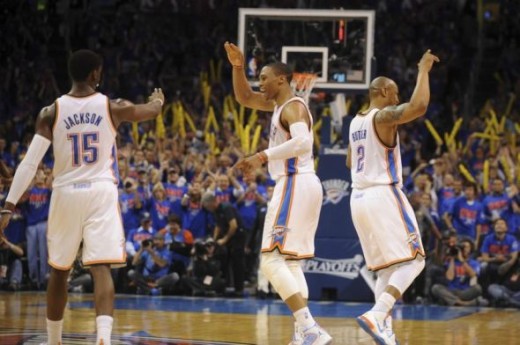
butler westbrook jackson thunder

Reggie Jackson has the hardest job in the world. He has to be the main facilitator and scorer on a bench unit that is about as hot and cold as it gets. Then he has to be the third option on the floor with Durant and Westbrook. If he does something bad during his time on the floor with the superstar duo, then the spot light shines on him. But if he does something good, then it probably had to do with the fact that Durant and Westbrook took so much of the defense’s attention which allowed Jackson to have an open lane or a wide open shot.

Then Game 4 happened. I’ve never seen a situation where two alpha males completely give the reins to the game over to somebody other than themselves. A lot of times, Durant and Westbrook are like the Mike Lowery and Marcus Burnett of the NBA: “We ride together, we die together, bad boys for life”. But in this one instance, whether it was their own insecurities in their play or a new confidence in another player not seen since the Harden days, Durant and Westbrook allowed Jackson to take over the game and in the end, win it for them. In reality, Jackson saved the season with his mini-explosion in Game 4.

4. Durant and Westbrook returning to form

Probably the biggest narrative of this series was the slump that both Durant and Westbrook faced in the Games 2-5. Without an unexpected career game from Jackson, the series would have probably been done in 5 games, much like last season. In those 4 games, the duo shot 73-209 from the field. That is a whooping 35% for two All-NBA players. Many media member started playing the Westbrook vs. Durant angle to the point that Westbrook felt the need to address it in an interview after Game 3.

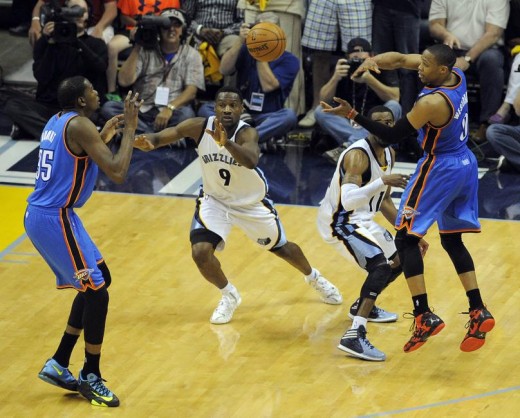
durant westbrook allen conley thunder grizzlies

Then the Oklahoman decided to print one of the dumbest headlines since the Chicago Tribune declared Thomas E. Dewey the winner of the 1948 Presidential election. Mr. Unreliable. A name that describes many people, namely deadbeat dads, parole violators, and teenagers. Not a name that describes Kevin Durant, the basketball player. If anything, he’s been Mr. Reliable his entire career. The attempted explanation and subsequent apology explained what the headline itself was trying to convey, but the damage had already been done to the newspaper.

Durant took it in stride, but you could tell that the headline perplexed him a bit. Great players always play their best when the cards are stacked against them. Down 3-2 with an elimination game in Memphis, Durant and Westbrook slowed their games down a bit, and started playing their brand of basketball. In Games 6 and 7, the pair averaged 60.5 points, 18.5 rebounds, and 12.5 assists per game on 54/53/88 shooting.

5. The Wake-Up Call

The Thunder needed this kick in the rear end. They slept walked through the final month of the season, and probably had this aura about them that they could turn it on or off at any point in the playoffs. But this season’s playoffs were a bit different. The 7th seeded Grizzlies were probably more of a 3 or 4 seed, were it not for injuries and having to play in the tough Western Conference.
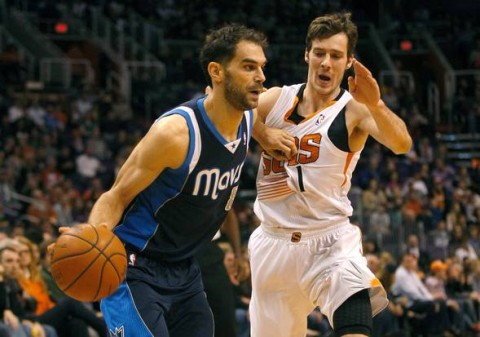
But, the name of the game is surviving and advancing, and the Thunder did just that. If the Thunder are fortunate enough to rack up 12 more victories, they should look back on this series and appreciate the fact that Memphis made them work so hard to get to Round 2.

Scott Brooks: It Might Be Time For A Change

scott brooks durant thunder

If you look at the recent history of the game, every great player who has won a championship needed a championship level coach to push him to the promise land. And by great player, I mean the transcendent players of their generation. In recent memory, those players have been Michael Jordan, Kobe Bryant, and LeBron James. Each of these players needed to go, not only through adversity, but also through a coaching change before they led a team to the championship. Tim Duncan should also be included in the list, but he has played for the same coach his entire career while racking up 4 titles in the process.

Kevin Durant, of the Oklahoma City Thunder, is paving his path towards being a transcendent player. He is on his way to winning his 1st MVP, has won 4 scoring titles before the age of 26, and leads a team that has been a championship contender for the past three season. He has a top 10 player by his side in Russell Westbrook, a versatile big man that can block shots and hit mid range jumpers in Serge Ibaka, and a great 6th man in Reggie Jackson. With all this at Durant’s disposal, why is it that the Thunder are struggling with their first round opponents, the Memphis Grizzlies?

The answers to that question are like pieces of a puzzle. When you analyze everything, you’ll see that many factors are contributing to the Thunder’s struggles in the first round. First off, Memphis is not your run of the mill 7th seed. The Grizzlies struggled out the gate due to Marc Gasol’s knee injury, but finished the season on a 33-13 tear that brought them up to the 7th seed. Without Gasol’s injury, this team probably finishes in the top 5 in the Western Conference. The next factor is that Memphis is built for the playoffs. They are a half-court oriented offense with one of the best defenses the league has to offer. And, their core is playoff-tested and has been together for at least 4 seasons. But these factors are more a microcosm of who the Grizzlies are.

It’s what the Thunder are doing (or not doing) that is affecting them in this series. Oklahoma City is a team that can play a variety of ways, but they’re at their best when they are running in transition and causing havoc in the paint through penetration. But those things tend to get muddled in the playoffs. Teams protect the ball more and defenses make it  a point to protect the paint. Less turnovers means less transition opportunities. More defenders in the paint means less avenues to get to the basket. Unfortunately for the Thunder, the Grizzlies are great at two things: protecting the ball and defending the paint.
scott brooks westbrook thunder

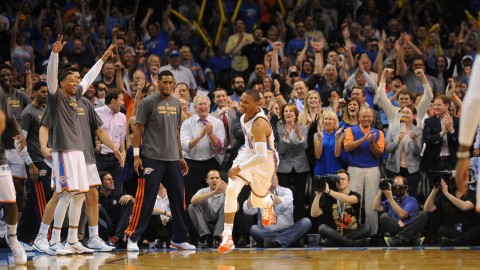
But with players as dynamic as Durant, Westbrook, Ibaka, and Jackson, the Thunder should not be struggling as bad as they are in this series. Part of that could be attributed to bad luck as both Durant and Westbrook seem to be in shooting funks. Part of that could be the Grizzlies’ defense, which packs the paint and dares you to beat them with perimeter shots, of which the Thunder aren’t making. But a lot of the Thunder’s problem has to do with scheming (or lack thereof), and that falls squarely on Scott Brooks.

Unfortunately, this has always been the knock on Brooks. The lack of an offensive system rarely rears it’s head for the Thunder, except when the transition faucet is turned off, the paint is packed, and the shots aren’t falling. It’s understandable that you would have an iso-oriented system when your two best players thrive in isolation situations. But it’s also important to have a system in place when the defense keys in on those two players. And that’s what is severely lacking for the Thunder in this series.

It’s almost asinine that Brooks, with the weapons he has at his disposal and the amount of time he’s had those weapons, would never have created a fail-safe offensive system that would play, not only to the strengths of his stars, but also to the strength of the role players around them. Brian Windhorst of ESPN tweeted during Game 3, “Grizzlies know all of OKC’s plays. When the 1st option is taken away the Thunder often just shut down their offense.” If anything, last season should have been a sign that the team needs an offensive system outside of superstar iso-plays. When Westbrook went down, it should have signaled to Brooks that a change was needed in order to prevent what happened in last season’s playoffs. Instead, with Durant and Westbrook both in tow, it seems as if Brooks has defaulted even deeper into superstar isolation mode.

It’s either that, or those two superstars aren’t trusting their teammates, which leads them to take it upon themselves to try and save the day. Whether Brooks is heeding both players to look for teammates more or not, this still goes back to Brooks. If isolation ball isn’t working, get onto your superstars and tell them to run the offense. Oh yeah, I forgot. There is no offense. Ibaka, one of the best release valves in the league and probably the best target for a pick and roll outside of Durant and Westbrook is getting completely frozen out of the offense in the fourth quarter and overtime. Jackson, who up until Game 4, was struggling mightily, was basically benched for games 2 and 3. Brooks could have and should have incorporated those two into the offense even more, especially in Games 2 and 3. Instead, the Grizzlies defenders keyed in on the superstar duo and made it extremely difficult for them to get into their sets, let alone get off a good shot.

durant collison allen gasol randolph grizzlies thunder

The other transcendent players I talked about in the opening had to endure coaching changes that brought about success. Michael Jordan went from Doug Collins to Phil Jackson. Kobe Bryant went from Kurt Rambis to Phil Jackson for his first three championships and from Rudy Tomjanovich to Phil Jackson for his next two championships. LeBron James went from Mike Brown to Erik Spoelstra for his two championships. The one constant between these two coaches is that they had an offensive system to fall back on. They had great players, but also a system that helped them out offensively if the opponent was exclusively targeting the star player. Jackson had the triangle offense and Spoelstra has a system that spaces the floor for James, Wade, and Bosh to operate.

It’s especially frustrating when you compare Brooks to Spoelstra. Both are young coaches in their first head coaching gigs who were basically gift-wrapped super-teams. Spoelstra found a way to develop a system that played to the strengths of all his players. Meanwhile, Brooks is still relying on the greatness of a couple players to get him out of jams. Westbrook and Durant are good enough to win you enough games to stay employed.

Don’t get me wrong. I don’t think Brooks is a bad coach. He’s done a great job in developing the talent OKC was loaded with over the years. He’s done a great job managing egos and developing the culture the Thunder are now known for. But as an X’s and O’s coach, I think Brooks has hit his ceiling. Just like players eventually reach a point where they no longer improve, I think Brooks has gotten to that point with this team. I’ve always said that Brooks is a great coach to lead us to the mountain and maybe even to get us halfway up the mountain, but it will take another coach to get us over the mountain. If Durant and Westbrook are ever to get over the hump, they may have to do it with another coach at the helm. I hope I’m wrong, but I’ve experienced too much of Brooks to think otherwise.

Enjoy the Moment: Durant and the MVP

durant thunder

Since the NBA’s first season in 1955-56, there have been 58 MVP’s. Those MVP’s have been won by 29 different players in 19 different cities (four of which currently don’t have NBA franchises). Of the 30 teams in the current NBA, 15 of those cities have never experienced an MVP season by one of their players. So when the inevitable happens and Kevin Durant is named the 2013-14 NBA MVP, Oklahoma City will join an exclusive fraternity of cities that have experienced a magical individual season by one of their players.

Oklahoma City has been lucky enough, in its short time as an NBA franchise, to experience a Coach of  the Year (Brooks, 2010), a Sixth Man of the Year (Harden, 2012), and a Rookie of the Year (Paul, 2006 with the New Orleans/OKC Hornets). The ultimate goal as a sports franchise is to win a championship. But what are teams but a collection of individuals. And if your team, if your city, houses the best individual player in that sport, that is like winning a championship in and of itself.

When an MVP season plays out, you see it coming. Of the 450-500 players that cycle through the league in a given season, only about 2-3 players are deserving of even being considered for the top individual prize in the NBA. And if you, as a fan of that team, are lucky enough to enjoy that experience, then you need to savor it. Because for as much as we like to think that MVP’s and championships will beget more MVP’s and championship, the future is never a definite when it comes to sports. The Russell Westbrook injury last season taught us that. A twist of the knee here, a tweak of the back there, an argument with the front office, and that player could be gone in an instant. Prime example is the last man to win an MVP not named LeBron James. Chicago Bulls guard Derrick Rose won the MVP in his third season in the league. He looked well on his way to contending for (and possibly winning) multiple MVP’s. But you know the rest of the story. Injuries and re-injuries have completely derailed his career to the point where we wonder whether he’ll ever get back to the MVP form he had pre-injury.

It’s not everyday you get to witness greatness. There are plenty of good players in the league. In any given game, you may see a 20-point scorer, a double digit rounder, or a defensive maven. Most nights the names change. But for MVP candidates, that dominance is seen on a night in/night out basis, over the course of an entire season. That degree of excellence goes from late October usually into late May/early June. That consistency is probably the biggest factor in determining who is MVP-worthy and who isn’t. It’s easy to get up for a game against Miami on a prime time Thursday TNT telecast. It’s that much harder to get up for a Tuesday night game in January against the Milwaukee Bucks. But those select few do it every night.

durant lebron james thunder heat

Eat it up Oklahoma City. Our story is a weird one in which we were basically gift wrapped a once in a generation player. Most cities, when they first get a team, have to toil around in the dredges of the league before they finally find those couple of players that actually make them competitive. But OKC was like “insta-rice”. We got the team, popped in the microwave for one minute (season) and, Voila!, playoff contender. It happened so quickly, that media decided to call it the OKC model of team rebuilding. This model, though, only works if you get a player like Durant in your clutches. It will be very interesting to see where teams like Orlando, Philadelphia, Milwaukee, and New Orleans stand in about 3 years when their rebuilds should start bearing fruit.

I always wonder how the OKC fan base will be react when this current run ends. Whether its in two years (a.k.a Durant’s free agency) or in 15 years, Thunder fans have been spoiled beyond belief. But this is the NBA, and success is very cyclical, especially for small market teams. Most Oklahoma fans suffer from what is locally called, the “Sooner mentality”. In three words, the Sooner mentality means “Championship, or bust!”. And we are starting to see that with Thunder fans. Lose a game in a series, and there is a section of fans that is clamoring for Scott Brooks’ head on a platter, and another section clamoring for Thunder GM Sam Presti to sign every available free agent, luxury tax and careful budgeting be damned. Those are the fans I wish I could grab by the shoulders, shake them a bit, look into their eyes, and say, “Stop worrying and enjoy this moment! It may repeat itself next season, but it also may be a once in a lifetime event”.

As we enjoy this moment, look back on the season that made Durant an MVP. Don’t focus on the numbers though. Even though the numbers improved, they don’t tell the entire story. Focus on the maturation of the man. Many players hit their head on ceilings they create because they get satisfied with what they’ve accomplished. Like the theme in the poem Ozymandias, they stand there relishing their accomplishments without realizing their satisfaction will eventually be their downfall. Durant could have been one of those players, and he still would have been considered great. But, instead, he took the hard lessons from the previous season and focused on how he could get better. It is a rare trait in a player to never find satisfaction in their successes. Instead of basking in the glow of their brilliance, they instead survey the field and know that others will be coming after what they have. LeBron James made that transition three seasons ago. Kobe Bryant before him. And Michael Jordan before him. This is the road the Durant is on, and luckily, for us, like Route 66 and I-44, that road runs straight through Oklahoma City. Congratulations Kevin. We are all proud of you.

The Race for 8th and the Thunder

shield

I have really enjoyed this first season of ‘Agents of S.H.I.E.L.D’. Many critics have panned it, but I think it has melded well with the Marvel movie universe, and has enough gumption to stand on its own. This season has focused on their hunt for The Clairvoyant, a villain who always seems to be one step ahead the agents. So much so, that the agents start to think the villain is in their head.

Well, I would like to let the agents of S.H.I.E.L.D know that I have found The Clairvoyant. His name is  Matthew Winick, and he’s the mastermind behind the NBA schedule. He has to be The Clairvoyant. Who else would’ve scheduled the Dallas Mavericks, Phoenix Suns, and Memphis Grizzlies to play each in round robin fashion in the final week of the season for the 8th seed in the Western Conference.

randolph nowitzki grizzlies mavericks

We rarely see “win and you’re in” scenarios in basketball, but this season we could possibly have 3 games which impact where those teams end up on the final day of the season. First off, the tie breakers are as follows:

  • Dallas owns the tie breaker versus Memphis (3-0)and is tied with Phoenix (1-1).
  • Phoenix is tied with Dallas (1-1).
  • Memphis owns the tie breaker versus Phoenix (3-0)

With Dallas holding a 1/2 game lead over the Suns and a 1.5 game lead over the Grizzlies, they are firmly in the driver’s seat. But the teams they face in their final 3 games have a winning percentage of .654. It doesn’t get any easier for Phoenix, whose four remaining opponents have a combined winning percentage of .577. The easiest trek may be Memphis’, which currently sits in the 9th position in the West. They play the 76ers and the Lakers before beginning their round robin games against the Suns and Mavs. They are in a much better position than Phoenix to control their destiny.

calderon dragic suns mavericks


As a basketball fan, you live for this time of year. The first two days of the playoffs have always been my favorite days of the season. Two days, two quadruple-headers. That is sweet nectar from the basketball gods. Luckily, basketball fans will get a 3 game play-in tournament before the playoffs even begin. Those games are:

  • April 12th – Phoenix @ Dallas
  • April 14th – Memphis @ Phoenix
  • April 16th – Dallas @ Memphis

With the Oklahoma City Thunder firmly in control of the No. 2 seed in the West after last night’s victory over the Los Angeles Clippers, my focus can be redirected towards the West’s 8th seed. Those three teams will be battling for the 7th and 8th seed. Other than who might finish with the 7th seed, how does this affect the Thunder?

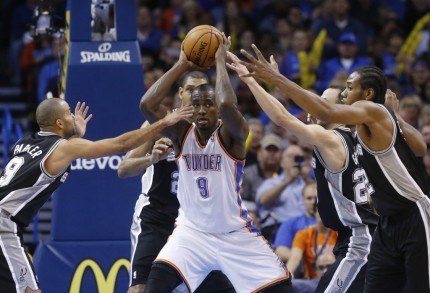
NBA: San Antonio Spurs at Oklahoma City Thunder

The answer to that lies in San Antonio. There’s still a sliver of hope the Thunder can get the No.1 seed in the conference, and in the league. That hope lies in the fact that the Spurs will face the Mavericks and Suns on back to back nights. Two desperate teams against a team that is known to rest its starters as the season winds down. Tony Parker will be out for tonight’s game against the Mavericks. After they face the “duo of desperation”, the Spurs then travel to Houston to face the Rockets, who may be needing to win in order to stay ahead of the Portland Trailblazers for the 4th spot (and final home court position) in the West.

All told, if the Spurs finish 1-3 in their final 4 games, and the Thunder win out, Oklahoma City will head into the playoffs with the No. 1 seed. A lot of things will have to fall in OKC’s favor, but it’s not an impossible scenario. With the Spurs playing 2, or possibly, 3 desperate teams, the onus may be on them to hold on to the top seed in the West.

Scoreboard Watching (2014 edition)

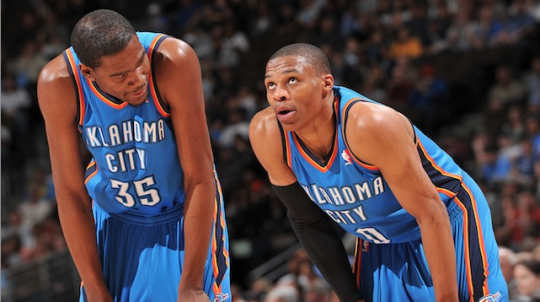
durant westbrook thunder

If you are a fan of a team, you’re always aware of your team’s games. But, sometimes, if you are wholly invested in one team, you tend to miss what out on what is going on around the rest of the league. Last season, I wrote a similar article concerning the other teams Thunder fans should be looking out for as that season closed (namely the San Antonio Spurs and Toronto Raptors). In a vacuum, a fan should only be worried about their team. But, in reality, with playoff positioning and/or draft positioning at stake, watching how other teams perform at the end of the season can add some drama to a point in the season where drama is sometimes lacking. This season, there are 5 teams Thunder fans needs to be paying attention to than can affect their near future.

1. San Antonio Spurs

  • Why it matters: The No. 1 seed in the Western Conference (and in the league) is at stake.
  • Team’s outlook: Currently 59-16 (1st in West), with 4 road games and 3 home games remaining.

Serge Ibaka

This is very reminiscent to what happened last season. This time though, it seems like the Spurs are far enough ahead to not have to worry about the Thunder chasing down the No. 1 seed from behind. The Spurs are currently on a roll, coming into the Thunder game having won 19 in a row, and hold a 4 game lead over the Thunder. With their penchant to rest starters late in the season, the Thunder still have a slight chance to catch the Spurs. But it seems like a foregone conclusion that the Spurs will head into the playoffs with the No. 1 seed in the West. One thing to remember is that if San Antonio does stumble, the Thunder own the tie-breaker over them.

2. Dallas Mavericks

  • Why it matters: The Thunder own the Mavericks’ first round pick if it is outside the Top 20.
  • Team’s outlook: Currently 44-31, (7th in the West) with 5 road games and 2 home games remaining

The Thunder got this draft pick in the Harden deal from Houston. There are two factions when it comes to this pick. Those that want the pick this season (slotted to be in the 21-23 range) and those that want the pick to go all the way until 2018, when it becomes unprotected. It will all depend on if Dallas make the playoffs or not. If they make the playoffs, they’ll be one of the top 10 teams in the league, thus garnering a pick in the 21-30 range, which transfers over to the Thunder. If they don’t make the playoffs, the Mavericks will pick in the lottery and will keep the pick.

The Mavericks are battling with the Memphis Grizzlies and the Phoenix Suns for the last two seeds in the Western Conference playoff race. Of the remaining games between the 3 teams, the Mavericks face the harder road with their opponents having a .525 winning percentage combined. But the road will not be easy for either one of the 3 teams because, NEWSFLASH!, they all play in the Western Conference. That being said, the Mavericks had their opportunity to put some distance between themselves and the other two teams, but flubbed an 8 game home stand to the tune of going 4-4. Luckily, all three teams play each other in the final week of the season.

I’m torn as to what I want to do with this pick. Part of me thinks that Thunder GM Sam Presti, with two draft picks late in the first round, could package those to move up a couple slots and get a shooter like Nik Stauskas of Michigan. But part of me also wants to see what happens if this pick actually reaches 2018 unprotected. Unless Dirk Nowitzki goes on Tim Duncan’s offseason training program, I see his effectiveness, and that of the Mavs, steadily going down in these next couple of seasons. And hopefully, they completely bottom out in the 2017-18 season.

3 and 4. Indiana Pacers and Miami Heat

  • Why it matters: The only teams that matter in the Eastern Conference
  • Teams’ Outlooks – With a virtual tie for the Eastern Conference top spot, these two teams meet one last time on April 11th. Indiana currently leads the season series 2-1.

heat pacers

With a 2.5 game lead over these two teams in the league standings, the Thunder are in control to maintain home court advantage against any of the East’s top teams if they meet in the NBA Finals. The major issue here is whether the Pacers will give Miami a run for their money and make the Eastern Conference Finals somewhat competitive. While Miami has been surging in the last 10 games, going 7-3, the Pacers have been doing the exact opposite, going 7-10 in their last 17 games.

The jump from being a good team to becoming an elite team is the hardest jump to make in the NBA. Not only do you have to start positioning your role players correctly, but your star players have to start taking that next step. For Indiana, a combination of questionable in-season moves and lack of player progression has slightly slowed that progression from good team to elite team. The mid-season trade that sent Danny Granger to the Philadelphia 76ers for Evan Turner and Lavoy Allen has yet to bear fruit. And the mid-season signing of Andrew Bynum can probably be deemed a failure due to a reoccurrence of knee issues for the center. In addition, Paul George and Roy Hibbert have failed to significantly improve from where they were in the beginning of the season. With this recent slide, rumors of infighting and selfishness have begun to sneak into the vernacular that describes the Pacers. The mental aspect of making the jump from a good team to an elite team is the hardest thing for a young team to grasp, and its currently showing with these Pacers.

The reason this matters to the Thunder is because the Western Conference playoffs are going to be a gauntlet. The first round match-ups will be formidable and the series will only get tougher from there. If Miami is able to skip through the East playoffs easily, and get some rest in the process, that could spell trouble for the team that comes out of the West, regardless of who it is.

5. New York Knicks

  • Why it matters: The Denver Nuggets own the Knicks’ pick for this draft
  • Team’s Outlook – Currently 33-43 (8th in the East), with 3 road and 3 home games remaining.

Looking towards the future at division rivals, the team that has the best chance of getting better quickly is the Denver Nuggets. The Nuggets suffered a myriad of injuries this season that prevented them from ever making a run at the playoffs. But with many of those players coming back next season and a potential lottery pick, the Nuggets are in position to get back to their winning ways. If the Knicks make the playoffs, their pick moves down to the No. 15 slot. But if the Knicks miss the playoffs, Denver will be slotted to pick in the 7-9 range, while also having the potential of getting a top 3 pick.

Seeding doesn’t seem to affect the Thunder that much. They know they can beat the Spurs in San Antonio, if necessary. Their main goals to finish this season are to stay ahead of the LA Clippers, Miami Heat, and Indiana Pacers, and to get/remain healthy. As the season rolls to a close, it’ll be interesting to keep a vested interest in these 5 teams, as their outcomes all have the potential of affecting the Thunder in the near future.

Westbrook, Minutes, Playoffs, and Questions

westbrook thunder

In last Tuesday’s game, the Oklahoma City Thunder, in the middle of the tightly contested game with playoff implications, decided to sit Russell Westbrook for the first 3 minutes of overtime. He had already played 31 minutes in regulation and the Thunder were sticking to their strict minutes restriction diet of only 32 minutes for Westbrook. In that 3 minutes span, the Thunder fell behind by 7 points to the Mavericks and never recovered. Look, I get it. In the grand scheme of things, a loss in game 71 of the regular season when the team basically has either the No. 1 or 2 seed in the Western Conference locked up pales in comparison to losing your 2nd best player for an extended period of time. But the plan the Thunder are using not only confuses me, but also worries me.

The minutes restriction plan is pretty self evident. The Thunder want to restrict Westbrook’s minutes to reduce the wear on his knee during the regular season. As in everything in life, though, the tough question is, “What is the end game?” Due to the Thunder organization’s tight-lipped nature, its hard to know what the Thunder are thinking moving forward. Since returning on February 20th, Westbrook has averaged 26.7 minutes per game in the 13 games he’s played. Now let’s say he continues on this charted track of minutes played for the remaining 11 games of the season (of which he’ll probably only play about 8). When the playoffs arrive, is he realistically going to jump from 28-32 minutes per game to 38-40 minutes per game? Wouldn’t that kind of bump in playing time have the same effect on the knee as his first return did in the beginning of the season?

This is worrisome because it seems that Westbrook, at 25 years of age, is on a similar rest plan as Dwayne Wade, who is 7 years Westbrook’s senior. Is this a cautious move by the Thunder to preserve Westbrook’s career or is there something still going on with Westbrook’s knee? It’s a scenario that leads not just to one elephant in the room, but a herd of them.

westbrook wade thunder heat

Elephant #1 – What happens if a playoff game goes into overtime? Double overtime? Or further? Playoff basketball is coming and the intensity ratchets up. We saw that in the double overtime thriller that was the Raptors game and the overtime loss in the Mavs game. A coach can never take into account overtime when they are thinking about a minutes restriction plan. Scott Brooks can’t play Westbrook 36 minutes and then take him out the final two minutes of a game using the thought process that “the game might go into overtime”. What happens if Game 4 of the 2011 West Semi-Finals repeats itself? If you don’t remember, that was the triple overtime classic the Thunder won in Memphis.

Elephant #2 – Speaking of Wade, what happens if Westbrook’s knee flares up and/or swells? The last 2 times that happened, the Thunder sent Westbrook to the operating room. True, the first time was a loose stitch. And the second time may have a precautionary procedure for loose bodies in the knee. What happens the third time the knee swells, though? Will the Thunder sacrifice Russell’s future for immediate success if a championship is at stake?

Elephant #3 – If Westbrook is forced to sit, how will this affect the team’s rhythm? As we’ve seen in this slew of back to backs, the Thunder are a different team with Westbrook on the floor. That change in rhythm can work in the regular season where you may play a good team one night and a terrible team the next. But in the playoffs, where an opponent has ample time to game plan for most scenarios, that change in rhythm can be a huge hindrance to the Thunder.

durant westbrook thunder bench

There are a ton of questions regarding the Westbrook knee situation. It is uncharted territory, not only for Westbrook and the Thunder, but also for the fans of the team. The organization will always protect itself. If Westbrook reinjures himself or if his knee swells up, I don’t think the Thunder would hesitate in shutting him down and protecting their asset for the future. But it’s the way they are setting it up that worries me. Now, I’m no doctor and I haven’t stayed at a Holiday Inn Express lately, but to have a guy with a recently repaired knee go from playing 28 minutes in the 20 games leading up to the playoff to 38-40 minutes in the playoffs, seems like a recipe for disaster to me. Hopefully, the team increases Westbrook’s work load in these last 11 games so the jump in minutes in the playoffs won’t be a shock to Westbrook’s body (knee).

The Stretch: The Thunder’s next 6 games

When the Oklahoma City Thunder were novices to playoff basketball, home court advantage was a must. In their first playoff series against the Lakers in 2010, the only two games the Thunder won in the series were in Oklahoma City, with a third victory being stolen by a Pau Gasol tip-in as time expired in the 4th quarter. The next season, the Thunder rode home court advantage all the way to the Western Conference Finals, where they lost to the higher seeded, and eventual champions, the Dallas Mavericks. The next season, the Thunder made a repeat trip to the WCF, where the met the higher seeded San Antonio Spurs. Three years worth of playoff experience helped the Thunder weather a 2-0 deficit in the series, and they eventually went on to win the next 4 games (3 of which were in OKC) to make it to the NBA Finals.

The Thunder are experienced enough to not get phased by road playoff games. But getting the highest seed possible is more of a psychological ploy than anything else. The opportunity to not only get the first two games at home, but also the deciding game, if necessary, gives a team a little more confidence moving forward.

Do the Thunder need to get HCA throughout the playoffs? Probably not. But the Thunder aren’t yet to the point where they are willing to sacrifice late season games in order to rest their weary starters. Resting Russell Westbrook is a given due to the delicate nature of his recovery from 3 knee surgeries in an eight month period. Other than Westbrook though, I think the rest of the players are gunning for as a seeding as possible. In order to achieve that, the next 6 games will be extremely pivotal to positioning the Thunder near the top of not only the Western Conference, but also the entire league.

The Thunder were in a similar position last season, with the same cast of characters playing similar parts this season. The Thunder once again trail the Spurs, this time by 2 games. They, of course, will need some help from other teams. The Spurs play 6 games between now and their April 3rd meeting with the Thunder. The combined winning percentage of those 5 team (they play Denver twice in that span) is .482. When you factor the home/road splits compared to where the games are being played (whether in San Antonio or on the road), that percentage jumps up to .495. That’s not an easy stretch for the Spurs.

In that same stretch, the Thunder only play 4 games: a home/road back to back against Denver (tonight) and Dallas. Then they play Sacramento on Friday and Utah on Sunday. That’s basically 4 home games in that stretch, as Dallas is a 50 minute plane ride from OKC and the stands will be peppered with plenty of Thunder fans. The Denver/Dallas B2B will be difficult as both teams attack the Thunder where they are weakest (perimeter defense) and score a lot of points.

Much like last season, focus will be the key word when it comes to this stretch. The team may be on high alert when it comes to the B2B, but then may let their guard down when it comes to the Sacramento and Utah games. The Thunder have a tendency to play down to their opponents, and Utah and Sacramento can give the Thunder problems, if allowed.


One major difference between last season and this season is the injuries. Last season’s team was completely intact when it when on its stretch run. The playoffs, of course, were a different story. This season, though, the Thunder will be missing Thabo Sefolosha and Kendrick Perkins for all of the stretch and likely will be missing Westbrook for some of the stretch. If I were a betting man, I’d say that Westbrook will miss the Denver game and one of the Sacto/Utah games.

Much like last season, the Thunder will get a 3-day break before the Spurs game. And then, they will hit the road for another game the next night, this time against the Houston Rockets. Luckily for the Thunder, it’ll be easy to get up for both of these games. The question is whether Westbrook will be available for both of these games.

If the Spurs stay true to form, they’ll start to rest their core on differing night beginning in April. If the Thunder are able to take the conference lead and maintain, they should be able to repeat what they did last season. And this time, not only is the number one seed in the conference at stake, but also the number one seed heading into the playoffs.