Category Archives: Random Thoughts

Random Thoughts

Oklahoma City Thunder – Halftime Report

Any time I hear the word halftime, this is the first thing I think about.

We’ve reached the half-way point in this strike-shortened season. Half time, baby! Everyone to the locker room, or as it’s called in the NBA, All-Star Weekend. Coming into the season, I didn’t know what to expect. We were bringing back our entire 10 man rotation, plus a couple young guys that had potential. But with a very short training camp, no summer league, and only 2 preseason games against the same team, it was a little difficult to gauge how the team would come out the gates. Conventional wisdom would say that in a shortened season, a team that experienced hardly any change would benefit the most early in the season.

That thought has not proven to be incorrect when it comes to the Oklahoma City Thunder. They are currently tied for the best record in the league at 25 – 7 and have a 2 game lead in the hyper-competitive Western Conference. If natural progression is the law of the land, then the Thunder are right where they are supposed to be. After finishing 4th in the conference last season and making it all the way to the Western Conference Finals, the Thunder are poised to take the next step in their natural progression.

Individual Grades (alphabetical order): I take into account what was expected of the player before the season started and how that player has fared in this first half of the season.

 Cole Aldrich (Stat line: 12 GP, 7.6 mpg, 1.8 rpg, 0.6 blks, 0.4 stls, 2.6 ppg)
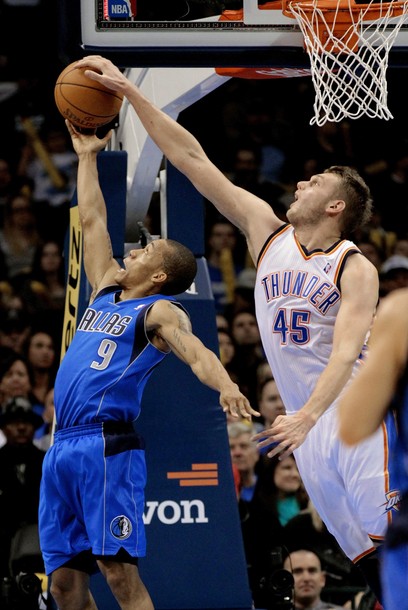
After spending last season shuffling between the Thunder and the Tulsa 66ers of the D-League, Aldrich was expected to continue developing into a rotational big man. When Nazr Mohammed was re-signed before the beginning of the lockout, it was an indication that the organization wanted Cole to continue to develop. In the 12 games that he has gotten in, Cole has shown a knack for causing havoc on the defensive end with his long wingspan and penchant for blocking or altering shots. On the offensive end, he has shown flashes of a nice post-up game (hooks, drop step, put back dunks), but has yet to fully assert himself and ask for the ball on the block consistently. He tends to be a bit over zealous on the defensive end and is prone to picking up fouls pretty quickly, especially on pump fakes. Aldrich shows great heart on the floor, though, constantly diving for loose balls. #FreeCole!

Expected Grade – C              Mid-Term Grade – C+


Nick Collison (Stat line: 31 GP, 20.5 mpg, 4.0 rpg, 1.3 apg, 0.3 blks, 0.5 stls, 4.5 ppg)

The No-Stats MVP. The ultimate glue guy. Collison was expected to continue being the first big man off the bench. A key cog that can be plugged in seamlessly if foul trouble or defensive lapses rear their ugly heads. Collison has not disappointed in his role. He is basically the same guy from last season with more of a willingness to unleash the soul crushing 12-15 foot jumper. A charge magnet, the 2nd unit gets their defensive identity from Collison. One of the smartest players in the league that is usually in the right place, at the right time (and not by coincidence). Future coach potential.

Expected Grade – B+               Mid-Term Grade – A-


Daequan Cook  (Stat line: 31 GP (12 GS), 19.7 mpg, 2.6 rpg, 0.3 apg, 0.3 blks, 0.5 stls, 5.6 ppg, 34% 3pt FG)

One of the wild cards coming into the season, Cook started last season in a rut that eventually led to him getting over 30 DNP-CD’s in the first half of the season. When finally given an opportunity to play, Cook became the deep threat that the Thunder had hoped for when they traded for him on draft night in 2010. Cook has continued to provide the deep threat for the Thunder this season and has also become a more integral part of the rotation, even starting 12 games in place of injured SG Thabo Sefolosha. He has improved his man on man defense and has involved himself more on the boards.

Expected Grade – C+              Mid-Term Grade – B-


Kevin Durant (Stat line: 32 GP (32 GS), 37.8 mpg, 8.2 rpg, 3.3 apg, 1.3 blks, 1.3 stls, 27.7 ppg)

A candidate for MVP coming into the season, Durant has not disappointed. While his scoring may have gone down just a tad bit, his rebounding, assists, and blocks are at career high levels. He is scoring at the most efficient rate in his career and he is starting to be relevant defensively, especially on the boards. He is learning how to get the ball in better spots and how to position himself to get better shots in crunch time. The only negative I can see in his game is the turnovers.  The athletic part of Durant is starting to mesh with the cerebral part. And that is a scary reality for the rest of the league. 

Expected Grade – A                 Mid-Term Grade – A


James Harden (Stat line: 31 GP (2 GS), 31.6 mpg, 4.1 rpg, 3.5 apg, 0.2 blks, 0.9 stls, 16.8 ppg, 37% 3pt FG)

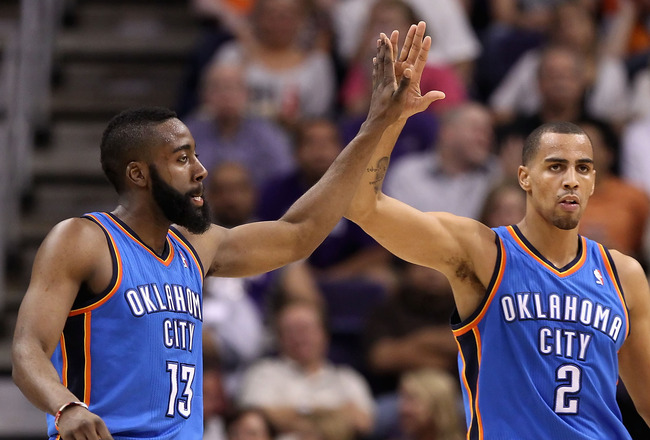
The glue that holds the “feuding” yin and yang that is Kevin Durant and Russell Westbrook together. We all know that the “feuding” part of that statement has proven to be false as this season has progressed. What started as an improvement over the 2nd half of the season last year morphed into calls for Harden to be the starting 2-guard as the new season began. Coach Scott Brooks kept Harden on the bench and he has turned into arguably the best 6th man in the league, providing instant offense off the bench, ala Jason Terry or Jamal Crawford. Along with being the unquestioned leader of the bench unit, he’s also in the game with the starters to close it out in most games. His playmaking ability and penchant for getting foul calls make Harden an offensive weapon to be marveled. While steadily improving defensively, he can still be had by good 2-guards, especially if quickness is a factor. Also, the home/road splits were an issue in the beginning of the season, but have normalized since then. Hopefully that doesn’t come up in the playoffs.

Expected Grade – B+               Mid-Term Grade – B+


James Harden’s Beard (Stat line: No stats can measure the greatness)

Seriously, this needed its own section. We’ve seen this thing grow from when Harden first joined the Thunder in June 2009. It started off so small and has blossomed into something so much greater. Olympic gods now bow in the presence of the Beard.

Expected Grade – A+              Mid-Term Grade – Infinity on a 4 point scale


Lazar Hayward (Stat line: 12 GP, 5.9 mpg, 0.9 rpg, 0.2 apg, 1.5 ppg)

Haywardwas obtained in a deal with the Timberwolves before the season. Hayward’s presence on the team is more as a practice player than as a regular rotation player. I believe, the bigger bodied Hayward has allowed Durant to simulate what its like to go against a stronger defender and to see what works against these types of defenders and what doesn’t. In his time on the floor,Hayward has shown to be a good transition player. He needs to be more consistent with his shot, especially from the 3-point line. Defensively, Hayward is an average defender.

Expected Grade – C                 Mid-Term Grade – C-


Serge Ibaka (Stat line: 32 GP (32 GS), 7.7 rpg, 0.5 apg, 3.3 blks, 0.5 stls, 8.3 ppg)

Just like James Harden (and Kevin Durant and Russell Westbrook before them), Ibaka was expected to make the big 3rd year leap that we’ve seen from developing Thunder players. At the beginning of the season though, Ibaka seemed a bit out of sync. He wasn’t as aggressive and was settling for jumpers, instead of trying to do his damage from the inside. But over the last month, we’ve seen the Ibaka that we love and that opposing teams hate. In the last 3 weeks, we’ve seen 3 double digit block games, a man’s triple double (points, boards, blocks), and a disruptive defensive force not seen since the heydays of Ben Wallace. He still leaves a lot to be desired on the offensive end of the court as an inside presence. Though he sometimes leave us salivating with Olajuwon like post moves, he still prefers the 15 footer, which he is starting to hit with more consistency lately. His penchant for going for blocks usually leaves a gaping hole in the middle for offensive rebounders.

Expected Grade – B                 Mid-Term Grade – B+


Royal Ivey (Stat line: 9 GP, 9.7 mpg, 0.7 rpg, 0.2 apg, 2.1 ppg)

Ivey’s role on the team is that of veteran point guard. He’s a defensive minded player that probably pushes Russell Westbrook and Eric Maynor in practice. When he has received playing time, Ivey has made a couple 3 pointers and played good defense. He has recently been called to duty a lot earlier in games because of some injuries to players. His defense keeps him in games, but his lack of a true identity (not really a point guard, but not very consistent with his jumper) can be a detriment if the team starts to struggle offensively.

Expected Grade – C                 Mid-Term Grade – C


Reggie Jackson (Stat line: 26 GP, 12.2 mpg, 1.1 rpg, 1.8 apg, 0.8 stls, 3.7 ppg)

My expectation for the rookie was that he would split time between the Thunder and the Tulsa 66ers of the D-League, gaining valuable experience against lesser competition in preparation to possibly be a regular rotation player next season. But with the injury to Maynor, Jackson was thrust into the rotation as the primary back up point guard. The results have been par for the course for a late first round rookie point guard. Some flashes of decent play sandwiched between lessons from the school of hard knocks. They say that experience is the best teacher, so hopefully this is a blessing in disguise for the future. But in the present, Reggie has shown that he has the athletic ability to play in this league, but is still trying to figure out the nuances of the point guard position. If he is on the floor with one of the three main ball handlers (Westbrook, Durant, or Harden), he immediately defers to them to run the offense. Also, defenses have learned to pressure the rookie into making bad decisions. With all that said, though, I like what I see in Jackson and believe this experience will help him immensely in the future.

Expected Grade – C                 Mid-Term Grade – C


Eric Maynor (Stat line: 9 GP, 15.2 mpg, 1.4 rpg, 2.4 apg, 0.6 stls, 4.2 ppg)

As a third year player, I fully expected Maynor to make that leap from okay player to good player. Already labeled by some to be the best back-up point guard in the league, Maynor’s steady hand at point made him the quarterback of one of the best bench units in the league. Like many players in this condensed season, Maynor’s play at the beginning was a bit careless, as he was averaging less assists and more turnovers. Nine games into the season though, Maynor suffered a torn ACL and was lost for the season. For all intents and purposes, Maynor’s recovery seems to be going ahead of schedule and he will be ready for training camp next season.

Expected Grade – B                 Mid-Term Grade – Inc.


Nazr Mohammed (Stat line: 31 GP (1 GS), 12.4 mpg, 3.0 rpg, 0.3 apg, 0.6 blks, 3.1 ppg)

The old man of the crew. In a room full of 20-somethings, Mohammed is the revered veteran. Mohammed’s role is that of back up center. Last season, he was invaluable as a stop gap until Kendrick Perkins came back from injury and as Perkins’s backup. There have been times this season where Mohammed has looked as spry as a spring chicken. And then there’s been blocks of game where Mohammed has literally looked like he has cement shoes on. That’s what you get with a 14 year vet. You take the good with the bad.

Expected Grade – B                 Mid-Term Grade – B-


Kendrick Perkins (Stat line: 31 GP (31 GS), 26.5 mpg, 5.9 rpg, 0.9 apg, 1.2 blks, 0.3 stls, 4.4 ppg, 10 technicals)

One of the most polarizing players on the team. Last year, Perkins was coming off major knee surgery and was slowed by bulky knee braces and the weight he put on while recovering. Vowing to come into camp more in shape, Kendrick came in 30-40 pounds lighter and shed the knee braces. But it’s been the same ol’ Perkins; a good post defender who does well against traditional centers, but gets lost if a team has an athletic and/or undersized center. Offensively, Perkins is a turnover waiting to happen. I don’t know if he lost some coordination during his recovery from surgery, but when he puts the ball on the floor, he usually loses it. When he attempts a shot, it’s usually a flat jump hook that is easily rejected. I don’t like to blast on Perkins since the Thunder’s record is so good with him in the lineup, but his biggest asset to the team is that he frees up Ibaka on the defensive end to be the NBA’s version of a roaming free safety. Another negative is the boneheaded technicals that Perkins picks up. He putting himself in a position to get suspended and miss time because of his hard-headedness.

Expected Grade – B                 Mid-Term Grade – C


Ryan Reid (Stat line: 2 GP, 5.0 mpg, 0.5 rpg, 4.0 ppg)

Every year there’s that one guy that you, as a fan, attach your heart strings to. The underdog. The runt of the litter. Ever since the Thunder drafted Reid in the 2nd round of the 2010 draft, I’ve followed his career in the D-League. I was pleasantly surprised when the Thunder offered Reid the final roster spot for this season. This organization rewards “those” types of players that work hard to pursue their dream, even if everyone else has told them they have no chance. Last season it was Robert Vaden. Next season it may be Latavious Williams or Tibor Pleiss. When Reid finally got some run on the Valentine’s Day game, I was texting my brother in law in all caps. Literally, this was my text, “RYAN REID SCORED!!!!!!!!!” Honestly, in his limited game time, he has shown a good mid-range jumper and has shown the potential to be a future glue guy.

Expected Grade – D                 Mid-Term Grade – C+


Thabo Sefolosha (Stat line: 18 GP (18 GS), 20.9 ppg, 2.7 rpg, 0.9 apg, 0.4 blks, 0.9 stls, 5.2 ppg, 48% 3-pt FG)

Another polarizing player on the team. While he is one of the best wing defenders in the league, his offensive inefficiencies can sometimes lead to the Thunder playing “a man down” on the offensive side of the court. The clamoring for a change in the starting line-up only got louder as last season’s playoffs pushed forward, and teams began corralling Durant and Westbrook. The thinking was that Harden, as a floor spreader, would allow Durant and Westbrook more room to operate on the offensive end. Hypothetically, this would seem like the correct way to go. But, as this season has shown, the value of a great wing defender should never be lost in the search for more efficient offense. The game is played on both ends of the court.  As an added bonus, Sefolosha had shown signs of being more offensively efficient this season. He had begun to drive the ball more to the basket and was shooting the 3-pointer at a 48% clip. Not that he shot that many, but of the few that he did shoot, he was making almost half of them. I still cringe when I see him lead a fast-break, though. Unfortunately though, Sefolosha has been battling foot issues and has been limited this season and is expected to miss one more month.

Expected Grade – B-               Mid-Term Grade – B+


Russell Westbrook (Stat line: 32 GP (32 GS), 4.8 rpg, 5.5 apg, 1.9 stls, 23.4 ppg)

Probably the most polarizing player on the Thunder. Last season, ironically, Westbrook’s 3rd, he went from good player to superstar. He, along with Derrick Rose, became the new standard for point guards: hybrids that could score 25 ppg and dish out 8 assists per game, while constantly breaking down a defense and doing their damage from the paint. You knew that Durant could score and that all he needed to do was refine the finer points of his game (rebounding, playmaking, etc). But you didn’t know where the learning curve would take you with Westbrook. Because of the criticism that Westbrook was receiving in last season’s playoffs and in the off-season, and the upcoming contract extension, I didn’t know what to expect from Westbrook. In the first 2 weeks of the season, it seemed like Westbrook was in the funk of all funks. His shot wasn’t falling, his assists were down, and there were rumblings of a true feud between he and Durant. Thankfully, things seemed to turn around in the middle of January (coincidentally once Russell signed his new contract) and Russell has been playing great ever since, garnering a couple Western Conference Player of the Week awards along the way. With Derrick Rose’s injury woes this season, Russell Westbrook has taken the role of premier point guard with his driving ability and consistent mid-range jumper. He still turns the ball over way too much and doesn’t always work to involve his teammates, but what I’m seeing from Russell this season is surprising because he’s still improving at a tremendous clip.

Expected Grade – A-               Mid-Term Grade – A


Surprises:

  • It’s amazing how important a real training camp and 4+ preseason games are to players in their preparation for a season. I noticed that in many of the Thunder players’ performances. They didn’t really take off until after the 2nd week of the season, which in actuality, would be the same amount of time as training camp and preseason games in a normal regular season.


  • I kept hearing about how injuries would shape this season because of the condensed schedule. But I had no idea it would be this bad. The Thunder have never experienced many injuries in their 4 season in Oklahoma City. An ankle sprain here. A pulled hamstring there. But this season, we’ve seen Maynor go out with a torn ACL, Sefolosha miss significant time with foot issues, and other players miss 1-2 games with general soreness.


Looking ahead:

  • The schedule gets tougher from here on out. We play the Lakers 3 more times, Miami and the Clippers twice, Chicago, Philly, Dallas, and San Antonio once each, and 6 more games against division rivals. We have a 3 game East coast trip after the All-Star break and a 5 game West Coast trip close to the end of the season. Needless to say, if we stay at the top the Western Conference, we would have definitely earned it.


  • Possible trade targets – Since the trading deadline is on March 15, I looked a possible trade targets for the Thunder and their struggles on the bench:
    1. James Anderson (Spurs)
    2. Tracy McGrady (Hawks)
    3. Stephen Jackson (Bucks)

Thunder UP!!!!!!


The Evolution of Daequan Cook

In a season where you have the best record in the league after 25 games, a lot of things have to go right as far as player development is concerned. Your young guys have to keep developing, while the veterans have to either add new wrinkles to their games or maintain the status quo from the previous season. While a big part of our success this season is due to the continued development of our young core (Kevin Durant, Russell Westbrook, James Harden, and Serge Ibaka), one of the biggest developments this season has been the evolution of Daequan Cook.

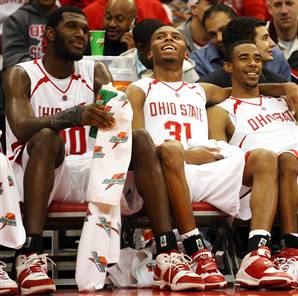
Mind you, Cook has always been a talented player. Though he was overshadowed for most of his high school career by OJ Mayo in Ohio, he was still considered a great player in his own right, and was a highly touted prospect that landed in Ohio State’s vaunted 2006 recruiting class, which also included Greg Oden and Mike Conley. For his one and only college season, he averaged just under 10 points per game as the Buckeye’s main outside threat on a team that made it all the way to the national championship game.

Coming off his freshman season, many thought Cook needed another year of seasoning at the college level to continue building his game. Instead, he chose to go the NBA route with his freshman brethren Conley and Oden. Here are some of the online scouting reports that were written about Cook:

Matthew Mauer of www.thedraftreview.com wrote:

“Unlike many young players he possesses an excellent mid-range game. Moves well without the ball, and understands how to fully utilize the entire floor to get his shot off. Has an NBA ready body that has shown development from his senior year of high school. Explosive scorer who can reel off big points in a hurry…Possesses legit three point range on his jumper. Unselfish and shows solid court vision to get teammates involved in the offense. Is a good athlete who contributes on the boards nightly. Has the ball handling ability and quick first step to break his man down on drives. Excellent finisher in transition and can end plays in dramatic fashion. Has a tremendous amount of confidence in his ability, rarely does he get rattled by the moment. Has all the physical gifts needed to emerge as a defensive presence…Defensively Cook has a habit of gambling too much and being impatient This exposes him to pick up quick fouls by reaching in or defending his man too aggressively”

Joseph Treutlein of www.draftexpress.com wrote:

“Cook already can score the ball at an NBA level, and with the trend towards undersized shooting guards of late, he has a very good chance to make significant contributions for a team in his future. The most notable thing about his scoring ability is how he can hit a shot with a hand in his face and how he’s so strong and able to hit shots nearly effortlessly from long range, as easy as he does from 10-15 feet out…In terms of things Cook brings to the table other than scoring, he’s not really going to wow you in any other area just yet…Cook did a solid job on the defensive end, but at 6’4, he’ll be at a bit of a disadvantage at the next level, even with his good physical tools.”

From the scouting reports, it appeared that Cook was going to be a good offensive player with the ability to develop other facets of his game (i.e. defense and playmaking).

After being chosen with the 21st pick in the 2007 NBA draft by the Philadelphia 76ers, and then promptly traded to the Miami Heat, Cook showed great promise in his rookie season. He averaged 8.8 points on 33% shooting from the 3 point line, but gave little else in the form of rebounds, playmaking, or defense. In his second season, he increased his scoring average to 9.1 points per game, but saw a decrease in every other major category.  On a positive note, though, he won the 3-point shooting contest at the All-Star game. In his 3rd season, nagging injuries and a falling out of favor with his coach led to Daequan playing in the least amount of games in his professional career and saw his scoring average dip to 5 points per game. After being an integral member of the Heat’s young core, Daequan’s position on the team could best be summed up by blogger Albert Random of www.heathoops.com :

Daequan Cook: No surprise here. He’s playing at a D-League level yet he’s set to make $2.2 million next season, after Riley inexplicably picked up his option. He is shooting 29% from the field, and 29% from beyond the arc. Need I say more? The hope is that he turns things around, because he will be on the Heat roster in 2010/11. Grade: F” 

With the impending free-agent frenzy of the summer of 2010, the Heat positioned themselves into being able to offer 3 max contracts to the likes of Dwayne Wade, Lebron James, Carlos Boozer, Amare Stoudemire, or Chris Bosh. In one of their final cost cutting moves, they traded Daequan Cook and their No. 18 pick to Oklahoma City for the Thunder’s second round pick (No.32).

Daequan was allotted a new start on a young, up and coming team. Not too different from the situation he was in while playing for Miami. He came in as a necessary sharp shooter, but had to find his spot in the rotation on a playoff team that returned its entire rotational roster from the previous season. Daequan was kind of force-fed into the rotation in the first 8 games of the season, and the results looked a lot like the 2nd half of the previous season with Miami. He struggled, averaging 1.9 points per game while shooting just 19% from the 3-point line. But the coup de grace was in what else he provided…which was basically nothing. He gave the Thunder 5 boards, 3 assists, and 2 steals TOTAL in those 8 games. Not to mention he had a -7 differential in those early season games.

Scott Brooks did what any good coach with a struggling young player would do. He sat him down and told him to earn his spot in the rotation through his performance and effort in practice. In coachspeak, that basically means, “Everyone struggles offensively in the NBA at some point. It’s what you can provide other than the scoring that can keep you on the floor.” If you are a one trick pony who isn’t performing your one trick, while giving little else, the NBA machine will chew you up and spit you out pretty quickly. Some players crumble under this pressure and are never to be heard from again in NBA circles.

Daequan decided to put in work. He could’ve cried and complained to his agent that he wanted out of Oklahoma City. Instead, he sat for 36 of the next 37 games honing his craft in practice and adapting to the Thunder way. Daequan had always been a good offensive player with the “potential” to become a good all-around player. When he finally got his opportunity to perform in late December, he relished that opportunity and played with effort every night. He notched a couple double-digit scoring games and became an integral part of the rotation as a sharp-shooter and floor spacer. But the important thing was that he was invested on the defensive side of the floor and gave effort in the other facets of the game (rebounding, making smart plays). Did he have overly impressive numbers? No, but he impressed with his effort as the season played out.

In the offseason, Daequan re-upped with the Thunder for 2 years. His role on the team would remain the same, but, hopefully, without the whole transition period. He has not disappointed in this early season run, providing 3 point shooting at a 41% clip, while being solid defensively and a great help on the defensive glass. In the past 5 games, he has started for the injured Thabo Sefolosha, and has averaged 9.2 points, 4 rebounds, and 1.2 blocks on 46% shooting from the 3-point line. This has provided a stop-gap to keep James Harden on the bench where he is much more effective coming in with the second unit. The Thunder are 4-1 in these past 5 games.

 Every championship team has a guy or two like this; specialists that perform a specific job. It necessitates that a role player perform one act greatly. Usually that is all the player is asked to do. But if that one player can also provide other things to the team other than his skill, then he becomes an invaluable asset. And that is what Daequan Cook has become to the Thunder. “All Dae, Er’r Dae!”

The Anatomy of a Dunk

Dunks happen every day on the basketball court. There’s a 10 foot rim and a lot of tall men. So there are going to be many instances within the flow of the game where these tall men jump up and push the ball through the cylindrical rim. It’s the easiest shot on the court. Most of the time there is no one in the way between the dunker and the rim. But sometimes, in that special moment, you get a situation where the dunker is challenged by someone to prevent them from pushing the ball through the rim. If the dunker succeeds, then he is awarded two points.

But every once and a while, a dunk happens that completely shatters any modicum of normalcy. It adds a blast of color to a black and white slate. It’s a series of actions that in that instant, completely empowers the dunker, while absolutely emasculating the victim. Everybody who attempts to block a dunk knows there’s a chance they might get dunked on. But, in these instances, the psychological impact that is expounded on the victim is so much, that they lose themselves for a little and forget what its like to be themselves.

There have always been 2 elements to every play in basketball. You have the scorer and the defender. But when this type of play happens, you have to encapsulate all the reactions from everyone on the floor, in the arena, and in the viewing audience to get of complete understanding of what exactly took place. The anatomy of the dunk encompasses so much more than the two players involved in the play. You have the reactions from the teammates of the dunker and from the teammates of the victim. You have the reaction of the fans in the stadium. And then you have the reaction of the opposing fans.

These dunk usually become synonymous with a point in time. It could become someone’s seminal play as their career begins to ascend.  It could be the decisive play in a playoff series that completely changes the outlay of that series. When a play like this happen, fans remember them. If the moment has future ramifications, people remember it even more.

Off the top of my head, I can only remember about 5 core-rattling dunks in my life.

In chronologic order:

  1. 1)      1991 Playoffs – Michael Jordan over Patrick Ewing
  2. 2)      2000 Olympics – Vince Carter over Frederick Weis
  3. 3)      2007 Playoffs – Baron Davis over Andrei Kirilenko
  4. 4)      November 2010 – Blake Griffin over Timofey Mozgov
  5. 5)      January 2012 – Blake Griffin over Kendrick Perkins

1991 NBA Playoffs –Chicago Bulls vs.New York Knicks

This is Michael Jordan at the height of his popularity. Tongue wagging, wearing the Number 5’s. Defending his first title. And here were these “bully on the block” upstarts from New York causing trouble and trying to build their own dynasty. They had their enforcer by the name of Patrick Ewing who patroled the paint and protected the rim. When these two forces met, it would change the course of this series and possibly the course of these two players’ careers.

The first thing you notice is the sick spin cycle move that Jordan puts on Charles Oakley and John Starks. I’m going this way, then, NOPE!, I’m going back towards the basket. Next thing I notice is the great screen by Horace Grant. One common theme in these dunks is that the victim is either screened or late in getting to the dunker. As the dunk is coming, you see Jordan and Ewing contiuously rising. But at one point, that bitch named Gravity takes a hold of Ewing, and he starts coming back down to Earth, while MJ is still rising. Then….BAAAAAMMMM!!!!!! And-1.

The Bulls bench doesn’t really react that greatly. Either they got to see that all the time (it being Jordan and all) or they were just tired of constantly cheering for the greatest ever. Just ask the Vice President whether his hands and glutes get a workout every State of the Union Address, having the get up and clap every 5th word. Hubert Davis, of the Knicks, reacted like his children just got eaten by wolves. Horace Grant decided that the shoes weren’t making him “like Mike” so he decided to slap the butt of Mike. And poor Patrick Ewing decided to shove an invisible man.

You love when these dunks happen on the road. You have that, “OOOOOOOOOO” sound from they crowd where they love the play, but feel bad that it was their guy that got posterized. Nowhere better for that to happen than in Madison Square Garden.

2000 Olympics – United States vs. France

Everyone knows the knock on Vince Carter. Great player who had to tools to be an all-time great player. But, he never played with the necessary determination to be one of the greats. He was okay with just being good. But for one summer, he became a beast. He literally took on the attitude that he was not going to be fucked with. He became the shooting guard version of Kevin Garnett. And then he got a steal in the open court against France with only 7’2″ Frederick Weis between him and the basket. James Bond, Jack Bauer, and Jason Bourne together couldn’t have fixed this international incident.

First off Frederick, you’re 7’2″. If you’re going to be in a poster, at least attempt to block the shot. The whole, “I’m going to stand here and take a charge” thing doesn’t really work out too well when the guy in front of you just won the NBA Slam Dunk competition in resounding fashion 6 months earlier. Read the scouting reports Weis! Secondly, other than the time they interviewed him after winning a title, this is the only other time I’ve ever seen KG not know what the hell to do with himself. Its almost like he said to himself, “I’ve got to match Vince’s intensity, so I’m going to chest bump-push him and show him my war face. Then I’m going to mean-mug the already wounded Frederic Weis.” It was classic KG. Thirdly, look at Vince’s face after the dunk. And then go look any picture of the rap group Onyx (especially Sticky Fingaz) and tell me Vince wouldn’t have been a perfect 4th member at that time. “SLAAAAMMMM! Duuh Duuh Duh Duuh Duuh Duuh Let the boys be boys!!!!” And lastly I love the reaction by French guard Laurent Sciarra. He was literally scared for his life and trying his hardest not to get into Vince’s bubble of unkempt rage. The man doesn’t even want to make eye contact with Carter.

As for the fans, they loved it. International fans love when Americans abuse them. They may not say it out loud, but there’s a reason they come out to see the best in the world. As you can tell in the video, even the French announcers love it.

Side note:  I think Vince Carter is the modern day Samson. When he grows his hair out, he becomes one of the best basketball players on the planet. But when he shaves it, he becomes just a good to great player. Who’s his Delilah?

2007 NBA Playoffs – Utah Jazz vs Golden State Warriors

After upsetting League MVP Dirk Nowitzki and the No. 1 seeded Dallas Mavericks in the first round, the Golden State Warriors were riding on cloud-9 heading into their 2nd round matchup with the Utah Jazz. The Bay Area was buzzing with Warriors fever and ORACLE Arena was a house of horror for visitors. After losing the first two games of the series in Utah in close fashion,  the Warriors returned home for their turn in this tango. The house was rocking with the Warrior faithful wearing their golden “We Believe” t-shirts. The Dub’s were up by 20 with 3 minutes to go and looking to put this puppy away. A jump shot or lay-up would have sufficed, but a self esteem-shattering dunk is just what The City ordered.

First thing I notice about this dunk is the crowd. As a season ticket holder for the Oklahoma City Thunder, I can honestly say that this crowd, and the one in Portland, are the only crowds that can compete against OKC’s. Good job Dub’s fans. Secondly, as Baron rises up for the dunk, it almost seems like his body and Kirilenko’s body become one. Almost like Baron is South America and Andrei is Africa and they are finally joined once again. Then the dunk happens and all hell breaks loose. Baron shows us that when he cares, he has a flat belly. And the fan at 0:30 seconds finally has an orgasm for the first time in his life. And Mikeal Pietrus does the internation sign for, “I need a wave cap”. And Matt Barnes walks away and shows some fans what his head would look like with a faux-hawk. And Dick Bavetta shows us how he seduced Charles Barkley. It honestly looked like a club that Stefon talks about on one of his SNL skits (You gotta be an SNL fan to get this one).

I love the reaction that the teammates of the victim have. They usually look away from both parties. They don’t want to feed into the fire that burns in the now powerful dunker. But they don’t want to completely deflate their brethren by letting them know they just saw that. Either way, its comedic gold at its finest.

November 2010 – New York Knicks vs. Los Angeles Clippers

We know this won’t last. In a couple season, the post game will develop and the knees will start to hurt a little bit from all the jumping. Once the game develops, the need to jump over people will cease to exist, as the player will play both with his mind and with his body. But until then, hot damn this guy can dunk!!!!!!! He was already on the map, but this one put one of those bold, capital stars next to his name. He was not only on the map; he was to be recognized now.

My first thought, after discussing the Baron Davis dunk, is why do Americans hate Russians? They have beautiful women who become spies, and they make Vodka. What more can you ask for? All kidding aside, whether this was a dunk or not is irrelevant. He gets high enough to just throw the ball into the hoop from a parallel angle. He supplied the arc of the ball, instead of releasing it and letting gravity determine the arc of the ball. Funniest thing about this is the reaction from the ref near the Knick’s bench. He did a pelvic thrust that a porn star would be proud of. Another reaction that teammates of the victim have is that they just stand in place and hardly move. And that’s exactly what Amare Stoudemire, Wilson Chandler, and Landry Fields did. The Knick’s bench actually did a pretty good job of containing the basketball fan within them. All except Kelenna Azubuike, who was inactive, but still had a Tourette Syndrome moment next to Ronny Turiaf.

It can’t be forgotten that Timofey Mozgov actually added fuel to his own fire. When Griffin’s weight was on him, Mozgov pushed him off and in the process, propelled Griffin even higher into the stratosphere to make it look even more impressive. Elevator going up. You know you’ve arrived for all the wrong reasons when you last name is synonymous with being climbed over and dunked on.

One thing I am extremely disappointed in is the crowd’s reaction. I don’t know if they didn’t realize what happened, or didn’t look up from their smart phones in time to see the play, but the react from the crowd is pathetic. You will see this play in the pantheons of great dunks and 95% of you fools are still sitting down. Shame on you Clippers fans. You surely won’t get a chance to redeem yourself from this one…..

January 2012 – Oklahoma City Thunder vs. Los Angeles Clippers

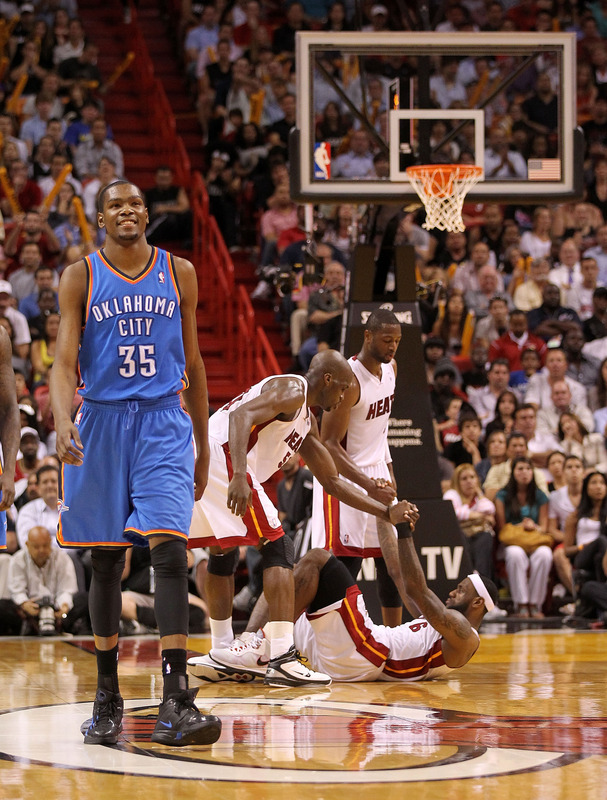
Oooops, spoke entirely too soon. In the NBA, with the greatest players in the world, you are bound to see great dunks night in and night out. I know I can’t forget Kirk Snyder’s dunk over Von Wafer in which he leaped over him Vince Carter-style. I saw it live and still count it as one of my all time favorite plays. But some players feast on doing this all the time. Names that come to mind are Dominique Wilkins, Jordan, Carter, Kobe Bryant, Lebron James, and Griffin. And sadly, it happened to my team, against my starting center.

As you can tell, I’ve been thinking about this dunk a lot. It was the prompt that made me start writing this article. It was almost identical to the Mozgov dunk, in that Griffin when up against a defender that pushed him up instead of over. I must say that this dunk was a bit more impressive though. Griffin actually reaches the rim, albeit with only a couple fingers.

But what I found completely interesting was Perkins’ reaction. In most plays, Perk will either be jacking his jaw at the refs or at his teammates or at the opponent. Or he’ll be putting on that Perkins Scowl. After this play, NOTHING. Just a face that says, “I admit defeat in this battle, but the war still continues.” As a big man, you’re destined to get dunked on from time to time. But you don’t expect to get posterized.

As far as the atmosphere, good job by the Thunder bench to not ever react at all to the dunk. I don’t know whether they say Griffin assault Perkins or whether they say paint dry. Way to at least support your man, Thunder bench. The Thunder that were on the floor did the customary “don’t look at the two involved in the play and don’t hardly move from where you’re at” bit. But, I do have to give props to the Clippers fans. They did what you are supposed to do after a great play. They stood up and applauded and acted a little bit happy. Baby steps, I guess.

B-ball Analogy – Russell Westbrook : point guards as Lebron James : small forwards

After watching Russell Westbrook’s recent performances this season, I can’t help but think that Russell Westbrook is the Lebron James of NBA point guards. The things that separate Lebron from everyone else are his skill set, size, strength, and freakish athletic ability. Some of these qualities are taught, while others are innate. These tools have given James the opportunity to earn 2 MVPs and twice lead his team to the NBA Finals. 

First off, comparing Russell to Lebron is not necessarily apples to oranges, but it is not what I’m intending to do here. While a one on one game between the two would be entertaining, I’m sure Lebron’s size and strength advantage would trump Russell’s athleticism and quickness. It is after all, basketball, where the player who is closest to the rim (taller) has the advantage most of the time. But, can the same things that give Lebron advantages, be the things that give Russell that extra edge and hopefully lead him to be one of the greats? 

3 S’s: Size, Strength, and Speed 

Individually, each of these characteristics can lead a player to have an advantage over another player. But if you possess an advantage in all 3 of these categories, the battle is already halfway won. That’s the thing about Lebron James. His size (6’8”) makes him above average for the small forward position. His speed can be matched by only a couple players at his position. But his strength is what completely makes him a match-up nightmare for the opposing player and defense. But when you put all 3 to work against the opponent, this is where Lebron overwhelms the opposition. 

Russell Westbrook is basically upper middle class when it comes to size in the point guard class. In looking at all the starting point guards in the league, the average height is about 6’3”, with Tyreke Evans being the tallest at 6’6” and Jameer Nelson and DJ Augustine/Kemba Walker coming in at about 5’11 ¾”. Russell is about 6’3 ½”. Nothing is going to overly separate him in this category. 

One of Russell’s main advantages is his strength. Only about 3 or 4 other point guards can compete with Westbrook in regards to strength. The factor that makes Russell different is in how his muscles distribute themselves on his body. The best comparison I can make is to Alfonso Soriano, the 2nd baseman who played for the New York Yankees, Washington Nationals, Chicago Cubs, and Texas Rangers this past decade. From 2002 to 2008, Soriano averaged 35.5 homeruns per season, a run unheard of for a 2nd baseman. What’s amazing about this run is in how Soriano’s musculature appears on his body. Soriano is all of 6’1” and 190 lbs. So a hulking Paul Bunyan he is not. Instead, Soriano has a wiry frame that packs muscle in an elongated fashion, instead of stacking muscle on muscle. This type of musculature is good for power and … 

Speed. In that same time frame, Soriano also averaged 29 stolen bases, which is pretty good for any baseball player that doesn’t necessarily specialize in speed, a la a pinch runner or lead off hitter. So, where Tyreke Evans and Deron Williams are bigger and stronger than Russell, his advantage at speed neutralizes that deficiency. Just ask Derek Fisher, one of the stronger, yet slower point guards in the NBA. 

Like James, Russell’s combination of these 3 characteristics (the 3 S’s) make him a load to handle for most point guards on a nightly basis. Knowing that you have these attributes leads to a person having….

 Freakish athletic ability 

The combination of the 3 S’s above, leads to having freakish athletic ability. Anybody who has high qualifications in the 3 S’s, is going to manifest itself in having this kind of athletic ability. The legendary, mythological stories of Lebron James grabbing a not so great lob with his hand nearly at the top of the square on the backboard and being so far above the rim that he couldn’t dunk it, but instead had to let it drop from above the rim are that of internet lore. Of course it happened in practice. Of course there were no cameras around. And of course, some teammates confirmed it. But, based on his athleticism, its something that we can consider possible. With Russell, it’s sort of the same way, but we get to see some of these things live in an NBA game. The dunk over Lamar Odom in their first playoff run against the Lakers in 2010. The lob that Earl Watson threw off the backboard, and Russell grabbed with one hand and dunked while skying over a Warriors player (we see you Marco Bellinelli). The facial he gave the Rockets last season. All tales of a book that is currently being written. 

Defensive ability 

The freakish athleticism also shows up on the defensive end of the floor if a player wants to work hard enough to show it. The same things that overwhelm defenders on the offensive side of the court, are also the things than can overwhelm an opponent on the defensive side of the court. Lebron is an average man defender, but a great help defender, getting into the passing lanes for steals, and coming up with self-esteem rattling blocks from the weak side or from behind. This is the only part of Russell’s game that leaves you longing a little. He was touted as a defensive guard coming out of college, but has only been an average defender in his young NBA career. But ask any of the international guards that he defended during the World Championships whether he can defend, and I’m sure you’ll get a resounding “YES” in whatever language they speak. 

Russell has the ability to be one of the better defenders in the league. The question is, does he want to be? He has shown more signs of being a shutdown defender this year. The aggressiveness that we saw in the World Championships is being shown more this season and that has led to a better defensive game plan from Russell. But that also leads to him gambling more and putting the rest of his team in 5 on 4 situations whenever his gambles don’t work. Through film-study, coaching, and experience, this part of his game can be fixed. The fact that he actually wants to be a better defensive player is the first step in becoming a better defender.    

Skill-set 

This may be the biggest difference between Lebron and Russell. While Lebron was your prototypical prodigy and came into the NBA with a deep skill-set, Russell had to learn a position that was not natural to him. And he had to learn it at the highest level of competition, night in and night out. So while Lebron has just had to refine and improve his skill set, Russell has had to constantly add more and more skills to his repertoire based on the learning curve. Organic growth at this level is very rarely seen from the point guard position. Yeah, you can have players learn a skill here or there, but to have a player go from where Russell was his rookie year to where he is now, is very rarely seen in professional sports. And this is what leads to the biggest difference between Lebron and Russell….. 

Will 

The will to constantly want to learn and get better is something that I think separates these two players. Russell’s meteoric rise is a manifestation of the hours of practice he has put in since his first day of minicamp in 2008. Great players usually take off in their 3rd season. This happened to Kevin Durant, Kobe Bryant, Dirk Nowitzki, Michael Jordan, etc. It’s the time when the game slows down for the player and their instincts begin to take over. All the stuff that Russell has learned and practiced these past 3 ½ years (refining his jump shot, knowing when to attack and when to pull up, learning how to run a team) are finally coming to fruition. Is he still a work in progress? Of course. What he showed in the first 2 weeks of the season, is where the learning comes into play. But what we’ve seen the last two weeks is the player that is destined for greatness. 

I don’t think Lebron has this will. Yes, he has all the talent in the world. But he basically came to the league a finished product. He just had to constantly get better at what he already knew he could do. He just now added a post-up game to his arsenal, and he’s 8 years into his career. With Russell, we don’t know what the ceiling is. We don’t know how far up he can go. Can he be a 25 points, 8 assists, 7 rebounds per game player? Based on his career arc so far, I wouldn’t put it past the realm of possibility. 

Closing ability 

Another thing that separates these two players is their mind-sets at the end of games. While Russell may make mistakes late in games, they are usually an effect of him needing to do something within the scope of the offense. When 3/5th of the offense is stagnant, and the main offensive weapon (Durant) is being heavily guarded, the only option is for Russell to somehow get off a shot. This is what leads to the bad shots and charge calls in close games. But the fact that he is willing to take these shots (and make some of them) shows a willingness to shine in pressure situations that is severely lacking in James’ game. As seen in last season’s Finals, when the pressure got hot, James usually deferred to Dwayne Wade and Chris Bosh. Russell seems to be learning what needs to get done to close games. Whether its hitting a couple 20 footers, getting the ball to the hot hand, grabbing the necessary rebound, driving the lane for a deuce, or, most importantly, hitting free throws consistently, he has been one of the main, if not the main, component in us winning close games. 

For all of his faults, Russell has always been a player that has wanted to improve in order to prove his detractors wrong. It’s what makes that cauldron of heat inside of him boil. It’s the reason he asks “Why not?”, instead of “Why?”.  It is because of this passion, that the Oklahoma City Thunder signed him to a max extension for the full 5 years. With this extension, the Thunder now have 2 of the top 15 players in the league signed for the next 5 seasons. So instead of comparing one player to the next, maybe it would be more apropos to compare the Thunder to what would seemingly be one of their main competitor should they win the West….the Miami Heat. But, hopefully, I’ll save that article for sometime in June.

Just A Game

Its funny how life sometimes put things into perspective. A dear friend of mines passed away on Wednesday. Someone that I can proudly say was like a 3rd grandfather to my kids. His wife was my kids’ main caregiver before they started school. And while this gentleman was at work most of the time his wife was running the home daycare, there were those days where he was home from work and would help out with the daily chores of running a home daycare. The kids even had their own nickname for him, just like a regular grandfather. Not only that, but his daughter and my wife were best friends in junior high and high school. In addition, he was also one of my co-workers for about 2 years. Needless to say, there was a bit of history between our family and theirs.

So when the Oklahoma City Thunder lost to the lowly Washington Wizards, it didn’t quite register as large a blip as it normally would have on my radar screen. I was still disappointed, don’t get me wrong. Title contenders aren’t supposed to be losing to teams that have a great shot at obtaining the No. 1 pick in the next draft. But at the moment, in that time, a loss to the team with the league’s worst record wasn’t really that important.

Honestly, in the context of an entire season, one loss isn’t really that important if you are either an elite team or a bottom of the barrel team. Barring injuries, I don’t think we will be struggling to hold our post as a home court advantage team in the Western Conference. History is sprinkled with examples of eventual champs getting surprised by that one go-getter team that is galvanized by their home crowd into playing out of their minds and winning that one crazy game. I call it the “Loser’s Game 7” effect. Washington will only have a couple of these games this season: OKC, Miami on February 10th and April 26th, Chicago on January 30th, the Lakers on March 7th, and the Clippers on February 4th. Bad teams don’t get hyped to play other bad teams. The Milwaukee Bucks don’t have their visit to New Orleans circled on any game schedule. Bad teams love being the hunters, if only for that one game.

The Thunder just happened to fall into the lions den on the wrong night. They started off good, but you could tell from the beginning they were playing a bit too loose with the ball. You give any team enough opportunities, and they’ll eventually start to cash in on those. And that’s what the Wizards did. They eventually started to feel good about themselves and started hitting shots, contested and open. They started to look like the team their fans imagined them to be. And for that one night, everything fell into place. The questionable blocking call was called a charge. The FT’s started falling. Hell, the 3 pointers started falling. In the end, the Wiz got one of their biggest wins of the entire season.

And it still doesn’t worry me that much. We are still a young team that is prone to hiccups at times, especially against lesser competition. We still had an opportunity at the end of the game to either tie it or win it outright. I just hope this serves as a lesson to the Thunder. When you are the hunted, you are usually getting the best from each team for the full 48 minutes. That’s something that still may be new to this young Thunder team. Elite teams lose sometimes, no matter who the other team is. The difference, is that they take each loss and use it as a lesson to be learned. And that’s what I’m sure Scott Brooks is doing right now.

As for me, I still did manage to watch the game last night on DVR. In the midst of pain, basketball is my refuge. Always has been. So with that said, I bid adieu to my friend, Hector Carreras. A good father, husband, soldier, pseudo-grandfather to my kids, and human being. An avid ping pong player, I guess the angel that used to play against God wasn’t cutting it anymore. So God had to call in his replacement. Rest In Peace, dear friend.

On the Road Again

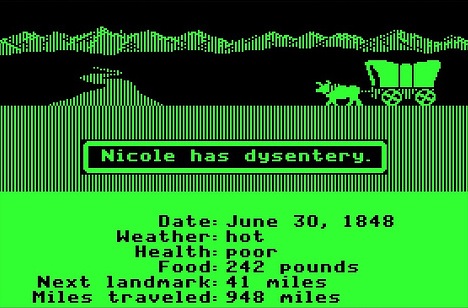
I’m a child of the late 80’s / early 90’s. It was during that time that I was in elementary school learning, as most of the world was, about computers. And, of course, the best way to learn is to interactively play games that also teach you about the subject matter. My favorite games to play on those old floppy-disc induced Apple computers was Oregon Trail. If you, either, don’t remember, or were too young to know what a floppy disc was, it was a story-based game of a journey through the Oregon Trail. You are the wagon leader of a party of settlers going from Independence, Missouri to Oregon’s Willamette Valley over the Oregon Trail in an oxen-drawn wagon. Along the trail, you have to make decisions concerning food and directions to survive the trail. You and your fellow settlers can die from a range of maladies from drowning to snake bites to dysentery. Needless to say, it is a game about the difficulties of being on the road.


Many teams in this young strike shortened season are probably looking at their road records and wondering whether the entire team is suffering from a bout of cholera. Of the 30 teams in the NBA, only 6 have a winning record on the road. While most teams struggle on the road in any given season, shortened or not, the upper echelon teams usually buck that trend and win wherever they play. Such has not been the case this season. 

  • The Southwest-leading San Antonio Spurs have an 8-4 record overall, but are an awful 0-4 on the road.
  •  The Pacific-leading Los Angeles Lakers are also 8-4 overall, but carry a 1-3 road record. 
  • The veteran Boston Celtics, a team that is supposed to know how to play on the road, is 1-3 in its games away from Massachusetts.

 Winning on the road usually involves a balanced combination of veteran leadership, youthful legs, good defense, and good bench play. It should come as no surprise that the 6 teams with winning road records have some semblance of each of those 4 characteristics needed to be a good road team.Oklahoma City (5-1), Chicago (7-2),  Miami(5-2), Orlando(4-2), and Indianapolis and Atlanta(both at 4-3) are all defensive minded teams with a nice mix of vets and youth, and good to great benches.

  •  5 of the 6 winning road teams are in the top 10 for point differential. 
  • 4 of the 6 winning road teams are in the top 10 for opponent’s PPG. 
  • 5 of the 6 winning road teams are in the top 10 for opponent’s FG%. 
  • Oklahoma City and Chicago have 2 of the best benches in the league.


 While it is still early in the season, trends like these don’t tend to change too much throughout the course of the season. We are already at least 1/6th of the way through the season (unless you are the Los Angeles Clippers). At this point, most teams are Denny Green (“They are who we thought they were!”). In the playoffs, you have to know how to win on the road. So take a good look at the 6 teams with winning road records. More than likely 2 of those teams will end up playing in the Finals.


End of a Rivalry

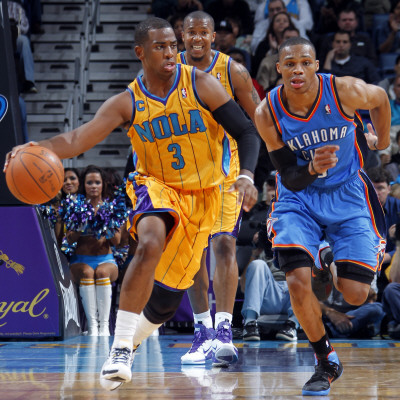
As the Oklahoma City Thunder set up for their game tonight against the New Orleans Hornets, I’m reminded that this is the first Hornets team completely absolved of any of its Oklahoma City history. What started as a response to an SOS from the league after one of the country’s worst national disasters has evolved into a love affair with a team that was formally from the Pacific Northwest. Who would have ever thought that the actions put forth from the response to Hurricane Katrina would have impacted 3 cities and 2 NBA franchises?

They say you never forget your first love. For someone who never thought he’d see a professional team in his home state, the arrival of the New Orleans Hornets was one of the best days of my life. I got on the phone as soon as I heard the news and was calling everywhere trying to find out where I could purchase season tickets. Novemeber 1st, 2005, was one of the most surreal days of my life. I was sitting there watching a regular season NBA game in Oklahoma City, with a team that was partially known as the OKC somethings. Needless to say, the New Orleans Hornets quickly became Oklahoma City’s first love when it came to professional sports.

We got to see the infancy of a point god, as we hosted Chris Paul during his rookie of the year campaign. We got to see the progression of David West from disappointing young player to “on the brink” All Star. We got to see JR Smith go from young, budding star to knucklehead. We saw game winners! We got to live the NBA experience. In return, Oklahoma City got showered with praise that it had never seen in such a positive light. We had been previously showered with praise before, namely in April 1995 and May 1999, but those were in response to tragedies that happened on our soil. But this was the national media heaping praise on us for our support of this nomadic franchise, and we started to kind of like it.

But alas, we knew it probably wouldn’t last. After that first season, there were inklings of hope among the populace that the Hornets may actually stay in Oklahoma City. And they did….for one more season. In hindsight, that was just foolish thinking from someone being in love. In the back of our minds, we knew that the NBA would never abandon New Orleans in its darkest hour. The NBA wanted to be there to celebrate New Orleans’s greatest triumph. But it still hurt when they officially returned back to the N.O. after the 2006-2007 season.

Fast-forward to the beginning of the 2008-2009 season. Through all the waiting and legal proceedings, the Seattle Supersonics became the Oklahoma City Thunder. OKC finally had its team and were revving up with Thunder fever. But most of us still had a very soft spot for our first love, the New Orleans Hornets. It was very apparent to me during the first Thunder game, when the ref signaled that a loose ball belonged to us and the PA announcers asked, “Who’s ball is it??????” That was the most difficult question I’ve ever had to answer in my life. My mind kept saying, “Remember to say Thunder ball, not Hornets ball!”.

Then the moment that we had been waiting for happened. On November 21st, 2008, OKC’s old team went up against OKC’s new team in OKC. It was like watching your ex-girlfriend fighting against your current wife. You want your current wife to win, but you don’t want her to slaughter your ex. We applauded when they introduced CP3, David West, Tyson Chandler, and even, Peja. Then they went out there and kicked our ass. They kicked it so bad that the coach was fired after the game.

Of course, the roles have reversed a bit as of late. The Thunder are one of the top teams in the league, and the Hornets have been on the brink of a rebuild for awhile, now. February 2nd, 2011 was the last time OKC got to experience the love-struck rivalry that was OKC vs. New Orleans. The last two remaining members of the OKC Hornets team were Chris Paul and David West. After suffering an ACL tear, David West never received an extension from New Orleans, and instead, chose to sign with the Indianapolis Pacers. Chris Paul went on to be traded to the Clippers in a blockbuster deal that transformed to junior varsity Clippers into Lob City.

So when the two teams meet up tonight, it will just be another game for me. I knew the day would come where the Thunder would face a Hornets team that had no connections to OKC at all. I just never thought it would get here so quickly. But such is the revolving door of NBA rosters. The only relic that still remains on the New Orleans team from its time in OKC is a HoneyBee by the name of Christina (pictured above). Other than that, its just another game in January. It has truly been a short, but strange ride.

Be Careful What You Wish For…


In late February of last season, when the Oklahoma City Thunder first acquired Kendrick Perkins, one of the biggest changes occurred on the offensive end of the floor. The lanes that were once open with the spacing provided by the perimeter games of Nenad Krstic and Jeff Green were no longer there. In its place, those lanes were replaced by “box and 1” defenses with defenders hedging off of Perkins and Thabo Sefolosha. 

Mainly used for his defense, Sefolosha’s inability to consistently hit jumpers limited the first team’s offensive production. The opposing shooting guard, usually one of the better ball hawks on the floor, was able to play off of Sefolosha and help defend throughout the floor, whether it was doubling down on Kevin Durant or Russell Westbrook, or plugging up an open lane in the interior. In addition, the team replaced one of the better shooting centers in the league with one of the more offensively-challenged centers in the league. Perkins does all of his work in the interior. While he may step out and try a 15 footer from time to time, his best play is no more than 5 feet from the basket. Krstic’s biggest offensive impact wasn’t necessarily his shooting; instead, it was in keeping the opposing center away from the basket. Also, Serge Ibaka’s midrange game had yet to develop any type of consistency. In essence, the team seemed like it was playing 2 on 5 on the offensive end with this line-up most of the time. 

This had the biggest effect on the play of point guard Russell Westbrook, whose game is predicated on using those lanes to drive to the basket. Westbrook’s stat line for the regular season remained consistent at 22 ppg on 44% FG shooting to along with 8.2 assists. But when the game slowed down as it usually does in the playoffs, his scoring increased to 23.8 ppg, but it was on 39% FG shooting to go along with 6.2 assists and 4.6 turnovers per game. Westbrook became less efficient in the playoffs and the offense, as a whole, became less efficient because of this. It was during these playoffs that the glaring need for a spacer became very evident. 

Once the season ended, the consensus was that the next step in the evolution of this team was to replace Sefolosha with 6th man James Harden in the starting 5. Harden was a much better shooter and creator than Sefolosha, which would’ve added another dimension to the starting 5. No longer would the wing defender be able to help by hedging off of Sefolosha, as Harden’s ability to consistently hit 3’s would negate this. This would’ve opened at least one extra lane for Durant and Westbrook to drive through. Add this to Ibaka’s improving midrange game, and this should have brought the offense back to where it was pre-trade, with good spacing and perimeter options. Seemed simple enough.

 But the devil’s advocate to this move has always been to ask where the bench scoring was going to come from once Harden was lifted off the bench. Every great team has at least one player from the bench that is able to take over when the bench unit is in there. The Mavs had Jason Terry and JJ Barea. The Lakers had Lamar Odom and Shannon Brown. The Spurs had Manu Ginobili. The Bulls had BJ Armstrong (first 3-peat) and Toni Kukoc (second 3-peat). And who could forget the Bad Boy Pistons and Vinnie “The Microwave” Johnson. Due to the Thunder’s great durability and good luck, we’ve never had to see what the second unit would look like without James Harden for an extended period of time. 

The Thunder’s bench unit has been a well-oiled machine for the past 2 seasons. With point guard Eric Maynor running the show, Harden doing the scoring, Daequan Cook providing spacing, and forward Nick Collison providing the muscle, the Thunder bench has been one of the most efficient in the league during that time. This season, the bench averaged 39 points per game in the first 5 games, with Harden doing the most damage at 16 ppg. Where the starting line-up falters, the bench usually picks up. 

Then the last two games happened. With Sefolosha dealing with a sore foot and flu-like symptoms and Cook also dealing with flu-like symptoms, the Thunder’s usual 10 man rotation was shortened to 8, with rookie Reggie Jackson and second year player Lazar Hayward filling in the missing pieces. With Harden in the starting line-up for the second half of the Dallas Mavericks game and starting outright in the Portland Trailblazers game, Thunder fans got a glimpse of what life would be like with Harden in the starting lineup. 

In the second half of the Mavericks game, the trio of Durant, Harden, and Westbrook scored a combined 31 points with 3 assists while trying to come back from a second half deficit. The rest of the team scored 9 points in the second half with only 5 coming from one bench player (Maynor). In thePortlandgame, the trio combined for 64 points and 16 assists, but struggled from the field, shooting only 40% from the floor combined. The bench, on the hand, had only 14 points on 6/17 shooting. 

While the trio figure themselves out, the bench is left to fend for itself without a valid scorer on tap. This is where an acquisition like Jamal Crawford, Vince Carter, or Tracy McGrady could’ve come in handy. While I like what I see from the future starting line-up, I also think the team is incomplete without a scorer off the bench. Which leads me to the weirdest thing I’ve said this young year: Damn, I miss Thabo Sefolosha.

Coming of Age

Many things usually happen when a man goes from his 20’s to his 30’s. It’s a time where the rambunctiousness of his 20’s starts to turn into the maturity of his 30’s. It’s a time when a man’s professional career usually starts to stabilize and take off. It’s also a time when a man either starts to think about settling down or starts to appreciate what he already has. This has a lot of bearing on me because I just recently started my 4th decade (which means I just turned 30). While I won’t bore you with where I’m at in my life at this point, I do think it’s a good comparison for a young team that is facing mounting expectations. 

There’s a point during this transition that I call the point of no return. While in your 20’s you can still mingle with those younger than you and still get away with it. It is not uncommon to see a +/- of age difference in a dance club of 8-10 years. So while the younger crowd may be in the 18-21 range, the older crowd will be in the 26-31 range. Once you start going past that, the dynamic starts to get a little weird and creepy, and sometimes, just plain sad. It’s a point where you’re too old to go back. You can try, but it probably won’t work out that well for you. 

This is the point where the Oklahoma City Thunder find themselves this year. A man in his 20’s is expected to fail as he finds his way through life. Failed relationships here. A job firing or two there. Its all part of the plan to find what really fits that person. But, if this constantly occurs to a man in his 30’s, then he is viewed as a disappointment. The run that the Thunder are currently on have seen them go from 23 to 50 to 55 wins all within a span of 3 seasons. But since we’re talking about a shortened season, let’s look at winning percentages: .280, .610, and .671. In order to achieve that final percentage, we’d have to get at least 45 wins in this 66 game season. Any regression at this point will be viewed upon as a disappointment, as we have now reached the point where at least a .600 winning percentage is expected. 

The Thunder’s young players now have to shoulder a lot more responsibility. It’s one thing to surprise everyone by going from 23 wins to 50 wins, and say that you expected to win every game. It’s a completely different ball game to be expected to win every game that you play from here on out. You literally go from attacking the target to being the target. The burden of proof lies in many of the young teams over the years that have faltered when they were expected to make that giant leap from playoff contender to championship contender. The most recent one, the New Orleans Hornets, went from taking the Spurs to 7 games in a Western Conference semi-finals matchup in 2008 to complete team dismantling in 2011. 

The leaders of the team are both 23 years of age. Responsibility is usually not something valued by most 23 year olds. But as we’ve seen throughout the last two seasons, these two are cut from a different cloth. Don’t be fooled by the number next to their ages. In terms of experience, they are about as young as a 25 year old sergeant that is serving his 3rd tour of duty in a warzone. One is a humble assassin, while the other is a fiery pit-bull. The unique thing is at certain points in a game, these two descriptions can be used for both players. It’s a thin line to walk when competition breeds results, and these two competitors set the baseline for the team to produce from. While very young, the qualities that these two exhibit will only help this team’s resolve as the expectations get heavier and heavier. 

The acquisition of Kendrick Perkins not only supplied a need on the court, but also in the locker room. The lack of accountability on the defensive end that permeated on the floor since the departure of assistant coach Ron Adams was quickly addressed when Perkins stepped into that locker room. This was a risky move by the organization that proved that they too were looking to shoulder more responsibility and take chances. 

The spotlight can be a double edged sword. Whenever HDTV’s started becoming more popular, there was an uptick in the plastic surgery performed on news anchors around the country. They loved being in front of the camera, but all of the sudden hated all the criticism concerning their wrinkles and unsightly blemishes. The Thunder became the darlings of the NBA at the beginning of last season. The team was coming off a successful season in which they made the playoffs for the first time and took the eventual champs to 6 games in the first round. Then their top two players led the B-Team to gold at the World Championships. They were given national games and the spotlight. But with that, came the constant scrutiny from the media about the relationship between Kevin Durant and Russell Westbrook. While the team exceeded their success from the previous season, there was an undercurrent of concern surrounding the relationship between their two star players. Both claimed there was nothing to be concerned about, but that has all been said before by divorced dynamic duos throughout NBA history. 

As we tear through this first week of the young NBA season, a word of caution as we head into this crazy season. No one knows exactly what lies ahead. Players that were around during the last lockout are like relics in a museum. While they may hold much wisdom, their usability is not nearly as plentiful. The Thunder are about as intact as any team out there from last season. They were not “humpty-dumpty’ed” like many other teams this offseason. The result has been a 3-0 start and a 1st place holding in the Western Conference. Funny, that I turned 30 a week ago and the Thunder are 3-0 a week later. While I’m not entirely set in my life, I can honestly say that I’m progressing at a reasonable rate and will enjoy this next decade of life. Hopefully the Thunder will join me on this ride.

In the Midst of Chaos

Here’s a hypothetical scenario: Let’s just assume you and every one of your 29 friends is married. You guys would always talk and hang out, but were kept apart by some controlling power (let’s say the wives) for about 5 months. Now, you and the guys are allowed to hang out again. But to spice things up, let’s say the wives felt bad and decided to all chip in and get each and everyone of you a week together in Miami and an MHP (Marital Hall Pass). Now, you know some of your friends would immediately use their MHP. But the question that needs to be asked is whether you, in the midst of all this chaos, would go against the very fiber of ethics and virtue that you’ve stood by for the past half decade because you were given permission to? 

This is the scenario and question I would pose to Sam Presti. We know that Presti was the honor role student at the San Antonio Model Academy. We’ve seen and read the book on how to do it. Develop a culture, build a great core, get good contributing players, and the rest will fall into place. It has worked in San Antonio and Utah for the better part of two decades. And it is beginning to work in Oklahoma City. The Thunder have developed a culture of community and hard work. They have a great core in Durant, Westbrook, Harden, and Ibaka. And they have good contributing players in Perkins, Sefolosha, Collison, and Maynor. But there is one thing that is missing from the equation that was always promised to us once we started our march to the promised land. 

In December 2008, while in the middle of the one of the worst beginnings to any NBA season, the question was always brought up about who would want to come to play in Oklahoma City. The answers ranged from sad to comical (redemption projects to Mark Price). The one answer that always intrigued me, though, was veterans wanting to win a ring. In the middle of a 3-29 start, the last thing you are thinking about is contending for titles. But now that we’ve knocked on championship’s doorstep, shouldn’t this be the next logical step in our player development? 

Leading up to opening of the free agency period, there was word that the Thunder had interest in obtaining Shane Battier. A veteran who would have been a great compliment to Kevin Durant off the bench and a good source of wisdom for our young team. Someone who was defensive minded and would fit seamlessly into the culture of the team. Even Kevin Durant wondered what Battier would look like in a Thunder uniform via his Twitter account. Instead, as the courting came down to the final days, the Thunder were not a part of the list of teams that Battier was looking at. He ended up signing with Miami for what is rumored to be 3 years / $9 million. Now, I wouldn’t have given him 3 years, but I would have given him $3.5 million per for 2 seasons. Don’t quote me on this and I hope I’m wrong, but I could see Battier hitting a big 3 against us in the Finals sometime in the next few seasons.

 Then there was the Chauncey Billups waiver wire Ebay auction. When the New York Knicks decided to amnesty Billups, all the non-tax paying teams had the opportunity to put in a bid for Mr. Big Shot’s services. It was rumored that OKC put in a bid, but like any skilled Ebay bidder, the Clippers came in at the last minute and offered $100 K more than any other team. Again, I could see Billups hitting a big shot against us in our probable first round match with the Clippers come May.

 Vince Carter was on the market after being waived by the Phoenix Suns. Carter always kills the Thunder. In 6 games over the past three seasons, Carter has averaged 22.8 points, 4.8 rebounds, and 2.3 assists on 20/45 shooting from 3 point land. Can you imagine if he were able to supply half of that to the Thunder off the bench? It would’ve made the transition to Harden starting a lot more smoother. Instead he signed with the team we faced in the Western Conference Finals last season.  

Presti is probably a better man than me. His patience reminds of the Chuck Norris quote, “He doesn’t sleep, he waits.” Presti has always tried to put himself in a position of power when dealing with any other team. He’ll take advantage of your mistakes while minimizing his. But at this point in the game, with us at the doorstep of becoming championship caliber, isn’t it time to take that risk on a veteran? 

Young players make mistakes in crunch time, especially in the playoffs. And while young players eventually (hopefully) learn from their mistakes, the time it takes to get there can be fraught with disappointment and frustration. A veteran player can be that bridge that helps guide a young team through rough seas. While we already have a few veterans on the roster (Mohammed, Collison, and Perkins), signing a free agent for the purpose of them wanting to compete for a championship makes it that much more important for the young guys. How many times have we heard, “We just want to win one for (Player X) who has never won a championship.” 

As a fan, you know that the window of success can close on your team as quickly as it opens. A tweak of the knee here, a bruised ego there, and the entire dynamic of the team changes overnight. When we experience success, we want to continue experiencing that feeling. It’s the reason why men think of sex 19 times an hour; its our epitome of success. I don’t necessarily want to see a big splash (i.e. paying Jamal Crawford $20 million for 2 seasons). But something to help the team in the immediate future, especially off the bench. 

I understand Presti has to look at the today AND the tomorrow, especially with us being a small market team. But myself, as John Q. Fan, just saw 3 of our biggest competitors get a piece that will probably make them better in the short term and am seeing a few of our other competitors making moves to obtain great players. In a time where we are financially sound, why not take a risk and use your MHP on something safe. It could make the difference in May and June.