All posts by Alex Roig

Unknown's avatar

About Alex Roig

Never been a writer. Probably will never be a writer. But always a fan.

Thunder Draft Options: Trade Partners

westbrook chandler
Layne Murdoch-NBAE/Getty

The Oklahoma City Thunder own the 21st pick in the upcoming 2017 NBA Draft, which is due to take place on June 22nd. Players selected with that pick usually aren’t viewed upon as franchise changers. If a team hits on a star with the 21st pick, then good on their scouting department. For the most part, though, teams picking in this range are looking for cheap role players to fill out their roster.

But the thing about the draft is it’s not just about the players getting drafted. More than any other sport, the NBA draft turns into a sort of swap meet where teams wheel and deal on players and assets in an attempt to set themselves up for the future. For teams who may not have the clout to be aggressive during free agency, the draft presents a different avenue to better their team. Continue reading Thunder Draft Options: Trade Partners

Thunder sign Semaj Christon

christon

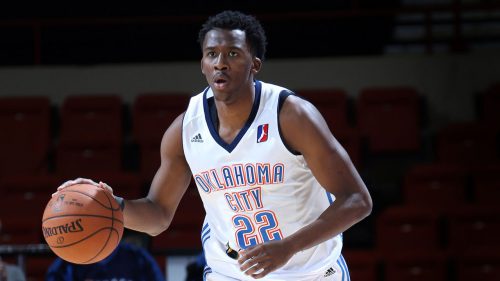
On Saturday, the Oklahoma City Thunder signed guard Semaj Christon. The 2014 2nd rounder played last season with Consultinvest VL Pesaro of Lega Basket Serie A, the top professional league in Italy. While there, he averaged 14.3 points, 3.7 assists, 3.3 rebounds, and 1.6 steals in 33.2 minutes of playing time. Previous to that, he spent his first two professional seasons with the Thunder’s D-League affiliate, the Blue. In addition, he has also been a member of the Thunder’s summer league team the last three seasons.

The 6’3″ point guard out of Xavier has shown a penchant for getting into the lane and causing havoc once he gets there. His sturdy frame and long arms allow him to finish in traffic, while his floor game allows him to find teammates for higher percentage shots. His jumper, while not the best, has improved over the past 3 seasons to the point where he has a pretty solid mid-range game.

With the signing of Ronnie Price earlier this offseason, the Thunder’s roster currently sits at 15 guaranteed contracts, with 3 of those contracts belonging to point guards (Russell Westbrook, Cameron Payne, and Price). So why did the Thunder sign Christon, if their roster is already at max capacity with contracts and points guards? The reasoning for that could be two-fold. Number one, the Thunder don’t appear to be done wheeling and dealing. The roster, as it currently stands, is a weird mixture of bruising big men, offensively challenged wings, and athletic guards who aren’t great at shooting. They have a sizable expiring contract in Ersan Ilyasova, and a young big they may be ready to move on from in Mitch McGary. If the right deal comes along, they could also feature Payne, who could net something substantial from a point guard starved team.

The second reason for signing Christon is to play the long game with him. While his contract can’t be guaranteed because of the Thunder’s 15 other commitments, there could be guaranteed money attached to it if he gets waived before the season starts. Then the Thunder could sign Christon to the Blue and see how the season plays out in terms of roster moves. If the trade deadline leaves the Thunder with an open roster spot, you can almost guarantee that spot will go to Christon. Another issue that is clouding the water in terms of Christon’s future is whether Price’s 2nd year is fully guaranteed.

If anything, the Thunder have secured themselves another weapon to throw at guard happy teams, while maintaining roster flexibility. Christon’s strength and wing-span could make him an asset on the defensive end of the floor, similar to what the Thunder saw from Dion Waiters in the playoffs last season. And while Christon’s offensive repertoire may not necessarily be what the Thunder need, it’s not like he’s offensively challenged. In the end, his contract is not currently guaranteed, and the Thunder have time to see how everything plays out in these next two months before the season starts.

Oklahoma City Thunder acquire Randy Foye from the Denver Nuggets

foye

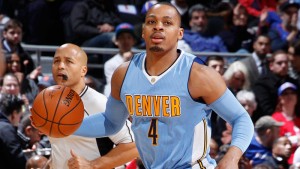
The Oklahoma City Thunder acquired Randy Foye from the Denver Nuggets on the trade deadline. The Thunder gave up DJ Augustin, Steve Novak, and both of their 2016 2nd round picks (theirs and Charlotte’s, which was acquired in the Jeremy Lamb trade this past offseason). In Foye, the Thunder get a combo guard who is a good (not great) defender and someone who can knock down open shots. This season, Foye is averaging 6 points and 2.1 assists in nearly 20 minutes of action per game. He is shooting only 29.6% from deep, but has shot 37% from that distance over his career. He shoots much better when he is wide open. He rarely got that opportunity in Denver, but will get a lot more looks in Oklahoma City with attention grabbers like Kevin Durant and Russell Westbrook on the floor.

The Thunder’s M.O. is usually to have three point guards on the roster. Foye is a good enough ball-handler to be a 3rd string point guard, while also being a good enough shooter to be a spacer off the bench. He will help the bench unit defensively and will add another ball-handler to that line-up. But his biggest value may be as a go-between for Cameron Payne as he gains experience in this, his rookie season. Payne has performed well this season, but when the lights were brightest (the Warriors game) he looked wide-eyed and shaky. Which is exactly what you’d expect from a rookie. The Thunder trust Payne, but if the stage gets too big for him come April, Foye is the perfect back-up plan to bridge the gap between this season and next season.

Many people will pan this trade, but I thought it was a good play by the Thunder. Augustin and Novak were out of the rotation and on expiring deals. Instead of just sitting on that, the Thunder decided to get a player that could possibly have an impact in the near future who was also on an expiring deal. In addition, the move generated a $3.75 million dollar traded player exception (TPE) and opened up a valuable roster spot for the Thunder.

That roster spot could be used on a buyout candidate later in the season. Names that have been thrown out as buy-0ut candidates are Kevin Martin, Joe Johnson, Lance Stephenson, and Andrea Bargnani. Players that won’t necessarily take over a starting spot, but could play a role for a playoff team.

In addition to the roster spot, the move also shaves off over $8 million dollars from the Thunder luxury tax bill. There was never going to be a move that brought the Thunder above the tax line. But any move that could lessen the blow a bit was always welcomed.

In the end, the Thunder felt they were good enough to stand where they currently were. The addition of Foye could prove to be the type of move that helps them against a Golden State in the postseason or it could just be a lateral move where the Thunder traded away two end of the bench players for another end of the bench player. Either way, what the Thunder received outside of Foye (the roster spot, the TPE, the smaller tax bill) could have bigger ramifications for the Thunder moving forward.

2016 Oklahoma City Thunder Trade Prospectus

dj augustin thunder

With a couple days left before the trading deadline, the Oklahoma City Thunder sit with the third best record in the NBA, and are 1 of 3 teams with at least 40 wins at the All-Star break. That would usually be great for most years. But this season, the two teams with better records than the Thunder are 1) in the same conference and 2) on historic win paces. Any move the Thunder make during the trade deadline will be with these two teams in mind.

As currently constructed, the Thunder are better equipped to deal with the San Antonio Spurs than the Golden State Warriors. They match up well position for position, and have the athleticism to give the Spurs problems. The Warriors on the other hand, present a different set of problems for the Thunder. Their penchant for scoring from the outside has baffled every team in the league. The Thunder have a habit of letting teams beat them from the outside, but for some reason, they have defended the Warriors reasonably well over the past two seasons.

When it comes to trades, its always about what a team needs and what a team is willing to offer. The Thunder were extremely busy before and during the trade deadline last season, acquiring Dion Waiters, Enes Kanter, Steve Novak, DJ Augustin, and Kyle Singler. All five players are still on the roster this season, with Kanter and Singler signing multiyear extensions in the offseason. In addition to the players the Thunder gave up to acquire that quintet, they also gave up two first round picks in the process. Those first rounders are lottery protected and likely will be honored within the next three years if the Thunder can keep their core together. With all that said, here’s a look at a couple of the assets the Thunder have in tow.

Assets

1. Serge Ibaka

Trading Ibaka this season is highly unlikely. He’s the third cog in the Thunder’s Big 3 and has been there from the beginning of the run. But while Kevin Durant and Russell Westbrook  have expanded their games to become two of the best players in the league, Ibaka, for all his tools, has never been able to consistently put it all together. Be it the low basketball IQ or the fact that Ibaka may not be as young as his counterparts, the time for Ibaka on the Thunder may be numbered. While he hasn’t necessarily been injury-prone throughout his career, he does appear to be slowing down. His rebound and block numbers are the lowest they’ve been since his rookie season. His overall FG% is under 50% for the 2nd straight season, after starting off his first 5 seasons above the median line.

In addition, three factors are working against Ibaka remaining in the current position he is in after this season. First, the style of play in the current NBA has negated the need for a shot blocker. Remember when the Lakers, Celtics, Magic, and Spurs were the class of the NBA in the late 2000’s and early 2010’s? It was all because of the big man position. Andrew Bynum, Pau Gasol, Dwight Howard, Kevin Garnett, and Tim Duncan were all extremely influential in their teams’ runs to the Finals during that period in time. The Thunder, trying to get to that position of power, decided to trade Jeff Green and Nenad Krstic to the Celtics for Kendrick Perkins. Not only did the trade give the Thunder a defensive post player, but it also opened the door for Ibaka to become the premier shot-blocker in the league. Well, those days are gone. The pace and space NBA has basically eliminated the need for a premier post defender. Elite wing defenders are where the money is now.

Secondly, in keeping with the fact that the NBA is changing, so too have positions changed. The traditional view of power forwards and centers no longer works in this new NBA. In its stead, successful teams are now starting to trot out bigger small forwards to play the power forward position. What a team may lose on the block, it may gain on the offensive end with more 3’s and transition buckets. Kevin Durant began his career as an oversized two guard, but eventually settled into his more natural position of small forward when Scott Brooks became the Thunder’s head coach. Through the years, the natural progression of an athlete’s body has allowed Durant to get a little bit thicker as he has aged. That increase in weight has allowed Durant to not only play in the post more as an offensive player, but also to better defend post players on the other end of the floor. Shifting Durant to PF permanently wouldn’t be that big of a jump for the Thunder. He’s already leading the team in rebounding and is second on the team in blocks per game at 1.2.

Thirdly, Steven Adams has become the prototypical post player for this new NBA. Someone who is athletic enough to patrol the entire paint, but also strong enough to play the enforcer role. He’s younger and more mobile than Ibaka, and he comes at a much cheaper price, for now. That’s where the decision will come into play after this season. Adams still has one more year left on his rookie deal after this season, but the Thunder have first dibs on an extension after this season. Adams will likely command a salary upwards of $12 million. Ibaka comes up for free agency the same year Westbrook does. If the Thunder are able to keep both Durant and Westbrook, they’ll be no way they can also keep Ibaka and Adams.

Again, I’m not saying it’ll happen this season. But Ibaka’s $12.25 million dollar salary may be useful if a jackpot deal pops up. And if that deals becomes availalbe, the team may think long and hard about trading Air Congo.

2. Expiring Contracts (DJ Augustin and Steve Novak)

The Thunder have a couple expiring contracts that may come into play during the trade deadline. DJ Augustin and Steve Novak are both on the final year of their deals, while Dion Waiters is on the final guaranteed year of his rookie contract. If Waiters is traded, the team he is traded to will have the right to match any offer Waiters is given in the offseason. But Waiters plays a big role on the Thunder as a multifaceted guard and will likely remain in that role throughout the season.

The Thunder are in a bit of a precarious situation with Augustin. His $3 million dollar salary may be useful in a trade, but the Thunder have to make sure they get a veteran point guard either via trade or as a buy-out signee. If the Thunder trade Augustin without getting another another veteran point guard, they risk heading into the postseason with rookie Cameron Payne as their only other option behind Russell Westbrook. While Payne has been good, the Warriors’ game showed that the postseason lights could a little too bright at this moment for the first year player out of little Murray State. The Thunder may just keep Augustin around as the veteran third string point guard.

Novak, on the other hand, is almost guaranteed to be moved by the deadline. His $3.75 million dollar contract is big enough to fetch a player of value for the Thunder. But also, the Thunder may just trade him to a team that needs salary in order to have an empty roster spot for a buy-out candidate, such as Joe Johnson or Kevin Martin.

3. Mitch McGary

The second year big man showed a lot of promise in the offseason and preseason. But a concussion in the preseason kept him out of the final week of practice heading into the season opener, and he has yet to find his footing in the rotation this season. McGary may be the Thunder’s most attractive asset as a young big on a cheap rookie scale contract. But that may also be the reason the Thunder keep him.

4. Multiple 2nd rounders and trade exceptions

This year, the Thunder have their own 2nd rounder and, likely, Charlotte’s 2nd rounder, which is protected for picks 56-60. In addition, the Thunder still have their 2nd round pick for 2017 and Memphis’ 2nd rounder for that year also (protected 31-35, unprotected in 2018). Second round picks are good filler for trades involving players that bring little to nothing to the table. For example, if the Thunder trade Steve Novak to the Trailblazers as a salary dump, then attaching a 2nd round pick will probably make it worth the Blazer’s while to take on Novak’s salary for the last 2 months of the season.

In addition to the 2nd round picks, the Thunder also have two trade exceptions. The Jeremy Lamb trade exception is worth $2.13 million and the Luke Ridnour trade exception is worth $2.85 million. While those amounts are relatively small, if a team is looking to unload one of their younger players without taking on salary, a trade exception may be the way to go.

5.  Alex Abrines

The Thunder own the rights to the 22 year old Spanish guard who is currently averaging 8 points per game on 41% shooting from 3-point territory for one of the premier teams in Europe, FC Barcelona. He is signed through 2019, but has a buyout clause. He lacks the athleticism to be a regular rotation player in the NBA, but would be a good addition as a 3-point specialist (a la Anthony Morrow) for a team that may need perimeter scoring in the future.

For as good as the Thunder have been this season, they still have holes that can be filled to further contend with the top teams in the league. Here’s a look at some of the areas of the need the Thunder could possibly fill.

Targets

1. 3 and D player

In this new NBA, the premier role player is that of a 3 and D wing. The Thunder have about 4 players in their rotation that masquerade as 3-and-D wings. The only problem is that those that are good at 3-point shooting (Anthony Morrow) struggle on defense, and those that excel at defense (Andre Roberson and Kyle Singler) struggle at consistently hitting their perimeter shots. The only player on the roster that qualifies as a viable 3-and-D wing is Dion Waiters, and he is great at neither.

Keeping up with the Warriors and Spurs of the league necessitates a team to have players that can be effective on both ends of the floor. The two players most commonly associated with the Thunder for this position are PJ Tucker of the Phoenix Suns and Courtney Lee of the Memphis Grizzlies. Both players are in the $5.5 million dollar range and could be had for an expiring and either McGary or Josh Huestis.

Some other surprising candidates may be Mirza Teletovic of the Phoenix Suns ($5.5 million) and Ben McLemore ($3.16 million) of the Sacramento Kings. Thunder GM Sam Presti has a habit of running misdirection plays where everyone in the media thinks he’s going one way, but he ends up going an entirely different direction (think last year with the Brook Lopez/Enes Kanter trade deadline happenings). While Teletovic is a bit too big to be a wing, he does bring the “3” part of the equation with him. He would allow the Thunder to stay big, while going small (Teletovic at 3, KD at 4, and Serge/Adams/Kanter at 5). McLemore would fall in line as a Presti reclamation project. The third year guard has never lived up to his No. 7 draft selection and has seemingly fallen out of favor in Sacramento. He came into the league as a player that could possibly be a good 3-and-D wing. Unfortunately, he has been inconsistent on both ends of the floor. McLemore could be a good replacement for Waiters if he bolts for greener pastures in the offseason.

Another name to watch out for is Victor Oladipo of the Orlando Magic. This one would probably require Serge Ibaka to move the needle enough for Orlando to make that trade. This one is likely not to occur this season.

2. Veteran Back-up Point Guard

If the Thunder plan to use DJ Augustin’s expiring contract in any of their trades, they would also need to obtain a veteran back-up point guard to buffer any of the inexperience Cam Payne would bring to the playoffs. A couple options are Michael Carter-Williams of the Milwaukee Bucks and Darren Collison of the Sacramento Kings. Carter-Williams is a big point guard that is a triple-double threat every time he steps on the floor. But his inconsistent jumper and being turnover prone continue to affect his play on the court. In addition, there are rumors that MCW isn’t really the easiest guy to get along with in the locker room. These are probably all reasons why the former Rookie of the Year could possibly end up on his third team in three years.

Darren Collison has been one of the best back-up point guards in the league. If Sacramento is indeed having a fire sale and looking to build for next season, then Collison may be one of the players that could be had from them. Unfortunately for the Thunder, he has another year left on his contract after this one. The Thunder really like Payne and getting Collison could stunt his development into next season.

3. Empty Roster Spot/Lower Tax Bill

The Thunder may eschew taking on another player in favor of just trading one or both of their expiring contracts in a salary dump to open up roster spots. Empty roster spots can be very valuable during this time of year. The buy-out market begins once the trading deadline has passed. Players like Joe Johnson, Kevin Martin, and Andrea Bargnani are a few of the names mentioned that will likely be bought out after the trade deadline. While none of those players would likely be a regular rotation player for the Thunder, they could be great in a specialist role off the bench. In addition, the Thunder have a couple players on their D-League team that could have some value to the Thunder. JP Tokoto has been good as a wing for the Blue, averaging 12.4 points, 4.8 rebounds, and 2.2 assists per game. Tomislav Zubcic, who was a late addition to the Blue roster from his native Croatia, has been averaging 8 points on 42.6% shooting from deep this season.

In addition, the Thunder currently sit about $12.4 million dollars over the luxury tax line. It’s a given they will pay the tax for a second straight season. But being that much over would mean the Thunder would have to pay out about $22 million. If they can lower their bill, it would be that much less the Thunder  has to pay out to the rest of the teams that aren’t over the luxury tax.

While the Thunder don’t seem to have the assets to do something big, if they feel this is the right time to pull the trigger on something, they may do it. Durant’s upcoming free agency and the fact that the Thunder are in the thick of things as far as contention goes, may sway them to do something outside the ordinary. As is the case usually with the trade deadline, all everyone is waiting for is for the first domino to fall.

Live from Thunder media day…

OKC media day

I was given the great opportunity by VAVEL to attend the opening media day for the Oklahoma City Thunder on Monday. It was a brand new experience for myself, but one that I thoroughly enjoyed. I was able to see some of the players take their official pictures that will be used as signature fodder for the rest of the season. And I was able to sit in on all the player and coach interviews. I got to finally meet Royce Young, ESPN NBA writer and founder of DailyThunder.com. Royce is someone who I’ve admired throughout the years and someone who’s work I great respect. I got to meet Chuck Chaney, founder of ThunderObsessed.com. He and I have always had a great relationship on Twitter, and it was good to finally meet him in person. I met some of my Latino brethren through the Telemundo affiliate in Oklahoma City. Most importantly though, after four years of having this website, I finally got to be a part of the media.

I will now be writing mainly for VAVEL.com. You may see some personal content on here, but I’ll mainly be on VAVEL. They have given me a great opportunity to be a managing editor for their Thunder page, and it is an opportunity that I could not pass up. I will still keep the website updated and you will still be able to see all of my work, which will be linked through VAVEL.

Here is my transcript of the different player interviews:

Media Day

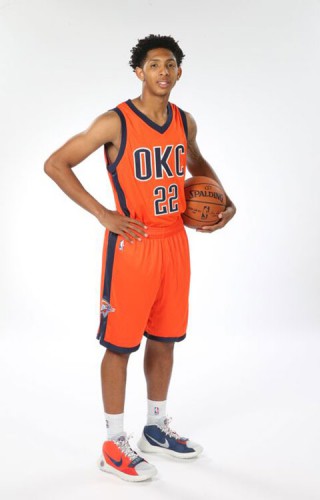
The Oklahoma City Thunder debut their new orange alternates

westbrook collison durant ibaka orange alternates

For years, Oklahoma City Thunder fans have been clamoring for an alternate uniform that featured more than a blue palette. Maybe something with a bright color to it, or an artistic rendition to the Thunder shield, or a play on the Oklahoma City moniker (OKC). Instead, they have been treated to alternates that have been bland and a bit too safe. The purpose of an alternate jersey is to feature something that is different than the original.

The Thunder’s home uniforms have always been there best. The classic blue lettering with the orange trim lends itself very nicely to most color schemes (jeans, khakis, etc) and looks very good on HD TV screens. The away blue jersey have a classic coloring to them, but the 12 white letters on the front of the jersey (OKLAHOMA CITY) are a bit much in terms of style.

Three years ago the Thunder debuted their first alternate jersey. The navy blue jersey looked retro in nature with the team name written down right side. The jersey had mixed reactions, with many liking the simplicity of the jersey, while also criticizing that simplicity for being too safe for the franchise’s first alternate jersey.

Last season, the Thunder introduced their shirt-jersey (“shirsey”). Used exclusively at home, the shirt-jersey finally made use of the OKC moniker, placing it in front of the Thunder shield. The shirt-jersey borrows from the classic-ness of the home whites, but suffers from the fact that it’s a shirt-jersey.

cameron payne thunder

Throughout the summer, there have been rumors of an orange alternate in the brewing for the Thunder. Uniform hawks began doing their sleuthing and discovered possible rendering of the orange alternates. Finally, three days before training camp began for the Thunder, the team and players started dropping clues through social media. Kyle Singler shared a photo through his Instagram account in Friday morning showing a piece of orange jersey fabric. The Thunder shared an Instagram photo showing an orange jersey with the number 0 on it. Finally, the team shared a photo through all of their medias showing Kevin Durant, Russell Westbrook, Serge Ibaka, and Nick Collison sporting the new orange alternates.

Brian Byrnes, Thunder senior vice president of Sales and Marketing, stated, “This new uniform not only features another of our primary team colors, it also reinforces the strong connection our team has to our hometown and home state.” The jersey, given the nickname “Sunset”, will have the OKC moniker written on the front in navy blue. The Thunder will debut the jersey at home on November 1ST against the Denver Nuggets, and will wear them 17 more times this upcoming season. They’ll be worn 10 times at home and 8 times on the road.

The Three That Will Never Be: The Legacies of Scott Brooks, Kendrick Perkins, and Derek Fisher

ibaka perkins durant fisher thunder

As the Oklahoma City Thunder embark on a new season, some of the same things from the past still remains. First off, Kevin Durant, Serge Ibaka, and Russell Westbrook should all be back and healthy. Secondly, the expectations of winning a championship will also be there. But for some reason this season feels different. Not a bad different, just a “lack of familiarity” type different. Something was missing, and that something was three component that had been a part of the Thunder for all or parts for their 7 seasons in Oklahoma City. Those three components were Derek Fisher, Kendrick Perkins, and Scott Brooks.

For 7 seasons prior, one or more of those pieces were always there to provide an anchor of calmness even in the most choppiest of seas. For the first time since the Thunder moved to Oklahoma City, neither of those three will be a part of the Thunder organization. From the time Scott Brooks took over for PJ Carlesimo on November 22, 2008, the organization has relied on his calming demeanor and almost fatherly-like approach to the development of the stars of the team. That approach to coaching is one of the reasons Brooks will be highly sought after once he decides to return to coaching. Teams are always in one of three phases in their developments: rebuilding, learning how to win consistently, and contending for a championship. Brooks mastered the first two phases of that process with relative ease, taking the Thunder from one of the worst teams in the league to championship contending in a four year span. That type of ascension is almost unheard of without the help of a superstar free agent being signed by the team.

What Brooks lacked in coaching acumen, he made up for with his interpersonal relationships with his players. Say what you want about his late-game play calling, but the players on the team would run through a wall for Brooks. Many in the media heap praise upon Phil Jackson for his career, but Jackson was never known as a great X’s and O’s coach. He had great assistants (Tex Winters, Jim Cleamons), and more importantly, great players. But he was also one of the best at managing superstar egos, which falls under the realm of interpersonal relationships. Brooks could have had a Jackson-like career, but lacked great assistants, and his great players were just coming into their prime during his tenure. Instead, Brooks will likely have a Doug Collins-like career as a coach that could have been one of the greats, but just happened to be the coach at the wrong time.

When the Thunder were starting their ascension, most of the upper echelon teams in the Western Conference had All-Star or near All-Star level centers and power forwards. The Los Angeles Lakers had Pau Gasol and Andrew Bynum. San Antonio had Tim Duncan and Tiago Splitter. Memphis had Marc Gasol and Zach Randolph. Dallas had Tyson Chandler, Dirk Nowitzki, and Brendan Haywood. Utah had Al Jefferson and Paul Millsap. To contend in the Western Conference at that time, a team needed a big body in the middle that could defend and rebound. In their early run, the Thunder had a front line of Nenad Krstic, Jeff Green, and an “even skinnier than he is now” Kevin Durant. They had Serge Ibaka on the bench, but he was still pretty raw during that time and had trouble keeping his fouls under control. It wasn’t until the Thunder met the Lakers in the inaugural playoff run in 2010 that they realized what they needed to continue the upward trend of the team’s development.

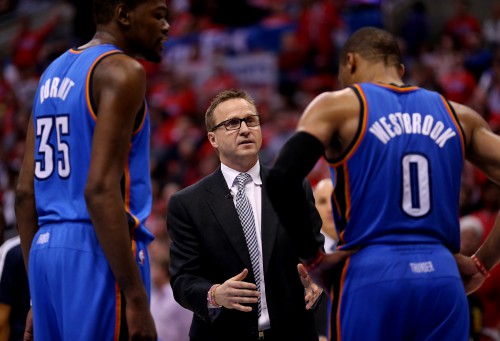
LOS ANGELES, CA - MAY 09: Head coach Scott Brooks of the Oklahoma City Thunder talks with Russell Westbrook #0 and Kevin Durant #35 against the Los Angeles Clippers in Game Three of the Western Conference Semifinals during the 2014 NBA Playoffs at Staples Center on May 9, 2014 in Los Angeles, California. The Thunder won 118-112. NOTE TO USER: User expressly acknowledges and agrees that, by downloading and or using this photograph, User is consenting to the terms and conditions of the Getty Images License Agreement. (Photo by Stephen Dunn/Getty Images)

At the trade deadline the next season, the Thunder traded Green and Krstic to the Boston Celtics for Kendrick Perkins and Nate Robinson. Even though Perkins was coming off a serious knee injury he suffered in the previous season’s Finals, he was the defensive anchor the team so badly needed. A couple weeks after arriving in Oklahoma City, the Thunder extended Perkins for four more seasons. Perkins immediately became the veteran presence the Thunder’s young players needed. He graciously helped in the development of Ibaka, taking his own experience from when Kevin Garnett took him under his wing in Boston and applying that to Ibaka. He gave the team a mean streak they didn’t have before his arrival. He quickly became the locker room buffering agent between all the Thunder’s young players as they learned how to succeed in the NBA individually and as a team (a major downfall of many young, up and coming teams in the past).

He was a great locker room presence. And if he was getting paid $5 million or less, that would have been fine. But in actuality, he was one of the highest paid players on the team and his performance on the court, especially on the offensive end, was often one of the most polarizing themes in sports. The knee injury he suffered while with the Celtics in the Finals the year before sapped the little bit of athleticism Perkins had going for him. While he was one of the best post defenders in the league, he was often a net negative on offense. As the NBA’s moved towards smaller, more skilled line-ups that could space the floor, the effectiveness of Perkins on the floor became more and more muted with each passing season.  When athletic power forwards started masquerading as centers, the need for a hulking presence down low became almost non-existant.

Compounding the polarization of Perkins was the trade of James Harden to Houston. Many thought the reason the Thunder traded Harden was purely financial, as they couldn’t afford to have 4 players on max or near max salaries (Harden, Durant, Westbrook, and Ibaka), along with Perkins’ $9 million annual salary. In addition to the trade itself, the fact the Thunder had the opportunity to waive Perkins under the amnesty provision, provided the framework for the “Thunder choosing Perkins over Harden” frame of thought that many in the media portrayed. In reality, the Harden trade had little to nothing to do with Perkins. Harden wanted to have his cake and eat it too, wanting max money and the opportunity to run his own team.

In the end, Perkins was relegated to being a back-up big in his final season with the Thunder before being traded to Utah for Enes Kanter. His tenure with the Thunder will forever be remembered for his defensive chops, menacing scowl, and “Shaq-tin a fool” moments. But his presence on the team forever shaped the maturation of Durant, Westbrook, and Ibaka. He helped navigate them through their first few seasons of success and kept them even-keeled.

The signing of a veteran is a rite of passage for a team that is moving into championship contending status. A veteran that has been where the players on the team want to be and has played a big part in previous championship games. That veteran for the Thunder was Derek Fisher. At the beginning of the lockout-shortened 2011-12 season, the Thunder lost back-up point guard Eric Maynor to a torn ACL. The only other point guard on the roster, besides Westbrook, was rookie Reggie Jackson. The Thunder managed for half a season with the rookie taking on back-up point guard duties, but when the opportunity arose to sign a waived Fisher, they pounced on the opportunity. Fisher paid almost immediate dividends as a calming, veteran presence and as a floor spacer.

Fisher went on to be part of the Thunder for the next two seasons after that one. He basically played the same role in each of the seasons as he attempted to capture that elusive 6th championship ring. Fisher never got that ring, but became, a lot like Perkins, a revered and respected figure in the locker room. A championship point guard his entire career, Fisher went on to retire and immediately became the head coach of the New York Knicks who were being run by Fisher’s former coach, Phil Jackson.

There’s a point in every player’s maturation where they eventually become the veteran. They become the guy that “has been there before” or “has seen it all before”. The Thunder brass probably felt like Durant, Westbrook, and Ibaka were ready to take the next leg of their journey on their own. They had grown under the watchful guise of Brooks, under the sturdy hand of Perkins, and under the guiding presence of Fisher to become what they are today. Sure they’ve faced some injury difficulties along the way, but those also have a way of toughening up a players’ resolve.

As fans, we always cheer for the superstars. But true fans cheer for the guys who make it despite their obvious flaws. The guys who are the bedrock over which championship sod is laid upon. There’s a sense of commonality between those players and someone who works a 9-5 and goes home everyday to a family and a mortgage. There’s a very real possibility the Thunder win a championship without any of those three guys within the organization. If that does occur, three of those championship rings better be sealed in a box and delivered to New York, NY (Fisher), Beaumont, TX (Perkins), and northern California (Brooks), because the DNA of any Thunder championship will definitely have the imprint of those three on it.

Russell Westbrook on Live! with Kelly and Michael

Russell Westbrook showed up on Live! with Kelly and Michael and talked about his injuries, his All-Star game MVP, and played some Pop-A-Shot. It was a very Westbrookian appearance in nature.

Disasters and Opportunities: How Oklahoma City got on the NBA map

hurricane katrina

Its a process that can be both beautiful and scary all at the same time. A low pressure disturbance, which is basically winds that pick up water vapor, intensifying into something so massive and deadly is why mother nature reigns supreme on the respect scale. Usually these storms run their course, while keeping their impact to a minimum on the area they impact. But every once and a while, these behemoths can impact an area so severely, that the ramifications are felt, not only years later, but also in cities outside of the affected areas.

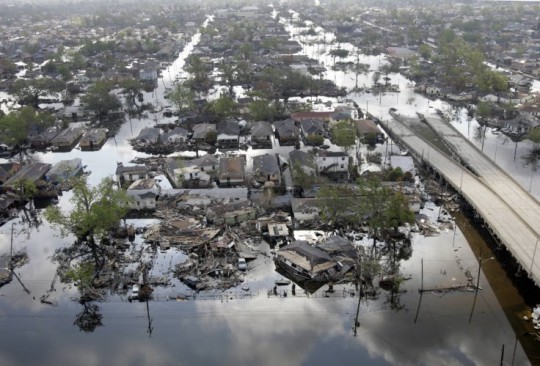
On August 29, 2005, Hurricane Katrina made landfall in Buras-Triumph, Louisiana, a city about 60 miles southeast of New Orleans.  It struck land as a Category 3 hurricane after intensifying all the way to a Category 5 only 24 hours earlier. As with most hurricanes, the danger didn’t lie in the storm itself, but instead, on the amount of water that was dumped into the area. It is estimated that New Orleans received 8-10 inches of rain over a 4-5 hour period, while also receiving 12-14 foot storm surges from the Gulf of Mexico. That deadly combination of rain and storm surge overwhelmed the aging levee system, which caused it to completely fail. To make matters worse, the natural geography and topography of New Orleans is not very conducive to flooding. The city is already located below sea-level and is surrounded by huge bodies of water (Lake Borgne and the Mississippi River to the east, Lakes Maurepas and Pontchartrain to the north, and the Gulf of Mexico to the southeast).

Once the storm passed through, the devastation become apparent. Over 80% of the city was completely flooded and infrastructure was almost non-existent. Bridges and highways were damaged. Hundreds were dead. Tens of thousands were displaced. The once great city was a shell of itself. As the shock and awe of the situation began to wear off, the reality of the monumental recovery/rebuild quickly shifted to the foreground.

When infrastructure and lives are in jeopardy, sports gets understandably pushed down on the priority list. But the NFL and NBA needed to find contingency plans for the two teams in New Orleans. The NFL season was about 10 days away from beginning when the hurricane struck. Nearby metropolises with NFL-ready stadiums  already had NFL teams, like the Houston Texans, Jacksonville Jaguars, and Kansas City Chiefs. Many other nearby cities didn’t have stadium capacity necessary for an NFL game. The Saints and the NFL chose San Antonio, Texas as the base for the Saints for the 2005 season, but the Saints only played 3 “home” games in the AlamoDome. Four other “home” games were played in Tiger Stadium in Baton Rouge, Louisiana and one other home game had to be shifted to Giants Stadium in East Rutherford, New Jersey. Because of all the limbo and travel, the Saints finished the season 3-13.

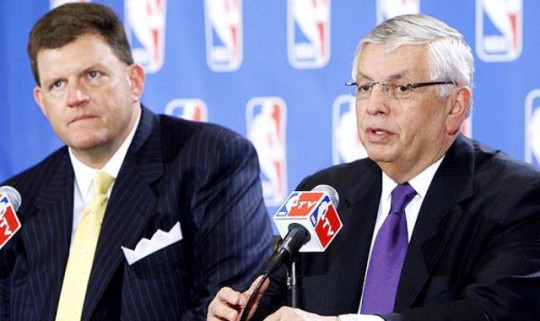
Unlike the NFL, which only had days to work on their contingency plan, the NBA had at least a month to work on theirs. The biggest question was where the Hornets would be headquartered while the city was being repaired/rebuilt. If this article were a TV show, this would be where the show would feature a flashback. In the mid-90’s, now Oklahoma City Thunder majority owner Clay Bennett was one of the principal owners of the San Antonio Spurs. One of his main duties was to attend the Board of Governors meetings the NBA and its owner has at various points in the season. When that many powerful people are in one room, networking is one of the orders of the day. During those times, Bennett and then NBA commissioner David Stern developed a relationship that would come to affect Oklahoma City in years to come.

stern-bennett-oklahoma-city-thunder

When the NBA started in on their process to find a suitable temporary location for the Hornets, one of the first people to contact Stern was Bennett. The businessman who had roots in Oklahoma through marriage had already convinced the mayor Mick Cornett and other business leaders that this was the opportunity they had been waiting for by the time he made that call. It’s at this point where the show would flashback again. Ten years prior to the events in New Orleans, Oklahoma City suffered its own tragedy. The carnage created by the bombing at the Alfred P. Murrah Federal Building may not have been as widespread as the flooding in New Orleans, but it still affected the lives of many Oklahomans, even still to this day. The bombing became the catalyst to the improvement of downtown Oklahoma City. The City no longer wanted to be known as the “fly over city where the bombing occurred.” Instead, it wanted to compete with the likes of Dallas, Kansas City, and San Antonio in matters of tourism and culture. One of the things approved in the first MAPS (Metropolitan Area Projects Plan) was the construction of an 18,000+ seat multipurpose indoor sports arena which originally was known as the Ford Center.

The Ford Center became the biggest selling point for Bennett in his quest to secure Oklahoma City as the temporary location for the Hornets. The 18,203 seat arena did not have a permanent tenant and was readily available for most any day the schedule called for. In addition, the business community stepped up to support the Hornets and cover a lot of the costs from the relocation. With all that in place, Stern and Hornets owner George Shinn made the decision to grant Oklahoma City the opportunity to temporarily house the Hornets for the 2005-06 season. While other cities may have been larger with more resources, such as Las Vegas or Kansas City, Oklahoma City offered no competition as far as pro sports goes and was ravenous in their pursuit to prove themselves on the big stage.

And prove themselves they did. The city took to the team like a fish to water. It was the combination of a young fan base cheering for a young team. Oklahoma City was okay with just having a team, while the team was thrilled to have a crowd cheer for them. For five years prior to the move to Oklahoma City, the attendance for the Hornets had dwindled to about 14,110 people per game. They finished last or second to last in 3 of those 5 seasons, and were worst in attendance the season before Hurricane Katrina hit.

The attendance in Oklahoma City averaged 18,168 as the Hornets went on to finish No. 11 in attendance in the league. The fans got to see Chris Paul’s rookie of the year campaign. They got to see the return of a hometown hero in Desmond Mason. They got to see one of the most vicious dunks ever when Kirk Snyder jumped over (yes, jumped over) Von Wafer for a dunk. They got to see the emergence of David West, who gave the fans three game-winning shots in that one season alone. They got to see a team that extolled many of the virtues they lived by; a team that many thought wouldn’t do well, but instead, stayed competitive throughout the season as they finished 38-44. Most importantly, the NBA decided to give OKC a second season, as the numbers in terms of population size weren’t yet where they wanted them to be in order to support two professional sports teams. The NBA knew that while the fan base for the Saints was strong, the fan base for the Hornets was not quite at that level. Instead of seeing an arena full of empty seats like they had before Katrina hit, the NBA decided to give New Orleans another year to recover, while also providing them some games in the Big Easy to whet their appetites.

chris paul okc

The 2006 offseason was the first offseason Oklahoma City ever got to experience, and it was a busy one at that. The team drafted 3 rookies (Hilton Armstrong, Cedric Simmons, and Marcus Vinicius), traded for Tyson Chandler, and signed Bobby Jackson and marquee free-agent Peja Stojakovic. While it was an exciting time to be an Oklahoma City Hornets fan, it was also starting to become bittersweet. When Stern and Shinn commented on the success of Oklahoma City as an NBA city, they always followed that up by stating they were fully committed to returning to New Orleans for the 2007-08 season. Being a Hornets fan in Oklahoma City began to feel like we were the committed mistress in a relationship that would be nothing more than a short-lived affair. The fan base loved their new team, but knew it belonged to someone else.

In the background, though, Bennett was trying to buy majority ownership of the Hornets from Shinn. He would allow Shinn to remain with the organization as a minority owner, but wanted majority rule in decision making. Shinn rejected the offer, citing the NBA’s desire to successfully return back to New Orleans. With that, Bennett set his sights on some other franchise to purchase.

As the season started, the Hornets came out like gangbusters. They started the season 4-0 and got all the way to 8-3 before the wheels started falling off the bike. Injuries derailed the seasons of Stojakovic, Paul, West, Jackson, and Chandler. The Hornets continued to battle hard through the injuries, but were never able to put enough victories together to make any sort of impact, as they finished with the same record as the previous season.

With that, the New Orleans/Oklahoma City Hornets once again became the New Orleans Hornets. While the hearts of many Oklahoma City fans were broken, there was another development happening in the Pacific Northwest.

During the season, Bennett purchased the Seattle Supersonics from Starbucks magnate Howard Schultz. The move was likely backed by the league to get a ground swell of support for the construction of a newer, more profitable arena in the Seattle area. When the local owner couldn’t get it done, the NBA tried to bring in the new kid in the NBA circles to put pressure on the Washington legislature to get an arena deal done. Bennett went to Seattle and laid down his plan: he would try to get an arena deal done for that next season (07-08). If nothing was done by then, Bennett would pursue other options. A blind man could have seen from a mile away what Bennett meant by “other options”.

With no arena deal in place, the wheels were already put in motion to try to get the Sonics to Oklahoma City. After a legal battle and about $100 million dollars in relocation fees and lease payments, the Seattle Supersonics officially became the Oklahoma City Thunder.

Disaster begets opportunity. That’s just the way the cycle works. In a Utopian scenario, Katrina never happens, Seattle keeps their team, and Oklahoma City eventually (somehow?) gets an expansion franchise. But that’s not how it happened. Tragedy and disaster happened. Because of that, an opportunity arose. And the rest, as they say, is history.

A look at the Thunder’s 2015-16 schedule

durant westbrook ibaka thunder

Click here for the Thunder’s full 2015-16 schedule.

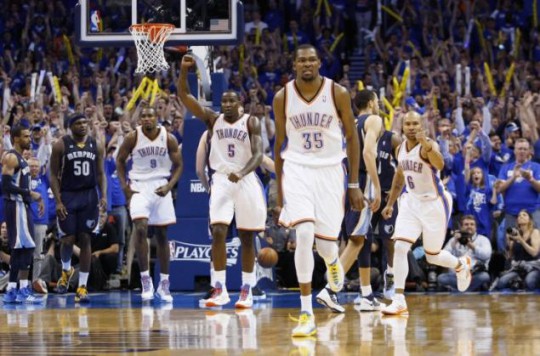
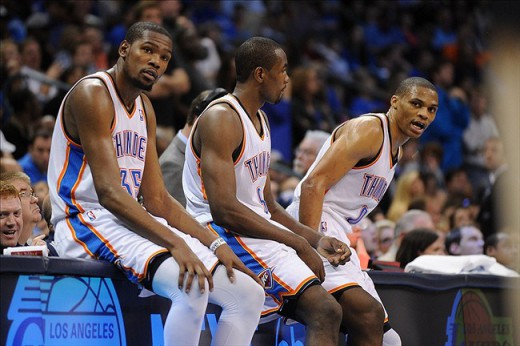
They say a picture is worth a thousand words. Do you know what the above picture says? It says, just like the looks on their faces, “Can we please get this sh!t started?”

On Wednesday, August 12th, the NBA (finally!) released their schedule for the upcoming season. The Oklahoma City Thunder found themselves with 24 primetime games, second only to the Cleveland Cavaliers and Golden State Warriors, who each have 25 primetime games. The primetime games include any games on TNT, ABC, or ESPN. In addition, they also have 9 games scheduled to be aired on NBATV. Being a nationally popular team can be a gift and a curse. All that attention usually means the team is predicted to do well in that particular season. But it can also be taxing on the players who have to play a schedule with slight variations that makes it a bit more difficult. Every team plays 82 games, with the same basic format depending on what conference they play in. But not every team has to face a top notch opponent once or twice a week for the entirety of the season. The schedule makers normally don’t have to worry about where to slot the Charlotte Hornets or the Portland Trailblazers because those teams don’t move the needle like the the aforementioned Thunder, Cavaliers, and Warriors do. But for certain teams, the schedule makers have to plug in their primetime games first and then go on from there.

Road Schedule Imbalance

The first thing I noticed when I saw the schedule was the imbalance in road games from the first half of the season to the second half of the season. In the first 41 games, the Thunder play 16 road games. In the final 41 games, they play 25 road games. While some may look at this as a detriment, I see it as a benefit. A home-heavy schedule in the beginning of the season allows for more practice time, which, for a team that was never fully complete due to injuries last season, will be extremely beneficial. Many don’t realize that Kevin Durant never got to play with Enes Kanter, DJ Augustin, and Kyle Singler. By the time the Thunder traded for these players, Kevin Durant was in the beginning stages of being shut down for the season. By the time the second half of the season rolls around this year, the Thunder should be firing on all cylinders.

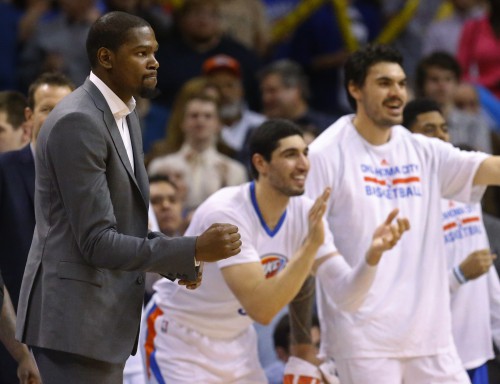
Injured Oklahoma City Thunder forward Kevin Durant, left, pumps his fist at teammates Enes Kanter, center, and Steven Adams, right, cheer in the fourth quarter of an NBA basketball game against the Toronto Raptors, Sunday, March 8, 2015, in Oklahoma City. Oklahoma City won 108-104. (AP Photo/Sue Ogrocki)

There’s an even greater imbalance after the All-Star break. In the 28 games post All-Star break, the Thunder will play 17 of those away from the Chesapeake Energy Arena. It’ll be imperative that the Thunder build up enough currency in terms of wins and losses before the All-Star break to help supplant the road-heavy schedule at the end of the season.

More rest in-season

NBA commissioner Adam Silver has made it a priority to provide players with more rest during the season by extending the All-Star break, limiting the amounts of back to backs and 4 games in 5 days. Due to their geography, teams that are in the middle part of the country don’t have to embark on long road trips, which limits the amount of back to backs. The Thunder only have 15 back to backs this season, compared to the league average of 17.8. In addition, the Thunder, like most teams in the league, only have one 4 games in 5 nights stretch, and it happens in the first week of the season (Nov. 1 – Nov. 5).

But that in-season resting may be a mirage. Due to the fact the Thunder are centrally located, it allows them to travel more often without racking up as many miles. The Thunder alternate between home and road in the first 8 games of the season, and don’t have their first multiple game road trip until December 21st. With so much travel, that feeling of rest may seem like a farce.

Opponents

Every team has their built in schedule (2 games each versus the teams in the opposite conference (30), 4 games each against division opponents (16), 4 games each against 6 other conference opponent (24), and 3 games each against another 4 conference opponents (12)). Luckily for the Thunder, the teams they only have to face three times out of the Western Conference are the Golden State Warriors, New Orleans Pelicans, Memphis Grizzlies, and Phoenix Suns. When you are building up a record, the less you have to play great teams, the better. Unfortunately, two of the three games against the Warriors and Grizzlies will be on the road.

Toughest Stretch

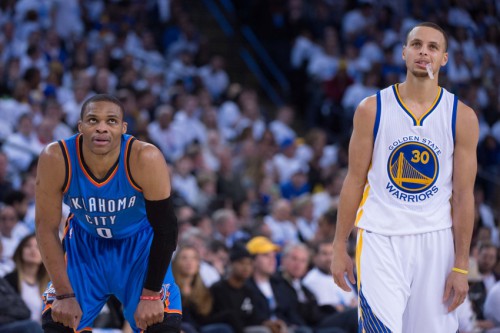
January 5, 2015; Oakland, CA, USA; Oklahoma City Thunder guard Russell Westbrook (0) and Golden State Warriors guard Stephen Curry (30) look on during the third quarter at Oracle Arena. The Warriors defeated the Thunder 117-91. Mandatory Credit: Kyle Terada-USA TODAY Sports

The toughest stretch for the Thunder will be a 15 game gamut from February 6th to March 12th that will see them face the world champion Warriors three times, the Los Angeles Clippers and New Orleans Pelicans twice, and once against the San Antonio Spurs. Nine of those games will be on the road, including a stretch of 6 out of 7, with the Warriors being the home game in between. Its a stretch where finishing 8-7 will put a smile on your face.

Top Home Games

Oct. 28 – vs. San Antonio – First game of the season. Against the Thunder’s biggest rival/big brother. With (hopefully) a complete and healthy roster. Not enough has been written about how Durant looked in Las Vegas last week. While he didn’t participate in any 5 on 5 contact drills, he did participate in every other drill. And he looked like Kevin Durant. Which is great news.

Nov. 18 – vs. New Orleans – Welcome back, Kendrick Perkins. Say what you want about Perkins, but his voice is still resonates in the locker room. Although they understood the move, many on the team were not entirely thrilled that Perkins was traded. He was like the wise sage on the team, if a wise sage cursed and spoke with a southern drawl. In reality though, this game is more about seeing how Anthony Davis continues to develop. He knocked on the doorstep of greatness last season, and will likely kick down that door this season. If the Pelicans can continue to pick up pieces here and there, they may be a team to contend with in the future.

Nov. 27 – vs. Detroit – Good riddance, Reggie Jackson. If the previous game on this list was to welcome back an old friend, this game is to jeer what became a malcontent at the end of his run with the Thunder. Reggie Jackson could have stayed a Thunder. He could have taken the 4 year/$48 million dollar contract they offered him before his 4th season and been one of the top 6th men in the league. Instead, knowing he was good enough to be a starting point guard in the league, he decided to pout his way through the first 50 games of the season, when the Thunder were needing every able body they had on deck due to their plethora of injuries. It wasn’t that he wanted out, because I agreed that he had the talent to be a starter in the league, and it showed in the extension Detroit gave him (5 yrs/$80 million, ironically, the same exact extension James Harden received when he was traded). But it was in the manner that he conducted himself to meet that end. Because of that, he will likely face at lot of this in his first return to the ‘Peake:

It may reach Patrick Beverly-like levels before its all said and done.

Dec. 25 – vs. Chicago – Derrick Rose and Russell Westbrook have not gone against each other in a regular season game since December 6th, 2010. Let that sink in for a minute. The two most athletically gifted specimens the point guard position has arguably ever seen have not faced each other in five full years!? The Christmas wish of a lot of NBA fans is that these two make it to this game in one piece and finally give us the show that has been five years in the making.

Feb. 21 – vs. Cleveland – Durant vs. LeBron. Westbrook vs. Irving. A possible Finals preview? Last season we were robbed of seeing these two teams at full strength in their two match-ups. LeBron James sat out the meeting in Oklahoma City, while Durant sat out the game in Cleveland with his injuries. Hopefully, the injury bugs turns away from these two games.

Feb. 27 – vs. Golden State – In the one game Oklahoma City was fully healthy against the Warriors, they beat them pretty convincingly. It always goes back to “what if?” when it comes to last season. In another meeting last season, Durant put on a show for the Oracle faithful, scoring 30 points in the first half before succumbing to a sprained ankle at the half.

Apr. 11 – vs. Los Angeles Lakers – Possibly the last time to see Kobe Bryant in a Lakers uniform. I’ve always said that the Spurs are who we modeled ourselves after, but the Lakers are who we wanted to beat. A lot of that has to do with the respect Durant and Westbrook have for Bryant, which he has verbally reciprocated time and time again.

Another great season is ahead for NBA fans. The league has once again tabbed the Thunder in their upper echelon of teams. With that said, I only have one question: Is it October, yet?