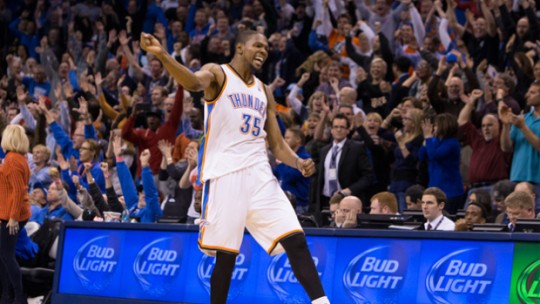
Since the NBA’s first season in 1955-56, there have been 58 MVP’s. Those MVP’s have been won by 29 different players in 19 different cities (four of which currently don’t have NBA franchises). Of the 30 teams in the current NBA, 15 of those cities have never experienced an MVP season by one of their players. So when the inevitable happens and Kevin Durant is named the 2013-14 NBA MVP, Oklahoma City will join an exclusive fraternity of cities that have experienced a magical individual season by one of their players.
Oklahoma City has been lucky enough, in its short time as an NBA franchise, to experience a Coach of the Year (Brooks, 2010), a Sixth Man of the Year (Harden, 2012), and a Rookie of the Year (Paul, 2006 with the New Orleans/OKC Hornets). The ultimate goal as a sports franchise is to win a championship. But what are teams but a collection of individuals. And if your team, if your city, houses the best individual player in that sport, that is like winning a championship in and of itself.
When an MVP season plays out, you see it coming. Of the 450-500 players that cycle through the league in a given season, only about 2-3 players are deserving of even being considered for the top individual prize in the NBA. And if you, as a fan of that team, are lucky enough to enjoy that experience, then you need to savor it. Because for as much as we like to think that MVP’s and championships will beget more MVP’s and championship, the future is never a definite when it comes to sports. The Russell Westbrook injury last season taught us that. A twist of the knee here, a tweak of the back there, an argument with the front office, and that player could be gone in an instant. Prime example is the last man to win an MVP not named LeBron James. Chicago Bulls guard Derrick Rose won the MVP in his third season in the league. He looked well on his way to contending for (and possibly winning) multiple MVP’s. But you know the rest of the story. Injuries and re-injuries have completely derailed his career to the point where we wonder whether he’ll ever get back to the MVP form he had pre-injury.
It’s not everyday you get to witness greatness. There are plenty of good players in the league. In any given game, you may see a 20-point scorer, a double digit rounder, or a defensive maven. Most nights the names change. But for MVP candidates, that dominance is seen on a night in/night out basis, over the course of an entire season. That degree of excellence goes from late October usually into late May/early June. That consistency is probably the biggest factor in determining who is MVP-worthy and who isn’t. It’s easy to get up for a game against Miami on a prime time Thursday TNT telecast. It’s that much harder to get up for a Tuesday night game in January against the Milwaukee Bucks. But those select few do it every night.
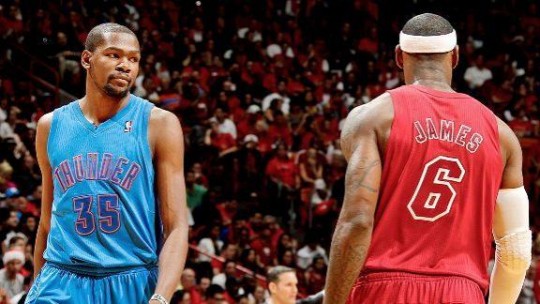
Eat it up Oklahoma City. Our story is a weird one in which we were basically gift wrapped a once in a generation player. Most cities, when they first get a team, have to toil around in the dredges of the league before they finally find those couple of players that actually make them competitive. But OKC was like “insta-rice”. We got the team, popped in the microwave for one minute (season) and, Voila!, playoff contender. It happened so quickly, that media decided to call it the OKC model of team rebuilding. This model, though, only works if you get a player like Durant in your clutches. It will be very interesting to see where teams like Orlando, Philadelphia, Milwaukee, and New Orleans stand in about 3 years when their rebuilds should start bearing fruit.
I always wonder how the OKC fan base will be react when this current run ends. Whether its in two years (a.k.a Durant’s free agency) or in 15 years, Thunder fans have been spoiled beyond belief. But this is the NBA, and success is very cyclical, especially for small market teams. Most Oklahoma fans suffer from what is locally called, the “Sooner mentality”. In three words, the Sooner mentality means “Championship, or bust!”. And we are starting to see that with Thunder fans. Lose a game in a series, and there is a section of fans that is clamoring for Scott Brooks’ head on a platter, and another section clamoring for Thunder GM Sam Presti to sign every available free agent, luxury tax and careful budgeting be damned. Those are the fans I wish I could grab by the shoulders, shake them a bit, look into their eyes, and say, “Stop worrying and enjoy this moment! It may repeat itself next season, but it also may be a once in a lifetime event”.
As we enjoy this moment, look back on the season that made Durant an MVP. Don’t focus on the numbers though. Even though the numbers improved, they don’t tell the entire story. Focus on the maturation of the man. Many players hit their head on ceilings they create because they get satisfied with what they’ve accomplished. Like the theme in the poem Ozymandias, they stand there relishing their accomplishments without realizing their satisfaction will eventually be their downfall. Durant could have been one of those players, and he still would have been considered great. But, instead, he took the hard lessons from the previous season and focused on how he could get better. It is a rare trait in a player to never find satisfaction in their successes. Instead of basking in the glow of their brilliance, they instead survey the field and know that others will be coming after what they have. LeBron James made that transition three seasons ago. Kobe Bryant before him. And Michael Jordan before him. This is the road the Durant is on, and luckily, for us, like Route 66 and I-44, that road runs straight through Oklahoma City. Congratulations Kevin. We are all proud of you.


 Now That's Thunder Basketball