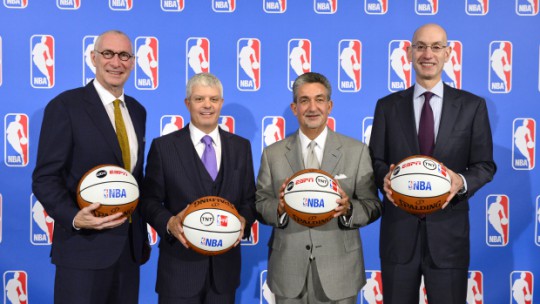
With the historical TV deal the NBA signed on Monday, the salary cap is poised to jump up by at least $30 million dollars in the next 2-3 seasons. The increase in salary cap also means an increase in players’ salaries, of which is of keen interest to the Oklahoma City Thunder. The team that has meticulously constructed itself around a developing nucleus of Kevin Durant, Russell Westbrook, and Serge Ibaka will be extremely tested in the next 2-3 years. The first series of extensions the players signed eventually led to the trade of James Harden. While the team wanted to keep the burgeoning quartet together, the economics of the day forced the Thunder to trade Harden, who was looking for a max deal, of which the Thunder could not afford without destroying their salary cap flexibility.
The first extension after the rookie deal is usually easy for a team to handle. At its apex, the 5 year max is only worth about $80 million dollars (or 25% of the salary cap). Its the second extension that can difficult for teams to handle. By the time a player has reached his second extension, he’s been in the league at least 7 seasons, which qualifies his max salary to take up at least 30% of the salary cap. Salaries for max players in their 2nd extension can easily climb above $20 million per season. If you are a championship contending team in the league, you more than likely have at least 2 players worthy of a max deal. And if you are paying them accordingly, then upwards of 55% of your cap space could possibly be used up on two players.
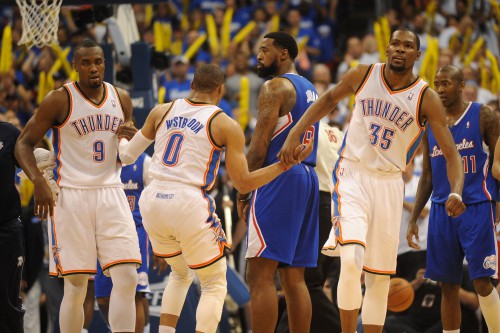
Luckily for the Thunder, those two players happen to be Durant and Westbrook (aka the reigning MVP and arguably the best point guard, respectively). Both players will be up for extensions in consecutive years, beginning in the 2016 offseason. And both players, health permitting, will be deserving of max extensions. Here’s the beauty of the CBA though: max deals are determined by percentages of the salary cap. So it does not matter whether the cap is $63 million (2014-15) or $90-100 million (projected for 2016-17), a max player will only take up a percentage of the salary cap. Even though there is more money in the pot, the percentages for max players should remain the same. And if your GM knows how to manage the money within the parameters of the luxury tax line, then it should be business as usual.
The trickier part of the equation will be Ibaka. The Thunder signed Ibaka to 4 year/$49 million dollar contract two seasons ago. It has turned into one of the better bargains in the NBA. If Ibaka continues on his developmental trajectory, will he be satisfied with a slightly below level max deal again? The Thunder saw how valuable Ibaka is when he missed the first two games of the Western Conference Finals. With no rim protector in the middle, the Spurs had their way with the Thunder, blowing them out in both games. In addition, Ibaka’s value to the offense as an offensive rebounder and perimeter release valve became even more apparent through the year last season. If Ibaka were a free agent right now, he’d likely fetch a slightly below market max deal. While Ibaka does appear to be extremely loyal, loyalty has to run both ways to be effective.
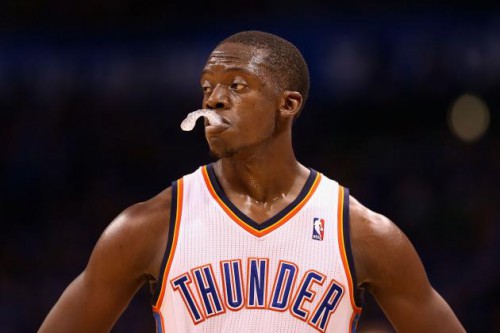
Then there’s the Reggie Jackson situation. As discussed in a previous post, Jackson wants to start and wants to get paid. The Thunder may be able to accommodate the monetary issue, but probably won’t be able to appease Jackson on the starting issue. The Thunder like to start a big defensive-minded SG. Unfortunately, Jackson is similar in stature to Westbrook. Jackson is in the unenviable position of being up for an extension about a year or two before the big money starts to flow in. Which means, even if he signs a big contract now, it may pale in comparison to similar contracts 2 years down the line. In the end, much like Harden, Jackson may be the odd man out,, when it comes to getting paid by the Thunder. Or Jackson may choose to sign a shorter deal with an eye towards the big money in 2-3 seasons.
A team is not just composed of 2-4 players, though. This is where the arduous planning of Thunder GM Sam Presti starts to take effect. If you’re going to have 3-4 players making max or close to max money, then you have to fill your roster with a mixture of specialists, veterans, and young players that are all relatively inexpensive. This is where Presti’s “kiddy-gloves” handling of the Thunder’s finances (keeping them under the luxury tax line) and asset usage begins to pay dividends.
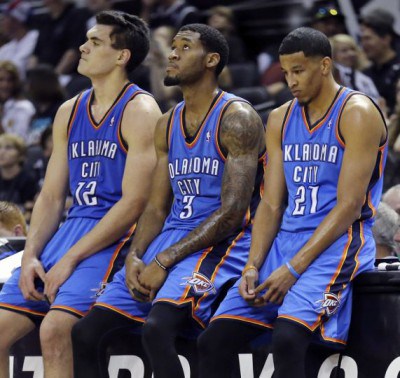
Presti has mostly done a great job of turning assets into usable parts and more assets. The Harden trade netted the Thunder Jeremy Lamb and 3 draft picks, which turned into Steven Adams, Mitch McGary, and Eurostash Alex Abrines. But it’s the Thunder’s penchant for stockpiling young talent that will make re-signing their core as a possibility. In addition to the 4 young players obtained in the Harden trade, the Thunder have stockpiled another Eurostash in Tibor Pleiss and a domestic draft and stash in Josh Huestis. Also, 2014 2nd round pick Semaj Christon appears to be in the Thunder’s future plans as he begins his career with the Thunder’s D-League affiliate, the Blue.
Why is this important? Because the Thunder’s current young players are all up for their first extension in the next 2-3 seasons. Of the current group of Jackson, Jeremy Lamb, Perry Jones, Andre Roberson, and Steven Adams, it is possible the majority of them will not be with the Thunder within the next 2-3 seasons. All these players have value, and the Thunder like to maximize the value of a player if they don’t necessarily see a future with them. With a cupboard full of young (unused) talent, the Thunder will be able to replace their current group of young players with cheaper alternatives within the next 2-3 seasons.
As the Thunder (and the NBA as a whole) ventures into this great unknown of luxury, it is good to know the Thunder are in prime position to continue doing what they are currently doing. They own the Bird Rights to their core players and can offer them more money than any other team. They are one of the few teams in the league that has a present and a foreseeable future when it comes to championship contention. If the CBA remains the same, the Thunder should be operating in the same manner 2-3 seasons from now.




 Now That's Thunder Basketball