In collaboration with Akeli Jackson of DYST Media, Steve Person of Hooptalk365.com and Jon Midget of SLCDunk.com.
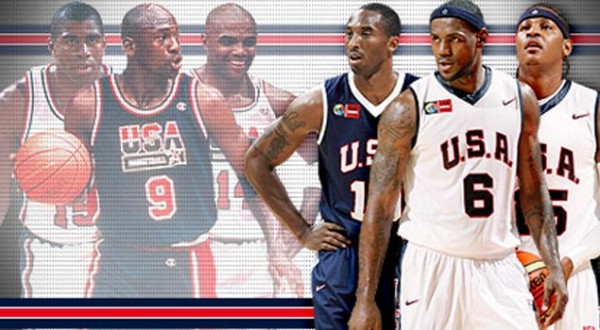
The debate has been raging all summer long about which team is better: the 1992 Dream Team or the 2012 US Men’s Olympic basketball team. Members from both teams have spoken publically and most have said that the Dream Teamers would be the victors. But the tally hasn’t been 100% on the side of the Dream Teamers. Kobe Bryant, in an interview, stated, “If you’re asking me, ‘Can you beat them one game?’ Hell yeah, we can beat them in one game. You didn’t ask me if we could beat them in a 7-game series. In one game, we can beat them. No question about it.” This discussion was presented for each of the subsequent “Dream Team” teams after the ’92 team, but the discussion usually died down pretty quickly. For some reason, though, the debate for the 2012 team has lingered on longer than it did for any of its predecessors. Maybe it’s Twitter, where the in your face, non-stop commentary sometimes leads to a paradigm shift in thought, even if it’s just for a moment. Maybe, people see a 2012 team that is loaded with a combination of great players and potential great players. Sadly, though, these types of debates usually remain as they are….figments of our statistical imagination.
Fortunately, I have more money than I know what to do with. So I decided to call a buddy of mine who works at an anti-aging clinic. He told me he would be able to revert the older Dream Teamers back to their 1992 form using hormone replacement and gene therapy. Of course, the players on the ’92 squad would have to agree with this. So, that’s where their ego and my money came into play. I got all the players from the Dream Team to sign on by offering them $10 million each and telling them that the 2012 team would wipe the floor with them. Christian Laettner even asked my buddy if he had anything that would bring his “Duke-swag” back. My buddy told him he didn’t have anything to cure failed potential. Surprisingly, Larry Bird required the least amount of work. His body is basically in the same physical shape now as it was then. Unfortunately, the anti-aging clinic didn’t have anything to bring Chuck Daly back from the after-life, so Lenny Wilkens, who was an assistant on the Dream Team, agreed to be the coach. The fine folks at Coachella kindly declined when we asked them if they could have Hologram Chuck Daly walk back and forth on the Dream Team sideline.
After 2 weeks of intense anti-aging therapy, and a month of “training camp”, the Dream Team was looking like its old self again. Magic Johnson was passive-aggresively talking trash, Larry Bird was sinking flat footed 3 pointers, and Michael Jordan was dunking on Patrick Ewing. The game was set up to happen the night before the gold medal game of this year’s Olympics. Only a few writers were privy to the game. Everyone who was witness to the game was CIA-scanned for electronic devices, meaning no photos or video of the game would ever exist. The 4 writers who were invited were each assigned a quarter to write about in detail. No one was allowed to release any information until after the gold medal game. This, is what transpired:
Pre-Game
The game would be played using a mixture of FIBA and NBA rules. The quarters would be 10 minutes in length to maximize the athletic potential of all the participants in the game. The FIBA 3-point line would be used, and the painted area used was the standard rectangular NBA format. Players wouldn’t be able to touch the ball on the rim like in international play. It would be counted as a goaltend, if the ball is touched while still on the rim. A team would have 8 seconds to bring the ball up past the half court line. The style of refereeing would be more international, allowing the players to be a little bit more physical on the perimeter and on the inside. The officials would be Ken Mauer, Dan Crawford, and Dick Bavetta. And, finally, a game like this wouldn’t be right without the use of an official David-Stern signed, NBA Spalding ball.
One of the most amazing sights to see on a basketball court are the pre-game antics of the different players. Some have customary handshakes and dances that they do. Some have a specific routine of stretching and warming up. One thing that stood out while watching these two teams warm up was the gawking and wide-eyed fandom that was apparent on the 2012 team’s side of the court. It is easy to think of athletes as robotic in nature, while forgetting that they were once young fans wanting to be like they hardwood idols. Especially when their idols are on the other side of the court with their deity-like skills on hand for display. But, just as quickly as they were star-struck, they were just as quickly snapped back into reality by Kobe Bryant, and, surprisingly, by Russell Westbrook. The Dream Team squad was all business on their end.

The referees called out the captains of each team (Johnson and Bird for the Dream Team and Bryant and James for Team USA). The Dream Team was in their classic whites and the 2012 squad in their new look blues. They all shook hands, the referees explained their expectations of the game, and each team went to their sidelines. Game time!!!

1st Quarter
Coach Lenny Wilkens trotted out Magic Johnson, Michael Jordan, Patrick Ewing, Scottie Pippen, and Charles Barkley as his starting five. Coach Mike Krzyzewski countered with Chris Paul, Kobe Bryant, Tyson Chandler, Lebron James, and Carmelo Anthony. And, just like that, 10 of the greatest basketball players were on the court exchanging pleasantries and shaking hands. Chandler and Ewing would be jumping at center court. Bavetta tossed the jump ball, and it is controlled by Ewing. Both teams started off by missing their first shot attempts. On the Dream Team’s 2nd trip down the floor, Kobe snuck into the passing lane and intercepted a pass from Pippen to Jordan leading to a breakaway dunk by Lebron James. The first two points were officially on the board. On their next trip down, Magic Johnson found Ewing on a no-look bounce pass for an and-1 layup. The teams exchanged makes and misses pretty consistently for the first 5 minutes.

After a timeout, Wilkens substituted Larry Bird and David Robinson for Pippen and Ewing. For Team USA, their first substitutions saw Kevin Durant and Deron Williams coming in for Chris Paul and Carmelo Anthony. On the first trip down for Team USA after the timeout, Durant made a 3 pointer off an offensive rebound from Chandler. Barkley gave Durant a shoulder check as he turned to go to the other side of the floor. Durant pushed Barkley and both players were given a double technical. On the next possession, Pippen, playing point guard, found Michael Jordan on the baseline for a jumper. 12-11 Dream Team at the half way point of the 1st quarter. After a Deron Williams layup, the Dream Team went on a 10-2 run, with Larry Bird supplying two 3-pointers and Tyson Chandler picking up his 2nd foul during that run.

After a run-stopping timeout, Coach K trotted out a line of Kevin Durant, Carmelo Anthony, Kevin Love, Deron Williams, and Russell Westbrook. Wilkens brought in Bird, Karl Malone, Robinson, John Stockton, and Clyde Drexler. Anthony and Malone exchanged buckets in the next two possessions. On the next Team USA possession, Westbrook lost possession of the ball, which was stolen by Stockton, who found a streaking Drexler for an easy 2. Another turnover, this time, by Kevin Love, led to a mid-range jumper by Malone. 28-17 Dream Team, with under two minutes left in the quarter. After a missed jumper by Durant, the Dream Team brought the ball up the court looking to add to their double digit lead. Stockton passed it to Bird, who is wide open for a corner 3, but missed it, leading to a transition 3 by Carmelo Anthony. On the next Dream Team possession, Williams poked the ball from Robinson as the shot clock expired, which led to a thunderous (pun intended) dunk by Westbrook on the other end. After a Stockton miss, Williams brought the ball up for the final possession of the quarter. Durant got the ball above the 3-point line, dribbled a little while jabbing towards the basket, and let loose a 28-foot dead on three that splashed through the net as time expires. 28-25 Dream Team, after one quarter.

2nd Quarter
The Dream Team came out to begin the 2nd quarter with Stockton, Drexler, Mullin, Bird, andEwing. Team USA squad went with Deron Williams, Kobe, Durant, Lebron, and Love. Team USA took advantage of the Dream Team’s limited defense, and scored on their first four possessions. However, the Dream Team extended their lead at the same time with three from downtown: two from Bird and one from Mullin.

On the Dream Team’s fourth possession, Lebron nearly steals the ball by knocking it out of Ewing’s hands, but it goes out of bounds instead. In a surprising display,Ewing thumped his chest several times, telling everyone in a loud voice, “I am a WARRIOR!” over and over. Mullin looks stunned for a moment as he wonders what his team would actually be like if Ewing really were a (GoldenState) Warrior. The Dream Team inbounded it toEwing, who immediately shows off his WARRIOR-ness by throwing up a running 18-foot fadeway that clanks off the rim (he was, admittedly, intimidated by the perpetual shut-down defense of Kevin Love).
Still, the Dream Team led 37-33 as Team USA calls a timeout.
Out of the timeout, The Dream Team came out with the same lineup. The 2012’ers let Lebron rest a bit and replaced him with Carmelo. Williams drove past Stockton to get an and-1. Stockton, one of the better defenders in NBA history, takes it personally, scowls, and on the next inbounds, rushes up the court and dropped a pull-up 3 right in Deron’s face. Realizing that Carmelo had Bird and Mullin taking turns “guarding” him, the 2012 squad goes to him on the next three trips down the court, with Carmelo hitting a 2 and a 3 (and having a missed 3 tipped in by Love). During that same time frame, the Dream Team goes on a bit of a cold streak from the field, and Team USA takes the lead 41-40, prompting the Dream Team to call a timeout.

One of the most amazing things to witness in a game like this is the interactions in the timeout huddle. While Team USA was all high-fives and laughs, it was all business in the Dream Team huddle. Lenny suggested putting in Laettner, but nobody even blinked. The players all knew they were old enough and wise enough to be coaches themselves. They noticed the 2012 squad trotting out Paul, Williams, Carmelo, Lebron, and Love. In response, Pippen tells Wilkens he’ll guard Carmelo so “they won’t have to worry about him touching the ball again”. Jordan says he and Stockton can take Paul and Williams. One of the funnier moments was when the Dream Teamers decided to put David Robinson in on Love, knowing that the Admiral would completely take advantage of the shorter, less athletic Love. The only person left to guard was Lebron, so they decided that, even though he can’t match LeBron’s total athleticism, the Mailman is the guy who can best match his speed and strength. So in came Malone.
On the first play, Pippen ran Carmelo through a beautiful “elbows-out-I’m-going-to-send-you-to-the-floor-weeping” screen set by Stockton. Anthony gets up a little wobbly and goes back to the bench, replaced by Durant. Pippen smiles.
At this point in the game, the Dream Team asserted themselves offensively and defensively. They continuously went inside to the Admiral, who routinely dunked it, probably wondering whether it was Kevin Love or a fruit fly he felt along the way. On the defensive side of the court, Chris Paul could barely make it past midcourt with Jordan hounding him. Paul passed to Deron Williams, who was being bumped and maimed by Stockton. Williams probably began to wonder why his team only had four guys on the court since he could not find Durant under that Pippen defensive blanket.
On Team USA’s next possession, Williams found Love with a nifty pass. Unfortunately David Robinson shoved the layup down Love’s throat. It seemed for a moment, while Love looked at Robinson in awe, that he was wondering if he was looking at a Greek God incarnate, or just the most ripped athletic specimen to ever walk the earth. Fortunately, Lebron wasn’t as impressed with Robinson’s physique, as he picked up the loose ball and put in the score.

The Dream Team continued to put on an offensive clinic in the next few possessions, going inside to David Robinson and running the 2012 defenders through a series of cuts and screens that sends everybody on Team USA into at least one Stockton screen. Chris Paul and Deron Williams, taking the brunt of the physicality, start to vehemently complain about the screens. As a writer, it’s crazy when the crowd noise is taken out of the equation and you can hear almost every conversation on the court. In response to the complaining about the screens, Dick Bavetta told the two 2012 guards, “Hey, if you want to try to knock down guys 50 to 100 pounds heavier than you 10 to 12 times every game, I’ll let you do it too.” Paul and Williams suddenly realized they were nowhere as tough as the guy with the short shorts.

On the other end of the floor, Paul and Williams were getting picked apart by Jordan’s defense and Durant was made to seem like he didn’t even exist on the floor anymore. Love kept looking to the bench, wondering why Coach K hadn’t noticed that David Robinson has 5 more inches and 8 times the athleticism on him. Lebron, realizing that he is only player that can do anything at this moment, begins to try to take over the game. He got past Malone on a couple of occasions, but the veteran power forward either stripped Lebron or knocked him off balance on his jumpers.
In all, it was a 16-6 run by the Dream Teamers that put them up 56-47 with two minutes to go in the half.
Time out for Team USA.
The 2012 team put in their small ball line-up for the final two minutes of the half: Chris Paul, Deron Williams,Kobe, Durant, and Lebron. The Dream Teamers decided to show the young guys that they can also go fast AND big at the same time. They trotted out Magic, Jordan, Pippen, Barkley, and the Admiral.
After the timeout, the 2012 squad looked to take advantage of their small ball lineup, especially at point guard with Magic being in the game. Heading into the game, one of the main headlines was the Kobe vs. Michael matchup. How would the player most compared to Jordan fare against him? In a couple words, not very well (in the first half, at least). Kobe tried to challenge Jordan in the final two minutes, but instead ended up costing his team.Kobe went 0-2 with two turnovers during that time-span.

Those turnovers and missed jumpers allowed the Dream Team to basically turn every defensive possession into a fast break opportunity. Magic was at his “Showtime” best, setting up Jordan, Pippen, and Robinson for dunks. On the final possession of the half for Team USA, Pippen deflected a Deron Williams pass that ended up in the hands of Charles Barkley who had a full head of steam with 5 seconds left. The only person back for the 2012 squad was Lebron, but even he realized that he’d rather fight another day than try to challenge Barkley with a full head of steam. Two-handed slam, buzzer, and that was the 1st half. 66-51 Dream Team.
3rd Quarter
Coming out of halftime, the 2012 squad looked to get back in the groove, down by 15. Coach K decided at halftime to throw caution to the wind and go with a more assertive lineup to combat these NBA greats. He turned the reigns of point guard over to Lebron, with Kobe alongside in the backcourt, Durant and Carmelo on the wings, and Chandler in the post. The Dream Team decided to start the 2nd half with Stockton, Jordan, Pippen, Malone, and Ewing in the paint.
Again, one of the great things about eliminating the crowd noise is that you can hear the different conversations going on between the players and coaches. At the scorer’s table, Jordan walked up to Kobe and tells him, “You may be able to sit at many players’ tables, but you still can’t sit at my table, rook.” Kobe, in turn, responded, “We’ll see about that. I still got a couple years left”, while he powdered his hands. On the sideline, Ewing, looking as refreshed as someone with a jersey soaked in sweat could look, barked at Chandler, saying “this my paint, you ready to bang?” Chandler responded with a smirk as Dick Bavetta handed him the ball. Chandler passed it toKobe and the second half began.
With Lebron controlling the ball at point, Team USA jumped out on a 6-0 run. On their first two possessions, on what looked like to be the same play, Lebron found a wide open Anthony who connected on back to back 3’s. Kack kaack!! “String music” yelled Carmelo. Jordan, disgusted by Pippen’s defensive effort, screams at his Bulls teammate, “get your man, Scottie!!!” Immediate timeout called by Coach Wilkens in an attempt to get the Dream Team’s focus back. The run, got the 2012 squad within single digits early in the 3rd quarter.
After the timeout, the Dream Team makes the necessary defensive adjustments. The two teams continue to battle back and forth throughout the quarter. Jordan would score, then Lebron would respond. The two teams began to trade baskets in an offensive display like none other. The 2012 squad continued to hang close, only down by 9 points. On the next possession, Kobe swiped the ball from Stockton with a chance to cut the lead to 7, but inexplicably dribbled the ball off his knee. From that point on, the Dream Team turned up their defensive intensity, which seemed to stifle Team USA’s offensive production in the middle of the 3rd. Jordan was all on top of Kobe, giving him a real headache. When Kobe drove left, Jordan was there. When Kobe drove right, Jordan was there. It was his Airness at his defensive best. Malone and Ewing were being savages in the paint, giving Chandler and Carmelo more than they could handle. But no one was stopping Durant, who kept the 2012 team treading water with a couple jumpers. The 2012 team remained down by 9, midway through the 3rd quarter, heading to an officials’ timeout.

The two teams made line up changes and exchanged baskets and misses for the next 3 minutes. With only a minute and a half left in the 3rd, the lead for the Dream Team was still 9, at 82-73. Lebron knew if something was going to happen, it had to happen now. One of the things that he learned in his championship season was to pick and choose when to take over, especially on a team full of superstars. It was go time. He knew it. Coach K knew it. Everyone on that 2012 bench knew it. After exchanging misses, Lebron drove to the basket using his strength to get an and-1 lay-up after a hard foul by Malone. After sinking the free-throw, Lebron blocked a last second shot attempt by Jordan to end the quarter. As the clock expired, both team walked to their respective sides knowing that the 4th would be a pure dogfight. With three quarters in the books, the Dream Team led 90-84.
4th Quarter
At the beginning of the 4th stanza, both teams decided to rest their main guys knowing that in order to win this dog fight, sustaining energy for the long haul was absolutely paramount. The Dream Team entered the quarter with Stockton, Mullin, Drexler, Malone, and Robinson, while Team USA countered with Williams, Westbrook, Iguodala, Carmelo, and Love. Team USA wasted their first two possessions on ill-advised 3-pointers by Russell Westbrook, while the Dream Team played much more efficient basketball, getting two easy buckets inside from Karl Malone. With that, the Dream Team took back control of the game, pushing their lead to 10, 94-84, a minute and a half into the fourth quarter.

On their next possession, Iguodala lets a tipped pass get by his finger tips out of bounds, leading to a turnover. On their way back to the other side of the court, Barkley gets up off the bench and starts barking at Carmelo, “You can’t hold the Mailman!” Carmelo looked back, replying, “Don’t talk too soon Chuck, still a long way to go.” Not even a minute later, Williams was able to strip the ball from Drexler while he was driving to the basket, leading to a 3 on 1 fast break which Williams converted to a layup to cut the lead down to 8. With that, Coach K got off the Team USA bench with two clinched fists in the air, signaling for a full court press. Realizing that Stockton was the only legitimate ball handler on the court for the Dream Teamers, Coach K put Westbrook, and his ravenous ball pressure skills on Stockton, while the other four Team USA defenders went into heavy man to man denial mode. Westbrook’s defensive pressure works as Stockton picked up his dribble near midcourt. Chris Mullin comes to the half court as a pressure release as Stockton passes the ball, but Iguodala is a half second quicker in the passing lane, leading to a fast break opportunity for TeamUSA. Iguodala got the ball to Westbrook, who penetrated to the basket only to have his shot rejected by David Robinson, who came from the other side of the court. Kevin Love (as always) was in the right position to corral the loose ball, drop step, and finish a layup to bring Team USA within 6 points, 94-88.

With 8 minutes and some change left in this heavyweight matchup, Dream Team coach Lenny Wilkens inserts Scottie Pippen in place of Mullin, while Coach K completes the chess match by substituting Durant and Paul for Iguodala and Williams. Before play begins, Krzyzewski calls Love over and whispers a brief 2-3 second order into his ear, to which Love gives a nod of agreement. After the teams exchange misses, the Dream Team was looking to utilize their advantage in the post. Stockton brings the ball up and passes it to Drexler on the wing. Drexler takes one dribble to the right, but passes it to Pippen who is coming off a Malone screen. Pippen zips a pass into the post to Robinson who has positioned himself for a quick shot. The Admiral goes up for a 3-foot hook shot, but is immediately fouled by Love. Coach K’s message to Love was to foul Robinson on his next shot attempt and make him earn those points due to the fact that Robinson was a 59% FT shooter in the ‘92 Olympics. The plan works as Robinson misses both free throws. Carmelo grabs the rebounds, dribbles up past the half court line as Coach K calls timeout with Team USA down 6. The coach knows that the next few minutes could be very important and wants to discuss strategy with the team.
And so it begins…….
6:43 left and both teams bring back their heavy hitters. The Dream Team 5 consists of Magic, Jordan, Barkley, Malone, and Ewing, while Team USA counters with Lebron, Kobe, Durant, Carmelo, and Chandler.

As expected, Jordan comes out of the timeout hitting a 2 pointer off a flare screen by Barkley, which, in the NBA, would’ve been illegal, but since the refs are allowing a more physical game, it was allowed to happen. On Team USA’s next possession, Lebron, using Kobe as a decoy, was able to complete a give and go in which Lebron backdoors Magic for the 3 point play, giving Team USA a chance to cut the lead to 5. Lebron completes the 3-point play with the free throw and cuts the lead to 96-91 with 5:44 to go in the 4th quarter.
After a failed possession by each team, and a costly turnover by Chandler in the post, the Dream Team has the ball with 3:37 to go. Kobe gets a ticky tack foul called on him, as he slightly bumps Barkley while attempting a double team. Barkley looks at Kobe and yells, “I know you’re not double-teaming me with the guy that is guarding Michael!” Barkley gets the ball out of bounds and gets it to Jordan, who raises up for a 17 ft jumper that bounces off the back of the rim. Durant grabs the rebound and quickly gets the ball out to Kobe. Kobe gets the ball up the court and quickly passes to Lebron who finds Durant trailing on the play for a wide open 3….good! Team USAonly down two, 96-94, much to the dismay of Coach Wilkens.
With 2 minutes to play, Coach Wilkens makes what is perhaps the coaching move of the game. He substitutes Pippen for Barkley, whose defensive lapses on the perimeter had cost the Dream Team most their lead. That move pays dividends as the defensive pressure from Jordan and Pippen limits Kobe to 1-4 shooting in the final 2 minutes, and keeps the ball out of Lebron’s hands by double teaming him every time he caught the ball in the perimeter. On the offensive end, the veteran leadership of the Dream Team took over. Magic Johnson showed poise in running the point, managing the shot clock, and finding Karl Malone for two back breaking 20 footers as the shot clock was expiring. The perimeter-oriented offense of Team USA proved to be their demise as they could not get anything easy going late in the game. When the final buzzer sounded, it was 100-96, Dream Team.

Both teams hugged and congratulated each other like it was the end of a hard fought playoff series. All the Dream Teamers were grabbing their younger counterparts and dispelling small nuggets of wisdom. And, of course, the Team USA members were all ears, soaking it all in like sponges. At center court, Michael Jordan hugged Kobe Bryant and talked with him for about a minute. What was said? Only those two know. But I would bet it would have something to do with respect and love for the game, for these two teams exemplify what being a basketball player and being a basketball team is to us fans. In a game that would seem only to occur in the imagination, this was an incredible display of basketball at its finest.




 Now That's Thunder Basketball