Tag Archives: fans

Crazy Uncle Perk

perk

We, as fans, sometimes view players as objects of entertainment. We look to them as visual and emotional toys that we unwrap every October, and hope to play with through June. When they no longer entertain us or completely frustrate us, they become highly expendable in our minds. We get on blogs and forums and completely blame that player for everything that is wrong with the team. It doesn’t matter whether the team is the best in the league or the worst in the league, there’s always that one player that catches the ire of most of the fanbase. Unfortunately, we sometimes forget that they are humans too.  

There has developed a sort of love-hate relationship between Thunder fans and center Kendrick Perkins in the last couple of weeks. None of it is due to anything personal. For all intents and purposes, Perkins seems like an affable guy who is completely devoted to his family. A big extended family that includes his nuclear family and his Thunder fam. Some players talk about their team being a family, when, in reality, family just means people that they have to deal with for 6-9 months out of the year. Some players, though, really do live by the “team is family” creed, inviting teammates to their house and generally, trying to bond with them throughout the season, and sometimes, even after the season.   

As a team, the Oklahoma City Thunder are very family oriented. The leaders on the team adhere to this concept as does the organization as a whole. The foundational culture of the team is rooted in family. And included in that family, is the entire fan base. We, as fans, are all invested in the same cause, but at different ends of the spectrum. The players are the performers and the fans are the audience. But sometimes, it’s easy to forget that the family concept is a two way street. We, as fans, expect for the team to acknowledge us, either through charity work, through team interviews, or through slogans, such as “Team is One”. We expect players to sign autographs for us at all hours of the day, wherever we see them. But, the sad truth is that fans do a bad job of picking players up when they aren’t providing what we expect of them.   
team is one

Family means different things to different people. To me, family is the group of people you are born/raised into and the people you accept into your circle. It’s a set of people whom you accept and can depend on through the good and the bad. And as a sports family, we’ve accepted the Oklahoma City Thunder into our family. They are interwoven into our fabric from October through June. We have Thunder watch parties, talk about the team around the dinner table, and talk about the people in the organization like they reciprocate talking about us at their dinner tables.

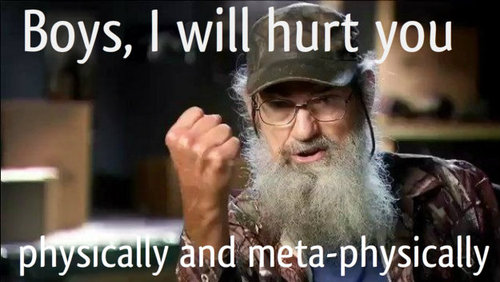
Family dynamics are a difficult part of co-existing as a family. Not everyone is going to get along the same all the time. But if a family is to co-exist, they have to accept the good and the bad of a member and go with it. For example, every family has that one family member. You know, the black sheep that’s kind of an outcast and rough around the edges. Its usually an uncle. They may have either served some time in jail or have a short temper. And they usually have drama with a wife, ex-wife, girlfriend, or baby momma (or a combination of all four) that spills over into family events. And when something goes down involving a bar, a fight, and a woman, you know Uncle was involved. But here’s the thing about Uncle, though. He’s full of wisdom and has a great ear for listening. And, he’s great at some sort of handy work, usually mechanics or carpentry. And when you need him, he’s always there, no questions asked.
si

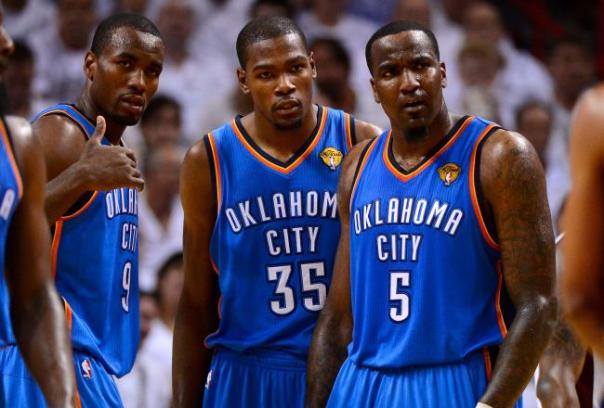
Well, that Uncle is Kendrick Perkins. He’s a little rough around the edges with the scowl and the intimidation. He’s probably on the naughty list of most of his opponents. And, he’s had some injury issues in the past. But when we need him to guard a Dwight Howard or a Marc Gasol, he’s there with his hard hat on, no questions asked. When we needed him to play through a torn groin and a wrist that needed to be surgically repaired, he gutted it out and performed beautifully. When his young teammates need an ear to vent to, he’s there to listen with some Southern drawl wisdom to accompany it. Whenever we need Perk, he’s there. And yet, when he is used incorrectly, or he doesn’t perform to our standards, we chastise him and await his presence with a pink slip in our hands.

If comparing Perkins to a family member doesn’t help you see his value, let me give you some tangible evidence versus some of the top centers in the game:  

Before Perkins 
green nenad

  • 2009-10 – including playoffs vs. Bynum (LAL), Howard (Orl), Perkins (Bos), Duncan (SA), M.Gasol (Mem), and Nene (Den) – 9-16 
  • 2010 thru Feb 23, 2011 – vs. Duncan (SA), Bynum (LAL), M.Gasol (Mem), and Nene (Den) – 2-6 

With Perkins 

  • March 14, 2011 – end of season (including playoff) vs. Bynum (LAL), Jefferson (UTA), Nene (Den), and D. Jordan (LAC) – 13 – 6 
  • 2011 – 2012 – 66 game season including playoffs vs. Bynum (LAL), Howard (Orl), M.Gasol (Mem), Duncan (SA), Jefferson (Uta), and D. Jordan (LAC) – 19 – 11  
  • 2012 – through the New Year 2013 – vs. Howard (LAL), M.Gasol (Mem), Duncan (SA), D.Jordan (LAC), and Jefferson (Uta) – 4 – 2

Excluding the first season the Thunder were in Oklahoma City, the team went 11 – 22 against top tier centers in the league before the arrival of Perkins. That’s a .333 winning percentage. After the arrival of Perkins, the team has gone 36 – 19 against top tier centers. That’s a .655 winning percentage. Looking at the raw data, Perkins has nearly doubled the chances of the Thunder winning versus a team with a top tier center.
nba_u_randolph-perkins01_576

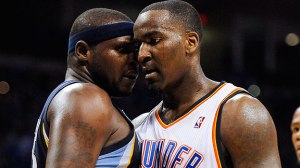
Understandably, the correlation is not one to one. The players around Perkins have gotten better as they have aged. But the Thunder doesn’t improve as quickly as it has without that rock in the middle. And there is no way the Thunder make it to the Finals last season without Perkins manning the middle. The defensive job he did on Dirk Nowitzki, Andrew Bynum, and Tim Duncan was a big reason the Thunder were Western Conference Champions. While his performance against the Heat in the Finals exposed his flaws, it wasn’t like he was put in a position to succeed by Coach Scott Brooks, either. Brooks needs to understand that against smaller, quicker teams, Perkins’s strengths will be negated. Conversely, Perkins needs to understand that against these teams, he may have to sit more time than usual. But that’s the thing about those crazy uncles. They are usually stubborn as a mule.

The Harden Conundrum

I have a friend that currently finds himself at a crossroads in life. Now, before I continue, let me give a little background of my friend. He moved into town about 5 years ago right out of law school. He was from a bigger city, but decided to start a law office in a smaller town to avoid the oversaturation of law offices in the bigger cities. He started the law firm with one of his old law school classmates, who was already in the area working as a public defender. After struggling for a couple years, they finally started building a good clientele portfolio from in and around town. Besides his job, my friend also began laying down roots in the community, marrying a local girl and becoming a recognized lawyer in the area. With that recognition, comes opportunities, of which, some were not local.

Now, I’ll keep my friend nameless, because I am privy to his finances. Due to them having their own business, much of their profits go to operational costs. My friend currently pays himself a salary of $65,000; enough to get by pretty well in the small town. As his clientele portfolio has expanded, he has increased his salary by $2000 every year since he began. He recently got a job offer from a law firm in a bigger city that would start him off at $100,000 with the opportunity to be a partner within a year of accepting the job.

My friend’s partner has started his own attack to keep my friend by his side. He has started pulling on my friend’s heartstrings, telling him that they can be the best law office in the area if they continue what they started; telling him that he is like the brother he never had; and even said he would increase his salary to $78,000 to prevent him from leaving. So this is where my friend finds himself: an opportunity to go to a major law firm and be a major player in the future or stay behind based on loyalty to continue building something that he started.

What would you do?

Before you answer, realize that there is no wrong answer. When it comes to financial decisions, you always decide with one of the two things: your heart or your wallet. Sometimes those two things are homogenous, making decisions extremely easy. But sometimes, those two things are at war, making the decision that much tougher. But in the end, you make your decision and live with it. Like I told my friend, people will always judge, but the only judges that matter are the ones at home and, more importantly,  the one in the mirror.

Would you fault this person for whatever decision they make?

I would hope that most people wouldn’t. When we are talking about money in the $50,000 – $100,000 range, we see a lot of ourselves in those dollar amounts, and know how we would side. In my friend’s case, he was debating between $100K and $78K. In this economy, many people would take the money and hope that the extra 22% would cushion the homesick feeling that sometimes accompanies a job-related move. And yet, when those figures move from $100,000 to $63 million, sports fans feel completely sickened by the fact that an athlete would choose the money over the team.

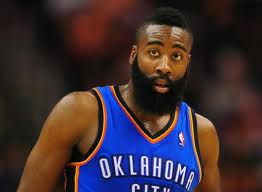
James Harden, of the Oklahoma City Thunder, currently finds himself in a boat similar to the one my friend is in. In a year, he could take the money and sign a max 4 year/$63 million contract with another team. Or, he could take less money (possibly as low as the $49 million Serge Ibaka extended for) to stay with the tightly-knit, championship-contending team he has help build from the foundation up. We, sports fans, are sometimes so myopic in our thinking, that we don’t realize the difference in money between my friend’s two offers and James Harden’s two possible offers are the same in terms of percentage (22%).

Would you ever leave 22% of your possible future income on the table?

Think about that. How ecstatic would you be if your job offered you a 22% raise tomorrow? I don’t know if there is a sound proof room insulated enough to not hear my screams of joy if that happened. And yet, sports fans like to believe they are above reproach and would always choose loyalty over money. And let’s not argue over the semantics of thousands versus millions. Most people in our salary range would like to think they can live just fine off of one million dollars per year. But if you had the opportunity to choose between $63 million and $49 million, would you really leave $14 million on the table? Forty nine million dollars can help you and children. Fourteen more can help your grandchildren. Money is money. The more you have, the better off you usually are.


I know James Harden’s heart is currently at war with his wallet. He has stated that he loves the city, loves the team, and hopes to continue building a possible dynasty with his brothers. He even intimated that he is willing to take less money, but, recently has backed off of that statement. When you don’t know what you are worth, you make statements like that. But when you realize what your market value is, your wallet (agent) starts to do the talking. I won’t fault Harden if he runs and takes the money. In an occupation where you are an injury away from not earning another paycheck, you take what you can, when you can. If the stories of my friend and James Harden are parallel, then we Thunder fans better enjoy the Bearded One as much as we can this season.

Occupy NBA: How Twitter helped the fans have a voice in this lockout.

In watching some of the pointless Occupy ____(insert city)____ protests that have gone on for the past month and a half, I have sometimes wondered what it would look like if NBA fans staged their own Occupy NBA protest during the lockout. Would we march at the hotel that the players’ union and owners were meeting at in New York? Or at NBA HQ in New York? Or at the court house in Minnesota where the anti-trust lawsuits would be taking place at? Instead of hippies and out of work yuppies, I could see a whole bunch of middle-aged men with their basketball jerseys on, dribbling basketballs throughout the parking lot. I could see young men trucking in portable goals and holding 3 on 3 tournaments in protest of the lockout. I could see someone bringing out a boombox and jamming to John Tesh’s Roundball Rock. But alas, that takes too much time and money to protest like that, and NBA fans have to do something to pay for the season tickets and NBA League Pass that they have. Instead, NBA fans protested in a new manner. They took their protesting to Twitter. And you know what, it actually had an impact. 

Twitter and the NBA is a match made in heaven. In all of the sport leagues, NBA players are the most accessible. They don’t wear helmets so it’s easy to see and recognize the players. They don’t have heavy armor on, so it’s easy for fans to try and dissect the meaning of their tattoos and get deeper into the psyche of that player. Because of this, NBA fans develop more of a connection, whether real or fantasized, with players than do the fans of other sports leagues. I love the Oklahoma Sooners football team, but I couldn’t pick their center, Ben Habern, out of a lineup if I tried. But I could recognize Minnesota’s back up center (Nikola Pekovic) in a crowded mall if I saw him. 

Another thing that is instantly recognizable about the NBA and its players through Twitter, is that they are all friends. The basketball culture is completely different than the football culture and the baseball culture. Because these players have been playing together in AAU and cross country camps for the better part of their high school careers, there develops a strong common bond that unites these players together as they move on in their respective basketball journeys. And it becomes very apparent on Twitter, as players from different teams communicate with each other more often then they they probably do with their own mothers. 

When you add the fact that fans can now actually communicate with your favorite players, that brings NBA fandom to another level. So, it was only a matter of time before NBA fans would take to Twitter to a) express their displeasure with the lockout or b) express their support to the players. Most players dismissed anything the fans said, but some players, Thunder center Nazr Mohammed, in particular, took to the Twitter-waves to quell any misunderstandings and explain to fans exactly what the players had given up and why they were fighting so hard. For a while, this actually worked in the players’ favor, as they were getting most of the public sentiment. But as the lockout dragged on, fans, and even some players, grew more and more frustrated, and took to the Twitter-waves to express that angst. 

But not only were fans and players able to use Twitter to express their feelings, basketball sportswriters also became primetime commodities during the lockout, especially when there was a meeting between the two sides happening. What used to be interesting tidbits that would appear in books written 10 years after an event, became instant news once it happens (i.e. Dwayne Wade’s blow-up against David Stern, Stern going home with the flu, Michael Jordan going all Scarface on the players that adored him and playing “the bad guy”, the players’ “STAND” shirts, etc.). Howard Beck, David Aldridge, Marc Stein, Larry Coon, and Chris Sheridan all became my new best friends every time the two sides had one of their meetings. These sportswriters provided a riveting play by play of legal negotiations as they were happening. They gave the back drops to what was going on, like who stepped out and why they stepped out. I, for one, took it all in. I was entranced by these negotiations and found myself almost wanting the lockout to continue so that I could “hear” the play by play of the negotiations by the sportswriters. Plus it was fun to hear FalseHoop and his followers come up with #ReasonsForLongLockoutMeeting. 

This all led to instant fan reaction. There was no need for sportswriters to put up surveys or take polls. The pulse of the fans was on full display, live and direct, with their tweets of displeasure and support. After each meeting that ended in disappointment, the pulse of the fans became more and more frustrated. Even worse for the NBA, some of the fans were becoming more and more apathetic. Don’t discount for a second the impact this had on Stern and the owners. With all the talk of a nuclear winter, the NBA did not want to turn into the NHL and have to play games on ION or SiTV when they came back a year or two later. Instead, they went back to the table, made a couple concessions, made the players feel better, and came to an agreement. And guess where I heard it first…….on Twitter.